Tag: City Tech

  • 10 Year Anniversary at City Tech

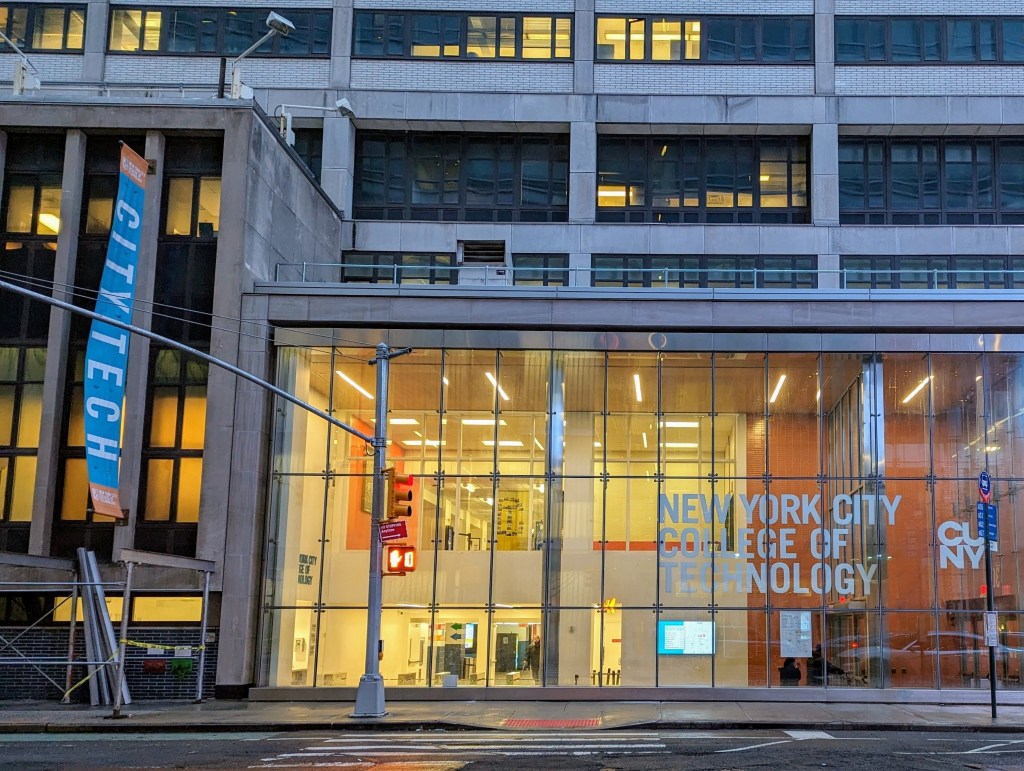
    New Entrance to the Namm Building at City Tech on Jay Street, Brooklyn.

    It’s hard for me to believe that it’s only been 10 years since I started teaching at City Tech in Brooklyn. My gray hair seems like a testament to it being far longer.

    I’ve been able to accomplish a lot of things since landing in Brooklyn as evidenced by my CV and Teaching Portfolio. I’ve had the joy of teaching great students, and I’ve enjoyed the collegiality and comradery of excellent coworkers.

    Some of the greatest hits of things that I’ve done–some alongside the best colleagues and others by myself–include:

    There’s a lot left to do. What can I accomplish in the next 10 years?

  • First Anniversary of My Generative Artificial Intelligence (AI) and Pedagogy Bibliography and Resource List

    Artificial intelligence in a giant room of computers. Image generated with Stable Diffusion.

    Tomorrow is the first anniversary of the Generative Artificial Intelligence (AI) and Pedagogy Bibliography and Resource List.

    I first launched it on 13 April 2023 when I was directing the Professional and Technical Writing (PTW) Program at City Tech before going on my current research sabbatical.

    The motivation for the resource was two fold: I wanted to learn all that I could about generative AI for my professional work as a teacher and scholar, and I needed to understand the changes taking place due to these new technologies for the benefit of my students who had already expressed concern and wonder about it.

    I launched it with more than 150 MLA-formatted citations of books, collections, and articles related to AI and generative AI with an emphasis on teaching but also including useful background and area specific sources.

    Now, it has over 550 citations! It also includes a growing list of online resources with direct links!

    I’ll keep adding to it periodically, and if you have some sources that I haven’t included but should, drop me a line (my email address is in the sidebar to the right).

  • New OER Launched: Yet Another Science Fiction Textbook (YASFT)

    Woman astronaut wearing an exosuit is reading a book in a futuristic library. A tall alien male is standing in the background selecting a book off the shelf. Image created with Stable Diffusion.

    I’m very happy to announce the launch of a new open educational resource (OER) that I’ve been working on for awhile!

    It’s called Yet Another Science Fiction Textbook (YASFT). It’s over 60,000 words and includes additional resources that can be helpful for readers, students, and instructors.

    YASFT is released under an Attribution-NonCommercial-ShareAlike 4.0 International Creative Commons License. It’s freely available to be read as it is. However, if anyone would like to use it in another way, there are licensing terms that must be followed: “This license requires that reusers give credit to the creator. It allows reusers to distribute, remix, adapt, and build upon the material in any medium or format, for noncommercial purposes only. If others modify or adapt the material, they must license the modified material under identical terms.”

    You can find YASFT under the Teaching menu above or directly here.

    Its abstract and table of contents are included below.

    Abstract

    Yet Another Science Fiction Textbook (YASFT) is an open educational resource or OER, meaning it is freely available for anyone to use and learn with. It provides a chronological history of Science Fiction (SF) with an emphasis on literature and film, and it includes other useful resources, such as a glossary of terms, an extensive list of SF definitions, additional resources, a syllabus with hyperlinked readings available online, and video lectures. It tells a story, but not the only story, about SF history. It’s also an experiment in using generative artificial intelligence (AI) to assist with editing a large body of text, in this case over 60,000 words.

    Table of Contents

        Front Matter
    What is YASFT?
    Who made YASFT?
    Why was YASFT made?
    Why is it called YASFT?
    How can YASFT be used?
    How was YASFT made?
    Acknowledgements
    Preface
    Origins of Science Fiction
    Early Fantastic Stories
    Scientific Revolution
    Age of Enlightenment
    Romanticism
    The Gothic
    Mary Shelley’s Frankenstein
    Science-Saturated Novel
    Victor Frankenstein’s Hubris
    Critique of the Age of Enlightenment
    Tabula Rasa
    Proto-SF
    Historical Context
    Edgar Allan Poe
    Nathaniel Hawthorne
    Jules Verne
    H. G. Wells
    E. M. Forster
    Pulp SF
    Historical Context
    Overview of Pulp SF
    Hugo Gernsback
    E. E. “Doc” Smith
    C. L. Moore
    Edgar Rice Burroughs
    H. P. Lovecraft
    SF Film Serials of the 1930s and 1940s
    Buck Rogers
    Flash Gordon
    Golden Age SF
    Historical Context
    Overview of Golden Age SF
    John W. Campbell, Jr.
    Isaac Asimov
    Ray Bradbury
    Robert A. Heinlein
    Frank Herbert
    Tom Godwin
    SF Film Through the 1950s
    Film vs. Literature
    Early SF Film
    1950s SF Film Boom
    Forbidden Planet
    New Wave SF
    Historical Context
    Overview of New Wave SF
    J.G. Ballard
    Harlan Ellison
    Philip K. Dick
    Samuel R. Delany
    Star Trek
    “The City on the Edge of Forever”
    Feminist SF
    Historical Context
    Beginnings of Feminist SF
    Definitions of Feminist SF
    Joanna Russ
    Marge Piercy
    Pamela Zoline
    James Tiptree, Jr.
    Ursula K. Le Guin
    Octavia E. Butler
    Afrofuturism
    Steven Barnes
    Tananarive Due
    Nalo Hopkinson
    Nnedi Okorafor
    Cyberpunk
    Historical Context
    Coining the Cyberpunk Term
    Cyberpunk Characteristics
    William Gibson
    Sprawl Trilogy and Stories
    Hermes 2000 and Floppy Disk eBooks
    The X-Files, “Kill Switch”
    Bruce Sterling
    Pat Cadigan
    Contemporary Science Fiction
    Historical Context
    Ted Chiang
    N. K. Jemisin
    Cory Doctorow
    Charlie Jane Anders
    Martha Wells
    Mary Robinette Kowal
    Ken Liu
    R. F. Kuang
    SF Film from 1960 Onward
    1960s
    1970s
    1980s
    1990s
    2000s
    2010s
    Global Perspective: Taiwanese SF
    Brief Taiwanese History
    Taiwanese SF Overview
    Taiwanese Fandom
    Cultural Comparisons
    Issues with Translation
    How to Keep Up With Science Fiction
    Appendices
    Appendix 1: Glossary of Science Fiction Terms
    Appendix 2: Chronological List of SF Definitions of Science Fiction with MLA Citations
    Appendix 3: Further Reading
    Textbooks
    Readers
    Teaching
    Online Research
    Appendix 4: Sample Syllabus with Hyperlinked Readings
    Appendix 5: Lecture Videos
    Appendix 6: Version History
  • Thoughts on Posthumanism, Social Justice, and Environmentalism on the Ivan Allen College Website

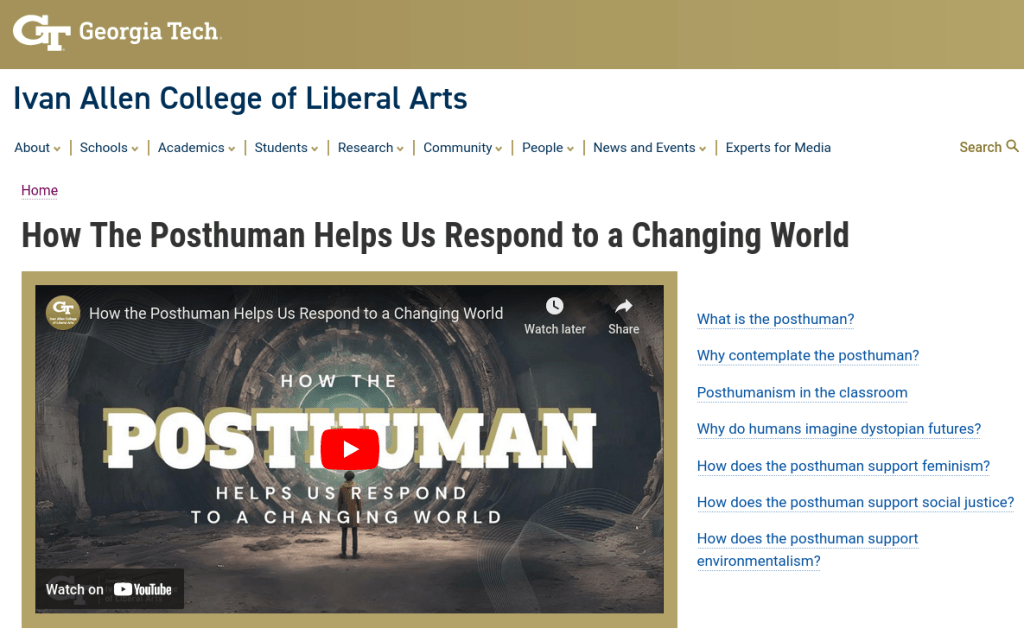
    Screenshot of top of article titled, "How the Posthuman Helps Us Respond to a Changing World." Link to article in the text below.

    How can we leverage posthumanist ideas to respond to the world’s social and ecological crises? My colleagues at Georgia Tech (Lisa Yaszek, Regents Professor of Science Fiction Studies; Zita Hüsing, Assistant Director of the Writing and Communications Program and Marion L. Brittain Postdoctoral Fellow; and Paul B. Foster, Associate Professor of Chinese) and I give our perspectives in this brief multimodal article that might be great to share with students if you need a resource that succinctly breaks down what posthumanism is and addresses its connections to feminism, social justice, and environmentalism.

    Previously, Lisa Yaszek and I wrote an book chapter on Posthumanism and Science Fiction for The Cambridge Companion to Literature the Posthuman (2016). You can read our chapter here.

    If you’d like to talk about posthumanism or collaborate on a related project, drop me a line at my email address in the about box to the right.

  • Reflecting on Moving a Hoard of Vintage Computers Through Brooklyn’s Streets

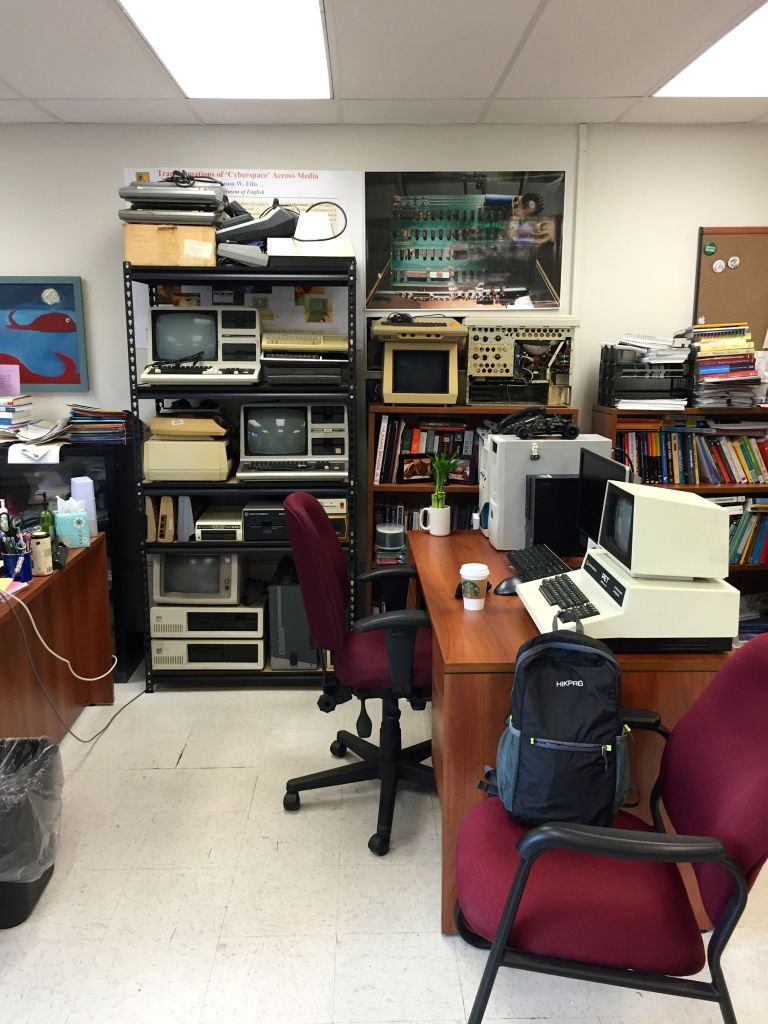
    My office space filled with vintage computers in Namm 520 at City Tech where I store the City Tech Retrocomputing Archive.
    My Retrocomputing Office Space

    I’ve written some about starting the Retrocomputing Archive at City Tech in my cramped desk area in Namm 520 here and here, but I don’t think I’ve written about how I moved the bulk of the lab’s holdings that belong to City Tech from one building to another.

    At a semi-enclosed campus, it might seem relatively easy to move equipment around, but when your campus is like City Tech’s, which is essentially a clusters of buildings on busy, big city streets with security and protocols it can be a real headache. Here’s how the move went down.

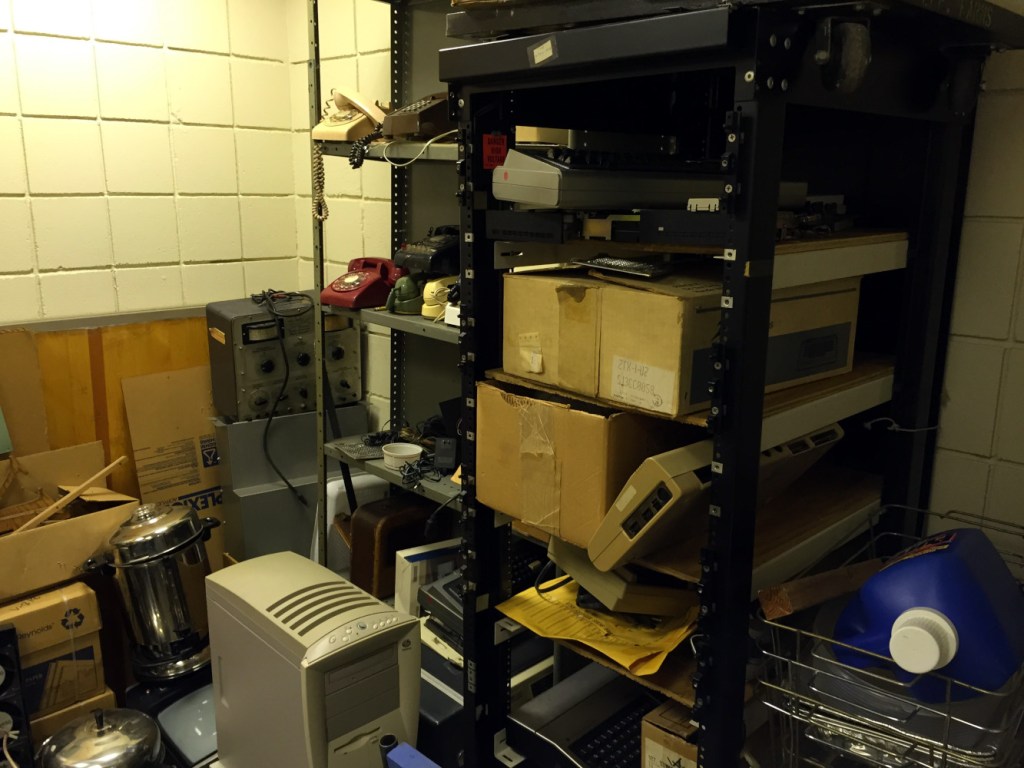
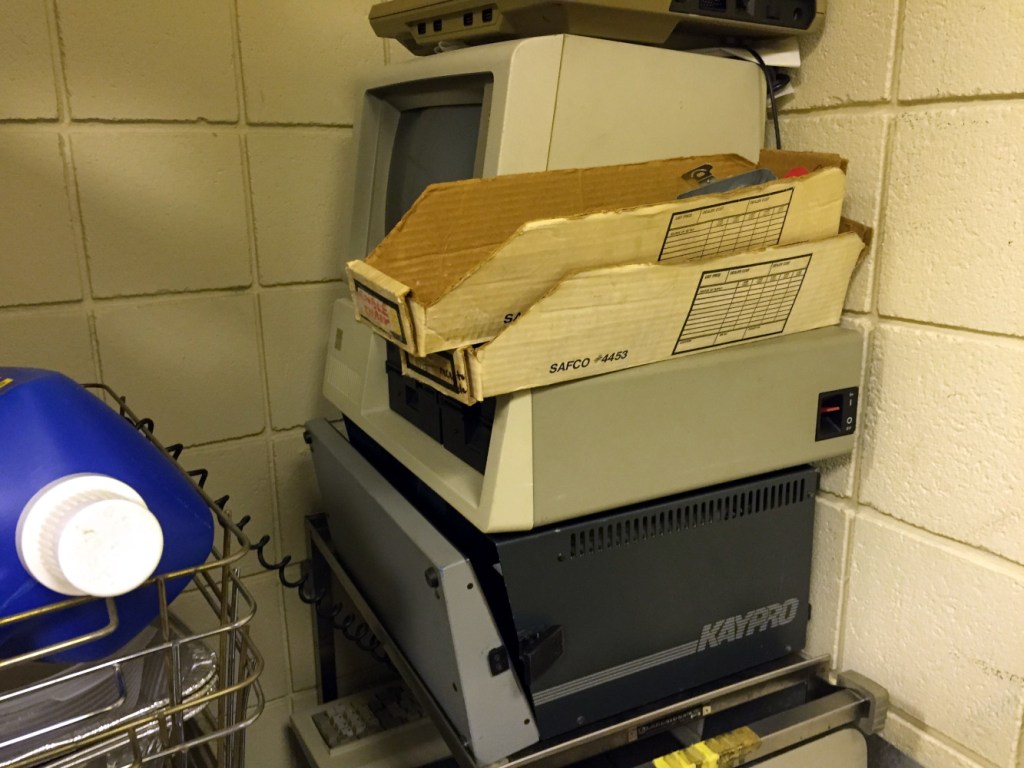
    In 2015, I learned through Mary Nilles, my dearly departed English Department colleague, that Stanley Kaplan, Senior CLT Assisting the Dean of the School of Technology and Design, had been keeping a collection of forgotten, vintage computers in a closet on an upper floor in City Tech’s Vorhees Building and the dean wanted the closet cleared out.

    I reached out to Stanley who gave me a tour of the large closet’s treasures seen below.

    I told him that I definitely wanted to move the computers into my office for the Retrocomputing Archive, but I would need to figure out the logistics of it since I didn’t have a car to move everything from one building to the next and a cart to carry the items from the top of Vorhees to the street and then from the street into the bowels of the Namm building where my office is.

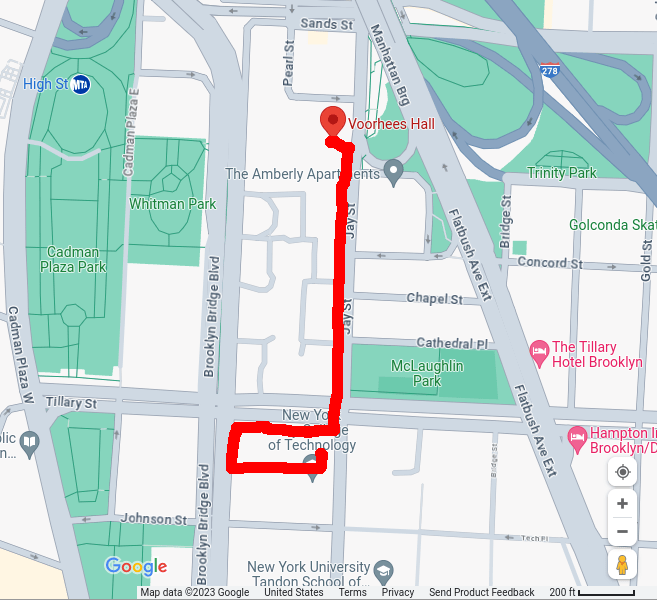
    Red line indicates the path that I walked from Vorhees to the Namm Building--including my path within the Namm complex and its elevators.

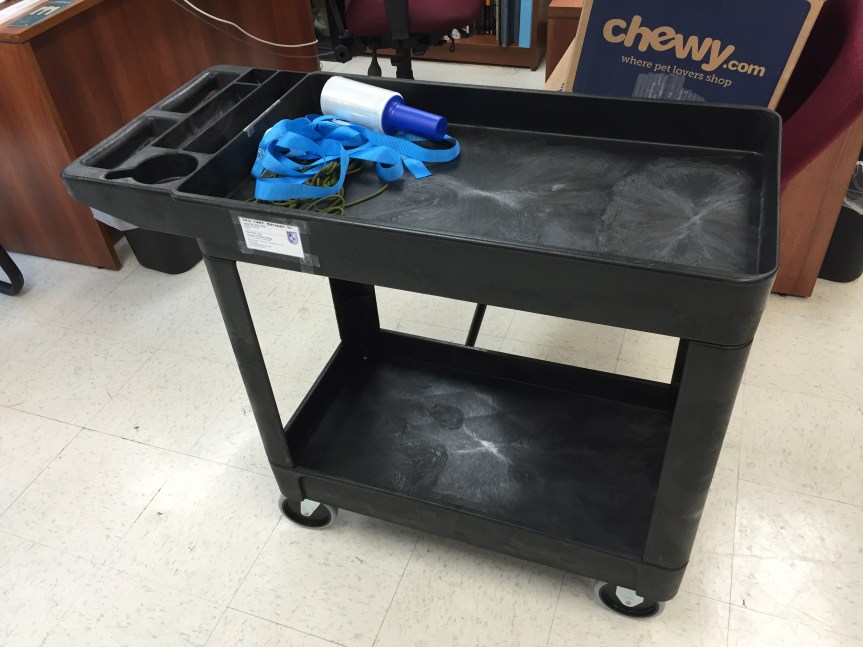
    I already had nylon straps and plastic wrap from our move to New York from the year before, which I could use to secure everything on a cart, which I didn’t have. So, I purchased up a heavy duty utility cart from Lowes for about $60 (I just looked and the price is up to $130 now!), and carried it boxed (~35 pounds) across the parking lot, down the street, up the stairs to the above ground subway at 4th Ave/9th St, up the steps at Jay St/Metrotech, two blocks down Jay St into the Namm Building, elevator ride up, and dropped it next to my desk exhausted. I assembled it in the office (I had considered assembling it in the Lowes parking lot, but it would have been too awkward to carry up the steps at the 4th Ave/9th St station.

    Utility cart

    For each load of computers from Vorhees to Namm, I put the heaviest equipment on the bottom and completely filled the lower shelf space to give it as low a center of gravity as possible. I stacked the top as reasonably as I could. I strapped it down and used the plastic wrap to secure smaller items that might wiggle loose during the rattly trip through Brooklyn.

    There were pros and cons about moving the computers from Vorhees to Namm. Leaving Vorhees and walking to Namm on Jay Street is down hill. However, the weight of the computers on the cart made it a strenuous task to hold the cart back from careening down the hill. The sidewalk is also uneven, broken, and pieced together with different kinds of material, which had to be navigated over and around. And, of course, there were the pedestrians, which occasionally made the move like a game of Frogger.

    I was able to move the bulk of the equipment in three trips. I might have gone back to pick up a few other things, but the second trip also turned out to be the most stressful. I never had any trouble with security at the entrance of Vorhees. I showed them my faculty identification and told them that I was taking the equipment to Namm. During the first trip into Namm past security, I wasn’t questioned about the equipment. Probably because logically I am bringing things into the building rather than attempting to walk them out, which I imagine happens on occasion.

    But, on the second trip into the Namm building, security stopped me and grilled me about what I was doing. Eventually, they led me to the security office on the first floor where I had an unpleasant conversation with the former public safety director about processes, protocols, and policies that admittedly serve a purpose in most cases but in an edge case like this.

    Despite the computers no longer appearing in any equipment databases, Stan and I had to fill out overzealous paperwork that had to be signed off exiting and entering a building. Individual items’ serial numbers weren’t checked against the paperwork, so it seems to have been bureaucratic onanism that added unnecessary labor to an already difficult project.

    Nevertheless, I moved the equipment into my limited office space and later purchased garage storage shelves to hold most of the larger computers with others on top of my official issued bookshelf and desk and others stacked into my filing cabinet.

    And, the utility cart came in handy when we received the first 160 box donation that inaugurated the City Tech Science Fiction Collection.