Tag: frankenstein

  • Science Fiction, LMC 3214: Concluding Frankenstein and Learning Exercise on the Sublime and Beautiful

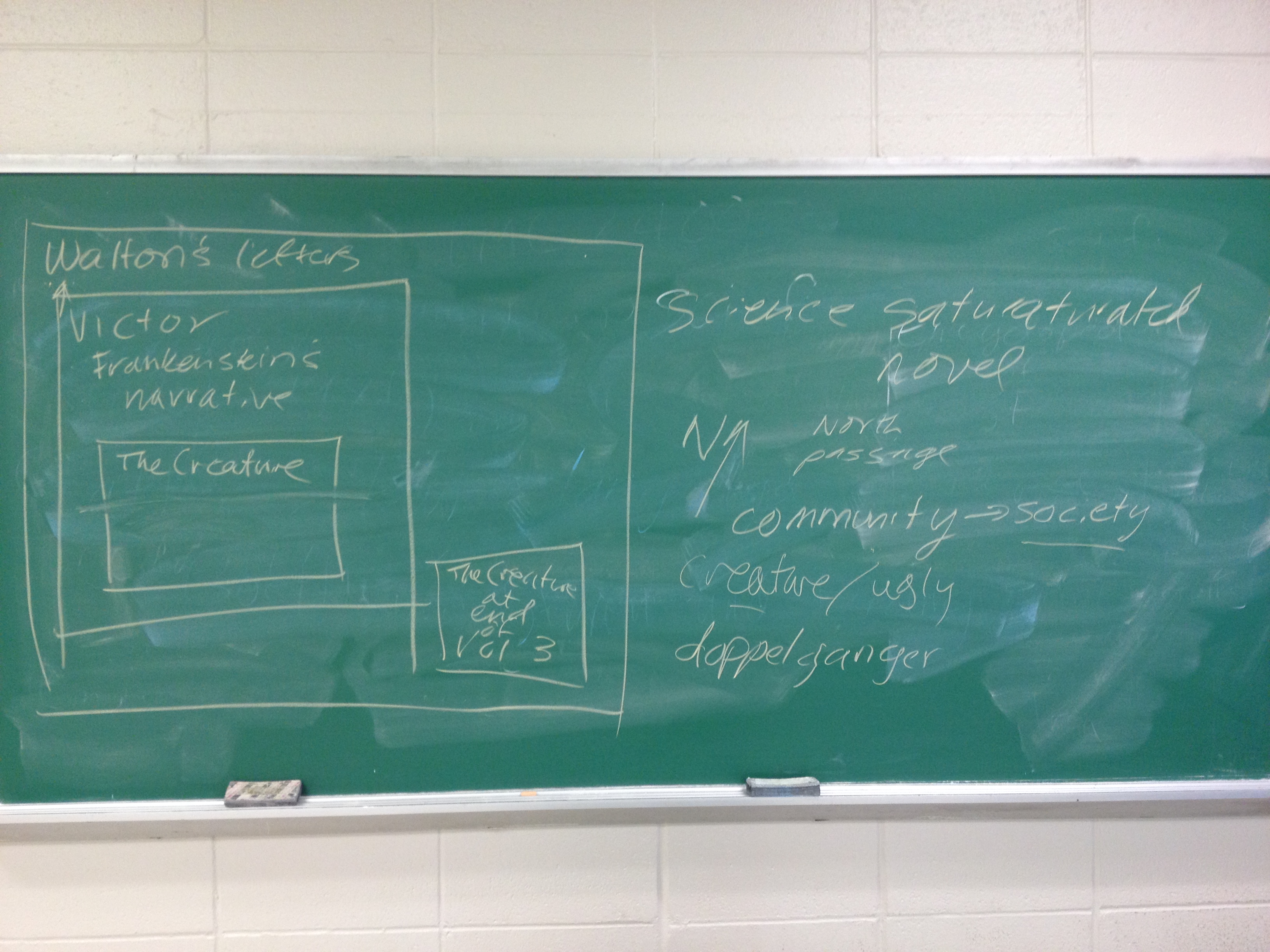
    Frames and science saturation.
    Frames and science saturation.

    In today’s class, we finished discussing Mary Shelley’s Frankenstein by discussing Volumes II and III and coving some major themes.

    To begin class, I wanted to have all of the students think about the sublime and the beautiful to better understand Mary Shelley’s engagement of those ideas in the settings and characterization in Frankenstein. First, I asked all of the students to quickly read summaries of the first three sections of Immanuel Kant’s Observations on the Feeling of the Beautiful and the Sublime on Wikipedia here. I also briefly described these sections to provide a rough sketch of what they would be reading. Then, I split the class into two halves: one half would find a picture or photo that represented Kant’s ideas of beauty and one half would find a picture or photo that represented Kant’s ideas of the sublime. Once they found an appropriate image, they would email a link to me with the subject “beauty” or “sublime.” This took about 10 minutes. Finally, I showed these images in front of the class and I invited the students to tell us why they choose it and then as a class we discussed how these worked or not as examples. I also found some examples that represented beauty and sublimity (I choose something technological to introduce a curveball to our discussion). We also looked at some of my photos of Mont Blanc and Chamonix from 2011.

    Some of the themes that we covered during the discussion of the last half of the novel included:

    • Epistolary and narrative frames
      • Issues of voice, authenticity, and mutual understanding/misunderstanding.
      • Rhetoric and empathy.
    • Science saturated novel
      • Victor, the Creature, and Walton are all scientists of a kind.
      • Victor chooses rationality/science cover irrationality/alchemy, his research leads to new discoveries, his research is reproducible. He learns the scientific method, applies it to a new hypothesis (creating life/reanimating tissues), and discovers new knowledge/techniques with real results (albeit without considering his responsibility to his creation).
      • The Creature uses rationality to figure things out and learn. He uses observations to learn language, which in turn allows him to learn about social and global relationships. His observations of the De Lacey family is almost like a sociological lab report. He uses deductive and inductive reasoning.
      • Walton is on a “voyage of discovery.” Search for knowledge (source of Earth’s magnetic field and geography) and acquisition of fame/wealth from discovering a passage to the Americas through the North Pole.
    • A Critique of the Age of Enlightenment
      • knowledge from science and rationality can have positive and negative effects on society (Victor waffles on this point in his thinking and conversations with Walton).
      • Connected this to the horrors of the 20th Century: World War II > Germany (weapons and genocide) and the United States (the atomic bomb)
    • Power of the novel from its ambiguities and tone (tension between positions)
    • Influence of Mary Wollstonecraft and William Godwin
    • Different interpretations of doppelgangers in the novel and issues of surface/appearance and psychology/inner self.
    • Issues of community, social responsibility, and isolation.

    I am fortunate to work with this dedicated group of students. They have raised exciting points and asked daring questions. If the first week is any indication of the following four, we will share many more interesting discussions on SF. Next week we will discuss Influences of SF, Voyages Extraordinaires, Scientific Romances, and the Pulps.
  • Science Fiction, LMC3214 Continues: Frankenstein Vol 1 and Active Learning

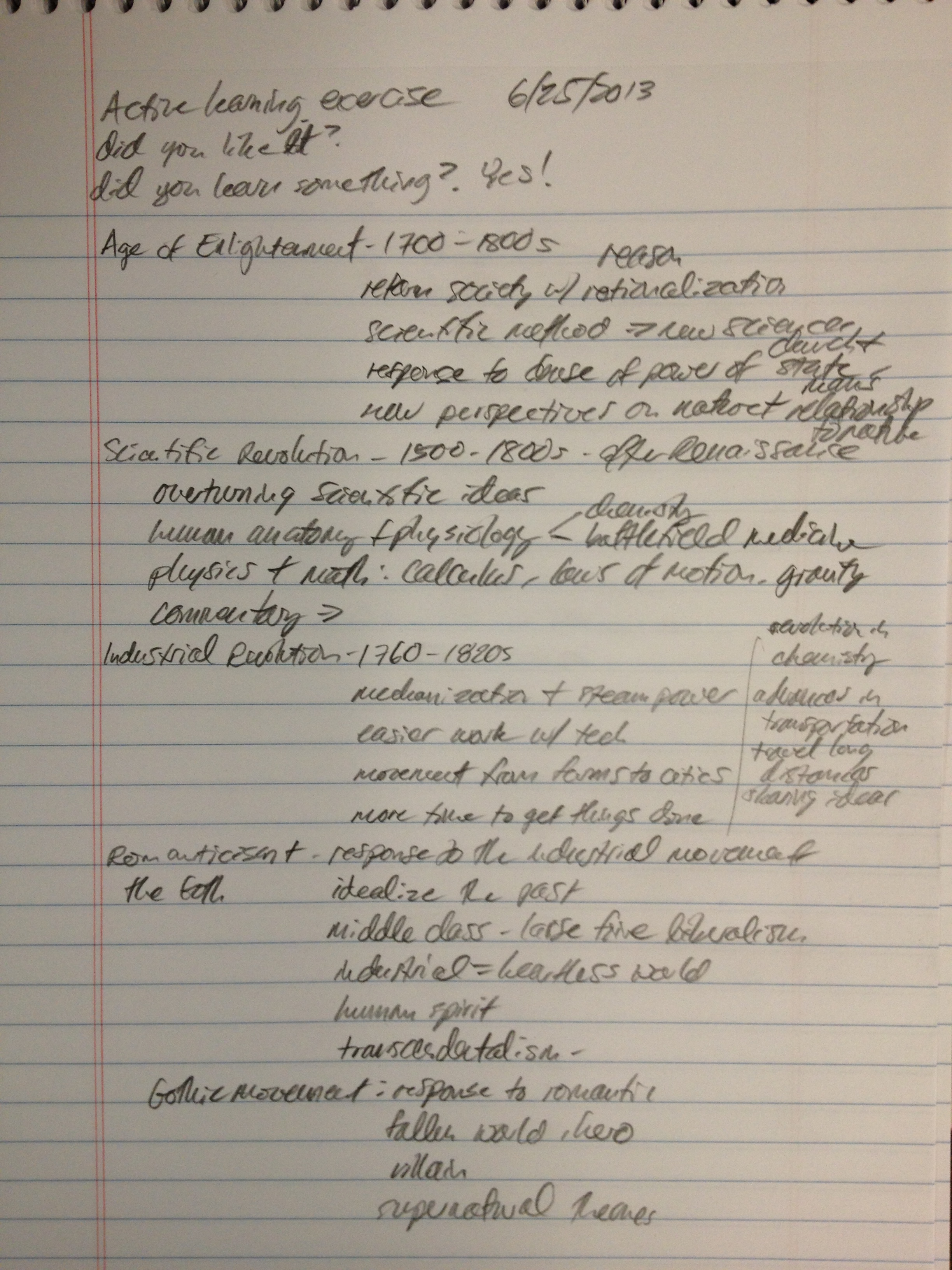
    My notes on what my students taught the class.
    My notes on what my students taught the class.

    During today’s Science Fiction class, we began discussing volume 1 of Mary Shelley’s 1831 edition of Frankenstein. After a brief lecture on Mary Shelley, her family, and the fateful June 1816 trip to Switzerland, I wanted to talk about how historical and cultural forces made it possible for a work like Frankenstein to come into existence. However, instead of lecturing about the Age of Enlightenment, the Scientific Revolution, Industrial Revolution, and Romanticism (and the Gothic), I decided to roll out an active learning exercise to facilitate peer learning. I divided my students into teams of three based on where they were sitting in the class. I reminded them to swap contact information with each other for sharing notes, studying, etc. Then, I explained the exercise to the class as a whole: I would assign each team a topic to research for 20 minutes using Wikipedia and EDU TLD sources on their laptops, tablets, and smart phones. Of course, I said that they could also rely on any knowledge that they already have, but they will have to share that knowledge with their team mates. While researching and talking about their assigned topic, they should compile a list of the most important ideas and/or figures and teach the class those topics. I walked around the class and told each group their assigned topic from the list above. After about 15 minutes I saw that the teams had completed the task, so I asked them to wrap it up and I called for a team to volunteer to present. Each team gave a superlative summary that I could add to, build on, and reference during our discussion of Frankenstein. I asked the students if they liked the exercise. There was no response, and my question was probably not a fair one to ask. Next, I asked if they learned something from the exercise, and they unanimously said, yes! Now that I’ve seen active learning work in my classroom, I will definitely think of other active, peer learning exercises to keep my classes dynamic and engaging for my students.

  • Ama Ata Aidoo’s Our Sister Killjoy and Frankenstein

    Y showed me a quote about Frankenstein and Science Fiction in a book on her postcolonial literature comprehensive exam reading list, Ama Ata Aidoo’s Our Sister Killjoy (1977).  Aidoo is a Ghanaian feminist writer, and she’s currently a visiting professor at Brown University.  I thought it was really interesting the way that Aidoo uses the Western Frankenstein myth or model to talk about the evolutionary derivation of whiteness (Europeans) from blackness (African) following the early-human diaspora from the African continent a couple million years ago.  The speaker aligns Europeans with Frankenstein’s monster, or the “man from the icy caves of the north,” through the exclamation, “But good God, I refuse to think that the man from the icy caves of the north could have been one of our inventions.  Yet sometimes one wonders, considering the ferocity with which he has been attacking us.  As though we were to blame for his feelings of inadequacy.  Both physical and otherwise.  Especially physical” (115).  And then the speaker ties it together with the Frankenstein story and a terrific observation about the nature of SF in general by saying, “It all sounds like science fiction.  Like the story of Frankenstein.  But then, science fiction is only a wild extension of reality, no?”  I’ve included the full quote with some extra material leading up to it below.

                My question is:  who was there when we were saying farewell to our God?  My Darling, we are not responsible for anybody else but ourselves.  We did not create other races.  So we should not let others make us suffer because we are stronger than them or have better skins.

                Sickle cell anaemia.  High blood pressure.  Faster heartbeats in infancy.  One truth maybe.  A whole lot of wishful thinking.  No amount of pseudo-scientific junk is going to make us a weaker race than we are.  And may they come to no good who wish us ill.  After all, what baby doesn’t know that the glistening blackest coal also gives the hottest and the most sustained heat?  Energy.  Motion.  We are all that.  Yes, why not? . . . A curse on those who for money would ruin the Earth and trade in human miseries.

                We have always produced great minds.  But good God, I refuse to think that the man from the icy caves of the north could have been one of our inventions.  Yet sometimes one wonders, considering the ferocity with which he has been attacking us.  As though we were to blame for his feelings of inadequacy.  Both physical and otherwise.  Especially physical.

                It all sounds like science fiction.  Like the story of Frankenstein.  But then, science fiction is only a wild extension of reality, no?  (Aidoo 114-115)

     What’s even more interesting about this quote is the fact that this novel is representative of Ghanaian literature despite its modernist underpinnings and Western intertextualities.  I’m not saying that a Ghanaian novel cannot do or contain those things, but my suspicion is that there are other novels that aren’t considered world literature, and here I’m borrowing from James English’s analysis of Keri Hulme’s the bone people in The Economy of Prestige, because they aren’t readily accessible to a Western audience.  This is because they are more Ghanian (whatever that might mean) and less engaged with post-Enlightenment, Western (or in this case, Northern) ideas and textual networks.

    However, this is the great debate in postcolonialist studies–following the colonial era, you can’t, as the saying goes, return home.  The colonial experience irrevocably changes the colonized’s culture and language.  In Ghana’s case, it was once a colonial holding of the United Kingdom, and it was the first African colony to achieve its independence from the crown.  As a result of the colonizer’s influence, English is the primary language of Ghana, and the UK educational system is more than likely similar to that of other former colonial holdings such as India.  Ghana is implicated with and tied to the West through its past and present, so there really isn’t such a thing as “pure” Ghanaian literature devoid of Western influence, but there is certainly Ghanaian literature that is part of the expansive global networks emanating diachronically from the Enlightenment and the continuing influence of the Western colonizer.

    Find out more about Aidoo on Wikipedia here, or on her Brown University faculty entry here.  The bibliographic entry for her novel is:

    Aidoo, Ama Ata.  Our Sister Killjoy, or Reflections from a Black-eyed Squint.  New York:  Longman, 1977.