Tag: Kent State

  • The Duck House in Kent, Ohio

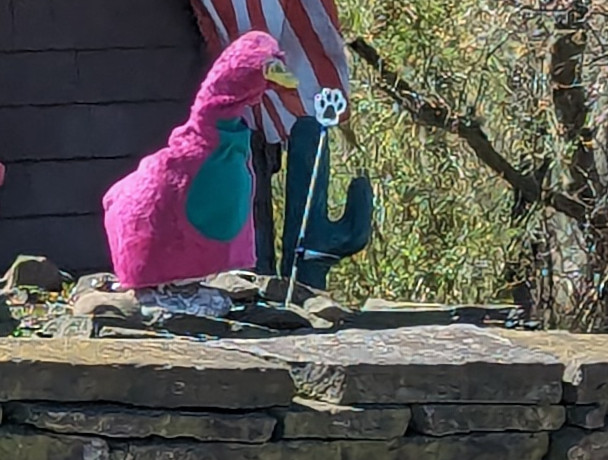
    Ceramic duck dressed as Barney the Dinosaur in Kent, Ohio.

    There’s a house on Stow Road in Kent, Ohio that has a ceramic duck in front of it. Normally, this would be nondescript. However, these fine people are kind enough to keep their ceramic duck clothed year round. When I was a graduate student, he wore many different outfits–from suits to puffer jackets. When I was in Kent a few weeks ago visiting my dissertation director Mack Hassler, I drove by the Duck House to see if they were keeping up the tradition, and I was very happy to learn that they are! On that sunny day, the duck was dressed up like Barney the Dinosaur.

  • Recovered Writing, Unpublished Film Adaptation Essay on Chris Columbus’ Bicentennial Man (1999), Mar. 1, 2011

    This is a 2,312-word essay on Chris Columbus’ Bicentennial Man (1999) for a cancelled companion titled When Worlds Collide: The Critical Companion to Science Fiction Film Adaptations for Liverpool University Press. I wrote my first draft and submitted it on May 30, 2009 (discussed here). A year-and-a-half later, the editors sent me suggestions and feedback on Jan. 31, 2011 (discussed here). I returned my substantially revised final draft (included below) on Mar. 1, 2011. My enjoyment of Isaac Asimov’s original novelette and novel-length-expansion with Robert Silverberg as The Positronic Man led me to write for this project when I first saw the call for contributors (even though I had not yet seen Columbus’ film!). I was thick in my PhD work when I wrote the first draft and nearing the end of that phase of my career when I submitted my revised copy. It is, unfortunately, a reminder that sometimes projects don’t work out for any number of reasons. I didn’t want my writing on these stories and its film adaptation to disappear, so I’m sharing it here. I am presenting it as-is based on the original document, which followed the house style provided by the editors–with only changes from British to American English spellings and punctuation use.

    Bicentennial Man (1492 Pictures, 1999)

    Adapted from Isaac Asimov, ‘Bicentennial Man’ (1976) and Isaac Asimov and Robert Silverberg, The Positronic Man (1993)

    (Dir. Chris Columbus; Sc. Nicholas Kazan; Pr. Wolfgang Petersen, Gail Katz, Laurence Mark, Neal Miller, Chris Columbus, Mark Radcliffe and Michael Barnathan; Cin. Phil Meheux; P.D. Norman Reynolds; SFX. Dream Quest Images; starring Robin Williams (Andrew); Sam Neill (Sir); Embeth Davidtz (Amanda Martin/Portia Charney); Wendy Crewson (Ma’am); Oliver Platt (Rupert Burns))

    Asimov’s “The Bicentennial Man” (1976) won the Nebula and Hugo Awards for Best Novelette in 1976 and 1977 respectively, and it has appeared continuously in print in various anthologies over the past three decades. Later, Asimov and Silverberg co-wrote a novel-length expansion of the original novelette which appeared in 1993 as The Positronic Man. These two works share a nearly identical plot, and the only additions in the novel include elaborate descriptive language, ancillary dialogue, and notable chapter expansions relating to the history of robotic development and the robot-protagonist Andrew’s trip to the Moon. These expansions are largely insignificant and did not influence Columbus’ critically derided and commercially unsuccessful adaptation.

    Asimov and Columbus use their respective media to tell a similar civil rights allegory about a robot with human-like qualities who aspires to a human identity and the rights that accompany it. In Asimov’s original novelette, the robot named Andrew overcomes real threats to his existence and he re-engineers his body in order to convince his society and government to grant him the legal status and rights of a human being, because he desires full self-determination. In this telling, Andrew seeks the legal authority to marry from his government. Both the film and the novelette carry an important message about equality and human dignity, but Asimov’s original story carries the burden much more confidently than the more recent film interpretation of that message.

    “The Bicentennial Man” is a unique Bildungsroman about Andrew, a robot who desires and ultimately achieves his humanity by freeing himself from the bonds of robotic servitude through his creative works and personal biology-machine negotiations.  Andrew begins his life as a purchased NDR robot by the Martin family and he is assigned domestic duties in their household. Soon after, he is named Andrew by his youngest charge, Little Miss. However, he quickly displays an unexpectedly preternatural creativity at woodworking, carving, and original thought. Andrew’s abilities allow him to obtain his freedom, write a history of robots from a robot’s perspective, develop a new science of biological prosthetics, and transform his machine body into one that is organic. On his 200th birthday, and after orchestrating his own mortality, he achieves recognition from the World Government that he is indeed human. Humanity however besets Andrew’s development from robot to virtual human being, which positions the story as a veiled social critique. A significant scene early in the story establishes why Andrew desires a human identity despite his robotic physicality and grounds the story in the American civil rights era:  Lost in the countryside, Andrew is confronted by two men who agree that, “If it doesn’t belong to anyone, he could be ours as much as someone else’s” (Asimov, 1991: 262).   At this point, Andrew’s situation connotes the predicament of former American slaves prior to the Civil War who traveled with manumission papers fearing they might be enslaved once again. The men’s disregard for Andrew’s freedom and personhood constitutes a powerful episode in the novelette, because it demonstrates a threat to Andrew’s personhood and a reason for his continuing work toward becoming human. Its absence from the film adaptation is symptomatic of the mishandling of the source material, which will be elaborated below.

    Columbus’ Bicentennial Man follows the narrative arc of the original, but it departs from Asimov’s novelette in a number of significant ways with the most consequential being Andrew falls in love with a human woman. It is Andrew’s desire to marry that provides the film a different allegorical message while maintaining a focus on Civil Rights. However, it is important to first note that in the original and adaptation, Andrew attempts to purchase himself from Sir, his human master. However, in the novelette, Sir initially refuses to grant Andrew’s freedom in exchange for money. It is only after Andrew wins a suit brought against robot freedom in the courts that Sir concedes to give Andrew his liberty in exchange for money. In the film, Sir immediately liberates Andrew with the caveat that Andrew vacate the Martin home immediately, and Sir says, ‘You wanted freedom. You must accept the consequences.’  In this regard, Andrew’s initial taste of freedom reflects how African-Americans were evicted from plantations following the Civil War with nowhere to go, but Andrew easily overcomes even this situation. It is on this point that the film fails where Asimov’s novelette endures. Andrew in the film never encounters a potentially hazardous circumstance on his journey to be human, and his battles are not convincingly hard-won. Then, finding himself alone in a world dominated by human beings, he serendipitously meets the cyberneticist Rupert Burns who helps his transition to a mortal human body so that he can romantically pursue Little Miss’ great-granddaughter Portia Charney. Instead of wanting the protections and rights of a human being due to his ambiguously defined legal status as in the original story, Andrew’s motivation for human identity comes from his desire to marry Portia. The film’s approach to a civil rights allegory is significantly different than Asimov’s story, but it is of significant importance to contemporary civil rights, which is addressed in the conclusion. Unfortunately, the film is marred by questionable issues in its handling of its source material and an unusual casting considering its subject matter. The first issue has to do with Asimov’s Three Laws of Robotics. In the important closing scene moments after Andrew’s death, Portia orders the android Galatea to unplug the machine keeping her alive after Andrew’s death, which is a gross violation of Asimov’s First Law of Robotics: “a robot may not injure a human being or, through inaction, allow a human being to come to harm” (Asimov, 1991: 126)  More importantly, the film’s cast is overwhelmingly white except for the only two prominent characters of color: an unidentified jazz singer (Paula West), and President Marjorie Bota (Lynne Thigpen). Each of these African-American actresses plays an influential role at key moments in Andrew’s transformation from robot to human being. The singer presides over the dance where Andrew begins to understand his feelings for Portia and the President grants Andrew’s request to be recognized as a human being. However, it is surprising that more persons of color were not cast as principles in the film, despite Hollywood’s long history of whitewashing ethnic roles or embracing diversity in its films’ casts considering the allegorical subject matter of the original and its adaptation.

    The presentation of the narrative in the original and film also greatly differs. Asimov builds momentum in the novelette through flashback and twenty-three short chapters. These chapters are snapshots in the long life of Andrew Martin as he attempts to transform from robot to human being. Additionally, these episodic chapters rise and fall with dramatic impact from event-to-event until the reader learns Andrew’s ultimate choice and his fate. On the other hand, the film is generally divided between Andrew’s life with the Martins, his search for robots like himself, and his transformation into a human being as he falls in love with Portia. The narrative is slow and plodding, and Robin William’s humor is lost behind the film’s script and special effects veneer. Through its narrative, the film presents a brighter and less dangerous narrative that follows Andrew’s human friendships and ultimately his courtship of a human woman. Besides its relaxed narrative that keeps Andrew out of harm’s way, the film has generally well lit and immaculately clean settings within the home and in the world-at-large, which conveys a sense of safety for Andrew as well as humanity. Furthermore, Columbus avoids dramatic tension by evading conflict or quickly diffusing stress between characters, such as between Andrew and Portia. The director also regularly employs wide shots, which lessens the emotional significance of many scenes. Despite its cinematographic deficiencies, the film endeavors to present a Civil Rights allegory that is closely aligned with its source.

    The novelette and film respond to issues of equality and Civil Rights found in many of Asimov’s stories in which robots have to deal with demanding human ‘masters’ spouting slurs, which in other contexts would be considered racist (the use of “boy,” for example: Asimov, 1941: 124). For Asimov and Columbus, Andrew is a bonded servant on two levels – as a thing purchased, owned, and controlled, and as a robot bound by the Three Laws of Robotics first enumerated in Asimov’s short story “Runaround” (1942). Andrew transcends these restrictions on his being and his behavior in order to achieve personhood just as some former African-American slaves overcame their status as property in order to register themselves as persons deserving freedom and equality. In Asimov’s original novelette, Andrew overcomes the threat to his right of self-determination by convincing his society and its government to grant him identical status as a human being, a “Bicentennial Man” (Asimov, 1991: 290). On the other hand, Columbus’ film places its emphasis on a threat to Andrew’s and Portia’s family by calling into question the right of a robot to choose to marry a human being and vice versa. Both are momentous civil rights issues, but the film’s execution of its message appears weighted more toward Andrew’s socialization as Portia’s mate rather than the harsh realities of a society against the marriage of a particular group.

    “The Bicentennial Man” deals with ontological concerns and identity politics as is true of many of Asimov’s robot stories. However, Andrew’s story more fully explores one robot’s path from robotic slavery to human freedom, and it does so by closely following models of American slave narratives that emphasize emancipation and personal development. These include Olaudah Equiano’s The Interesting Narrative of the Life of Olaudah Equiano, or Gustavus Vassa, the African (1798), Frederick Douglass’ Narrative of the Life of Frederick Douglass, an American Slave (1845), and Booker T. Washington’s Up from Slavery (1901). These authors demonstrate their subjecthood as equals of all human beings through their lives and writings, and furthermore, they prevail over Thomas Jefferson’s comments on American slaves in his Notes on the State of Virginia (1784): “that in imagination they are dull, tasteless, and anomalous,” and he “never [saw] even an elementary trait of painting or sculpture” (Jefferson, 1984, 267). Likewise, Andrew overcomes society’s expectations by demonstrating that he is artistically creative and an independent thinker who desires freedom. Asimov mirrors slave narratives in his futuristic story:  Andrew obtains a personal awareness of his oppressive situation as a robotic slave, he attempts to purchase himself from his master with money saved from his creative labour, he experiences a different way of interacting with humans and robots on the Moon, and he spends his life proving himself an equal of other humans. Andrew, like former American slaves, also demands to know why he is not considered an enfranchised human. He challenges his society’s beliefs about robots, and he ultimately convinces his society and government to grant him equal status with human beings. However, Andrew’s successes in the novelette and film are an oversimplification of the past and present difficulties of people of color to achieve the full benefits of civil rights and wider societal acceptance, but it could be Andrew’s desire to marry a human being in the film adaptation that gives the film more contemporary, perhaps even prophetic importance.

    Despite Bicentennial Man’s problems, it may signify the future of civil rights issues in its handling of an individual’s right to marry. Asimov’s novelette appeared a few years after the landmark ruling of the United States Supreme Court in ‘Loving v. Virginia’ (1967), which made all anti-miscegenation laws unconstitutional thus legalizing all mixed-race marriages. However, this issue was not explored in the original story. On the other hand, the film relies on the right to marry as the motivation for Andrew’s development in the last half of the film. In order to marry the human woman Portia, Andrew must transcend his robotic body and convince his society and government to allow him the right that human beings take for granted. This civil rights issue raised in the film is prophetic of the growing call for gay men and lesbians to share the legal right to marry. The film appeared three years after the passage of the Defence of Marriage Act (DOMA) in 1996, which broke the Full Faith and Credit Clause of the U.S. Constitution. It dictates that the States must respect the laws of other States. Without DOMA, all States would have had to respect the marriages of gays and lesbians if any one State had made those marriages legal. Civil rights are and will continue to be a struggle for minority groups in the United States, and it is in this light that Bicentennial Man succeeds as a film veiling a message on an on-going civil rights debate.

    Notes

    Isaac Asimov, ‘Bicentennial Man’ in I. Asimov, Robot Visions (New York: ROC, 1991), pp. 245-290. Originally published in Stellar #2 (1976).

    Isaac Asimov, ‘Runaround’ in I. Asimov, Robot Visions (New York: ROC, 1991), pp. 113-134. Originally published in Astounding Science Fiction (April 1941).

    Isaac Asimov and Robert Silverberg, The Positronic Man (New York: Doubleday, 1993).

    Frederick Douglass, Narrative of the Life of Frederick Douglass (Boston: Anti-Slavery Office, 1845).

    Olaudah Equiano, The Interesting Narrative of the Life of Olaudah Equiano, or Gustavus Vassa, the African (London, 1793).

    Thomas Jefferson, Notes on the State of Virginia (New York: Library of America, 1984), pp. 266. Originally published in 1784.

    Booker T. Washington, Up from Slavery: an autobiography (New York: Doubleday, Page & Co., 1901).

  • Taiwanese Publisher Who Printed My Dissertation Ruined by Inferno

    IMG_20180715_154104

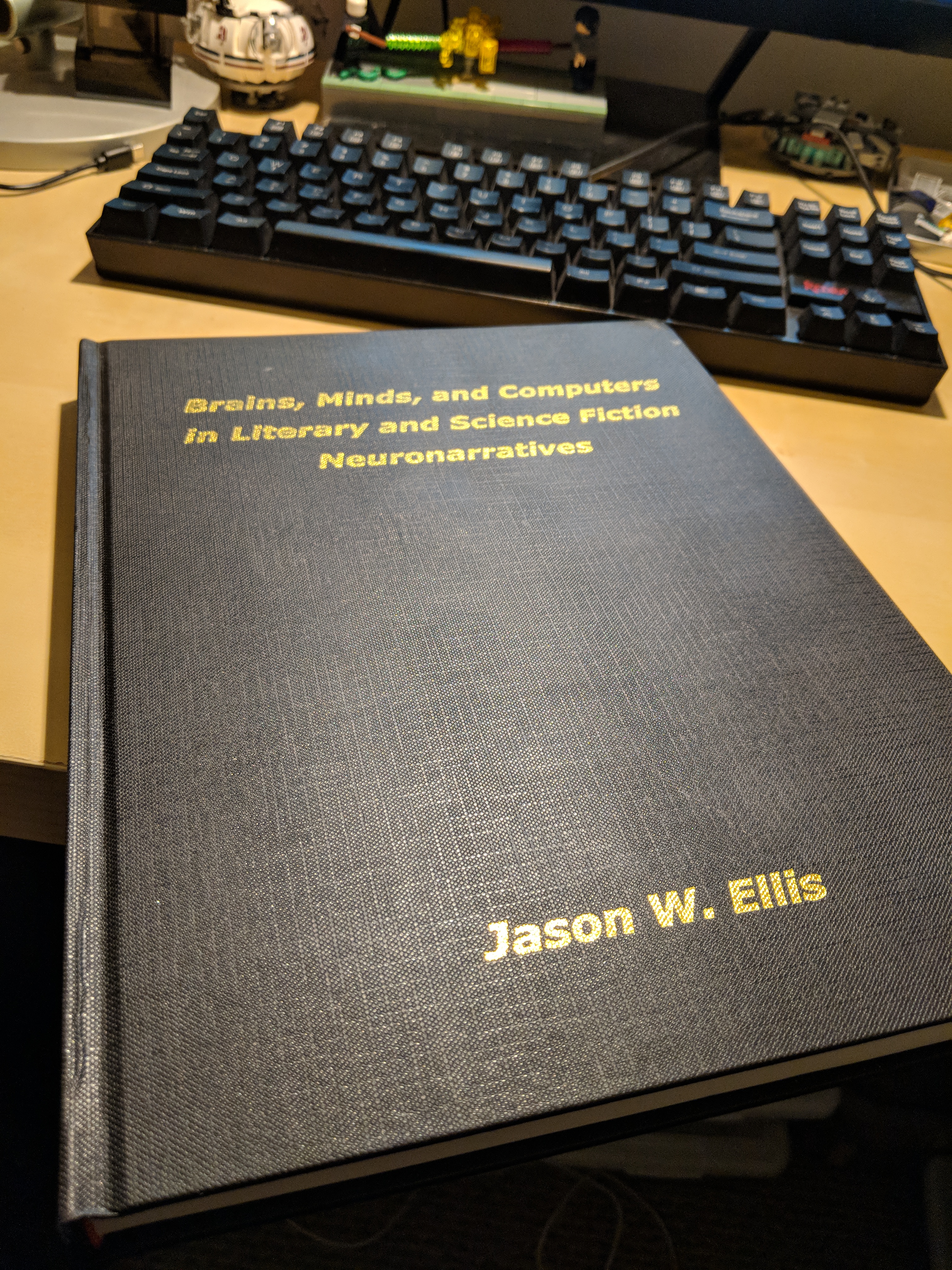
    I was sad to learn that Zonghe Zhuangding, Ltd., the publisher who worked with Y’s father to print an exquisite hardcover edition of my PhD dissertation, “Brains, Minds, and Computers in Literary and Science Fiction Neuronarratives,” shuttered their business after their shop burned down. Zonghe Zhuangding provided printing and book binding services for publishers in Taiwan until the fire consumed their entire facility.

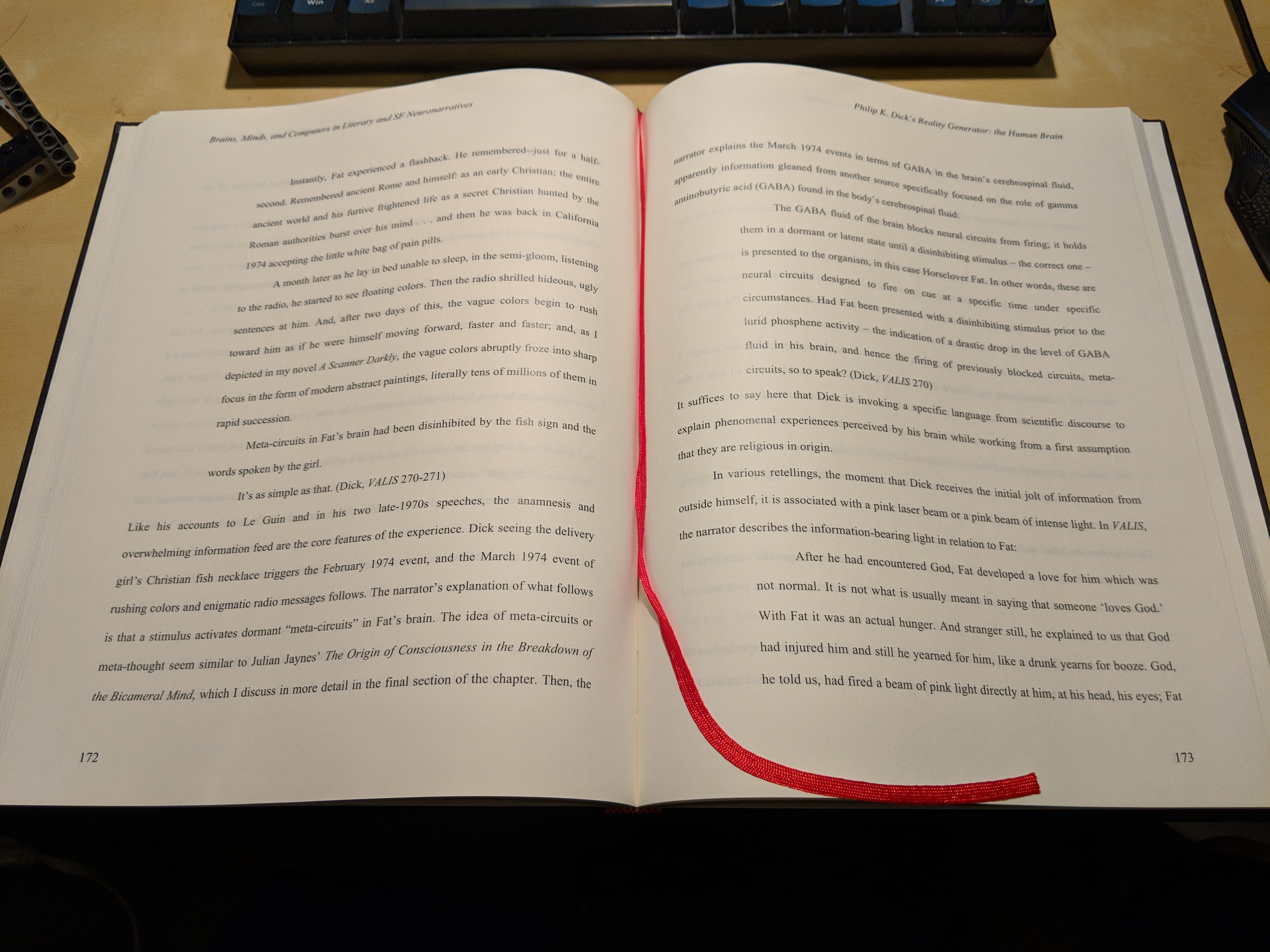
    Y’s father insisted that we publish my dissertation after I defended it in 2012. Zonghe Zhuangding did an amazing job printing the book-version of my dissertation, which I had to layout with opposing running headers and other book-design features. The gold-typeface on the cover and spine look very impressive. And, the stitched-in red ribbon bookmark was a surprise bonus (see below).

    After Y defended her dissertation last year, her father had her dissertation printed there, too.

    N.B.: In Chinese, zhuangding means binding or book binding.

    IMG_20180715_154158

  • A Brief Note on Steven Lynn’s Rhetoric and Composition: An Introduction

    When I asked Dr. Courtney L. Werner, a friend and colleague at Kent State University where we earned our PhDs (find her blog here and connect with her on Twitter here), what I should read that captures the theoretical breadth and historical depth of her discipline of study–Rhetoric and Composition–I dutifully wrote down what she told me: Steven Lynn‘s impressive Rhetoric and Composition: An Introduction. I think that it has been about three or four years since I jotted down her suggestion, but I’m happy to report that I finally got around to reading it over the past few days and I’m certainly the better for it.

    For those of you who might be like me–not really knowing anything about Rhetoric and Composition when going into graduate school, but wanting to learn more about this important discipline after learning of its existence–I recommend Lynn’s book as a thorough starting point.

    Lynn begins his book with a chapter on the relationship and interconnectedness of Rhetoric and Composition. He guides his reader through seeing them separately and together while peppering his discussion with an exhaustive and concise (what a balancing act throughout the book) theoretical-historical context.

    In the chapters that follow, he designs them around the five canons of rhetoric as an art: invention, arrangement, style, memory, and delivery. Each chapter combines discussion of the historically relevant development of the canon, its major contributors, its past and present scholarship, and applications for the classroom. The final chapter on delivery has a lot of helpful material for first time composition instructors, too.

    During my time at Kent State, I am glad that I taught in the writing program and I am glad to have had the opportunity to learn from and share ideas with graduate students and faculty in the Rhetoric and Composition Program, including Brian Huot, Pamela Takayoshi, and Derek Van Ittersum. In retrospect, however, I wish that I had made it a point to join a Rhetoric and Composition seminar (for credit or to audit), because I see now how it would have enriched my scholarship and pedagogy in pivotal ways. If you are like me in this regard or still on your path to a terminal degree, I recommend Lynn’s book for learning Rhetoric and Composition’s ideas, debates, and scale as a student, incorporating its ideas into your daily practices as a teacher, and opening up new possibilities in your thinking as a scholar.

    Lynn, Steven. Rhetoric and Composition: An Introduction. Cambridge: Cambridge UP, 2010. Print.

  • Recovered Writing, PhD in English, Dissertation Defense Opening Statement, May 15, 2012

    This is the sixty-fourth post in a series that I call, “Recovered Writing.” I am going through my personal archive of undergraduate and graduate school writing, recovering those essays I consider interesting but that I am unlikely to revise for traditional publication, and posting those essays as-is on my blog in the hope of engaging others with these ideas that played a formative role in my development as a scholar and teacher. Because this and the other essays in the Recovered Writing series are posted as-is and edited only for web-readability, I hope that readers will accept them for what they are–undergraduate and graduate school essays conveying varying degrees of argumentation, rigor, idea development, and research. Furthermore, I dislike the idea of these essays languishing in a digital tomb, so I offer them here to excite your curiosity and encourage your conversation.

    I prepared this brief statement to introduce the thinking behind the choices that I made on which writers to include and the emergent theme of the dissertation that would lead to my current research: technological ephemerality. This statement is part justification and part roadmap for where I am now and will be in the future.

    To set the stage for making this statement, imagine me sitting at the head of a conference table. Behind me on a podium is a Powerbook 145 with Gibson’s eBook of Neuromancer, Count Zero, and Mona Lisa Overdrive open and the big box for the Neuromancer video game adaptation from the late-1980s.

    Dissertation Defense Opening Statement

    Jason W. Ellis

    15 May 2012

                I would like to thank you all for reading my dissertation, “Brains, Minds, and Computers in Literary and Science Fiction Neuronarratives” and for meeting with me today. I am looking forward to your questions and our discussion. Before we begin, I would like to take this opportunity to describe my project’s goals, it’s origins, my methods of research, and what I hope it accomplishes. As you will see, my iPad figures prominently in these things.

    In my dissertation, I draw on my interdisciplinary interests in literary studies, science fiction studies, history of science and technology, and evolutionary psychology to situate science fiction’s emergence as a genre in the early twentieth century within the larger context of the human animal’s evolutionary co-development with technology. In a sense, I sought the raison d’être of the genre in a Darwinian and cognitive context. I believe the communal teaching aspect of science fiction to be an integral part of the genre itself, and it is this aspect that I gave the name “future prep.” From another perspective, I define science fiction as the kind of literature that performs this function. I also wanted to take one related thread from the genre’s overall development—that being brains, computers, and artificial intelligence—and trace it through the work of three significant writers, namely: Asimov, Dick, and Gibson.

    My dissertation originates in part from my long interest in the biology of the human brain. Perhaps this is a byproduct of the conceptual metaphors that I learned in school or in books that the brain was a type of computer and the computer was a type of brain. We know that these are imperfect analogies, but you can imagine that they can have a strong influence on the development of a curious mind. Even at an early age, I strongly felt the link between brains and computers as evidenced by a sustained performance that convinced my kindergarten classmates I was a robot. More recently, I fell into the physics of mind when I was in high school. Thanks to Stephen Hawking, I stumbled onto the work of his collaborator Roger Penrose, who had done other work arguing that the brain is not a Turning-type computer and that quantum phenomena must play some part in the emergence of human consciousness. Much later, during my MA at the University of Liverpool, I made a deal with a friend in the neuroscience program to give me a digital copy of my brain in exchange for my participating in his neural correlates of facial attractiveness study. However, the most recent and profound shift in my thinking came about in a serendipitous way. During the preparation for my PhD exams, I met with Professor Clewell to discuss my readings for the postmodern theory exam. I recall our conversation veering toward computers and the human brain. I learned from Professor Clewell about the emergent discourse surrounding the human brain and the human experience from a Darwinist/evolutionary rather than a Freudian/psychological or Marxist/social perspective. As invested as my work up to that point was in cultural theory, I was very intrigued by the interdisciplinary possibilities that neuroscientific topics and evolutionary psychology might provide for my work in literary history. Without a doubt, this was a pivotal moment in the development of my dissertation. It provided me a direction to expand the scope of my project from one author—originally on the fiction of Philip K. Dick alone—to three by developing a new theory of the genre in terms of the human brain’s evolution. This was new territory for the literary history of science fiction, and I wanted to trek an unexplored path into this uncharted territory.

    The next stage was to select the literary focus of my research. I chose Dick’s work, because I believe his awareness of the brain’s role in human experience and in our relationship with technology strongly connects to my theory of science fiction. Then, I selected Asimov as a connection between the early editors who shaped the genre and later writers including Dick, whose androids obviously respond to Asimov’s robots. Finally, I decided on Gibson, because he reinvented Dick’s concerns about technologization of the human experience in a more nuanced manner than Dick’s paranoiac division between the android and the human.

    Research and writing of my dissertation presented its own challenges, but I was very pleased that part of the subject matter inspired my own processes of work. In my reading and research, I leveraged computer technology to my advantage to build efficiencies and speed into my work. In particular, I wanted to make all of my research—primary and secondary sources—available on my computer, iPad, and iPhone. The primary reason for this was to make it easier for me to track my research and use digital tools such as textual analysis software and key word search on materials I had read or skimmed. Having the materials on my various computing devices made it easy to search the same or multiple documents very easily and quickly while taking notes or writing in Microsoft Word on my MacBook. Of course, my brain did the work of configuring, contemplating, and creating the dissertation itself.

    The issue of obsolescence, which I discuss a bit about in the concluding part of my dissertation, was also a driving force behind my efforts at digitization of my research materials. For example, the last half of the second chapter presented a unique problem—I needed to read the editorials of the old pulps—particularly Amazing Stories and Astounding—but these pulps are not widely available in library collections, and when they are, it can be difficult to handle and read them due to their extreme fragility. Luckily for my research, legions of science fiction pulp collectors have made much of this material available online as scanned copies. Obviously, there are tensions between the efforts of cultural preservationists and the Disney-fication of copyright law, but due to the nature of my research and its importance to the long literary history of science fiction, some of which is egregiously at risk of disappearing, I side with the preservations. Unfortunately, the scanned materials were not always complete, but they did provide me with some useful evidence and clues to more. I filled these missing holes with interlibrary loan requests that took several weeks to complete. For other primary sources, I was able to track down circulating text files—such as for Asimov’s, Dick’s, and Gibson’s novels, and others, I purchased either through Amazon’s Kindle shop or Apple’s iBook store. I should note that I used these non-paginated materials for research purposes, and I cross-referenced any findings there with the physical copies that I own or borrowed from the library—the only exception being Dick’s Exegesis.

    I also converted many sources on hand into digital copies for my personal use. Generally, I took photos of pages, created a PDF, and ran OCR software to generate searchable text. Due to my limited time, this was especially useful during my research trip to UC-Riverside’s Eaton Collection in February. In addition to my typewritten notes on my MacBook, I captured over 1000 pages of rare and interesting primary research for the Dick and Gibson chapters with my iPhone 4S’s built-in camera. Some of this research is included in the dissertation, but there is much left for me to review as I begin the process of transforming the dissertation into a publishable manuscript. This extra work paid off by revealing quotes overlooked during skimming or reading. While I am reading to you from my iPad, I also have my dissertation manuscript, primary sources, secondary sources, notes, and much more all available at the touch of my finger. However, I have to remain vigilant with my archival practices to ensure my access to my data now and in the future. It is also a challenge to find software that maintains compatibility and preserves my workflow.

    As Gibson warns us in his afterword to the Neuromancer e-book, technology’s fate is obsolescence. As he foretold, it was nearly impossible to access his e-book in its original version. First, I had to wait several weeks to receive a copy of the e-book’s disk from one of the three American universities that hold it. Then, I had to find an older Macintosh with a floppy disk drive to read the disk and in turn allow me to read the e-book. Unfortunately, there are no Macs with floppy disk drives anywhere near Kent State. I turned to eBay to find an early PowerBook, but unfortunately, the first one I purchased was destroyed during shipping. Eventually, I was able to read the e-book with this PowerBook 145, but it took time, money, and know-how. What does the future hold for those of us who want to read the stories these technologies have to tell us, and what effects do these technologies have on our cognitive development? These are questions I plan to investigate following the dissertation.

    In closing, I hope that my work on the literary history of science fiction accomplishes two things. First, I believe that science fiction’s roots run deep, and my dissertation is meant to show how it is a literature that emerges as a byproduct of powerful evolutionary forces of the development of the human brain in conjunction with the human animal’s co-evolution with technology. Second, I hope that my work facilitates further cross-discipline discussion and leads to additional research into the brain’s role in the emergence of human experience and the enjoyment of fiction—especially science fiction.