Tag: Lego

  • Building City Tech’s New Academic Building at 285 Jay Street With LEGO

    IMG_1612

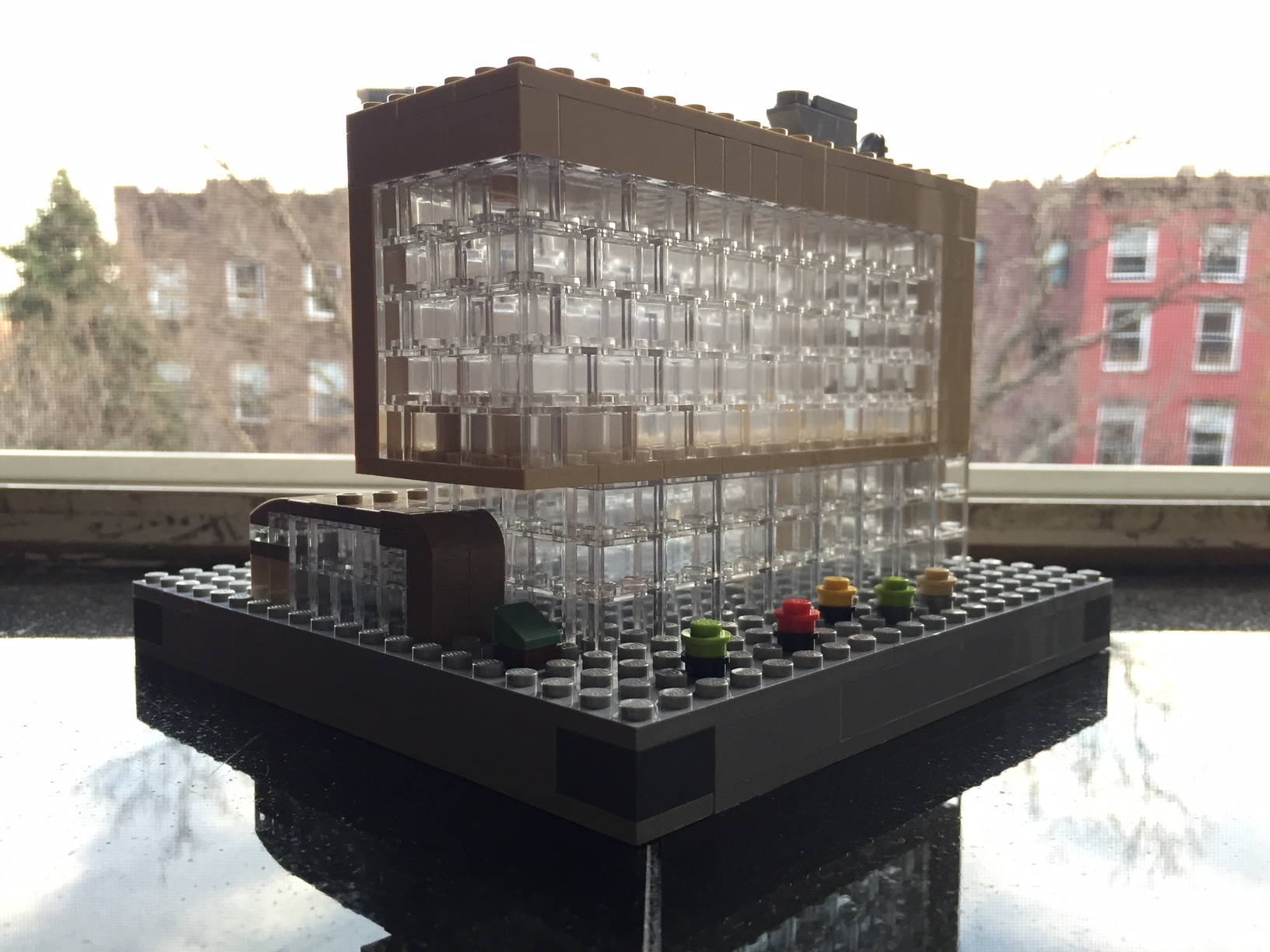
    Over the past few days, I build a small scale model of the new City Tech academic building at 285 Jay Street. Still under construction, this model highlights its eventual glass-covered transparency (see this PDF for additional renderings of the building’s completed construction) with the model’s approximately 160 clear 1×2 bricks:

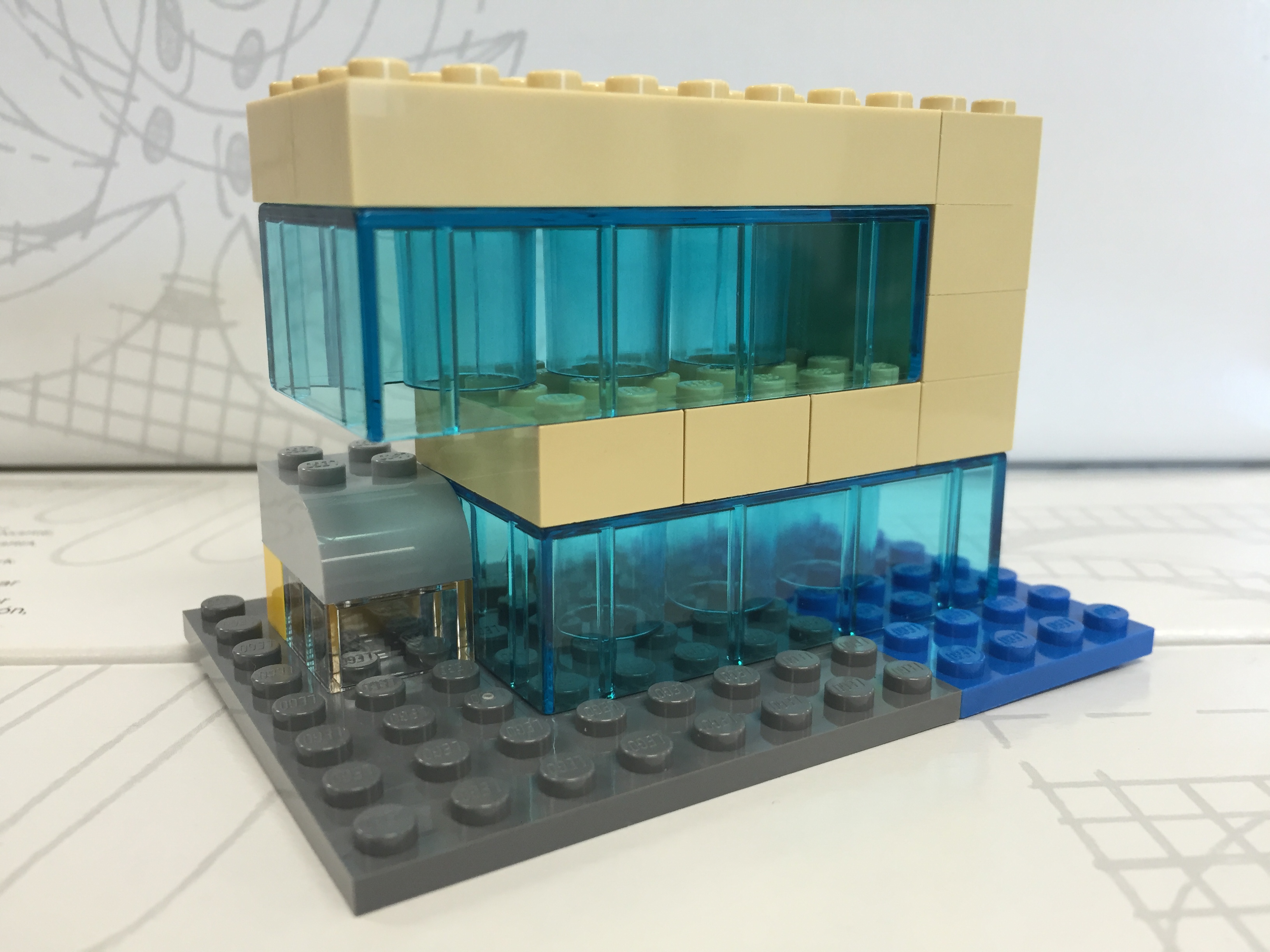
    My Serious Change Through Play collaborator Patrick Corbett original gave me the idea to build a model of the new building after we made our first grant-funded LEGO brick purchase. Here is what that first, simple model looked like:

    IMG_0516 2

    With only a few LEGO and Duplo bricks, I was able to capture the glass structure, upper floors overhang, and intersecting curve of the auditorium. Eventually, we incorporated this model into the Serious Change Through Play branding logo. While I like this smaller model, I wanted to build one that was larger and captured more detail without breaking the bank.

    To begin my larger design and assess what extra LEGO pieces that I would need beyond those that I already own, I copied LEGO brick/plate design grids (see Duckingham Design’s grids, which are terrific) into Microsoft Windows’ Paint and drew in a rough sketch of each side’s elevation:

    After these initial designs, I knew that I had most of what I would need to build the base and solid-color aspects. However, I didn’t have any of the clear bricks. Luckily, I saw a bin full of clear 1×2 bricks at the Flatiron LEGO store a week ago, so I returned there to purchase those and spare bricks that I thought might be useful during the build:

    After disassembling all of the bricks in the pick-a-brick container (NB: if you purchase a pick-a-brick container from the LEGO store, you should assemble all of the bricks in order to maximize how many bricks can fit and minimize wasted empty space), I used plates and bricks to construct a 20×20 stud base with a height of 1 brick and two plates (one plate level on top and one plate level on bottom):

    Next, I began the fun part of the build, which I like to think about as similar to the writing process–brainstorm, draft, and revise. While I had my elevations to work from, I thought of specific ways to put the bricks together that represented the building better and served to make a stronger model. For example, using overlapping joints and interlocking corners in the upper stories look good and make the model sturdier.

    The intersecting auditorium provided some of the best challenges during this build, because it has an interesting curve that is like the forward leading edge of an airplane wing. This required a lot of digging through my boxes of bricks to find pieces that conveyed this as best as possible at this scale and appear close to the colors in the building design documents:

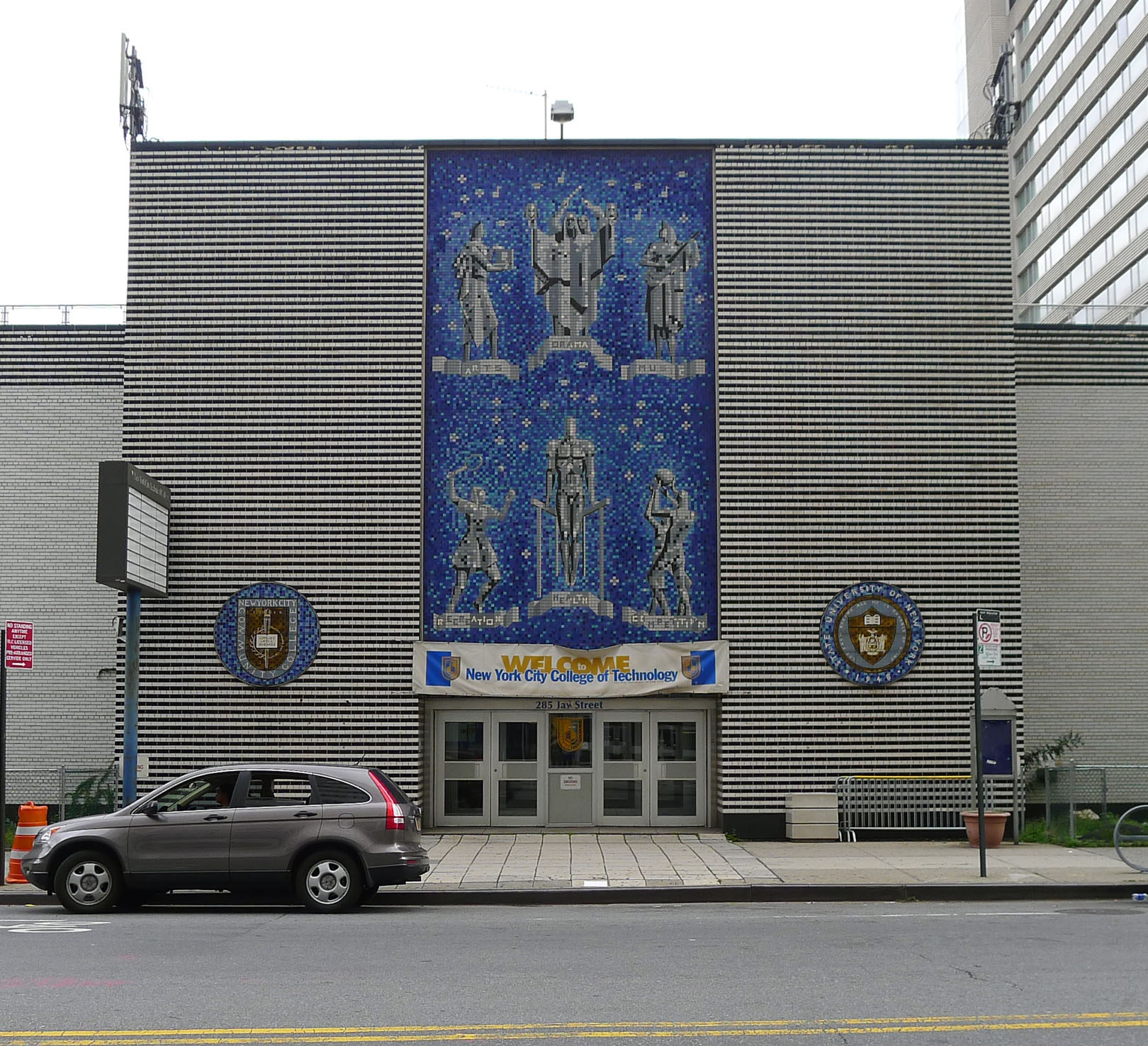
    You might have noticed a white, silver, and blue structure in the rear of the building. I felt that I would be remiss if I neglected to include the spirit of the building that used to be at 285 Jay Street–City Tech’s previous auditorium with its Klitgord mosaic (see page 8 of City Tech Connections vol. 6 no. 2 here for more information, or speak to Dr. Mary Nilles, who taught me about the history of the mosaics). The original Klitgord mosaics, crafted by Nathiel Choate and Joseph von Tury in 1962 for the auditorium building, look like this (photo by William Avery Hudson):

    8039626236_63e363ed36_o
    Photo by William Avery Hudson.

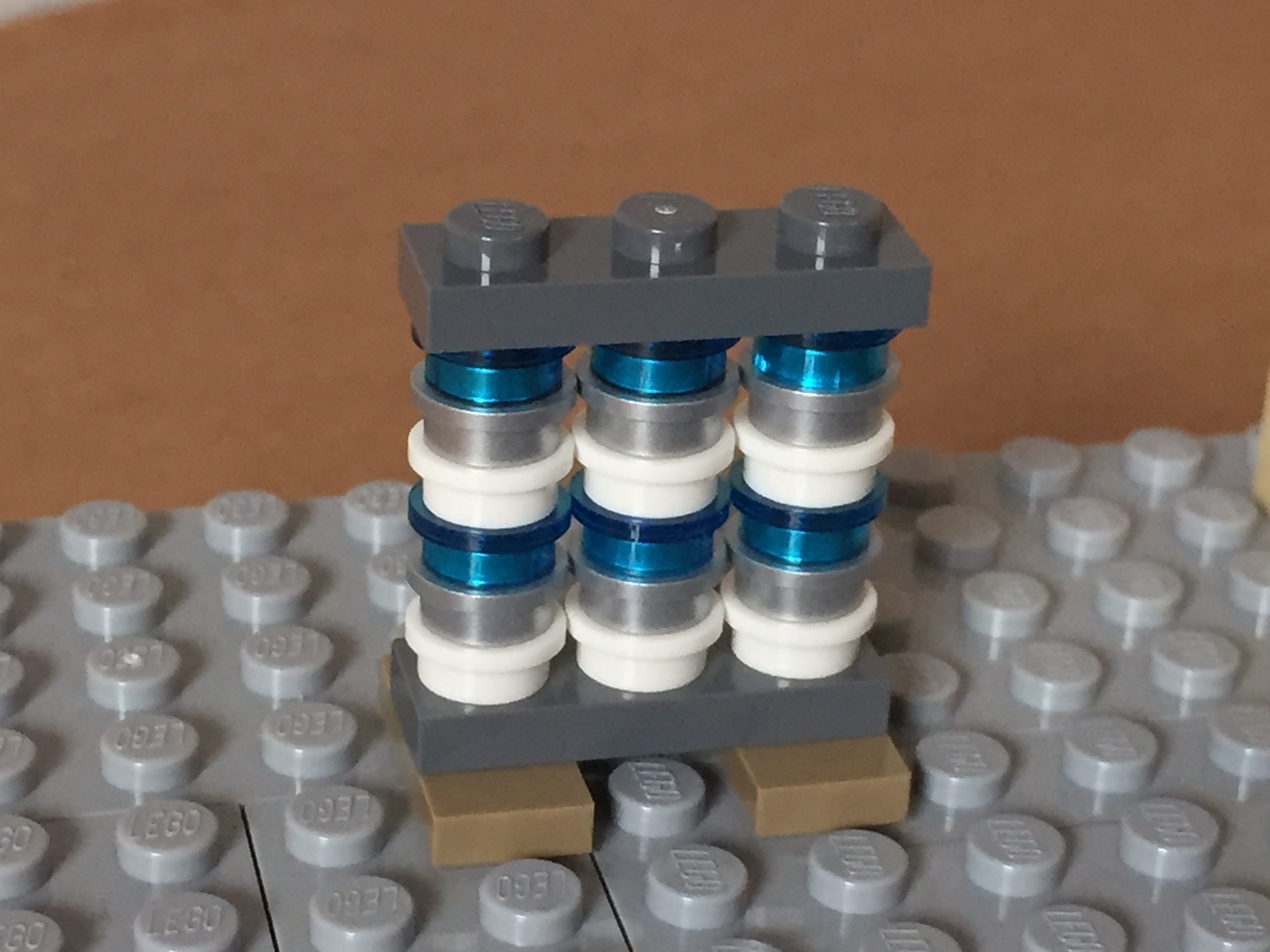
    Using the microscale of my model, I wanted to capture the color scheme and figures despite the extremely low resolution of the medium at this scale. Nevertheless, I figured that I could convey that there are six human figures and a color scheme of white, silver, and blue. Therefore, I built this model of the mosaic–perhaps the preserved mosaic will have a home in the new building?

    IMG_1608

  • Why Do I Build LEGO Sets Before Creating My Own Models? Thoughts on Haptics and Star Wars Rebels 75053 The Ghost

    IMG_1629

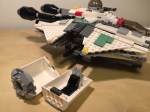
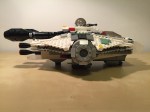
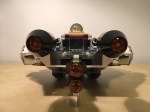
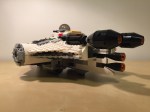
    I recently purchased the LEGO Star Wars Rebels 75053 The Ghost set to cannibalize for a MOC project. However, before I parted out the set and sold off the minifigures, I built the set one time and purposefully spread the build time across several days even though the set itself should only take a couple of hours of concentrated build time to complete. Why?

    A personal reason stems from the enjoyment and stress relief that comes from building something with my hands. I see the model take shape as I place brick after brick. I take joy in the innovative techniques employed by the model’s designers. I reflect on the relationship of the model to its source material–in this case, the television program Star Wars: Rebels.
    From a learning perspective, the haptic experience of building the model by following its instructions teaches the builder the process and techniques of the designer. Combined with the builder’s experience gained from model building and creative expression, one can reflect on the model’s design and guess about alternative methods and potential roadblocks encountered by the designer in earlier versions. In a sense, LEGO bricks serve as an interface between builder and designer, and through the interface, the builder learns and imagines new possibilities, which the builder can turn toward future projects. Building, pulling apart, rebuilding, redesigning, and creating forms the basis of a self-perpetuating active learning experience–one that begins guided and ends self-directed.

    By spreading the build across several days, it allowed me to enjoy an extended building experience while giving my brain the space to think about and reflect on the building techniques employed by the sets designers. Had I built the model as quickly as I could have otherwise, I would not necessarily learn as much from the instructions and haptic experience of following the instructions to construct the model.

    Based on my extensive first-hand experience as a LEGO builder and an educator who uses LEGO in his Technical Writing and Science Fiction classes, the transition from guided to self-directed learning is one of the powerful characteristics of LEGO as a learning platform. Furthermore, its orientation as a technology of play opens engagement and enables learning that is fulfilling because of the enjoyment that it can bring about (of course, LEGO might not be for everyone and the source of enjoyment in learning differs from person to person–as with the projection learning with lecture and PowerPoint, or other forms of active learning exercises, I propose that LEGO is another tool in the educator’s toolbox that can be used, repurposed, hacked, etc. as the case and need arises).

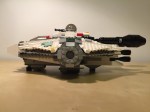
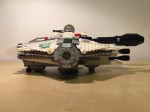
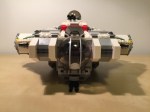
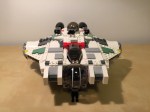
    Before I disassemble The Ghost, here are some images of a nice model that accurately captures its source while adding play elements that fans of the series–young and old–will likely enjoy.

  • Customized LEGO Star Wars Millennium Falcon 75105 from The Force Awakens

    Customized LEGO Star Wars Millennium Falcon 75105

    Introduction

    After watching Star Wars Episode VII The Force Awakens for the first of four times (so far), I purchased the new LEGO Millennium Falcon 75105 (LEGO website page and Brickset model page). It is a wonderfully designed model that balances play with detail. This latest Falcon model from LEGO captures how the passage of time and change of hands has affected this storied ship’s appearance in the film. Despite the interior and exterior greebling, the layout of the Falcon is spacious and accommodating for customization by the LEGO builder. It was my intention to customize the Falcon to be more screen accurate in the main hold and cockpit, and more detailed in the engine compartment and rear storage/bunk spaces. Through the process of customization, I worked on the exterior dorsal and ventral sides (including an improvement to the boarding platform. Below, I offer some explanation and photos for each before and after stage of my customization, including the cockpit, exterior dorsal, exterior ventral, interior fore, and interior aft.

    Cockpit, Before Customization

    The original cockpit accommodates two minifigures–one sitting forward on the right (pilot) and one sitting one row behind on the left (copilot). It comes with a single lever for control and a printed wedge brick with cockpit controls. Due to the conical elements used for the cockpit, space is extremely limited. However, the rear of the cockpit has a strange design that is not evocative of the rear of the cockpit, which would have controls, lights, and a door. I targeted these issues in my customization seen below.

    Customized LEGO Star Wars Millennium Falcon 75105

    Cockpit, After Customization

    In my customization of the cockpit interior, I raised the control panel by one plate and gave the pilot and co-pilot handle-bar controls like in the films. Above the directional control bars, there are three adjustable levels sitting on top of the printed control panel wedge brick for controlling the engines.

     Exterior Dorsal, Before Customization

    These images are of the Falcon’s exterior before any customization. Of note, the Millennium Falcon’s fore running lights are red instead of clear (a change depicted in The Force Awakens), and a less clean exterior to illustrate its aging and modifications.

    Exterior Dorsal, After Customization

    The one external element that I wanted to accentuate as much as possible was the slightly raised panels above the rear quarter over the engines. This was easily accomplished by adding a single plate above the hinge for each sectional panel, and adding a single plate height to half of the bordering panels. The latter, however, also required finding 1×3 flat plates for the segmented panels as seen below.

    Exterior Ventral, After Customization (no Before photos taken)

    Originally, the boarding platform does not have hydraulic lifters and the bottom of the Falcon is largely exposed to the Technic beams that form the support skeleton for the model. I added the lifters and covered much of the bottom (more can be done when I have the bricks available to accomplish a better approximation of the Falcon’s bottom exterior (angled forward pods and rear hold pod beneath the engines).

    Interior Fore, Before Customization

    The 75105 Millennium Falcon model continues the innovative “petal” design forming the dorsal fuselage of the spacecraft, which first appeared in the 4504 set and was improved in the 7965 set. The best change from the earlier designs is for the forward bisecting panel leading from the mandibles to the gun turret. Instead of opening up toward the turret (4504) or opening forward toward the mandibles (7965), the panel now swings forward and down between the mandibles thus giving easier access to the builder for play inside the Falcon. The navigational computer is more accurately captured with a sticker applied to a flat plate than printed wedge bricks in 7965, and the Dejarik table is printed on a round shield element. My complaints with the interior design have to do with the inaccuracy of the placement of the Dejarik table/benches and bunks. I focused on this in my customization.

    Interior Fore, After Customization

    In my customization, I moved the Dejarik table and benches across from the navigation computer, which required rebuilding part of the mandible supports and the swing components for the center panel (to clear the center bench back). I relocated one of the bunks to the end of the hold to create the medibay where Finn bandages Chewbacca’s arm. In the main hold, I constructed a forward wall with panel details taken from the First Order Snowspeeder 75100 set.

    Interior Aft, Before Customization

    The engine compartment in the rear of the model is similar to the one in 7965. This part of the Falcon captures the junked essence of the Falcon in general and the effects of the passage of time and unkind handling of the Falcon depicted in The Force Awakens. I wanted to keep its garbage appearance while giving the engine compartment greater substantiality.

    Interior Aft, After Customization

    In the rear hold/engine compartment, I constructed two storage rooms/bunks with swinging doors (I would have preferred to have sliding doors but I don’t have the elements to do this while conserving the limited space available), and I designed additional mirrored engine modules that go on either end of the original engine included with the set, which I hope makes the engine look more substantial for a spacecraft capable of completing the Kessel Run in 14, er, 12 parsecs!

    Conclusion

    I hope to further customize the 75105 Millennium Falcon. As I acquire new bricks and elements, I would like to think about how to better integrate the engines into the design and aesthetic of the YT transport. Other goals include, integrate a mechanism for lowering and raising the boarding platform, similar to the 4504 set, design screen accurate landing gear that raise the Falcon by at least one plate higher while on display, and further integrate my customization into the model so that it attains a unity of design instead of a piecemeal added-on quality.

    If you have customized the 75105 or other Millennium Falcon sets, please sound off in the comments. Thanks for stopping by!

    Photos updated on 4 Jul. 2024.

  • Science Fiction, LMC3214, Summer 2014: Exploring Cultural Connections Through Haptics and LEGO

    The Millennium Falcon circles Tech Tower.
    The Millennium Falcon circles Tech Tower.

    Before closing out the last class that I would teach at Georgia Tech as a Brittain Fellow, I brought a great big container of LEGO bricks to class for my students to explore and enjoy thinking about science fiction with haptics. As I had done last year, I invited my students to think of something from their experience of science fiction that emblematized what science fiction means to them. Put another way, I asked them to build a model of the thing that first comes to mind when they think of science fiction. It could be a robot, blaster, rocket, cyborg, computer, spaceship, etc. Whatever it was, I wanted them to use the available bricks to build an approximation of the thing, present their model to the class, and explain its provenance. I would add to each presentation of a LEGO MOC (my own creation) with additional SF examples and historical relevances.

    The challenge to this assignment was that 2/3 of the class were taking the course remotely online. While I invited students to build something and share it on Twitter, few did or were able to do so before class that day. One online student joined us for the on-campus class, which added one more student to the mix and was much appreciated by me and his peers.

    After giving instructions and discussing haptics, I gave the students about 25 minutes to find bricks and build their models.

    Then, students were invited to come to the front of the class, place their model under the document camera for the benefit of online students, and tell us about their creation and its inspiration to them.

    Matthew and his model of the Starship Enterprise NCC-1701-D from Star Trek: The Next Generation.
    Matthew and his model of the Starship Enterprise NCC-1701-D from Star Trek: The Next Generation.
    Jarad and his lightsaber from Star Wars.
    Jarad and his Jedi lightsaber from Star Wars.
    Aditya and his moon rover.
    Aditya and his moon rover.
    Lauren and her planetary rover.
    Lauren and her planetary rover.
    Tyler and his TARDIS.
    Tyler and his TARDIS.
    James and his spacecraft.
    James and his spacecraft.
    Peter and his flying car.
    Peter and his flying car.
    Roxanne and her spacecraft.
    Roxanne and her spacecraft.
    James and his Daban Urnud ship from Neal Stephenson's Anathem.
    James and his Daban Urnud ship from Neal Stephenson’s Anathem.
    Sang and his futuristic aircraft.
    Sang and his futuristic aircraft.

    I was proud of the creations and connections that my students made during this end-of-semester exercise. Despite a number of same types of SF emblems (air/spacecraft), each student assumed a different approach and had different points of origin for their inspiration. Also, no two models were alike. Each one is a expression of the individual using a three-dimensional modeling art and design form–LEGO.

    Besides drawing on different kinds and ways of thinking for this exercise, I know from students comments that they appreciated having a creative outlet in the class beyond their analytical final papers, which are creative in other ways (argumentation, research, prose writing, professional formatting/design, etc.).

    Some of them choose to keep their models while others let me keep their models to show future students.

    LMC3214, Summer 2014 Class Photo.
    LMC3214, Summer 2014 Class Photo.

    Finally, my Science Fiction class would not have been possible without the technical support of Ted Skirvin, who worked with me to use the affordances of the room with my teaching style while accommodating the needs of online students.

    Ted Skirvin of Georgia Tech's Global Learning Center.
    Ted Skirvin of Georgia Tech’s Global Learning Center.
  • Science Fiction, LMC 3214, Summer 2014: Mary Shelley’s Frankenstein (Day 1 of 2)

    Popular or Sci-Fi depictions: The Creature in Boris Karloff disguise and Victor Frankenstein as the mad scientist.
    Popular or Sci-Fi depictions: The Creature in Boris Karloff disguise and Victor Frankenstein as the mad scientist.

    Today, my LMC 3214 students and I shifted our attention away from contemporary science fiction as represented by Ted Chiang’s “The Truth of Fact, the Truth of Feeling” towards the beginning of the genre.

    My goal was to shift my students’ thinking about Frankenstein away from the popular conception (photo above) to the novel’s original depiction of these important characters in science fiction and English literature (photo to the right, below). When time and materials permit, I will bring in other Lego models to illustrate some of my larger points in class.

    SF original: Mary Shelley's learned and angry Victor Frankenstein and grotesque, gargantuan Creature.
    SF original: Mary Shelley’s learned and angry Victor Frankenstein and grotesque, gargantuan Creature.

    During today’s class, I lectured on precursors of the genre beginning with the Epic of Gilgamesh (connecting each of these earlier works to either Chiang’s story or Frankenstein to illustrate how the themes in SF influences still remain today) and moved forward to modernity. I glossed the Age of Enlightenment, the Scientific Revolution, the Industrial Revolution, Romanticism, and the Gothic.

    With that groundwork established, we began discussing Mary Shelley’s Frankenstein (1818). I lectured on her biography and significant themes in the novel (science saturated novel, all three protagonists are scientists–Walton, Victor, and the Creature, and the biology of mind). The latter theme of mind (empiricism vs. rationalism) was what I rounded out the lecture with by discussing how the rationalists via Noam Chomsky eventually won out over the empiricists (the tabula rasa/the blank slate).

    My students are building their discussions on Twitter using the hashtag #lmc3214. Please join in and participate in the conversation!