Tag: Pedagogy

  • Mirja Lobnik’s and My Workshop at the Assessing Multimodality: Navigating the Digital Turn Symposium: Multimodality and Perception: A Multi-Sensory Approach to Teaching Rhetorical Skills

    photo
    Perception and cognition.

    This morning, Mirja Lobnik and I will be co-hosting a workshop on “Multimodality and Perception: A Multi-Sensory Approach to Teaching Rhetorical Skills” at the Assessing Multimodality: Navigating the Digital Turn Symposium co-hosted by Georgia Tech’s Writing and Communication Program and Bedford St. Martin’s. Our workshop is about multisensory perception, multimodal composition, and cognition:

    Associated with the use of various media to create cohesive rhetorical artifacts and the neurology of the ways humans process information through different sensory channels, multimodality has gained considerable ground in the composition classroom. Insofar as multimodal pedagogies emphasize the role of students as active, resourceful, and creative meaning-makers, it tends to enhance student engagement and, by extension, the teaching of composition and rhetorical skills. Focusing on sensory details of embodied, lived experience, this workshop centers on teaching that engages students both in mind and body. This approach not only promotes the students’ creation of multimodal artifacts but also encourages students to explore and critically reflect on personal experiences. Specifically, Lobnik focuses on aural composing modalities, including speech, music, and sound, and assignments that highlight sound as a rhetorical and creative resource: a transcription, audio essay, and a video. Ellis discusses cognition, metacognition, and curation and an assignment that integrates Twitter, Storify, ComicLife, and the written essay.

    If you get to attend our workshop or the symposium’s other great sessions, please tweet using the hashtag: #AMsymposium.

  • Down and Dirty Guide to Literary Research with Digital Humanities Tools: Text Mining Basics

    2010-10-05 - IMG_2791
    Miao and Jason get things done with computers!

    As part of the final Digital Pedagogy seminar of fall 2012, Margaret Konkol, Patrick McHenry, Olga Menagarishvili, and I will lead the discussion on “trends in the digital humanities.” You can find out more about our readings and other DH resources by reading our TECHStyle post here.

    As part of my contribution to the seminar, I will give a demo titled, “Down and Dirty Guide to Literary Research with Digital Humanities Tools: Text Mining Basics.” In my presentation, I will show how traditional literary scholars can employ computers, cameras, and software to enhance their research.

    To supplement my presentation, I created the following outline with links to useful resources.

    Down and Dirty Guide to Literary Research with Digital Humanities Tools: Text Mining Basics

    1. Text Analysis and Text Mining
      1. My working definition of text mining: “Studying texts with computers and software to uncover new patterns, overlooked connections, and deeper meaning.”
      2. What is Text Analysis: Electronic Texts and Text Analysis by Geoffrey Rockwell and Ian Lancashire
      3. Text mining on Wikipedia
      4. Text Mining as a Research Tool by Ryan Shaw (an excellent resource with a presentation and links to more useful material on and offline)
    2. Advantages to Digital Research Materials
      1. Ask Interesting Questions That Would Otherwise Be Too Difficult or Time Consuming to Ask
      2. Efficiency
      3. Thoroughness
      4. Find New Patterns
      5. Develop Greater Insight
    3. Types of Digital Research Materials
      1. Your Notes
      2. eBooks
      3. eJournals
    4. Digitizing Your Own Research Materials
      1. What to Digitize
        1. Primary Sources
        2. Secondary Sources
      2. How to Digitize
        1. Acquire
          1. Camera > high resolution JPG
          2. Scanner > high resolution TIFF or JPG
        2. Collate as PDF
          1. Adobe Acrobat X Pro (now XI!)
          2. PDFCreator
          3. Mac OS X Preview
        3. Perform Optical Character Recognition (OCR) to generate machine readable/searchable plain text
          1. Adobe Acrobat X Pro
            1. Print PDF to a letter size PDF
            2. Tool > Recognize Text
          2. DevonThink
          3. Use Google
          4. Others?
        4. Save As/Export plain text > .txt files
        5. Engage the “Text” in New Ways
          1. New Ways of Seeing “Texts”
            1. Keyword Search
            2. Line Search
            3. Word Counts
            4. Concordance
            5. Patterns
          2. Tools to Help with Seeing “Texts”
            1. AntConc
            2. BBEdit (“It doesn’t suck” ®)
            3. MacOS X and Linux: cat, find, grep, and print (use “man cat” and “man grep” to learn more from the Terminal. More info herehere, here, here, and here.)
            4. DevonThink
            5. Notepad++
            6. Mac OS X Spotlight/Windows 7 Search
            7. TextEdit
            8. Others?
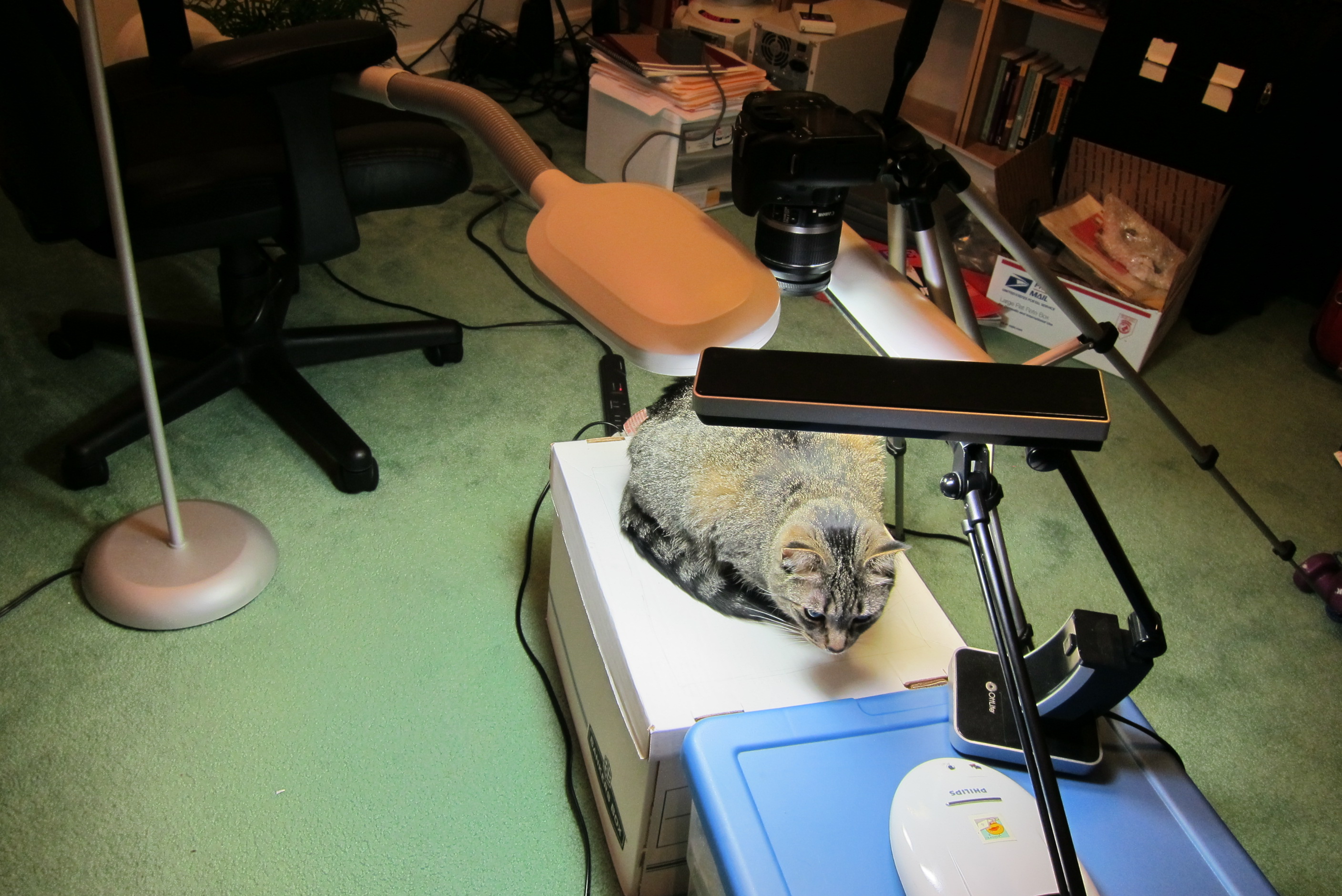
    IMG_0987
    Miao awaits digitization.
  • My Georgia Tech ENGL 1102 Class Description and Reading List for Spring 2012, “The Promise and Peril of the Digital Age Explored Through Science Fiction”

    Martin Widmer’s “Tomb [V’]” (2007).
    [UPDATE: I volunteered to teach three sections of ENGL1101 instead of three sections of ENGL1102 when the school made the request. This gives me an opportunity to immediately revise my ENGL1101 syllabus and try new things with my students!] In Spring 2013, I will be teaching three sections of ENGL 1102 (sections: P1, E, and M). For these sections, I will guide students toward completing and exceeding the desired educational outcomes with a class structured on the them, “The Promise and Peril of the Digital Age Explored Through Science Fiction.”

    Building on the rhetorical strategies and WOVEN modalities introduced in ENGL1101, this class further develops students’ communicative and critical thinking abilities by guiding students through challenging research-based projects. The research focus of this class is on the promise and peril of the contemporary digital age. Science fiction is a uniquely suited genre for considering the digital age, because it is the only literature that is firmly situated at the intersection of science, technology, and culture. Furthermore, science fiction is a literature about the present in which it is written rather than its imagined future. With this in mind, recent science fictions comment on our present and our near future in simultaneously promising and troubling ways. Drawing on science fiction across multiple media (including novels, films, and video games) and using newly acquired tools of critical theory from cultural studies and the study of science and technology, students will develop a number of research-based projects individually and collaboratively that explore how science fiction informs and critiques the on-going digital age. All of these projects will culminate in or include a digital component (e.g., blog posts, Twitter essays, Storify curations, online videos, and Omeka archives). Also, students will learn how to use digital humanities technologies to inform their thinking and research.

    Reading List:

    Oryx and Crake, Margaret Atwood, Anchor, 2004, 978-0385721677

    Ready Player One, Ernest Cline, Broadway, 2012, 978-0307887443

    Neuromancer, William Gibson, Ace, 2000, 978-0441007462

    River of Gods, Ian McDonald, Pyr, 2007, 978-1591025955

    Rainbows End, Vernor Vinge, Tor, 2007, 978-0812536362

    Online reading:

    Little Brother, Cory Doctorow [available here]

    Game List:

    CYPHER: Cyberpunk Text Adventure [available here]

    I am still developing the class syllabus and assignments. When these are completed, I will post copies in a subsequent post.

  • Rebecca Wilson Lundin’s “Teaching with Wikis: Toward a Networked Pedagogy”

    At tomorrow’s Blogging Brown Bag discussion organized by Kent State University’s Office of Digital Composition, we’re going to discuss Rebecca Wilson Lundin’s “Teaching with Wikis: Toward a Networked Pedagogy” from Computers and Composition 25 (2008) 432-448.  I thought I would post some of my thoughts here before our meeting in the Satterfield Reading Room tomorrow.

    Lundin’s article is a great introduction to educators about the potential and promise of using wikis in the composition classroom.  In fact, I was jazzed about one day using a wiki in my own classes in the future after reading her essay.  I may be somewhat biased in my eagerness to use wikis in the classroom, because I am a contributor to Wikipedia, and I know how to install MediaWiki on a Mac OS X box.  However, I think that Lundin makes some persuasive points about the power of wikis in the composition classroom, so let me go into some of those in more detail.

    She begins by talking about a networked pedagogy (I’m thinking Foucault’s biopolitics) comprised of “writing as a networked activity,” and “teaching as a networked activity” (432).  These ideas of shared, distributed, and interconnected means of learning and teaching should be facilitated by technologies that reinforce those network oriented goals, such as wikis.

    Wikis are excellent examples of a collaborative writing and composing technology that obviously engages network culture, come close to embodying the original vision of hypertext, and the unique features of wikis including editability and page histories reinforce compositional goals of revision and collaboration.

    Lundin’s essay emphasizes how wikis challenge assumptions about the traditional composition classroom (i.e., individual authorship, workshopping papers, teacher facilitated discussion, etc.).  She demonstrates that wikis challenge these assumptions in four key ways:  

    1) New media composition in a wiki requires little if any expertise beyond the use of a word processor and the open design of wikis promise to unbound student creativity and expression by embracing multimodality.  

    2) Collaborative writing made possible by wikis breaks down the single author paradigm by allowing all wiki participants to write, edit, and comment on any wiki pages including those of other students and those created by the teacher.  Furthermore, the transparency, as Carr et. al. describe it, of wikis through page histories facilitates reflection on the individual’s writing as well as the group collaborative process.

    3) Critical interaction by a real audience of a student’s peers along withfeedback from the teacher should enable a more authentic engagement of students’ work.  Instead of writing for the teacher, students will write for one another, and give criticism to one another.  I think that this aspect holds a lot of promise, but as Lundin admits this is one of the more difficult aspects to engage students with when she discusses her creation of a “class of lurkers” (441). Additionally, she notes problems with flame wars between students.  This part of her essay particularly intreged me, due to my own work on trolls and flame wars in academic discussion lists.

    4) Online authority, particularly on wikis, is decentralized and virtually anonymous.  Instead of merely subverting authority, Lundin makes a valid argument that instead authority in the traditional teacher-student sense is complicated by wiki work.  This could serve to undermine what power the teacher may hold over the classroom dialog and guiding of student work, but the very nature of wikis does empower all users, teacher and student alike, through page histories and what Will Richardson calls soft security, or participant policing of the wiki.  Additionally, student anonymity could help some students contribute in writing through the wiki when they are hesitant to contribute verbally in the classroom.

    Concluding, she indicates that wikis, through their social and networked interaction, promote student social context awareness, because despite the appearance of anonymity, they are engaging one another as social writers.

    I find Lundin’s essay compelling, and I plan on considering ways in which I can implement wikis in future classes.  I like how wikis will make writing regularly so much easier, and most wikis will pragmatically make teacher evaluation of writing easier by selecting to view all contributions by a particular writer/student. As Lundin noted, some teachers would be reticent to have a fully open wiki, and I would fall into this category as well for the simple fact that it might be better for all parties concerned not to allow for too much tomfoolery.  However, a little tomfoolery might be a good thing, and turn into a teachable moment.  I will have to think more on this point as I figure out how to design my class around a wiki/network paradigm.  Also, I am concerned about the flame war aspect of online communication for the composition classroom.  This will inevitably happen, and my primary concern is potential alienation of some students as a result of one or some students non-reflective acts.  Again, this is something that I will have to think further about.  

    If you are a teacher, I definitely recommend you find this article (details listed above), and read it–my notes do not do it justice!

  • ONTAP 5 Minute Teaching Session – Sci-Fi or SF?

    Today, I had to give a five minute lesson to my ONTAP group at Kent State University as part of graduate teaching assistant training.  We were asked to teach the class something that we were familiar with, it could be on any subject, and we could teach it anyway we wished.  I chose to teach everyone the distinction between sci-fi and SF.  I got some good comments from everyone in class, which ranged from “I watch a lot of Science Fiction movies, and now I have the language to talk to my friends about it more effectively,” to, “I didn’t really follow what you were saying.”  I tried to construct it to connect with everyone, but I guess Michael Berube was right and we’re “teaching to the six.”  Anyways, I’ve included my notes below (I would have included the video that they made, but it’s on VHS tape and I don’t have an easy way to convert it for posting on YouTube).  Enjoy!

    ONTAP 5 Minute Teaching Session

    Today let’s talk about Science Fiction, sci-fi, and SF.  Science Fiction, as the scholar Darko Suvin puts it, is the literature of “cognitive estrangement.”  What does that mean?  Science Fiction is estranging, that is it puts the reader in unfamiliar territory.  You might say that other literature such as the gothic or even postmodern literature does the same thing, and you’d be right.  However, what sets Science Fiction apart is the cognitive aspect of its estranging function.  The cognitive estranging aspect of Science Fiction is called the novum, which is the technological and scientific extrapolation from the here-and-now that is the kernel of the story, the techno-scientific kernel of the narrative that is essential to the story and sets it apart from mainstream or fantasy literature.  What are some novum examples?  One example of the novum might be robots.  Can you name some others?  Space ships, ray guns, aliens, and humans with a multiplicity of sexes rather than just male and female are a few other examples.

    Okay, so now you roughly know what Science Fiction is, however did you know that Science Fiction is a little more complicated than that?  You see, for much of the history of Science Fiction, beginning with its naming by the pulp magazine publisher, Hugo Gernsback, in 1929, academic and journalist elites have often sneered at Science Fiction as marginal, low, or pop culture.  These Science Fiction detractors pointed to the weakest stories and worst movies as examples of the supposed overall low quality of Science Fiction.  An early response to this problem was offered by the Science Fiction author Theordore Sturgeon in the 1950s when he stated that, “ninety percent of everything is crap.”  That observation is now known as Sturgeon’s Law and is available in the Oxford English Dictionary.  Sturgeon’s point is that there’s a lot of good Science Fiction, but there’s a lot more bad stuff that people point to when they talk about Science Fiction.  Also, the implication is that ninety percent of mainstream literature is also crap, and canonical literature such as Shakespeare’s Romeo and Juliet isn’t derided because of the multitude of trashy Romance novels.

    This state of affairs expanded with the widespread adoption of the truncated term, sci-fi.  Sci-fi became widely used to describe Science Fiction by journalists with an implied insult toward the genre as a whole. 

    In the 1970s, Science Fiction scholars and critics decided it was time to distinguish hackwork from the 10% of good stuff.   The new term for the best work, which often received the most critical attention, was simply SF.  SF works are those based on a novum and are as well or better written than its mainstream counterparts.  Sci-fi was used to label works with a much less extrapolated novum, and a very low level of quality in writing or production in the case of movies or television. 

    So, what are some examples of SF and sci-fi?  A recent example of SF film would be The Matrix.  It extrapolates from our world to create a reasonably plausible future based around computer simulation, autonomous robot beings, and a planet devastated by war.  An example of sci-fi would be George Lucas’ Star Wars movies.  Sure, there are space ships, ray guns, and aliens, but there’s also the Force, which is more fantasy than Science Fiction, and the laws of physics are violated egregiously in space such as having things slide off space ships in outer space as if it were an airplane in the Earth’s atmosphere.  What are some Science Fiction movies that you’ve seen, and what would you classify them as–sci-fi or SF?  Some other examples of sci-fi include Plan 9 From Outer Sapce, Back to the Future, Cloverfield, and Red Planet.  Other examples of SF include A.I. Artificial Intelligence, A Scanner Darkly, WALL-E, The Dark Knight, and Mission to Mars.

    Now you’re all initiate Science Fiction scholars who know the difference between SF and sci-fi!