Tag: PKD

  • Recovered Writing: Handwritten Notes from 1st International Philip K. Dick Conference Dortmund, Nov 15-18, 2012

    Conference group photo from PKD Dortmund Conference.
    Conference group photo from PKD Dortmund Conference.

    This is the thirty-first post in a series that I call, “Recovered Writing.” I am going through my personal archive of undergraduate and graduate school writing, recovering those essays I consider interesting but that I am unlikely to revise for traditional publication, and posting those essays as-is on my blog in the hope of engaging others with these ideas that played a formative role in my development as a scholar and teacher. Because this and the other essays in the Recovered Writing series are posted as-is and edited only for web-readability, I hope that readers will accept them for what they are–undergraduate and graduate school essays conveying varying degrees of argumentation, rigor, idea development, and research. Furthermore, I dislike the idea of these essays languishing in a digital tomb, so I offer them here to excite your curiosity and encourage your conversation.

    In this Recovered Writing post, I am bringing my analog writing into the digital realm of cyberspace by scanning the pages of my notebook from the First International Philip K. Dick Conference, Dortmund into a PDF. Instead of copy-and-pasting my writing as I have done on my previous Recovered Writing posts, this one has be downloaded as a PDF below.

    In addition to my record of all of the sessions and keynote speeches, you can observe my degrading handwriting (I’m so far removed from my days as a draftsman-in-training or as a high school student receiving commendations for his penmanship), trouble with spelling jargon and names, and rough sketches of Laurence Rickels’ theatrically performative keynote presentation.

    I was so busy during the last bit of 2012 and all of 2013 that I never returned to collect my thoughts from the Dortmund conference in a blog post. This wasn’t because I thought it wasn’t important. In fact, it was tremendously important and enlightening to me. In my 2012 retrospective post, I wrote, “November 15-18: I attended the first international Philip K. Dick conference at UT-Dortmund in Dortmund, Germany. I delivered a heavily revised version of my SFRA 2012 paper, “Philip K. Dick as Pioneer of the Brain Revolution.” The conference was a fantastic experience. I promise to write more about this in a separate post. In the meantime, you can see my pictures from Germany here.” Unfortunately, the demands of teaching, research, and job hunting took precedence over my desire to “write more about [the conference] in a separate post.” It will have to suffice for now to post these notes for any and all who have the time and ability to decipher my scribblings. If you are so inclined, good luck!

    You may download my notes from the First International Philip K. Dick Conference, Dortmund here: ellis-jason-pkd-dortmund-notes.pdf.

  • Reading List for PhD Minor Exam on the Works of Philip K. Dick

    In June 2010, I will take my three PhD exams in the Kent State University English Literature PhD program.  For these exams, I convened a committee of trusted professors, each administering one exam. I choose to take my exams in these areas: 20th Century American Literature (administered by Kevin Floyd), Postmodern Theory (administered by Tammy Clewell), and the Philip K. Dick Canon (administered by Donald “Mack” Hassler). Below, I have included my Philip K. Dick reading list. Go here to read my Postmodern Theory exam list, and here to read my 20th Century American Literature exam list.

    PhD Minor Area Exam:  Philip K. Dick’s Fiction and Non-Fiction, and Critical Works

    Director:  Donald “Mack” Hassler

    Novels by Philip K. Dick, organized by date of composition.

    1. Dick, Philip K. Gather Yourselves Together.  1950.  1994.
    2. —. Voices from the Street.  1952.  2007.
    3. —. Vulcan’s Hammer .  1953.  1960.
    4. —. Dr. Futurity.  1953.  1960.
    5. —. The Cosmic Puppets.  1953.  1957.
    6. —. Solar Lottery.  1954.  1955.
    7. —. Mary and the Giant.  1954.  1987.
    8. —. The World Jones Made.  1954.  1956.
    9. —. Eye in the Sky.  1955.  1957.
    10. —. The Man Who Japed.  1955.  1956.
    11. —. The Broken Bubble.  1956.  1988.
    12. —. Puttering About in a Small Land.  1957.  1985.
    13. —. Time Out of Joint.  1958.  1959.
    14. —. In Milton Lumky Territory.  1958.  1985.
    15. —. Confessions of a Crap Artist.  1959.  1975.
    16. —. The Man Whose Teeth Were All Exactly Alike.  1960.  1982.
    17. —. Humpty Dumpty in Oakland.  1960.  1986.
    18. —. The Man in the High Castle.  1961.  1962.
      2009/12/2
    19. —. We Can Build You.  1962.  1972.
    20. —. Martian Time-Slip.  1962.  1964.
    21. —. Dr. Bloodmoney, or How We Got Along After the Bomb.  1963.  1965.
    22. —. The Game-Players of Titan.  1963.  1963.
    23. —. The Simulacra. 1963.  1964.
    24. —. The Crack in Space.  1963.  1966.
    25. —. Now Wait for Last Year.  1963.  1966.
    26. —. Clans of the Alphane Moon.  1964.  1964.
    27. —. The Three Stigmata of Palmer Eldritch.  1964.  1965.
    28. —. The Zap Gun.  1964.  1967.
    29. —. The Penultimate Truth.  1964.  1964.
    30. —. Deus Irae.  1964.  1976.  (Collaboration with Roger Zelazny).
    31. —. The Unteleported Man.  1964.  1966.  (Republished as Lies, Inc. in 1984).
    32. —. The Ganymede Takeover.  1965.  1967.  (Collaboration with Ray Nelson).
    33. —. Counter-Clock World.  1965.  1967.
    34. —. Do Androids Dream of Electric Sheep? 1966.  1968.
    35. —. Nick and the Glimmung.  1966.  1988.
    36. —. Ubik.  1966.  1969.
    37. —. Galactic Pot-Healer.  1968.  1969.
    38. —. A Maze of Death.  1968.  1970.
    39. —. Our Friends from Frolix 8.  1969.  1970.
    40. —. Flow My Tears, The Policeman Said.  1970.  1974.
    41. —. A Scanner Darkly.  1973.  1977.
    42. —. Radio Free Albemuth.  1976.  1985.
    43. —. VALIS. 1978.  1981.
    44. —. The Divine Invasion.  1980.  1981.
    45. —. The Transmigration of Timothy Archer.  1981.  1982.

    Short Fiction by Philip K. Dick, needs elaboration by individual stories.

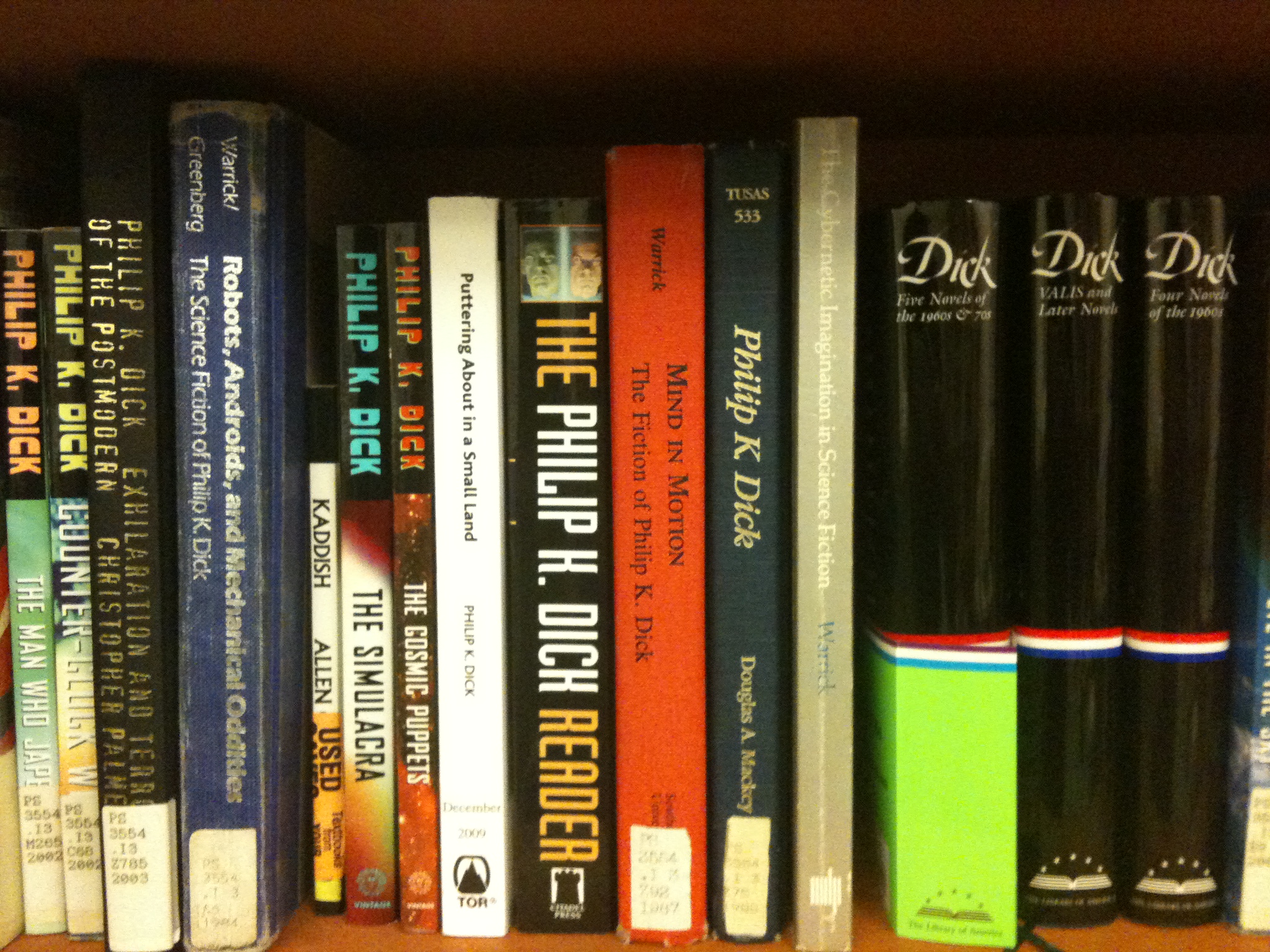
    1. The Philip K. Dick Reader.  1997.
    2. Robots, Androids, and Mechanical Oddities:  The Science Fiction of Philip K. Dick.  Eds. Patricia S. Warrick and Martin H. Greenberg.  1984.

    Selected Stories of Philip K. Dick.  2002.

    Non-Fiction by Philip K. Dick

    1. Dick, Philip K.  “The Android and the Human.” Vector:  Journal of the British Science Fiction Association 64 (March/April 1973):  5-20.
    2. —. The Dark Haired Girl.  1988.

    Critical Works

    1. Fitting, Peter.  “Ubik:  The Deconstruction of Bourgeois SF.” Science Fiction Studies 2:1 (1975).  19 October 2007 <http://www.depauw.edu/sfs/backissues/5/fitting5art.htm&gt;.
    2. Haney, William S. II. Culture and Consciousness:  Literature Regained.  Lewisburg:  Bucknell University Press, 2002.
    3. Kucukalic, Lejla. Philip K. Dick:  Canonical Writer of the Digital Age.  New York:  Routledge, 2009.
    4. Mackey, Douglas A. Philip K. Dick.  Boston:  Twayne Publishers, 1988.
    5. Palmer, Christopher. Philip K. Dick:  Exhilaration and Terror of the Postmodern.  Liverpool:  Liverpool UP, 2003.
    6. On Philip K. Dick:  40 Articles from Science-Fiction Studies.  <more information>.
    7. Sutin, Lawrence. Divine Invasions: A Life of Philip K. Dick.  New York:  Carroll & Graf, 2005.
    8. Suvin, Darko.  “P.K. Dick’s Opus:  Artifice as Refuge and World View.” Science Fiction Studies 2:22 (1975).  19 October 2007 <http://www.depauw.edu/sfs/backissues/5/suvin5art.htm&gt;.
    9. Vest, Jason P. The Postmodern Humanism of Philip K. Dick.  Lanham, MD:  Scarecrow Press, 2009.
    10. Warrick, Patricia S. The Cybernetic Imagination in Science Fiction. Cambridge: MIT Press, 1980.
    11. —.Mind in Motion:  The Fiction of Philip K. Dick.  Carbondale and Edwardsville:  Southern Illinois UP, 1987.
  • Stanislaw Lem’s “Philip K. Dick: A Visionary Among the Charlatans”

    In Science Fiction Studies #5 (1975), Stanislaw Lem wrote an article, translated from the Polish by Robert Abernathy, describing, analyzing, and challenging the work of Philip K. Dick (up to that point). Titled “Philip K. Dick: A Visionary Among the Charlatans,” it is a rich essay that has much to say about Dick’s work and the work of the critic.

    Lem says that Dick, like other science fiction authors, takes from the “warehouse which has long since become their common property,” or what Damien Broderick later theorized as the SF mega-text (57). One of the themes that Dick relies on is the catastrophe, but unlike most other science fiction authors, the catastrophes in Dick’s fiction occur for unascertainable reasons, i.e., the uncovered causes are deferred to the end. The common denominator in all of Dick’s fiction is a world beset by an unconstrained and monstrous entropy that devours matter and even time. Following his instincts, as Patricia Warrick would later say of Dick that he is understood intuitively, Lem says of Dick that he does not go in for rational explanations, but instead, confounds both the plot and the conventions of the science fiction genre itself. Of this, Lem demonstrates that genres have conventions, but those conventions were formed by previous breaking of convention to make the genre thus. Dick does this to science fiction, changing it to meet his own needs and creativity. Coupled with his genre breaking is the fact that Dick is a bricoleur, though this is not the word Lem uses, but it is very much what he is describing. Lem describes Dick’s work as something offered for sale at a “county fair,” having been made from a variety of concepts and ideas, but making the new creation solidly his own. Dick is not a futurologist, but rather representing the very idea of futureshock in his stories. Dick is not an extrapolator who changes one thing and leaves all the rest unscathed. He shows how civilization goes on, progress forward, but having been changed radically by the events presupposed in his stories. He acknowledges that history cannot be rewound. The fusion of the natural with the artificial, a point also raised by Warrick, Leo Marx, and Sharona Ben-Tov, means that there can be no more talk of a return to nature. In this, Dick does question progress, but not by chucking the concept. Instead, he complicates it, and again, confounds it. For Dick, our technological labyrinth prevents us from returning to nature–again, connections with Warrick, Marx, and Ben-Tov. Lem conjectures on this as something beyond the scope of Dick’s work, but nevertheless should be taken into account. He thinks about how the “irreversibility of history, leads Dick to the pessimistic conclusion that looking far into the future becomes such a fulfillment of dreams of power over matter as converts the ideal of progress into a monstrous caricature” (64). It is this carrying Dick’s ideas further in his criticism that Lem attempts to practice the very thing Dick practiced in his writing. And most importantly, in his short engagement of the novel Ubik, Lem, a good structuralist, avoids the author’s interpretation of the work, and instead considers how the thing ‘ubik’ and its combination of the old and philosophical with the modern and consumer culture resulted in such a powerful metaphor and not a futurological or technical artifact (66).

    Two other things that I would like to leave with you from this essay is Lem’s idea about the relationship of the critic to a work–as defender rather than prosecutor–a way that I have tried to work in my own scholarship and reviews: “I think, however, that the critic should not be the prosecutor of a book but its defender, though one not allowed to lie: he may only present the work in the most favorable light” (60).

    And I would like to quote at length, Lem’s concluding paragraph, in which he gives a honest, gracious, and thoughtful tribute to Dick’s writing. Lem says:

    The writings of Philip Dick have deserved a better fate than that to which they were destined by their birthplace. If they are neither of uniform quality nor fully realized, still it is only by brute force that they can be jammed into that pulp of materials, destitute of intellectual value and original structure, which makes up SF. Its fans are attracted by the worst in Dick–the typical dash of American SF, reaching to the stars, and the headlong pace of action moving from one surprise to the next–but they hold it against him that, instead of unraveling puzzles, he leaves the reader at the end on the battlefield, enveloped in the aura of a mystery as grotesque as it is strange. Yet his bizarre blendings of hallucinogenic and palingenetic techniques have not won him many admirers outside the ghetto walls, since there readers are repelled by the shoddiness of the props he has adopted from the inventory of SF. Indeed, these writings sometimes fumble their attempts; but I remain after all under their spell, as it often happens at the sight of a lone imagination’s efforts to cope with a shattering superabundance of opportunities–efforts in which even a partial defeat can resemble a victory (66-67).

    I am also under that spell and happily on the battlefield, a little the worse for wear, but with kit in hand. At least, I thought I was on a battlefield until I realized that I was sitting at a desk in front of a computer wildly typing away on this very blog. I suppose the battlefields, like ontologies, can change unexpectedly and for inexplicable reasons.

    Image of Lem at the top of the post is from the Wikimedia Commons, details here.
  • Mary Kay Bray’s Copy of Time Out of Joint

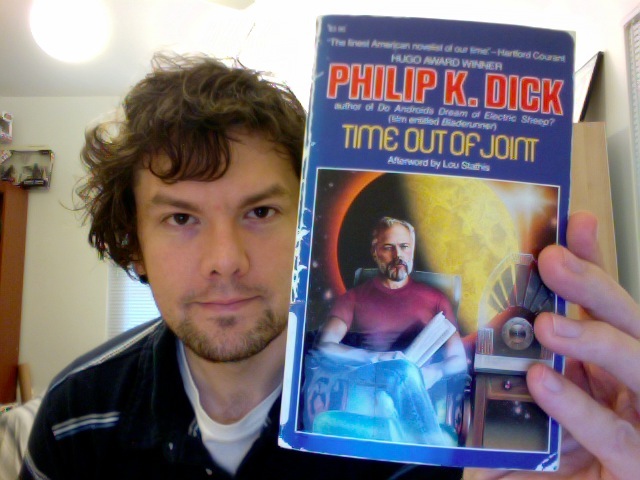
    I just cracked open the copy of Philip K. Dick’s Time Out of Joint that I requested via interlibrary loan for my PKD exam. I noticed that it arrived at the Kent State Library from the Watson Library at Wilmington College in Wilmington, OH, but I didn’t register where I had heard of Wilmington before. It has a colorful cover by Roy Colmer that portrays Phil Dick sitting with book in hand next to an old radio and eclipsing a distant planet in the background, but the real treasure was just inside the front cover:

    This copy of Time Out of Joint used to belong to Mary Kay Bray, the science fiction scholar who was active in the Science Fiction Research Association and whose name is honored with her memorializing SFRA award: the Mary Kay Bray Award for Best Feature, Essay, or Review in the SFRA Review. She taught at Wilmington College. After her death in 1999, her close friend Professor William L. Andrews of UNC, Chapel Hill funded this award in Bray’s name. I was honored with the 2007 award for two reviews I wrote: one on Heinlein’s Starship Troopers and one on Ian McDonald’s Brasyl. Since then, I have served on the awards committee two years. See the other award winners here.

    I was already looking forward to reading Time Out of Joint, but I am even more eager to do so now knowing that this particular copy of the novel belonged to a distinguished scholar and teacher with many friends in the SFRA. I only wish that I had had the chance to meet her in person. As it is, we are connected through time by science fiction.

  • Why Is the Digital Future Only Found in Books?

    Awhile back, Mack Hassler and I were talking about online personas and the differences between created personas in traditional print culture and the new electronic media.  Mack pointed out that the real interesting personae come through print culture and he named examples including Swift, Greg Egan, Philip K. Dick, and David Foster Wallace (think “Lyndon”)–all of whom employ internal controversies and different voices.  Philip K. Dick is an interesting example particularly if you consider his last published novel, The Transmigration of Timothy Archer (1982).  It strikes me how much his supposedly strong female protagonist, Angel Archer, is like the author.  After reading Sutin’s biography of Dick, Divine Invasions (2005), there are unmistakable parallels between Archer and Dick, and I draw the conclusion that Archer is a voice for the author–a persona of her creator–PKD.

    What does that have to do with the divide between print and computer media cultures?  There’s something to be said about the complexity and the richness of layers, all of which are probably tempered and strengthened by the publication process including acceptance and editing, present in print media–novels and short stories–that facilitates strong persona creation unequaled by electronic media as yet.  We all create online personae through email, social networking, or blogging (among other personal broadcast technologies). Those who interact with us electronically do so via cyberspace, that shared consensual hallucination, and we meet with only what we bring us–our words and stray bits of data including images, sounds, videos, and our reputation.  It is these things that others use to create an image or avatar of ourselves in their minds in order to make sense of our interactions–that’s just what our brains do with the available data at hand.  However, as Mack observed and I agree, the new media has permitted a proliferation of persona creation, but it is by-and-large thinned out in comparison to what we find in print media.

    This then leads to my personal conundrum.  Mack said to me, “You’re serious about print, but you’re not serious.”  I am heavily invested in computer technology.  I built a PC specifically for online gaming–not that my grad student responsibilities allow me any time for that–and I recently decided to invest in Apple due to the economic downturn, which netted me their latest and greatest machined aluminum MacBook with a solid-state hard drive.  Despite the hardware underpinnings of my digital life via email, Facebook, and my blog, I rarely read or encounter stories online.  Yes, I read a lot online, probably more than I should considering my other duties, but the one thing that I don’t read online are SF stories.  The stories, the SF, that creates, imagines, and interfaces with the future is largely nonexistent on the medium that those stories take as its object of interest.  If I want to read about cyberspace, I don’t look online, I turn to pulp, paper, and the book for that imaginative immersion.

    Where does that leave us in regard to the new media and books?  Considering my recent conversation with Stephen R. Donaldson, there is change in the wind, but obviously no one has the one answer to what that change may encompass.  I’m curious to hear the thoughts of Robert H. Jackson next Tuesday when he presents on the future of books at the Kent State Library.  I know he won’t have all (if any) the answers, but perhaps the face-to-face interaction will be illuminating in ways that online persona interaction is not.