Tag: Recovered Writing

  • Recovered Writing: PhD in English, Semeiotics Midterm and Final Exam Responses, Fall 2007

    This is the thirty-third post in a series that I call, “Recovered Writing.” I am going through my personal archive of undergraduate and graduate school writing, recovering those essays I consider interesting but that I am unlikely to revise for traditional publication, and posting those essays as-is on my blog in the hope of engaging others with these ideas that played a formative role in my development as a scholar and teacher. Because this and the other essays in the Recovered Writing series are posted as-is and edited only for web-readability, I hope that readers will accept them for what they are–undergraduate and graduate school essays conveying varying degrees of argumentation, rigor, idea development, and research. Furthermore, I dislike the idea of these essays languishing in a digital tomb, so I offer them here to excite your curiosity and encourage your conversation.

    At Kent State University, I am glad that I took Dr. Gene Pendleton’s Semeiotics seminar (ENG 75057). Dr. Pendleton is a formidable professor who consistently amazed me (and I believe the class as a whole) with the depth and breadth of his philosophical knowledge and the effortless way he would explain, chart, and diagram each semeiotic lecture. If Dr. Pendleton was a philosophical locomotive, we students were his freight cars. Each class would begin with a powerful lurch as he would begin lecture. It was in the morning and the material was difficult. He would start out in a low gear and drag us all along for the ride until the momentum of each of our lumbering weight added to his increasing momentum. Occasionally, we would encounter screetching brakes and perilous squeals on too sharp turns, but the train would make the next station safely with Dr. Pendleton’s locomotive in the lead. I admire his mastery of the material and ability to explain it in a number of ways until everyone has a modicum of understanding. Through my on-going development as a scholar and teacher, I hope to emulate those qualities he demonstrates in my own classes.

    This Recovered Writing post includes my midterm and final exam written responses on all matters semeiotic. Imagine them bleeding red and you’ll get an idea of what the marked versions resembled. Looking back at these documents remind me that it was all part of a greater process of personal and intellectual development.

    Jason W. Ellis

    Dr. Gene Pendleton

    Semeiotics

    October 18, 2007

    First Exam

    1.         Discuss the semiotic approach of Saussure by defining and integrating the following terms:  differential network; signifier/signified; arbitrary; diachronic/synchronic; langue/parole.  Why is Saussure’s notion of the sign considered binary?

    Saussure went off in his own direction in developing a theory of a system of signs.  The basis of his theory in studying language (langage) is that it is a differential network.  This means that language is based on a system of relationships like the relationships between places on a map.  Additionally, meaning is derived from the relationship between things, and no meaning is possible for something alone and unconnected to the overall network of relationships.  For Saussure, the relational system of signs states that meaning is derived from the relationships between other signs in the language.  This is in opposition to the substantive view of signs in that there is something stable about words pointing to one thing, and that words have meaning in their own right.  Essentially, this means that something about itself that gives meaning.  Saussure challenges this through proposing that signs are arbitrary in nature.  This means that there is nothing about a cow (i.e., the cowness) that means it should be and always called ‘cow.’  What about other languages?  What about multiple names pointing to the same thing?  These questions point to the arbitrariness of signs.  Returning to his concept of the differential network of signs, it’s important to note that differential means difference.  Therefore, Saussure says that language is learned through opposition.  This is the idea of binary opposition (e.g., dogs and non-dogs are binary opposites).  Binary opposition allows for multiple ways of dividing up the world around us, and the way in which we divide up the world is based on our language framework.  Unlike Peirce’s use of a triadic relationship of signs, Saussure develops a dyadic relationship of signs.  His notion of the sign is constructed from two parts:  the signifier and the signified.  These two elements are directly connected in the way that they can be analogous called two sides of a piece of paper and therefore, inseparable.  The signifier is the sign-vehicle.  This is the word, mark, or representation that points to the signified.  The signified is the concept or idea of the sound image.  Saussure develops this theory in order to study language.  However, instead of studying it diachronically or through time, he approaches the study of language synchronically or as a slice of time.  He brackets language in order to study its structures at a moment of time rather than as a historical development.  In his study of langage, he divides it into two elements that are interdependent:  langue and parole.  Langue is the abstract language system.  It’s a system of language, set of social conventions, and independent of parole but in a relationship with parole.  parole is the act of speaking.  It is the concrete instances of speech rather than the abstract structure of speech.  Parole depends on the individual will and it therefore, volunteeristic.  Connected to parole is the idea of conversational implicature.  This is the set of limitations and conversational directions that one should follow if you want to communication.  This comes from langue.  Additionally, we learn langue or socially inculcated rules when we are learning language.  Then, we perform those rules through parole.

    2.         Explain Austin’s theory of the speech-act.  Include a discussion of performatives in your response.  What is the descriptive fallacy?

    Austin’s theory of the speech-act is in opposition to the descriptive fallacy, which states that the primary reason for language is to describe the world.  He doesn’t believe this to be the primary purpose of language.  Instead, he says that there is an aspect of language that’s performative.  For example, if you say, “I promise,” you are performing an act to do what it is that you promised to do rather than merely describing something.  These performatives or illocutionary acts are doing two things:  saying something and performing the action.  It’s based on working out rather than truth or falsity.  Austin’s terms for this are:  a successfully completed or performed illocutionary act is considered happy or felicitious while an unsuccessfully compoleted or performed illocutionary act is unhappy or infelicitous.  Also, performatives depend on appropriate circumstances based on context and convention.  For example, you have to have done something wrong to actually apologize for it.  A locutionary act is a speect-act that is merely descriptive rather than performing an action via the speech-act itself.  In addition to locutionary and illocutionary acts there is a third:  perlocationary acts.  This is essentially the effects or results of the locutionary act.  This act stresses the effect on the hearer or receiver of the speech-act.

    3.         Why is Bakhtin considered a proponent of dialogism?  How is his view opposed to standard behavioristic accounts of communication?  What is polyphony?  Heteroglossia?  What are centripetal and centrifugal forces?  What is the significance of “carnival” in Bakhtin’s thought?

    Bakhtin developed his literary theory around the idea of dialogism, which is the idea that all language including works of literature are dialogic in nature.  This means that each utterance or work of literature is in dialog with that which has come before, and in expectation of things to be said in the future.  Furthermore, dialogism is founded on the ideas that meaning is interactive and significance is also interactive.  Dialogism is at the heart of the notions of text, self, and culture.  Therefore, language and culture are not created in vacuum, but in the continuous interchange or dialog between everyone.  It follows that no utterance is solely self-determined, and it’s an attack on monology, or one sided ‘conversations.”  Instead of the voice coming from top-down (e.g., Stalinism), all voices are intermingled and reliant upon one another for meaning.  Another way of looking at this, is that Bakhtin and his circle promoted a polysemic approach to signs through dialogism.  This means that certain signs have multiple meanings (e.g., run as a verb and a noun).  He developed the concept of polyphony in literature along with the idea of heteroglossia, which comes into play in his study of the modernist novel.  Heteroglossia is the presence of multiple voices in a given text.  An example of this would be Fyodor Dostoevsky’s The Brothers Karamazov.  The voices of the brothers operate in opposition to one another along lines of contra and pro, which results in dramatic tension and moves the narrative forward.  There are different voices including that of the author’s in a given text.  Heteroglossia can be said to be a model for the polyphony of voices in dialogic language and culture.

    Connected to the concepts of monophony and polyphony are the ideas of centripetal and centrifugal.  Centripetal means a pulling to center or pro-authoritarian ideas, and centrifugal means a pushing away from the center or anti-authoritarian ideas.  Bakhtin’s dialogism is clearly centrifugal, because it implies a breakdown of norms and a reversal of roles.  Role reversal is important to Bakhtin through the idea of carnival.  During carnival, as in Shakespeare’s Twelfth Night, roles are reversed.  Characters that emphasize this are the rogue, fool, and clown.  These characters each challenge authority and represent centrifugal ideas.  Carnival and subversive characters such as the clown attempt to subvert language through parody.  This subversion is a reorienting from within.  Reorienting from within the text takes place through deconstruction.  Essentially, something within the text itself must lend to its own deconstruction.  An example of this is Dostoevsky’s Notes from Underground.  The voice given to the main character seems like parody, but it turns the reader against the author’s intentions for the text.  Once an utterance or text is released into the world, it takes on a life of its own, and the author no longer has control over the interpretation or understood meaning by those reading the text.

    4.         Jakobson promotes a theory of semiotic significance involving selection and combination.  Relate these to the following:  paradigmatic/syntagmatic; metaphor/metonymy; equivalence.  How are these oppositions related to aphasiac disorders as noted by Jakobson?

    Jakobson applies Saussure’s theory of linguistics to a theory of poetics.  In doing so, he draws on Saussure’s use of Cartesian planes to illustrate his ideas of selection and combination as perpendicular concepts that result in language and culture.  The vertical axis involves concepts that are based on association by substitution and works by association of resemblance.  Therefore, paradigmatic and metaphor are mapped on this axis.  Paradigmatic elements involve the building blocks such as phonemes, words, and sentences.  These are the elements from which selection is made.  Metaphor illustrates the idea of substitution, because metaphor is the substitution of one thing for another.  For example, in the verse, “My love is like/a red, red rose,” the word ‘like’ facilitates the substitution of ‘red, red rose’ for ‘love.”  Conversely, syntagmatic and metonymy are plotted along the horitzontal axis.  These are side-by-side associations.  They are related as being part of something else, or in relation to something else.  They are linear in the sense that they are strung together.  Therefore, syntagmatic is the combination of the paradigmatic elements to form words, sentences, etc.  It is the syntactic structure and organization of separate elements to construct meaning through combination and selection.  For Jakobson, this polarity is the foundation of language.  With polarity comes the idea of equivalence.  Messages (i.e., utterances) are combinations made of selected parts, and the select appropriately, one needs a code.  A code acts as the determinant of what to select and how to combine the selections into something meaningful.  A broad example of code is the English language, and a narrow example of code is contract law.  Applied to poetics, equivalence is achieved through selection and combination.  For example, in describing the motion of a jet fighter, an equivalence can be made with birds:  The F-16 soars/screams/swoops/etc.  Furthermore, this opposition works in realms beyond language, and may apply to any symbolic process or any system of signs.  All of this is built on the combination of these two modes.

    Jakobson drew on his studies of aphasia to establish these as integral to speech operations and comprehension in humans.  Aphasia is the inability to produce or understand language due to injury sustained to the speech centers in the human brain.  The two types of aphasia that Jakobson was interested in were semantic disorders and syntactic disorders.  A semantic disorder is a vertical axis disorder and therefore, affects one’s ability to properly choose words.  For example, one may ask for a fork, but really want a knife.  They are associated together as silverware, but are not true substitutions.  Syntactic disorders involve the inability to combine words in the proper way.  For example, this disorder might be exhibited by someone who says, “My hovercraft is full of eels.”  Okay, so that’s actually an example of a semantic disorder.  A syntactic disorder example would be to say, “Run like to go for an I.”

    5.         Explain the Peircean notion of the tripartite nature of the sign.  What is the significance of icon, index and symbol in Peirce’s tenfold classification of signs?  What are the different types of interpretant?

    For Peirce, signs are composed of three elements.  The first is the sign/representamen/sign-vehicle (I’ll use the latter term).  The sign-vehicle is the mark or symbol that carries meaning for someone receiving the sign-vehicle.  The second is the interpretant, which is the effect of the sign-vehicle on one who receives and comprehends the sign-vehicle.  The third element of the tripartite nature of the sign is the object.  The object is the ‘thing’ about which the sign-vehicle represents.  This can be anything from a physical object such as a chair or a concept like ‘university.’

    The sign-vehicle relates to its object by means of three types of relationships.  The first is icon.  An iconic relationship is one of resemblance or shared qualities between the sign-vehicle and object.  An example of this would be a picture or photograph.  The second type of relationship is index.  An indexical relationship is a dyadic relationship based on causality or force.  This means that the relationship involves two things and the connection is causal or one-to-one.  For example, one thing, action, or force results in something else occurring (i.e., causality).  A concrete example of an indexical relationship is finding someone else’s footprints on a deserted island.  You know they aren’t your footprints, therefore they were made by someone else.  The symbol is the third type of relationship.  This involves conventional relationships, which is the basis for the way language is setup in such a way that ‘cow’ stands for the animal.  An example of this is the fish or ichthys symbol standing for alpha and omega, fisher of men, and Christ.

    Peirce developed three types of interpretant.  The first is the immediate interpretant, which is what is usually referred to as the sign’s meaning, and is always there embedded in the sign.  The second is the dynamical interpretant, which is the sign’s effect over time within the limits of one’s lifetime.  The third is the final interpretant.  This is an ideal, teleogical final goal/end/purpose of the sign.  Essentially, this is the actualized potential of the sign at the end of time.  The final interpretant is a scientific standpoint in the sense that this is actualized when all the data are in and the goal or end of the semeiotic process is realized.

    6.         What are some of the hallmarks of Russian Formalism?  Are there any similarities to Structuralism?  What is emphasis laid on the notion of ‘making strange?’

    Russian Formalism is a reaction to the symbolistic work generated in Russian during the early part of the twentieth-century.  Symbolism involves the atmospheric, moody, subjective, and emotional works from that time, and it is not a formal approach to analysis.  How should this work be evaluated?  Without Formalism, it’s criticism will be like the literature that’s being critiqued.  The Formalists (including Viktor Shklovsky, Boris Eichenbaum, and Roman Jakobson and the OPOJAZ in St. Petersburg and the Linguistic Circle in Moscow) set out to build a scientific approach to criticism.  This involves downplaying the content and deriving aesthetic significance from the form rather than the content.  Also, the text must be divorced from external contexts such as history, author, politics, etc.  For the Formalists, everything for analysis is on the page.  It becomes a verbal icon and the author loses any right to say what it means.  The internal (as in the text) is promoted and the external (everything outside the text) is disparaged.

    OPOJAZ (Society for the Study of Poetic Language) began with symbolism, but developed into a reaction against it.  Subjectivity and vague philosophy are discarded in an attempt to arrive at a scientific method for literary and art criticism.  This is a direct challenge to the earlier forces of symbolism and Romanticism, which promoted the doing away with rules and supporting the idea that the imagination was a cognitive enterprise where one could get in touch with truth with one’s unique genius.  The Formalists accept the autonomy of art (art and literature is divorced from externals), and the application of critique that looks at how it’s produced, not what it’s about.  In order to study literature, the first order of business was to define what is a work of art/literature.  This developed into a definition of literariness.  Literariness is not found in the author, but in the text itself, and the use of language must distinguish it from other uses of language.  Shklovsky said that literariness is determined by the text’s ability to “make strange.”  This means that the reader cannot simply look through it.  The language has to be made strange in such a way to make it opaque so that the reader has to pay attention to the words and not the underlying meaning or story. “Making strange” is the disturbance of the linguistic framework in order to change your worldview.  This is a reaction against language in the everyday sense, and it’s readily more apparent in poetry than in prose.  This concept goes hand in hand with modernism, which began in the late nineteenth-century.  During that literary era, literature becomes more self-referential.

    Shklovsky’s poetics of fiction shares some similarities with Saussure and Structuralism, but his work wasn’t directly influenced by Saussure.  Shklovsky plots the poem onto the paradigmatic and the novel to syntagmatic, because the passage of time is the central concern of the novel.  Furthermore, Shklovsky separates the prose-plot from the prose-storyHe says that the plot is made strange.  There is something about the plot that distinguishes it from a progression of events (i.e., there are no heroes in a mere history–study happens).  The defamiliarization of events destabilizes the syntagmatic quality of novels and gives the text meaning beyond the story.  For this analysis, he draws on Laurence Sterne’s Tristram Shandy, which is often pointed to as originating many modern narrative techniques such self-reflexivity and intertextuality.

    ——————-

    Jason W. Ellis

    Dr. Gene Pendleton

    Semeiotics

    December 6, 2007

    Final Exam

    1.         Discuss Lacan’s notion of the “mirror stage.”  Relate it to the notion of the unified self as an ideal.  Distinguish the imaginary order from the symbolic.  Why does Lacan claim that the unconscious is structured like a language?  Include a discussion of metaphor and metonymy in your response.

    Lacan’s concept of the mirror stage, or imaginary stage (meaning image, not imagination) is a developmental stage that takes place between six to eighteen months, and it’s dominated by the image.  What that means is that during that period, the child first sees itself in the mirror.  This does not mean that the child recognizes itself in the image reflected by the surface of the mirror, rather that it raises in the child an awareness of the other, something outside of itself.  The child seeing the reflection derives a certain joy from the event.  More importantly, seeing itself in the mirror anticipates the child as autonomous and in control of its actions and behavior.  The image provides the child a reflection of an integrated whole, which contrasts with the baby’s spastic behavior resulting from a lack of coordination and a fragmentation of functions.  Essentially, the child regards its body, as best a baby can, as bits and pieces rather than an interconnected whole.  Furthermore, the baby can’t distinguish or separate itself from the world.  There is no sense of other prior to the mirror stage.  The baby’s image in the mirror is an idealized, unified self.  The child’s identification with images during this stage seems to be an ideal on our part.  Another term for this is imaginary mastery, or mastery of the image.  Imaginary mastery leads to biological mastery through development, but any future relationship with the real world will have to take in account imaginary mastery.  We are fundamentally an alien nation at the root of our self.  There’s a gap that can’t be breached, and we can’t ever be fully integrated.  We project a self that is integrated, but it’s ideal that we cannot attain.  This leads to an illusion of autonomy, or control over ourselves through rationality rather than giving into desires.  We are a fragmented self, but we believe ourselves to be integrated.

    The sense of self comes from identifying with images of others.  During the mirror stage, we identify with the nurturer/entity taking care of us.  We aren’t doing anything for it, but it is doing things for us (e.g., feeding, cleaning, caring for, etc.).  This leads us to desire things, because others (e.g., the nurturer) desire them (e.g., apparently, us).  Thus, we, as babies, are wrapped up in that other person’s desires, and we want to be the object of that person’s desires.  This leads to a de-centering of desire.  This means that our biological needs are projected on others that we want to want us rather on ourselves.

    Following the mirror stage is the Oedipal stage.  Lacan replaces Freud’s penis with the idea of the phallus.  The phallus is the symbol of the object of the mother’s desire.  The child will want to be the object of the mother’s desire.  Consequently, the desire of the nurturer is integral to all this for Lacan.  The sexual is downplayed in this dynamic, and it’s true for boys as well as girls.  During the early years of development, the child figures out what the mother wants in order to become the phallus object.  However, along comes the father and he brings in the symbolic order through law via language.  This socialization on the part of the father for the child is accomplished through language.  Furthermore, language was there before the child exists, and it represents the other.  The father thwarts the child’s Oedipal aspirations to be the object of the mother’s desire by the introduction of language in the years 5-6.  The child must be dominated by language (i.e., law), and the male/father represents this for the child.  Once the child recognizes that it can’t be the every desire of the mother, and accepts the father and the father’s law, then the child achieves an acceptance of castration and no longer wants to be the object of the mother’s desire.

    Lacan argues that the unconscious is structured like a language, because it operates on selection and combination, condensation and displacement, and it comes into being in relation to language.  In his analysis of signs, he found that slippages occur between the signified and the signifier whereby the signifier takes on greater significance than the signified (e.g., the urinary separation of men’s/women’s bathrooms–the sign on the door–signifier–takes on greater meaning than the door–signified).  In psychoanalysis, meanings are to be found between signifiers (i.e., the concept lies between the gaps of signifiers).  In this sense, metonymy is a relationship that’s associative, not metaphorical, a chain.  For example, the baby takes the place of the phallus for the mother.  Metaphor is condensation or substitution of one thing for another.  Lacan saw the disruptions or gaps as what we really are.  As a psychoanalyst, you look for pauses (gaps), and at the metaphors in what people say and follow the chain (metonymy) of signifiers back to the suppressed desire or instinct.  Therefore, unlike the Freudian unconscious that’s there from the beginning, the Lacanian unconscious is produced by language, thus it’s structured like a language.


    2.         Explain Barthes’s employment of the notion of connotation.  How is it reflected in his distinguishing of levels of signs?  Use the example of the soldier saluting the French flag in your discussion.  How does Barthes make use of the fashion industry to explicate his structuralist approach to semiotics?

    Barthes borrows concepts from Hjelmslev to arrive at his own notion of connotation.  The idea comes from metalanguage and object languages.  You use one language to talk about another language.  This involves two elements:  expression and content.  Expression is the thing said, and the content is the meaning behind the expression.  For Hjelmslev, signs exist at the intersection of the expression plane and the content plane.  Connotation is seeing the expression plane as a language in itself.  The connotator is one element of the expression plane seen as itself.

    What he develops is a second order signifier system.  This means that it takes one system to say something about the other.  In his formulation the first order system is the denotative.  This is the actual image taken as an image without reading anything into it imaginatively, ideologically, or otherwise.  The second order system is the connotative.  This is the meaning behind the image.  On the connotative level, the image must be read in a certain way, or the image promotes a particular reading for a particular group of people.  For example, in the example of the photo of the black French soldier saluting.  On the denotative level, the photo is simply that:  a photo a black French soldier saluting.  However, on the connotative level, there are additional meanings that are meant to promote ideology and myth.  Signification in Barthes system is a little complicated, but decipherable.  On the denotative level, the denotative sign is made of a signifier/signified.  The signifier is the picture, and the signified is the thing that the picture is of.  On the connotative level, the denotative sign is the signifier, and the signified are the values, ideology, myth, etc. that try to persuade people that the ideological aspect is natural in the denotative sign.  Thus, the dominative elite promotes their ideology through seemingly “natural” images.  In this example, the photo implies allegiance by France’s colonized subjects, and it promotes French imperialism as good, because it produces loyal colonized subjects.

    The dominant bourgeois ideology is promoted through the second order system of connotation.  Through images, people consume myths as factual and not merely semeiological.  However, it should be noted that not all of this is intentional or propaganda.  Other things contribute to connotative messages associated with images that may not be the intent of the producer.

    Producers of these images need people to get it and comprehend it.  To make sure that they do, they employ images and words.  Barthes uses the fashion industry as an example of this.  In fashion magazines, there are many images of the fashions, but there are also brand names, brand logos, or brand symbols in the image or on the clothing advertised.  These images can be read with semeiology, which is a meta-language, a language for talking about other languages.  It’s metalinguistic to say these pictures are content that I’m talking about on the denotative and connotative levels of the second order signifier system.  However, Barthes goes beyond this by showing that metalanguage itself can be employed in higher levels.  For example, a third level might be to look at the rhetoric involved in the image and words.  This means, talking about them as an expression of rhetoric.  In this way, the picture can be semeiologically studied in a variety of ways.  You can look at the rhetoric involved and question its persuasive qualities.  The image means something, which would pertain to ideology.  Then you can turn to the object, the signified, and say something about it and what is being expressed and how.  A semeiologist may expand or contract these levels of analysis.

    Barthes takes his analysis of fashion to explicate his structuralist approach to semeiotics.  Before, commutation of phonemes or the changing of sounds in words was used to reveal significance.  If making a substitution changed the meaning of the word, then it was significant.  If not, there is no significance.  Barthes extends this to patterns and colors in clothing.  He substituted different patterns or color schemes to determine significance.  Thus, he applies structural linguistics to non-linguistic things like fashion and arrives at a vestimentary code or a code of vestments (clothing).  In this elaboration by Barthes, the denotative is “are you in fashion or not?”  The connotative is something else:  myth on social effects and myths associated with fashion are systems of connotation.  This also includes rhetorical and persuasive connotations.  However, Barthes is accused of logocentrism (the word is central/dominant), because he emphasizes written fashion and commentary on fashion.


    3.         Distinguish between Kristeva’s notions of the semiotic and the symbolic.  In what sense is this distinction employed to place aspects of the biological in the symbolic order?  How do the ideas of the chora and the chorion function in the previously mentioned distinction?  In what sense is Kristeva in line with other postmodernists in promoting a denial of the Cartesian ego/self?

    Kristeva wants to distinguish between the semeiotic and the symbolic.  She does this through looking at poetry.  She believes that the body leaves an imprint on the work through sensation.  The body impacts language.  One must read off this bodily impact in language, read off the physical influence.  She finds there’s a particular dynamism to the bodily impact on language.  Language is supposed to be dynamic, but what allows it to renew itself?  Clearly, creativity is at the root of cultural change.  Creativity causes language and culture to have that dynamic.  However, she doesn’t agree with Lacan’s notion of the symbolic (i.e., “name of the father” ushers us into language, child made aware of its non-omnipotence through the symbolic order, the symbolic order and language create the unconscious).  She argues for a pre-verbal semeiotic stage.  She draws on avant-garde poetic language to show that you find the imprint of the preverbal semeiotic stage embedded in it.  The preverbal semeiotic stage takes place in the child’s infancy, prior to the inculcation of language–before the father stands between the mother and child.  How does this pre-oedipal stage occur?  There must be energy and drives identified with the id.  Considering avant-garde poetry, it demonstrates a turning your back on traditional poetic form.  If you look at the semeiotic, it’s made apparent through subversion of traditional way doing things.  There must be a source of energy to bring this about.  Thus, creativity is a new way of looking at things, a subversion of the old.  This is an almost physical influence on language.  The body, through the preverbal semeiotic stage, leaves an imprint on language in this way.

    Kristeva doesn’t contradict Lacan in regard to the preverbal semeiotic stage, but she de-emphasizes the symbolic.  You have to get back to the body in order to locate the bodily origins of the subject.  The root of this lies in the memory traces, mnemonic traces, or corporeal memory of the symbolic separation of mother and child and the immediacy between mother and child.  Corporeal memory went on before the symbolic mediation.  The semeiotic for Kristeva is the memory before the symbolic erupts into language, and it’s remembered through the poet’s use of creative language.  This only applies to poetry that’s considered subversive, such as T.S. Eliot’s The Waste Land.

    Kristeva takes the terms chora and the chorion from Plato’s Timaeus, which is a cosmology or story about how the world was made and its large-scale structure.  Plato distinguishes between what we call Platonic forms or ideals (abstractions), which represent stability, permanence, triangleness, and the real world (concrete), which is corporeal, spatial, and includes individuals.  In the story, the Demiurge uses the Platonic forms to enforce form on chaos.  This allows an agent to come up to the chaos to impose form on the chaos.  For Plato, the chora is the space in which these forms are imposed on chaos to form things.  For Kristeva, she’s also looking at biology where the chora is both the image and technical term from embryology that is the bodily site of the fetus.  Whereas for Plato, the chora is the receptacle, a nurse, almost a mother.  It’s the receptacle of becoming.  It should be noted that being is the Platonic forms, and becoming is the concrete and individuals.  Returning to Kristeva, the fetus signals the mother through a sort of semeiotic process.  The chorion, or the membrane enclosing the fetus in the womb is a symbolic form where the fetus ends and the mother begins.  However, there’s more going on that simply separation.  Kristeva recognizes that something is going on in respect to language.  In this sense, the concrete is couched in terms of bones, hormones, etc., and the symbolic is mothering and separation.  Furthermore, when a woman becomes pregnant, her body is prevented from menstruating after receiving hormone signals.  Somehow the embryo signals the mother to stop menstruating or it will die.  Thus, the chorion defines the semeiotic space of the other, because it separates fetus and mother, and it allows communication/signaling.  Also, it’s important to remember that a linguistic sign is used in the absence of the object.  In this case, the object is there, but it’s still the other.  There is no distinction between reality and the other.  Through this, the mother’s body becomes a semeiotized body.  The mother’s body acts as the means of mediation between the fetus and the semeiotic order.  The fetus has no control over what’s happening, but it can signal, but that’s all.  Activity, developments, and acting on the fetus are negativity.  The fetus is being generated, but negated (i.e., other things acting on me).  Additionally, the chora is the space where the speaking subject is being formed, and that is a theoretical space as well as a real space.

    Kristeva takes an anti-reductionist approach to the ego.  Looking back to Edmund Husserl, there’s an opposition between the natural standpoint (e.g., there’s a tree) and the world as perceived or imagined (e.g., the tree presented to consciousness).  The way the world is presented to consciousness means that you have to bracket the natural standpoint.  Everything about the real world is mediated through consciousness.  Thus, you posit the tree in your mind, but in what sense?  Essentially, you’re saying, “I’m committed to the tree in a certain way.”  Kristeva then takes the idea of the thetic from Husserl.  If you posit something, it has being in its own right.  The thetic for Kristeva requires a break in the signifying process.  You make it part of your awareness–that thing is something that I consciously think of and recognize as independent of myself.  You have to adopt an attitude toward something.  The pre-sentience uttering of children is already thetic.  When a child sees and animal and says, “woof woof,” the child recognizes the dog, cat, etc. as being something separate from itself.  Attribution is going on even at this elementary level.  Whereas we can say, “I’m grouping these together under a common rubric,” a child can’t, but they do it nonetheless with metonymy.  Association, shared qualities, or attributes are all primal associations made on the part of the child.  This isn’t yet the symbolic stage, so the child is drawing on the semeiotic unconscious to lump things together metonymically.

    4.         What does Derrida mean by “deconstruction”?  Why does he attack what he considers to be the “metaphysics of presence”?  What is his notion of the logic of the supplement?  How is it employed in his deconstruction of Austin’s approach to speech acts?  Why does he object to Saussure’s phonocentric structuralism?

    Derrida, drawing on Hegel’s idea of overcoming differentiation through a method of synthesis, plays with the idea of overcoming differentiation.  In Western thought, there’s generally a hierarchy where some things are favored over others.  Derrida shows that these hierarchies can be broken down, that every hierarchy can be inverted.  He does this by showing how one thing is no better than another, not that you can replace one thing with another.  This is the basic idea behind Derridian deconstruction.

    The fundamental hierarchy in Western thought is presence (dominance)/absence (derivative).  For Derrida, one can show absence as fundamental and presence as derivative.  This comes from the orthodox logic of the primary/origins and derivative/supplementary.  There are things that seem necessary, and those that don’t.  For example, ornament is something we think of as supplementary.  Derrida picks on the derivative/supplementary.  He picks on the throw away remark, the footnote to show that what’s going on isn’t what’s really going on.  He shows that what’s supplementary can dominate what came first.  He attacks the logic of the supplement.

    Derrida is influenced by Nietzsche’s genealogy of morals.  Nietzsche argued that morality came about for humans through an extended process of breeding that resulted with an animal (human) with the right to make promises.  What this means is that over time humans develop a conscience by sharing a remembered past of pain and torture that resulted from doing what they wanted and not keeping promises (Nietzsche believed in acquired/inherited traits–definitely not a Darwinian).  Eventually a human animal is produced that has a conscience and feels bad when it doesn’t keep a promise.  This produced humans that are predictable, and morality gives us something beautiful:  civilization.  The way Derrida is influenced by this is that you can’t assume the origins are primary with respect to hierarchies.

    Derrida attacks the hierarchy of metaphysics of presence and absence.  The metaphysics of presence has to do with speech, which is considered primary to much of linguistic semeiotics, and absence or writing is considered derivative.  The idea of supremacy of the metaphysics of presence has to do with the fact that if someone’s speaking, they are present with the listener.  The speaker can be questioned, and asked to make things clear about what’s been said.  Absence or writing comes after speech, and is disjointed from the author.  Once something is written down, it’s divorced from the author, and the reader may misunderstand or misinterpret the intentions of the author.  Therefore, it’s considered supplementary or derivative to speech, because it follows speech in development and it’s open to misunderstanding.  However, Derrida shows that speech is just as prone as writing to misunderstanding or misinterpretation.  Whatever someone says, we each have a particular framework in which we take what’s been said and that may color or effect the way we understand what someone else says (e.g., two people on a news program arguing past one another, because they can’t understand the other person’s viewpoint no matter how much is said to clarify each position, or a boyfriend saying something meant as a compliment to a girlfriend, but the girlfriend interprets that as an insult).  The assumption is that speech is clear or can be clarified, but that’s not the case.  When you say something, you’re sending out this idea in your head through language.  However, Derrida doesn’t go along with the Cartesian ego and the immediate relation with yourself.  There can’t be an immediate relation with the self, because there are always mediators (e.g., language).  For Derrida, you don’t know what you mean until you say it.

    Derrida believes in a free play of signifiers.  Signifiers are not fixed to specific signifieds, but to various signifieds (think:  Pierce’s interpretants).  You never get to the outside–there’s always another signifier.  This results in a constant deferral of meaning (i.e., to put off meaning for ever through an infinite chain of signifiers).  You can’t pin meaning down even though we’re dominated by the metaphysics of presence.  Writing can discover meaning of words after the act of writing, but there’s no transcendent signified.  There’s nothing outside language that can give it meaning.

    Derrida approaches the breaking down of hierarchies through binary oppositions.  This draws on binary logic (i.e., true or false, no other options, but we do think outside this).  Within the binary opposite, the hierarchy can be inverted.  The habituation that engenders in us the acceptance of a particular hierarchy can be overcome by imaging something constantly deceiving us.  If we actively think about this over a given amount of time, we can overcome these hierarchies.  Through this, we can overcome the culturally created hierarchies we’ve been led to believe as natural and not constructions.

    Derrida shows how hierarchies aren’t necessary by inverting binary opposites, and one case in which he does this is with J. L. Austin’s approach to speech acts.  Austin talks about performatives being the basis of language by developing the idea of the descriptive fallacy (i.e., language’s primary purpose is to describe the world and everything else is derivative).  Derrida attacks Austin’s own attack on hierarchies by showing that Austin is creating a new hierarchy.  He sites the example of signatures.  These are a kind of performative in that your signature is a performance, an acceptance of something.  However, these are felicitous, because a child can’t sign a contract.  Austin submits to the hierarchy that he’s attacking.

    Derrida objects to Saussure’s phonocentric structuralism, because phonocentrism privileges speech over other communication (another hierarchy).  Writing and speaking is emblematic of absence (sounds bad) and presence (sound good).  Derrida introduces a new concept to writing whereas the old concept was opposed to speech (i.e., you can’t write temporally and it represents absence).  This is called gram or différance.  Self-references aren’t possible.  In itself, it has no significance, its significant in relation to other things.  When something is put down in writing, it carries with it a trace of other things.  This trace contains the elements of a chain or system–all elements of the language.  The text carries the whole structure of the system.  None of them are either completely absent or present.  The gram is the most general concept of semiotics for Derrida.  It is the play of differences.  The play of differences is dynamic and ever changing.  It’s not in a static system as it was for the structuralists.  Poststructuralists object to the static dimension of structuralism.  So for Derrida and the poststructuralists, the signified and signifier are constantly slipping past one another, and there’s nothing outside language producing this slippage, which stands against the Cartesian ego and the idea of the fountainhead.  The effect of différance is that the psyche is the result, but not the cause.  We are what we are within a network and the past is present through absence.  Drawing on Heidegger, we are a projection into the future, with no terminus of meaning in sight.

    5.         What does Eco mean by a code?  What types of codes were emphasized in lecture?  How does the “watergate” example show Eco’s concern with the distinction between mere communication and signification early in his career?  Why is this distinction grounds for considering him a humanist?

    For Eco, a code is used for communicational purposes.  It can be true of false, and it can encompass different kinds of communication including language.  In class, there were three types of codes emphasized.  They are digital code, analog code, and processual code.  Digital code is based on absolute difference with no overland (e.g., it’s either a 1 or a 0).  Analog code is organic and is based on gradual approximation (e.g., color or early analog computers used for making comparisons based on sound waves or electrical impedance).  Processural codes are rules that structure relationships.  This includes discursive relationships (if and then) and correlational relationships (if and only if).

    In addition to codes there are s-codes, or institutional codes.  An s-code is a system with a structuring syntax.  One example would be numbers, because s-codes are either right or wrong.  You can’t lie with them.  When one goes to a code, then you can find true/false statements.  Furthermore, if the capacity for deception is there, we have moved beyond the s-code into a code such as language.

    Eco’s “Watergate Model” reveals a distinction between signification and communication.  In the example, an engineer downstream from a watershed between two mountains has an apparatus in place that alerts him when the watershed reaches a particular point of saturation, which is called the “danger level.”  Different kinds of information can be communicated to the engineer through this system such as how much water is above or below the danger level, what is the rate of change, and of course, is the water level greater or less than the danger level.  The apparatus is a buoy connected to a transmitter that sends a signal through a wire or channel downstream to the engineer’s receiver.  The signal received is translated through the receiver to indicate the information described above.  The problem with the system is that the channel is receptive to noise, which may result in incorrect messages from the receiver.  Therefore, the system should be complicated such that the signal sent is a more complex code that supplies redundancy essentially for error correction purposes and to obviate the influence of noise in the channel.  Now, the engineer in this system matters.  There are four things he’s considering under the code this system is based on.  Those are:  1) signals carried through the channel, 2) his/her own ideas about how to act/appropriate action based on the information presented by the receiver, 3) possible behavioral responses on the part of the engineer, and 4) a rule connecting elements from the three previous aspects of this system.  Eco considers the first three aspects of this system as s-codes, which are systems or structures that operate independently of the overall system.  The fourth aspect, or rule aspect, is a code, because of its correlative function to unify the three different aspects of the system.  The engineer brings about the correlation of the first three aspects into the code.  This example illustrates how Eco may be considered a humanist, because he shows how the engineer, the human element is necessary to turn communication into signification.  The code aspect of the system came about through the engineer’s presence, thought, and action.  The code is a semeiotic system, and that’s present only through the conditional placement of the rational human agent.
     

  • Recovered Writing: PhD in English, African-American Literature Theme Analyses of The Black Atlantic, Cosmopolitanism, and Olaudah Equiano (and Others), Spring 2009

    This is the thirty-second post in a series that I call, “Recovered Writing.” I am going through my personal archive of undergraduate and graduate school writing, recovering those essays I consider interesting but that I am unlikely to revise for traditional publication, and posting those essays as-is on my blog in the hope of engaging others with these ideas that played a formative role in my development as a scholar and teacher. Because this and the other essays in the Recovered Writing series are posted as-is and edited only for web-readability, I hope that readers will accept them for what they are–undergraduate and graduate school essays conveying varying degrees of argumentation, rigor, idea development, and research. Furthermore, I dislike the idea of these essays languishing in a digital tomb, so I offer them here to excite your curiosity and encourage your conversation.

    Dr. Babacar M’Baye is one of the most generous professors at Kent State University that I had the pleasure to learn from and work with. In the spring of 2009, I took his 76104 African-American Literature seminar. On the first day, we discussed the overview of the course and its assignments including the first of the five theme analyses included below. Based on my reading and thinking about the topics of this first analysis on Paul Gilroy’s The Black Atlantic and Olaudah Equiano’s autobiography, I asked Dr. M’Baye if I could meet with him after class to discuss an idea for my final paper. He enthusiastically agreed, and we ended up talking for several hours that afternoon. When I thought that I was taking up too much of his time and tried to disenage, Dr. M’Baye offered up another idea, thread, or proposal that kept the conversation rolling solidly forward. The fruits of that and other conversations led to an early form of my essay, “Engineering a Cosmopolitan Future: Race, Nation, and World of Warcraft,” which was included in The Postnational Fantasy, my co-edited book with Masood Raja and Swaralipi Nandi. The seed of an idea contained in this theme analysis led to my larger work and a greater opportunity to work with my friends and colleagues. I have Dr. M’Baye to thank for that.

    To help us focus our thinking and encourage seminar discussion, Dr. M’Baye gave us the opportunity to write five brief analyses during the semester. We had the freedom to explore these based on our scholarly interests and research. The first analysis is on “The Black Atlantic, Cosmopolitanism, and Olaudah Equiano,” the second is on “Becoming Free in the Stories of Olaudah Equiano and Mary Prince,” the third is on “W.E.B. Du Bois, Carol Swain, and African-American Duality” (something I wrote on tangentially before here and here), the fourth is on “Sociology of Master and Slave Relationships,” and finally, the fifth is on “African-American Writing, the Tabula Rasa, and Inverting the Hierarchy.” Due to their brevity, I believe that much more could be said on each topic. In retrospect, I would reconsider how to approach and explain some of my arguments. As with the previous Recovered Writing posts, these are presented as-is.

    Jason W. Ellis

    Thematic Analysis 1–The Black Atlantic, Cosmopolitanism, and Olaudah Equiano

    Paul Gilroy argues in The Black Atlantic: Modernity and Double Consciousness (1993) that:

    The specificity of the modern political and cultural formation I want to call the black Atlantic can be defined, on one level, through this desire to transcend both the structures of the nation state and the constraints of ethnicity and national particularity. These desires are relevant to understanding political organising [sic] and cultural criticism. They have always sat uneasily alongside the strategic choices forced on black movements and individuals embedded in national political cultures and nation states in America, the Caribbean, and Europe. (19)

    His theory of the black Atlantic breaks down the traditional historical barriers raised to encapsulate national and geographic narratives. Instead, Gilroy qualifies his theory as, harkening back to Deleuze and Guattari, “the rhizomorphic, fractal structure of the transcultural, international formation I call the black Atlantic” (4). The black Atlantic is the cross-pollination, transplantation, and circulation of language and culture that ignores historic and legal ideas of national and ethnic boundaries. It is a hybridization of cultures and languages that was a part of the cybernetic feedback loop of modernity. The black Atlantic formed and was formed by modernity–they are inextricably linked through, using Gilroy’s image, “the ship,” which “immediately [focuses] attention on the middle passage, on the various projects for redemptive return to an African homeland, on the circulation of ideas and activists as well as the movement of key cultural and political artifacts: tracts, books, gramophone records, and choirs” (4). It is the movement of people and ideas that lends Gilroy’s theory to a cosmopolitan reading in all of the disputed meanings of that word–morally, economically, culturally, and politically. Without naming it as such, Gilroy’s theory is cosmopolitan in nature, because it is based on a transcendence of boundaries and a sharing of ideas conveyed by individuals and their creative works.

    Olaudah Equiano represents a cosmopolitan figure within Gilroy’s black Atlantic theoretical framework via his autobiography, The Life of Olaudah Equiano (1789). Equiano, a trained and well-regarded seaman, traveled the world aboard ships as a slave and later an emancipated freeman. On one level, the black Atlantic, as a network of relationships and movement of people and ideas, made Equiano a hybrid in part of African descent with a particular ethnic and cultural past. Also, there are significant moments of signifyin’ in his autobiography evidenced by his veiled sarcasms and dealing with the white hegemonic world in the eighteenth century. Another part of his hybrid identity is his Englishness. He understands how to use the English language as a tool, and he recognizes English ways aboard ship and in personal relationships. Furthermore, the isolated world of the ship presents another set of codes that Equiano mastered in order to negotiate his way in a world diametrically opposed to his personhood as a free and cosmopolitan individual who enjoyed encountering other cultures in his far travels abroad. Furthermore, he makes compelling arguments for opening trade between England and Africa instead of relegating Africa as a place for colonial rapaciousness. Equiano sought to engage his world as a cosmopolitan rather than take from it following the anti-cosmopolitan post-Enlightenment European model. And what is most intriguing about his narrative is that the anthropological study of his homeland is not the only cultural observations taking place. As a cosmopolitan, he observes, critiques, and incorporates that which he feels will improve his person as a citizen of the world.

    ——————-

    Jason W. Ellis

    Thematic Analysis 2–Becoming Free in the Stories of Olaudah Equiano and Mary Prince

    The Life of Olaudah Equiano (1789) is as fascinating a story as it is a groundbreaking work for African American Literature. It is interesting how Equiano weaves together the harrowing tales of his life as a slave and later as a black skinned freeman in the eighteenth century. Some forty years later, The History of Mary Prince (1831) relates the oral narrative of Mary Prince as a person born into slavery on the island of Bermuda. Her travails and the descriptive power of her story clashes with that of Equiano, which probably gestures toward the rhetorical purposes underlying the publication of these stories. Setting aside issues of argumentative purpose, these two early slave narratives are united in the process of freedom. Each narrative relates a different trajectory for the emergence of freedom, or the best facsimile thereof at that time, for these two people of African descent. Equiano’s liberty is secured through capitalist exchange and the purchase of self from the European master. Prince attempts to purchase her freedom, but it is ultimately a matter of travel and law that secures her freedom. What do these different achievements of freedom during the long Slave Trade Era have to say about the nature of personal liberty and agency for those persons grossly deprived of it?

    Equiano eventually purchases his freedom from his then master, Robert King. Recalling his day of emancipation, Equiano writes, “When I got to the office and acquainted the Register with my errand, he congratulated me on the occasion, and told me he would draw up my manumission for half-price, which was a guinea. . . .Accordingly he signed the manumission that day; so that, before night, I who had been a slave in the morning, trembling at the will of another, was become my own master, and completely free” (Equiano 144). There were two exchanges of capital in Equiano’s attaining freedom. First, he had to pay King for himself, and then he had to pay the Register for drafting his manumission papers. With these things done, and the manumission papers signed by King, Equiano’s status from slave to freeman shifts as from morning to evening; within the space of a day, he “becomes” free, but there is nothing about his person that has changed. What has changed is the quasi-legitimate status as a freeman. I use the modifier “quasi,” because we learn through the remainder of the narrative that having manumission papers were not absolutely respected by “free” whites.

    Mary Prince’s freedom was achieved by her reversing the Middle Passage with her master and mistress to London, England where she “knew that [she] was free” (282). Even though England was the largest slave holding country in the world at that time, there was legislation in place to prevent the holding of slaves within England (and this was extended to other British territories in the subsequent Slavery Abolition Acts). However, it meant little for Prince to be free in England with no means of support, shelter, or employment. Her owners used this to their advantage to keep her under their control until two to three months after her arrival in England, until their threats to “thrust [her] out” (282) pushed her to leave of her own accord. Unfortunately, she could not, with the legal assistance of others, convince her owners to buy her freedom and return home a free woman. Thus, Prince was a free woman within England, but that freedom would dissolve immediately if she returned to the West Indies. Hence, her freedom, though enforced by law within the British Isles, was tenuous without the exchange of capital that made Equiano’s liberty a reality. However, the individualized freedoms of Equiano and Prince are something short of the freedom enjoyed by the hegemonic Europeans of that era. Prince desired manumission papers like those Equiano secured from his master, but as we see from Equiano’s narrative, the freedom afforded by such papers are not always worth the paper that the words of freedom are written on.

    ——————-

    Jason W. Ellis

    Thematic Analysis 3 — W.E.B. Du Bois, Carol Swain, and African-American Duality

    In The Souls of Black Folk (1903), W.E.B. Du Bois wrote:

                After the Egyptian and Indian, the Greek and Roman, the Teuton and Mongolian, the Negro is a sort of seventh son, born with a veil, and gifted with second-sight in this American world, –a world which yields him no true self-consciousness, but only lets him see himself through the revelation of the other world.  It is a peculiar sensation, this double-consciousness, this sense of always looking at one’s self through the eyes of others, of measuring one’s soul by the tape of a world that looks on in amused contempt and pity.  One ever feels his twoness, –an American, a Negro; two souls, two thoughts, two unreconciled strivings; two warring ideals in one dark body, whose dogged strength alone keeps it from being torn asunder (214-215).

    In this passage, Du Bois is laying out his theory of African-American duality.  When he published the collection that this passage is contained in, the use of the word “Negro” to denote persons of African descent did not semantically illustrate the duality Du Bois addresses.  However, the hyphenated identity of African-American came into widespread use during the 1980s, and it encapsulates graphically, on the page and in the mind, the “twoness” that Du Bois describes.

    Even though Du Bois published this work over a hundred years ago, the reality of African-American hybrid identity in the United States is an ongoing pragmatic fact.  The continuity of African-American marginalization from the antebellum era to the present pressures African-Americans to negotiate and maneuver their identity with the white hegemony (government, capital, and social sphere).

    Du Bois goes on to write:

                The history of the American Negro is the history of this strife,–this longing to attain self-consciousness, manhood, to merge his double self into a better and truer self.  In this merging he wishes neither of the older selves to be lost.  He would not Africanize America, for America has too much to teach the world and Africa.  He would not bleach his Negro soul in a flood of white Americanism, for he knows that Negro blood has a message for the world.  He simply wishes to make it possible for a man to be both a Negro and an American, without being cursed or spit upon by his fellows, without having the doors of Opportunity closed roughly in his face (215).

    Du Bois does not desire to dissolve “American Negro” identity, but he desires the freedom to be both without the threat of racist retaliation.  In this passage, he makes a profound observation that white American and African America have knowledges and cultures that can be shared.  This is one of the main arguments for open borders for immigration, because the cross pollination of cultures leads to the synthesis new things that were not possible within the isolated cultures.  As forced immigrants, African-Americans bring their own experiences and heritages from Africa and from their experiences as slaves that can enrich the American experience as a whole.

    Dr. Carol Swain, professor of Political Science and Law at Vanderbilt University, recently presented at the Kent State library on the topic, “Immigration, Identity Politics, and the Decline of America: A Challenge for President Obama.”  Her presentation, particularly considering Dr. Swain being African-American, flies in the face of Du Bois’ argument for the maintenance of what we now call African-American identity.  Her presentation was primarily about the problems she sees with immigration in the United States, but at the end, she swung things around to identity politics in general.  She sees America as being a homogenous population with a shared sense of what it is to be American.  She acknowledged that it is a divisive issue between white and racial/ethnic diversity, but she considers assimilation “a good word” (however, she didn’t exactly say what standard folks should assimilate into).  She stated that, “we need to see ourselves as Americans,” and “we need to give up some of that [racial/ethnic] identity and have one identity.”  Interestingly, early in her talk she said, “black men running the two major parties doesn’t solve the race problem.”  So, it seems that she acknowledges that there is a “race problem,” but I cannot agree with her solution taking the United States back to isolationist politics and the farce of the “melting pot.”  Invoking nationalism and a call for national identity in a world of increasing globalization and cosmopolitan movement is an unacceptable retreat into a national tortoise shell.  Dr. Swain’s position is one that will further erode the pragmatic position of the United States within the world body politic, and her desire for the erasure of identities in favor of an essentialized national identity is tantamount to an erasure of history.

    ——————-

    Jason W. Ellis

    Thematic Analysis 4 – Sociology of Master and Slave Relationships

    Henrietta Jacobs/Linda Brent wrote in this significant passage from her Incidents in the Life of a Slave Girl (1861):

    If you want to be fully convinced of the abominations of slavery, go on a southern plantation, and call yourself a negro trader.  Then there will be no concealment; and you will see and hear things that will seem to you impossible among human beings with immortal souls. (499)

    She is referring to the “concealment” of the horrors perpetuated on black slaves by white masters on Southern plantations.  Each plantation was largely isolated from the others by the breadth of arable and unusable land.  It is the isolation of the plantation from public view, and the policing of slaves by the slave owner that perpetuated a system that Jacobs calls “a curse to the whites as well as to the blacks” (498).  The curse of slavery is something that is also recounted in other slave narratives.  One such example is found in The Life of Frederick Douglass where he writes, “I saw more clearly than ever the brutalizing effects of slavery upon both slave and slaveholder” (373).  Another example comes from The History of Mary Prince (1831) where she relates, “They were not all bad, I dare say, but slavery hardens white people’s hearts towards the blacks” (258).  Jacobs goes on to call it “the demon Slavery” (532).  These passages report on the effects wrought on slave and master, and they reveal a historical progression of the effect of master-slave relations since the time of the earliest slave narratives.  Slavery, as an institution or system, initiates a set of power relationships in which the slave is subjugated to the will of the master.  But, where does the brutality enacted by masters on slaves come from?

    The recent expose of the interrogation tactics at Abu Ghraib Prison in Iraq is a recent reminder of the dehumanizing atrocities that one human can inflict on another.  Antebellum slaves were in a similar situation to those Abu Ghraib prisoners, or prisoners anywhere, because they were held captive in a panopticon-like prison that extended across the entire Southeast of the United States.  The South was like a prison containing smaller plantation prisons, and these isolated feifdoms, plantation owners took on the role of guards and their slaves were prisoners.

    The master/guard and slave/prisoner relationship was explored in a controversial experiment known as the Stanford Prison Experiment.  Held in 1971, the Standford Prison Experiment randomly assigned a group of 24 male college student volunteers to be either guards or prisoners for an extended role-play within an artificially constructed jail.  During the early stages of the experiment, certain behaviors began to be exhibited on both sides of the guard/prisoner divide.  Prisoners lost solidarity, began to identify with their prisoner number rather than their own name, and would accept their meted punishments.  The guards, with no other beginning difference than the volunteer prisoners, became abusive, controlling, and manipulative–they took charge of the prison and assumed complete control over the lives of the prisoners.  Zimbardo, as the lead researcher, assumed the role of the prison’s warden, and he admits that even he found himself slipping into the situation as if it were real and not simulated.  Obviously, there is something powerful at work in a situation when some people exercise full authority over others.

    The atrocities that occurred during the slave era reveal something deeply embedded in the psychology of human beings that was later illuminated in the Stanford Prison Experiment.  There is something about the situation, the institution of slavery itself, which warps the possibility of an equal relationship between persons.  This is not an apology, but it is a perspective deserving further discussion in a historical context.

    ——————-

    Jason W. Ellis

    Thematic Analysis 5 – African-American Writing, the Tabula Rasa, and Inverting the Heirarchy

    In the slave narratives of Olaudah Equiano, Frederick Douglass, and Harriet Jacobs, and the later writings of W.E.B. Du Bois, there is the repeated engagement of the enlightenment concept of the tabula rasa, or blank slate.  The idea of the tabula rasa refers to the theory that each person is born without knowledge or culture, and it is through education and acculturation that one learns to be a particular type of person.  The ideal is to enrich the tabula rasa so that one’s intellect blossoms.  However, the ideal professed for slaves was to debase their intellectual potential, because enrichment of the mind would result in slaves who would not wish to remain slaves.

    An important European representation of the tabula rasa is in Mary Shelley’s Frankenstein (1818).  Victor Frankenstein’s Monster is not created with knowledge or experience.  Instead, he learns, as a child learns, and eventually is able to speak and read thanks to observing a family from his careful hiding space next to a cottage (reminiscent of Harriet Jacob’s hiding place).   However, he serendipitously learns about his creator, of who he demands to create him a mate.  Following Victor’s decision to destroy the female creature, the Monster says, “Slave, I before reasoned with you, but you have proved yourself unworthy of my condescension.  Remember that I have power; you believe yourself miserable, but I can make you so wretched that the light of day will be hateful to you.  You are my creator, but I am your master; obey!” (172, Penguin Classics edition).  The Monster’s education and mastery of his own circumstance results in his deconstructing the creator/created and master/slave hierarchy between Victor and himself.  This possibility was the fear of the Anglo-European masters.

    In The Life of Olaudah Equiano (1814, four years before Frankenstein), his freedom comes about through, in part, education.   He writes, “I thought now of nothing but being freed, and working for myself, and thereby getting money to enable me to get a good education.  For I always had a great desire to be able at least to read and write; and while I was on shipboard I had endeavoured to improve myself in both” (95).  His education is part of what enables him to obtain his freedom and lead a very cosmopolitan lifestyle as a seaman.

    In The Narrative of the Life of Frederick Douglass (1845), Douglass relates how an early mistress taught him how to read and write, but quickly stopped after his master scolded her and Douglass.  His master said, “A nigger should know nothing but to obey his master–to do as he is told to do.  Learning would spoil the best nigger in the world . . . if you teach that nigger . . . how to read, there would be no keeping him.  It would forever unfit him to be a slave. . . . It would make him discontented and unhappy (364).  For Douglass’ master, education and the filling of the tabula rasa would “spoil” a slave, and make him “unfit” to be a slave.  Again, Douglas’ master exhibits the fear that education and the subsequent consciousness raising inverts the hierarchy of master/slave, which leads to trouble for the Anglo-European master.

    Harriet Jacobs writes in her Incidents in the Life of a Slave Girl (1861) of her first mistress who taught her how to read and write at early age:  “While I was with her, she taught me to read and spell; and for this privilege, which so rarely falls to the lot of a slave, I bless her memory” (449).  It is this early education that facilitated her beginning “the war of my life” (460).

    Du Bois’ experience as an educated African-American in the early twentieth-century reveals the frustration he felt being unable to affect change through his many schemes.  But, his story of the two “Johns” in The Souls of Black Folk (1903), reveals the violent reaction of a frustrated awareness that fatalistically mirrors the final confrontation of Victor and the Monster.

  • Recovered Writing: Handwritten Notes from 1st International Philip K. Dick Conference Dortmund, Nov 15-18, 2012

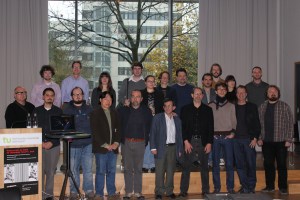
    Conference group photo from PKD Dortmund Conference.
    Conference group photo from PKD Dortmund Conference.

    This is the thirty-first post in a series that I call, “Recovered Writing.” I am going through my personal archive of undergraduate and graduate school writing, recovering those essays I consider interesting but that I am unlikely to revise for traditional publication, and posting those essays as-is on my blog in the hope of engaging others with these ideas that played a formative role in my development as a scholar and teacher. Because this and the other essays in the Recovered Writing series are posted as-is and edited only for web-readability, I hope that readers will accept them for what they are–undergraduate and graduate school essays conveying varying degrees of argumentation, rigor, idea development, and research. Furthermore, I dislike the idea of these essays languishing in a digital tomb, so I offer them here to excite your curiosity and encourage your conversation.

    In this Recovered Writing post, I am bringing my analog writing into the digital realm of cyberspace by scanning the pages of my notebook from the First International Philip K. Dick Conference, Dortmund into a PDF. Instead of copy-and-pasting my writing as I have done on my previous Recovered Writing posts, this one has be downloaded as a PDF below.

    In addition to my record of all of the sessions and keynote speeches, you can observe my degrading handwriting (I’m so far removed from my days as a draftsman-in-training or as a high school student receiving commendations for his penmanship), trouble with spelling jargon and names, and rough sketches of Laurence Rickels’ theatrically performative keynote presentation.

    I was so busy during the last bit of 2012 and all of 2013 that I never returned to collect my thoughts from the Dortmund conference in a blog post. This wasn’t because I thought it wasn’t important. In fact, it was tremendously important and enlightening to me. In my 2012 retrospective post, I wrote, “November 15-18: I attended the first international Philip K. Dick conference at UT-Dortmund in Dortmund, Germany. I delivered a heavily revised version of my SFRA 2012 paper, “Philip K. Dick as Pioneer of the Brain Revolution.” The conference was a fantastic experience. I promise to write more about this in a separate post. In the meantime, you can see my pictures from Germany here.” Unfortunately, the demands of teaching, research, and job hunting took precedence over my desire to “write more about [the conference] in a separate post.” It will have to suffice for now to post these notes for any and all who have the time and ability to decipher my scribblings. If you are so inclined, good luck!

    You may download my notes from the First International Philip K. Dick Conference, Dortmund here: ellis-jason-pkd-dortmund-notes.pdf.

  • Recovered Writing: My First Professional, Academic Presentation, “Monstrous Robots: Dualism in Robots Who Masquerade as Humans,” Monstrous Bodies Symposium, March 31-April 1, 2005

    This is the thirtieth post in a series that I call, “Recovered Writing.” I am going through my personal archive of undergraduate and graduate school writing, recovering those essays I consider interesting but that I am unlikely to revise for traditional publication, and posting those essays as-is on my blog in the hope of engaging others with these ideas that played a formative role in my development as a scholar and teacher. Because this and the other essays in the Recovered Writing series are posted as-is and edited only for web-readability, I hope that readers will accept them for what they are–undergraduate and graduate school essays conveying varying degrees of argumentation, rigor, idea development, and research. Furthermore, I dislike the idea of these essays languishing in a digital tomb, so I offer them here to excite your curiosity and encourage your conversation.

    Almost nine years ago, I gave my first academic conference presentation at the Monstrous Bodies Symposium—a continuation of Science Fiction-focused initiatives at Georgia Tech by Professor Lisa Yaszek. In addition to presenting, I organized the academic track of the symposium and recorded the sessions for the School of Literature, Communication, and Culture (now, Literature, Media, and Communication). After my presentation below, I am including a press release for the symposium that describes it in more detail along with our special guests: Paul di Filippo and Rhonda Wilcox.

    My presentation, “Monstrous Robots: Dualism in Robots Who Masquerade as Humans,” continues the work that I began in the SF Lab the previous year and  continued in my undergraduate thesis later. These ideas figured large throughout the close of my undergraduate degree and my MA in Science Fiction Studies at the University of Liverpool. By the time that I was well into my PhD at Kent State University, I began thinking along parallel lines in terms of human-computer interaction and its effect on human brains and the “minds” of computers. Instead of thinking of doppelgängers and opposition, I reframed my thinking around co-evolution, evolutionary psychology, neuroscience of mind, and human-computer interaction. This presentation is another step in the development of my thinking and self along these lines.

    Later, I will post another version of this essay that was revised for my first SFRA Conference in White Plains, NY in 2006.

    Jason W. Ellis

    Monstrous Bodies Symposium 2005

    31 March 2005

    Monstrous Robots:  Dualism in Robots Who Masquerade As Humans

    Robots who masquerade as human in science fiction (SF) are monstrous bodies because they are humanity’s created doppelganger of itself and as a result they reflect the best and the worst of what it means to be human.   These technological appropriations of what it means to be human are important because they are a space within SF where issues about the encroaching of science and technology on the borders of the human body after the end of World War II.

    In order to explore these issues, I want to begin by defining the terminology that I will be using.  I define doppelganger as an unnatural double of a person or of humanity.  Human-like robots are the doppelganger of humanity because they mimic what it means to be human.  They appear human and they must perform themselves accordingly.  This doppelganger is haunting because its existence challenges what it means to be human.  If someone acts human and looks human why is there any reason to question the validity of that person’s humanity?  The answer is that:  the existence of human-like robots makes the very concept of humanity suspect.  Robots are the product of their creators.  The double mirrors its creator by reflecting an extreme of human behavior.  This reflection is called dualism.  I define dualism as a doubled status such as good and evil or organic and synthetic.  Human-like robots are either very good or very bad and this is determined by the nature of their creators.  Therefore, these robots tell us a great deal about the nature of their creators.

    I will be examining two examples of human-like robots in SF literature and film.  The first is Isaac Asimov’s “humaniform” robot, R. Daneel Olivaw, from the Robot, Empire, and Foundation series of novels.  Daneel is best described as an android because he is a robot made in the appearance of a man.  His outer skin is not organic in nature.  The second human-like robot is James Cameron’s original Terminator from the film of the same name.  The Terminator is best called a cyborg because he is a fusion of man and machine (organic skin and hair covering a robotic interior).  The former is an example of a good android and the latter is an example of a bad cyborg.  These characters are doubles of humanity in their respective stories and they are also mirrors of one another.

    Asimov began writing the robot novels that feature R. Daneel Olivaw in the 1950s, during the first phase of the Cold War.  The novels take place in a far future where humans have colonized a significant portion of the galaxy.  Although the robots are instrumental in the process of colonization, humans remain fiercely divided on whether or not robots should exist at all.  Given that Asimov himself was very much in favor of the promising new technologies of his day (e.g., automation in manufacturing and computers), it is not surprising that he picks the robots in his novels to be utopic in nature.  His robots are the embodiment of these new technologies.  In order to make his robots “perfect people,” he constructed his robots with the Three Laws of Robotics that he first made explicit in his short story, “Runaround:”

    (1) A robot may not injure a human being, or, through inaction, allow a human being to come to harm.

    (2) A robot must obey the orders given it by human beings except where such orders would conflict with the First Law.

    (3) A robot must protect its own existence as long as such protection does not conflict with the First or Second Laws. (I, Robot 44-45)

    The Three Laws provided each robot with an ethical system that must be obeyed because it is hardwired into its positronic brain.  Therefore, Asmovian robots represent the best of what humans can be, but at the same time they reveal what we are not.

    R. Daneel Olivaw is what Asimov termed a “humaniform” robot.  Daneel has the appearance of a human from one of the fifty Spacer worlds (i.e., worlds originally populated by Earth people during a period of expansion in our future).  Daneel’s partner in the novels The Caves of Steel, The Naked Sun, and The Robots of Dawn is Elijah Baley, a detective from Earth.  In The Caves of Steel, Baley describes Daneel as appearing “completely human” (83).  He later says, “The Spacers in those pictures had been, generally speaking, like those that were occasionally featured in the bookfilms:  tall, red-headed, grave, coldly handsome.  Like  R. Daneel Olivaw, for instance” (94).  Baley even suggests that Daneel is secretly Dr. Sarton, the Spacer found dead in The Caves of Steel.  This however is not the case.  Daneel was modeled after Dr. Sarton’s appearance.  This revelation leads to Daneel revealing what lies beneath.  In Dr. Han Fastolfe’s office, “R. Daneel pinched the ball of his right middle finger with the thumb and forefinger of his left hand…just as the fabric of the sleeve had fallen in two when the diagmagnetic field of its seam had been interrupted, so now the arm itself fell in two…There, under a thin layer of fleshlike material, was the dull blue gray of stainless steel rods, cords, and joints” (The Caves of Steel 111).  As Baley passes out from the shock, the fact that the “R.,” which stands for “Robot,” in front of Daneel’s name is in fact deserved!

    The broadest doubling that involves Daneel is that he is a mirror for humanity.  When a character becomes aware of Daneel’s true being, it destabilizes that character’s understanding of the difference between robot and human.  Most of Asimov’s robots are very metal and very plastic.  They are the epitome of synthetic.  Daneel’s construction sets him apart from the apparent synthetic robots because he appeared to be human.  Elijah Baley first greets Daneel at Spacetown thinking that he is a Spacer.  Later Baley says to his superior, Commissioner Julius Enderby, “You might have warned me that he looked completely human” and he goes on to say “I’d never seen a robot like that and you had.  I didn’t even know such things were possible” (The Caves of Steel 83).  Elijah and most other humans are not aware that a human form robot was a possibility.  Although Elijah comes to terms with Daneel, other characters are driven to destroy humaniform robots.  Elijah’s wife is secretly a member of the Medievalists, a group that wants to do away with all robots, including Daneel.  Commissioner Enderby, also a Medievalist, murders Dr. Sarton, not because he wants to kill Sarton, but because he mistakes him for Daneel.

    Daneel is also the double of his human partner, Elijah Baley.  Before Elijah meets Daneel, he is confident in his own abilities as a detective.  After he partners with Daneel, however, he begins to call into question his own abilities and talents.  Robots are meant to be superior to humans and Elijah extends this to his own profession that is now being intruded on by an android.  Baley is narrating at the beginning of The Caves of Steel:

    The trouble was, of course, that he was not the plain-clothes man of popular myth.  He was not incapable of surprise, imperturbable of appearance, infinite of adaptability, and lightning of mental grasp.  He had never supposed he was, but he had never regretted the lack before.

    What made him regret it was that, to all appearances, R. Daneel Olivaw was that very myth, embodied.

    He had to be.  He was a robot (The Caves of Steel 26-27).

    This anxiety is one of the motivating factors behind The Robots of Dawn, when Elijah is brought in to investigate the murder of a humaniform robot like Daneel.  If Elijah fails, he will loose his job and be declassified.  The fear of declassification is dire to Elijah because he had seen his own father declassified when he was only a boy.  Therefore, the existence of humaniform robots creates the situation that elicits this fear in Elijah.  Eventually Elijah warms up to his robot partner, but along the way Elijah often finds ways to make himself feel superior to robots by making Daneel follow unnecessary orders or by calling other robots by the derogatory label, “boy” (The Robots of Dawn 34).

    James Cameron’s Terminator is a cyborg character that is born of a different cultural moment than Asimov’s robots.  The Terminator was originally released in 1984 while the Cold War was still in full swing and Ronald Reagan had been reelected President of the United States.  Even more significantly, The Terminator was riding the wave of office computing and robotic manufacturing.  Whereas Asimov viewed technology in utopic terms, Cameron only sees these technological advances as dystopic.  The Terminator would have been a film that the Medievalists of Asimov’s Robot novels would have lauded.

    After the opening scene of the future wasteland of 2029, the Terminator arrives naked in Los Angeles of 1984.  J. P. Telotte writes that the “film’s title implies that its central concern is the technological threat, embodied in a killer cyborg which, for all of Arnold Schwarzenegger’s excess muscularity, disconcertingly blends in with the human:  speaks our language, crudely follows our basic customs, acts in roughly effective ways.  In fact, the film emphasizes just how easy it is to ‘pass’ for human in a world that judges that status so superficially” (172).  The Terminator has been given instructions to kill Sarah Connor in 1984 in order to prevent the birth of her future child who will lead humanity to victory over the machines.  He goes about doing this in a militarily calculated manner.  He obtains the weaponry and clothes that his mission requires.  The Terminator uses his human appearance and voice to blend into mid-1980s California.  Despite his robotic core, he is able to perform himself as human effectively enough to maintain the belief that he is human to those who passively interact with him.  Sarah Connor and Kyle Reese, the man sent back in time to save her, are the only persons that know what the Terminator really is.

    The Terminator is a chillingly evil double of humanity.  Through the first part of the film the audience does not yet know exactly what lies beneath his skin.  We are treated to his superior strength, but only later in the film, after he has sustained damage, do we really begin to understand what lies beneath the surface.  The hard metal robot body that is under the soft organic skin is the true nature of the Terminator.  Without the skin he looks like the killing machines that greet the audience at the beginning of the movie.  The shining flying machines and the bone crunching treads of the tank are siblings of the Cyberdyne Systems Model 101 Terminator.  The Terminator is the result of the military-industrial complex losing control of Skynet, a computer network of control and command systems that were integrated into the implements of American war making.  After Skynet becomes self-aware, it views humanity as its only threat.  Skynet then acts in its own best interest by appropriating humanities’ weapons of war in order to eliminate its creator.  In contrast to Asimov’s robots, the Terminator seems to be the direct result of machine rather than human construction.  In the movie, Terminator 3:  Rise of the Machines, smaller versions of the flying Terminator and tank Terminator are revealed to have been developed before Skynet launches its nuclear attack.  Therefore, it seems reasonable to assume that the cyborg Terminators were developed by Skynet for the purpose of infiltrating pockets of human habitation to wreak havoc by undermining the belief that what appears human actually is.  Again, the cyborg Terminator, like R. Daneel Olivaw, threatens what it means to be human by destabilizing the criteria used to determine human from machine.  But Cameron’s view is diametrically opposite Asimov’s in respect to machine agency.  Asimov’s robots are dedicated to helping humanity, but Cameron’s Skynet becomes self-aware on its own without any safeguards in place.  In Cameron’s look at the future, humanity loses control to the machines and must take that control back.

    Another doubling is between the Terminator and Sarah’s protector, Kyle Reese.  The most obvious difference is that Reese is much smaller than the Terminator.  Additionally, Reese feels pain and he can be injured.  The Terminator sustains damage but it unrelentingly follows it programming.  Because of the limitations placed on time-travel, neither Reese nor the Terminator can bring any weaponry with them into the past.  The Terminator takes his weapons indiscriminately from a gun shop and in turn kills the proprietor.  Reese takes his first weapon, a revolver, from a police officer and then he takes his second, a shotgun, from a parked police cruiser.  The other weapons that Reese and Sarah use are hand made explosives.  Reese uses ingenuity and resourcefulness to match the brute force onslaught of the Terminator.  In effect, the Terminator itself is a weapon.

    An interesting mirroring in The Terminator is between the machines and Sarah Conner.  On one level, the Terminator is the destructor.  Its mission is to go into the past and eradicate any instance of a “Sarah Connor” in the Los Angeles area.  Sarah, on the other hand, is told that she will give birth to John Connor, the future leader of the human resistance.  The Terminator tries to kill the woman who is capable of creation.  On a broader level, Skynet is capable of creation through production.  Skynet must have a means for building Terminators (cyborgs, airplanes, and tanks) and it must also have some creative capabilities because it created the mechanism for traveling into the past.  Thus, Skynet and Sarah follow parallels in that each stand for their species and point toward the future.  Skynet wants to maintain its existence and the existence of its machine armies.  Sarah wants to live and know that humanity will continue with the help of her yet-to-be-born son, John.  The Terminator, as a creation of Skynet, is the means by which Skynet can strike at Sarah because Skynet and Sarah’s futures are mutually exclusive.  Within the frame of the movies, machines and human beings are not meant to live together in harmony.  Another doubling between Sarah and the Terminator is that they are both covered in some way.  Telotte points out, “If the gradual stripping away of the Terminator’s human seeming warns us not to judge an android by its cover, the gradual emergence of Sarah’s character and potential as she responds to this threat reminds us that it is no more reliable to judge the human self by its various cultural trappings” (173).  His true robotic interior is revealed throughout the progression of the movie.  This is done “by seeing for ourselves how he sees…for the point-of-view shots reveal that the Terminator does not “see” images but merely gathers ‘information’” (Pyle 232).  Additionally, the Terminator’s flesh is stripped away through gunfights and explosions that eventually reveal the cold metal of its endoskeleton.  Sarah’s cultural coverings are removed as well as she shifts from clumsy waitress that freezes at the sight of the Terminator to technologically adept mother of the future who triumphantly crushes the machine in a hydraulic press.

    Finally, Cameron’s Terminator is the doppelganger of Asimov’s R. Daneel Olivaw.  The Terminator works toward the domination of machines over humanity whereas Daneel works cooperatively with humans such as his partner and friend, Elijah Baley.  The text at the beginning of The Terminator states, “The machines rose from the ashes of the nuclear fire.  Their war to exterminate mankind had raged for decades, but the final battle would not be fought in the future.  It would be fought here, in our present.  Tonight.”  The machines (i.e., Skynet and the Terminator) mean to “exterminate mankind.”  On the other hand, Patricia Warrick writes, “The…robot detective novels…illustrate Asimov’s faith that man and machine can form a harmonious relationship” (61).  Both have their robotic selves hidden under a layer of flesh.  They perform themselves as human in order to fit in with the cultural surroundings in which they find themselves (e.g., 1980s Los Angeles or Asimov’s Earth encased in “caves of steel”).   The Terminator means to destroy humanity while Daneel wishes to work along side humanity.

    Both R. Daneel Olivaw and the Terminator are doppelgangers of humanity, other characters in their respective works, and each other.  They maintain a human appearance and performance in order to pass as human to the casual observer.  R. Daneel Olivaw is given his “humaniform” appearance in order to work with humans (both Spacer and Earth person alike).  The Terminator uses his appearance as a sort of disguise in order to infiltrate humanity in order to kill from within.  Daneel represents the very best of human nature through cooperation and a moral imperative.  The Terminator represents the very worst of humanity through death dealing and a lack of moral standing. Despite the best intentions of Daneel, who was built the way he was, he is still viewed as a threat by some.  The Terminator, who also had no choice in his appearance, is a real threat to humanity because he uses his appearance to get closer to his prey.  Therefore, the bodies of R. Daneel Olivaw and the Terminator are examples of monstrous bodies in SF because they assume an appearance and identity that destabilizes what it means to be human and in so doing they each have a unique nature that is dependent on that of their creators.

    Works Cited

    Asimov, Isaac.  The Caves of Steel.  New York:  Bantam Doubleday Dell, 1954.

    —.  I, Robot.  New York:  Gnome Press, 1950.

    —.  The Naked Sun.  New York:  Bantam Doubleday Dell, 1957.

    —.  The Robots of Dawn.  New York:  Doubleday, 1983.

    Pyle, Forest.  “Making Cyborgs, Making Humans:  Of Terminators and Blade Runners.”    Film Theory Goes to the Movies.  Ed. Jim Collins, et al.  New York:  Routledge,            1993.  227-241.

    Short, Sue.  “The Measure of a Man?:  Asimov’s Bicentennial Man, Star Trek’s Data, and     Being Human.”  Extrapolation 44:2 (Summer 2003):  209-223.

    Telotte, J.P.  Replications:  A Robotic History of the Science Fiction Film.  Urbana, IL:         University of Illinois Press, 1995.

    The Terminator.  Dir. James Cameron.  Orion Pictures, 1984.

    Terminator 3:  Rise of the Machines.  Dir. Jonathan Mostow.  Warner Bros., 2003.

    Warrick, Patricia S.  The Cybernetic Imagination in Science Fiction.  Cambridge, MA:         MIT Press, 1980.

    ——————–

    Monstrous Bodies Press Release

    What:  “Monstrous Bodies in Science, Fiction, and Culture: Celebrating 25 Years of the Fantastic in the Arts at Georgia Tech”

    When:  March 31-April 1, 2005

    Where:  Bill Moore Student Success Center and the Skiles Building, Georgia Institute of Technology

    From March 31st through April 1st the School of Literature, Communication and Culture (LCC) will host a two-day symposium in which participants explore the meaning of monstrous bodies in science, fiction, and culture. The symposium, which will take place in the Bill Moore Student Success Center at the Georgia Institute of Technology, is free of charge and open to all interested parties.

    The symposium celebrates both LCC’s ongoing commitment to the study of the fantastic in the arts and, more specifically, the pivotal role that LCC Professor Emeritus Irving F. “Bud” Foote played in shaping this commitment. Foote taught the first accredited science fiction class at Tech in the early 1970s and over the course of the next two decades brought a number of science fiction writers to Tech including Frederik Pohl, Ursula K. LeGuin, Octavia Butler, and Kim Stanley Robinson. Upon his retirement in 1997 Foote donated 8000 science fiction-related items to the Georgia Tech Library, and the Bud Foote Science Fiction Collection was born. With additional gifts from Georgia Tech alumni and science fiction authors such as David Brin and Kathleen Ann Goonan, the Bud Foote Collection is now one of the twenty largest research collections of its kind.

    The Monstrous Bodies symposium will commemorate both Professor Foote’s legacy and LCC’s continued dedication to the study of the fantastic in the arts by featuring student research on and creative writing in science fiction, fantasy, horror, and the gothic. The symposium will also include art and film exhibits as well as presentations by local scholars, science fiction writers, editors, publishers, and artists from Adult Swim, Cartoon Network’s late-night cartoon programming for adult audiences.

    Our special guests of honor are two leading figures in fantastic art and scholarship: science fiction author Paul di Filippo and popular culture expert Rhonda Wilcox. In 2004 Di Filippo received the Prix L’Imaginaire for his short story “Sisyphus and the Stranger”; other stories have been nominated for Hugo, Nebula, BSFA, Philip K. Dick, Wired Magazine, and World Fantasy Awards as well. Wilcox is the author of the forthcoming book Why Buffy Matters: The Art of Television and coeditor of Fighting the Forces: What’s at Stake in Buffy the Vampire Slayer and Slayage: The Online International Journal of Buffy Studies.

    If you have any other questions or comments, contact conference coordinator Prof. Lisa Yaszek or conference assistant Amelia Shackelford.

    For more information

    On the symposium, please visit http://monstrousbodies.lcc.gatech.edu;

    On the Bud Foote Science Fiction Collection, please visit http://sf.lcc.gatech.edu;

    On previous student work in the Bud Foote Collection, please visit http://sciencefiction.lcc.gatech.edu.

  • Recovered Writing: Undergraduate Science, Technology, and Gender Course, Online Discussion Writing and Group Presentation Introduction, Spring 2005

    This is the twenty-ninth post in a series that I call, “Recovered Writing.” I am going through my personal archive of undergraduate and graduate school writing, recovering those essays I consider interesting but that I am unlikely to revise for traditional publication, and posting those essays as-is on my blog in the hope of engaging others with these ideas that played a formative role in my development as a scholar and teacher. Because this and the other essays in the Recovered Writing series are posted as-is and edited only for web-readability, I hope that readers will accept them for what they are–undergraduate and graduate school essays conveying varying degrees of argumentation, rigor, idea development, and research. Furthermore, I dislike the idea of these essays languishing in a digital tomb, so I offer them here to excite your curiosity and encourage your conversation.

    In Spring 2005, I was a member of Professor Carol Senf’s LCC 3304, Science, Technology, and Gender class. Professor Senf–who I now consider a good friend and colleague–organized the class around online discussions, in-class discussions, and a final team-based, research/presentation project. In this post, I am including my introduction for my team’s final project on the transsexuality/transgenderism in film and my eight online discussion postings. In the former, I am including only my introduction, because I do not have permission from my teammates to post the completed project. In the latter, I am including my saved files, some of which appear to be fragments of the online postings–perhaps notes or drafts that I revised online. The discussion postings are based on readings and viewings. They involve analysis and exploration. Aside from the fragmentary nature of some of the postings, the writing and focus seem to improve over time. Everything is posted as-is.

    Jason W. Ellis

    Professor Carol Senf

    LCC 3304

    Spring 2005

    Introduction to Transsexuality in Film Presentation

    Opening slide that I created for our presentation.
    Opening slide that I created for our presentation.

    Our group is exploring transsexuality as presented in contemporary film.  Transsexual theorist Sandy Stone defines a transsexual as “a person who identifies his or her gender identity with that of the ‘opposite’ gender.  Sex and gender are quite separate issues, but transsexuals commonly blur the distinction by confusing the performative character of gender with the physical ‘fact’ of sex, referring to their perceptions of their situation as being in the ‘wrong body’” (Stone, sec. 2, par. 2).  A transsexual person feels his/her gender to be disconnected from or other than his/her sex.  This is an interesting topic for discussion because transsexuality calls into question the assumed de facto nature of binomial sex.

    Film is a popular entertainment medium that mirrors currently held beliefs, and it can educate and challenge the status quo by bringing stories (otherwise unheard) to a larger audience.  Additionally, film and transsexuality are both technologically based and they both “came of age” during the twentieth century.  Film and transsexuality double one another in that both record performances (i.e., the former on film and the latter on a person’s body).  Teresa de Lauretis (as quoted in Hausman 14) goes so far as to say that gender is “the product of various social technologies, such as cinema, as well as institutional discourses, epistemologies, and critical practices.”  In the last chapter, Hausman writes, “Transsexuals seek to become the true representatives of a gender”  (193).  Gender, in part, is a technologically manufactured construct.  Thus, film and transsexuality are linked because both are manifestations of recording technologies and film is part of the mechanism that constructs the idea of gender for all, including transsexuals, to emulate.

    There are many films with main characters that are transsexual.  These films range from biographies to inventive dramas.  We will be taking a cross section of these films to look more closely at how transsexual characters are presented and how other characters interact with and perceive them.  Our presentation will point out common themes as well as stereotypes that we find in these films.  We will look at different reactions to male-to-female transsexuality and female-to-male transsexuality.  Additionally, we want to look at what these representations tell us about the perception of transsexuals today.

    In the course of our research we found four narrative types employed in films that feature transsexuality.  Those four categories are:

    1. aversity or challenge
    2. bildungsroman or a coming of age story
    3. doppelganger or the transsexual is a double of other characters
    4. farce or fantasy

    Mind you, we are putting the films, not the people, into categories.  These categories serve as shorthand that allows us to build connections between movies and the way that they each present transsexuality.  These filmic presentations of transsexuality form a broad spectrum ranging from cookie-cutter stereotypes to solid character development.  The ways in which the transsexual characters in these films are portrayed as well as the way in which others around them perceive and interact with them tells us much about the cultural moment in which these films were made.  Some films instigate thought and discussion whereas others perpetuate stereotypes.  Therefore, transsexuality in film is a valuable resource for learning more about past and present presentations of transsexuals and they also reflect on the attitudes and beliefs of the filmmakers and the audience.

    ———————

    Jason W. Ellis

    Professor Carol Senf

    LCC 3304

    01/25/2005

    Online Discussion Post 1

    Olivia Judson responds to the question, “Isn’t anthropomorphism something biologists try to avoid?” in the following excerpt from the FAQ section of her website:


    “When I studied animal behavior in college, I was told anthropomorphism was a Big No-No. But as I read more widely, I concluded this stance is misguided. Two of the greatest evolutionary biologists–Darwin and Bill Hamilton (my PhD supervisor, and my nomination for the 20th century biologist most like Darwin)–regularly put themselves in the place of the organisms they were watching, and I think that doing so helped them to some of their most profound insights. As long as everyone understands that we don’t know what is really going on inside an animal’s head–that anthropomorphism is a metaphor, not a description–considering life from an organism’s point of view can be a powerful aid to the imagination, and therefore, a powerful tool. Indeed, I think the real danger with [anthropomorphism] is in treating it as an intellectual sin. A taboo on anthropomorphism has the effect of leading us to believe that humans are so different from other animals that we can’t possibly relate to them. But that’s wrong (http://www.drtatiana.com/faq.shtml#anthro).”


    She makes the point “that anthropomorphism is a metaphor, not a description.”  Metaphor and analogy are models that help us better understand something that is foreign to our experience.  Judson uses anthropomorphism as a tool to better understand the biology and behavior of organisms that lead very different lives from humans.  Additionally, she is able to convey detailed information in a more “friendly” way than an elitist scientific text.  Anthropomorphism is engaging for the layperson and the scientists alike.  Judson is saying that even scientists such as Darwin, Hamilton, and herself use anthropomorphism as a tool in their work thus it shouldn’t carry the taboo that is often associated with it within scientific circles.


    Similarly, Marlene Zuk’s writes, “A model system is one that is used to obtain general results about some aspect of biology” (24).  Zuk describes a model system as taking detailed observations of one group and then applying the collected results to other groups (e.g., another sex of the group species, another age group, or another species).  A scientist may lose objectivity in an experiment or observation due to anthropomorphism and they may over generalize the results of their experiments and observations due to relying on a model system beyond its scope.


    A model system is like a rock being dropped into a pond.  At the center there is the largest disturbance of the water.  This corresponds to the model system and the group it was based on.  The model system can be used much more accurately on this central group than any other.  Then there are ripples emanating from the center.  These ripples lose intensity as they get further away from point where the rock/model system impacted the water.  The ripples correspond to the other groups that the model system may be applied to.  In the case of many drug tests, the model system is based on data derived from the “average male.”  When the drug is released for sale, the model system for drug interaction and side effects may vary for other groups that will be taking the drug (e.g., young women, older women, older men, men or women with other health problems, etc.).  If care isn’t taken in the application of a model system to groups farther out from the group that was used for building the model system, then it may result in problems.


    Linking this back to Judson, if the bounds of objectivity are pushed too far, the data collection in building the model system may be corrupted.  As Darwin wrote, “False facts are highly injurious to the progress of science, for they often endure long; but false views, if supported by some evidence, do little harm, for every one takes a salutary pleasure in proving their falseness; and when this is done, one path towards error is closed and the road to truth is often at the same time opened” (Chapter 21, 1st paragraph).  It is the responsibility of the scientist to be aware of what extent he or she utilizes anthropomorphism and model systems.  Zuk’s personal account (using “I” and writing about Brother Loon) and Judson’s anthropomorphism combined with wit are two ways to write about science without losing sight of what they are writing about.  Additionally, Zuk’s description of a model system applies to Judson’s anthropomorphic descriptions.  Judson writes on her website, “As long as everyone understands that we don’t know what is really going on inside an animal’s head…considering life from an organism’s point of view can be a powerful aid to the imagination, and therefore, a powerful tool.”  Zuk and Judson both use anthropomorphism as a valuable tool to convey their respective stories and scientific information.  Anthropomorphism, like model systems, is an important tool that comes with a disclaimer limiting the scope and depth of its utility within a scientific discourse.

    —————–

    Jason W. Ellis

    Professor Carol Senf

    LCC 3304

    2/7/2005

    Online Discussion Post 2

    David Reimer is quoted on page 262 of John Colapinto’s As Nature Made Him:


    “You know, if I had lost my arms and my legs and wound up in a wheelchair where you’re moving everything with a little rod in your mouth–would that make me less of a person?  It just seems that they implied that you’re nothing if your penis is gone.  The second you lose that, you’re nothing, and they’ve got to do surgery and hormones to turn you into something.  Like you’re a zero.  It’s like your whole personality, everything about you is all directed–all pinpointed—toward what’s between the legs.  And to me, that’s ignorant.  I don’t have the kind of education that these scientists and doctors and psychologists have, but to me it’s very ignorant.  If a woman lost her breasts, do you turn her into a guy?  To make her feel ‘whole and complete’?”


    David is addressing the idea that Dr. John Money summed up by saying, “You cannot be an it” (248).  David compares an apparent physical disability with the unseen lack of a penis.  He calls into question the belief that if one’s sexual identity is ambiguous, then their identity as a person is considered less than the identity of a person with a clear sex identity.  He cannot find the logic behind the doctor’s (such as Dr. Money’s) belief that sexual identity is necessary for personal identity.  David clearly delineates what our culture considers important concerning identity when he says, “It’s like your whole personality, everything about you is directed…toward what’s between the legs.”  He considers this “ignorant” because this classification neglects the person in toto.  David has thoughts, feelings, and dreams like any other person.  Even though he endured a botched circumcision, surgeries, hormone treatments, and counseling to help acclimate him to living a life as “Brenda,” he knew on the inside that he was in fact male.  David had not been given a choice about what sex he should be.  His parents and his doctors chose a sex for him based on physical characteristics derived from his injury.  David turns the table on this reasoning by saying, “If a woman lost her breasts, do you turn her into a guy?  To make her feel ‘whole and complete’?”  A woman’s breasts are one of the most obvious signifiers of being female.  His point is that if the physical manifestation of what we see and identify as being a male or female trait is removed then by the logic of doctors, such as Dr. Money, the person should have their sex reassigned so that they appear to be the sex that their scarred body appears to be.  This can be extended to Bob from Fight Club.  Bob had “bitch tits” and he had been castrated because of testicular cancer.  Should he have been transformed into a female because of his loss of his testicles as well as the way that he looks?


    Dr. Money’s stand links back to Darwin’s primary sexual characteristics in his theory of sexual selection.  Darwin’s use of primary sexual characteristics is to denote what elements of an organism that are necessary for reproduction.  For human beings, these primary sexual characteristics are used as cues for sexual identity.  This extends to the way in which the individual interacts with others as well as the way others may interact with the individual–based on the perception/understanding of what sex the individual is.


    Colapinto’s book is not a scientific text.  He uses journalistic investigation and personal narratives to build his argument.  The author gives David, Brian, their parents, and others a voice through their personal narratives.  Without Colapinto’s book and subsequent television appearances, their voice would have been oppressed within anonymous case studies.  In giving David and his family a voice, they were able to dispel the claims made by Dr. John Money concerning the “John/Joan” case.  Additionally, sexual identity is something that is more than the sum of its parts.  Being male or female (for the individual) is more than a checklist (e.g., penis–check, testicles–check, etc.).  David knew that he was male despite being told he was female.


    It should also be noted that Dr. Money does not appear to have followed the scientific method in developing his theory that nurture is capable of reassigning biological sex or intersexual ambiguity.  Instead of rigorously following up on the John/Joan case, he effectively dropped the ball.  Also, in light of new evidence presented by the Diamond and Sigmundson paper, Dr. Money and others who promoted intersexual infant surgeries did not change or reevaluate their standing on this procedure.  Case studies are based on observation and extrapolation from particular cases.  For example, Freud’s psychoanalysis was based on case studies that he made with only a limited number of patients.  Diamond and Sigmundson paper was “powerful…in presenting anecdotal evidence of the neurobiological basis of sexuality” (210).  The doctors on both sides of this issue have to rely on the case studies of extreme cases in order to derive their theories regarding the basis of sexual identity.


    Colapinto’s book reveals that more than scientific discovery is taking place in these investigations.  It reads like a drama because of the personal stakes that the doctors have in their work.  Dr. Money’s personal attacks erupt within his books that are supposed to be scientific texts.  Additionally, Dr. Money is presented as being less than objective by not disclosing certain elements of why he chose to not report what he knew had happened with Brenda/David and he would not explain his own shift in beliefs that took place between his doctoral dissertation (which presented a positive picture of intersexuals who had not undergone surgeries in infancy) to his profound belief that a person with ambiguous physical characteristics must be made either physically male or female while they are very young.


    A final important point that Colapinto makes in As Nature Made Him is that David exists has a hybrid.  David identifies himself as male now even though he was raised as a girl.  He said, “I feel sorry for women.  I’ve been there” (262).  He then talks about gendered roles for women such as staying in the kitchen and being told to leave chopping the firewood to the men.  David goes on to say, “I remember when I was a kid and women were fighting like hell to get equal rights.  I said, ‘Good for them.’  I kind of sensed what position women had in society.  Way down there.  And that’s who I was portrayed.  And I didn’t want to go way down there.  I felt, I can do whatever anybody else can!  But ‘Oh, you’re a girl–you might get hurt playing ball’” (262).  He has walked the proverbial mile in another sex’s shoes.  His hybridity allowed him to see the demarcation lines because he had crossed over them in his transformation from Brenda to David.

    ——————-

    Jason W. Ellis

    Professor Carol Senf

    LCC 3304

    3/3/2005

    Online Discussion Post 3

    Doppelgangers in The Stepford Wives destabilize female identity and agency.  The American Heritage College Dictionary 3rd edition defines doppelganger as, “A ghostly double of a living person, esp. one that haunts its living counterpart.”  Doppelgangers are a mirror of a person, but not an exact duplicate.  Additionally, a double is not natural and it is usually dangerous because of its encroaching on the identity of the original.


    There are two kinds of doppelgangers or mirroring in The Stepford Wives.  The first mirroring takes place between the women of Stepford (i.e., Carol Van Sant et al) and the women who have recently moved to Stepford (i.e., Joanna, Bobby, and Charmaine).  The established women think and behave as a representation of an ideal of femininity held by the men of Stepford (and reinforced by the culture at large such as in advertising of housecleaning products).  The women who have recently moved to Stepford are trying to maintain their own identity and agency.  There is a conflict between the constructed identities of the Stepford women and the recently arrived women.  Joanna and Bobby can’t identify with the Stepford women because they are embedded (literally) with a diametrically opposed view of what it means to be a woman, and in particular, a wife.


    Underlying this is the obvious level of doppelgangers between the original woman and the ideal Stepford wife that she “becomes.”  The robot/animatronic doubles are revealed at the end of the film when Joanna stabs Bobby to see if she bleeds.  Bobby does not and she falls into a loop of her preprogrammed motions and words.  The women of Stepford are replaced with robotic replications.  These robot doubles are built by the Men’s Association to give the husband what he considers an idealized housewife.  These doubles are unnatural (they don’t bleed and they are mechanical instead of organic) and they are dangerous to the not-yet-replaced women of Stepford.  The doppelganger has to usurp the place of the real woman by killing her.  The synthetic replaces the organic.  Additionally, this point is interesting because it means that the men can only enjoy their ideal of the female if that ideal is a constructed, synthetic being instead of an alive, organic one.


    The doppelganger is important to our study of gender because it makes apparent how one group is objectified by another group (e.g., in this case women/wives are objectified by men/husbands).  The men already objectified the women before they were replaced with robot doubles.  Joanna didn’t have a choice in their move to Stepford and her husband doesn’t respect her choice to be a photographer.  Because Joanna is a “thing” instead of a person, Walter is able to replace her with her robot double.  In doing so, Joanna is killed and her voice (i.e., choice, creativity, and identity) is destroyed.

    ——————-

    Jason W. Ellis

    Professor Carol Senf

    LCC 3304

    3/3/2005

    Online Discussion Post 4

    Alice Domurat Dreger quotes Donald Bateman (a hemophiliac) in the Epilogue of her book, Hermaphrodites and the Medical Invention of Sex, as having said, “the social history of medicine is usually recorded by its practitioners, by social workers, or researchers.  Not much of it is chronicled by its victims or the recipients of treatment.  The sick, like the poor, leave very few archives behind them” (167).  The medical professionals usurp the voice of the individual who they objectify as the patient.  The body of the individual is made to “tell a story” through the doctor’s descriptions, photographs, and drawings.  The individual/patient is denied a voice in the medical literature because it is meant to be “objective.”  Science and medicine considers things, not individuals.


    An example of this is a gynecological examination.  The woman to be examined has her body covered in such a way to section off the upper portion of her body from her lower portion.  The doctor is meant to conduct his/her examination on “body parts” that are in a sense removed from the individual.  This has come about in order to establish the objectivity of the medical professional as well as lowering the possibility that some may consider the doctor conducting the examination in a non-professional way.  This objectivity may also make the woman more comfortable in a situation that elicits the taboo against persons (particularly of the opposite sex) looking at our naked body.  The objectification of intersexual individuals however extends beyond this example.


    Intersexuals have had decisions made about their bodies and their sexual identity without their voice being heard.  These decisions may be made while he/she is very young and it may be made by the medical professional along with input from the individual’s parents or the parents may go along with the “professional opinion” of the doctor.  The dynamic of this decision-making has a lot to do with many factors such as socioeconomic background of the parents, education, and geographic location of the parents and doctor (people in one location may have accepted mores or ideas that are different from people in other places).


    Dreger goes on to say that a shift took place after the “Age of Gonads.”  Dreger writes, “The late twentieth century, however, has seen the emergence of the voices and claims–to autonomy, to authority–of medicine’s subjects.  Intersexuals, like hemophiliacs and other medical patients, have begun to record and make known their stories in ever greater numbers” (168).  We have been reading about these voices such as Herculine Barbin’s memoirs and David Reimer’s story in John Colapinto’s As Nature Made Him.  There are stories to be told that are important both to the teller of the story and to an anticipating audience.  We have also read stories and seen movies where a person isn’t give a choice such as Joanna in The Stepford Wives and Yod in Piercy’s He, She, and It.  Joanna wants to be remembered through her photographs.  Yod leaves a message for Shira where he gets to tell his own story and make his own requests.  Barbin dealt with medical and legal authorities in his transformation from woman to man.  Reimer had to contend with the accepted authority on intersexuals–Dr. John Money.  The individual challenges authority in order to make their voice heard.


    Individuals “placed under the microscope” struggle for agency and the authority of the self.  Intersexuals, like anyone, want control of their bodies and their identity.  Certain authorities exert their power over the individual and in so doing render the individual an object without a voice.  Authority exerted by the medical profession continues to the present from the “Age of Gonads” that Dreger looks at.  Intersexed individuals have come a long way to gaining a voice, but there are areas that there is still a conflict on whose authority reigns supreme.  What form do these conflicts take?  What other areas do there exist conflicts between the intersexual as an individual and an authority that denies the intersexual a voice (e.g., the law or the church)?


    xxxxxxxxxxxxxxxxxxx


    Intersexuals and others identified as in need of help by the medical profession are objectified as patients instead of individuals.  The scientist and the doctor does not name them nor does he (more often than she) allow them a place or venue to tell their own story.  The object is voiceless whereas the individual has a voice to tell his/her own story and to make choices for his/herself.  Because medical professionals saw these individuals as objects of study, they also were denied a voice in the choices made about their own bodies.  Authority to medicine and law overruled the unacknowledged authority of the self.


    The issue of authority has been present in most of the works that we have considered thus far in the course.  David Reimer had choices made about what sex he should be raised as in Colapinto’s As Nature Made Him.  Yod was created to serve a purpose in Piercy’s He, She, and It.  Joanna faces the lesser decision made by her husband to move to Stepford, and then she is made to forfeit her life when her husband has a robot double created to assume her role as wife and mother.  There is a constant struggle between those of authority and those victim to the whims of that authority.  The issue lies in those persons [fragment]

    ——————–

    Jason W. Ellis

    Professor Carol Senf

    LCC 3304

    3/18/2005

    Online Discussion Post 5

    Destabilization of Normality and Reactions from Authority


    Before Callie/Cal runs away from Dr. Luce and her parents in Middlesex, Eugenides writes:


    I had miscalculated with Luce.  I thought that after talking to me he would decide that I was normal and leave me alone.  But I was beginning to understand something about normality.  Normality wasn’t normal.  It couldn’t be.  If normality were normal, everybody could leave it alone.  They could sit back and let normality manifest itself.  But people–and especially doctors–had doubts about normality.  They weren’t sure normality was up to the job.  And so they felt inclined to give it a boost.  (Eugenides 446)


    Binomial sex is considered the norm and


    The authority here lies with doctors and with parents to a much lesser extent.


    Another example of an authority trying to regulate normalcy is 19th and 20th century England.  In the movie Wilde, Oscar Wilde’s claim against [fragment]

    ———————

    Jason W. Ellis

    Professor Carol Senf

    LCC 3304

    4/1/2005

    Online Discussion Post 6

    Categorization and Authority in The Well of Loneliness


    Stephen’s tutor, Miss Puddleton (Puddle), is concerned about Stephen because “none knew better than this little grey woman, the agony of mind that must be endured when a sensitive, highly organized nature is first brought face to face with its own affliction” (155).  Puddle practices what she would say to Stephen.  She considers saying, “You’re neither unnatural, nor abominable, nor mad; you’re as much a part of what people call nature as anyone else; only you’re unexplained as yet–you’ve not got your niche in creation.  But some day that will come, and meanwhile don’t shrink from yourself, but just face yourself calmly and bravely…Cling to your honour for the sake of those others who share the same burden.  For their sakes show the world that people like you and they can be quite as selfless and fine as the rest of mankind.  Let your life go to prove this–it would be a really great life-work, Stephen” (154).  She wants to say that Stephen is not “unnatural,” “abominable,” or “mad.”  Puddle’s conception of categorization holds that an “invert” or lesbian identity has not yet found its “niche in creation” because a person like that is “unexplained as yet.”  She believes that when that behavior is explained (categorized) by someone (authority) then inverts will hold a place all their own in the “natural” world.  Puddle wants to tell Stephen that this goal is accomplished if she will be herself and maintain her “honour.”  This path is akin to leading by example.  Stephen can show the world that she and others like her are no less human than anyone else.


    Unfortunately, there are many forms of categorization and different authorities vying for the power of categorization.  Puddle’s formulation maintains that authority in the invert by leading a good life.  This is honorable, but not always practical because people often have prejudices and opinions that are not easily swayed.  Stephen’s parents, Sir Philip and Anna fight over Stephen’s nature.  Sir Philip is accepting of his daughter, but he dies before he can explain to Anna what Stephen’s nature is.  Others, like Puddle and Sir Philip, are accepting of Stephen because they see her as a person with skills and abilities that they respect despite the gendered overlay of those skills.  For example, Colonel Antrim “dearly loved a fine rider, and he cursed and he swore his appreciation” (109).  Colonel Antrim would defend Stephen to the other riders.  The others were made uncomfortable that a woman entered what was generally accepted as a male sport.  They would snicker and whisper when Stephen was not around that she was only a girl or that what she was doing was unnatural.  They would credit the horse more than the rider.  Colonel Antrim would hear none of that and exclaim, “Damn it, no, it’s the riding.  The girl rides, that’s the point; as for some of you others–” (109).


    Colonel Antrim’s “oaths could not save Stephen now from her neighbours, nothing could do that since the going of Martin–for quite unknown to themselves they feared her; it was fear that aroused their antagonism.  In her they instinctively sensed as outlaw, and theirs was the task of policing nature” (110).  The community plays a great part in the categorization of “normality” versus “abnormality.”  Because Stephen participated in many male dominated sports and academic pursuits, it unnerved many in the community that believed that this was not the natural order of things.  As John Merrick says to two socialite guests in David Lynch’s The Elephant Man, “People are often frightened by what they don’t understand.”  “Inverts” or lesbians were not understood in the binomial heterosexually dominated world of Radclyffe Hall.  Stephen is female but her “mannish” appearance is disconcerting to many people (both female and male) in the community.  Social mores and beliefs are constructed from the interaction of people within a community (which was larger at that time than say a thousand years before that due to such influences as new transportation technologies and publishing).  Within a small community such as that around Morton, the people gossip and react to the things that they observe.  Based on their own interaction and connections to the world outside their small community, “theirs was the task of policing nature.”  They feared Stephen because she was not like other women in their cultural moment.  Their “policing nature” did not mean that they were likely to lock her up, but that they reacted to Stephen and what she represented to them (i.e., a challenge to the status quo of binomial heterosexuality).


    This policing action is made very clearly when Ralph, the husband of Stephen’s first lover, Angela, reacts to the green-fly, “He nagged about the large population of green-fly, deploring the existence of their sexual organs:  ‘Nature’s a fool!  Fancy procreation being extended to that sort of vermin!’” (151).  Ralph is calling Nature “a fool” because he does not believe that insects should procreate the same way as humans do.  Science has revealed that sex is not only binomial but of many different combinations of sex and procreation beyond “male” and “female.”  Ralph’s arrogance is directly connected to the arrogance of those that react negatively toward Stephen and her nature.  In the same paragraph as Ralph’s exclamation against the green-fly, he says to his wife, “How’s your freak getting on…She’s appalling…it’s enough to make any man see red; that sort of thing wants putting down at birth, I’d like to institute state lethal chambers!” (151).  He marks himself as a fascist and closed minded about a woman who does not act or dress according to the way he and others believe a woman should act and dress.  Ralph is an extreme example, but his belief that the culturally created definitions of what it means to be male or female (and how to act and dress according to that sex) is above one’s nature and the way that Nature makes people.


    Science also grapples for authority to categorize things and people.  The work done by science is often an extension of cultural preconceptions.  For example, the American Psychological Association labeled homosexuality an illness until a little over twenty years ago.  In Carroll Smith-Rosenberg’s “Discourses of Sexuality and Subjectivity:  The New Woman 1870-1936,” she describes the work done by Krafft-Ebing in categorizing women he labeled as lesbian.  He used “social behavior and physical appearance” instead of the “sexual behavior of the women” when he categorized them (269).  An interesting side note is that Havelock Ellis wrote the introductory commentary for The Well of Loneliness.  He is described by Smith Rosenberg as “a complex figure” who was “an enemy of Victorian repression and hypocrisy” but he “insisted that a woman’s love for other women was both sexual and degenerate” (270).  He did argue however that “Inversion…was biological, hereditary, and irreversible” (270).  So there was discussion going on before and during the time that The Well of Loneliness was published about what it means to be a lesbian.  The majority view however was that homosexuality was a mental disease that can be treated and possibly reversed.  Some today, still hold this view (e.g., the debate in the Technique in 1996 over the publication of a religious group’s full page ad showing an attractive young woman who was able to turn from gay to straight thanks to the help of the church–not exactly science but a case illustrating the continuing debate over reversibility of homosexuality).


    The Well of Loneliness is a source of many examples of different authorities working to promote their own understanding of nature.  Categorization and labels serve both to help others understand who a person is, but they can also be used to undermine a person’s agency and self by assigning them a position “less than normal.”  Normality should be viewed as a spectrum rather than an absolute list of criteria with any deviation being identified as abnormal.  Understanding and acceptance (Sir Philip, Puddle, and Colonel Antrim) are more useful and powerful because they are inclusive whereas choosing not to understand and early medical categorization as other (Mr. Antrim, Ralph, and nineteenth century science) are both overlaying community prejudices in order to exclude persons who have something to contribute to the community.

    ———————–

    Jason W. Ellis

    Professor Carol Senf

    LCC 3304

    4/15/2005

    Online Discussion Post 7

    Transformations and Authority in Hausman and Two Postmodern Fictions


    Authority is one of the primary issues that we have been discussing during the course of this semester.  This issue is apparent in Bernice L. Hausman’s Changing Sex:  Transsexualism, Technology, and the Idea of Gender and it also appears in two books that I have read outside of class in Greg Bear’s Blood Music and Ishmael Reed’s Mumbo Jumbo.


    Hausman writes, “trannssexual’s demands for surgical and hormonal interventions were perceived, at least partially, as an effect of a still developing medical technology that had yet to realize its full potential.  This differentiates the medical practitioners from their transsexual subjects, for whom surgery was the final answer to their misery, a technological repair of ‘nature’s mistake’” (43).  She also writes that transsexuality is an invention of the twentieth century because it wasn’t until after Dreger’s “Age of Gonads” that medical technologies were developed to assist in the physical transformation of a person of one biological/physical sex into the opposite sex.  With the birth of endocrinology and advanced surgical techniques, one could potentially metamorphose into the gender (also a recent development) that they believed that they were.


    The authority to define, control, and reinforce physical transformation such as the bodily metamorphosis of the transsexual lies in many different hands.  As we increase the magnification of the microscope, the endocrinologist becomes the new definer of what it means to be male or female.  Before the rise of the chemicalization of the body, the “Age of Gonads” depended on observation of the gonadal tissues of the individual to determine sex.  Endocrinology discovered the hormonal messages that are sent and received by different organs within the body.  It was also determined that the female body should be the focus of endocrine research because of the more complex female endocrine system because of its regulation of the reproductive cycle.  Hausman writes, “One result of the emphasis on women as the ideal subjects of endocrinology may have been the differing ratios of men to women seeking sex change:  statistically, more men have, in the past, requested and achieved sex change” (37).  Because women were the subjects of endocrine research, Hausman goes on to say, “Thus, I would suggest that the historically higher numbers of men seeking sex change must somehow be correlated to the discourses within which both men and women who feel themselves to be ‘in the wrong body’ construct themselves as entitled subjects of medical treatment” (37).  The medicalization of the hormonal systems of women led to the establishment of people seeking medical treatment and surgery when they felt they were actually the other gender.  Therefore, transsexuality as a phenomenon is a technological invention.


    Transsexuality serves to reinforce the binomial sex paradigm as well as the authority of the medical professional.  Hausman writes in the Introduction, “physicians and other clinicians demonstrate the homophobic prejudice that grounds the practices of sex change in a desire to see bodies that are sexed in accordance with social categories of appropriate gender performance” (7).   What other groups connect to this discourse of “sex[ing] in accordance with social categories of appropriate gender performance?”  The biochemical and drug manufacturing industries certainly play a part in developing synthesized hormones that were administered for menopausal women.  These chemical companies coupled with the rise of the advertising agency drove the chemical companies’ products into new hands where a need might not have existed before.  Along with this was the move from injected hormones to pill form hormones that could be administered at home without the need of a doctor’s visit.  This also led to self-medication and the use of these medicines by persons without a prescription.  This leads to the appropriation of authority by the individual.  There are those, such as Agnes in Hausman’s introduction, who self-medicate in order to achieve their goal of gender transformation.  Additionally, Agnes coupled her hormonal treatments with performing herself as female in order to convince the doctors that she was a hermaphrodite instead of a male who had been taking hormonal treatments for a very long time.  Today, the process for gender reassignment in the US is complicated by psychologists labeling transsexuality and transgenderism as an illness that is mitigated through a protocol with a goal of transformation.  The individual is the ultimate authority as far as choice is concerned because he or she decides that he/she is not of the gender that he/she feels.  But there is a feedback loop where all of these authorities play off and within each other in order to build male and female gender distinctions.  Therefore, endocrinologists better define and label the human subject within their science, biochemists manufacture new synthetic hormones to be administered to the human subjects, advertising agencies work with the biochemical companies to sell their product and infiltrate new markets (with existing medicines–less R&D spending), and the male or female individual chooses to use these medicines and technologies for bodily transformation or for mediating menopause.  These authorities feedback into one another so that one cannot be said to be an ultimate authority, but that each in turn plays a part in how gender and transgenderism is presented and “treated.”


    Greg Bear’s Blood Music is about a lone male scientist (an authority) working in a big lab who reengineers a set of his own white blood cells to be thinking machines called noocytes.  When his superiors (another authority) sack him on the suspicion of his work, he injects these intelligent machine cells back into his body in order to smuggle them out of the building in the hopes he can retrieve them later.  These cells (a new authority) then go about reengineering his body so that he becomes one with these cells.  The cells then venture away from his body (i.e., labeled a plague by medical authorities) and convert all living matter in North America into one huge organism where the identities of the people are embedded within this new life form, but few of the millions of inhabitants of North America are given a choice in joining with the new life form.  This summary of the novel reveals the layers of authority that exist.  This example doesn’t directly discuss gender other than the whole mess is instigated by a Frankenstein like character who decides to do very dangerous science (working on human biologicals much less reinjecting those biologicals into himself).  But it does reveal the authority that is assumed by certain individuals or groups and ultimately the greatest authority is represented by the new life form in its assimilation of North America.  The medical professionals and scientists that we have been reading about assume this kind of authority.  First the physical appearance was assimilated and cataloged, then the gonads/sex glands were identified and labeled, and now the endocrinological/chemical systems of our bodies were dissected and put into “male” or “female” categories.  Our bodies were assimilated from without by medicine and science.  Additionally, when North America is turned into a “germ” civilization, what does it mean to be male or female?  Memories and consciousnesses are there within the fabric of these microscopic creatures, but the physical manifestation of a person is no longer relevant (except when the noocytes need to communicate with one of the few unaltered humans in North America).  Therefore, this colonization made us strangers in ourselves because it narrowed the focus of sex/gender identities as either male or female while turning the spectrum of reality into abnormality.


    The other book that I mentioned above is Ishmael Reed’s Mumbo Jumbo.  Reed’s novel is a postmodern retelling of history through a narrative that takes place in the early part of the twentieth century (which coincidentally is when advances took place to move medical science from the “Age of Gonads” into endocrinology).  “Jes Grew” is a identified as a plague by the Atonist authorities (essentially western, white, Christian leadership) because it is an invasion of the spirit that empowers groups under the Atonist powers that be.  It is difficult to give a short description of Jes Grew, but I think that the quotes of James Weldon Johnson at the beginning of the novel point the reader in the right direction.  Johnson wrote in The Book of American Negro Poetry, “The earliest Ragtime songs, like Topsy, ‘jes’ grew.’” and “we appropriated about the last one of the ‘jes’ grew’ songs.  It was a song that had been sung for years all through the South.  The words were unprintable, but the tune was irresistible, and belonged to nobody.”  Jes Grew is both an invasion from without but it is also an appropriation by a group’s past (African American) into the present.  The dancing and song that was part of Jes Grew empowered individuals that were part of an oppressed group in American society.  It relates to gender because both African American men and women were part of Jes Grew.  It went against prohibition and anti-dancing movements that were part of early twentieth century America.  Another part of the narrative shows a separation between Voo Doo practitioners as being predominantly male.  Some of the history of The Work involves both men and women, but in the story it is men who drive the story.  But in the end, one of the main characters, Earline, who was possessed earlier but relieved of the bad spirit, apologizes for her “breakdown” but PaPa LaBas says, “I don’t think it was a nervous breakdown, I have my theory.  Nervous breakdown sounds so Protestant, we think that you were possessed.  Our cures worked, didn’t they?  All you have to know is how to do The Work” (206).  Earline goes on to say that she wants to travel and learn more about The Work so it may not be so male dominated because it is a female that is identified as the one going off to seek more learning, but it the division within the novel is something to take note of.


    Hausman writes about a real world struggle of authorities within the discourses of gender and transgenderism.  Bear presents an inventive story where choice is irrelevant to the overwhelming force of intelligent germs.  Reed’s Jes Grew is a spiritual invasion that he describes as having a rich history that is at odds with the Atonist/western hegemony.  Each of these works talk about how authority and hegemony figures into discourses of identity, gender, and transgenderism.  The fictional works are primarily concerned with gender and identity whereas Hausman’s work delves into all three issues.  Thus, issues of identity are bound to the interplay of the authorities that construct the framework within which one can know who he/she is.

    ——————

    Jason W. Ellis

    Professor Carol Senf

    LCC 3304

    5/3/2005

    Online Discussion Posting 8

    Issues of Shame in Deirdre N. McCloskey’s Crossing:  A Memoir


    Michael Warner’s theory of sexual ethics and shame appear in Deirdre N. McCloskey’s Crossing:  A Memoir.  McCloskey is writing about her transformation from man to woman.  She is an outside other who is using medical technology and techniques to physically alter her male body to match her female self.


    In Chapter 14, McCloskey writes about how rumors began to circulate about her plans for transformation that prompts her to confront the issue head on by sending letters to her colleagues and speaking with the press.  She writes in bold, “I am not ashamed of this and am not going to let people treat it as shameful.  For myself and for the politics I am not going to be put back into a closet, ever” (90).  McCloskey invokes the language of shame that Warner discusses in his book The Trouble With Normal.  McCloskey is “not ashamed” and she will not “let people treat it as shameful.”  She feels female inside but she has a physically male body.  The medical intervention that she chose to have performed will allow her to cross from a male sexed body to a female sexed body.  She sees no shame in this because she had no choice in the way that she feels.  In the same way that a person with clinical depression should not feel ashamed of the way that they feel, Deidre does not feel ashamed of the way that she feels (which forms part of her identity).  Warner writes, “Sooner or later, happily or unhappily, almost everyone fails to control his or her sex life.  Perhaps as compensation, almost everyone sooner or later also succumbs to the temptation to control someone else’s sex life” (1).  Warner is primarily writing about gays and lesbians and sexual orientation, but his theory of shame works with anyone with a different sex identity than what is presented or believed to be “normal.”  McCloskey is the outside other who does not fit into what most people would believe to be normal.  Despite her not being like most men because she choose to transform her body into a that of a woman, she should not feel ashamed of her identity or her medically altered body.


    Warner writes about the different meanings that we have for stigma.  He writes, “Ordinary shame…passes.  One might do a perverse thing and bring scorn or loathing on oneself…This kind of shame affect’s one biographical identity” (28).  This transitory shame is not the same as the shame that someone that falls outside of what is assumed to be sexually normal.  Warner goes on to write, “The shame of a true pervert–stigma–is less delible; it is a social identity that befalls one like fate.  Like the related stigmas of racial identity or disabilities, it may have nothing to do with acts one has committed.  It attaches not to doing, but to being; not to conduct, but to status” (28).  McCloskey performs herself as and appears to be a biological woman.  However, her body is literally marked.  She has stigmata (physical markings–scars) that, if seen, mark her as a “true pervert” who has made a crossing that to many people is unnatural.  McCloskey writes that she will not be “ashamed” and she will not let others “treat it as shameful.”  McCloskey understands that to those who know of her transformation, she is marked.  Many are accepting, but others cannot deal with her choice.  Warner writes, “The ones who pay are the ones who stand out in some way.  They become a lightning rod not only for the hatred of difference, of the abnormal, but also for the more general loathing for sex” (23).  Transgendered people are “lightning rods” because during their crossing, they may appear to be of both sexes.  This stage of metamorphosis (and some may never gain the accepted physical appearance of the sex that they choose) brings their transformation to the forefront to those who consider it unnatural.  Warner goes on to write, “It is their sex, especially, that seems dehumanizing” (24).  This identification of “sex” with “dehumanizing” may be what precipitates violence and outrage by some against those with different sexual orientation or gender identity.  The “normal” person dehumanizes the outside other because of their difference.  Because the other is “abnormal” they are identified as being less than a “normal” person.  The “normal” person disregards the identity of the self or the fact that the other is a human being due respect and equal rights.


    Is McCloskey ambivalent about her identity as a post-operative MTF transsexual?  Warner writes about “identity ambivalence” in the lesbian and gay movement, but this can also apply to transgendered persons because they are also made to feel sexual shame.  He writes, “The distinction between stigma and shame makes it seem as though an easy way to resolve the ambivalence of belonging to a stigmatized group is to embrace the identity but disavow the act” (33).  Ambivalence is the disregarding of some aspect of your identity yet still holding on to the group identity.  Warner is writing about gays who disregard the fact of gay sex yet want to have a gay identity (he cites the example of the author who cuts out his article in a gay magazine to send to his mom because on the same page is a gay phone sex ad).  At first, McCloskey was going to keep her transformation under wraps until after she began the trip that would culminate with her surgery in Australia.  After rumors began to circulate, she communicated her intentions to her colleagues as well as the curious press.  But she writes of herself as the feminine Deirdre and she refers to her past self, Donald, in the third person.  She performs herself as female and she writes of behaviors and thoughts that might be described as feminine or of the female mind.  Granted, we only read part of her memoir, but it seems like she is shifting from a transsexual identity to that of a real woman.  Deirdre writes about an encounter with a nurse who told her “I’m like you, I had the operation…I mean, I’ve had a hysterectomy” (201).  Deirdre writes in response to this, “So just like me, thought Deirdre, she has a vagina but no ovaries.  Deirdre was like her, like a woman on hormone replacement therapy after a hysterectomy or menopause.  Goodness, she thought, I am a woman on hormone replacement therapy” (201).  The ultimate goal of a transsexual transformation is to become the physical reality of the felt gender identity.  Perhaps it is best that someone who crosses should then assume the identity of the sex and gender that he/she has become and disregard the transsexual identity of transformation.  Additionally, if the person assumes the sex and gender identity of that which they have become, this sets the person within the generally accepted framework of binomial normalcy.  However, I think Warner would identify McCloskey as being ambivalent about her sex identity because she is like the new middle-class gays who don’t want to get involved in politics.  She has attained what she wants (to become a woman) and she has established herself within her field as an expert.  She no longer has to struggle to attain what she wants.  The same is true for the gays that Warner discusses in his book.  The old fights and struggles are a distant memory to the comfortable middle-class gays who have jobs and relationships without (much) fear of reprisal.  They have ambivalence about their gay identity that allows them the luxury to disregard part of that identity in order to make themselves more acceptable to the general public (who have opinions on what is “normal” and who have their opinions shaped by popular culture).


    McCloskey’s memoirs bring up the issues of sexual shame and identity ambivalence that Warner describes in his book.  Deidre works against sexual shame during her transformation but she seems to give into identity ambivalence once she has attained her goal of becoming a woman.