Tag: Science Fiction

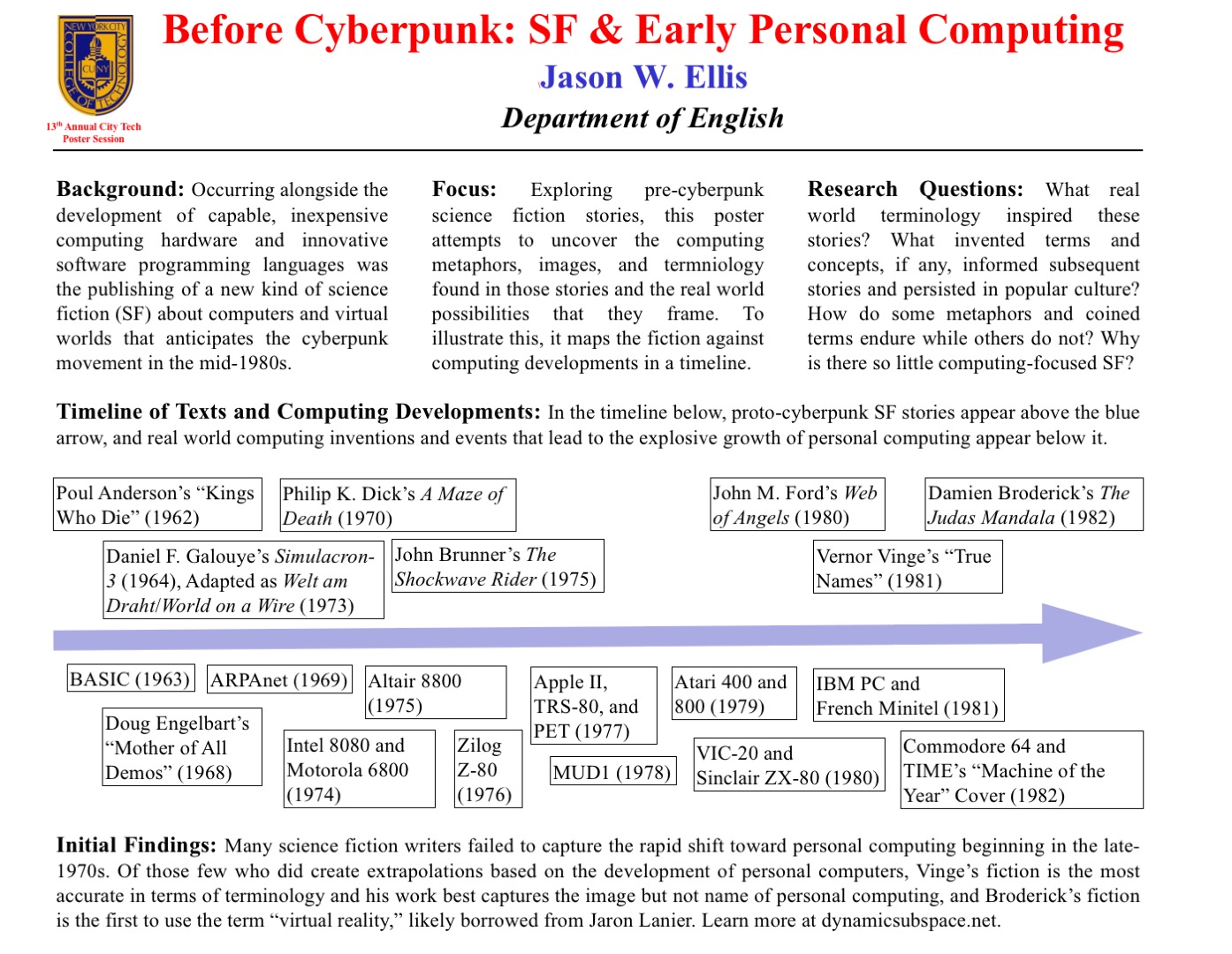
  • Before Cyberpunk: Science Fiction and Early Personal Computing (for the 13th City Tech Poster Session)

    ellis-40x31_poster-template-landscape

    For the New York City College of Technology, CUNY’s 13th Annual Research Poster Session, I created the poster embedded above to illustrate my current research on pre-cyberpunk science fiction (SF) about computing and personal computing. The poster discusses my focus and provides a timeline with SF about computing matched with key technological innovations that made the personal computing revolution in the late-1970s possible.

    What I am interested in is the fact that William Gibson’s “cyberspace” captured the popular imagination about the metaphorical place where computing, processing, navigating, interacting, and communicating occurs, but some of the very good SF about computing that predates Gibson’s coining the term cyberspace failed to leave an indelible impression. Certainly, these stories were read and circulated, but the reach of their images and metaphors seem to have been limited in scope as compared to Gibson’s writing.

    One of the ideas that I have had since creating the poster is that the idea of hidden computing or outlaw computing is something central to Vernor Vinge’s “True Names.” This, of course, features large in Gibson’s fictions, and it is the image that I am looking for in other SF of this transitional era.

    At the poster session, I will carry my Raspberry Pi-based touchscreen-computer-in-a-Suntory-box-from-Japan to demonstrate the idea of hidden computing. I will post a step-by-step instruction post soon about assembling the Raspberry Pi-based computer and offer some additional thoughts about how I would like to use them in my technical communication classes.

    In this post, I want to provide some of my notes and links to relevant resources as a record of the initial research that I did in preparation of this poster. It is my hope that it might lead to conversations and collaborations in the future.


    Fiction Sources

    Murray Leinster’s “A Logic Named Joe” (1946): Home computers connected to a large scale network. [Couldn’t fit within poster dimensions, but a significant work that needs mentioning.]

    Isaac Asimov’s “The Fun They Had” (1951): Children discovering a print book are agog at what it represents while their classroom/desktop teaching computers flash mathematical fractions at them. [Couldn’t fit within poster dimensions, but another important work in this genealogy.]

    Poul Anderson’s “Kings Who Die” (1962): Human-computer interface, according to Asimov and Greenberg in The Great SF Stories #24, “one of the first stories to address this question” (69).

    Daniel F. Galouye’s Simulacron-3 (1964): Also published as Counterfeit World. Adapted as Welt am Draht/World on a Wire (1973). Simulated reality for artificial beings programmed to believe (except in the case of one character) that they are real and living in the “real world.”

    Philip K. Dick’s A Maze of Death (1970): A crew in a disabled spacecraft while awhile their remaining lives in a computer generated virtual world.

    John Brunner’s The Shockwave Rider (1975): Computer programming and hacking. First use of the term “worm” to describe a type of self-propagating computer program set loose on the computer network. Protagonist as outlaw.

    [Five year gap during the personal computing revolution. Were the SF writers playing with their new personal computers?]

    John M. Ford’s Web of Angels (1980): The “Web” is a communication and computing network connecting humanity. “Webspinners” are an elite group of programmers who can manipulate the Web in unique and unexpected ways. Protagonist as outlaw.

    Vernor Vinge’s “True Names” (1981): Computing power hidden from view of a watchful government–literally under the floor boards. Early MMORPG/virtual reality experience of what was later called cyberspace. Protagonist as outlaw.

    Damien Broderick’s The Judas Mandala (1982): First SF to use the terms “virtual reality” and “virtual matrix.” Protagonist as conspirator/outlaw?


    Nonfiction Sources

    Cavallaro, Dani. Cyberpunk and Cyberculture: Science Fiction and the Work of William Gibson. New Brunswick, NJ: Athlone Press, 2000. Print.

    Ferro, David L. and Eric G. Swedin. Eds. Science Fiction and Computing: Essays on Interlinked Domains. Jefferson, NC: McFarland, 2011. Print.

    Kay, Alan C. “A Personal Computer for Children of All Ages.” ACM ’72 Proceedings of the ACM Annual Conference – Volume 1. New York: ACM, 1972. n.p. Web. 18 Nov. 2015.

    Mowshowitz, Abbe. Inside Information: Computers in Fiction. Reading, MA: Addison-Wesley, 1977. Print.

    Murphy, Graham J. and Sherryl Vint. Beyond Cyberpunk: New Critical Perspectives. New York: Routledge, 2010. Print.

    Slusser, George Edgar and TA Shippey. Eds. Fiction 2000: Cyberpunk and the Future of Narrative. Athens: University of Georgia Press, 1992. Print.

    Stableford, Brian. Science Fact and Science Fiction: An Encyclopedia. New York: Routledge, 2006. Print.

    Timeline of Computer History. Computer History Museum, 2015. Web. 18 Nov. 2015.

    Warrick, Patricia. The Cybernetic Imagination in Science Fiction. Cambridge: MIT, 1980. Print.


  • Living in the Present with Vintage Computers, and Reading the Past as a Netrunner: On Reading William Gibson’s All Tomorrow’s Parties

    Having just finished William Gibson’s All Tomorrow’s Parties (1999) and thus concluding his Bridge Trilogy, I cannot say with anything resembling certainty that I have read or not read these novels before. As I said when I began writing a few notes on my blog about Virtual Light and Idoru, I have a creepy feeling of having been in these novels before, of having read them sometime and some place. If I have encountered these novels directly before, the memory source for those encounters is locked away in some inaccessible part of my memory. Anyways, if I did read them before and there should be some memory, I am hopeful that it is still there and simply inaccessible to my mind’s eye in the present and not eradicated by some biological injury.

    Despite my memory’s misgivings and uncertainty, I can certainly say that I enjoyed this vision of the future/present/near past illustrated in the fast and sharp language Gibson lays down in these three novels. In All Tomorrow’s Parties, we experience Laney’s virtuosity as a netrunner who builds alliances/buys alliances that out maneuvers the 0.001%er Harwood. Laney’s ability as a psychopharmacologically enhanced cyborg who can see the flows of data, understands what we have all just recently learned about the power of metadata, and seizes the accreting eddies and currents of information, narrative, and inevitability leading to something bigger, powerful, and otherwise unseen–an undertow of history.

    Laney as netrunner seems an analog of what we have all become in one way or another. We manage our flows of information with RSS feed aggregators, news readers, the Facebook wall, the Twitter feed, the timeline, hashtags, tagging, Friend lists, Google+ Circles, subscriptions, etc. Before all of this, there was talk in the magazines about creating intelligent agents–small programs that would scour the Internet for the information and news that we would like to learn more about (perhaps through keywords and other coded instructions)–that helped manage what we read and saw while also managing our precious pre-broadband bandwidth.

    It is worth noting that in both cases, watching the firehose of feed data now or harvesting news bits with intelligent agents, all data written by someone for the info consumption of others is a practice of historic preservation, archivization, observing what has come before. Taken one step further, none of us experience the present due to our biological senses and cognition systems that delay our experiencing the world beyond ourselves. Thus, the netrunner (and ourselves as modern netizens) are a further step away–observer experiences, reports multimodally over the Internet, we experience the multimodal report. To go further on this point or digress on the transformation of these experiences by the media and modal channels involved would likely cover several volumes, so I will end the digression here.

    There are times when I feel like Laney must have felt in his dank cardboard hovel in the Japanese train station. Surrounded by his own filth and barely holding on to life with a ritual of cough syrup and sugars to keep his body barely operational but well enough that he could remain plugged into the data feed via his VR eye goggles. Trying to keep up what is going on in the world, going on with family and friends, going on professionally via the numerous and multiplying channels of social and broadcast media is daunting. It is a burden–a heavy one at that. Any attempt that I make at streamlining, modulating, organizing, and taming these never ceasing feeds of information makes me feel overwhelmed, lacking control, and otherwise wasted. My own compulsion to try to keep up, to interact, and to communicate in kind leaves me feeling dread over joy more often than not.

    At least in Laney’s case in All Tomorrow’s Parties, he is working toward a goal of swinging the nodal point away from Harwood and towards something different, perhaps altruistic and thus the many Rei Toei’s are born of nanotech assemblers in the many Lucky Dragon establishments.

    Another interesting image for me and my work as a researcher of our shared digital culture is the Bad Sector shop on the San Francisco side of the bridge. Chevette finds Tessa outside the Bad Sector shop working on her tiny video drone, God’s Little Toy (an increasingly ubiquitous and problematic technology today ranging from privacy violation to public safety in the air and on the ground). Later, Rydell goes to the Bad Sector to obtain two cables for Rei Toei’s holographic projector. Inside the Bad Sector shop, Gibson describes its Jurassic technologies–lingering on audio recording media going back to the beginning and vintage personal computers–particularly those encased in beige. Of course, the shop’s name refers to a bad sector on computer readable magnetic media–a physically unreadable or damaged location on the media platter–floppy or hard disk.

    For media archivists, the bad sector is like a burned or rotted page in an ancient manuscript. There is the possibility that the data might exist copied by the manipulations of digital technology far more quickly than that by a human scribe, but if no copy or backup exists, the bad sector–depending on the type of magnetic media, its data density, etc–could leave some information permanently inaccessible. Although, I can imagine a bad sector can, in some very particular circumstances, tell us things about how technology-as-culture was developed and continues to develop (the physicality of drive mechanisms, error correction algorithms, the application of scientific principles to avoid physical destruction of the drive media, the deformities or problems with a given writer’s computer setup, how that writer’s computer influenced the development of cultural works–lost drafts, overwritten work, etc.). So, the bad sector can be seen as a loss on the one hand and potentially a gain for understanding on the other.

    My office at City Tech (and the previous labs of vintage computer that I have built up, sold off, donated over the years beginning at my childhood home in Brunswick, GA, my flea market booth at Duke’s Y’all Come Flea Market in Darien, GA, my home in Norcross, GA, the Special Collections of Georgia Tech’s Library Archives, and now my college in Brooklyn, NY) is kind of like the Bad Sector on the bridge. It is cobbled together. It is incomplete. It is bricolage. It is pieced and held together with equal parts ingenuity and duct tape. Unlike the Bad Sector in All Tomorrow’s Parties, it is mine and not something bought and sold by off-bridge investors. Like the bridge in the novel, my vintage/retro computing lab is a community effort–I get and give, others get and give. I work on it and at it to remember where we have come from and to reflect on how our past innovations inform and continue to speak to our current digital culture. I want its archive to provide testimony about who we were and who we have become as human beings and thinking organisms. It is part of my research and pedagogy.

    William Gibson’s Bridge Trilogy (Virtual Light, Idoru, and All Tomorrow’s Parties) is an impressive vision. My deja vu or amnesia–depending on your point of view–about the novels might say more about how much like the present some themes and images in Gibson’s novels speak to the way things were and are in the real world.

  • What Do We Call Their Union: On Reading William Gibson’s Idoru

    Continuing with William Gibson’s Bridge Trilogy, I read Idoru (1996) this past Sunday.

    My sense of deja vu was as pronounced as when I read Virtual Light, but I still cannot bring myself to say with absolute certainty that I had read these books before. I tend to believe that my triangulation of these narratives from conference going and secondary literature reading have implanted the seeds of these novels in my memory–with roots long, but stem and leaves stunted–almost translucent.

    Idoru circles the entertainment-industrial complex’s creation of celebrity, fandom’s eclipsing of the actual cultural production of celebrity, personal metadata and its uses for surveillance and control, and another trajectory of emergent AI/personality construct–in this case the idoru, Rei Toei.

    Rei Toei is like a more advanced version of the vocaloid, Hatsune Miku. Her entrance into the real world might be more aligned today with 3D printing technologies and robotics like Danny Choo’s Smart Doll (though, I’m sure Mr. Choo would do equally interesting and exciting things if he got his hands on a packet of self-assembling nanomachines described in the novel). Or, in 2009, a Japanese man married Nene Anegasaki, a character from the Nintendo DS game Love Plus (Telegraph story, BoingBoing video). These bonds are so strong that in 2012, a Japanese groom and his bridge destroyed his Nintendo DS and Love Plus game cartridge, which held his saved game data with (again) Nene Anegasaki (Kotaku story, Twitter post).

    I recalled David Levy’s Love and Sex with Robots: The Evolution of Human-Robot Relationships (2008), which explores how humanity’s relationships with its technologies–especially those anthropomorphized or imbued with human qualities–has and continues to change over time.

    In regard to Rez’s desire to wed Rei Toei, on the one hand, the union is of celebrity–albeit two forms of it: a human male musician and an AI construct gendered female and given form holographically (machinery and bandwidth permitting). What should we call this sameness?

    On the other hand, it is a union of biological and technical, human and computer, human and technology, human and entertainment, human and the Other. What should we call this difference?

    However, the wedding of human-AI construct seems pedestrian, a reinscription of heteronormativity. It is a capitulation to heteronormative culture instead of an embrace of the newness, the otherness, the differentness brought about by human-technology co-evolution (thinking of Bruce Mazlish’s The Forth Discontinuity).

    Considering its heteronormative trajectory, what is Rez and Rei Toei’s marriage produce? Seems like there’s talk about some kind of becoming or emergence. This brings to mind arguments like Leo Bersani’s in “Is the Rectum a Grave?” or Christine Overall’s in Why Have Children? It should go without saying that a child need not be the result of a union/marriage/partnership, but if we follow the heteronormative logic of Rez and Rei Toei marriage, what might their desire be–merging, emergence, becoming, creating?

    Regardless, I welcome these new developments, their possibilities, and how we account for them with language. But, I hope that the new is unshackled from simply repeating what has come before.

  • Déjà vu or Reality: On Reading William Gibson’s Virtual Light

    Over the weekend, I began reading William Gibson’s “Bridge Trilogy” beginning with his novel, Virtual Light (1993).

    Reading the novel, I had a tremendous sense of déjà vu that was impossible to shake. I asked myself these questions in response to this strange feeling that persisted during the hours of reading and after:

    Have I read this before? This is entirely possible. I used to have copies of the Bridge Trilogy novels, but I sold them before moving to Liverpool for graduate school. As I look back on my blog–or am reminded of things I have wrote about on my blog when I occasionally receive and respond to a comment on something long forgotten–I have read a number of things that I cannot now recall in my memory.

    Have I read so much secondary literature about it that I feel as if I have read it? This is definitely a possibility, because I read through a lot of secondary literature on Gibson’s oeuvre as I was writing my dissertation and in preparing for my research trip to the University of California, Riverside Library in 2012. In academia, I have found myself circling works through the secondary literature. I learn bits and pieces through summary and arguments that I then piece together in my mind as a kind of jigsaw puzzle version of the work in question. You triangulate the narrative and characters from that data that you have. Of course, this is not the same as having read the real thing, but it is akin to how we know about some Greek dramas and ancient philosophies–the surviving references instead of the thing itself.

    Are there so many aspects of the present (or recent past) like those we encounter in Virtual Light that I feel as if the novel mirrors the present? Besides the image of the bridge and its bricolage/assemblage/community, Virtual Light has augmented reality, navigation systems, cracking car computer/communication system, SWATTING (of a kind), armed drones, an erased Middle Class, a San Francisco dependent upon the service industry, and a security-industrial complex. I recently read Bruce Sterling’s The Hacker Crackdown (1992), which seems to figure into the novel by anecdote and theme (differentiating hackers/merry pranksters from hackers/criminalization). The connection between the themes of his over two-decade old novel and the present is strong. Maybe it should be required reading for contemporary security analysts.

    So, have I read it before? I’m still not sure, but I’m left with a strange feeling about the novel and the present.

  • Science Fiction, LMC3214, Summer 2014: Exploring Cultural Connections Through Haptics and LEGO

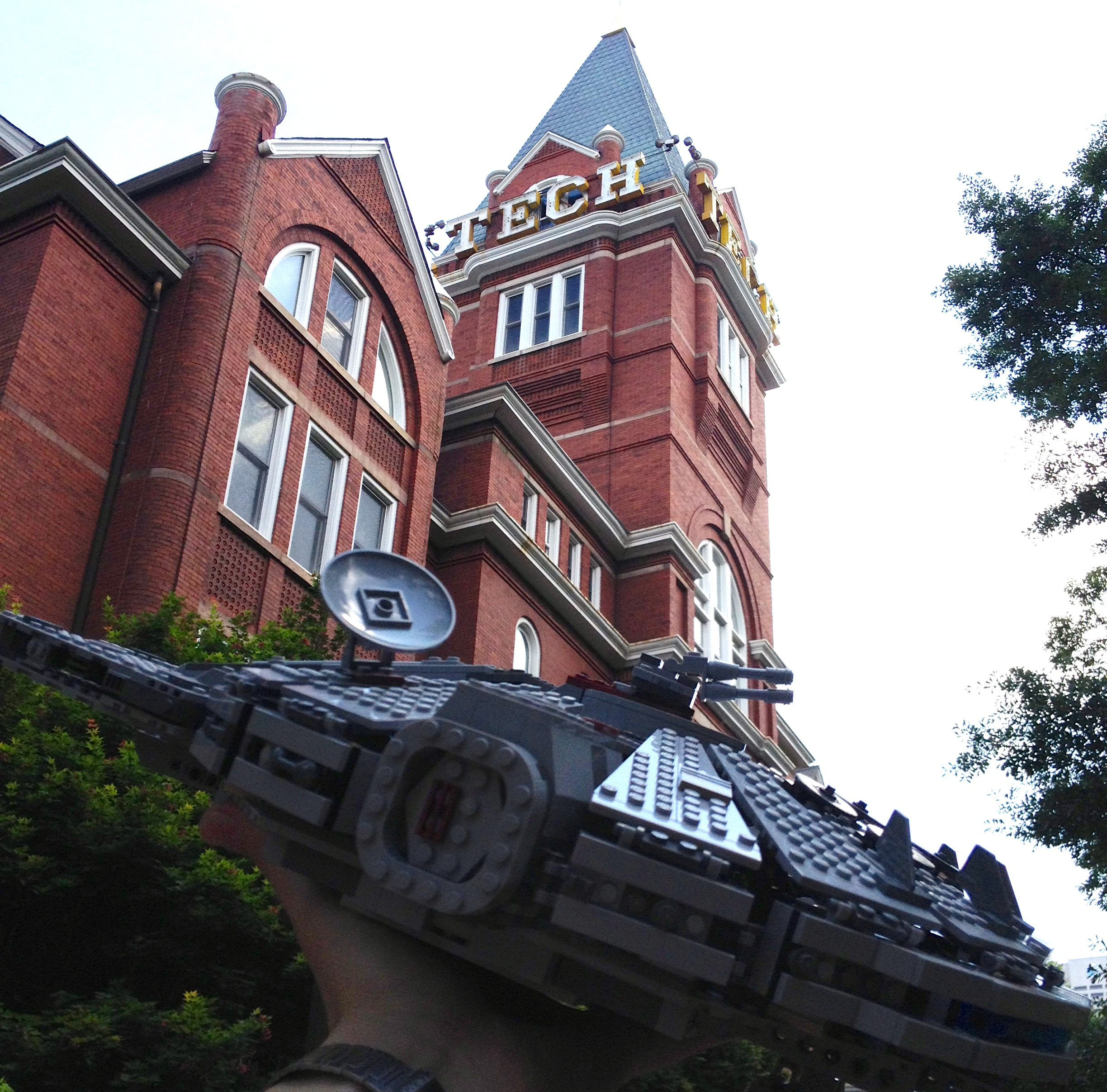
    The Millennium Falcon circles Tech Tower.
    The Millennium Falcon circles Tech Tower.

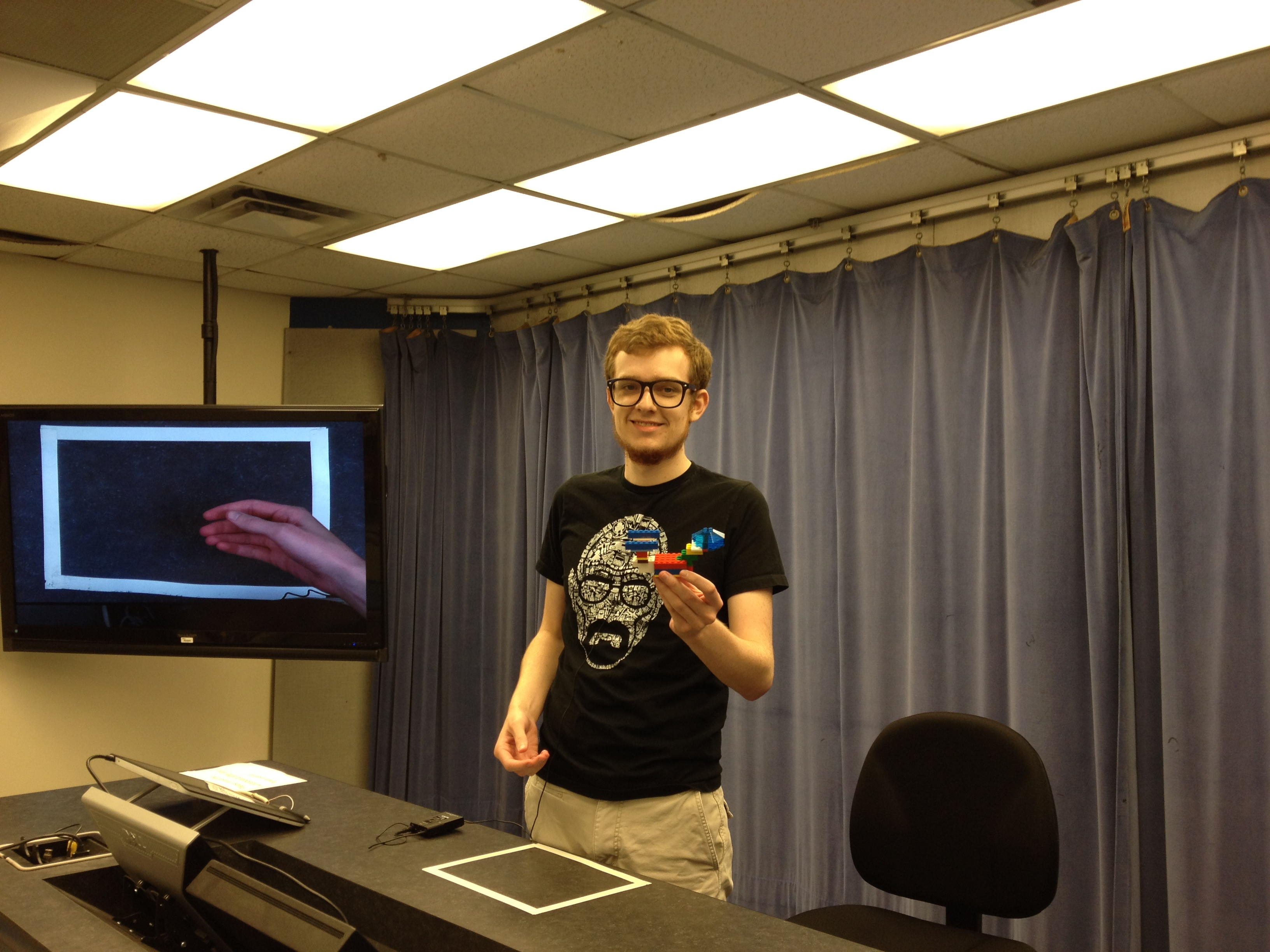
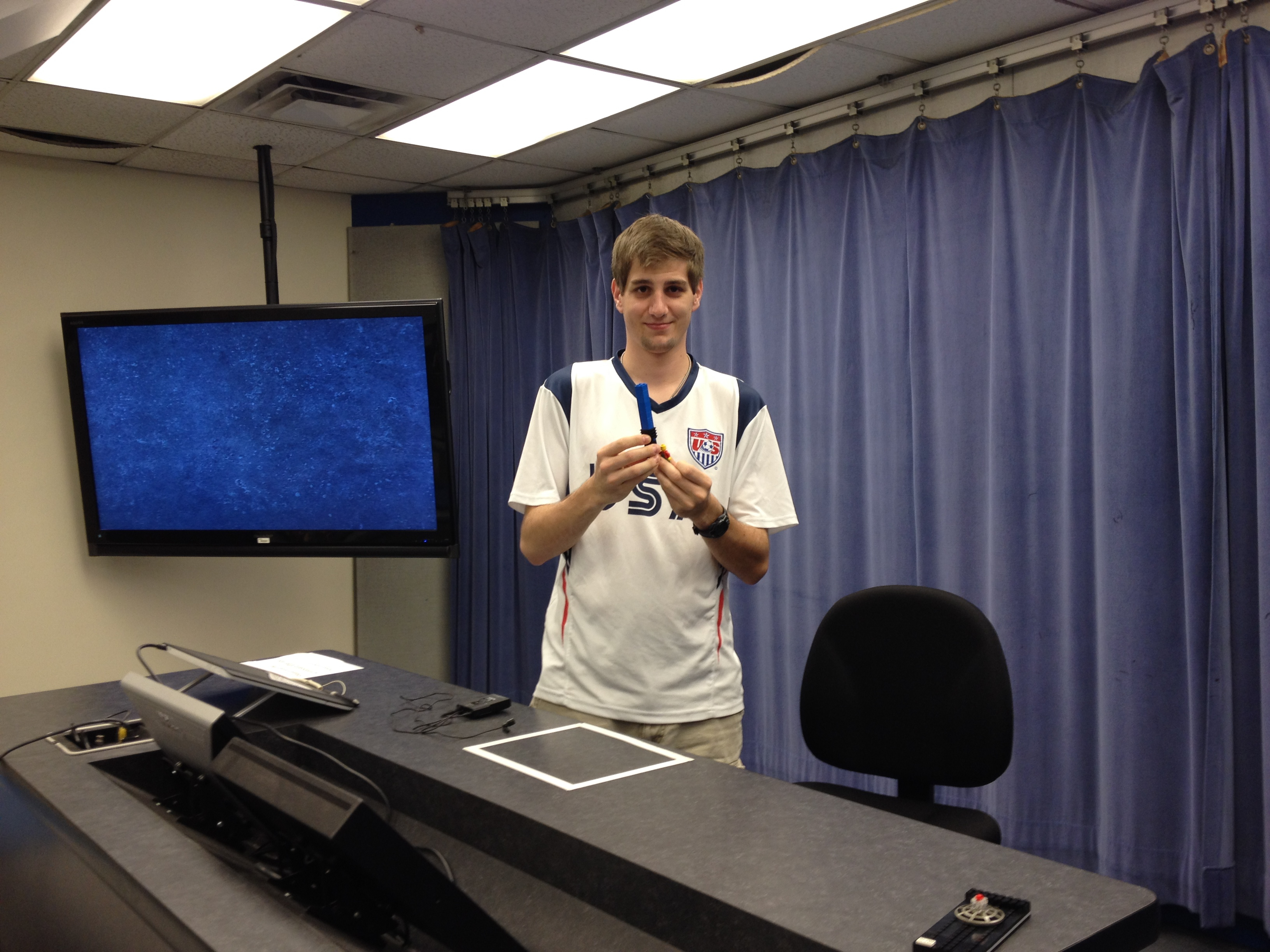
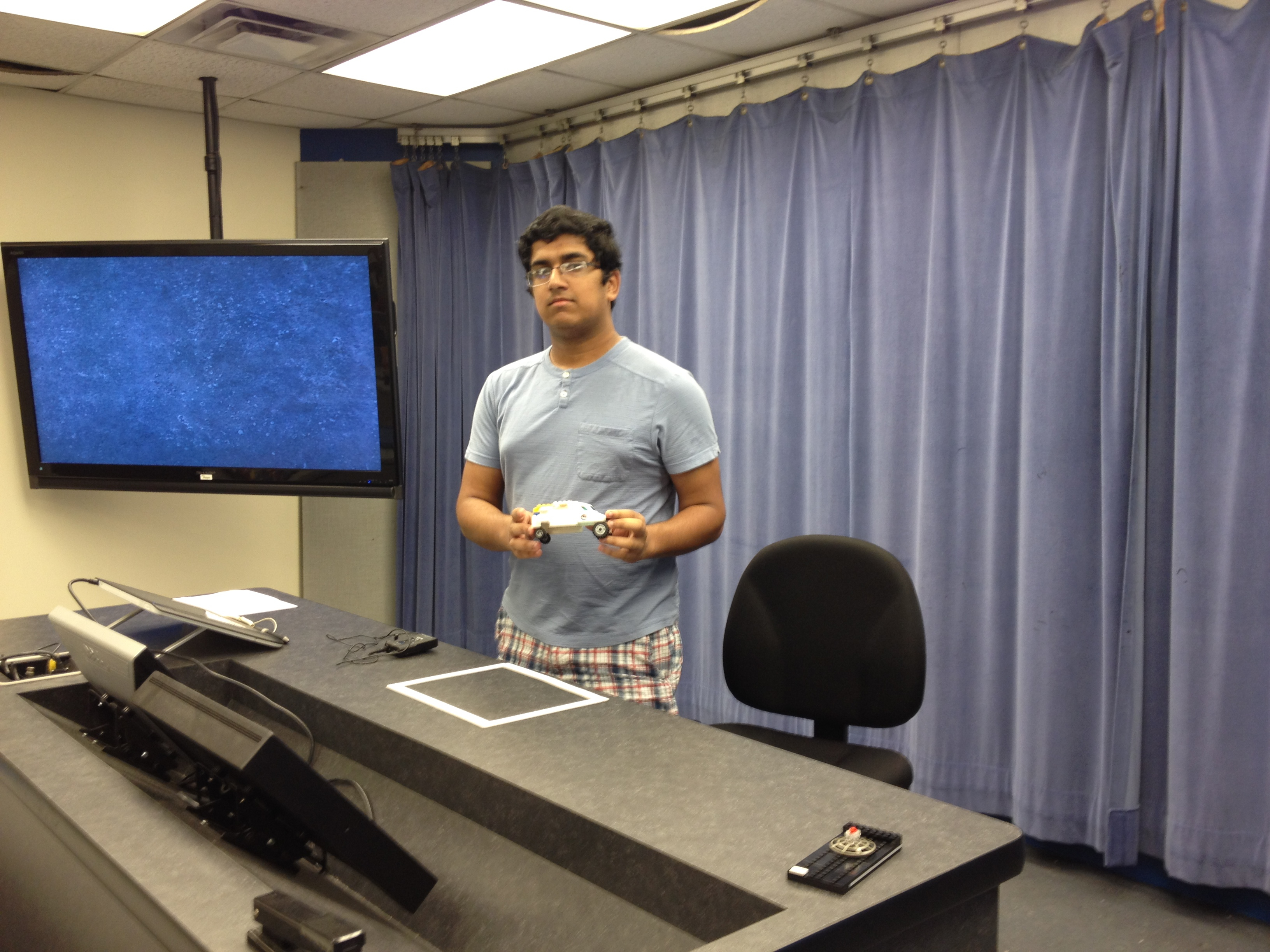
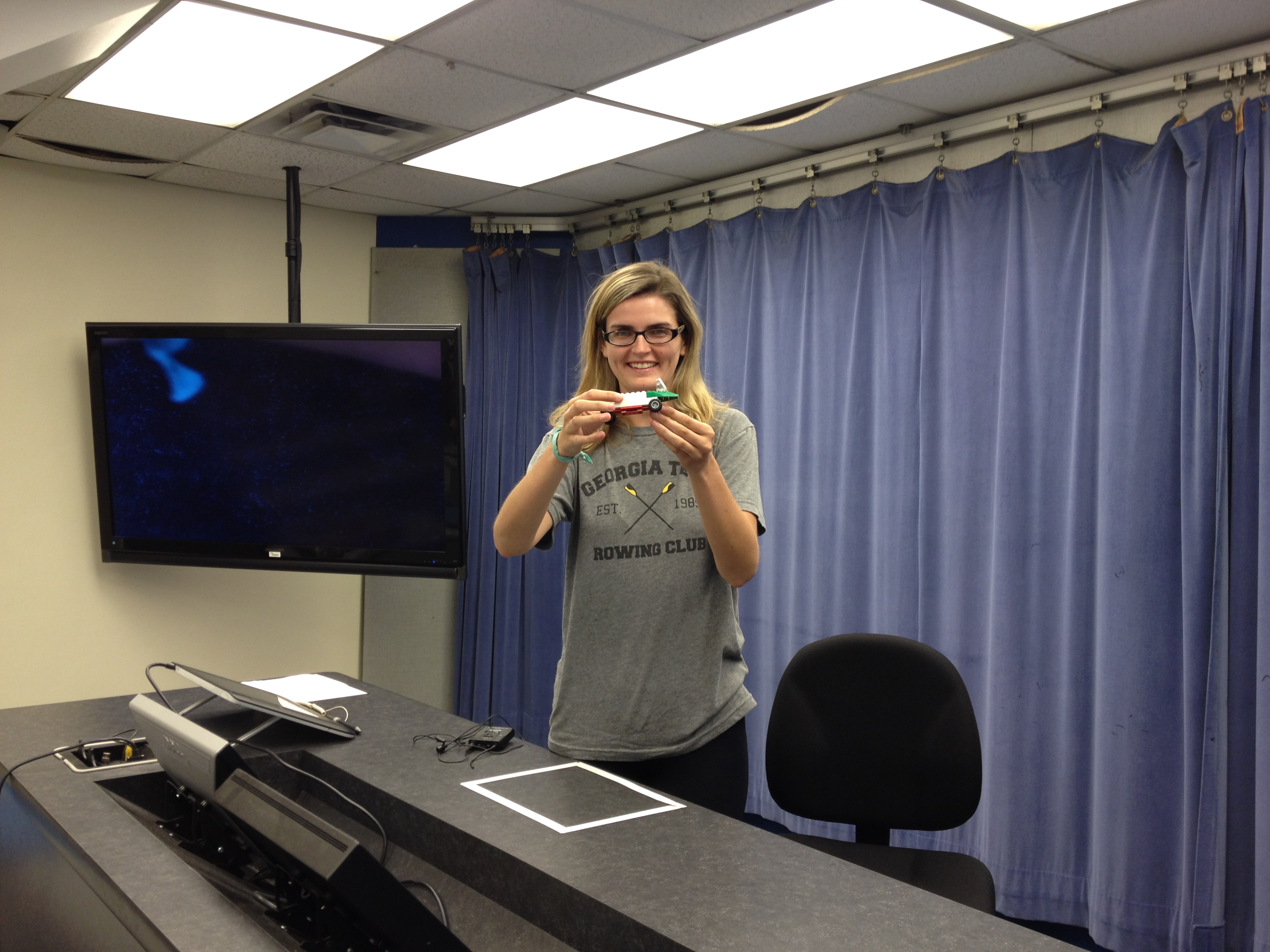
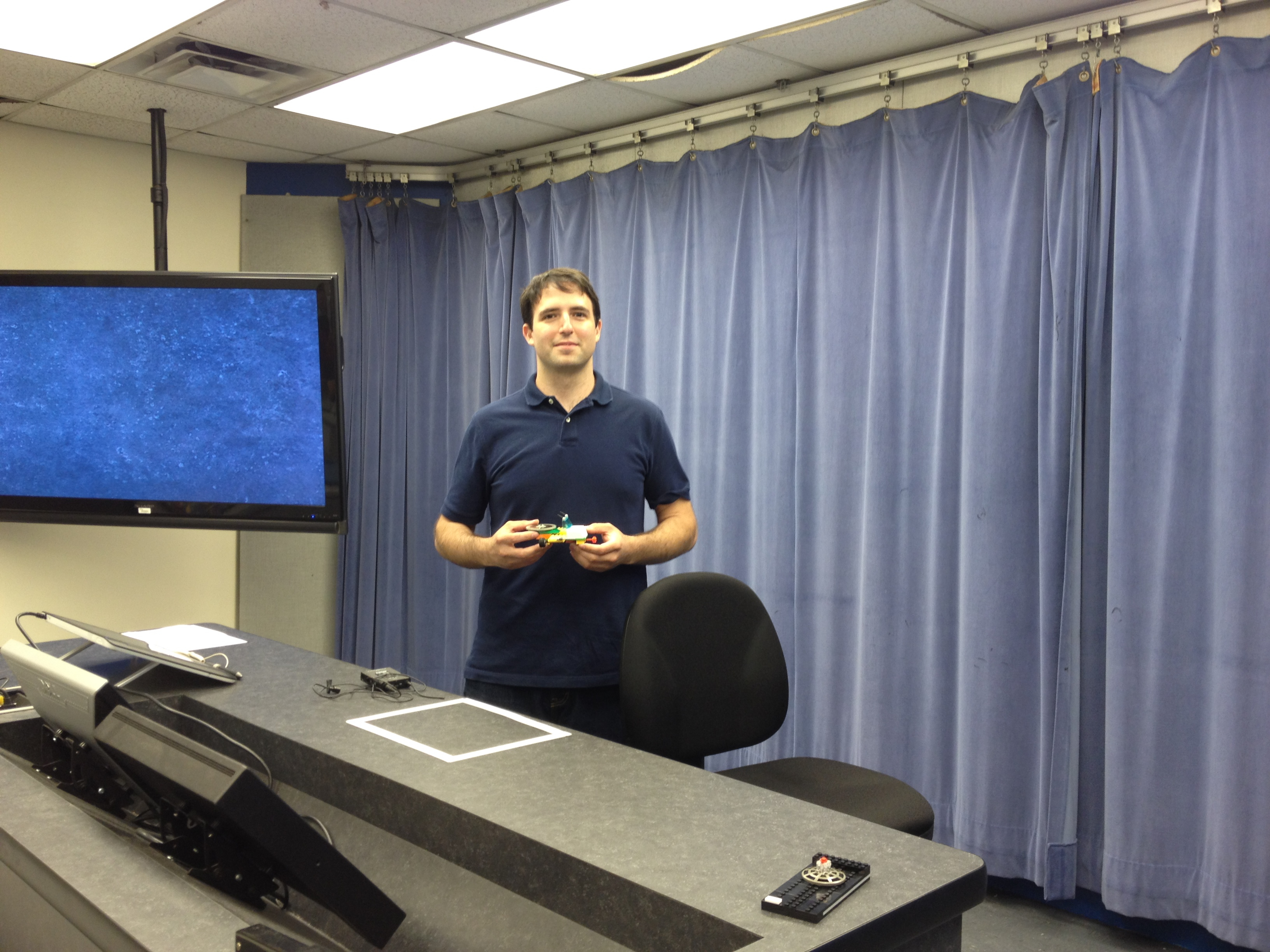
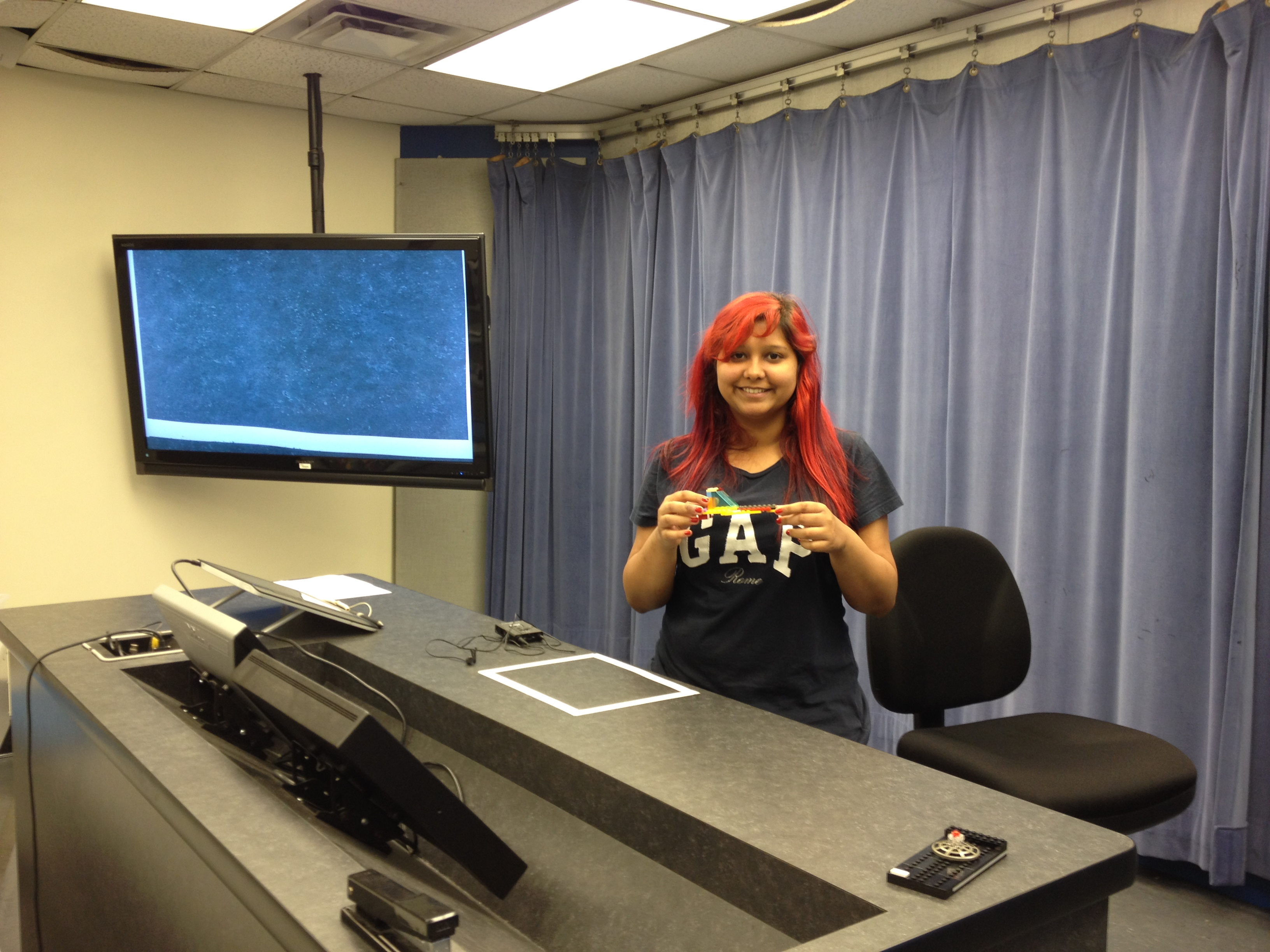
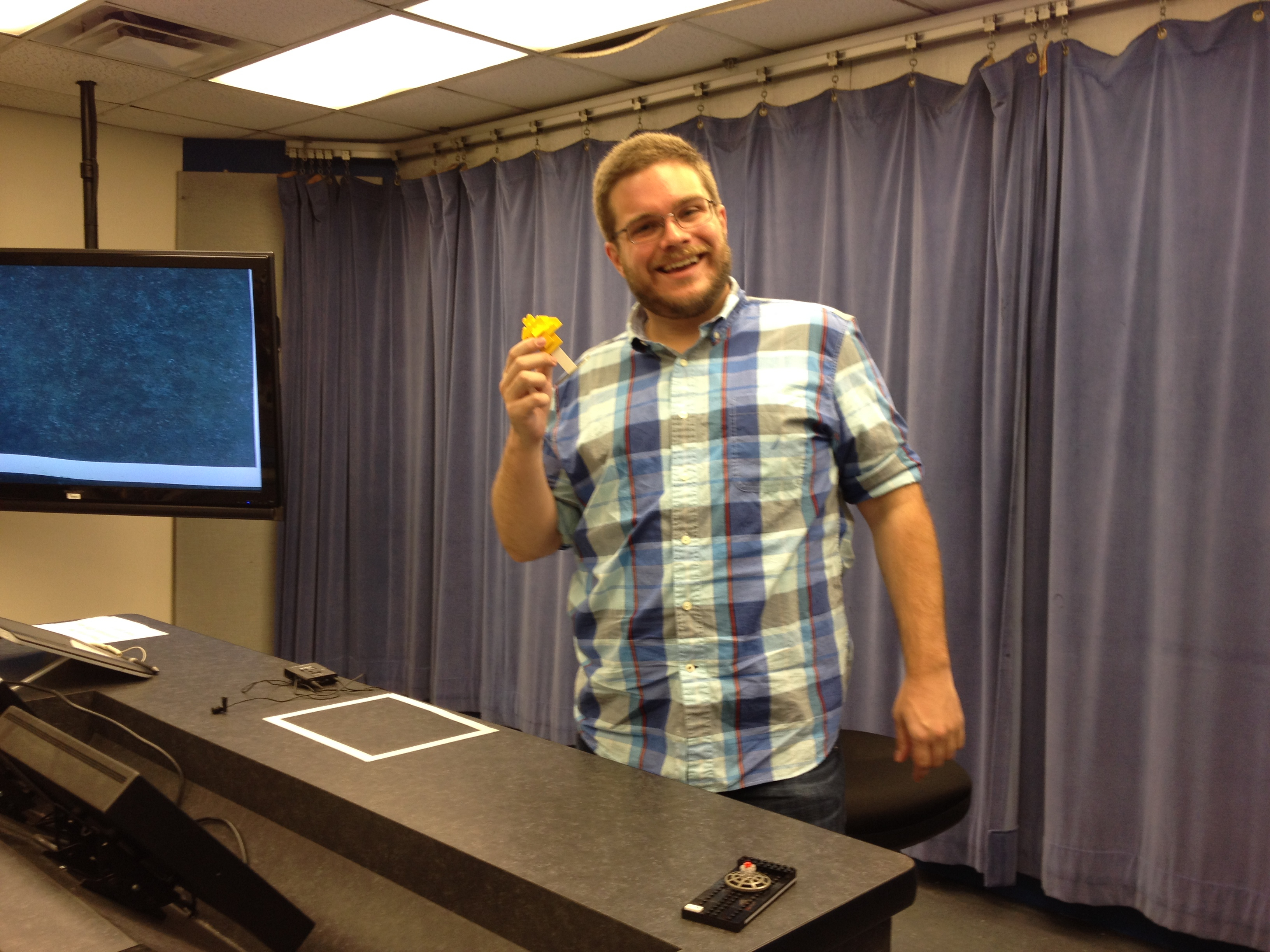
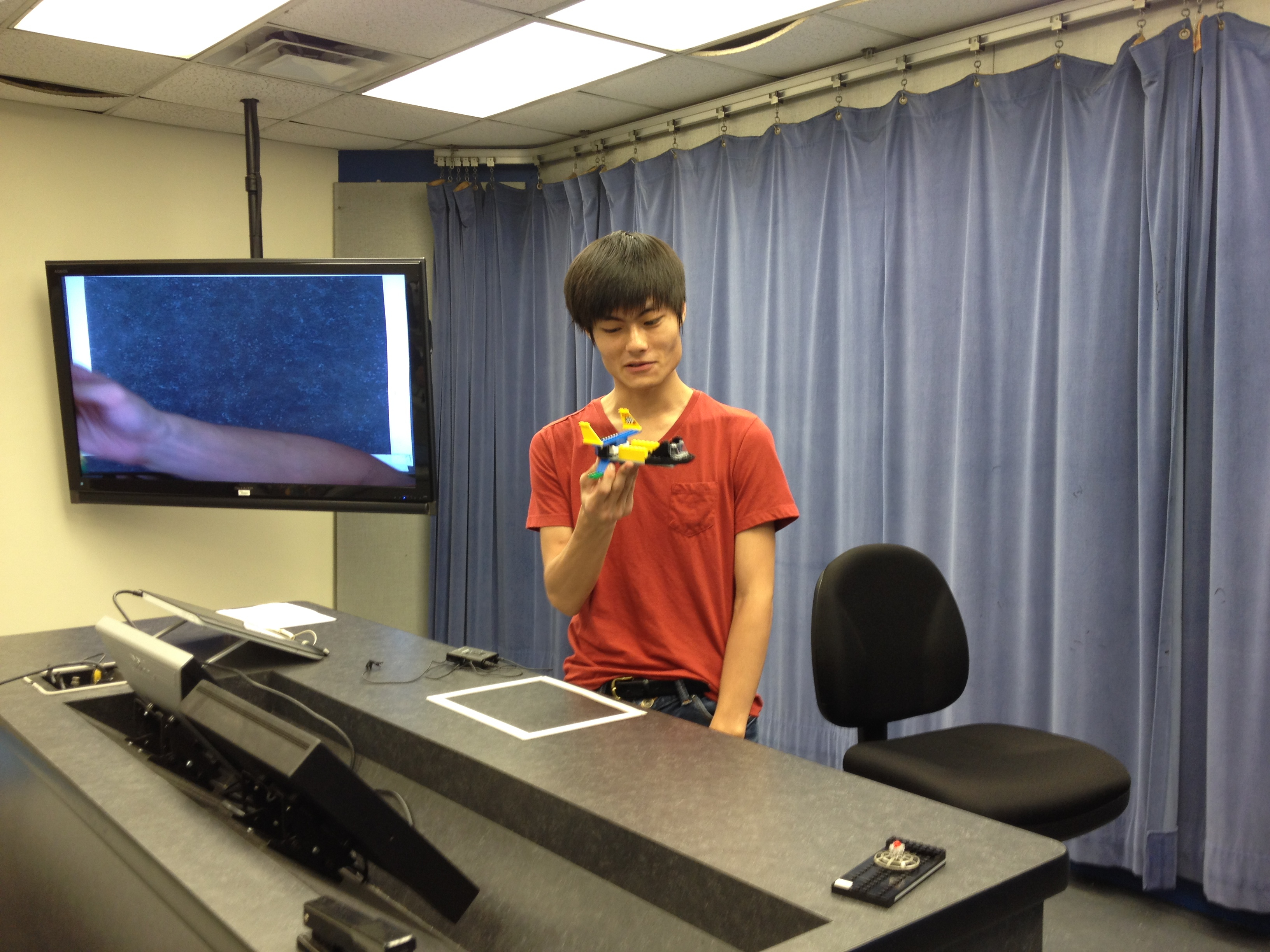
    Before closing out the last class that I would teach at Georgia Tech as a Brittain Fellow, I brought a great big container of LEGO bricks to class for my students to explore and enjoy thinking about science fiction with haptics. As I had done last year, I invited my students to think of something from their experience of science fiction that emblematized what science fiction means to them. Put another way, I asked them to build a model of the thing that first comes to mind when they think of science fiction. It could be a robot, blaster, rocket, cyborg, computer, spaceship, etc. Whatever it was, I wanted them to use the available bricks to build an approximation of the thing, present their model to the class, and explain its provenance. I would add to each presentation of a LEGO MOC (my own creation) with additional SF examples and historical relevances.

    The challenge to this assignment was that 2/3 of the class were taking the course remotely online. While I invited students to build something and share it on Twitter, few did or were able to do so before class that day. One online student joined us for the on-campus class, which added one more student to the mix and was much appreciated by me and his peers.

    After giving instructions and discussing haptics, I gave the students about 25 minutes to find bricks and build their models.

    Then, students were invited to come to the front of the class, place their model under the document camera for the benefit of online students, and tell us about their creation and its inspiration to them.

    Matthew and his model of the Starship Enterprise NCC-1701-D from Star Trek: The Next Generation.
    Matthew and his model of the Starship Enterprise NCC-1701-D from Star Trek: The Next Generation.
    Jarad and his lightsaber from Star Wars.
    Jarad and his Jedi lightsaber from Star Wars.
    Aditya and his moon rover.
    Aditya and his moon rover.
    Lauren and her planetary rover.
    Lauren and her planetary rover.
    Tyler and his TARDIS.
    Tyler and his TARDIS.
    James and his spacecraft.
    James and his spacecraft.
    Peter and his flying car.
    Peter and his flying car.
    Roxanne and her spacecraft.
    Roxanne and her spacecraft.
    James and his Daban Urnud ship from Neal Stephenson's Anathem.
    James and his Daban Urnud ship from Neal Stephenson’s Anathem.
    Sang and his futuristic aircraft.
    Sang and his futuristic aircraft.

    I was proud of the creations and connections that my students made during this end-of-semester exercise. Despite a number of same types of SF emblems (air/spacecraft), each student assumed a different approach and had different points of origin for their inspiration. Also, no two models were alike. Each one is a expression of the individual using a three-dimensional modeling art and design form–LEGO.

    Besides drawing on different kinds and ways of thinking for this exercise, I know from students comments that they appreciated having a creative outlet in the class beyond their analytical final papers, which are creative in other ways (argumentation, research, prose writing, professional formatting/design, etc.).

    Some of them choose to keep their models while others let me keep their models to show future students.

    LMC3214, Summer 2014 Class Photo.
    LMC3214, Summer 2014 Class Photo.

    Finally, my Science Fiction class would not have been possible without the technical support of Ted Skirvin, who worked with me to use the affordances of the room with my teaching style while accommodating the needs of online students.

    Ted Skirvin of Georgia Tech's Global Learning Center.
    Ted Skirvin of Georgia Tech’s Global Learning Center.