Tag: Science Fiction

  • Recovered Writing: Undergraduate Science Fiction Final Paper, Exploring SF Themes of Human Technomediation in Blake’s 7, July 26, 2002

    This is my inaugural post in a new series titled, “Recovered Writing.” I am going through my personal archive of undergraduate and graduate school writing, recovering those essays I consider interesting but that I am unlikely to revise for traditional publication, and posting those essays as-is on my blog in the hope of engaging others with these ideas that played a formative role in my development as a scholar and teacher. Because this and the other essays in the Recovered Writing series are posted as-is and edited only for web-readability, I hope that readers will accept them for what they are–undergraduate and graduate school essays conveying varying degrees of argumentation, rigor, idea development, and research. Furthermore, I dislike the idea of these essays languishing in a digital tomb, so I offer them here to excite your curiosity and encourage your conversation.

    This essay was my final project in Professor Lisa Yaszek’s Science Fiction class at Georgia Tech in the summer semester of 2002. My friend Mark Warbington had recently introduced me to Blake’s 7, which I immediately liked. There were a lot of cross-connections between the subject matter of our SF class and Blake’s 7, which I found exciting and pointed the direction for some of my future scholastic work. Specifically, I wrote about technological mediation of human experience, memory, and perception in this groundbreaking British SF series.

    Jason W. Ellis

    Professor Lisa Yaszek

    LCC3214 Science Fiction

    July 26, 2002

    Final Paper: Blake’s 7

    Blake’s 7, the BBC science fiction television show that ran from 1977-1981, has many characters who are either computers/robots or cyborgs. These characters are either all technology or their person has been radically altered by technology. Their character traits or level of technical mediation often is reflective of their role as “good” or “bad.” These representations bring into question concepts such as “human” and “identity” in a world where technological mediation is dictated by an oppressive government.

    Roj Blake is the main character of Blake’s 7 and he is a cyborg. His life experiences have been mediated with the use of chemicals and psychological treatments designed to alter his memories and divert his way of thinking in a way different from how he would have wanted it to be. When the series opens in the episode, “The Way Back,” the first scene is of a menacing black video camera, topped by a red indicator light, diligently scanning the prosaic passing by of pedestrians along a corridor. The black video camera serves as an always watchful eye over the citizens of the Earth Federation. Among the pedestrians is Blake. He is meeting with a young woman, Ravella, who is going to take Blake to meet with a man who has news of Blake’s family–at least as far as Blake knows. As they are walking Ravella asks Blake, “And eating and drinking — you’ve managed to do without?” Blake answers in an irritated voice, “Well, since you were so insistent I’ve done without food or drink for thirty-six hours.” Ravella asks him if he feels any different. Blake says that he does not. She then says, “All our food and drink is treated with suppressants. Going without for a day and a half, they should be wearing off.” Blake says laughing, “Not that again.” Blake doesn’t know that he has been modified by the Federation after he gained prominence as a renegade leader against the Federation. Instead of making a martyr out of Blake, the Federation turned him into a pawn for their uses. They had him admit his guilt and then denounce the work he had once done against the Federation. Later Blake finds his way back to who he really is, but as is shown in later episodes the Federation programming is still a part of him. This long term programming does not cause him to be “bad,” but it will allow control over his thought processes to an extent that the Federation can bring Blake to them as part of a ruse.

    An extension to Federation reprogramming of people to serve a purpose is the use of Mutoids. In the second season episode “Duel,” Space Commander Travis has set a trap for Blake. Travis’ helmsman is a female Mutoid. Prior to the space battle between Travis’ ships and Blake’s Liberator, the Mutoid takes a small vial of liquid and places it in a recess on her chest. During their discussion the Mutoid refers to Travis as “an unmodified” and Travis acknowledges her “need for blood serum.” The Mutoid also notes, “Opponents of mutoid modification call us vampires.” The reason for this reference is made later in the episode when the Mutoid is in need of serum and she tries to supplant her needs by draining the blood out of bat like creatures. Then the Mutoid captures Jenna of Blake’s crew and the Mutoid extends a long hypodermic needle from her arm gauntlet, but Travis stops the Mutoid before she is allowed to use it. On the night before Jenna’s capture Travis and the Mutoid are waiting up in a tree for daylight. Travis asks the Mutoid, “Tell me something, do you remember who you were?” Travis is referring to the Mutoid’s life before she was “modified.” Travis is clearly attracted to the Mutoid and he tries to interest her with information about her past, “Your name was Keyeira…You were very beautiful, very much admired.” Unfortunately for Travis the Mutoid had no interest in her past life. Her transformation from Keyeira to the Mutoid was complete and unencumbered. The chemical and technological alterations to her body made her a cyborg. Her mental programming however made her much more like a robot in that she was self aware, but uninterested beyond what her duty was. The role of the Mutoid is a tool. She is to follow orders and be a contributing officer of the Earth Federation.

    During the second season the viewer is introduced to a clone of Blake in the episode, “Weapon.” Clonemaster Fen makes two clones of Blake based on the Federation’s “DNA identity profile” of Blake which the Clonemasters were able to deduce “a full genetic pattern” which they used to build the multiple Blakes. Clonemaster Fen says of these new Blakes, “We may copy life. We may not create new forms. This man is a copy of Blake, a physical copy only, because he was not grown from a cell taken from Blake. And since he has not Blake’s experiences, he cannot be Blake. We have given him some background knowledge, the beginnings of identity, and the basis of understanding.” This clone of Blake is a being grown in a laboratory and has its memory imprinted by technological means. It is a cyborg in that it was not born of woman and that its knowledge and mind were developed inside a computer and implanted with technological equipment. This clone soon meets up with another cyborg, Rashel.

    Rashel is a labor-grade slave who Coser, the inventor of IMIPAK, brings with him on his escape from the Federation. At the beginning of the episode, “Weapon,” Coser and Rashel are watching their space craft explode. Rashel keeps answering Coser as “yes, sir.” Coser responds loudly to her, “And don’t call me, sir. You’re not a slave anymore. You’re with me now. I set you free.” Not much is said of how a labor-grade slave comes to be, but looking at how the Federation has a special corp devoted to reprogramming of persons to fitted roles in society, I venture that Rashel was likewise programmed. This could have taken the form of being raised with psychological conditioning and administered drugs as in Huxley’s Brave New World, or she was like the Mutoid in “Duel,” with a unique past which was taken from her when she was reprogrammed by the Federation. Coser who says he has freed Rashel has his own problems adjusting to Rashel’s new station as a free person. He constantly bosses her around and physically acts out in rage about her sometimes not understanding a situation or something that he has said. After Rashel has been assaulted by a monster inhabiting the planet they are on, she says, “Perhaps that was the only one.” Coser angrily says, “Perhaps, perhaps! Just get on with it, will you?!” Rashel yells back to Coser, “Stop treating me like a bond slave! [Coser picks up the projector] You set me free.” In a way it seems that Rashel was programmed to fill a certain role in society and those around her who know her station respond in kind. Coser has his own programming to overcome, but he is soon killed by the weapon he created so he doesn’t have the chance to deprogram the remains of Federation control over him.

    Rashel and the clone Blake team up to make the Federation leave the abandoned planet where the action takes place in “Weapon.” Using IMIPAK they “tag” Servalan and Travis so that if anyone activated the trigger on IMIPAK Servalan, Travis and anyone else within a million miles range who has been tagged would be killed. The Clonemasters who made the Blake clone follow “the Rule of Life.” The clone Blake slips into this mode of thinking in his conversation with Coser when they first meet. Blake laces his fingers together and says, “All life is linked.” Servalan and Travis after obtaining IMIPAK wish to use it to demand absolute control over all. If someone is tagged with the IMIPAK projector then they could be killed at any point of their life with the IMIPAK trigger. When Coser was talking to the clone Blake about the potential of IMIPAK he said, “Selected victims, groups, whole populations. You can be like God.” The clone Blake understands the potential of this weapon and it violates the primary foundation of the Clonemaster’s programming. When the life of Rashel is threatened by Travis, the clone Blake throws his arms around her and says, “No! All life must have reverence.” The clone of Blake and the freed labor-grade slave, Rashel are more positive roles of cyborgs compared to Mutoids and the negative reprogramming done by the Federation. The Clonemasters value life and instilled that in the clone of Blake. Rashel was given the opportunity of freedom despite the one who freed her not quite coming to terms with that. Together they start out as Rashel says at the end of “Weapon,” “Then we could start to explore our planet.”

    The Mutoid is the most cyborg of the characters in that her memory is erased and her body has been modified to handle much different situations than an unmodified human. The trade off is that her body is dependent on a blood serum. In being the most modified of the characters she is representative of the Federation and evil. The less technically mediated characters are those of Blake, Blake’s clone, and the freed labor-grade slave, Rashel. These characters break out of their assigned and programmed roles that the Federation has prepared for them. In doing so they become identified as “good” and they work against the Federation which is “bad.” Blake’s clone and Rashel work together to claim a planet for themselves by using a Federation weapon against that oppressive government. Blake reclaims his memories and identity after being forced to do so when the renegade organization he once led asked him back after he had been reprogrammed by the Federation to denounce them.

    After Blake, Jenna, and Avon take control of the alien space ship that Blake calls the “Liberator,” they are introduced to the ship’s computer, Zen. In the third episode, “Cygnus Alpha,” Zen introduces himself and the crew begin to see how he operates and what his and the ship’s capabilities and limitations are. Zen can control the ship on voice command. It can also monitor ship’s internal (how badly have we been damaged?) and external sensors (are there ships following us?). Zen’s integration with the ship is not completely revealed. One way of looking at Zen is that of a robot who follows certain rules and obeys orders. The difference is that the robot is built into the ship and is referred to as a “computer.” Zen is not merely a device to figure things out and process information. Zen is able to perform assigned tasks and monitor other maintenance systems onboard ship such as the automatic repair function. There is a negative side to Zen’s abilities in that it can be “taken over” and controlled by remote. Another computer/robot called Orac was able to do this, and the alien builders of the “Liberator” were able to take control of Zen and fly the “Liberator” back to its home station.

    Blake’s crew also encounters another computer called Orac who becomes one of the crew. This computer is able to view all Federation communications traffic as well as it has access to all computer stored information owned by the Federation. It is able to do this because it was built by the creator of the computer chips of most of the Federation’s computer systems. In his chip design there is a special part that Orac has access to–a kind of backdoor. Orac’s processing ability and it’s almost infinite access to information reveals that it is a very powerful computer. Again, Orac is also much like a disembodied robot in that it is able to perform assign tasks and it operates on a set of built-in rules. Orac is able to control other computer systems including Zen in the “Liberator.” Orac is subject to subversion on some of the carrier waves it uses for communication with other computer systems because it extends into dimensions outside of our own. An intelligence in another dimension once tried to use this carrier wave to enter our universe/dimension through Orac.

    Zen and Orac serve positive roles in that they serve Blake and his crew. But they are subject to the same kind of problems that affect any centralized computer system. If the central computer is compromised then the whole system is compromised.

    The prison ship serves as an analogy for the Federation in general. The ship relies on the central computer. Blake is trying to convince Avon to assist with the takeover of the ship. Blake knows that Avon’s skills are invaluable to his plan. Blake quizzes Avon on his abilities to operate the prisoner ship’s computer in the second episode, “Space Fall.” Avon responds, “ I could open every door, blind all the scanners, knock out the security overrides, and control the computer. Control the computer and you control the ship.” The Federation is also integrated to a great deal with it’s computer systems. In later episodes which culminate to the second season’s finale, “Star One.” Star One is the hidden base of the Federation’s central computer system. This computer system organizes and modulates all systems of production, economies, and weather systems on all the Federation’s worlds. It’s location is hidden even from upper command of the Federation because knowledge of its existence and its control would be the ultimate power in the Federation.

    Centralized computer systems are the norm in Blake’s 7. Those that serve good are often more humanized than those that serve the forces of oppression and the Federation. Orac and Zen have names whereas the computers of the Federation are merely “computers.” Orac and Zen talk and have a higher level of interaction with the characters than do the computers of the Federation. Federation computers often involve Federation personnel reading off displays and dials what is going on. Orac and Zen have human elements of thought and action. The Federation computers require a human mediator to supply information and retrieve information.

    Computers and cyborgs in Blake’s 7 both offer insight into the ideas of human and machine integration and interaction. Computers fill the role of the robot and information processing systems. Computers which are on the side of “good” are often more human than those on the side of “bad.” Cyborgs are presented as varying degrees of humanity reprogrammed and modified to serve a role dictated by the oppressive Federation. Some cyborgs are able to break out of this programming and in turn innovate their own programming. Others must maintain their role because of chemical necessity as is the case of the Mutoids. Those cyborgs who are less chemically mediated tend to be the more positive roles such as Blake, the clone of Blake and the labor-grade slave, Rashel.

  • Notes and Photos from Minister Faust’s LMC Distinguished Speaker Presentation at Georgia Tech

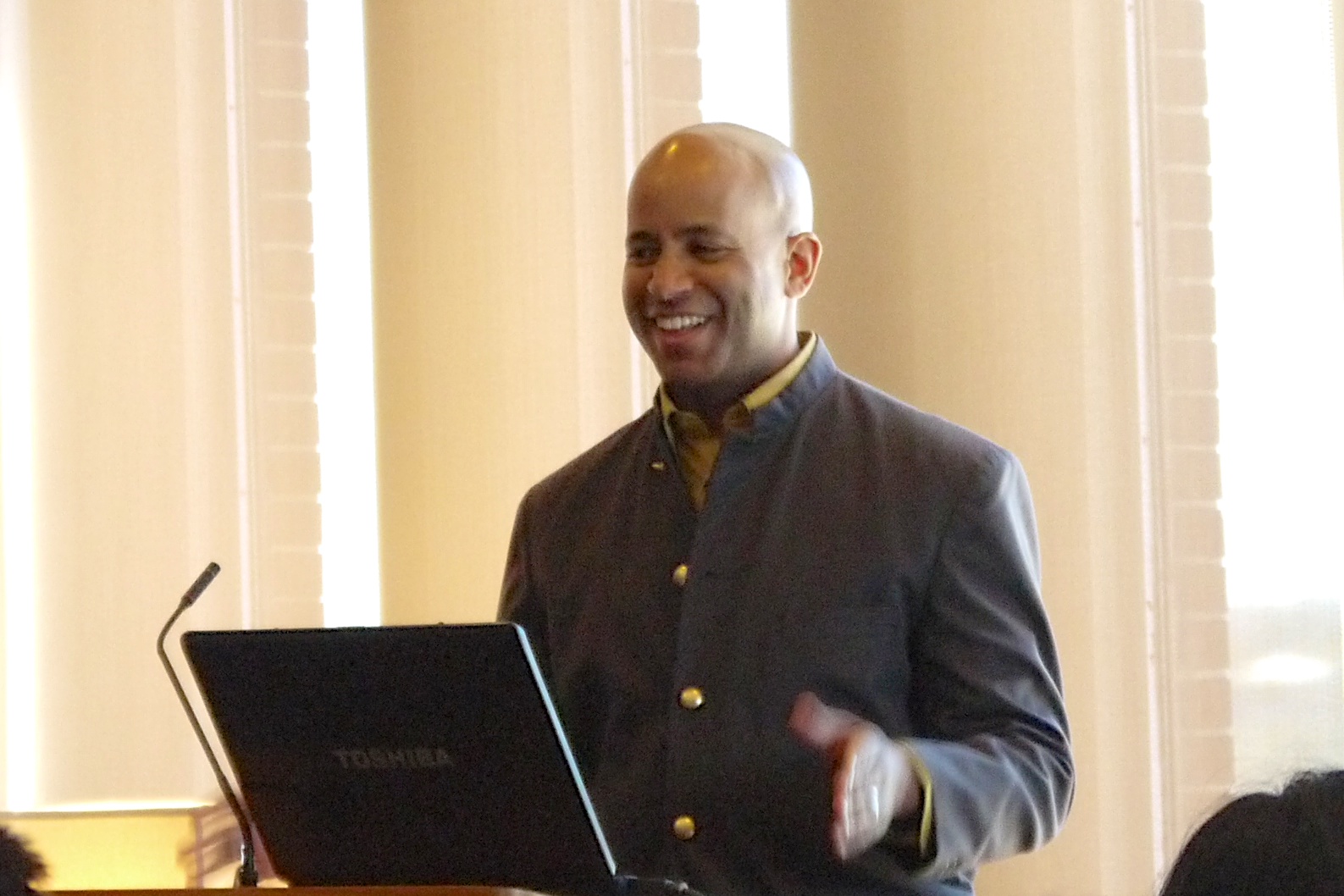
    Minister Faust in the Ferst Room.
    Minister Faust in the Ferst Room.

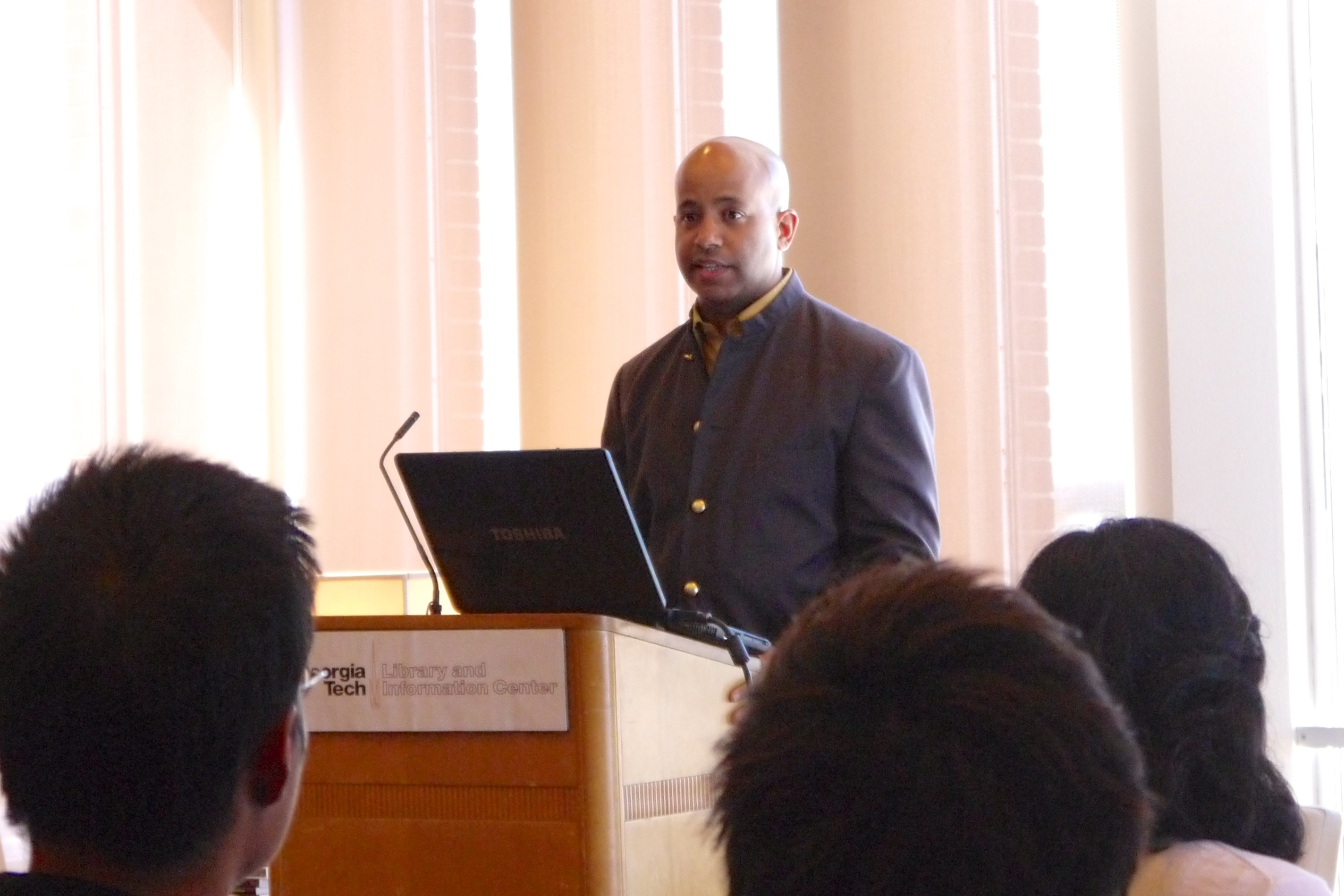
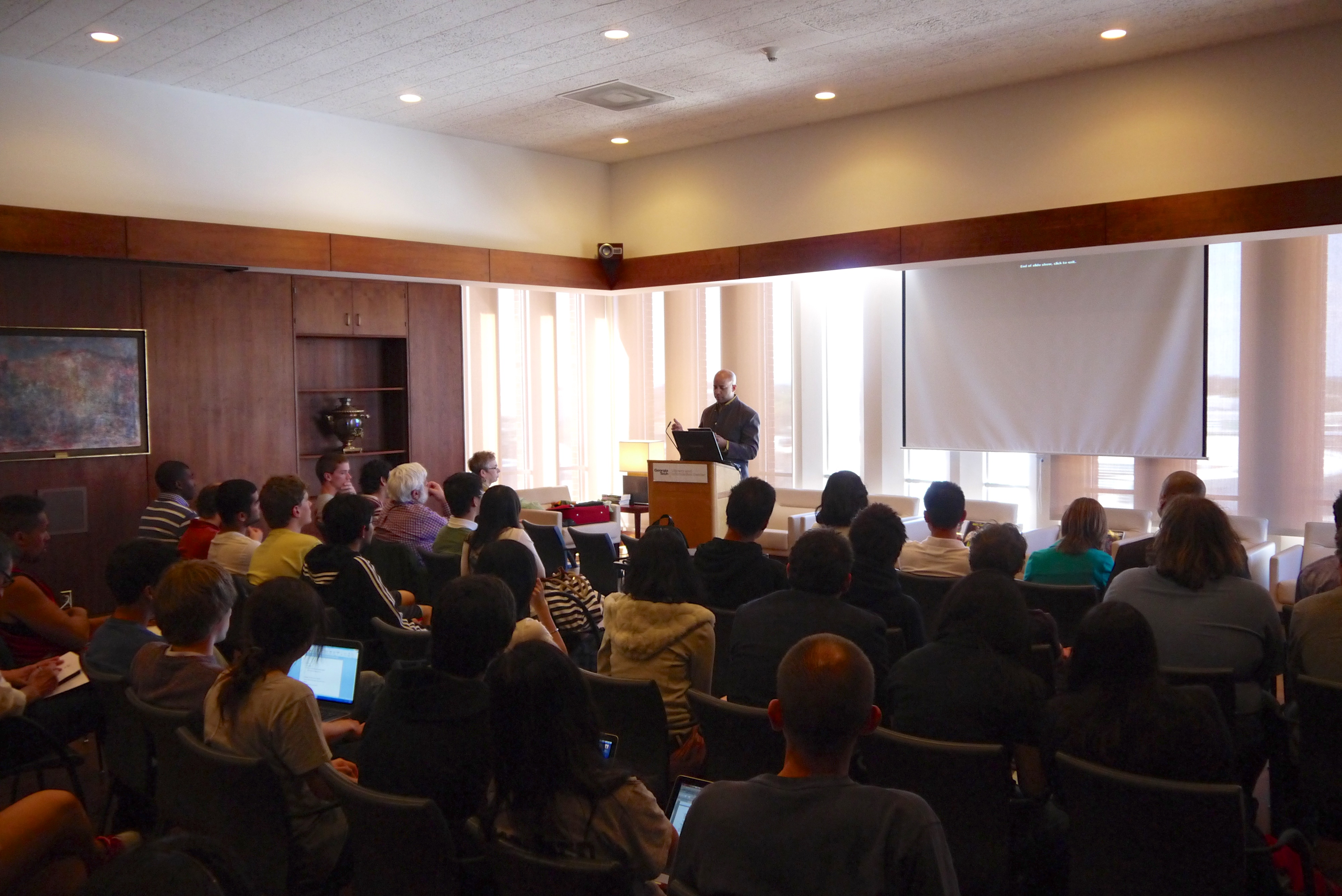
    On Monday, April 1, Minister Faust, the Canadian science fiction writer, delivered a presentation and performed readings from his published fiction to a full audience in Georgia Tech Library’s Ferst Room. His visit to Georgia Tech was part of the School of Literature, Media, and Communication’s Distinguished Speaker Series. There were also three nearby high school classes in attendance through telepresence technology.

    Minister Faust began with a presentation titled, “Afrofuturism, E-Town, Imhotep-Hop and Me.” In this presentation, he sketched Canada’s historical, cultural, and political landscape, followed with background on his hometown, Edmonton and the neighborhood that he calls “Kush,” and concluded with an overview of Afrofuturism and his unique approach to storytelling that he calls, “Imhotep-Hop.”

    Minister Faust reads to his audience.
    Minister Faust reads to his audience.

    Imhotep-Hop builds on the science fiction genealogy of cyberpunk > steampunk > Afrofuturism > steamfunk. Like those inventive subgenres, it is a kind of culture jamming. Like its namesake, it is grounded in intellectualism and the desire for gaining and sharing knowledge. However, Minister Faust recognizes that fiction must be entertaining. He uses allegory and humor to convey interesting and engaging stories about serious matters. Perhaps most importantly, Imhotep-hop indicates the past (ancient African stories and mythologies, presented as allegory) and present (the here-and-now) while pointing toward the future.

    Following his presentation, Minister Faust read from two of his novels: The Coyote Kings Book One: Space Age Bachelor Pad and The Alchemists of Kush.

    Minister Faust performing his reading.
    Minister Faust performing his reading.

    This is the second time that I have had the pleasure and honor of attending a reading by Minister Faust. The first time that I met him was at the 2012 Science Fiction Research Association Conference in Detroit. His reading there, like this one at Georgia Tech, was electric! Instead of simply reading from his novels as a speaker and author, Minister Faust performs his characters. His face, hands, and arms form an orchestra with his talented and powerful voice to convey urgency and surprise, excitement and peace, hostility and love. As he reads a scene to the audience, you are drawn into the story as much if not more so than a Console Cowboy sucked into the other worldly expanse of William Gibson’s cyberspace. Good storytelling, like that performed by Minister Faust, is a far more satisfying virtual reality than any generated in the Crytek or Unreal engines.

    Minister Faust presenting.
    Minister Faust presenting.

    Dr. Lisa Yaszek scheduled Monday’s reading to accommodate one of my ENGL1101 classes. As a former Tech undergraduate, I understand how vitally important it is to students’ personal development and enrichment by attending special events and presentations. Some of my fondest memories of my Tech years include meeting Stephen Wolfram and watching Honda’s Asimo robot in person (twice). Furthermore, one of these meetings–spending the day with science fiction writer Kathleen Ann Goonan changed the direction of my life forever. At the end of that day, I told Dr. Yaszek that I had made up my mind to study science fiction professionally–and I did!

    Minister Faust presenting.
    Minister Faust presenting.

    My students from that class and my other two sections were in attendance. Several of my students asked Minister Faust probing and insightful questions about the creative process, the relationship between writing and improving one’s mood, and the influence of his cultural experience on his personal writing style.

    Minister Faust presenting.
    Minister Faust presenting.

    Building on Dr. Laura Otis’s previous Distinguished Speaker Series talk [which I wrote about here], I asked Minister Faust, what kind of conscious thinking does he do as he writes (e.g., verbally, visually, haptically, aurally, etc)? I was very happy to learn that he thinks multimodally depending on the content of a scene or the direction from which he comes when building his stories (verbally first sometimes, visually first at others, or aurally/musically for others). Ultimately, his thinking in different modes is expressed verbally in writing.

    Minister Faust presenting.
    Minister Faust presenting.

    He also gave a second reading on the morning of Tuesday, April 2. Unfortunately, I was unable to attend. However, I am eager to find out which of my students went to that reading!

    Me and Minister Faust.
    Me and Minister Faust.

    In addition to visiting Minister Faust’s official website to purchase his books directly from the author at a discount, you can purchase his books in print from Amazon here or in Kindle ebook format here.

    I also highly recommend that you watch his TEDxEdmonton talk here and this interview featuring him talking about the fiction of Philip K. Dick in three parts here, here, and here .

    Minister Faust is doing very important work through his writing. It is entertaining and educational; It is lighthearted and serious. I believe that it will be read and remembered in the SF pantheon. I am happy and thankful that he shared some of that work with the Georgia Tech community.

  • Notes from the State of Black Science Fiction Film Festival 2013

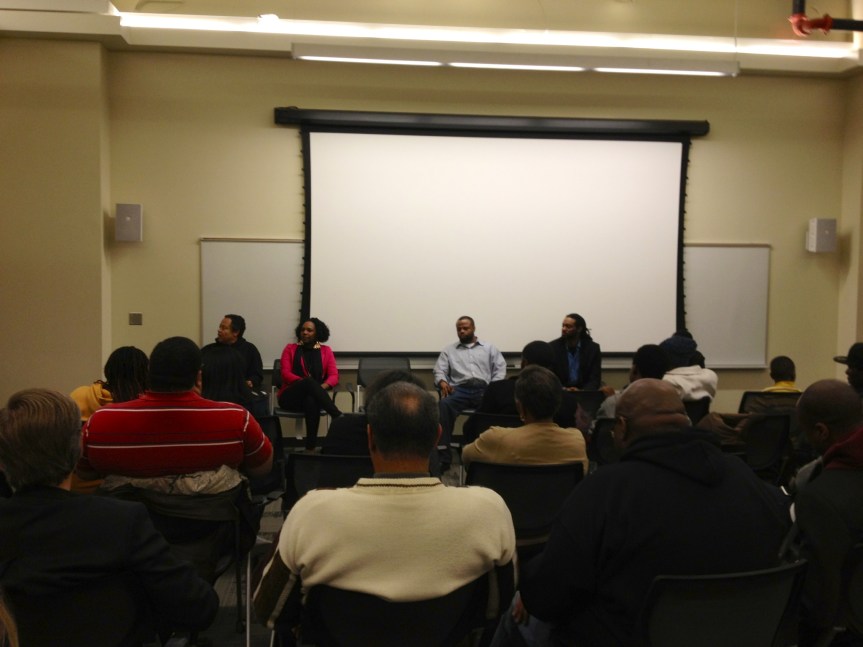
    Audience and panelists at the State of Black SF Film Festival.
    Audience and panelists at the State of Black SF Film Festival.

    Tonight, it was standing room only in Georgia Tech’s Hall Building Room 102 for the 2013 State of Black Science Fiction Film Festival. Co-presented by the School of Literature, Media, and Communication and the State of Black Science Fiction Collective, it presented a number of cutting edge and independent films and opened conversation between filmmakers, writers, and critics. Professor Lisa Yaszek introduced the festival and Georgia Tech’s long history with science fiction via her predecessor Bud Foote, and Milton Davis and Balogun Ojetade organized the festival, introduced the films, and lead the post-screening panel discussion.

    All of the films were exceptionally great! I have listed the films shown below with links to the video or more information where available.

    Clayton Ziga’s “I am Designer” imagines a world where adoptive children can be surgically and technologically redesigned to meet the wants of their adoptive parents.

    Matthew Savage’s dieselpunk, noirish short film “Reign of Death,” pits a gumshoe against an allegedly murderous robot. I really liked the integration of the CGI robot with the Sin City-esque visual feel of the moving picture.

    Tommy Bottoms showed off his webseries, “Eternal.” It was billed as “True Blood meets The Wire,” and it combines the gritty reality of life with action and humor. In the episodes that we saw, I have to say that my favorite line of the whole night came when the main character Josh Davis, not understanding how the vampires around him seemingly vanish in thin air, exclaims, “Fucking magic tricks!”

    We caught a glimpse of Teresa Dowell-Vest’s “Genesis: New American Superheroes,” which is about a couple who survived the Tuskeegee Experiment, went on to become scientists, and bestow science-derived gifts to their their five children: Tage/Power of Earth, Xavier/Power of Water, Xander/Power of Fire, Jordan/Power of Wind, and Quincey/Power of Technology and Knowledge.

    Bree Newsome treated the audience to her Southern tale of horror titled, “Wake.” A woman gets more than she bargains for when she conjures a man to marry after ridding herself of her controlling father. Besides being creepy, disturbing, and occasionally funny, I enjoyed its playful use of language.

    Balogun Ojetade showed the audience an excerpt from the larger steamfunk project titled, “Rite of Passage: Initiation.” In the scene, Harriet Tubman challenges her student Dorthy to a martial arts contest.

    Finally, Donnie Leapheart presented two episodes of his action-packed webseries Osiris. This SF thriller is about a seemingly immortal man fighting back against corporate interests who want to commoditize and sell his ability to live forever. The two episodes that we saw were slick and clever. I was also impressed by the high production value of this series made for the web.

    After the screening, Davis and Ojetade lead a panel discussion with Teresa Dowell-Vest, Donnie Leapheart, Tommy Bottoms, Bree Newsome, and Steve Barnes (writer, critic, and martial artist). What follows are my notes and paraphrasing from the conversation.

    Question: What makes something black SF?

    Bottoms: It can be the production side, actors, or story. However, anyone should be able to enjoy these films, not necessarily an exclusive black audience.

    Dowell-Vest: She aims to create a body of work that transcends race and is enjoyable to a broad audience.

    Leapheart: He embraces the idea of black SF, because he knows that there are black nerds, but they don’t get represented. Since SF is the biggest grossing genre for a broad audience, why are not more black filmmakers putting their voice out there in SF to reach that audience?

    Barnes: He breaks down the definitions of SF, fantasy, and horror to help develop the terminology of the discussion. Broadly speaking, all fiction is fantasy, because fiction is not real. However, what we think of as fantasy involves a world that is unlike our own and operates by a set of rules significantly different than our own. SF is a subset of fantasy that must follow the rules of science, but it can be allowed to break one rule–such as time travel–to produce stories around: what if, if only, and if this goes on. Horror is another subset of fantasy in which the dominant mode is fear and it generates dread in the audience. There are many different kinds of horror: SF horror, fantasy horror, psychological horror, etc.

    Question: How and why are black people portrayed negatively in the media?

    Newsome: Where do we start!?

    Bottoms: Right now, our culture embraces this as entertainment. At least in the past with Blaxploitation, social consciousness and positive endings were an integral part of the early wave of these films.

    Newsome: We are fighting and combating stereotypes. Media is not separate from the social world.

    Barnes: Negative portrayals are likely not something done with conscious intent, but are the way people actually thought. Put another way, they are not trying to make a group look negative. Instead, they are simply presenting their internalized beliefs. Furthermore, it has a lot to do with one group in a superior position defining itself against others.

    Leapheart: We can blame the media, whites, etc., but if you look online there are many negative videos produced by blacks with loads of views and other positive videos with very few views. Is art imitating life or life imitating art? Should we give people what they want (or think that they want), or do we keep doing our own thing?

    Dowell-Vest: She is concerned about the declining representation on television. At one point, we had a menu of options (e.g., Cosby, A Different World, In Living Color, etc.), but now it seems to be all on the shoulders of the character Olivia Pope in the show Scandal. If she were played by a white woman, would we be having this conversation? She sees a cycle of fight-struggle-complacency, and she worries that we are now in a period of complacency. True art and storytelling come from bucking the status quo.

    Barnes: In the history of network television, there have only been four successful black-starring hour-long dramas. This is why so much rides on Olivia Pope and Scandal. He also mentioned the TV series Deception.

    Newsome: Waits for a time when we don’t have to rely on only one show to represent all black people.

    Question: What is the future of black film (while considering Quintin Tarantino’s Django Unchained)?

    Bottoms: Don’t tell someone that they can’t make a film. If you think that you can do it better, then you go out and make it. He enjoyed Django Unchained despite the problems that some people had with its language–how else could you do it, he asked?

    Barnes: Loved Django Unchained. He went to see it with one of Louis Farrakhan’s body guards, who laughed his ass off. Only five directors could have pulled off this film, and four didn’t want to do it. Taratino grew up around black people, and he represented what he knew from his perspective. Anyone can write about others’ experiences, and we have a right to disagree with their perspective. A good thing about Django Unchained is that it proved that a movie with central black characters can sell to an international audience. He asked the audience a pointed question: When was the last time that you saw a film with slaves? Amistad? No, it debated their freedom. Beloved? They were ex-slaves. This is the third rail of cinema, and Taratino is crazy enough to go there and he made people laugh doing it. The film is not a perfect thing, but it is a good thing.

    Dowell-Vest: She is from Virginia, and for her, Nat Turner is very real history. There is something significant about that moment when the oppressed have their time or their revenge. It can be soul serving or spiritually serving. She felt that Taratino had given her what she needed.

    Newsome: You can’t say he can’t make something because of his race, because then, you say that I can’t make a kind of film due to my race.

    Leapheart: Concerned that despite the high a film like this might give us now, it is likely not the beginning of a new wave. Instead, its momentum will dissipate.

    Barnes: Yet, a film like this sets the ground for the future: experience, learning, jobs. It is up to you guys (the filmmakers on the panel) to make the future.

    Bottoms: There is this thing that I’ve heard about called the Internet, and it gives us new options, choices, and a chance for change. However, change takes time.

    Unfortunately, at that point, we had to close it down for the evening. This was an exciting event that reminded me it was very good to be back in Atlanta at Georgia Tech.

    The conversation continues at the State of Black Science Fiction group on Facebook here. See you there!

    Update: Dead video links removed on 9 Nov. 2023.

  • Trying to Come to Terms with Disney’s Acquisition of Lucasfilm and Star Wars in About 1200 Words

    Earlier today, I heard about Disney’s move to acquire Lucasfilm and the Star Wars franchise from George Lucas for $4.05 billion. At first, I was incredulous. I thought that this was an Internet hoax born of Hurricane Sandy regurgitating seawater onto a New England data server unfortunately left behind by the first responders. There is a nice press release and a photo of Lucas holding a pen above a nondescript piece of paper to prove otherwise.

    Gauging from folks’ responses on the web, Facebook, and Twitter, there seems to be a lot of confusion about this news. I certainly feel it myself. Looking at it through the cold logic of capitalism, Lucas is in the movie making business. What he might have once claimed was art or a manifestation of myth-made-modern was in fact simply a way to make lots of money. To borrow from Jay and Silent Bob, Star Wars (and Indiana Jones–a property apparently not of significant worth in the big scheme of things to Disney) was George Lucas’ “motherfucking movie check.” Lucas made it big–maybe it was part talent, part strategy, and part luck–and now, he has the opportunity to cash out. His ‘art’ was a tremendous investment that he has now leveraged to a lucrative payday. His selling the Star Wars/Lucasfilm property to Disney is an obvious choice. Disney has long partnered with Lucasfilm on part rides and merchandising. Additionally, Disney has shifted its attention toward acquisition of popular cultural properties to supplement what little remains of their own creative impetus. Disney bought Pixar, Steve Jobs’ insanely creative 3D animation studio in 2006 for $7.4 billion. Then, Disney purchased Marvel Comics for around the same price as Lucasfilm in 2009. Of course Disney would want Lucasfilm to join its portfolio of cultural holdings. As a result, a substantial amount of American culture is now owned by a single mega-corporation, Disney.

    Looking at the situation from my Star Wars fanish eyes, I am uneasy about this transaction. Despite Lucas’ attempts at destroying his legacy through the investments he made in the culturally bankrupt Star Wars prequels and the failed continuation of the Indiana Jones series in the “Kingdom of the Crystal Skull,” I have always identified him as being the embodiment of the Star Wars universe. Of course, he originated the idea and benevolently maintained despotic control over that idea (compared to Paramount and Star Trek–Lucas is a saint in permitting and occasionally encouraging fan films and fandom in general). I suppose it always seemed in my mind that the author/text|Lucas/Star Wars were signs signifying the same thing. They were shared significations within my mind about what ‘Star Wars’ was and represented. For example, it seems in retrospect that nearly every pre-prequels Star Wars conversation (certainly EVERY post-prequel conversation operates in this way) eventually would come back around to Lucas’ vision, intentions, mistakes, successes, etc. as it related to the narrative space and its possibilities within the imaginations of me and my friends. In a similar way to Steve Jobs and Apple, it doesn’t feel right to separate the author from the work. Certainly, I can imagine the Star Wars universe–its stories, technologies, and cultural context–without invoking the authorial ghost of Lucas. However, the authorial ghost seems ever near and inseparable from the thing (Stars Wars) itself.

    I can rationally think of how many billions of dollars George Lucas made from the Star Wars films among other things. I can rationally think about the exploited labor and anti-environmental effects of the merchandising that forms feedback cycle of the cultural consumption of ideas and things. I understand that Lucas, through his life, success, and business decisions, has enacted a real-life version of THX 1138. Despite all of these things, I cannot divorce myself from the love that I have of the Star Wars universe, its characters, its technologies (especially the Millennium Falcon–something that I imagine flying far more often than I might have any right to), and its wonder. Perhaps its this love for Star Wars that via the signification system transfers to Lucas in some weird way. He might have mucked up the possible narrative that I imagined and that my friends imagined for the Star Wars prequels, but my delight in Star Wars fills me with positive emotions that inform and shape my dichotomous respect and disdain for Lucas. While he and his vision do not define everything in my mind about Star Wars, his work and choices endowed me with an imaginative appreciation for Star Wars and a curiosity that far exceeds the bounds of “a long time ago in a galaxy far, far away.” While I cannot give Lucas all the credit, I can safely say that Star Wars played a significant role in my being where and who I am today.

    Lucas made a significant choice today to sell Lucasfilm to Disney. Since Lucas is so interwoven into the very idea of Star Wars and its potential fulfilment in culture, I am left feeling uneasy about the transfer of his intellectual property to Disney, the cultural aggregator, shaper, and producer. If we want to think of this as one artist giving something to be reshaped and retold by another artist, then Lucas has given his property to Walt Disney’s zombie. The Disney of today is a shuffling undead shell of what it once was (and here I am not attempting to wax nostalgically as I did with Star Wars–Disney and his team of storytellers did fantastic things for culture and education through the era just before I was born–what followed after has by-and-large little to be desired). The Disney company today seeks the brains of other culture producers–Pixar, Marvel, Lucasfilm–on which it feeds and continues its ravenous lurching. I suppose it is this image on the edge of consciousness that disturbs me the most. I am saddened that Lucas gave up control of his property to producers and committees–a fate that I am not sure is any worse than his own revisionist impulse in the prequels. I admit that I am simply being romantic, but I believe that this romantic impulse for the bond between author and text represents something as deep perhaps as the supposed mythical qualities of the stories Lucas told us about the Skywalker clan.

    What does all of this mean for the future of Star Wars? Disney certainly didn’t wait for the ink to sign on the papers before they announced that a new Star Wars film would be released by 2015. Apparently, the acquisition included treatments that Lucas had been working on, but these will be re-developed by Disney. In a related note, I heard from today’s conference call that Disney CEO Iger said that Disney would focus on mobile gaming instead of big box/console games based on the Star Wars universe. This could have other repurcussions for the cultural impact and interactive engagement with its continuing stories. On this point, I am thinking about how these media are now interdependent and connected for conveying narrative and solidifying the cultural memory of those narratives. It would seem that Disney has hit the ground running with Star Wars, and I expect–for good or ill–a great many new things from Lucas’ universe. Unfortunately, he will not have any control over its further expansion, and I am doubtful that I will be as nearly as eager to be a participant in its expansion under the irksome visage of the Mouse.

  • Back from Two Week Trip to UC-Riverside and the Eaton Science Fiction Collection

    From February 5 to 18, I researched in the Eaton Science Fiction Fiction and Fantasy Collection the University of California, Riverside‘s Tomas Rivera Library. As I mentioned last year, I was very appreciative to have won an R. D. Mullen Fellowship to fund my travel and accommodations for the research-oriented trip.

    Professor Rob Latham administers the fellowship and the science fiction work at UC-Riverside, which includes an annual SF symposium and the biannual Eaton Conference co-hosted with the library’s special collections. He is a gracious host, and I enjoyed our conversations while I was in Riverside.

    UC-Riverside is building a strong constellation in science fiction studies. Besides Latham at the helm, the university recently hired the science fiction writer Nalo Hopkinson into the creative writing program. Now, the university is conducting a new hire for a science fiction media studies person (I applied, but alas, I didn’t make the short list). I suspect more the university will continue to grow in this direction–at least, I hope that it does, because it can grow the SF program around the significant holdings of the library.

    The Eaton Collection is located on the fourth floor of the Thomas Rivera Library and its hours of operation are from 9:00am to 5:00pm Monday through Friday. I planned my trip so that I would have two full weeks to work in the special collections to conduct research for my dissertation chapter on Philip K. Dick, his 2-3-74 visions, and his health problems. In the event that I found as much material related to Dick’s work as possible, I also planned a contengency set of materials on the following chapter on William Gibson’s work.

    I am very happy to report that I achieved both goals and went a bit beyond my original set of documents thanks to cross referenced connections as well as new leads produced by my readings. Additionally, Reference Library Gwido Zlatkes turned me onto the two boxes of Philip K. Dick archival materials, which included some very cool autographed materials along with a full run of the Philip K. Dick Society Newsletter and other rare magazines and fanzines (including the November 6, 1975 Rolling Stone article).

    I began my research by reading the full thirty issue run of The Philip K. Dick Society Newsletter, which includes a double issue (#9/10) on cassette tape—one side being an interview conducted by Paul Williams with Dick and the other side Dick recording writing notes. The experience of fast-forwarding Dick’s posthumous canonization yielded more primary sources than I could have hoped for in letters and interviews. Interviews with Dick’s friends and former spouses also provide important corroboration and clarification of Dick’s sometimes-unreliable personal narratives.

    References in the Newsletter, combined with other research done before my visit to Riverside, led me to other interviews, notes, and reviews in fanzines including: The Alien Critic (later Science Fiction Review), Algol (later Starship), and The Patchin Review, and magazines including: Locus, Vertex, Science Fiction Eye, The Magazine of Fantasy & Science Fiction, and Analog.

    After exhausting my leads in the collection related to Dick’s later fictions and personal life, I spent the last three days collecting research for the William Gibson chapter of my dissertation. I focused on the Locus reporting of Gibson’s success following the publication of Neuromancer in 1984 and later interviews with the writer in 1991 and 2003. I was pleased to find a fanzine co-edited by Gibson titled Genre Plat, but Gibson’s essay, “Blues for Horselover Fat” in the fanzine Wing Window provides the strongest evidence that I can use to bridge my chapters on Dick and Gibson.

    To fill out the time that I was in the library, I also found photographs and reports of past Science Fiction Research Association meetings, including the one hosted at Kent State University in the mid-1980s where Samuel R. Delany was honored with the Pilgrim Award.

    My UC-Riverside visit was punctuated with a weekend visit to see Patrick and Sharon Sharp in Los Angeles. They played hosts and guides to my first visit to the strange world of LA–a place that actually felt like another country to me. We visited the Little Tokyo area for lunch and snacks and then strolled through the Museum of Contemporary Art’s (MOCA) Naked Hollywood: Weegee in Los Angeles photography exhibition (Weegee was doing amazing stuff with photography!). We also enjoyed the sunset from the top of the Westin Bonaventure Hotel (a fascinating hotel with interesting designs and spaces, but is it really postmodern? I think that a better case could be made for Riverside’s Mission Inn in that respect). I also got to meet their very friendly cat, Tonks.

    I believe that the research trip (and my first trip to California for that matter) was a smashing success! I have many materials that I have notes on and many other materials that I need to review again. I also got to reconnect with friends and colleagues there: Pawel Frelik, Mark Biswas, and William Sun.