Today, I began teaching my first Science Fiction class at Georgia Tech (LMC 3214 SS2). It is a short-session class, so my students and I will explore the history of SF in only five weeks on a grueling 4 days per week, 2 hours per day schedule.
Following a short break after reading the syllabus, I conducted an interactive exercise where I wrote “Science Fiction (SF)” on the left side of the chalkboard and “Sci-Fi” on the right side. I sketched out the differences between the two terms and how we might use them to identify different types of SF. Then, I handed the chalk to a student who I asked to go to the board and write a type of SF that she liked in the spot that she felt best represented it in the SF/Sci-Fi continuum. As a class, we would discuss these examples. The other students and I would help point out how we might view these examples in different ways along the SF/Sci-Fi axis. Each student would hand off the chalk to the next student. We completed two rounds of this before running out of time in class.
I think that I have an excellent group of students. Most are SF fans invested in the genre in one media form or another. Some students are there for pragmatic reasons. I believe that as the class unfolds all of my students will find interesting and significant connections to their thinking, life, and work.
Tomorrow, we begin discussing Mary Shelley’s Frankenstein.
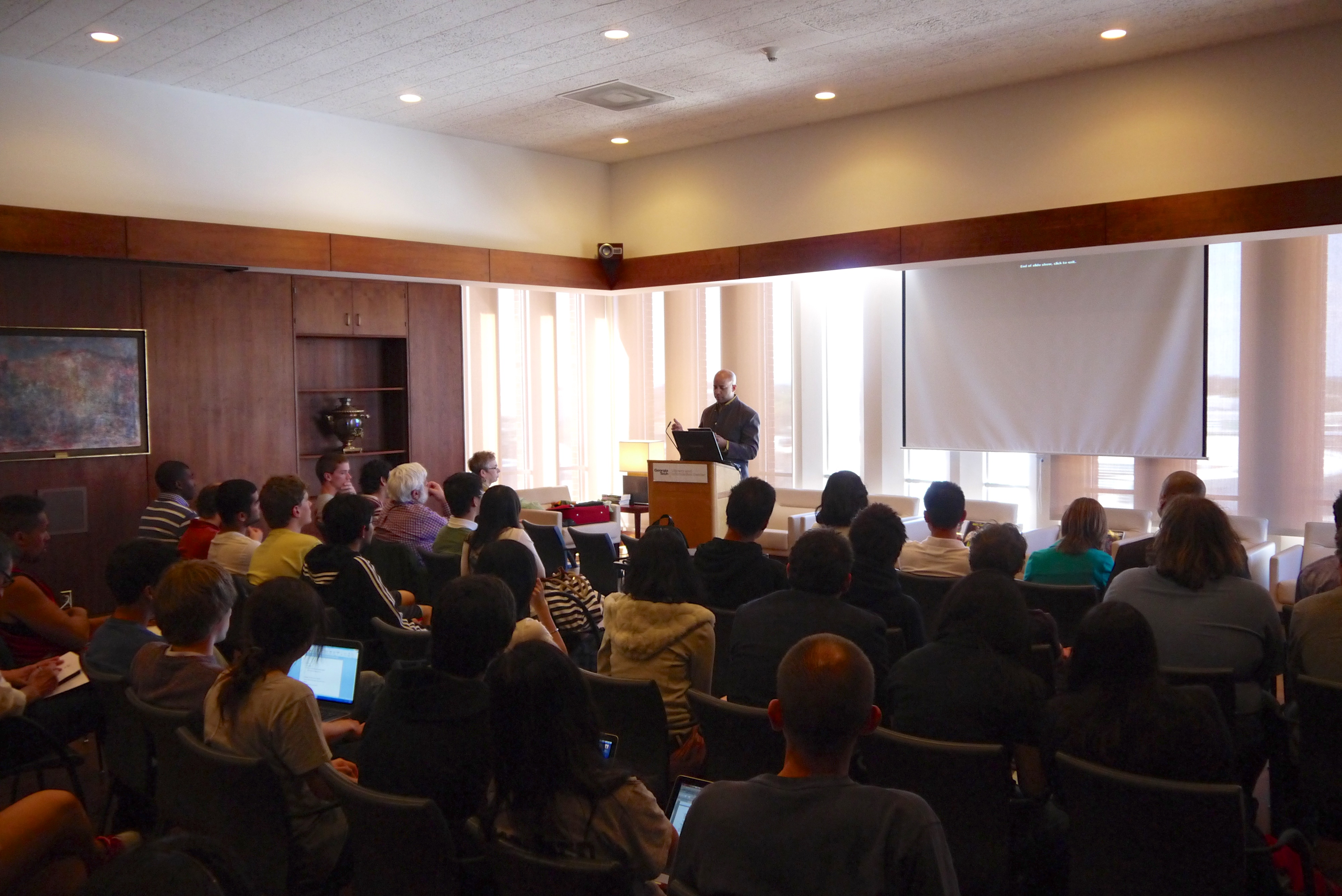
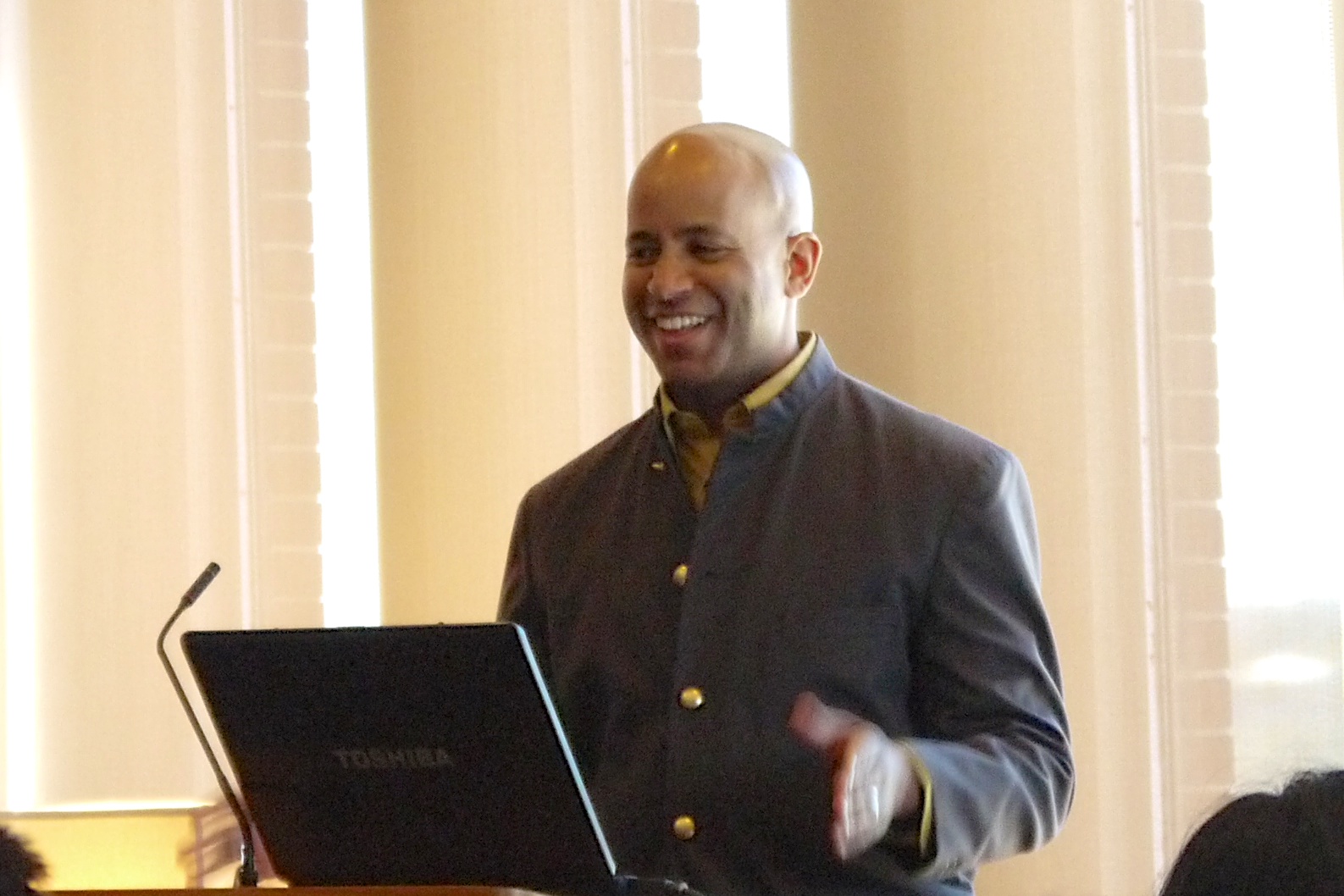
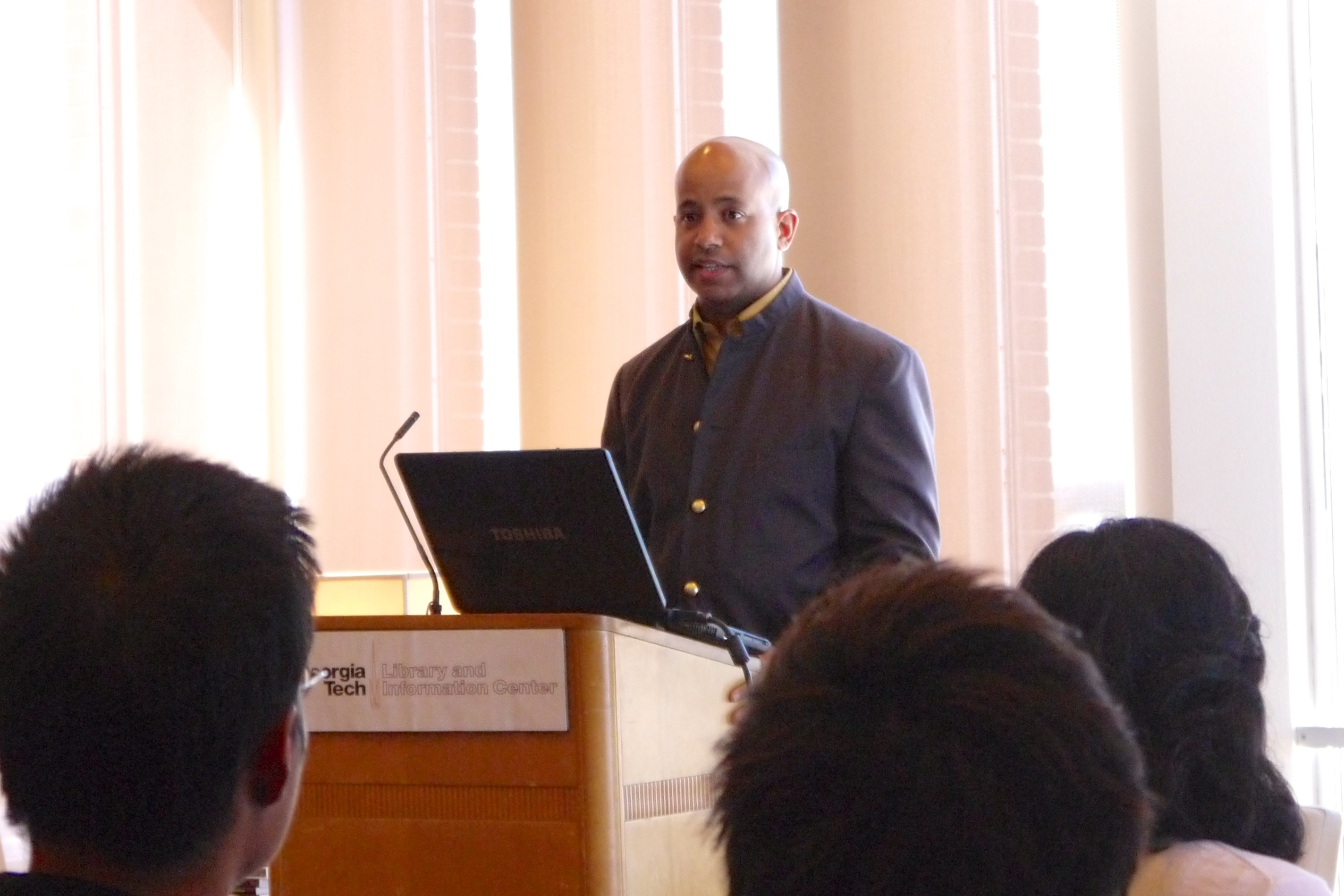
On Monday, April 1, Minister Faust, the Canadian science fiction writer, delivered a presentation and performed readings from his published fiction to a full audience in Georgia Tech Library’s Ferst Room. His visit to Georgia Tech was part of the School of Literature, Media, and Communication’s Distinguished Speaker Series. There were also three nearby high school classes in attendance through telepresence technology.
Minister Faust began with a presentation titled, “Afrofuturism, E-Town, Imhotep-Hop and Me.” In this presentation, he sketched Canada’s historical, cultural, and political landscape, followed with background on his hometown, Edmonton and the neighborhood that he calls “Kush,” and concluded with an overview of Afrofuturism and his unique approach to storytelling that he calls, “Imhotep-Hop.”
Minister Faust reads to his audience.
Imhotep-Hop builds on the science fiction genealogy of cyberpunk > steampunk > Afrofuturism > steamfunk. Like those inventive subgenres, it is a kind of culture jamming. Like its namesake, it is grounded in intellectualism and the desire for gaining and sharing knowledge. However, Minister Faust recognizes that fiction must be entertaining. He uses allegory and humor to convey interesting and engaging stories about serious matters. Perhaps most importantly, Imhotep-hop indicates the past (ancient African stories and mythologies, presented as allegory) and present (the here-and-now) while pointing toward the future.
This is the second time that I have had the pleasure and honor of attending a reading by Minister Faust. The first time that I met him was at the 2012 Science Fiction Research Association Conference in Detroit. His reading there, like this one at Georgia Tech, was electric! Instead of simply reading from his novels as a speaker and author, Minister Faust performs his characters. His face, hands, and arms form an orchestra with his talented and powerful voice to convey urgency and surprise, excitement and peace, hostility and love. As he reads a scene to the audience, you are drawn into the story as much if not more so than a Console Cowboy sucked into the other worldly expanse of William Gibson’s cyberspace. Good storytelling, like that performed by Minister Faust, is a far more satisfying virtual reality than any generated in the Crytek or Unreal engines.
Minister Faust presenting.
Dr. Lisa Yaszek scheduled Monday’s reading to accommodate one of my ENGL1101 classes. As a former Tech undergraduate, I understand how vitally important it is to students’ personal development and enrichment by attending special events and presentations. Some of my fondest memories of my Tech years include meeting Stephen Wolfram and watching Honda’s Asimo robot in person (twice). Furthermore, one of these meetings–spending the day with science fiction writer Kathleen Ann Goonan changed the direction of my life forever. At the end of that day, I told Dr. Yaszek that I had made up my mind to study science fiction professionally–and I did!
Minister Faust presenting.
My students from that class and my other two sections were in attendance. Several of my students asked Minister Faust probing and insightful questions about the creative process, the relationship between writing and improving one’s mood, and the influence of his cultural experience on his personal writing style.
Minister Faust presenting.
Building on Dr. Laura Otis’s previous Distinguished Speaker Series talk [which I wrote about here], I asked Minister Faust, what kind of conscious thinking does he do as he writes (e.g., verbally, visually, haptically, aurally, etc)? I was very happy to learn that he thinks multimodally depending on the content of a scene or the direction from which he comes when building his stories (verbally first sometimes, visually first at others, or aurally/musically for others). Ultimately, his thinking in different modes is expressed verbally in writing.
Minister Faust presenting.
He also gave a second reading on the morning of Tuesday, April 2. Unfortunately, I was unable to attend. However, I am eager to find out which of my students went to that reading!
Me and Minister Faust.
In addition to visiting Minister Faust’s official website to purchase his books directly from the author at a discount, you can purchase his books in print from Amazon here or in Kindle ebook format here.
I also highly recommend that you watch his TEDxEdmonton talk here and this interview featuring him talking about the fiction of Philip K. Dick in three parts here, here, and here .
Minister Faust is doing very important work through his writing. It is entertaining and educational; It is lighthearted and serious. I believe that it will be read and remembered in the SF pantheon. I am happy and thankful that he shared some of that work with the Georgia Tech community.
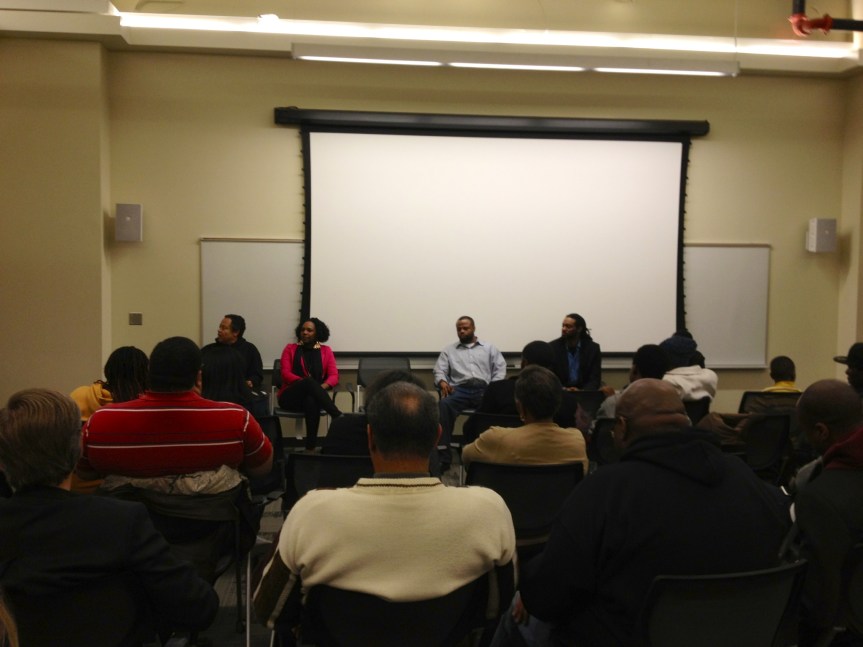
Audience and panelists at the State of Black SF Film Festival.
Tonight, it was standing room only in Georgia Tech’s Hall Building Room 102 for the 2013 State of Black Science Fiction Film Festival. Co-presented by the School of Literature, Media, and Communication and the State of Black Science Fiction Collective, it presented a number of cutting edge and independent films and opened conversation between filmmakers, writers, and critics. Professor Lisa Yaszek introduced the festival and Georgia Tech’s long history with science fiction via her predecessor Bud Foote, and Milton Davis and Balogun Ojetade organized the festival, introduced the films, and lead the post-screening panel discussion.
All of the films were exceptionally great! I have listed the films shown below with links to the video or more information where available.
Clayton Ziga’s “I am Designer” imagines a world where adoptive children can be surgically and technologically redesigned to meet the wants of their adoptive parents.
Matthew Savage’s dieselpunk, noirish short film “Reign of Death,” pits a gumshoe against an allegedly murderous robot. I really liked the integration of the CGI robot with the Sin City-esque visual feel of the moving picture.
Tommy Bottoms showed off his webseries, “Eternal.” It was billed as “True Blood meets The Wire,” and it combines the gritty reality of life with action and humor. In the episodes that we saw, I have to say that my favorite line of the whole night came when the main character Josh Davis, not understanding how the vampires around him seemingly vanish in thin air, exclaims, “Fucking magic tricks!”
We caught a glimpse of Teresa Dowell-Vest’s “Genesis: New American Superheroes,” which is about a couple who survived the Tuskeegee Experiment, went on to become scientists, and bestow science-derived gifts to their their five children: Tage/Power of Earth, Xavier/Power of Water, Xander/Power of Fire, Jordan/Power of Wind, and Quincey/Power of Technology and Knowledge.
Bree Newsome treated the audience to her Southern tale of horror titled, “Wake.” A woman gets more than she bargains for when she conjures a man to marry after ridding herself of her controlling father. Besides being creepy, disturbing, and occasionally funny, I enjoyed its playful use of language.
Balogun Ojetade showed the audience an excerpt from the larger steamfunk project titled, “Rite of Passage: Initiation.” In the scene, Harriet Tubman challenges her student Dorthy to a martial arts contest.
Finally, Donnie Leapheart presented two episodes of his action-packed webseries Osiris. This SF thriller is about a seemingly immortal man fighting back against corporate interests who want to commoditize and sell his ability to live forever. The two episodes that we saw were slick and clever. I was also impressed by the high production value of this series made for the web.
After the screening, Davis and Ojetade lead a panel discussion with Teresa Dowell-Vest, Donnie Leapheart, Tommy Bottoms, Bree Newsome, and Steve Barnes (writer, critic, and martial artist). What follows are my notes and paraphrasing from the conversation.
Question: What makes something black SF?
Bottoms: It can be the production side, actors, or story. However, anyone should be able to enjoy these films, not necessarily an exclusive black audience.
Dowell-Vest: She aims to create a body of work that transcends race and is enjoyable to a broad audience.
Leapheart: He embraces the idea of black SF, because he knows that there are black nerds, but they don’t get represented. Since SF is the biggest grossing genre for a broad audience, why are not more black filmmakers putting their voice out there in SF to reach that audience?
Barnes: He breaks down the definitions of SF, fantasy, and horror to help develop the terminology of the discussion. Broadly speaking, all fiction is fantasy, because fiction is not real. However, what we think of as fantasy involves a world that is unlike our own and operates by a set of rules significantly different than our own. SF is a subset of fantasy that must follow the rules of science, but it can be allowed to break one rule–such as time travel–to produce stories around: what if, if only, and if this goes on. Horror is another subset of fantasy in which the dominant mode is fear and it generates dread in the audience. There are many different kinds of horror: SF horror, fantasy horror, psychological horror, etc.
Question: How and why are black people portrayed negatively in the media?
Newsome: Where do we start!?
Bottoms: Right now, our culture embraces this as entertainment. At least in the past with Blaxploitation, social consciousness and positive endings were an integral part of the early wave of these films.
Newsome: We are fighting and combating stereotypes. Media is not separate from the social world.
Barnes: Negative portrayals are likely not something done with conscious intent, but are the way people actually thought. Put another way, they are not trying to make a group look negative. Instead, they are simply presenting their internalized beliefs. Furthermore, it has a lot to do with one group in a superior position defining itself against others.
Leapheart: We can blame the media, whites, etc., but if you look online there are many negative videos produced by blacks with loads of views and other positive videos with very few views. Is art imitating life or life imitating art? Should we give people what they want (or think that they want), or do we keep doing our own thing?
Dowell-Vest: She is concerned about the declining representation on television. At one point, we had a menu of options (e.g., Cosby, A Different World, In Living Color, etc.), but now it seems to be all on the shoulders of the character Olivia Pope in the show Scandal. If she were played by a white woman, would we be having this conversation? She sees a cycle of fight-struggle-complacency, and she worries that we are now in a period of complacency. True art and storytelling come from bucking the status quo.
Barnes: In the history of network television, there have only been four successful black-starring hour-long dramas. This is why so much rides on Olivia Pope and Scandal. He also mentioned the TV series Deception.
Newsome: Waits for a time when we don’t have to rely on only one show to represent all black people.
Question: What is the future of black film (while considering Quintin Tarantino’s Django Unchained)?
Bottoms: Don’t tell someone that they can’t make a film. If you think that you can do it better, then you go out and make it. He enjoyed Django Unchained despite the problems that some people had with its language–how else could you do it, he asked?
Barnes: Loved Django Unchained. He went to see it with one of Louis Farrakhan’s body guards, who laughed his ass off. Only five directors could have pulled off this film, and four didn’t want to do it. Taratino grew up around black people, and he represented what he knew from his perspective. Anyone can write about others’ experiences, and we have a right to disagree with their perspective. A good thing about Django Unchained is that it proved that a movie with central black characters can sell to an international audience. He asked the audience a pointed question: When was the last time that you saw a film with slaves? Amistad? No, it debated their freedom. Beloved? They were ex-slaves. This is the third rail of cinema, and Taratino is crazy enough to go there and he made people laugh doing it. The film is not a perfect thing, but it is a good thing.
Dowell-Vest: She is from Virginia, and for her, Nat Turner is very real history. There is something significant about that moment when the oppressed have their time or their revenge. It can be soul serving or spiritually serving. She felt that Taratino had given her what she needed.
Newsome: You can’t say he can’t make something because of his race, because then, you say that I can’t make a kind of film due to my race.
Leapheart: Concerned that despite the high a film like this might give us now, it is likely not the beginning of a new wave. Instead, its momentum will dissipate.
Barnes: Yet, a film like this sets the ground for the future: experience, learning, jobs. It is up to you guys (the filmmakers on the panel) to make the future.
Bottoms: There is this thing that I’ve heard about called the Internet, and it gives us new options, choices, and a chance for change. However, change takes time.
Unfortunately, at that point, we had to close it down for the evening. This was an exciting event that reminded me it was very good to be back in Atlanta at Georgia Tech.
The conversation continues at the State of Black Science Fiction group on Facebook here. See you there!
Earlier today, I heard about Disney’s move to acquire Lucasfilm and the Star Wars franchise from George Lucas for $4.05 billion. At first, I was incredulous. I thought that this was an Internet hoax born of Hurricane Sandy regurgitating seawater onto a New England data server unfortunately left behind by the first responders. There is a nice press release and a photo of Lucas holding a pen above a nondescript piece of paper to prove otherwise.
Gauging from folks’ responses on the web, Facebook, and Twitter, there seems to be a lot of confusion about this news. I certainly feel it myself. Looking at it through the cold logic of capitalism, Lucas is in the movie making business. What he might have once claimed was art or a manifestation of myth-made-modern was in fact simply a way to make lots of money. To borrow from Jay and Silent Bob, Star Wars (and Indiana Jones–a property apparently not of significant worth in the big scheme of things to Disney) was George Lucas’ “motherfucking movie check.” Lucas made it big–maybe it was part talent, part strategy, and part luck–and now, he has the opportunity to cash out. His ‘art’ was a tremendous investment that he has now leveraged to a lucrative payday. His selling the Star Wars/Lucasfilm property to Disney is an obvious choice. Disney has long partnered with Lucasfilm on part rides and merchandising. Additionally, Disney has shifted its attention toward acquisition of popular cultural properties to supplement what little remains of their own creative impetus. Disney bought Pixar, Steve Jobs’ insanely creative 3D animation studio in 2006 for $7.4 billion. Then, Disney purchased Marvel Comics for around the same price as Lucasfilm in 2009. Of course Disney would want Lucasfilm to join its portfolio of cultural holdings. As a result, a substantial amount of American culture is now owned by a single mega-corporation, Disney.
Looking at the situation from my Star Wars fanish eyes, I am uneasy about this transaction. Despite Lucas’ attempts at destroying his legacy through the investments he made in the culturally bankrupt Star Wars prequels and the failed continuation of the Indiana Jones series in the “Kingdom of the Crystal Skull,” I have always identified him as being the embodiment of the Star Wars universe. Of course, he originated the idea and benevolently maintained despotic control over that idea (compared to Paramount and Star Trek–Lucas is a saint in permitting and occasionally encouraging fan films and fandom in general). I suppose it always seemed in my mind that the author/text|Lucas/Star Wars were signs signifying the same thing. They were shared significations within my mind about what ‘Star Wars’ was and represented. For example, it seems in retrospect that nearly every pre-prequels Star Wars conversation (certainly EVERY post-prequel conversation operates in this way) eventually would come back around to Lucas’ vision, intentions, mistakes, successes, etc. as it related to the narrative space and its possibilities within the imaginations of me and my friends. In a similar way to Steve Jobs and Apple, it doesn’t feel right to separate the author from the work. Certainly, I can imagine the Star Wars universe–its stories, technologies, and cultural context–without invoking the authorial ghost of Lucas. However, the authorial ghost seems ever near and inseparable from the thing (Stars Wars) itself.
I can rationally think of how many billions of dollars George Lucas made from the Star Wars films among other things. I can rationally think about the exploited labor and anti-environmental effects of the merchandising that forms feedback cycle of the cultural consumption of ideas and things. I understand that Lucas, through his life, success, and business decisions, has enacted a real-life version of THX 1138. Despite all of these things, I cannot divorce myself from the love that I have of the Star Wars universe, its characters, its technologies (especially the Millennium Falcon–something that I imagine flying far more often than I might have any right to), and its wonder. Perhaps its this love for Star Wars that via the signification system transfers to Lucas in some weird way. He might have mucked up the possible narrative that I imagined and that my friends imagined for the Star Wars prequels, but my delight in Star Wars fills me with positive emotions that inform and shape my dichotomous respect and disdain for Lucas. While he and his vision do not define everything in my mind about Star Wars, his work and choices endowed me with an imaginative appreciation for Star Wars and a curiosity that far exceeds the bounds of “a long time ago in a galaxy far, far away.” While I cannot give Lucas all the credit, I can safely say that Star Wars played a significant role in my being where and who I am today.
Lucas made a significant choice today to sell Lucasfilm to Disney. Since Lucas is so interwoven into the very idea of Star Wars and its potential fulfilment in culture, I am left feeling uneasy about the transfer of his intellectual property to Disney, the cultural aggregator, shaper, and producer. If we want to think of this as one artist giving something to be reshaped and retold by another artist, then Lucas has given his property to Walt Disney’s zombie. The Disney of today is a shuffling undead shell of what it once was (and here I am not attempting to wax nostalgically as I did with Star Wars–Disney and his team of storytellers did fantastic things for culture and education through the era just before I was born–what followed after has by-and-large little to be desired). The Disney company today seeks the brains of other culture producers–Pixar, Marvel, Lucasfilm–on which it feeds and continues its ravenous lurching. I suppose it is this image on the edge of consciousness that disturbs me the most. I am saddened that Lucas gave up control of his property to producers and committees–a fate that I am not sure is any worse than his own revisionist impulse in the prequels. I admit that I am simply being romantic, but I believe that this romantic impulse for the bond between author and text represents something as deep perhaps as the supposed mythical qualities of the stories Lucas told us about the Skywalker clan.
What does all of this mean for the future of Star Wars? Disney certainly didn’t wait for the ink to sign on the papers before they announced that a new Star Wars film would be released by 2015. Apparently, the acquisition included treatments that Lucas had been working on, but these will be re-developed by Disney. In a related note, I heard from today’s conference call that Disney CEO Iger said that Disney would focus on mobile gaming instead of big box/console games based on the Star Wars universe. This could have other repurcussions for the cultural impact and interactive engagement with its continuing stories. On this point, I am thinking about how these media are now interdependent and connected for conveying narrative and solidifying the cultural memory of those narratives. It would seem that Disney has hit the ground running with Star Wars, and I expect–for good or ill–a great many new things from Lucas’ universe. Unfortunately, he will not have any control over its further expansion, and I am doubtful that I will be as nearly as eager to be a participant in its expansion under the irksome visage of the Mouse.
Martin Widmer’s “Tomb [V’]” (2007).[UPDATE: I volunteered to teach three sections of ENGL1101 instead of three sections of ENGL1102 when the school made the request. This gives me an opportunity to immediately revise my ENGL1101 syllabus and try new things with my students!] In Spring 2013, I will be teaching three sections of ENGL 1102 (sections: P1, E, and M). For these sections, I will guide students toward completing and exceeding the desired educational outcomes with a class structured on the them, “The Promise and Peril of the Digital Age Explored Through Science Fiction.”
Building on the rhetorical strategies and WOVEN modalities introduced in ENGL1101, this class further develops students’ communicative and critical thinking abilities by guiding students through challenging research-based projects. The research focus of this class is on the promise and peril of the contemporary digital age. Science fiction is a uniquely suited genre for considering the digital age, because it is the only literature that is firmly situated at the intersection of science, technology, and culture. Furthermore, science fiction is a literature about the present in which it is written rather than its imagined future. With this in mind, recent science fictions comment on our present and our near future in simultaneously promising and troubling ways. Drawing on science fiction across multiple media (including novels, films, and video games) and using newly acquired tools of critical theory from cultural studies and the study of science and technology, students will develop a number of research-based projects individually and collaboratively that explore how science fiction informs and critiques the on-going digital age. All of these projects will culminate in or include a digital component (e.g., blog posts, Twitter essays, Storify curations, online videos, and Omeka archives). Also, students will learn how to use digital humanities technologies to inform their thinking and research.
Reading List:
Oryx and Crake, Margaret Atwood, Anchor, 2004, 978-0385721677
Ready Player One, Ernest Cline, Broadway, 2012, 978-0307887443
Neuromancer, William Gibson, Ace, 2000, 978-0441007462
River of Gods, Ian McDonald, Pyr, 2007, 978-1591025955