My current access to Azeroth is kind of convoluted. It’s a little bit like an incantation or prayer that my Undead priest Mordvar might have to speak in order to heal a comrade or hurt a foe.
I’m running World of Warcraft 1.12 via Wine in the foreground window where you see Mordvar flying a Tawny Wind Rider on a flight path. In the background on the right, I have Windows 7 Professional 32-bit (a copy that I received for free from a Microsoft event in Ohio some years back) running in Oracle VirtualBox. And in Windows 7, I have an old copy of SingleCore Vanilla, a WoW server emulator that I connect to on my local machine.
This weird assemblage allows me to explore Azeroth for research using admin tools that are otherwise unavailable to normal WoW players.
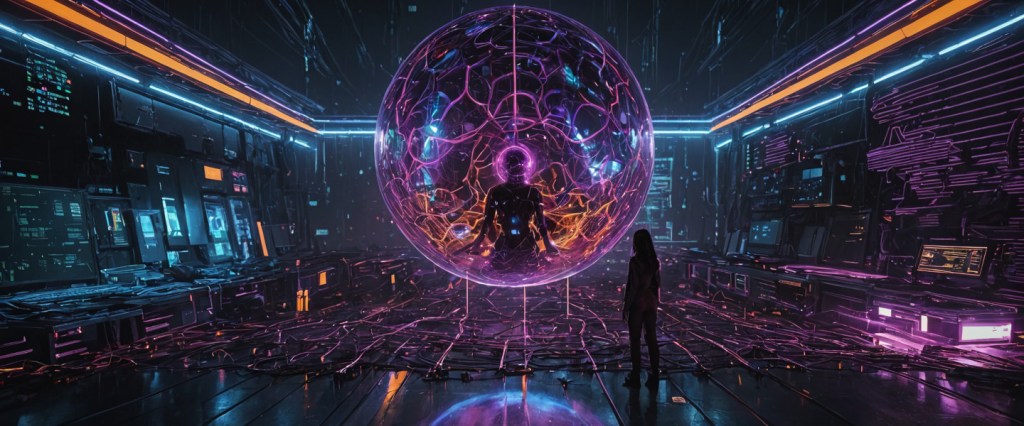
I’ve been working on the site’s header image using different Stable Diffusion SDXL models, which give it a higher fidelity without needing as much post-processing outpainting and inpainting as the current header needed, which was made with an SD 1.5 model.
The idea behind the header image is a cyberpunk scene within cyberspace. The scene takes place within a virtual room representing computers and terminals with an orb-like artificial intelligence in the center levitating above the floor. Within the orb, a shadowy figure can be seen. To the side of the AI is a woman standing before it and peering into the depths of its otherness.
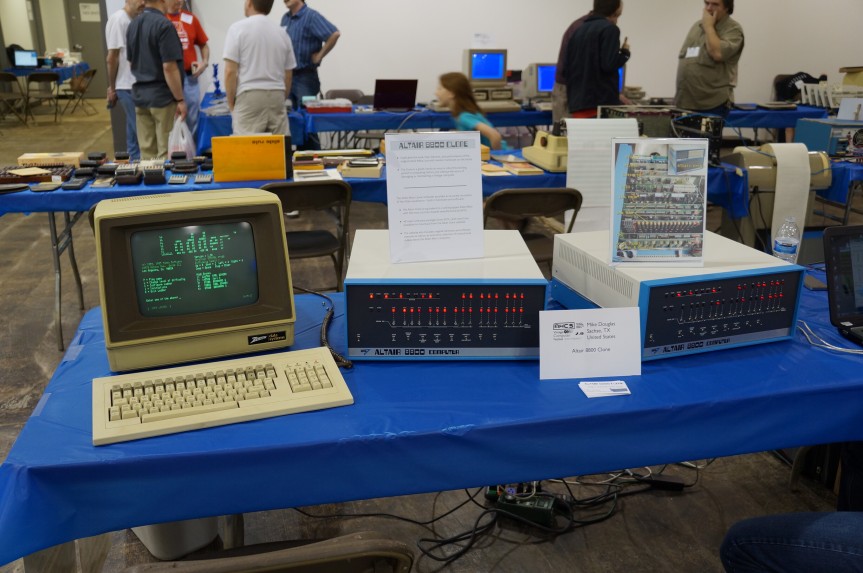
Altair 8800 kit computer running at the SEVCF 2014. This computer is mentioned in Buchanan’s article.
In the November 1977 issue of Analog Science Fiction/Science Fact magazine, Martin Buchanan published a feature article on personal computers titled, “Home Computers Now!” In it, he opens with a scenario about how PCs can automate family life and then goes into the nuts and bolts of how computers work, what to look for in a kit, and what the future of computing looks like. It was at the end of the article that this passage stood out to me:
"With cheap processors, cheap memory, and cheap communications, what can't we do? The effects on individuals and society will be major and unpredictable. Today's personal computer is just a beginning" (Buchanan 74).
Buchanan, Martin. “Home Computers Now!” Analog, Nov. 1977, pp. 61-74.
I added a whole new section on the Hard SF writer Joan Slonczewski (they/them/theirs) to the Feminist SF chapter of the OER Yet Another Science Fiction Textbook (YASFT). It gives students an overview of their background as a scientist, writer, and Quaker, and it discusses three representative novels from their oeuvre: A Door Into Ocean (1986), Brain Plague (2000), and The Highest Frontier (2011). Like the Afrofuturism chapter, I brought in more cited, critical analysis of Slonczewski’s writing, which is parenthetically cited with a full citation instead of using a works cited list or footnotes.
Slonczewski’s A Door Into Ocean was the inspiration for the image above that I created using Stable Diffusion. It took the better part of a day to create the basic structure of the image, then there was inpainting of specific details such as the woman’s footprints in the sand, and finally, feeding the inpainted image back into SD’s controlnet to produce the final image.