Tag: Star Wars

  • How to Build a Sparring Lightsaber with Parts from Home Depot and Spare Parts (with thoughts on learning and haptics)

    Photo courtesy of Ryan Cox.
    Photo courtesy of Ryan Cox.

    My cousin Ryan Cox is a longtime practitioner of a variety of martial arts including kung fu and tai chi. Ryan and his two older brothers–Ian and Jarret–grew up learning, sparring, and developing uncanny skill in hand-to-hand combat and weapons sparring. While Ryan and his brothers have developed rhizomic networks to enhance their abilities and pass on what they have learned to others, Ryan has went the most far afield when he traveled to Wudang Mountain to train with the kung fu monks who reside there.

    Photo courtesy of Ryan Cox.
    Photo courtesy of Ryan Cox.

    When we were younger, I remember myself being the one drawn to the Star Wars mythos more than anyone else in my family, but now Ryan tells me that he was always interested in the Jedi, their mystique, and their lightsabers. In more recent years, he has learned a lot of the backstory of the Star Wars universe from books and video games. His knowledge in those realms far outstrips my own.

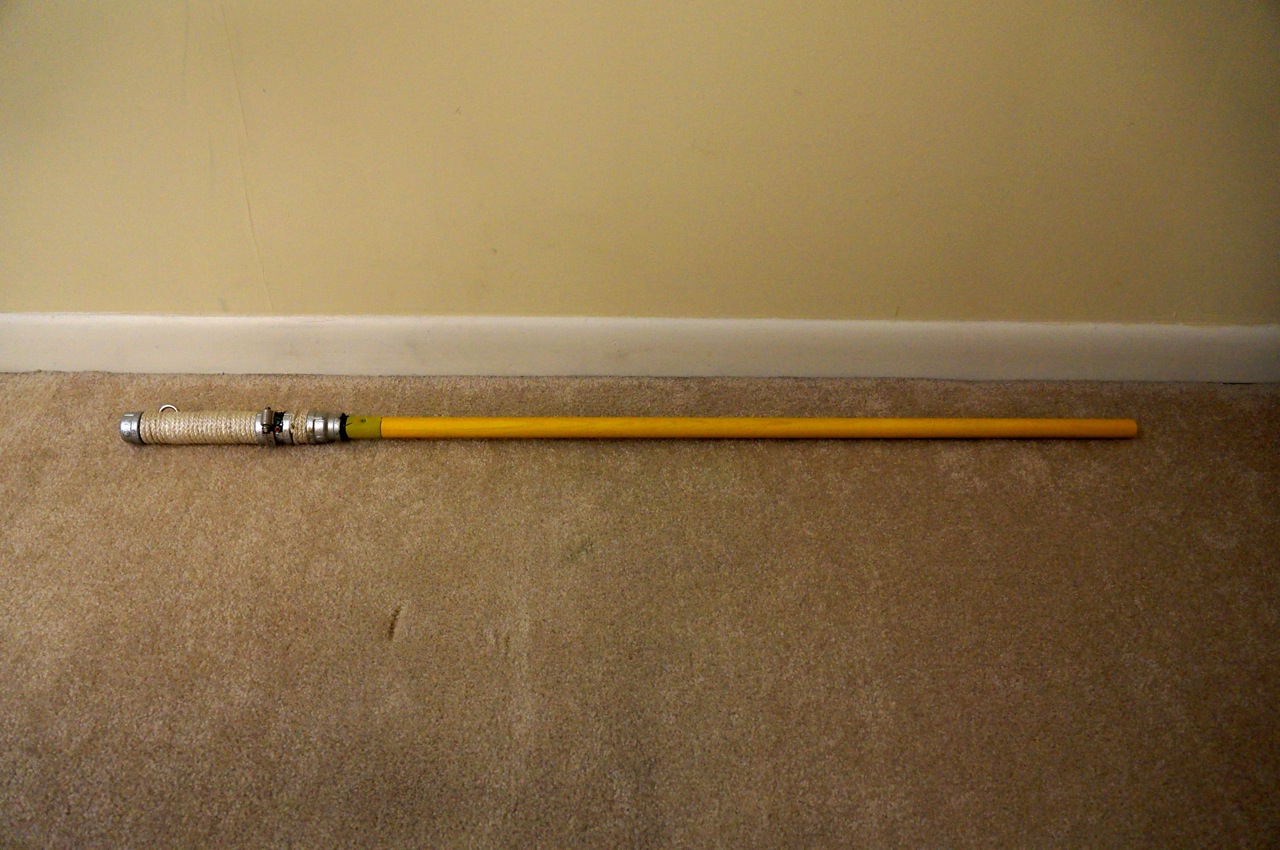
    So, I was intrigued when he began talking with me about building his own lightsaber for demonstrating his swordmanship and possibly sparring if the “blade” were strong enough to withstand strikes. The guide that follows illustrates the first lightsaber that I built for Ryan in the fashion of General Rahm Kota’s. I used off-the-shelf parts easily obtained at Home Depot or any hardware store. Since I built this lightsaber, Ryan has modified it more, and I have built two lightsabers for myself–one that resembles Luke Skywalker’s Return of the Jedi lightsaber and one that resembles Darth Maul’s The Phantom Menace double bladed lightsaber. This guide focuses on Ryan’s “Mark I” lightsaber.

    Pedagogically, I promote the idea that haptics, building, and making are integral parts to any kind of education. We are embodied beings who do things physically in the world–whether it be in real life or online. I enjoy building things in my own time as another way to think about things–in this case, Star Wars, science fiction, Jedi mythos, world building, canon vs. noncanon, and design considerations: rhetoric of technology, aesthetics, practicality, etc. In Ryan’s case, haptics, proprioception, and movement are integral to his learning and lived experience. I am looking forward to learning from him with this artifact that I designed and built. The modes are the same–physicality, materiality, and haptics–but our efforts converge from different directions for a kind of haptic, learning synergy.

    I began the project by assembling the parts that I needed for creating the lightsaber’s hilt and belt clip. I carried an image of Rahm Kota’s lightsaber on my iPhone and went to the plumbing aisle of my local Home Depot.

    lightsaber-DSC01972

    These parts included:

    • 6″ x 3/4″ galvanized steel pipe
    • 3/4″ coupling
    • Two 3/4″ to 1/2″ coupling (one for display and one for sparring with permanently installed “blade”–these two couplings are interchangeable)
    • “Close” 3/4″ pipe (approximately 1 1/2″ long)
    • 3/4″ cap
    • D-ring
    • Carabiner
    • Hose clamps

    Roughly, these parts are assembled to create the lightsaber:

    lightsaber-DSC01973

    Other parts that I used for this build include:

    • 1/4″ white nylon rope (grip wrap)
    • 36″ x 1/2″ oak dowel rod (scrapped due to paint problem)
    • 48″ x 1/2″ paint brush rod (cut to 36″ and replaced the oak dowel rod)
    • Doorbell button assembly (for parts)
    • 80mm computer case fan (for electromagnet assembly)
    • JB Weld
    • Rustoleum Florescent Yellow Paint

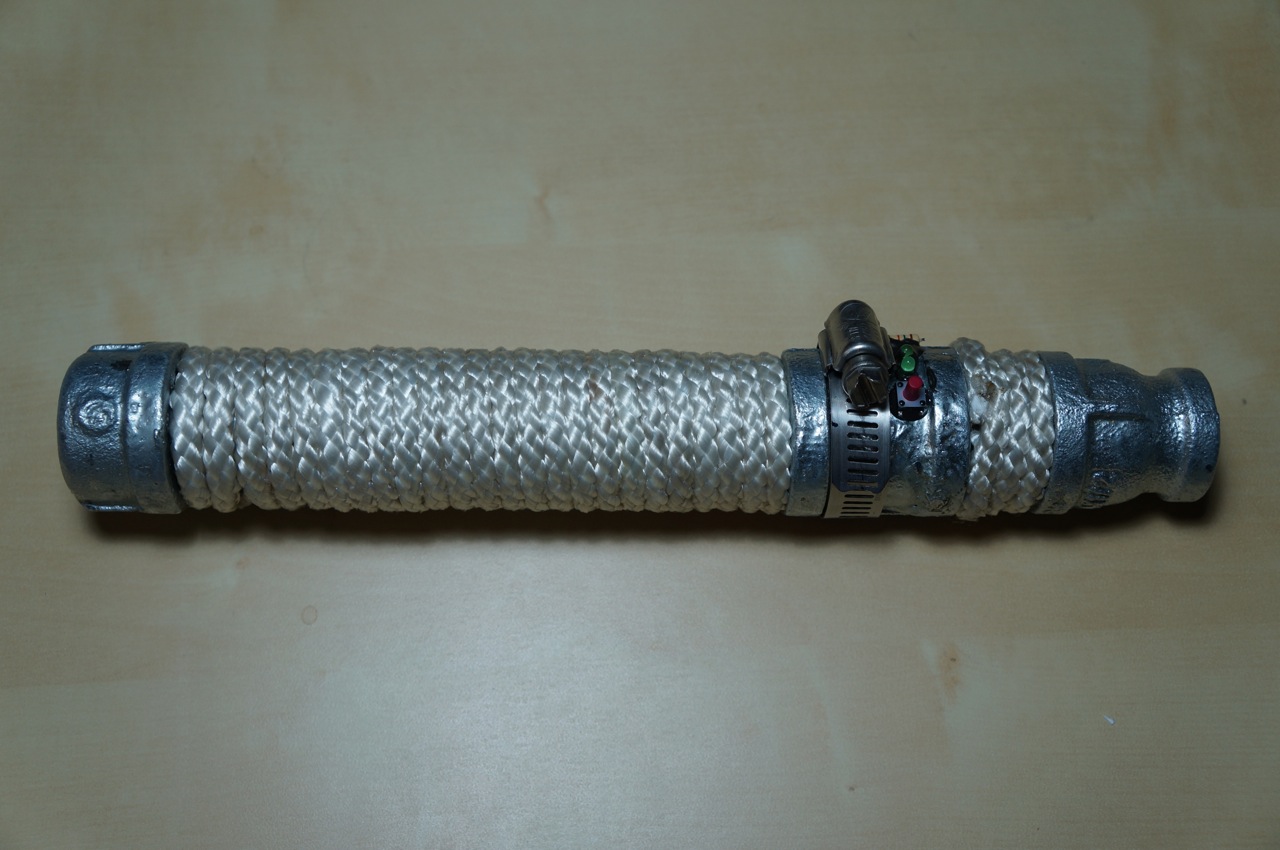
    To create the lightsaber’s handle, I screwed all of the handle components together except for the 3/4″ to 1/2″ coupling like this: 3/4″ cap | 6″ x 3/4″ pipe | 3/4″ to 3/4″ coupling | 3/4″ close pipe.
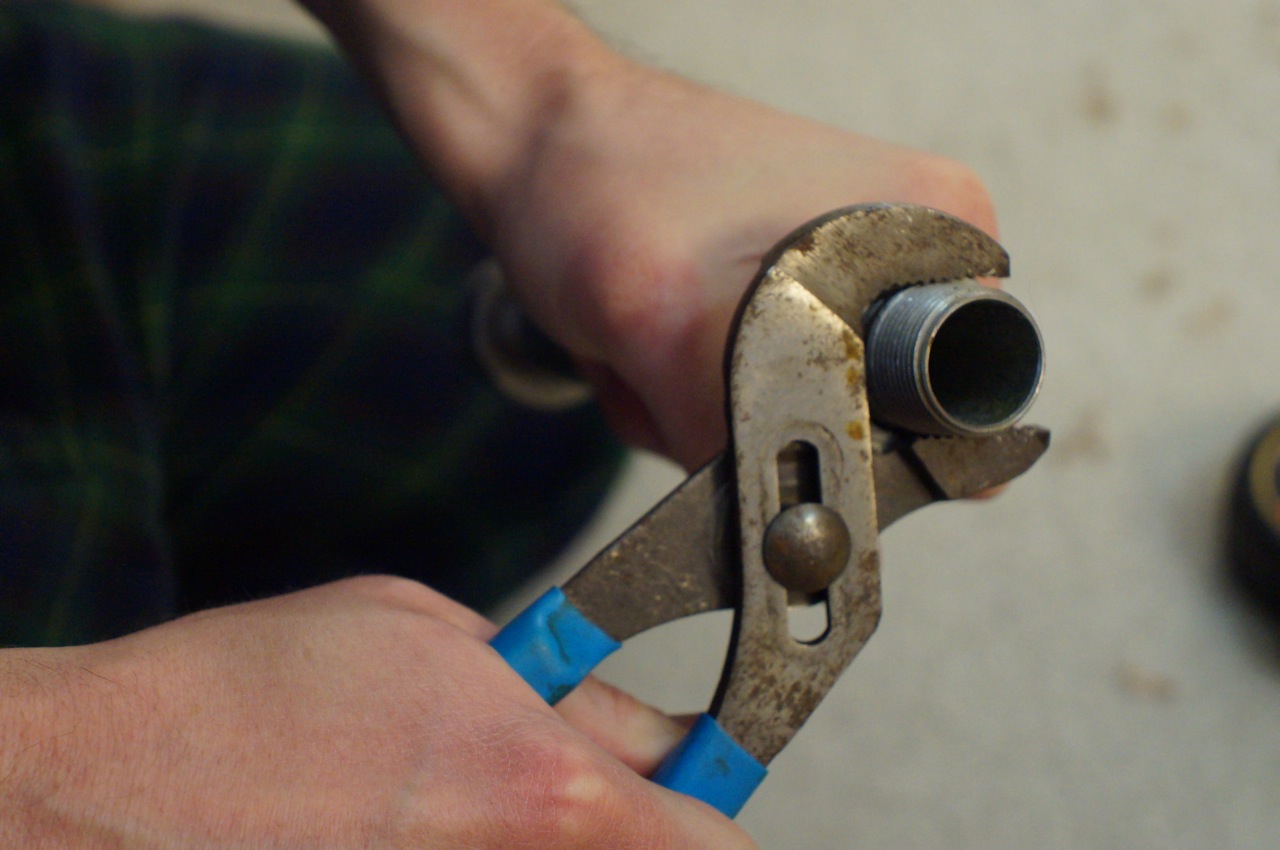
    lightsaber-DSC02005

    Then, I prepared the nylon rope to create the grip on the two pipe sections (6″ pipe and close pipe) by burning frayed ends to melt the nylon.

    lightsaber-DSC02009

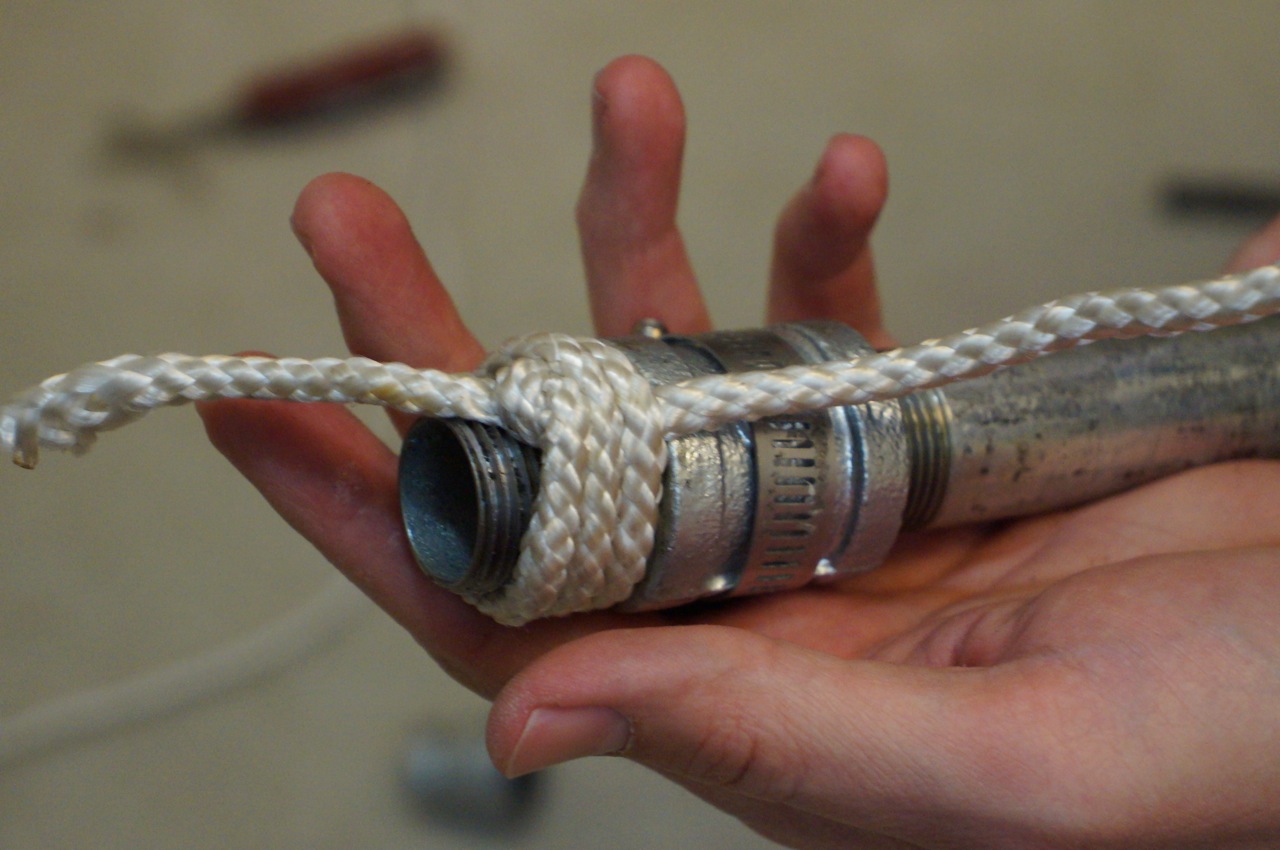
    Beginning at the business-end of the lightsaber, I tucked a small piece of rope under the first wrap against the 3/4″ coupling to hold the rope in place and prevent unraveling.
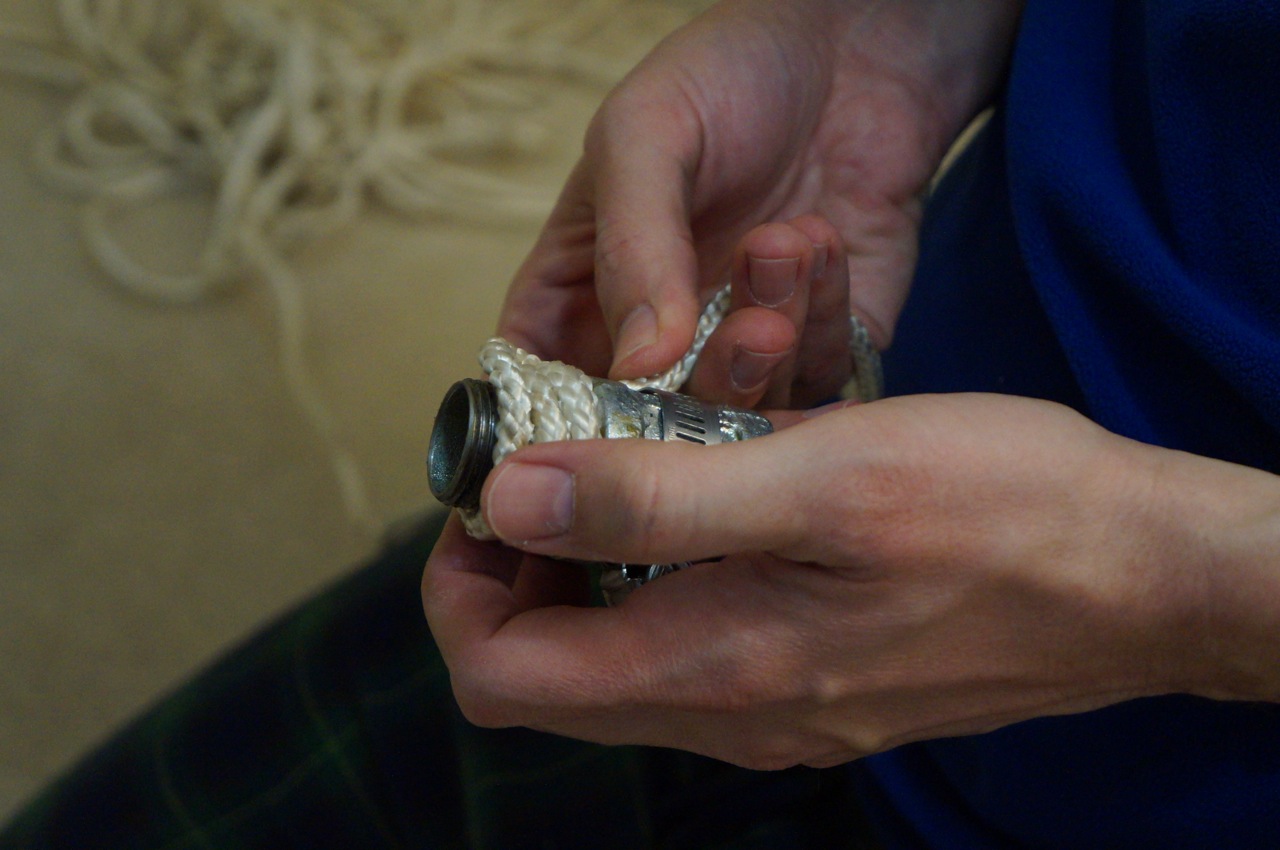
    lightsaber-DSC02011

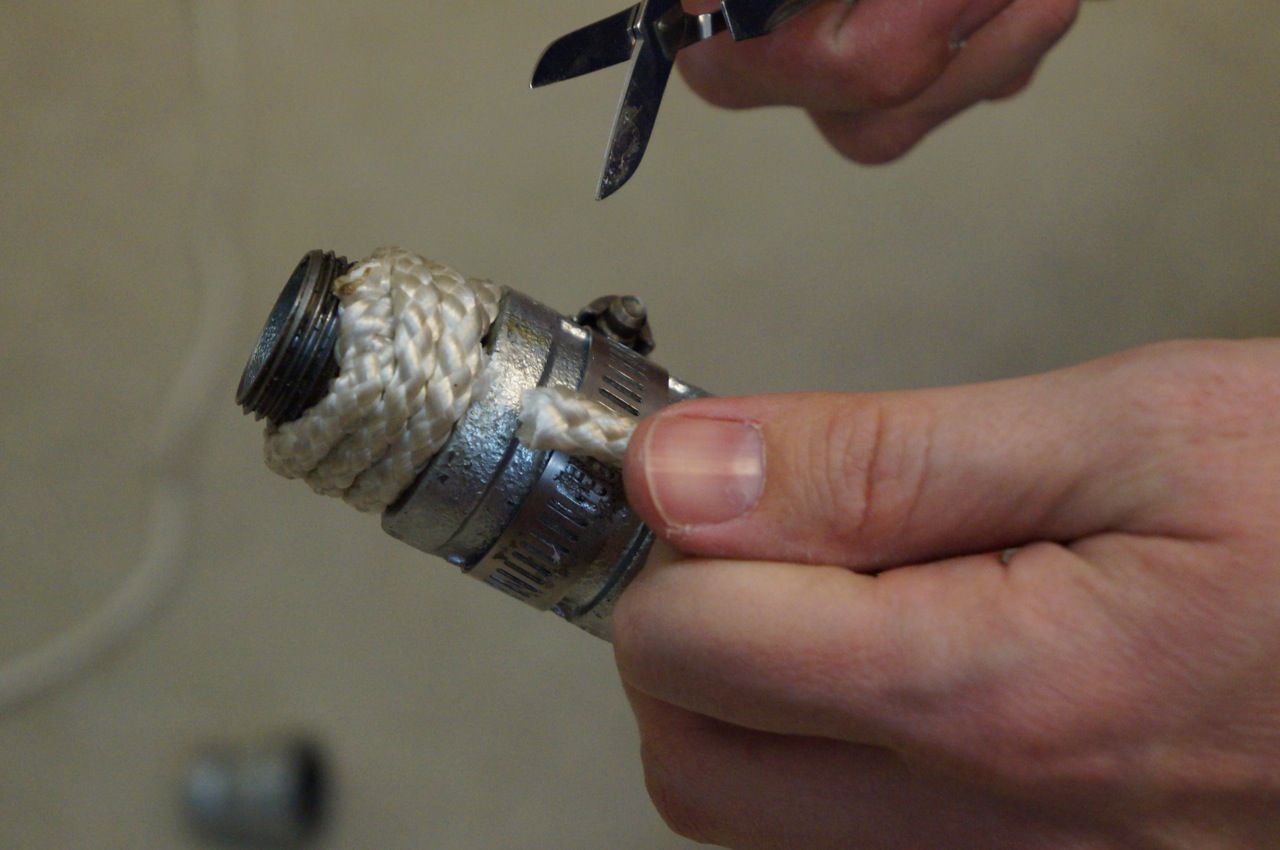
    At the top end, close to where the 3/4″ to 1/2″ coupling (or lightsaber emitter/business end), I created a loop with the rope under the last wrap, which I ran the last wrap through and pulled into the wrap, which hid the end of the rope under the wrap.
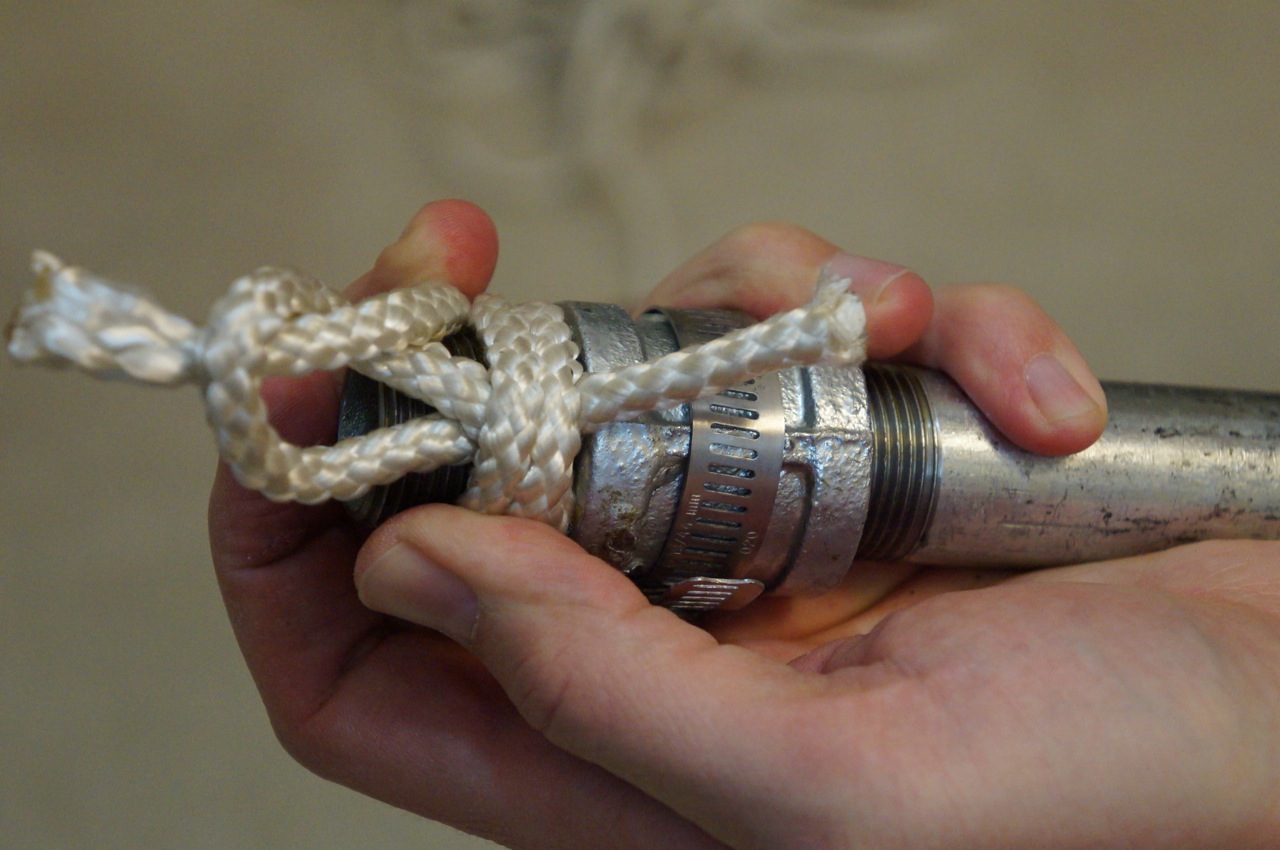
    lightsaber-DSC02019

    lightsaber-DSC02022

    I cut the loose ends.
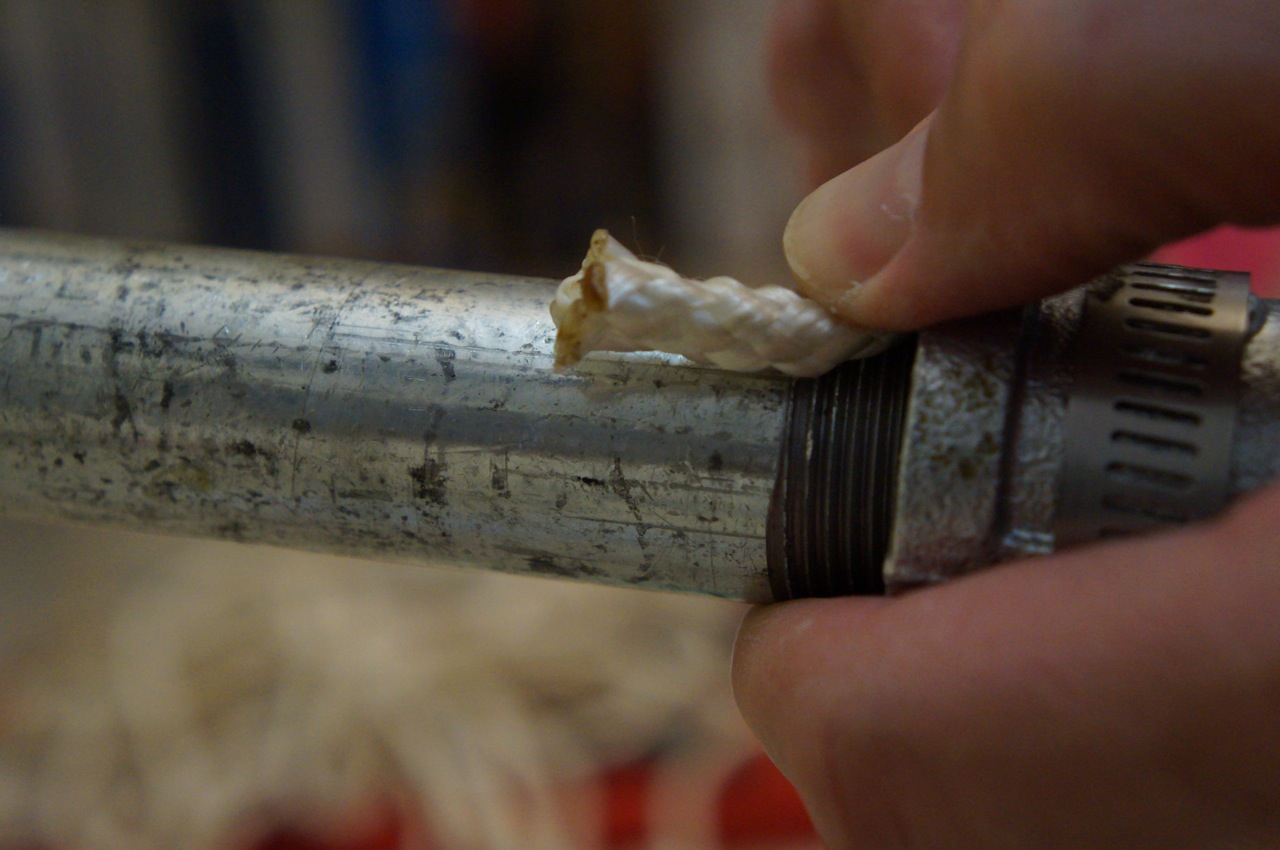
    lightsaber-DSC02023Beginning on the other side of the 3/4″ coupling, I repeated these steps with the longer wrap of the 6″ pipe section. First, a small piece under the first wrap.
    lightsaber-DSC02036

    I pulled the rope tight around the pipe and pushed each wrap down to keep the grip as tight as possible.lightsaber-DSC02041
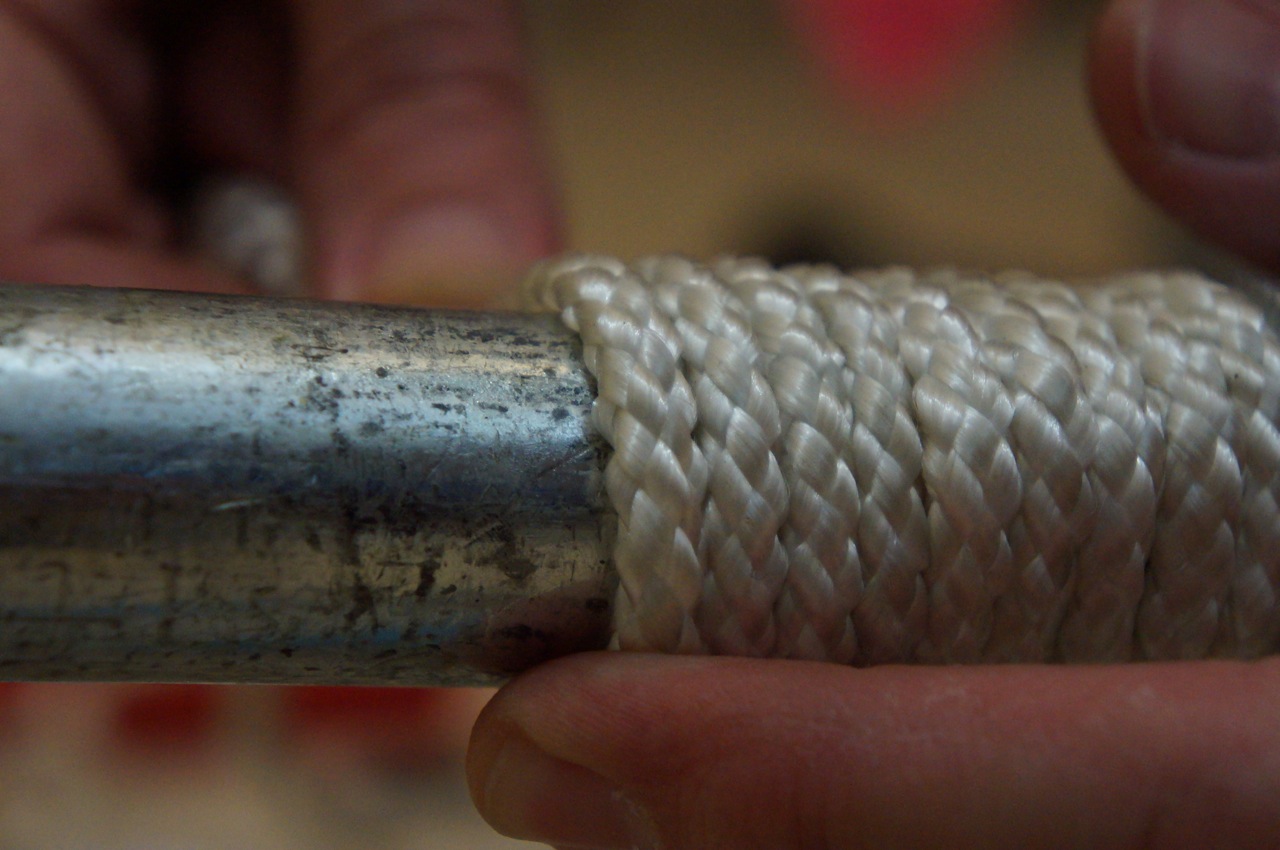
    Mose tried to help with the process as much as possible.lightsaber-DSC02043

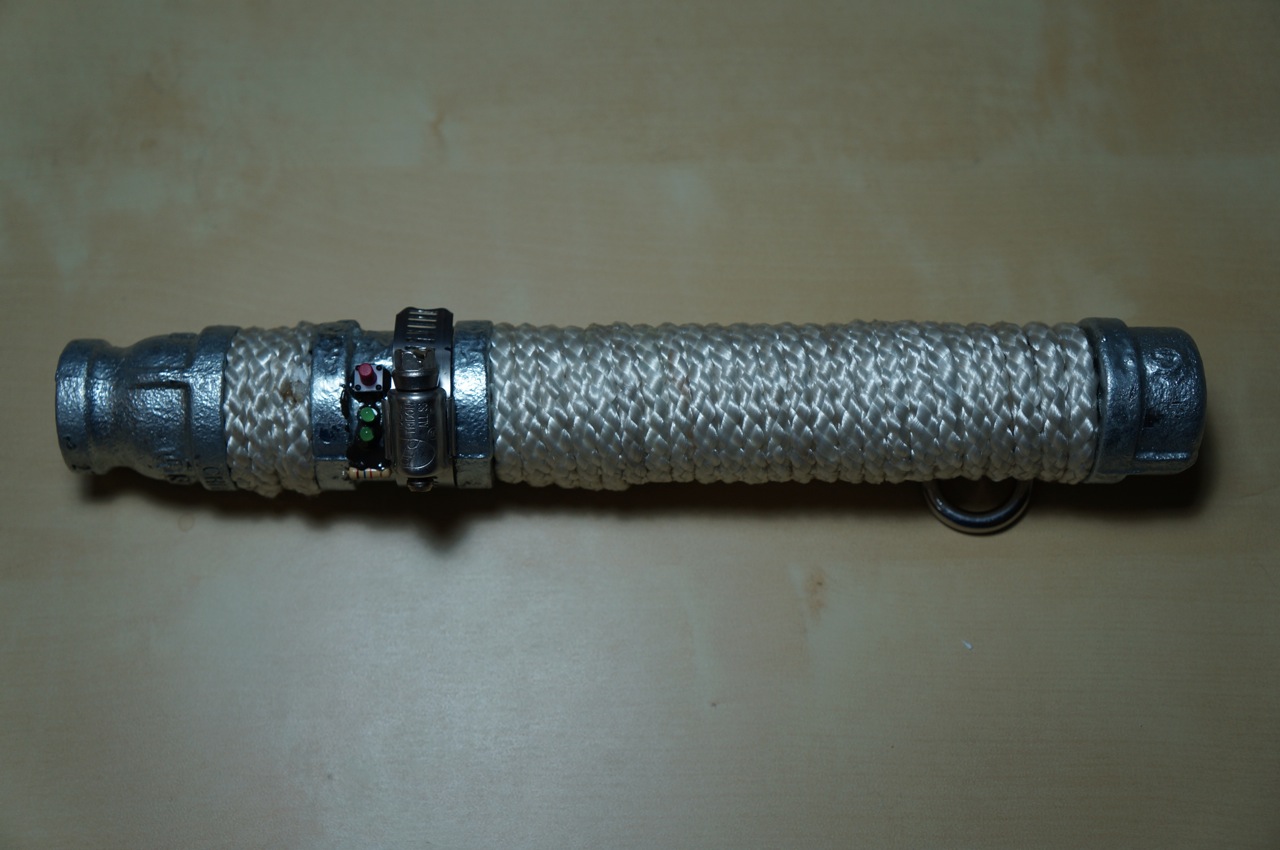
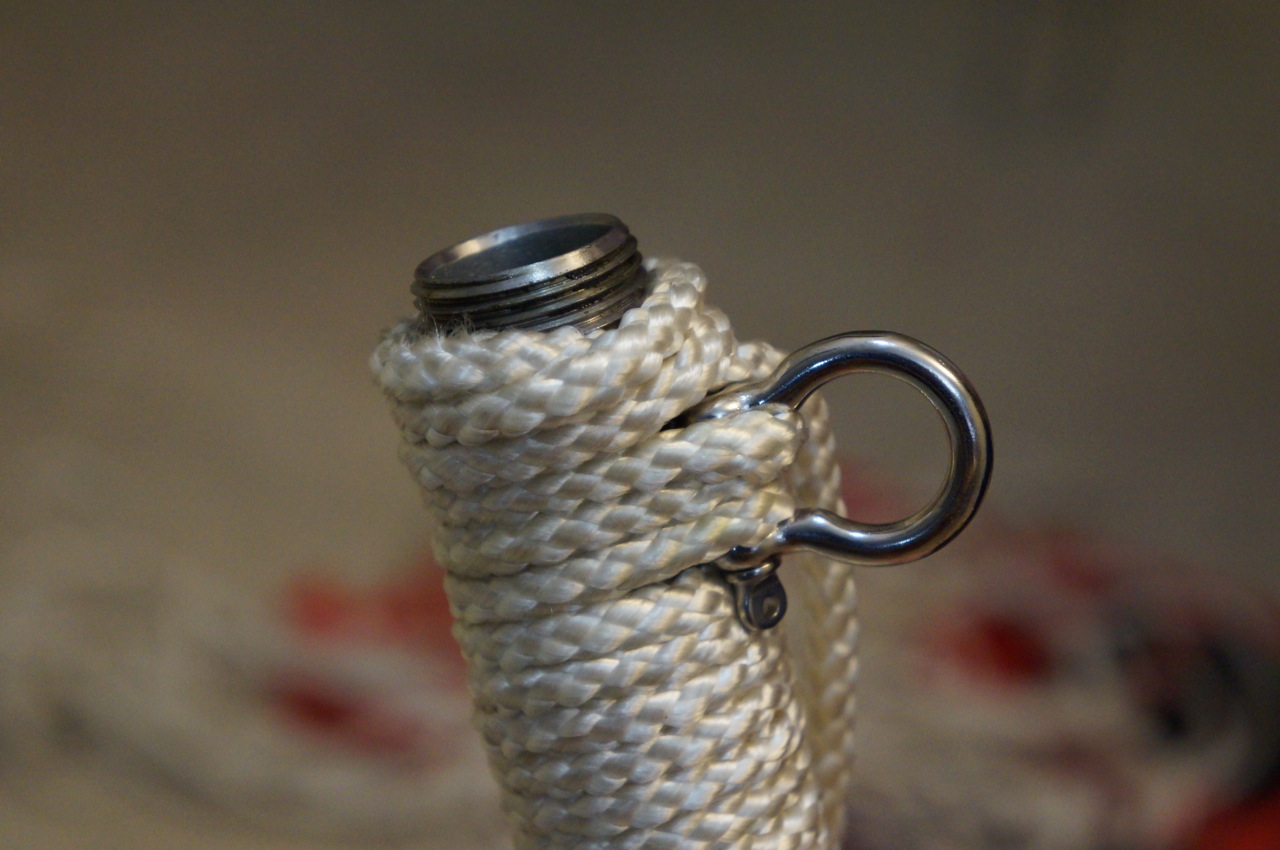
    At the end of the 6″ long pipe, close to where the end cap goes, I placed the D-Ring and ran the rope through its eye to connect it to the handle.

    lightsaber-DSC02050

    As in the shorter section wrap, I created a loop and pulled the end of the rope through and under the last lines of wrap to hide the end and prevent the grip from unraveling.
    lightsaber-DSC02051

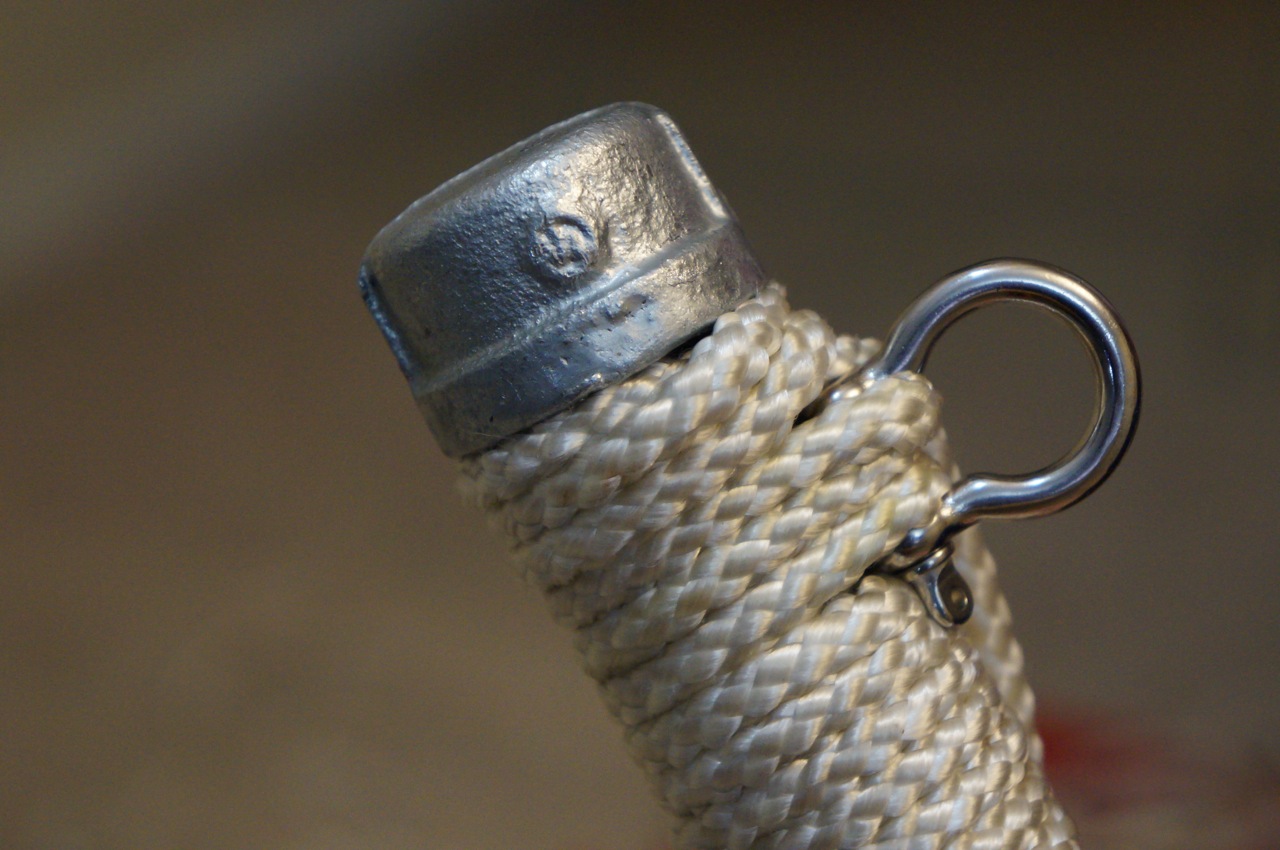
    Finally, I installed the cap. Before doing this, I wrapped the grip higher than necessary so that the the cap would compress the wrap when tightly screwed onto the 6″ pipe.lightsaber-DSC02052
    Since Ryan would likely bang his lightsaber when sparring, I wanted to make it as practical as possible while giving it a technological appearance. First, I tried attaching a circuit board from an average doorbell button with two hose clamps.
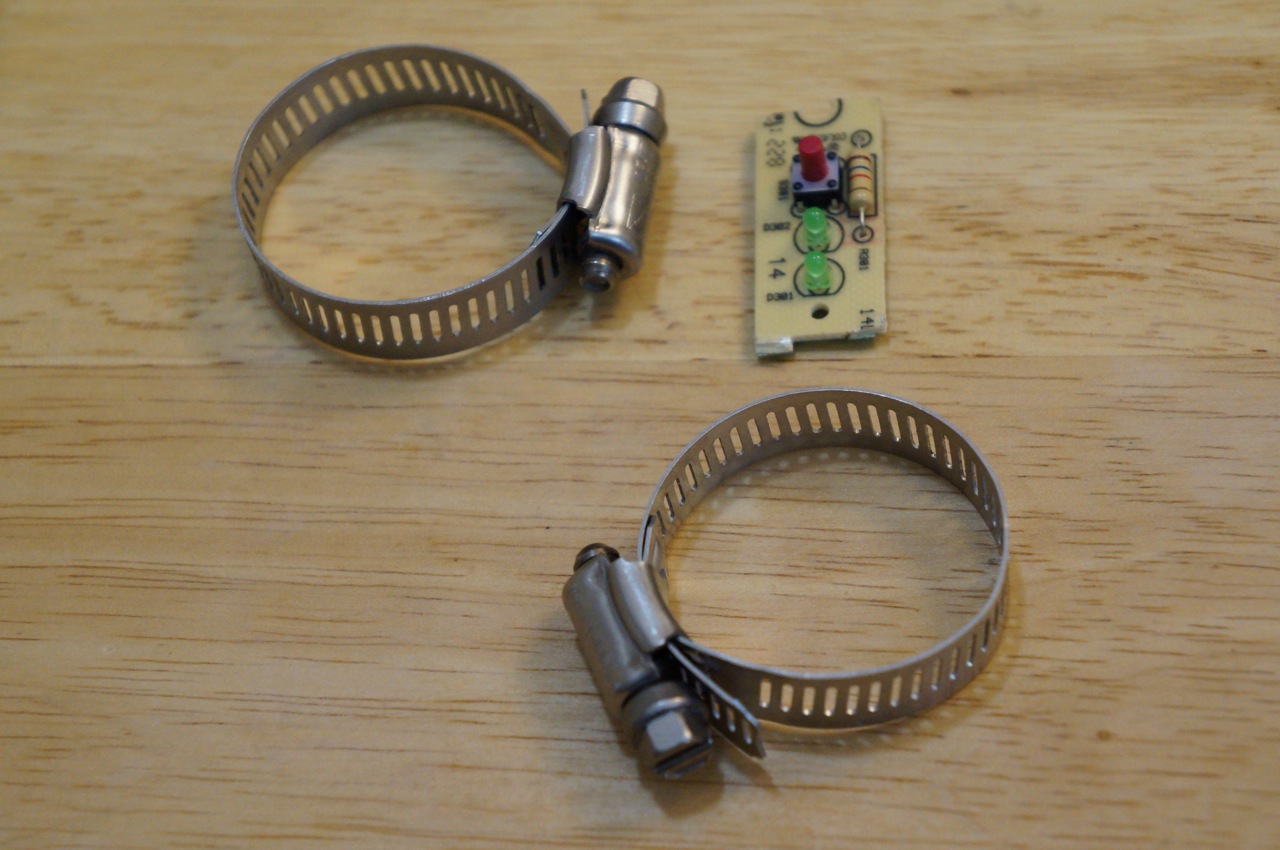
    lightsaber-DSC02053 lightsaber-DSC02055 lightsaber-DSC02057

    While I thought this fit the rugged look that Ryan might like for his lightsaber, I thought that it would be more practical to use only one hose clamp and affix the doorbell components with JB Weld after removing them from the circuit board.
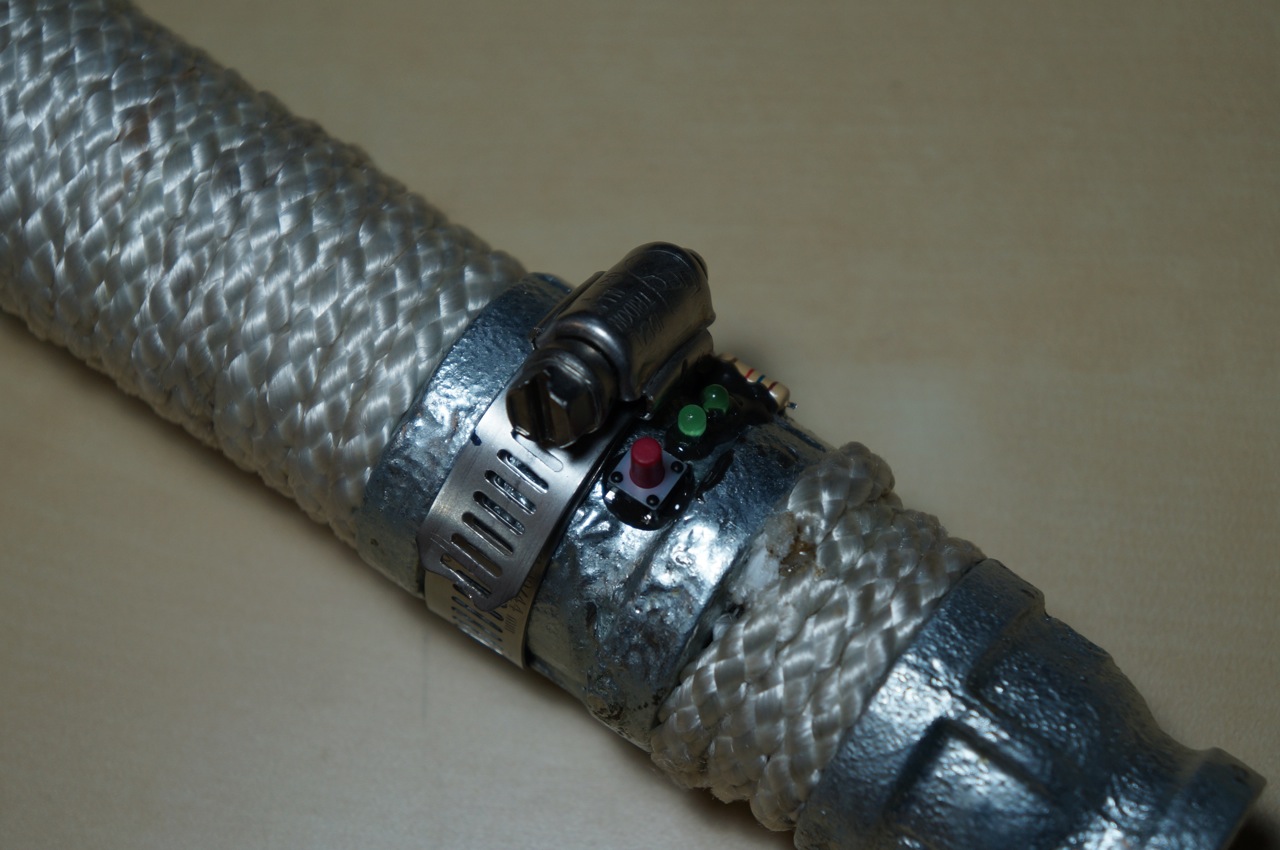
    lightsaber-DSC02090

    I liked this configuration best. The hose clamp protects the switch, lights (non-functional), and resistor.

    Next, I wanted the display emitter on the deactivated lightsaber (3/4″ to 1/2″ coupling) to look “realistic,” so I pulled the electromagnet from an 80″ computer fan, crushed it with my channelocks, and inserted it into the 3/4″ end of the 3/4″ to 1/2″ coupling. Repurposing the electromagnet draws on a visual/physical rhetoric of technology in the same way that movie props and set design use this for world building, extrapolating, and establishing plausibility.

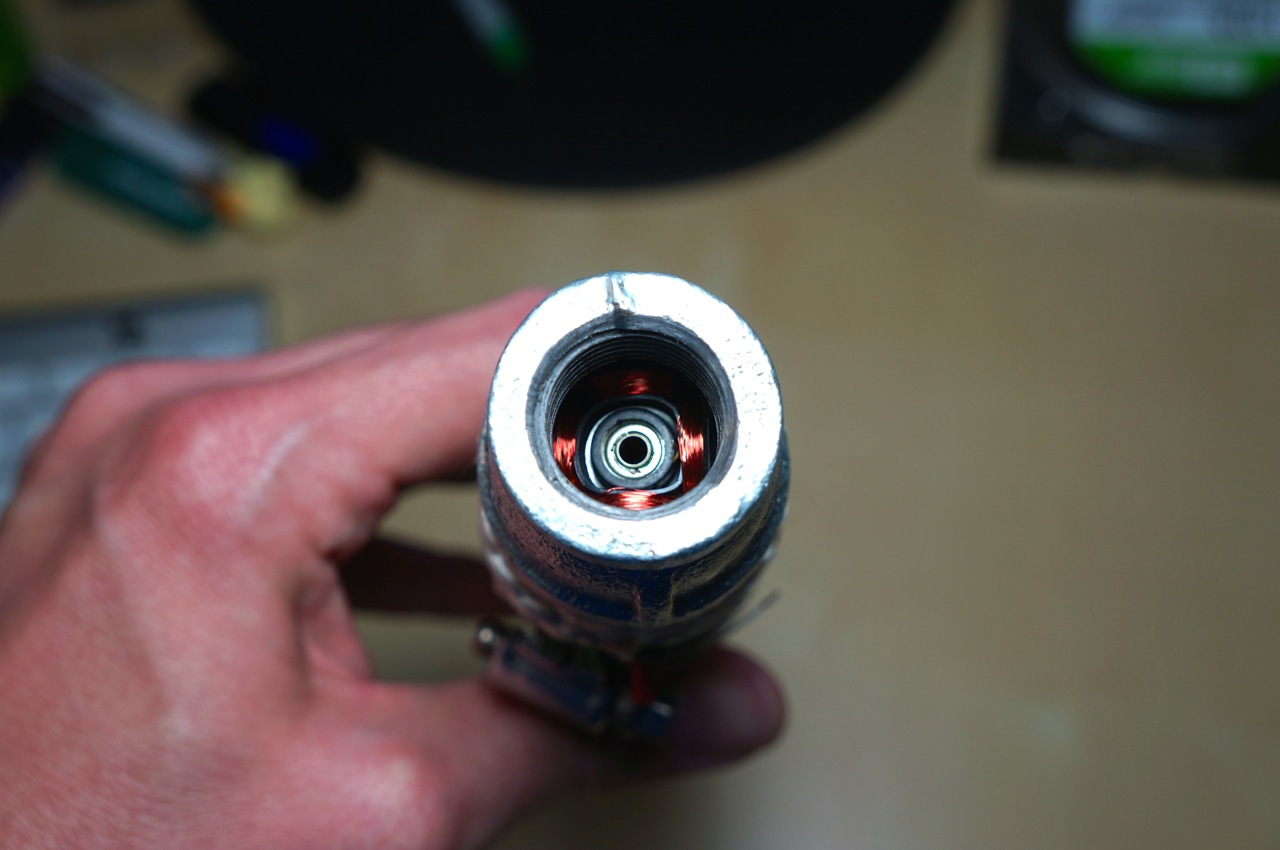
    lightsaber-DSC02098 lightsaber-DSC02088

    The next phase of the lightsaber build involved the other sparring emitter. I needed to rigidly attach a wooden blade to the second 3/4″ to 1/2″ coupling in the 1/2″ end of the coupling and paint it to match the yellow blade color that Ryan sought (signifying the Consular Jedi).

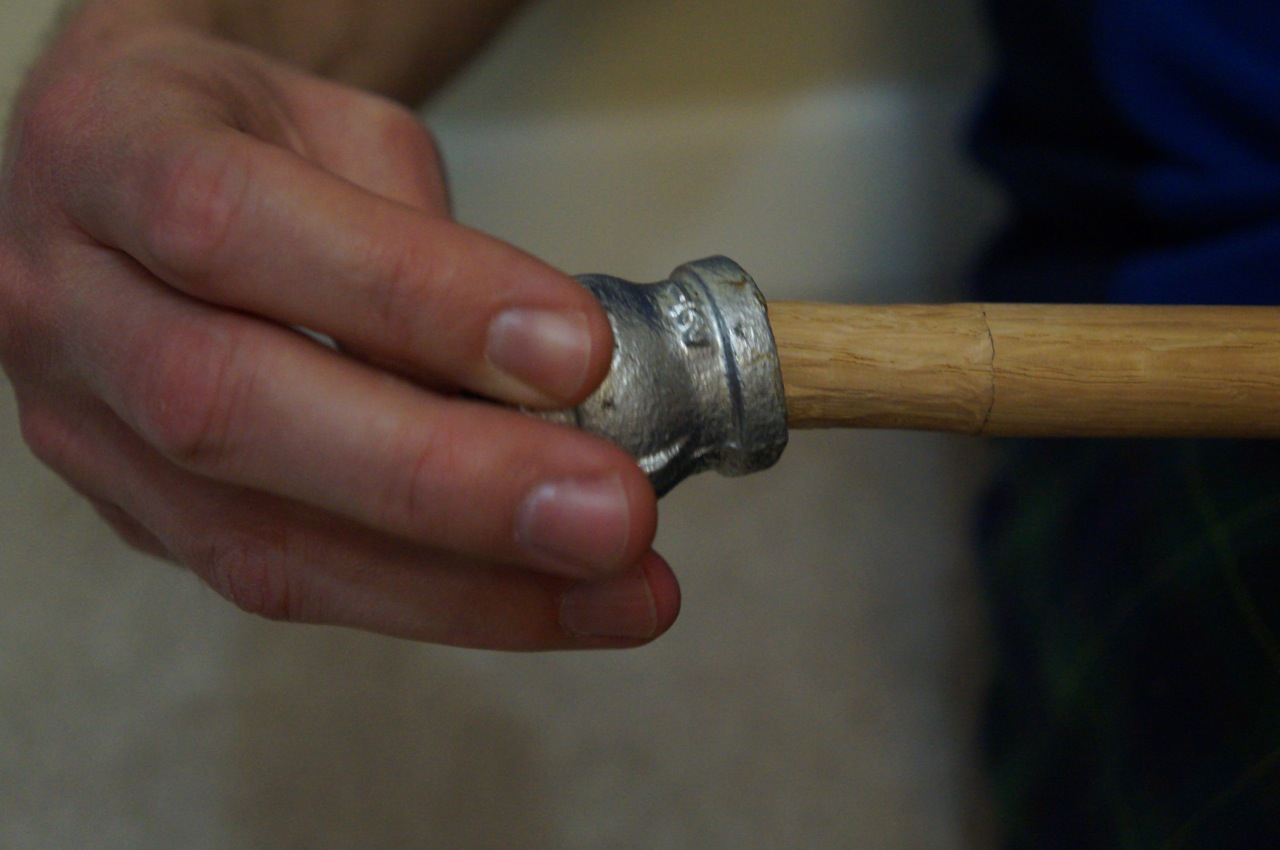
    I began by taking an oak dowel rod and whittling one end enough to screw it into the 1/2″ end of the 3/4″ to 1/2″ coupling.


    lightsaber-DSC01976 lightsaber-DSC01981 lightsaber-DSC01982 lightsaber-DSC01983

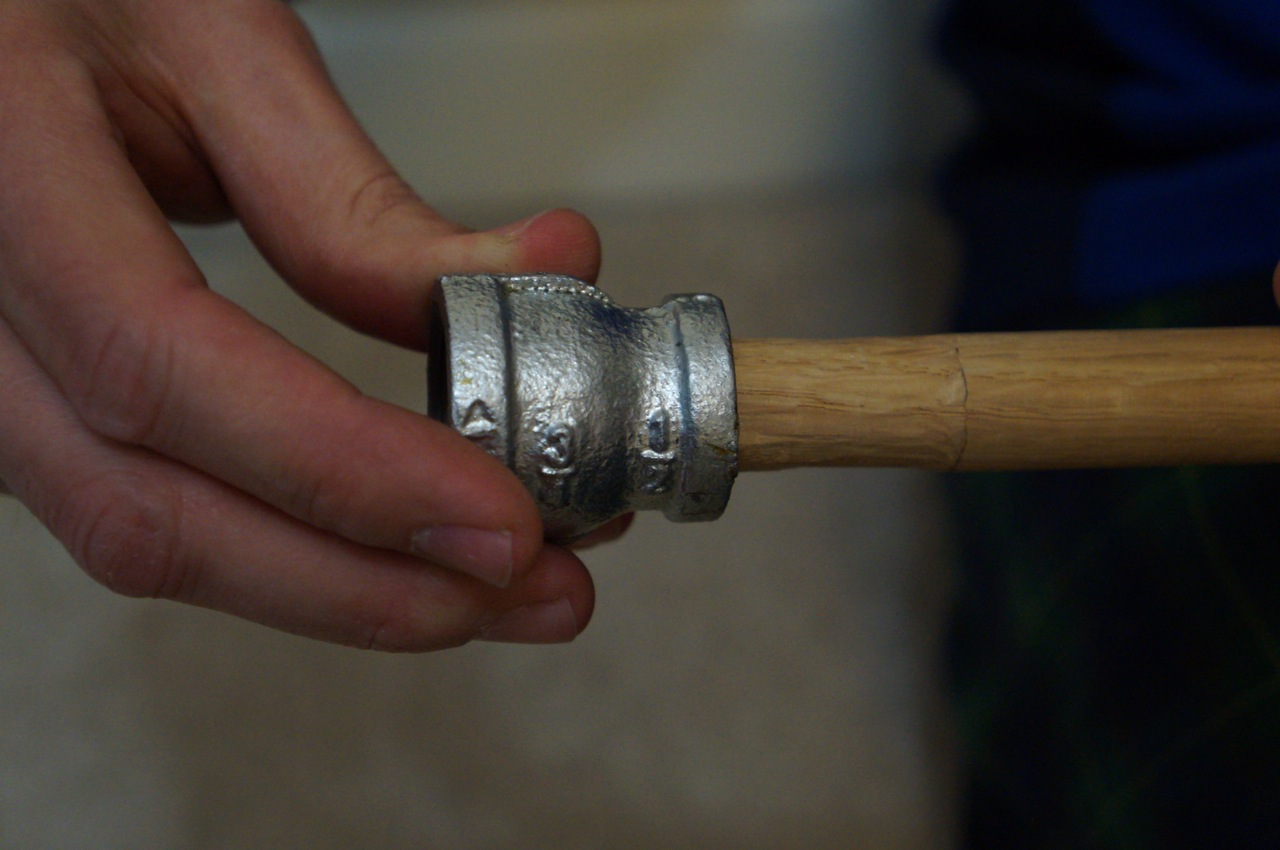
    Then, I used JB Weld to permanently connect the coupling to the dowel rod.
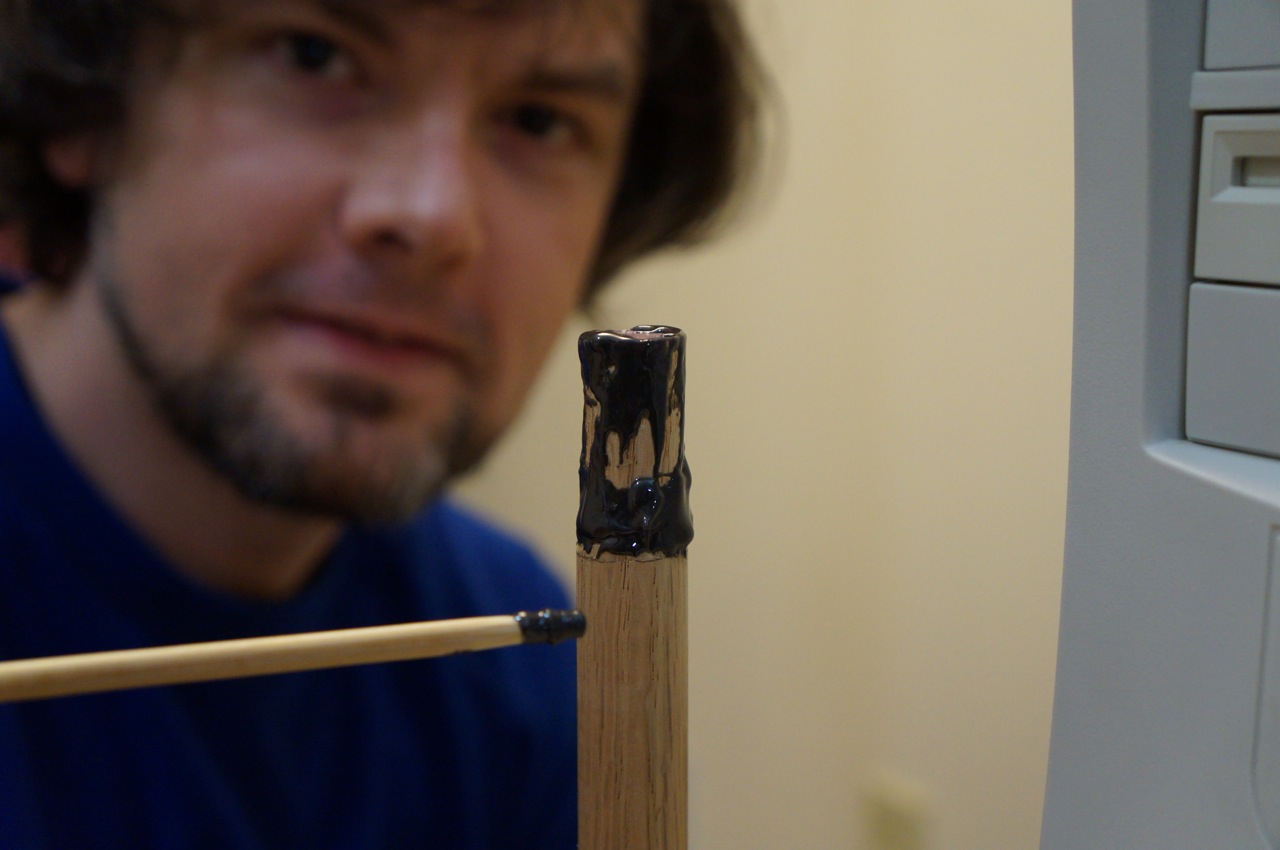
    lightsaber-DSC01988

    I had to make sure that I did not put too much JB Weld on the tip closest to the 3/4″ pipe thread, which screw into the “close” end of the lightsaber when the blade needs to be drawn.lightsaber-DSC01989

    I made sure that it was centered and straight.

    lightsaber-DSC02000

    Finally, I painted the dowel rod above the coupling with a primer and then with the florescent yellow.


    lightsaber-DSC02058

    lightsaber-DSC02072

    Unfortunately, I misread the spray paint cans and ended up with a mess when the florescent yellow would not stick to the dried primer (I mistakenly picked up white primer + paint instead of simply primer).
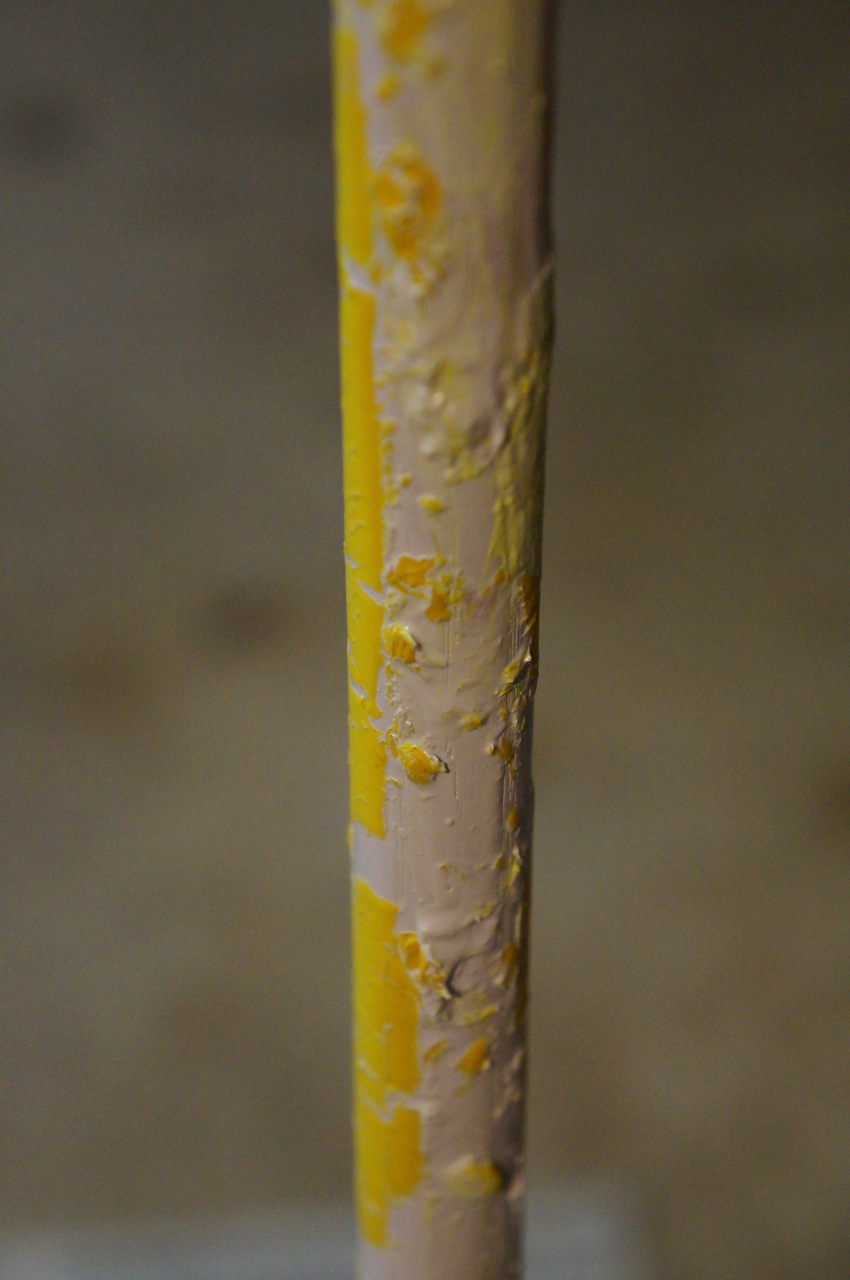
    lightsaber-DSC02075
    Luckily, I had a paint brush handle in the garage that was long enough to serve the same purpose even if it might be made out of pine instead of oak.
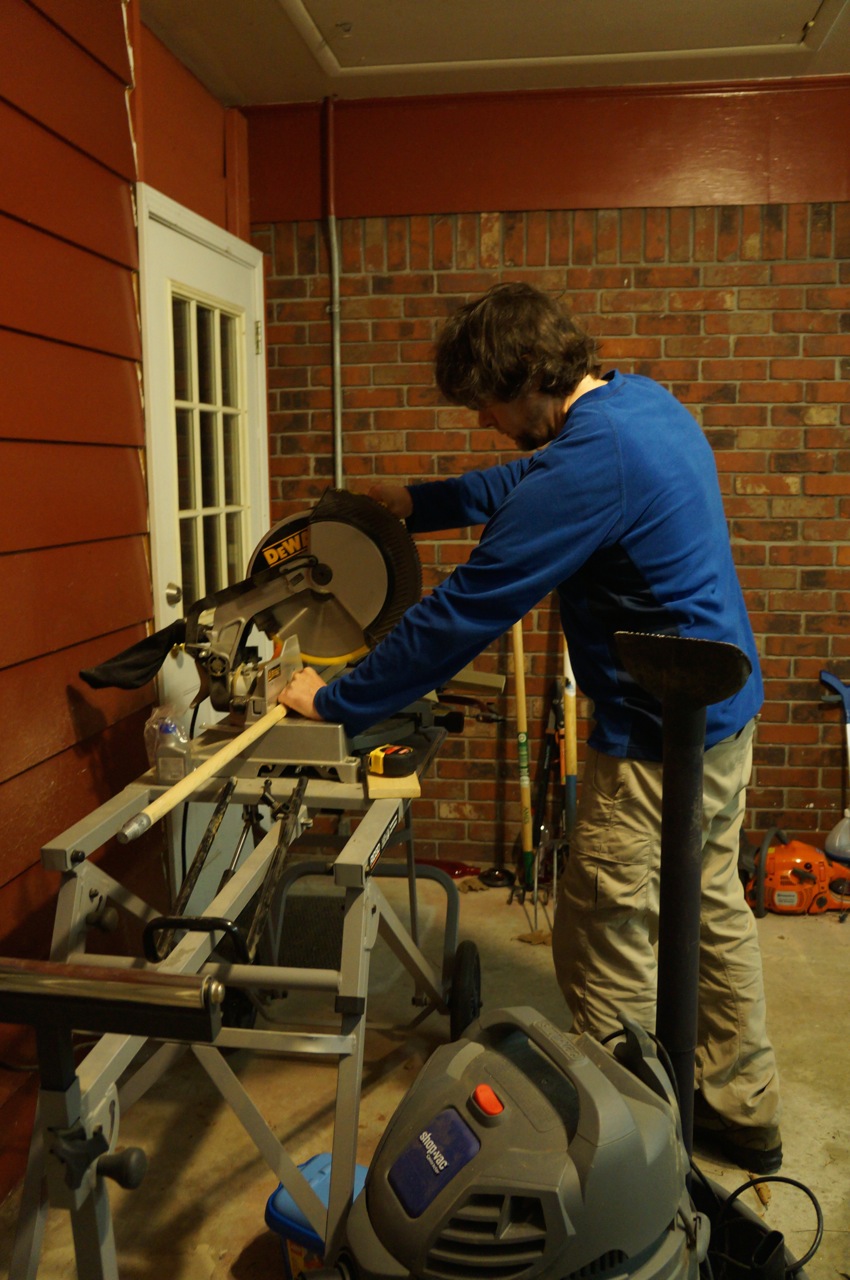
    lightsaber-DSC02073

    I cut the paint brush handle down to 36″.
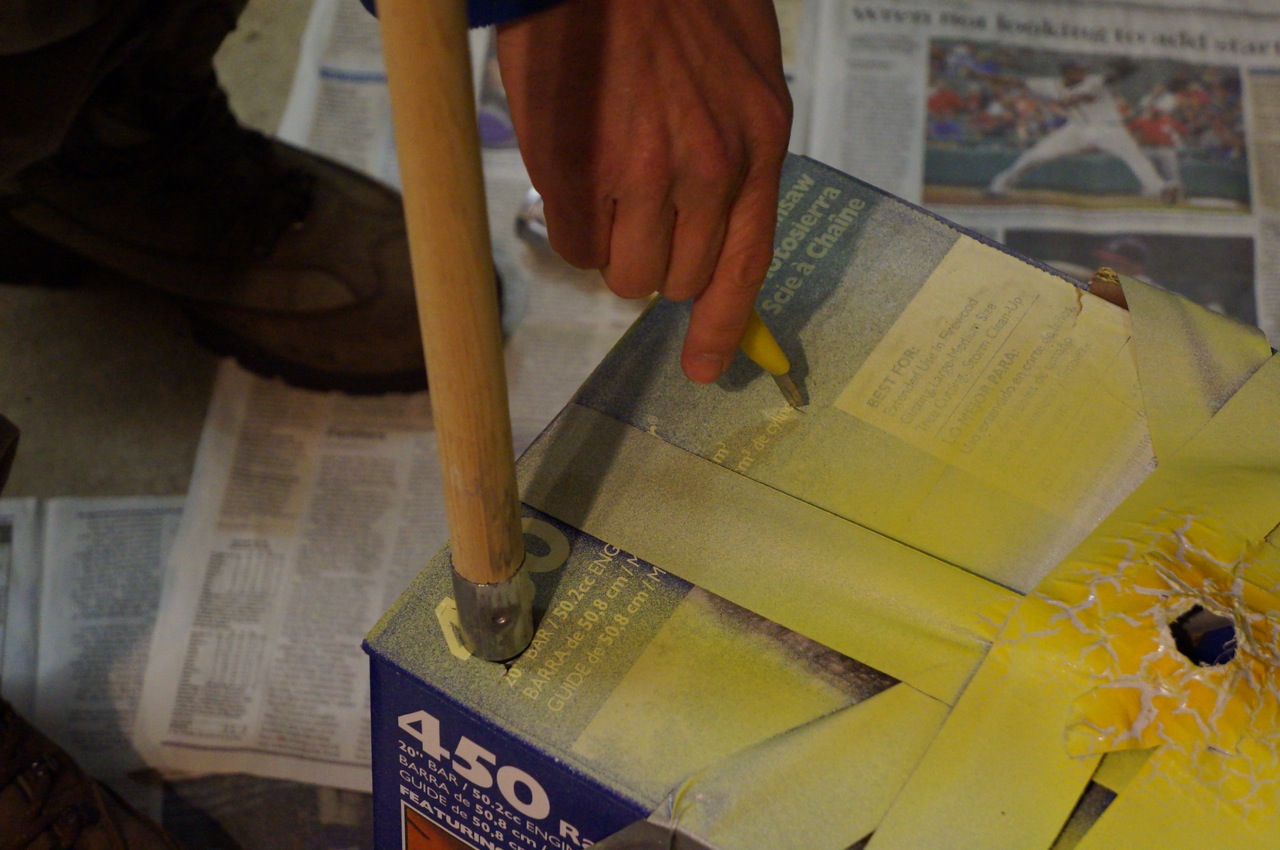
    lightsaber-DSC02077

    Set it up for painting with the remaining florescent yellow paint.
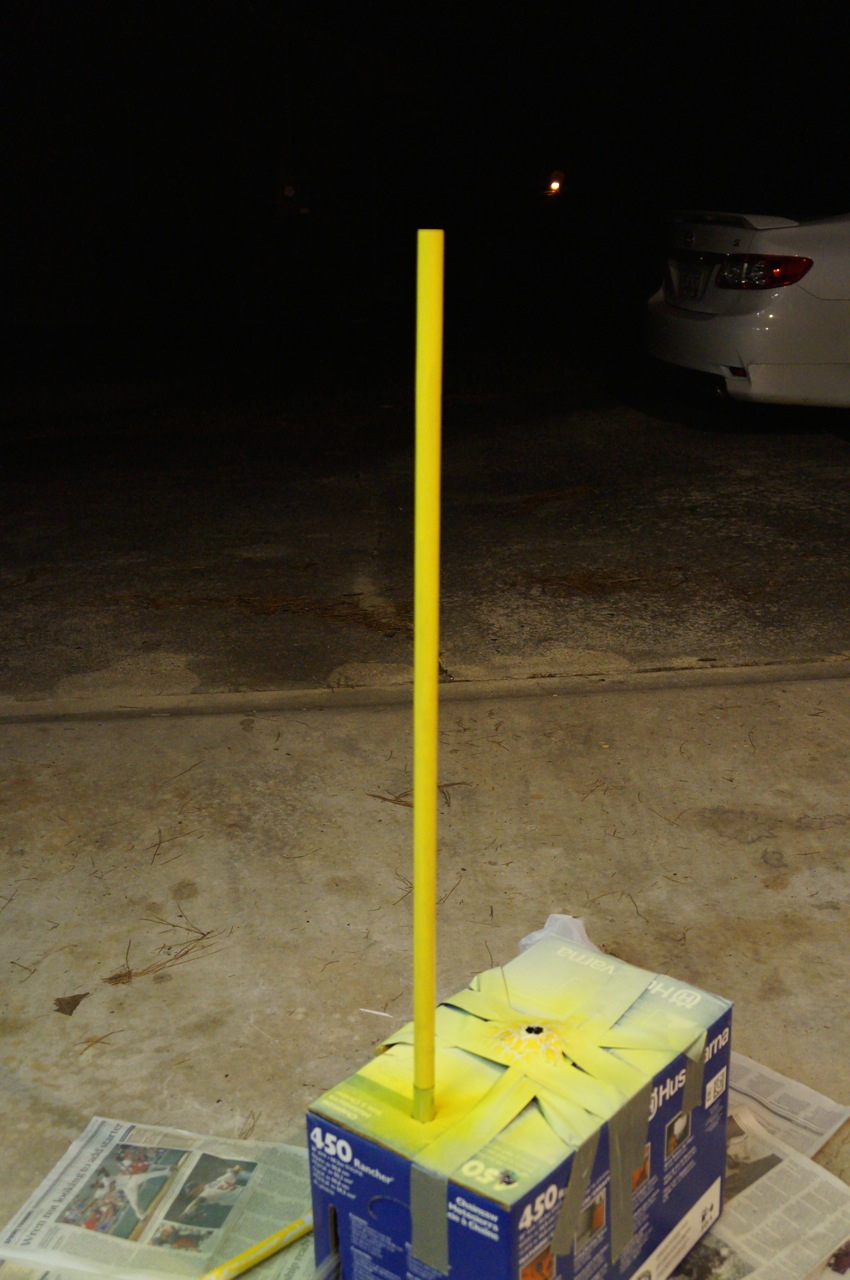
    lightsaber-DSC02080

    Many coats later, it was a bright yellow befitting a Consular Jedi!

    After the paint dried, I screwed the metal end of the brush into another 3/4″ to 1/2″ coupling and bonded the blade to the coupling with JB Weld.

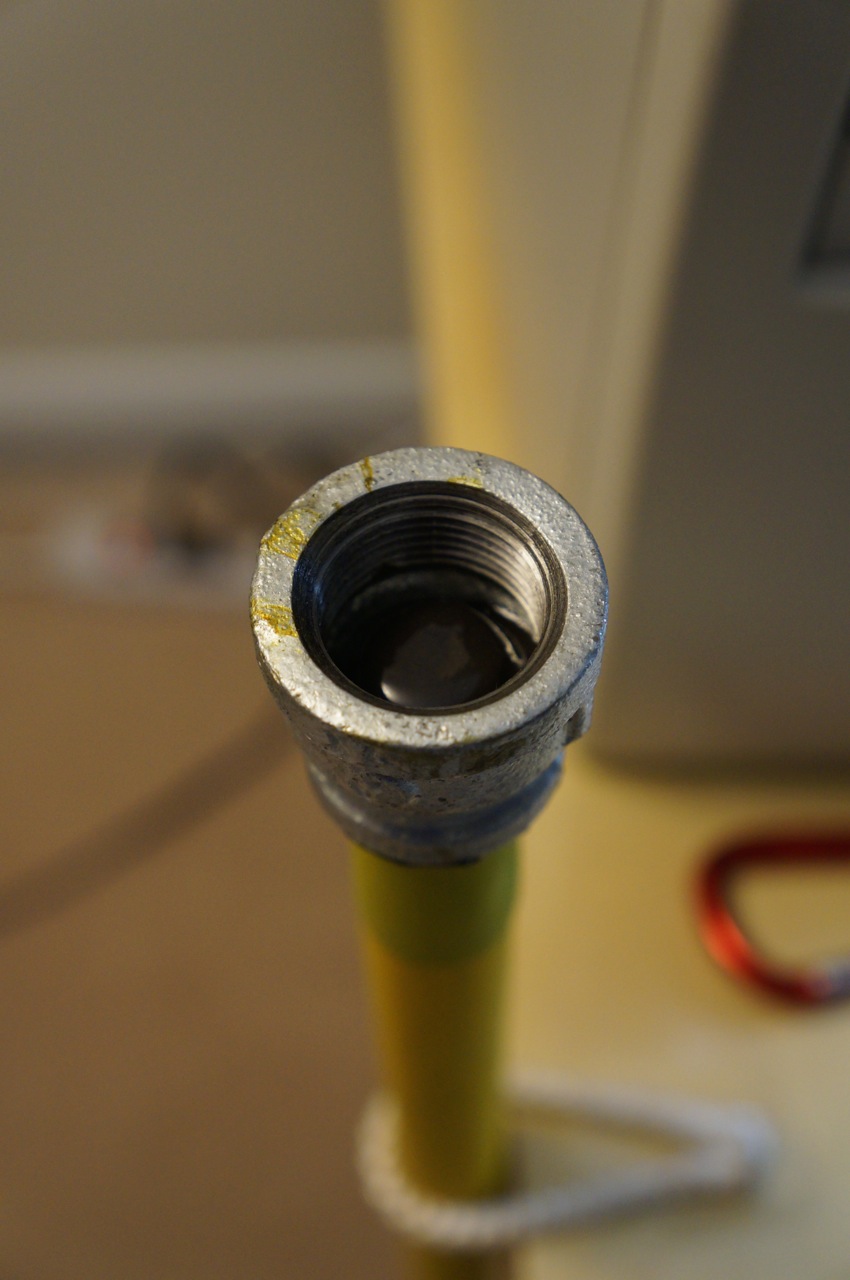
    lightsaber-DSC02094 lightsaber-DSC02095 lightsaber-DSC02096

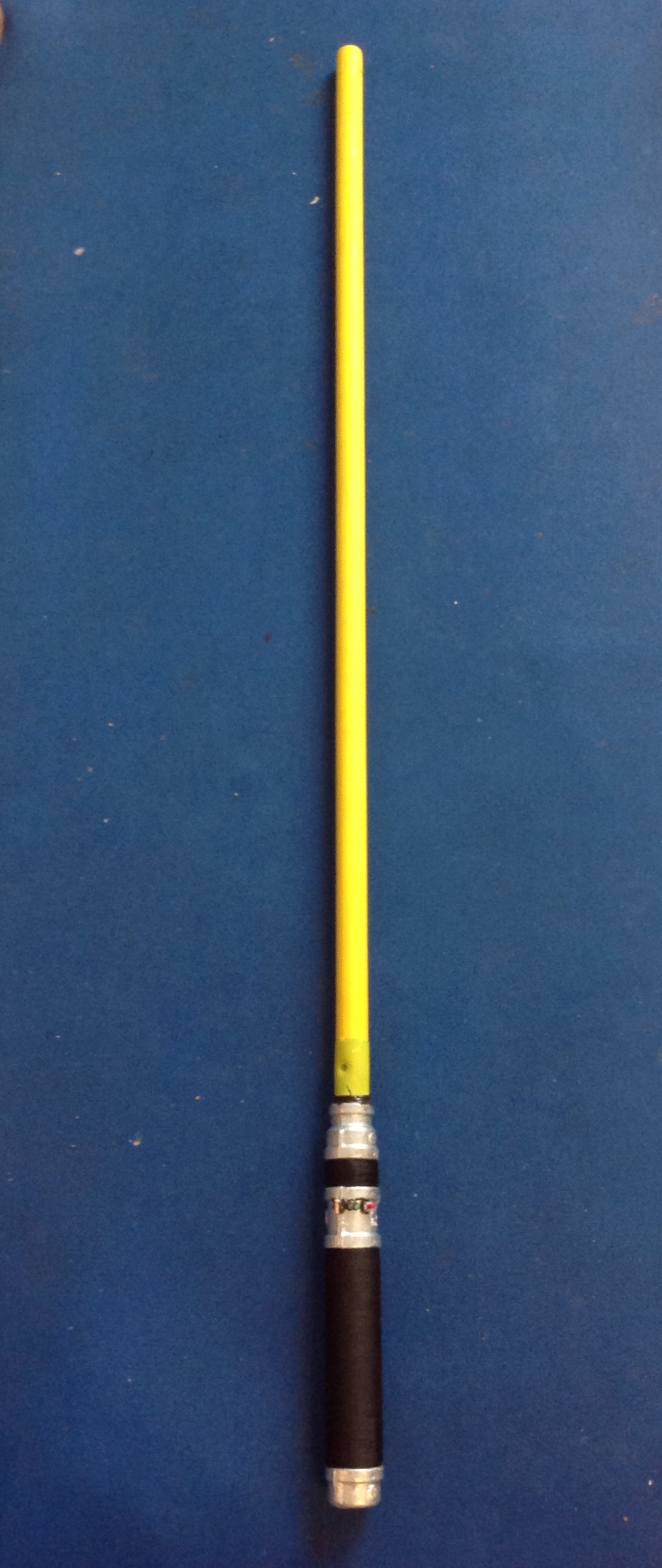
    After everything had dried, I mated the blade with the lightsaber handle.
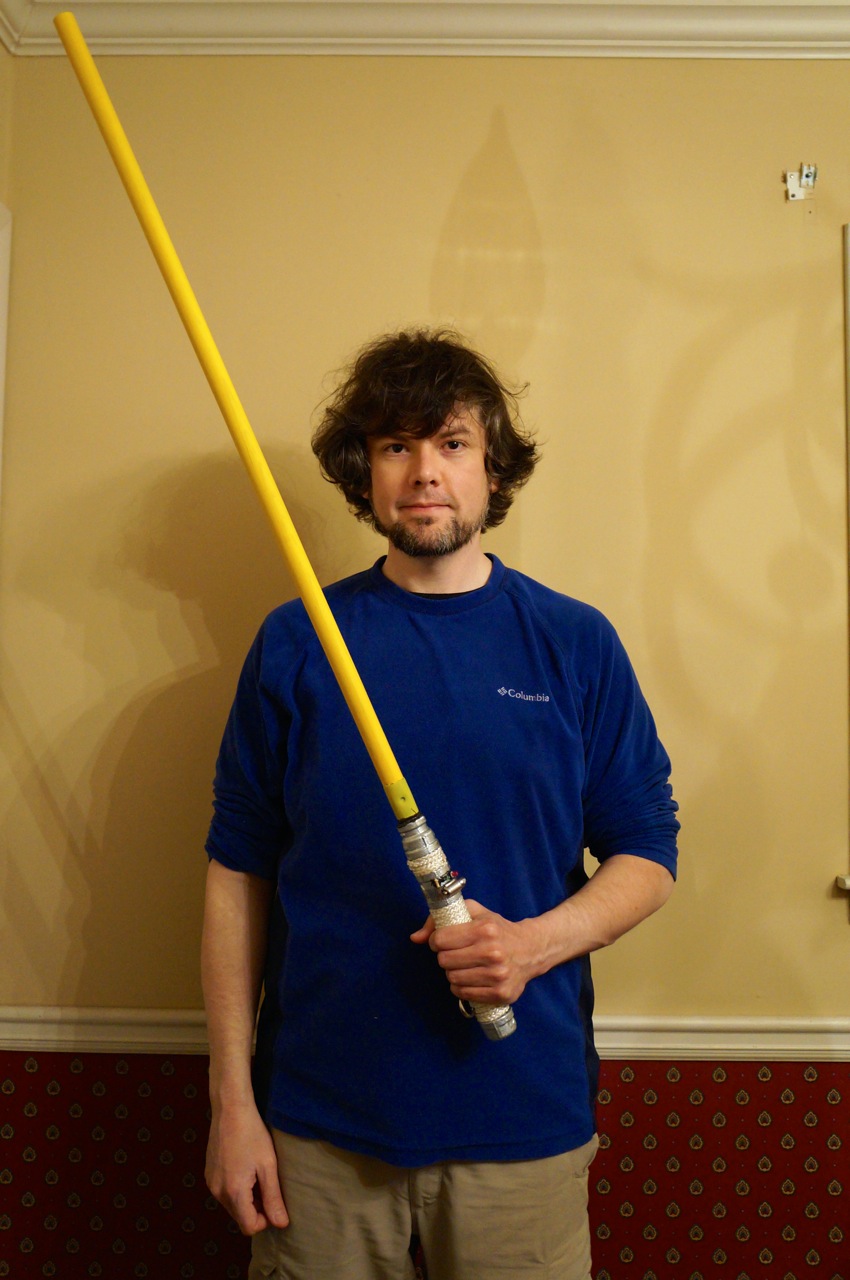
    lightsaber-DSC02102 lightsaber-DSC02103

    I was happy with the outcome of the lightsaber in deactivated mode, too.
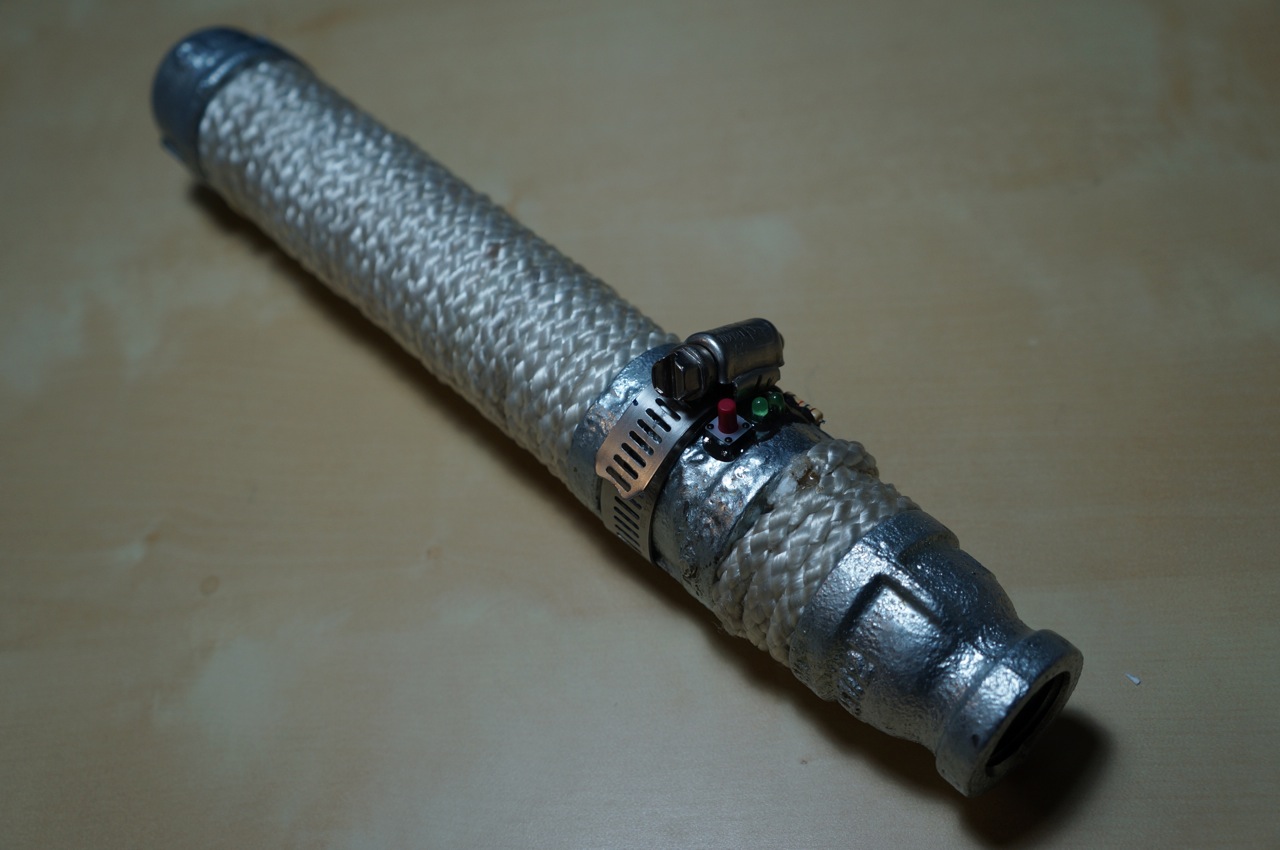
    lightsaber-DSC02092 lightsaber-DSC02091 lightsaber-DSC02086

    I gave the lightsaber to Ryan as a birthday present. I included this explanatory diagram that explains how the saber is more than simply parts (e.g., the rope is from the same bundle that Ryan and I used when we cut trees down in my yard last year).lightsaber-DSC02085
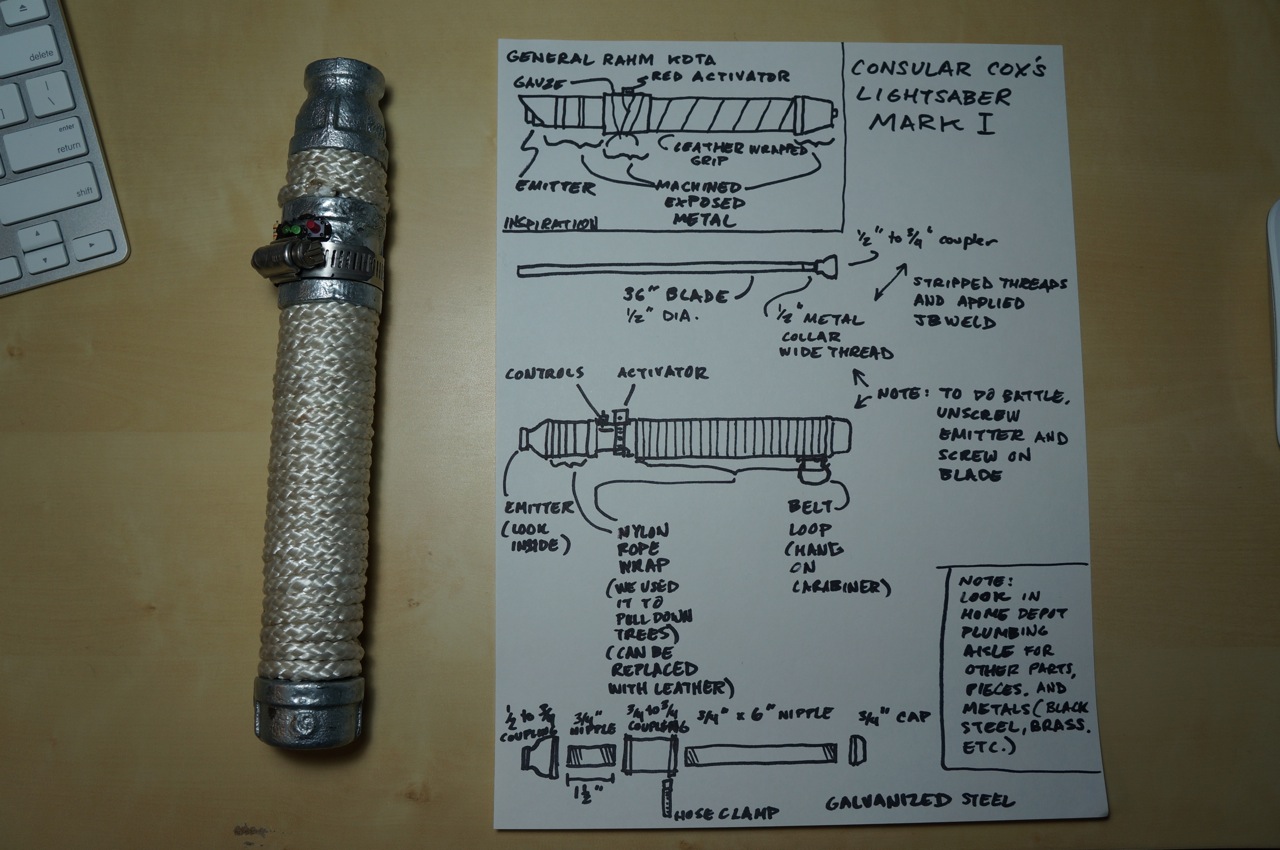
    Since I build this lightsaber, Ryan removed the nylon rope grip and improved it with three layers of bank line or tarred twine. The result is quite impressive aesthetically and practically!
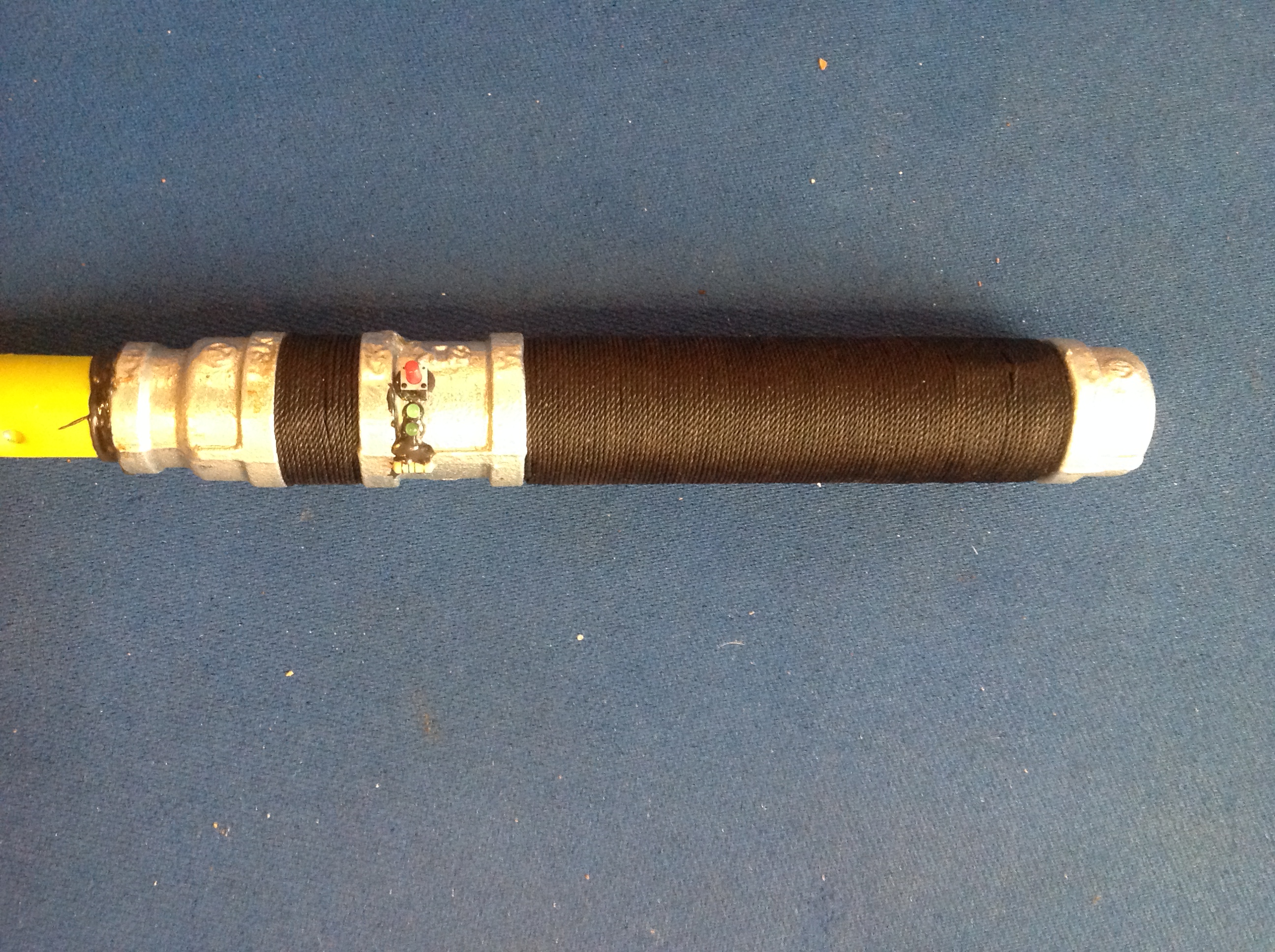
    IMG_8146
    Photo courtesy of Ryan Cox.
    IMG_0905
    Photo courtesy of Ryan Cox.

    I will post future posts on the lightsabers that I have built for myself and examples of our sparring (when we have the time for Ryan to teach me some things).

    UPDATE: Readers asked me to post photos of my other lightsabers–one inspired by Luke Skywalker’s lightsaber in Return of the Jedi and Darth Maul’s double-bladed lightsaber from The Phantom Menace. When I built these sabers for myself, I didn’t take as many photos of the process as in the lightsaber above for Ryan, but these photos should illustrate the basics of how to build similar DIY lightsabers.

    Luke Skywalker ROTJ Lightsaber and Stand
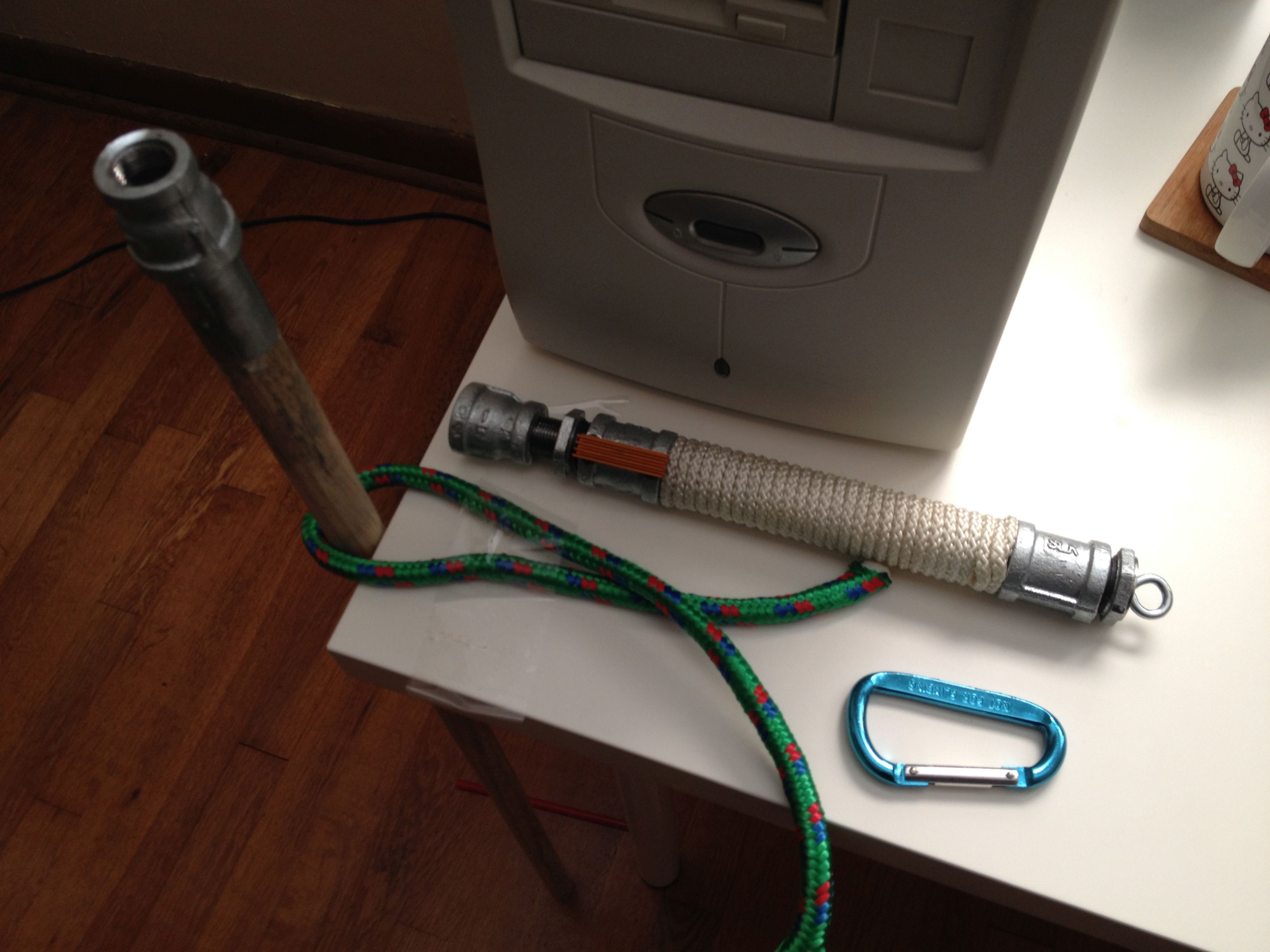
    IMG_4671This was the first version of Luke’s lightsaber. I am working from memory as I do not have the lightsaber in front of me to give the exact specifications. I believe that working from the left to the right: 3/4″ to 1/2″ reducer, 1/2″ threaded pipe 1″ long, 1/2″ to 3/4″ bushing, 3/4″ coupler, 3/4″ pipe 7″ long, 3/4″ coupler, 3/4″ to 1/2″ bushing, flat washer with eye bolt affixed (epoxied into bushing). The orange lightsaber control attached to the first coupler is from a computer motherboard heatsink (sawed in half with a hacksaw) and epoxied to the coupler. The wrap is nylon rope.

    IMG_4761In the next iteration, I replaced the nylon rope wrap with rubber o-rings that I ordered online (pack or 40 or 50). To install the o-rings, remove the last coupler on the right and roll down the o-rings one-by-one.


    To display Luke’s lightsaber, I used smaller pipes attached to a wood base (two different sizes of lumber screwed together through the metal base connected to the pipes).

    Darth Maul’s Double-Bladed Lightsaber
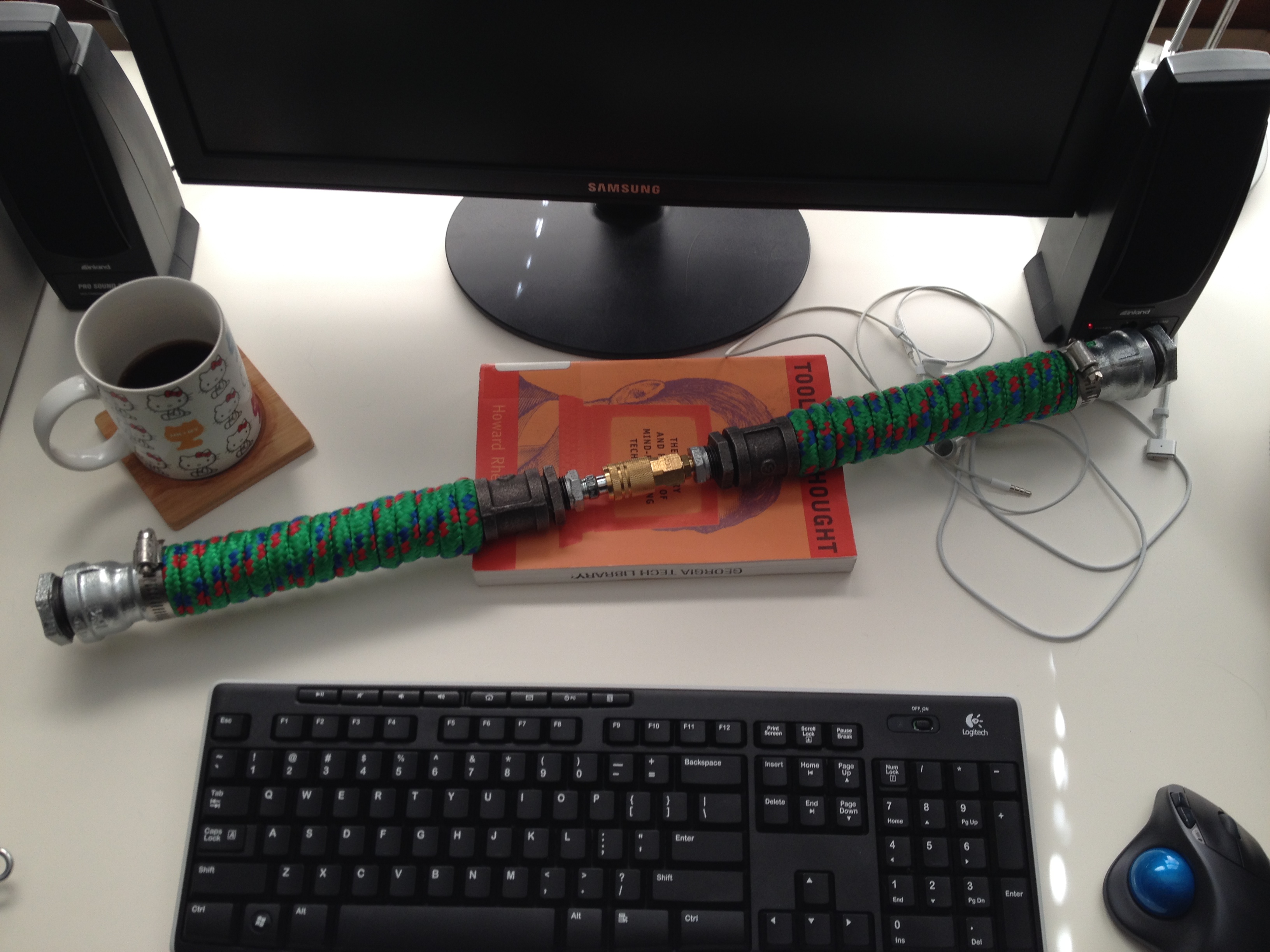
    IMG_4672I built this Darth Maul inspired lightsaber as a way to figure out an easy way of having a two bladed saber that can split into two separate lightsabers. My solution was to use quick disconnect air hose fittings.
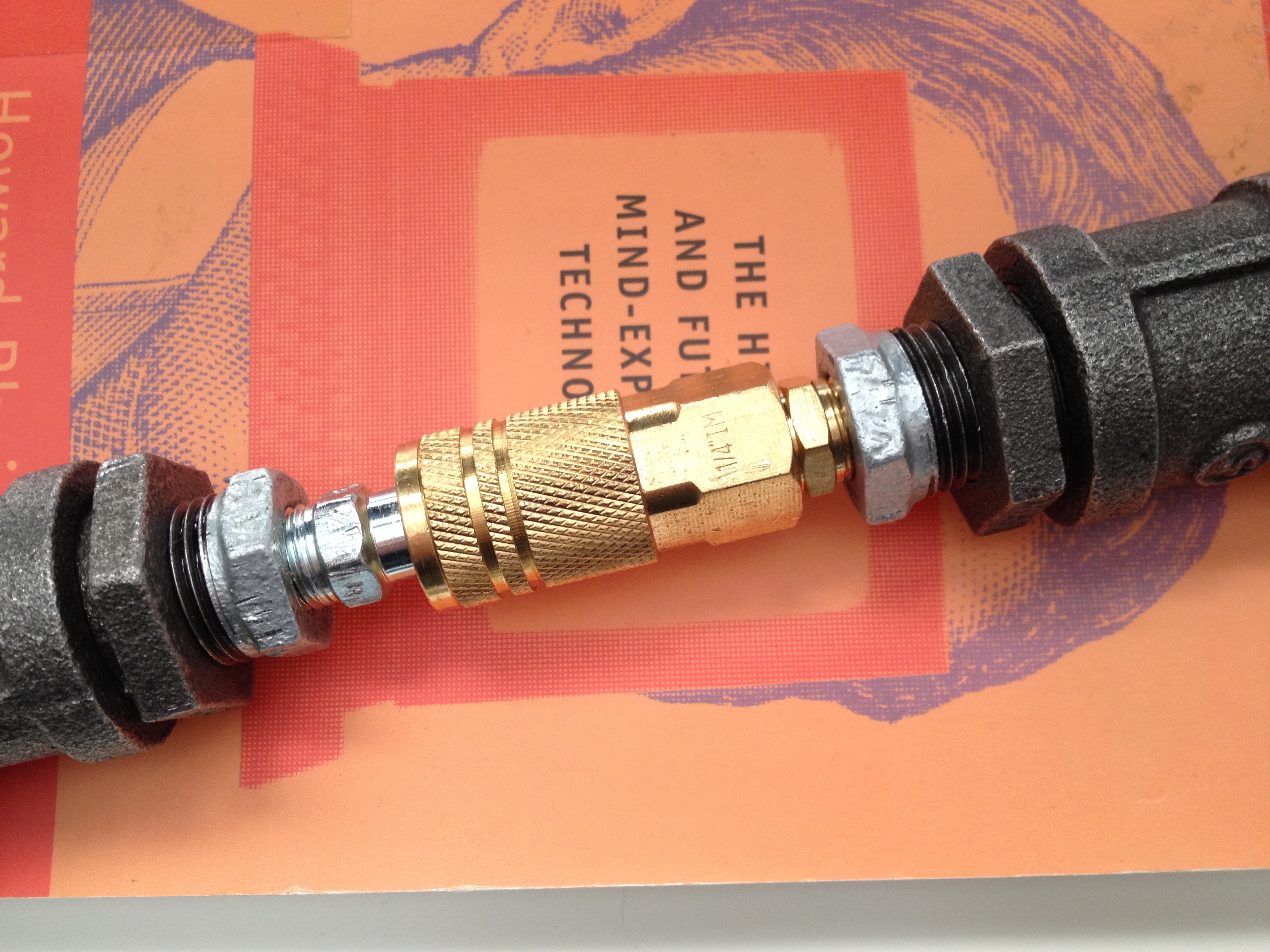
    IMG_4673In order to make this work with the larger pipes used for Darth Maul’s lightsaber, which appears heftier in Episode I, I had to use two bushings to reduce down to the smaller size of the air hose fittings.

    IMG_4593Here is the double-bladed lightsaber connected.

    IMG_4594Here is the double-bladed lightsaber disconnected into two separate sabers. I didn’t build blade attachments for this saber, so I couldn’t test how much pressure/stress could be applied to the quick disconnect coupler that holds everything together. I suspect that this kind of assembly can only be used for show rather than demonstration of saber techniques (as I had constructed the two sabers above). With further modification, I believe that someone could sheath the quick disconnect coupler with metal so that the saber appears more solid from end-to-end instead of having this smaller, weak point in the middle as this demonstration saber appears.

    I hope these extra photos and explanation help. Good luck with your builds, and please share any photos that you post online of your sabers in the comments below!

  • Trying to Come to Terms with Disney’s Acquisition of Lucasfilm and Star Wars in About 1200 Words

    Earlier today, I heard about Disney’s move to acquire Lucasfilm and the Star Wars franchise from George Lucas for $4.05 billion. At first, I was incredulous. I thought that this was an Internet hoax born of Hurricane Sandy regurgitating seawater onto a New England data server unfortunately left behind by the first responders. There is a nice press release and a photo of Lucas holding a pen above a nondescript piece of paper to prove otherwise.

    Gauging from folks’ responses on the web, Facebook, and Twitter, there seems to be a lot of confusion about this news. I certainly feel it myself. Looking at it through the cold logic of capitalism, Lucas is in the movie making business. What he might have once claimed was art or a manifestation of myth-made-modern was in fact simply a way to make lots of money. To borrow from Jay and Silent Bob, Star Wars (and Indiana Jones–a property apparently not of significant worth in the big scheme of things to Disney) was George Lucas’ “motherfucking movie check.” Lucas made it big–maybe it was part talent, part strategy, and part luck–and now, he has the opportunity to cash out. His ‘art’ was a tremendous investment that he has now leveraged to a lucrative payday. His selling the Star Wars/Lucasfilm property to Disney is an obvious choice. Disney has long partnered with Lucasfilm on part rides and merchandising. Additionally, Disney has shifted its attention toward acquisition of popular cultural properties to supplement what little remains of their own creative impetus. Disney bought Pixar, Steve Jobs’ insanely creative 3D animation studio in 2006 for $7.4 billion. Then, Disney purchased Marvel Comics for around the same price as Lucasfilm in 2009. Of course Disney would want Lucasfilm to join its portfolio of cultural holdings. As a result, a substantial amount of American culture is now owned by a single mega-corporation, Disney.

    Looking at the situation from my Star Wars fanish eyes, I am uneasy about this transaction. Despite Lucas’ attempts at destroying his legacy through the investments he made in the culturally bankrupt Star Wars prequels and the failed continuation of the Indiana Jones series in the “Kingdom of the Crystal Skull,” I have always identified him as being the embodiment of the Star Wars universe. Of course, he originated the idea and benevolently maintained despotic control over that idea (compared to Paramount and Star Trek–Lucas is a saint in permitting and occasionally encouraging fan films and fandom in general). I suppose it always seemed in my mind that the author/text|Lucas/Star Wars were signs signifying the same thing. They were shared significations within my mind about what ‘Star Wars’ was and represented. For example, it seems in retrospect that nearly every pre-prequels Star Wars conversation (certainly EVERY post-prequel conversation operates in this way) eventually would come back around to Lucas’ vision, intentions, mistakes, successes, etc. as it related to the narrative space and its possibilities within the imaginations of me and my friends. In a similar way to Steve Jobs and Apple, it doesn’t feel right to separate the author from the work. Certainly, I can imagine the Star Wars universe–its stories, technologies, and cultural context–without invoking the authorial ghost of Lucas. However, the authorial ghost seems ever near and inseparable from the thing (Stars Wars) itself.

    I can rationally think of how many billions of dollars George Lucas made from the Star Wars films among other things. I can rationally think about the exploited labor and anti-environmental effects of the merchandising that forms feedback cycle of the cultural consumption of ideas and things. I understand that Lucas, through his life, success, and business decisions, has enacted a real-life version of THX 1138. Despite all of these things, I cannot divorce myself from the love that I have of the Star Wars universe, its characters, its technologies (especially the Millennium Falcon–something that I imagine flying far more often than I might have any right to), and its wonder. Perhaps its this love for Star Wars that via the signification system transfers to Lucas in some weird way. He might have mucked up the possible narrative that I imagined and that my friends imagined for the Star Wars prequels, but my delight in Star Wars fills me with positive emotions that inform and shape my dichotomous respect and disdain for Lucas. While he and his vision do not define everything in my mind about Star Wars, his work and choices endowed me with an imaginative appreciation for Star Wars and a curiosity that far exceeds the bounds of “a long time ago in a galaxy far, far away.” While I cannot give Lucas all the credit, I can safely say that Star Wars played a significant role in my being where and who I am today.

    Lucas made a significant choice today to sell Lucasfilm to Disney. Since Lucas is so interwoven into the very idea of Star Wars and its potential fulfilment in culture, I am left feeling uneasy about the transfer of his intellectual property to Disney, the cultural aggregator, shaper, and producer. If we want to think of this as one artist giving something to be reshaped and retold by another artist, then Lucas has given his property to Walt Disney’s zombie. The Disney of today is a shuffling undead shell of what it once was (and here I am not attempting to wax nostalgically as I did with Star Wars–Disney and his team of storytellers did fantastic things for culture and education through the era just before I was born–what followed after has by-and-large little to be desired). The Disney company today seeks the brains of other culture producers–Pixar, Marvel, Lucasfilm–on which it feeds and continues its ravenous lurching. I suppose it is this image on the edge of consciousness that disturbs me the most. I am saddened that Lucas gave up control of his property to producers and committees–a fate that I am not sure is any worse than his own revisionist impulse in the prequels. I admit that I am simply being romantic, but I believe that this romantic impulse for the bond between author and text represents something as deep perhaps as the supposed mythical qualities of the stories Lucas told us about the Skywalker clan.

    What does all of this mean for the future of Star Wars? Disney certainly didn’t wait for the ink to sign on the papers before they announced that a new Star Wars film would be released by 2015. Apparently, the acquisition included treatments that Lucas had been working on, but these will be re-developed by Disney. In a related note, I heard from today’s conference call that Disney CEO Iger said that Disney would focus on mobile gaming instead of big box/console games based on the Star Wars universe. This could have other repurcussions for the cultural impact and interactive engagement with its continuing stories. On this point, I am thinking about how these media are now interdependent and connected for conveying narrative and solidifying the cultural memory of those narratives. It would seem that Disney has hit the ground running with Star Wars, and I expect–for good or ill–a great many new things from Lucas’ universe. Unfortunately, he will not have any control over its further expansion, and I am doubtful that I will be as nearly as eager to be a participant in its expansion under the irksome visage of the Mouse.

  • Science Fiction and Your World

    Continuing from my last post, Dr. Takayoshi asked us to practice what she preaches and create a multimodal work to show to our students (e.g., an example of how to do multimodal work, something that ties into a multimodal assignment, or an introduction to our class).  Also, it should be 4 minutes in length.

    As much as I didn’t want to do something of this magnitude in one day, this assignment did help me crystallize my thoughts regarding the first writing class that I’ll teach in the Fall at KSU.  I decided to go with the theme, “Science Fiction and Your World.”  I’m going to assign my students a number of SF short stories and secondary readings to begin discussions about contemporary issues, which will lead into their writing assignments.  I found a nice anthology edited by Orson Scott Card that I’m going to assign, which is titled, Masterpieces:  The Best Science Fiction of the Twentieth Century.  I wouldn’t say that it’s the best anthology out there, but it has a number of enjoyable and topical stories that I believe my students will enjoy.

    After deciding my course’s theme, I storyboarded an introductory video that’s a campy informative mix.  It’s just over 4 minutes long, and available on YouTube.

    Oct. 21, 2023 Update: Video link removed as it no longer exists.

  • Galaxy Quest and Fandom

    This is my second review segment for the Georgia Tech SF Radio Program. The theme of this episode is fandom, so I reviewed the film, Galaxy Quest and related that to the rise of fandom. Be sure to check out the show on Sunday, September 23 from 7pm until 9pm. Listen to it in Atlanta on 91.1FM or online at wrek.org.

    Galaxy Quest and Fandom
    Jason W. Ellis

    Science Fiction has a long standing dialog between SF producers and the fans that follow, devour, and over analyze every detail and plot point of their respective SF love. This is proven by the early New York City Futurians and SF conventions or “cons” that accreted greater and greater numbers of SF readers, writers, and enthusiasts. This subculture of SF enthusiasts is known as fandom. Members of SF fandom go by different names including Trekkies, Browncoats, Whovians, and Otaku. However, that’s not to say it’s a subculture on the fringe in terms of numbers. In fact, fandom has gone mainstream. The larger national and international conventions such as Atlanta’s own Dragon*Con hosts an influx of tens and tens of thousands of SF fans to share something unknown, or at least unknown in the same magnitude and intensity, to the majority of pop culture consumers, and that is community.

    In many ways, fandom hit the mainstream with the 1999 release of Galaxy Quest. This film starring Tim Allen, Alan Rickman, Sigourney Weaver, and Tony Shalhoub is about the washed-up cast of a late 1970s SF television show rising up to their fictional roles following an unexpected alien encounter. These aliens, called Thermians, contact Jason Nesmith (played by Tim Allen) believing that he is his fictional television role, Captain Peter Quincy Taggart. These naive aliens regard intercepted human television transmissions as “historical documents” and utilize them to rebuild their society. However, their new civilization is threatened by the reptilian Sarris, the genocidal leader of a warring alien species. The real life actors portraying film actors in turn portray the fictionalized crew of the Thermian constructed NSEA Protector in order to stop Sarris’ plans to obliterate the remaining Thermians.

    Galaxy Quest has a deep connection to fandom, because a group of Questarians, or fans of the old television show (think Trekkies), assist the real life Protector crew with the help of a serendipitous exchange of authentic and prop communicators. Justin Long portrays the de facto leader, Brandon, of a band of Questarians. They rely on social networking and pooled, specialized knowledge to help Taggart and his crew. In the end, these die hard fans are as much the heroes as the TV stars, in part because they are both on the big screen, but also because fans are the driving force behind SF. They keep it alive and elevate it to mythic status by the communal sharing of ideas, stories, costumes, fan films, fanfic, and lest we forget, commercialization.

    There are many other aspects of fandom in film such as the 1998 film, Free Enterprise. Directed by Robert Meyer Burnett, it’s about two friends clinging to their SF geek interests while seeking life advice of their hero, William Shatner. Another film about fan life is the forthcoming 5-25-77 written and directed by Patrick Read Johnson. It’s an autobiographical take on the fateful day that the original Star Wars film was released. In both of these examples, the SF source (not to be confused with force) supports the release–in the case of the former with a starring role by Shatner and the latter is produced by Gary Kurtz, who also produced two Star Wars films.

    Fans also create parodies and original works based on the SF sources they love most. A famous example is Samuli Tors-sonen’s Finnish Star Wreck films including the immensely popular Star Wreck: In the Pirkinning released in 2005. In the Pirkinning is a feature length film complete with professional special effects and it’s an mash-up of Star Trek and Babylon 5. Other examples of fan films include Troops, the 1997 mockumentary mix-up of Star Wars and COPS. More recent examples include Star Wars: Revelations and Chad Vader.

    Underlying fandom, fan films, and SF in general are fans. They are the immediate audience for new SF produced by writers and film makers as well as fan produced content available online. They’ve always been there, and they are making their voices heard more loudly than ever before thanks to the increasingly pervasive Internet, which has not only facilitated the building of fan communities, but also the sharing of rich and imaginative content made for other fans and as an homage to the creators on high. In the coming years, the division between fans and creators will further diminish, and I say to all the fans out there, the immortal words of Captain Taggert: “Never give up, never surrender!”