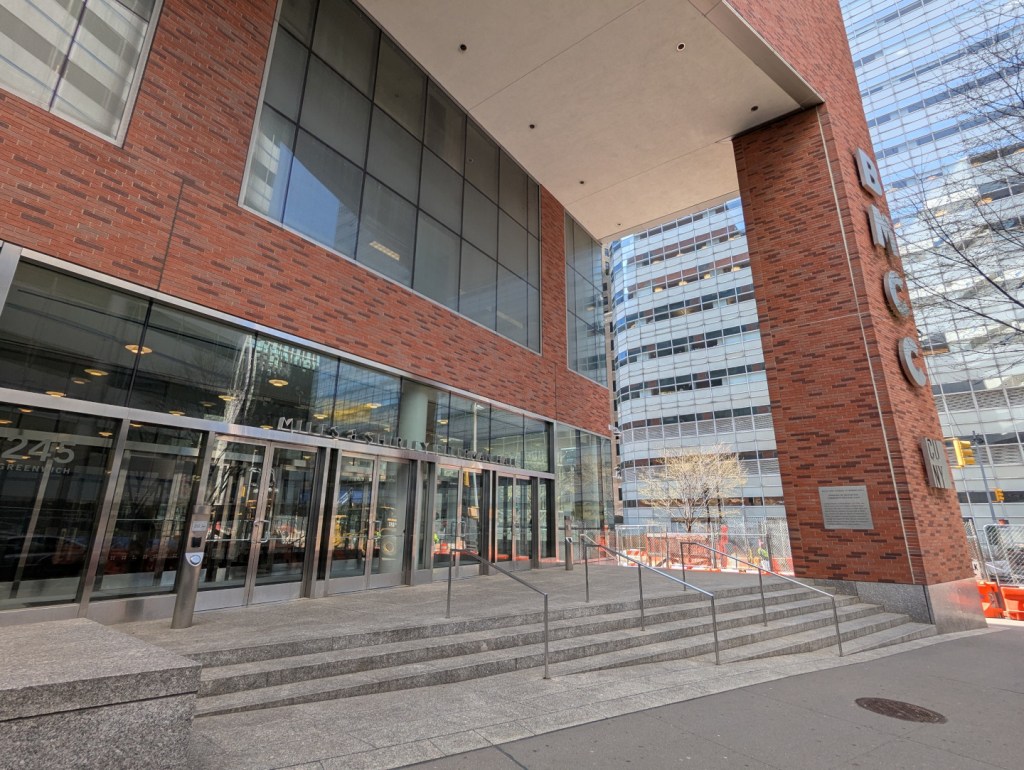
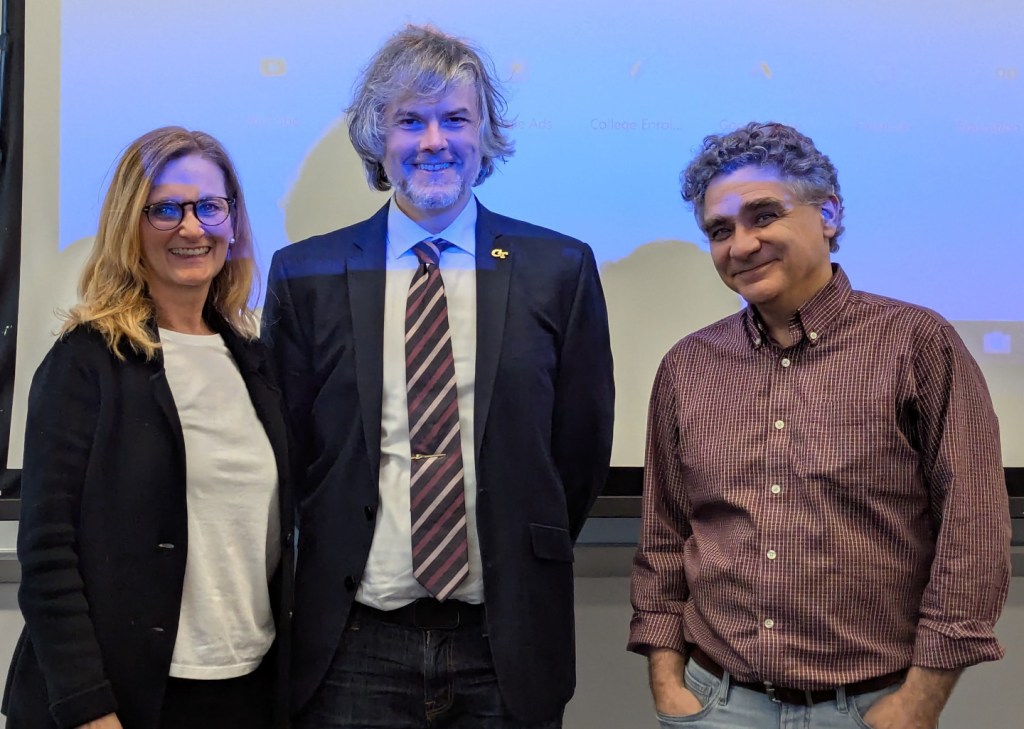
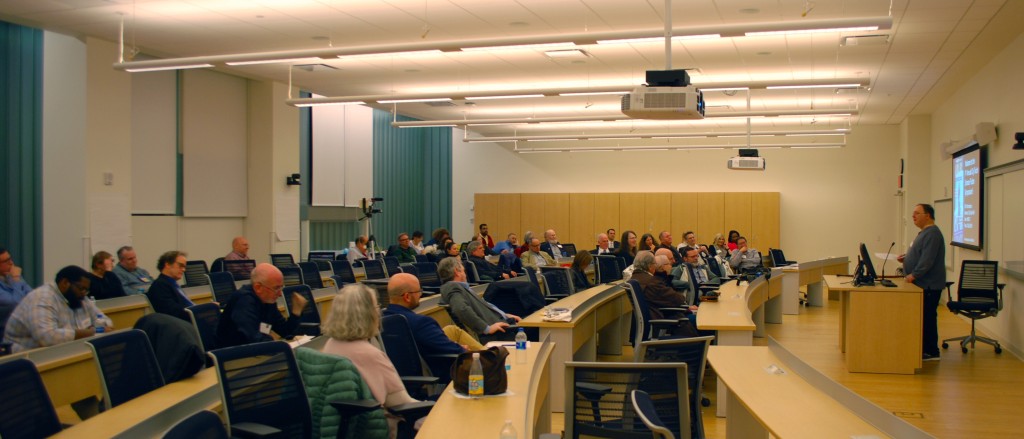
Yesterday, about twenty faculty and students gathered in BMCC’s Fiterman Hall room 1304 to discuss the effects of Generative AI on college writing, higher education, and society-in-general for the Spring 2025 Robert Lapides Faculty Forum. I was honored to have been invited to participate.
For my part in the conversation, I came at the issue from four vectors: as a science fiction scholar, a writing instructor, a technical communication instructor, and computer hobbyist. My desire to learn how Generative AI works and to pass on what I have learned to my students is informed by my adherence to William Gibson’s axiom, “the street finds its own use for things,” which is coupled with Donna Haraway’s “Cyborg Manifesto” and claiming the tools of technology for our own purposes to build the network, community, and world that we want.
While it was scheduled for only two hours, we ran over by 20 minutes–something the organizers said hadn’t happened before. I think that if time hadn’t been called, we might still be there into the wee hours.
The BMCC students in attendance demonstrated their engagement and concern about these technologies in the classroom and their everyday lives.
I closed my comments in response to a question about how we might use Generative AI to fight back against authoritarianism. I offered an assemblage of open source generative AI, a bit of Harlan Ellison’s “‘Repent, Harlequin!’ Said the Ticktockman” (1965), and Orson Scott Card’s Ender’s Game (1985).
Besides the substance of the discussion, I think meeting colleagues at BMCC might have opened doors for further work on AI matters and the annual City Tech Science Fiction Symposium. Stay tuned!
I’ll be speaking on a discussion panel about Artificial Intelligence, Generative AI, and College Writing at Borough of Manhattan Community College, CUNY (BMCC), Fiterman Hall 1304 on Wednesday, April 2 from 2-4 PM. If you’re free, it would be great if you could join us for what I think will be a lively in-person conversation. Details are below and the event flyer is posted above and below.
The Spring 2025 Robert Lapides Faculty Forum
Wednesday April 2 Fiterman Hall 1304 (245 Greenwich St.) 2-4 pm
A Step Toward the Unified Macro-Mind or a Cybernetic Lawnmower in the Groves of Academia? : Generated Text and the Future of College Writing
Recently, Large Language Models and generated texts have sent shockwaves through the academic community. Do they represent the initial glimmerings on a new horizon of transhuman creativity or are they, in Noam Chomsky’s phrase, merely “glorified autofill,” a “high-tech plagiarism” based on a self-cannibalizing database? Where old-fashioned plagiarism now seems like a relatively simple matter of ethics and originality, Artificial Intelligence and the looming specter of the Literary Chatbot bring a whole host of more tangled issues of Perception, Knowledge, Autonomy, and Class Warfare into the classroom.
Many believe the neural net models of cognition don’t begin to pierce the mystery of the mind—Roger Penrose and others remain unconvinced that human thinking can be reduced meat-puppet computation, while John Searle’s Chinese Room parable undermines the idea that mere symbol-juggling can ever result in emergent consciousness. Still, techno-optimists believe we are at the precipice of an age of cyborg enhancements in which human potential will be radically expanded and the primate mind will be uploaded into Cloud-dwelling immortality.
We will be discussing these issues and many others in an open symposium with CUNY professors Jason Ellis, Carlos Hernandez, Lisa Sarti, and Shane Snipes. We encourage our colleagues to come to voice their concerns and hopes on this increasingly crucial and urgent matter.
The event is named in memory of Robert Lapides, a past English department professor at BMCC. Reading his obituary, you get the sense that he did good work that saved voices from the past from erasure, and created space for voices in the present to carry the work forward.
“Robert Lapides, professor emeritus in the English Department, husband of Professor Diane Dowling, died on January 1, 2021. At BMCC for over 40 years, Professor Lapides will be remembered for his passion, his life-long fight for social, economic, and racial justice, and his commitment to building communities where differences can be expressed. Never afraid to speak up or ask questions, he was genuinely interested in his students and colleagues. His intense curiosity about people, places, politics, history, literature, psychology, religion–about what it means to be human–informed all his efforts. He encouraged his students to embrace their humanity, including the parts of themselves they felt they needed to hide, building their courage to write honestly. His legacy can be found in his influence on the many students and colleagues he worked with, the online communities he created, in his faculty magazine Hudson River, and for editing Lodz Ghetto, collected writings left behind by Jews confined to the Lodz Ghetto in WWII. Until the end, he was working on his book about the creative development of Charles Dickens, which will be published posthumously” (from Ellen Moody’s Under the Sign of Sylvia blog, 25 Mar. 2021).
The event is free and open to the public. Pre-registration for this in-person event is not required. Participants and attendees who are not affiliated with the college will need to sign-in at the security desk before entering and walking down the hallway to the right to room A-105.
Program
9:00AM Opening Remarks
Jason Ellis and Justin F. Vázquez-Poritz
9:15AM Break
9:20AM Paper Session 1
Moderator: Wanett Clyde
Jason Ellis, “A History of Generative AI in SF”
Jacob Adler, “The End Zone: A.I. as a Commentary on the Human Condition in 17776”
Martijn J. Loos, “A Plea for Theory: The Relationship Between Real-World AI and its Representation in Science Fiction”
10:40AM Break
10:50AM Paper Session 2
Moderator: Kel Karpinski
Virginia L. Conn, “The Tyranny of Neutrality in AI 2041”
Nathan Lamarche, “Monotheistic Ethics in Caprica: The Consequences of AI Development on Queer Futurity”
Adam McLain, “Computational Poetics: Franny Choi’s Soft Science and the Dialogues to Come”
12:10PM Lunch
1:10PM Student Panel
Moderators: Jill Belli and Vivian Zuluaga Papp
Lucas Felipe
Christine Retirado
Malik Joseph
Journey Ford
2:00PM Break
2:10PM Asimov’s/Analog Writers’ Panel
Moderator: Emily Hockaday
Sarah Pinsker
Mercurio D. Rivera
Sakinah Hoefler
Matthew Kressel
3:50PM Break
4:00PM Keynote Address
Moderator: Leigh Gold
Marleen S. Barr, “Science Fiction/AI/Feminism: A Temporal Progression”
Participants
Jacob Adler has been part of the CUNY system for a number of years now, most recently as the Cataloging and Metadata Librarian for the Lloyd Sealy Library at the John Jay College for Criminal Justice. In September 2024, he contributed to Space, the Feminist Frontier, a scholarly book publication about feminist topics related to the Star Trek franchise. Since 2022 he has been involved with providing educational material about artificial intelligence, including creating academic research guides and delivering presentations in CUNY and throughout the Westchester Library System. Other than AI, his interests include media history, fiction writing, and tabletop role-playing games.
Marleen S. Barr is known for her pioneering work in feminist science fiction scholarship and has recently retired from teaching English at the City University of New York. She has won the Science Fiction Research Association Award for Lifetime Contribution to Science Fiction Scholarship. Barr is the author of Alien to Femininity: Speculative Fiction and Feminist Theory, Lost in Space: Probing Feminist Science Fiction and Beyond, Feminist Fabulation: Space/Postmodern Fiction, and Genre Fission: A New Discourse Practice for Cultural Studies. Barr has edited many science fiction critical anthologies and co-edited the science fiction issue of PMLA. She is the author of the novels Oy Pioneer! and Oy Feminist Planets: A Fake Memoir. Her When Trump Changed: The Feminist Science Fiction Justice League Quashes the Orange Outrage Pussy Grabber is the first single authored Trump short story collection. It is followed by This Former President: Science Fiction as Retrospective Retrorocket Jettisons Trumpism. Her latest critical anthology is Jewish Women Writers Create Science Fiction: Gender, Temporality–and Yentas.
Jill Belli is Associate Professor of English at New York City College of Technology, CUNY, where she happily teaches science fiction and utopian studies often. She’s working on long-standing projects on well-being & happiness in education and writing & revising in speculative fiction. Newer interests include nature writing, healing & illness, tarot & astrology as storytelling / intuitive literacy, and grief. Learn more about Jill and her interdisciplinary research and teaching: jillbelli.org.
Wanett Clyde is the Collections Management Librarian at CUNY’s New York City College of Technology, where in addition to managing the library’s collection she oversees the university archives. Her research seeks to explore the intersection of Black history and fashion history, drawing out under credited African-American contributors, their critical innovations and accomplishments, and other meaningful connections in the overlapping research spheres.
Virginia L. Conn is a Teaching Assistant Professor at Stevens Institute of Technology. She researches depictions of the “new socialist human” in socialist science fiction and how those depictions guided policy decisions in Mao-era China, Soviet Russia, and East Germany. She is currently working on her book manuscript, which offers a literary-material account of the relationship between socialist literary policies and the concurrent sociopolitical and technological drive to create the “new human” in daily life. She is also the managing editor of the Science Fiction Research Association Review.
Lucas Felipe is a student at City Polytechnic High School of Engineering, Architecture, and Technology.
Journey Ford is an Entertainment Technology student at the New York City College of Technology, CUNY.
Leigh Dara Gold is a Doctoral Lecturer in the English Department at City Tech. She currently teaches composition, fiction, drama, poetry, and several other literature classes. Her doctoral work, completed at NYU in 2011, explored mourning in the work of Else Lasker-Schüler using several theoretical approaches, among them feminist, trauma, and poetic theories. Since then she has deepened her focus on interdisciplinary work such as writing about Ursula K Le Guin, Mary Shelley and Le Guin’s intersections, Eastern philosophies and ethics in Le Guin’s work, trauma in women writers of science fiction, including Octavia Butler, and the role of the body in poetry. Leigh recently published an essay about Judith Merril in Jewish Women Science Fiction Writers Create Future Females: Gender, Temporality—and Yentas, edited by Marleen S. Barr (Lexington Books, 2024).
Emily Hockaday is the senior managing editor of Analog Science Fiction and Fact and Asimov’s Science Fiction Magazine. She coedited the horror anthology Terror at the Crossroads with Jackie Sherbow and is the editor of the speculative poetry anthology Heartbeat of the Universe. Hockaday is the author of Naming the Ghost, Blood Music, and In a Body. She has received grants from the De Groot Foundation, Café Royal Cultural Foundation, NYFA City Artist Corps, and Queens Council on the Arts. You can find her at www.emilyhockaday.com.
Sakinah Hoefler is a fiction writer, poet, and playwright. She’s a proud recipient of the 2023 Analog Award for Emerging Black Voices. Her work has been published both domestically and internationally, and her plays have been produced by places such as Cincinnati Playhouse in the Park and the University of Cincinnati’s College-Conservatory of Music. A former chemical engineer for the United States Department of Defense, she currently teaches writing at Princeton University. She resides in Newark, NJ with her wonderful husband and adorable son.
Malik Joseph is a student at City Polytechnic High School of Engineering, Architecture, and Technology.
Kel R. Karpinski (they/he) is the IT/ILL Librarian and Associate Professor at the New York City College of Technology, CUNY. Their research focuses on mid-century queer films and novels as they relate to sailors and hustlers in Times Square and how these texts map queer desire onto the city. Kel is also a zine maker and a NY Queer Zine Fair organizer.
Matthew Kressel is a multiple Nebula and World Fantasy Award nominated author and coder. His many works of short fiction have appeared in Analog, Asimov’s, Lightspeed, Clarkesworld, Tor.com/Reactor, Beneath Ceaseless Skies, and many other publications and anthologies, including multiple Year’s Bests. Eighteen of his stories will be included in his debut collection, Histories Within Us, coming from Senses Five Press in February. His far-future novel Space Trucker Jess is coming in 2025 from Fairwood Press. And his Mars-based novella The Rainseekers is forthcoming from Tordotcom in early 2026. Alongside Ellen Datlow, he runs the Fantastic Fiction at KGB reading series in Manhattan. And he is the creator of the Moksha submissions system, used by many of the largest fiction publishers today.
Nathan Lamarche is a Master of Arts in English student at the University of Alberta. Their current studies focus on writing centres and composition theory, Indigenous and queer fiction storytelling, and the relational impacts of technology on our perspectives of the self, with a keen interest on the development of AI technology through the anthropomorphisation of social-oriented technologies and services and their impacts on society, the parallel between Generative AI and monotheistics ethics, and AI’s disproportionate impact on cultural and queer marginalisation. They have received several awards and scholarships, including the Sarah Nettie Christie Scholarship, the Belcourt Brosseau Métis Awards, and The Kerry Wood Memorial Award in Arts.
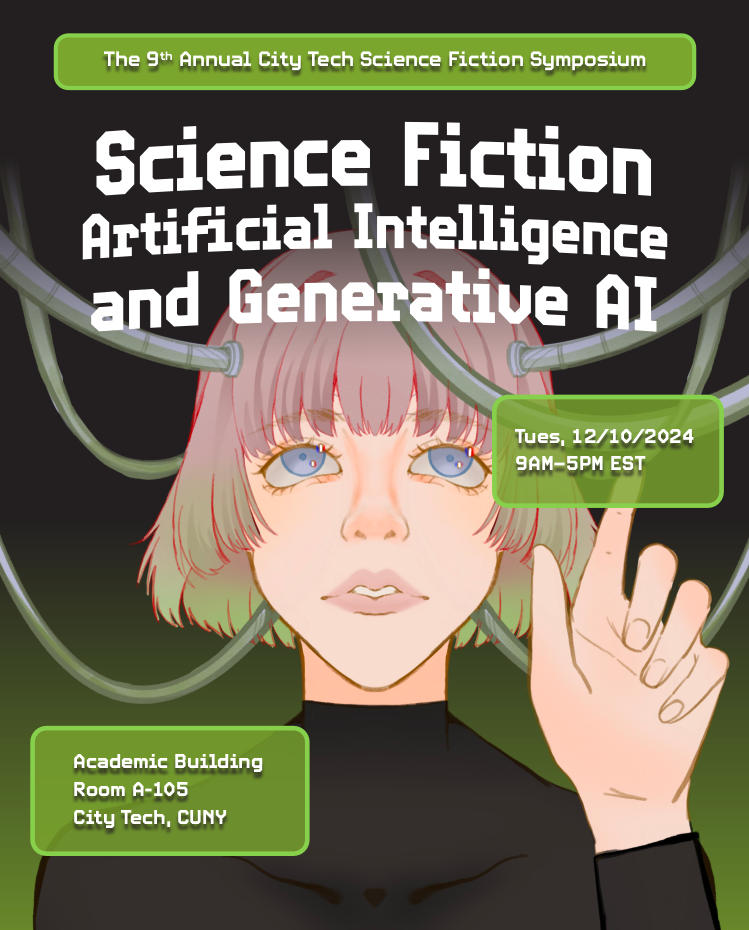
Vivian Li designed this year’s event poster. She is a graphic designer specializing in branding and visual storytelling, but more than anything she’s just another human who wants to make the world a brighter and more connected place through thoughtful design. She believes that in a world increasingly driven by technology and AI, design has the power to bring a vital human touch to the exciting digital landscape. Her mission is to craft visuals that resonate emotionally, adding warmth and personality to fast-paced modern experiences. Connect with her at: https://www.linkedin.com/in/vivian-l-8a177b19b/.
Martijn J. Loos is a Dutch PhD candidate at New York University’s department Comparative Literature. He has a RMA in Comparative Literary Studies from Utrecht University and has taught at University College Tilburg. He works at the intersection of science fiction and philosophy, with a special emphasis on the relationship between the (political) real and the science-fictional. He has published on, amongst others, H. P. Lovecraft, Octavia E. Butler, Ray Bradbury, and Ted Chiang. He enjoys Belgian beers and anything involving laser guns.
Adam McLain is a graduate student in the English department and law student at the School of Law at the University of Connecticut. He studies dystopian literature, legal theory, and sexual justice. They received bachelor’s in English from Brigham Young University, a master’s of theological studies from Harvard University, and a master’s in English from University of Connecticut.
Vivian Zuluaga Papp is a Doctoral Lecturer in the English Department here at City Tech. She has a BA in English from Columbia University, an MA in British and American Literature from Hunter College, and her Ph.D. is in Eighteenth-Century British Literature from Fordham University. Previously, she taught classes in Satire, Women in Science Fiction, Afrofuturism, and Imaginary Travel Narratives while a Postdoctoral Teaching Fellow at Fordham University. Her research interest is in the field of visual epistemology in seventeenth-century scientific texts and early forms of the novel. She is the author of a short science fiction story “Catbot’s in the Cradle,” which was published in Behind the Yellow Wallpaper: New Tales of Madness, and has a chapter coming out in a Science Studies anthology on real and imagined visual manifestations of the “unseeable” in Daniel Defoe’s A Journal of the Plague Year and Robert Boyle’s New Experiments Physico-Mechanicall, Touching the Spring of the Air and Its Effects.
Sarah Pinkser is the author of over sixty works of short fiction, one novella, two novels, and two collections. Her work has won four Nebula Awards (Best Novel, A Song For A New Day; Best Novelette, “Our Lady of the Open Road,” Best Novelette, “Two Truths And A Lie,” Best Short Story, “Where Oaken Hearts Do Gather,”), two Hugo Awards (“Two Truths And a Lie” and “Where Oaken Hearts Do Gather”), the Philip K Dick Award, the Locus Award, the Eugie Foster Award, and the Theodore Sturgeon Award, and been nominated for numerous Nebula, Hugo, Locus, and World Fantasy Awards. Her fiction has been translated into almost a dozen languages and published in magazines including Asimov’s, Strange Horizons, Fantasy & Science Fiction, and Uncanny and in many anthologies and year’s bests. Sarah’s first collection, the Philip K Dick Award winning Sooner or Later Everything Falls Into the Sea: Stories, was published by Small Beer Press in 2019, and her first novel, A Song For A New Day, was published by Penguin/Random House/Berkley in 2019. Her latest book is We Are Satellites, published in 2021. Her second collection, Lost Places, was published by Small Beer Press in 2023 and was followed by the Tordotcom novella Haunt Sweet Home in September 2024. She is also a singer/songwriter with four albums on various independent labels (the third with her rock band, the Stalking Horses). She lives in Baltimore, Maryland and can be found online at sarahpinsker.com and x.com/sarahpinsker.
Christine Retirado is a Communication Design student at New York City College of Technology, CUNY.
Mercurio D. Rivera is a writer whose short fiction has won readers’ awards for Asimov’s and Interzone magazines and has appeared in markets such as The Magazine of Fantasy & Science Fiction, Lightspeed, i09, Nature, Black Static, and various anthologies, podcasts, and “best of” collections. His novel Wergen: The Alien Love War (published by NewCon Press), which was nominated for the Arthur C. Clarke Award, tells stories of unrequited love set against the backdrop of humanity’s complicated relationship with an enigmatic alien species. And his Asimov’s story “Beyond the Tattered Veil of Stars,” was podcast by Dust Studios, and features Gillian Jacobs (of Community) and Justin Kirk (of Weeds), and is available anywhere you listen to podcasts.
Justin F. Vázquez-Poritz is the Dean of the School of Arts and Sciences at New York College of Technology, CUNY.
When you put together an event like a symposium or conference, you need a keynote speaker who can anchor it, pull together its various threads, and share their reputation to elevate the event for the benefit of the audience and participants. Mike Flynn, the author of Eifelheim and “The Forest of Time,” graciously agreed to be all that by closing out the Fourth Annual City Tech Science Fiction Symposium in 2019 that celebrated Astounding/Analog‘s 90th anniversary. He passed away at the end of September. Locus remembers him here, and his family started this thread of memories on Facebook. You can watch his touching keynote address below.
The Sixth Annual City Tech Science Fiction Symposium on Access and Science Fiction will be held on Thursday, December 9, 2021 from 9:00am-5:00pm EST (GMT/UTC -5 hours) online via Zoom Webinar.
To participate in this free event, attendees will need to (1) Signup for a free Zoom account here (if you don’t already have one), and (2) Register here to receive access instructions to the Zoom Webinar. Participants may register any time before or during the event!
For those who would like to watch the event without registering, you can join the YouTube Livestream here.
In addition to the Zoom Webinar Chat and YouTube Live Chat, join the event conversation with the event hashtag #CityTechSF and follow us on Twitter @CityTechSF.
As indicated below in the program, some symposium content is pre-recorded to offer more time for discussion on the day of the event. Pre-recorded content includes author readings and full paper presentations. Some of this content is in production and will be posted soon.
9:00am-9:15am Opening Jason W. Ellis Justin Vazquez-Poritz
9:15am-10:05am Paper Session 1: Access to International SF Jill Belli – Moderator Emrah Atasoy – “Access to SF in Turkey and Turkish SF Abroad” Shanky Chandra – “Chinese Science Fiction: A Literary Genre, A Tool of Teaching Science or A Secret Weapon of China’s Soft Power?” Gillian Polack – “The Problem of Susan Australia, or, The Tyranny of Distance” | Watch Expanded Presentation
10:05am-10:10am Break
10:10am-11:00am Paper Session 2: Access to Science/Fiction/World A. Lavelle Porter – Moderator Chris Leslie – “Reevaluating the Inclusiveness of the Interstellar Republic of Letters” Katherine Buse and Anastasia Klimchynskaya – “Science Fiction and Citizen Science” Aaron Zwintscher – “Star Wars Biomes: Simulacra, Nature, and Passivity in No Dialogue Nature Shows”
11:00am-11:05am Break
11:05am-11:45am Discussion Panel: “Accessing the Feminist Science Fiction Archive, Or, Young Women Read Old Feminist SF” Lisa Yaszek – Moderator Panelists: Josie Benner Olivia Kiklica Jessica Taetle Edeliz Zuleta
11:45am-11:50am Break
11:50am-1:10pm Paper Session 3: Access, Inclusion, and Representation in SF Joy Sanchez-Taylor – Moderator Leigh Gold – “Confronting Language in the Science Fiction Text: Language, Access, and Trauma in Octavia Butler and Ursula K Le Guin” Katherine Pradt – “Shipping Supergirl: Discovering and Defending Lesbian Identity Through a DC Fandom” Sean Scanlan – “Cool Access and Access to Cool: Gibson’s Gun Moll, Dorotea Benedetti” Ida Yoshinaga – “Corporate Employment Practices Towards Greater Diversity of Story Development for SFF Screen Stories”
1:10pm-1:15pm Break
1:15pm-2:25pm Access, Accessibility, Bodies, and Minds in SF Lucas Kwong – Moderator Jacob Adler – “‘Everything Herein is Fantastic’: Accessibility and Inclusivity in Dungeons & Dragons” Ryan Collis – “Autistic Speculative Imaginings: Accessing and Creating Minor Literatures” Annette Koh – “Urban Planning for Cyborg Cities: Thinking about disabilities and mobilities in sci-fi as an urban planner”
2:25pm-2:30pm Break
2:30pm-3:55pm Analog Writers Panel and the Analog Emerging Black Voices Award Emily Hockaday – Moderator Panelists Alec Nevala-Lee Marie Vibbert Chelsea Obodoechina Trevor Quachri and Emily Hockaday – Award Presentation
3:55pm-4:00pm Break
4:00pm-5:00pm Keynote “Writing Ourselves In: Teaching Writing and Science Fiction with Wikipedia” Ximena Gallardo C. and Ann Matsuuchi Wanett Clyde – Introduction and Moderator
Ximena and Ann’s book chapter, “My Books Will Be Read By Millions of People!”: The LaGuardia Community College Octavia E. Butler Wikipedia Project,” that appears in Approaches to Teaching the Works of Octavia Butler, edited by Tarshia Stanley (Modern Language Association, 2019), has been made accessible via the CUNY institutional repository, Academic Works: https://academicworks.cuny.edu/lg_pubs/141/. This book was awarded Idaho State University’s 2021 Teaching Literature Award.
Participants
Jacob Adler has worked as the Metadata and Cataloging Librarian at the Bronx Community College Library since 2017. Before that he performed various other cataloging work, most notably at The Paley Center for Media from 2010 to 2016. In addition to his professional work he wrote a fantasy novel for the 2018 National Novel Writing Month contest; he continues to work on the novel and seek to get it published. He is especially interested in early television history, particularly the original 1959-1964 Twilight Zone television series. He is also currently pursuing a master’s degree in Museum Studies, which he is on track to receive in January 2022.
Emrah Atasoy, PhD, serves as a visiting postdoctoral scholar at University of Oxford’s Faculty of English between September 2021 and September 2022 as a recipient of the TUBITAK (The Scientific and Technological Research Council of Turkey) 2219 International Postdoctoral Research Fellowship Grant. His research interests include speculative fiction, futuristic narratives, critical future studies, utopian and dystopian studies, critical dystopia, science fiction, apocalyptic fiction, ecocriticism, posthumanism, Turkish speculative fiction, twentieth-century literature, and comparative literature. He was a visiting scholar at Penn State University under the supervision of Prof. Dr. Jennifer Wagner-Lawlor in the academic year 2015-16. His work has appeared in journals such as Studies in the Novel (2022, collaborative article with Prof. Dr. Thomas Horan), Utopian Studies, Librosdelacorte.es, Literary Voice, and Methis. Studia Humaniora Estonica. His monograph Epistemological Warfare and Hope in Critical Dystopia has been published by Nobel in 2021. His most recent publications include “Speculative Fiction Studies in Turkey: A Preliminary Survey” (2021), in Utopian Studies, “Dys/utopian Narratives on the Screen: Beyond the Binaries in Children of Men and Lobster” (2021), in The Postworld In-Between Utopia and Dystopia: Intersectional, Feminist, and Non-Binary Approaches in 21st Century Speculative Literature and Culture (2021, Routledge), edited by Tomasz Fisiak and Katarzyna Ostalska, and “Epistemological Warfare(s) in Dystopian Narrative: Zülfü Livaneli’s Son Ada and Anthony Burgess’s The Wanting Seed” in Speculations of War: Essays on Conflict in Science Fiction, Fantasy and Utopian Literature (2021, McFarland), edited by Annette M. Magid. He is a member of both Utopian Studies Society-Europe and the Society for Utopian Studies (SUS). His research at the University of Oxford is supported by TUBITAK BIDEB (The Scientific and Technological Research Council of Turkey) under Grant 2219-International Postdoctoral Research Fellowship Program.
Jill Belli is Associate Professor of English at New York City College of Technology, CUNY, where she happily teaches science fiction and utopian studies often. She’s working on long-standing projects on well-being & happiness in education and writing & revising in dystopian texts. Newer interests include looping as composing practice, tarot and astrology as storytelling and knowing, William Reynolds, and grief. Learn more about Jill and her interdisciplinary research and teaching: jillbelli.org.
Josie Benner is a Biomechanical Engineering Major and Science Fiction Minor at Georgia Tech. She works in Professor Lisa Yaszek’s Sci Fi Lab, with funding from Georgia Tech’s Center for Women, Science, and Technology and the Ivan Allen College for the Liberal Arts.
Shanky Chandra is a Ph.D. scholar from the Centre for Chinese and Southeast Asian Studies, Jawaharlal Nehru University, India, in New Delhi. His research interests include modern and contemporary Chinese Science Fiction. The title of his Ph.D. thesis is “Socio-Political and Cultural Factors in the Making of Chinese Science Fiction Writer Liu Cixin: Understanding The Three-Body Problem.” Chandra took his B.A. (2011) and M.A. (2013) in Chinese language and literature, and M.Phil. (2016) from Jawaharlal Nehru University at New Delhi, India. In 2013, the Ministry of Human Resource Development (MHRD) awarded the Chinese Government Scholarship to Shanky Chandra for Post Graduate Diploma at Beijing Language & Culture University (Higher level 1 & 2) 2013-2014. Chandra taught Chinese language and literature at St. Stephen’s College (2014-2019), Delhi University. He completed the Advance Mandarin Teacher Training Program from the National Taipei University of Education Chinese Language Education Center, Taipei, Taiwan, in July 2018. Recently, he spent one year at the Department of Modern and Contemporary Chinese Language and Literature at the School of Chinese Language and Literature of Beijing Normal University (BNU) as a senior visiting scholar under the supervision of Prof. Wu Yan (HYI fellowship). He is also a member of the International Forum of Chinese Language Teachers (国际汉语教师微信群) and its official Account e-journal (国际汉语教师500强公众号). Currently, he is a visiting fellow at Harvard Yenching Institute, Harvard University.
Ryan Collis is a second year PhD student in Education at York University in Ontario, Canada who researches the creation of learning spaces for autistic students. He holds degrees in English (BA, Queen’s ‘99), Computer Science (BScH, Queen’s ‘00), Education (BEd, OISE ‘05), and Science and Technology Studies (BScH, York ’19; MA, York ‘20). Ryan has been a high school teacher in the York Region District School Board since 2006 and is a founding member of the editorial board of the Canadian Journal of Autism Equity. Ryan lives with his wife and son in Ajax, Ontario.
Jason W. Ellis is an Associate Professor of English at the New York City College of Technology, CUNY, where he coordinates the City Tech Science Fiction Collection. He coedited The Postnational Fantasy: Postcolonialism, Cosmopolitics and Science Fiction (McFarland, 2011) and a special issue on Star Wars: The Force Awakens of New American Notes Online, and talked with Dr. Neil deGrasse Tyson about the relationship between SF and society on StarTalk Radio. He holds a Ph.D. in English from Kent State University, M.A. in Science Fiction Studies from the University of Liverpool, and B.S. in Science, Technology, and Culture from Georgia Tech.
Ximena Gallardo C. is a professor of English at LaGuardia Community College-CUNY. She has been a Wikipedia editor since 2012 and a WikiEducation instructor since 2014. Among her current Wikimedia projects are The LaGuardia WikiProject Octavia E. Butler and the LaGuardia and Wagner Archives GLAM initiative, as well as the Wikibooks projects Perspectives in Digital Literacy and Themes in Literature.
Leigh Dara Gold received her doctorate in German Literature in 2011 from New York University. She teaches Introduction to Poetry and English 1121 at New York City College of Technology, and Ancient Literature and Composition at Borough of Manhattan Community College. Her current research interests include science fiction’s role in the classroom, research on Ursula K. Le Guin, and connections between dance, literature, and philosophy.
Emily Hockaday is the managing editor and poetry editor for Asimov’s Science Fiction and Analog Science Fiction and Fact. Her first full-length poetry collection, Naming the Ghost, will be out in November 2022 with Cornerstone Press. You can find her online at www.emilyhockaday.com or @E_Hockaday.
Olivia Kiklica is a Computational Media Major and Science Fiction Fellow at Georgia Tech. She works in Professor Lisa Yaszek’s Sci Fi Lab, with funding from Georgia Tech’s Center for Women, Science, and Technology and the Ivan Allen College for the Liberal Arts.
Anastasia Klimchynskaya’s research brings together literary theory, sociology, and neuroscience to study how storytelling and narrative shape what (we believe) we know about the world. She received her PhD in Comparative Literature from the University of Pennsylvania, focusing on the way science fiction emerged as a literary form in the nineteenth century to express a new social and technoscientific paradigm. Her book project extends this work into the twenty-first century, using the two periods as foils for each other to examine how our fictions shape the innovation, use, and understanding of technoscientific advancements – and, in turn, how these advancements shape the very form of the stories we tell.
Lucas Kwong is an assistant professor of English at New York City College of Technology. His scholarship on fantastic fiction, religion, and colonialism has been published in Victorian Literature and Culture, Religion and Literature, and Journal of Narrative Theory. He also serves as the assistant editor for New American Notes Online, an online interdisciplinary scholarly journal, and as editor for City Tech Writer, a journal of student writing. He lives in Brooklyn with his wife.
Chris Leslie (he/him) is a visiting professor at the South China University of Technology whose research investigates the interactions among science, technology, and society. This paper is based on the research for his book From Hyperspace to Hypertext: Masculinity, Globalization, and Their Discontents, which will be published by Palgrave in 2022. Dr. Leslie is chair of the IFIP working group on the history of computing and a creative consultant for Zhejiang Hexin Toy Group in Yunhe, China.
Ann Matsuuchi is an instructional technology librarian and professor at LaGuardia Community College-CUNY. Past writing projects include those that focus on Samuel R. Delany and Wonder Woman, sf tv shows such as Doctor Who, and Asian American comic books. Ann teaches digital literacy, online cultures, and the fundamentals of internet studies. Current projects include one that focuses on Melvin Van Peebles, and a reference guide to Delany’s works.
Alec Nevala-Lee was a 2019 Hugo and Locus Award finalist for Astounding: John W. Campbell, Isaac Asimov, Robert A. Heinlein, L. Ron Hubbard, and the Golden Age of Science Fiction (Dey Street Books / HarperCollins), which was named one of the best nonfiction books of the year by The Economist. He is the author of three suspense novels from Penguin, including The Icon Thief, and his work has appeared in such publications as the New York Times, the Los Angeles Times, Salon, The Daily Beast, Analog Science Fiction and Fact, and two editions of The Year’s Best Science Fiction. His next book, Inventor of the Future: The Visionary Life of Buckminster Fuller, will be published by HarperCollins on August 2, 2022.
Evelyn Ng is a City Tech Communication Design student with a focus on illustration. She’s designed and illustrated the poster for “The Sixth Annual City Tech Science Fiction Symposium on Access and Science Fiction”. When she isn’t working, she spends her time looking through art publications to elevate her design techniques. See more of her work on Instagram and on her online portfolio.
Chelsea Obodoechina is a graduate student and teaching assistant. In her spare time, she writes short speculative fiction inspired by her academic background in sociology. Her works have been featured in Cast of Wonders, the Unfettered Hexes anthology, and Anathema: Spec from the Margins. She lives in Montreal, Canada with her family.
Gillian Polack, Ph.D. is an Australian speculative fiction writer based in Canberra, Australia. She was the 2020 recipient of the Ditmar (best novel, for her 2019 novel The Year of the Fruit Cake) and the Bertram A. Chandler (lifetime achievement in science fiction) awards. She is an ethnohistorian with a special interest in how story transmits culture, both Medieval and modern. Her current research examines how contemporary speculative fiction novels serve as vectors for cultural transmission. A study of this will be released in 2022 (Story Matrices: Cultural Encoding and Cultural Baggage in the Worlds of Science Fiction and Fantasy, Academic Lunare). Her research at Deakin University furthers this work. Dr Polack’s publications include ten novels, short stories, a monograph (History and Fiction, shortlisted for the William Atheling Jr Award for Criticism or Review) and various works of non-fiction. A list of her books can be found at https://gillianpolack.com/my-books/.
A. Lavelle Porter is an Assistant Professor of English at New York City College of Technology. He holds a B.A. in history from Morehouse College and a Ph.D. in English from the CUNY Graduate Center. His writing has appeared in venues such as The GC Advocate, Callaloo, The New Inquiry, Poetry Foundation, and the African American Intellectual History Society. He recently published The Blackademic Life: Academic Fiction, Higher Education, and the Black Intellectual with Northwestern University Press.
Katherine Pradt is a librarian at the Graduate Center of the City University of New York. In addition to supporting academic research and answering citation style questions (and troubleshooting the printers), she works to connect scholars to open-source tools and open access resources. She holds an MFA in addition to her library degree and is writing a novel set in occupied New York during the Revolutionary War.
Trevor Quachri, who took the reins of Analog Science Fiction and Fact as editor in 2012, started off as an editorial assistant in 1999 and worked his way up the ladder at Analog and Asimov’s Science Fiction, under Stanley Schmidt, Sheila Williams, and Gardner Dozois, respectively. On top of that, he’s also been a Broadway stagehand, collected data for museums, and executive produced a science fiction pilot for a basic cable channel. He lives in New Jersey with his fiancée, daughter, and way, way too many comic books.
Joy Sanchez-Taylor is a Professor of English at LaGuardia Community College (CUNY) whose research specialty is intersections between science fiction, fantasy, and critical race theory. Her book Diverse Futures: Science Fiction and Authors of Color (2021) examines the contributions of late twentieth and twenty-first century U.S. and Canadian science fiction authors of color to the genre. Dr. Sanchez-Taylor is currently working on a monograph project on diverse fantasy representations.
Sean Scanlan is Associate Professor of English at New York City College of Technology—CUNY where he specializes in literary technologies and American and global literature. He published “Global Homesickness in William Gibson’s Blue Ant Trilogy,” for the collection The City after 9/11: Literature, Film, Television (2016), and he is the founder and editor of NANO: New American Notes Online.
Jessica Taetle is a Computational Media Major and Science Fiction Fellow at Georgia Tech. She works in Professor Lisa Yaszek’s Sci Fi Lab, with funding from Georgia Tech’s Center for Women, Science, and Technology and the Ivan Allen College for the Liberal Arts.
Justin Vazquez-Poritz is the Dean of the School of Arts and Sciences at New York College of Technology, CUNY.
Marie Vibberthas sold over 70 short stories to professional publications such as Analog Science Fiction & Fact, The Magazine of Fantasy & Science Fiction, Nature, Vice’s Motherboard, Lightspeed, Escape Pod, and more. Her works have been translated into Chinese and Vietnamese. Her debut novel, Galactic Hellcats, came out in 2021. Publisher’s Weekly called it “A rip-roaring space heist.” By day she is a computer programmer at Case Western Reserve University.
Lisa Yaszek is Regents’ Professor in the School of Literature, Media, and Communication, where she explores science fiction as a global language crossing centuries, continents, and cultures. Yaszek’s books include Galactic Suburbia: Recovering Women’s Science Fiction (Ohio State, 2008); Sisters of Tomorrow: The First Women of Science Fiction (Wesleyan 2016); The Future is Female! 25 Classic Science Fiction Stories by Women (Library of America, 2018); and Literary Afrofuturism in the Twenty-FirstCentury (co-edited with Isiah Lavender III, Ohio State, 2020). Her ideas have been featured in The Washington Post, Food and Wine Magazine, and USA Today, and she has been an expert commentator for the BBC4’s Stranger Than Sci Fi, Wired.com’s Geek’s Guide to the Galaxy, and the AMC miniseries James Cameron’s Story of Science Fiction. A past president of the Science Fiction Research Association, Yaszek currently serves as a juror for the John W. Campbell and Eugie Foster Science Fiction Awards.
Ida Yoshinaga is an Assistant Professor of Science Fiction Film at the Georgia Institute of Technology, and her screen-studies research centers on the production relations between creative labor from racial/gender/class minority groups and majority-dominated management, within corporate transmedia. Along with workplace allyship between these two unequal statuses, she studies the global stratification of SFF-genre scriptwriting within the story development process, as well as produces and facilitates the development of cultural screenplays for Indigenous or 4th cinema and TV.the development of cultural screenplays for Indigenous or 4th cinema and TV.
Edeliz Zuleta is a Biomechanical Engineering Major and Science Fiction Minor at Georgia Tech. She works in Professor Lisa Yaszek’s Sci Fi Lab, with funding from Georgia Tech’s Center for Women, Science, and Technology and the Ivan Allen College for the Liberal Arts.
Aaron Zwintscher is an adjunct professor of English at the New York City College of Technology. He is also an ambient musician and noise artist.