Blog

  • Review of Donald E. Hall’s The Academic Self: An Owner’s Manual, Recommended for Graduate Students, Postdocs, and Junior Faculty

    Hall, Donald E. The Academic Self: An Owner’s Manual. Columbus: Ohio State UP, 2002. Print.

    I picked up Donald E. Hall’s The Academic Self from the Georgia Tech Library after completing my teaching assignment for Spring 2013–eleven years after the book had been published. Specifically, I was looking for books and articles to help me grapple with the challenges of this stage of my professional life as a postdoctoral fellow: teaching a 3-3 load, performing service duties, researching, writing,  receiving rejections (and the far less often acceptance), and applying for permanent positions. In the following, I summarize Hall’s arguments, provide some commentary, and close with a contextualized recommendation.

    Hall states in the introduction that the goal of The Academic Self is, “encourage its readership to engage critically their professional self-identities, processes, values, and definitions of success” (Hall xv). I found this book to be particularly useful for thinking through my professional self-identity. As I was taught by Brian Huot at Kent State University to be a reflective practitioner in my teaching and pedagogy, Hall argues for something akin to this in terms of Anthony Giddens’ “the reflexive construction of self-identity” (qtd. in Hall 3). Hall truncates this to be “self-reflexivity,” or the recognition that who we are is an unfolding and emergent project. I use this blog as part of my processes of self-reflection–thinking through my research and teaching while striving to improve both through conscious planning and effort.

    However, unlike the past where the self was static and enforced by external forces, modernity (and postmodernity–a term Hall, like Giddens, disagrees with) has ushered in an era where the self is constructed by the individual reflectively. From his viewpoint, the self is a text that changes and can be changed by the individual with a greater deal of agency than perhaps possible in the past (he acknowledges his privileged position earlier in the book, but it bears repeating that this level of agency certainly is not equally distributed).

    In the first chapter, titled “Self,” Hall writes, “Living in the late-modern age, in a social milieu already thoroughly pervaded by forms of self-reflexivity, and trained as critical readers, we academics in particular have the capacity and the professional skills to live with a critical (self-) consciousness, to reflect critically upon self-reflexivity, and to use always our professional talents to integrate our theories and our practices” (Hall 5). If we consider ourselves, the profession, and our institutions as texts to be read, we can apply our training to better understanding these texts and devise ways of making positive change to these texts.

    He identifies what he sees as two extremes that “continue to plague academic existence: that of Casaubonic paralysis and Carlylean workaholism” (Hall 8). In the former, academics can be caught in a ignorant paranoia like Casaubon of George Eliot’s Middlemarch (1871-1872), or in the latter, academics can follow Thomas Carlyle’s call to work and avoid the “symptom” of “self-contemplation” (qtd. in Hall 6).

    In the chapter titled “Profession,” Hall calls for us to apply our training to reflective analysis and problem solving of our professional selves and our relationship to the ever changing state of the profession itself. He questions to what extent the work of professionalism (seminars, workshops, etc.) are descriptive or prescriptive. “The ideal of intellectual work” varies from person to person, but it is an important choice that we each must make in defining who we are within the profession.

    He reminds us that, “much of the pleasure of planning, processing, and time management lies not in their end products–publication or project completion–it is derived from the nourishment –intellectual, communal, and professional–provided by the processes themselves” (Hall 46). He builds his approach to process on his personal experiences: “Unlike some, I know well when my work day is over. Part of the textuality of process is its beginning, middle, and most importantly, its end” (Hall 46).

    His talking points on process are perhaps the most practical advice that he provides in the book. In planning, he advises:

    1. begin from the unmovable to the tentative in your scheduling, know yourself–plan according to your habits and work on those aspects of your planning that need adjustment, and stick to your well planned schedule to yield the personal time that you might be lacking now without such a plan
    2. break goals and deliverables into their constituent parts [or building blocks (my Lego analogy) or code (my programming analogy)]
    3. monitor your progress and see daily/smaller goals as ends in themselves rather than simply means to a greater end
    4. take ownership of your goals, schedule, and commitments to others [this is something that I carry forward from my Mindspring days: Core Values and Beliefs: Do not drop the ball.]
    5. deal with and learn from setbacks–life, bad reviews, rejections, etc. [this is easier said than done, and the external effects of bad reviews goes beyond its effect on the writer]
    6. let change happen to our goals and research as our workplace, interests, and circumstances change
    7. taking ownership of our work in these ways can help protect us from and strengthen us against burnout

    Hall goes on to suggest ten steps for professional invigoration to help folks suffering from a stalled career or burnout. However, these ten pieces of advice are equally applicable to graduate students, postdocs, and beginning faculty: join your field’s national organization, read widely in your field, set precise goals, maintain a daily writing schedule [my most difficult challenge], present conference papers, write shorter artifacts to support your research [reviews or my case, this blog], know the process and timeline of manuscript publishing, foster relationships with publishers and editors, politely disengage from poor or dysfunctional professional relationship/praise and value positive relationships, and find support in your local networks.

    The final chapter, “Collegiality, Community, and Change,” reminds us, “always t put and keep our own house in order” (Hall 70). He suggests strategies counter to what he calls “the destructive ethos of ‘free agency’ that seems to pervade the academy today–the mindset that institutional affiliations are always only temporary and that individuals owe little to their departments or institutions beyond the very short term” (Hall 70). On professional attitudes, he encourages a focus on the local (institution) before national (beyond the institution), the current job as potentially your last job–treat it with that respect, meet institutional expectations, collegial respect of others, and learning the history of our institution/school/department from everyone with whom we work.

    Perhaps most notably, he writes, “If we measure our success through the articulation and meeting of our own goals, as I suggest throughout this book, we can achieve them without begrudging others their own successes. However, if we need to succeed primarily in comparison to others, then we are deciding to enter a dynamic of competition that has numerous pernicious consequences, personal and inter-personal” (Hall 74-75). As I have written about on Dynamic Subspace before, it was the overwhelming in-your-faceness of others’ successes on social media like Facebook that distracted me from my own work. Seeing so many diverse projects, publications, and other accomplishments made me question my own works-in-progress before they had time to properly incubate and grow. For all of social media’s useful and positive aspects for maintaining and growing networks of interpersonal relationships, I had the most trouble resisting the self-doubt that the Facebook News Feed generated for me.

    Finally, he encourages dynamic and invested change in departments and institutions. However, as junior faculty, it is important to research and weigh the possible repercussions for working to make change. Hall is not arguing against change by those without tenure, but he is warning us to proceed cautiously and knowledgeably due to a number factors: potential sources of resistance, jeopardizing our jobs, etc.

    Hall’s “Postscript” reinforces the overarching idea of ownership by calling on the reader to live with “intensity,” an idea that inspired Hall from Walter Pater’s 1868 The Renaissance: “burn always with [a] hard, gem-like flame” (qtd. in Hall 89). Hall’s intensity is one self-motivated, well-planned, dynamically agile, and passionately executed.

    Hall’s The Academic Self is a very short read that is well worth the brief time that it will take to read. It offers some solid advice woven with the same theoretically infused self-reflexivity that he encourages. It practices what it preaches. The main thing to remember is that the book is eleven years old. When it was published, the field of English studies was experiencing an employment downturn (albeit one not as pronounced as in recent years). Michael Berube’s “Presidential Address 2013–How We Got Here” (PMLA 128.3 May 2013: 530-541), among many other places–this issue just arrived in the mail today, so I was reading it between chapters of Hall’s book, picks up some of the other challenges that graduate students, postdoctoral fellows, and junior faculty have to contend with in the larger spheres of the profession and society. The other advice that Hall provides on personal ownership and collegiality, I believe, remains useful and inspirational. In addition to reading Hall’s book, you should check out his bibliography for further important reading in this vein.


  • The Cute Insistence of Cats as an Impediment to Preparing Future Pedagogy

    Moses collapses on Donald A. Norman's Living with Complexity.
    Moses collapses on Donald A. Norman’s Living with Complexity.

    While preparing for my three fall semester classes and reading Donald A. Norman’s Living With Complexity, Moses decides to collapse on my book and immediately fall asleep. I believe that he is asserting his “Right to be Cute.”

  • Adventures with a CustoMac: My Instructions for Turning Asus P8Z77-V Based PC into a Screaming-Fast Hackintosh

    16 GB Transcend Flash Drive from NOVA in Taipei, Taiwan
    16 GB Transcend Flash Drive from NOVA in Taipei, Taiwan

    My friend sent me a link to a video by someone who turned an older Core2Duo-based Dell Optiplex into a Hackintosh. The video convinced me to do something that I had been meaning to do for a long time but had never got around to actually doing: removing Windows 7 on my ASUS P8Z77-V/Intel i7-based PC that I built late last year and  installing Mac OS X 10.8.

    A Hackintosh, or what some folks call a CustoMac, is a standard PC that runs one of the Intel-based version of Mac OS (this includes 10.4 Tiger, 10.5 Leopard, 10.6 Snow Leopard, 10.7 Lion, and 10.8 Mountain Lion).

    Prior to this project, I had purchased Mountain Lion from the MacApp Store for my old MacBook 5,1 (Aluminum Unibody, Late-2008). When my parents gifted me a rMPB, it already had Mountain Lion installed. This gave me the needed components that I needed to setup my flash drive to install Mac OS on my PC: a Mac and a purchased copy of Mountain Lion.

    According to the definitive source for creating CustoMacs, TonyMacx86, my hardware isn’t ideally suited for a pain-free installation (If you are beginning from scratch, you should check out TonyMacx86’s excellent buyer’s guide here). Nevertheless, I worked my way through six re-installations before discovering the combination of settings that yielded a reliable and stable Mountain Lion installation.

    This is my PC’s hardware configuration:

    • ASUS P8Z77-V LGA 1155 Z77 ATX Intel Motherboard
    • Intel Core i7 2700K LGA 1155 Boxed Processor
    • Corsair XMS3 Series 16GB DDR3-1333MHz (PC3-10666) CL 9 Dual Channel Desktop Memory Kit (Four 4GB Memory Modules)
    • evga 01G-P3-1561-KR GeForce GTX 560 Ti 1024MB GDDR5 PCIe 2.0 x16 Video Card
    • Antec High Current Gamer 750W Gamer Power Supply HCG-750
    • Corsair Vengeance C70 Gaming Mid Tower Case Military Green
    • Cooler Master Hyper 212 Plus Universal CPU Cooler
    • Samsung 22X DVD±RW Burner with Dual Layer Support – OEM
    • Intel 128 GB SATA SSD
    • Western Digital Caviar Green WD10EARX 1TB IntelliPower 64MB Cache SATA 6.0Gb/s 3.5″ Internal Hard Drive – Bare Drive

    These are the steps that led to my successful Mountain Lion installation:

    1. Follow TonyMacx86’s UniBeast (the software that prepares your installation media) and Mountain Lion installation guide here. I have modified the instructions below to reflect what I did after creating my bootable flash drive containing the Mountain Lion installer and a folder that I made containing MultiBeast (the software that configures your Mountain Lion installation for your computer’s hardware). (Depending on your needs, you might need other software, including MaciASL, which can create a DSDT file–another kind of configuration file for MultiBeast that gives Mac OS the information that it needs to run well on your hardware. You will need to configure it with sources  from PJALM’s DSDT Patch Repositories. Ultimately, I decided to proceed with a DSDT-free installation.)
    2. Turn on the PC with the flash drive inserted on one of the front mounted USB 3.0 slots.
    3. Press F8 to select bootup device and select the flash drive.
    4. Chimera, the bootloader software, provides you with an option to select the flash drive’s Mac OS installation to boot. If you press the down arrow key on the keyboard, you will be presented with other options including help. If you begin typing, you can enter commands to assist with booting the installer.
    5. On the Chimera boot selection screen, type “PCIRootUID=0”. Press Enter. This ensures that the installer’s Mac OS installation will display video correctly. Without this option, the screen goes dark after the Apple logo over gray screen.
    6. From the Mac OS installer menu bar, select Utilities > Disk Utility > Format your boot drive for Mac OS Extended, Journaled. Close the Disk Utility window to return to the installer. Proceed with installation. Reboot when completed.
    7. Press F8. Select the flash drive. At the Chimera screen, select your internal hard drive’s new Mac OS Mountain Lion installation, type in “PCIRootUID=0”, and press Enter.
    8. Mountain Lion will boot from your hard drive and begin the setup procedure (choosing location, creating your Admin account, etc.).
    9. If you have already downloaded MultiBeast and placed it in a new folder on your flash drive, open your flash drive from the Desktop, navigate to MultiBeast, and launch it.
    10. Proceed to the selection screen and check these things:
      1. UserDSDT or DSDT-Free Installation
      2. Drivers & Bootloaders > Drivers > Audio > Realtek ALC8xx > Without DSDT > ALC892
      3. Drivers & Bootloaders > Drivers > Network > hnak’s AppleIntelE1000e Ethernet
      4. Drivers & Bootloaders > Drivers > Miscellaneous > USB 3.0 – Universal
      5. Drivers & Bootloaders > Drivers > System > Patched AppleIntelCPUPowerManagement > OS X 10.8.x
    11. Complete installation and close MultiBeast.
    12. Navigate to Applications > Utilities > Disk Utility. Select your hard drive and click Repair Permissions. When completed, close Disk Utility, eject your flash drive and remove from the USB port, and reboot.
    13. When back at the Desktop, go to System Preferences > Energy Saver > Disable Computer Sleep by sliding the widget to the far right.
    14. Plug your computer into your router with an ethernet cable if you have not already done so. You can easily get online with the wired connection.
    15. Your installation is complete!
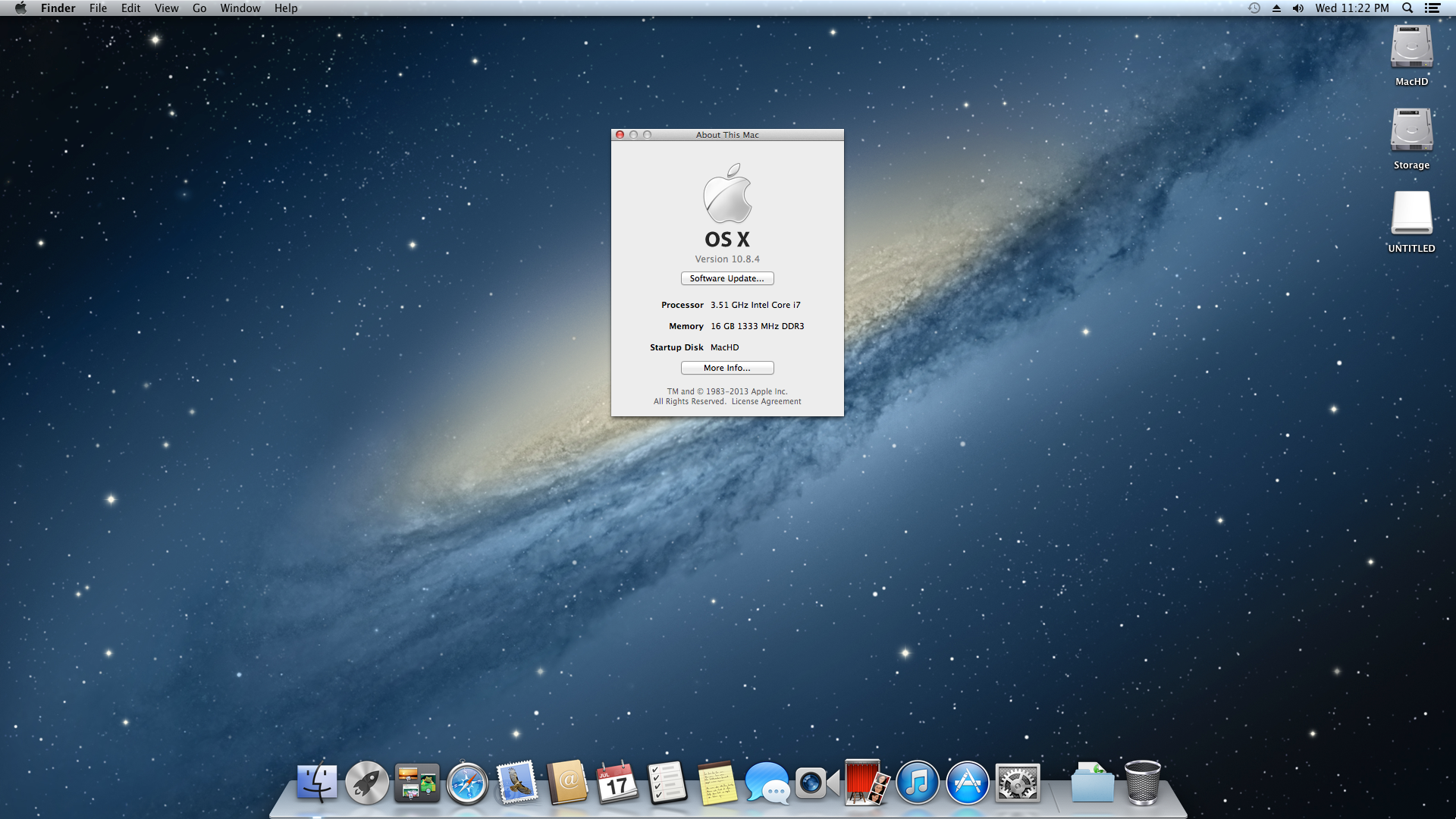
    Mac OS X 10.8.4 desktop showing CPU and memory. Everything is running a-okay!
    Mac OS X 10.8.4 desktop showing CPU and memory. Everything is running a-okay!

    I chose to go this route, because I could not get Mac OS to boot with the DSDTs that I created with MaciASL (using the configuration for the P8Z77-V motherboard and graphics source per PJALM’s instructions). My problems could have been related to the DSDT or due to incompatibilities between its settings and my P8Z77-V’s BIOS ROM version (I was unable to use the motherboard’s BIOS Flashback feature to successfully load one of these hacked BIOS ROMs on this site). Apparently, if you can get the DSDT to install correctly and have the hacked BIOS, you will be able to enjoy power management settings and control. Since I have my computer only on when I am using it, I do not have any problem with this lack of functionality. Since installation, my Hackintosh has been running great. It is snappy, video and sound work great, network connectivity is fine, and Doom 3 plays fantastically at 1080p!

    After the installation, I discovered one tremendous problem: FileVault cannot be activated for your boot drive. Apparently, this is due to FileVault needing a real Mac’s EFI environment (or the error message that it generates indicates that it has to do with its inability to re-partition the bootdrive–likely due to the Chimera bootloader). As far as I can tell from reading posts on the TonyMacx86 forums, there is no way around this problem. One option would be to save your files in a TrueCrypt container or fully encrypted drive that is separate from your bootdrive. Another way is to use TrueCrypt full disk encryption as detailed on this helpful blog post from Frugal Computing (FC also has some great articles about building Hackintoshes).

    Others in the TonyMacx86 forums have had varying levels of success with the Asus P8Z77-V and Mountain Lion, so I do not want to dissuade you from attempting to get more functionality on your installation. The above is simply a report of what worked for me. It might work for you, and it might give you a beginning for your own Hackintosh project.

  • Custom Light-Up Display Stand for LEGO Star Wars Midi-Scale Millennium Falcon 7778 with Han Solo and Chewbacca from 7190

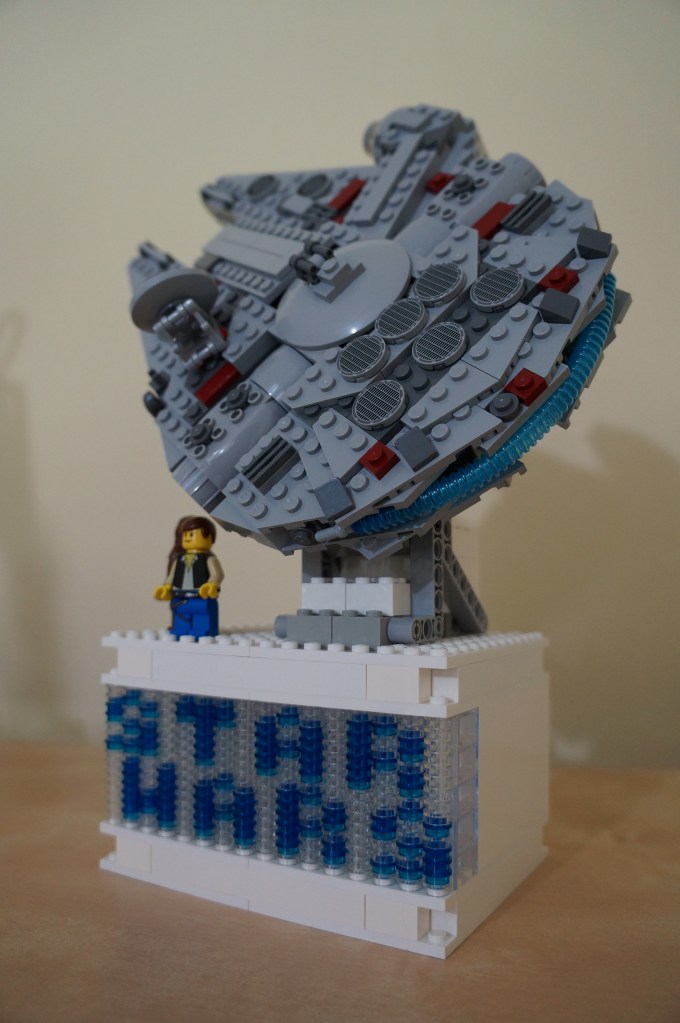
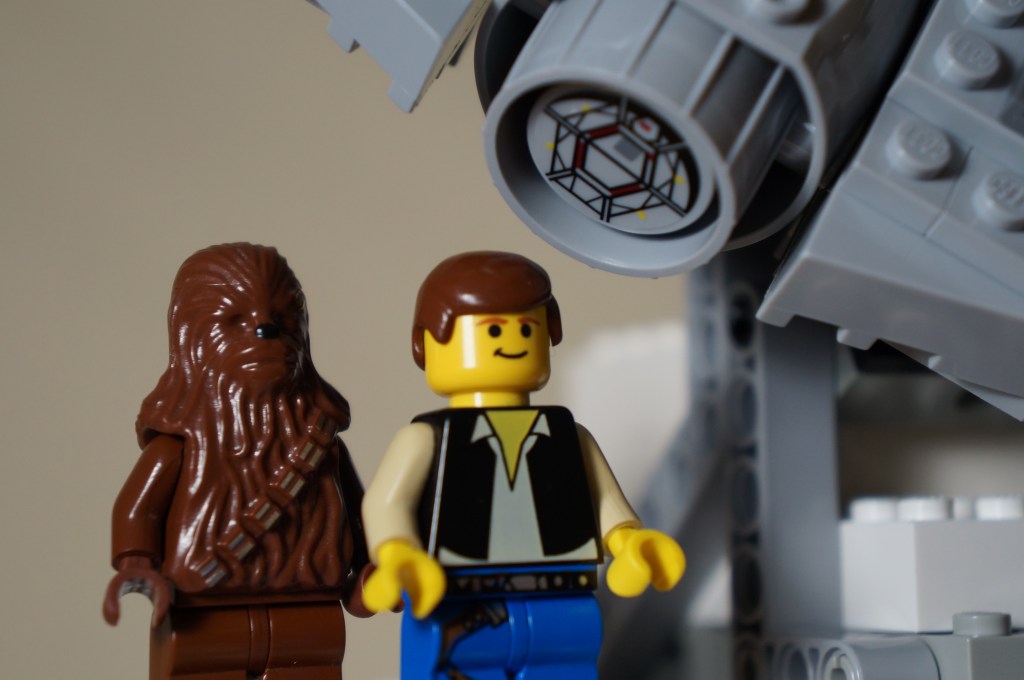
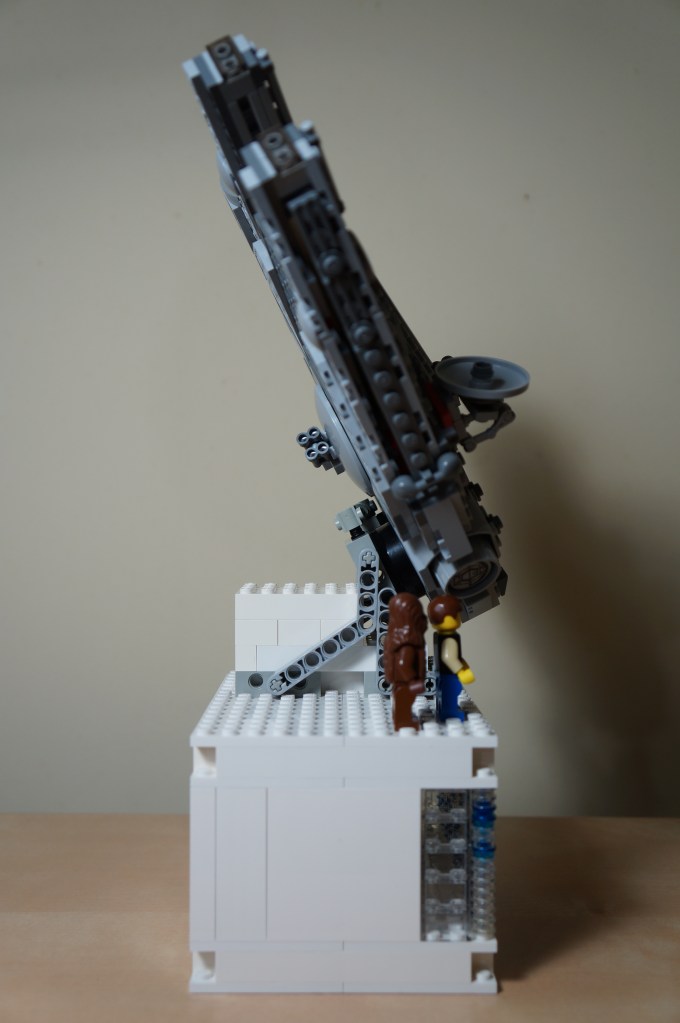
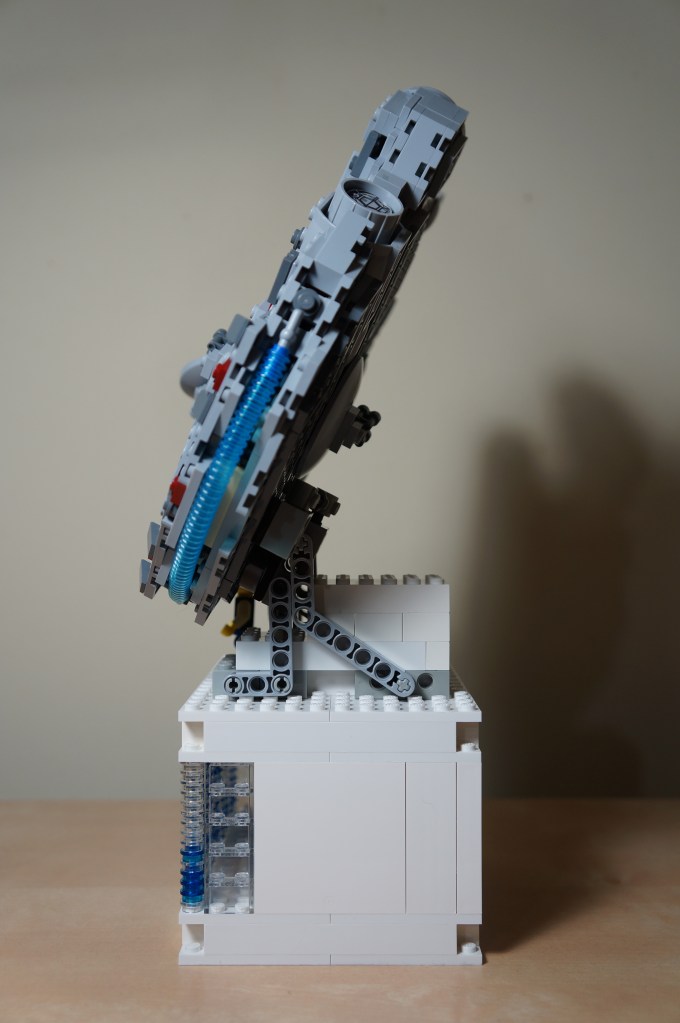
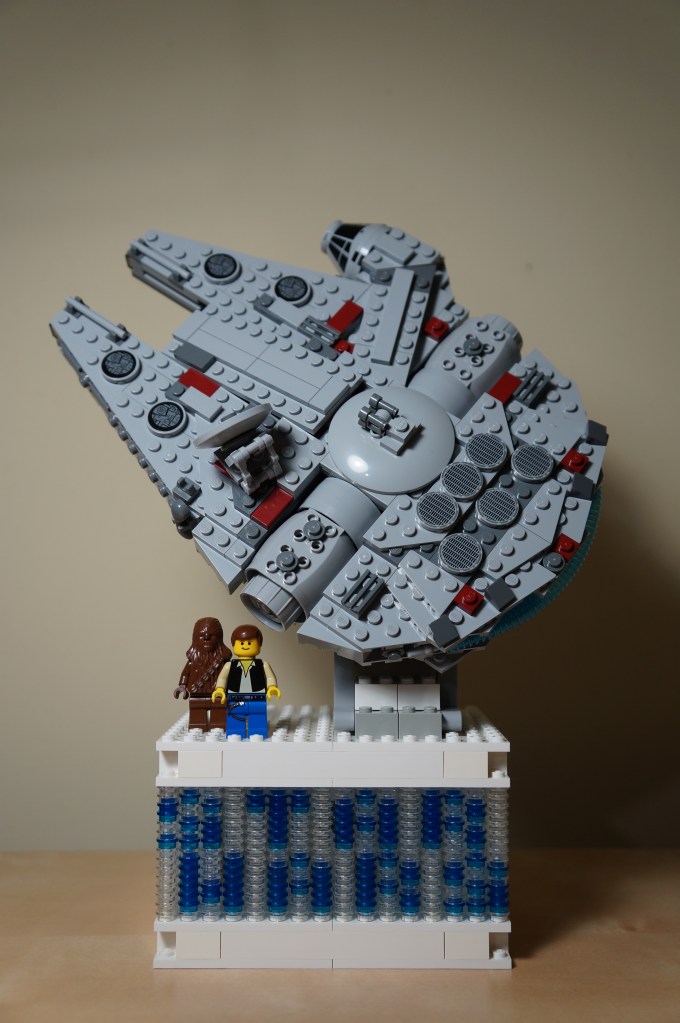
    Yesterday, I spent the afternoon building a custom display stand for the “midi-scale” Lego Star Wars Millennium Falcon 7778. I used white bricks and plates to build an empty box for its base. On its front, I used clear round pieces for filler and translucent blue pieces for the letters. I planned out the letters on an index card that I drew a grid pattern on. If you count the columns, you can see that I was left with an extra, unused column. Y suggested setting the bottom line of text off by one column to spread this spare column between both lines of text, which I think works very well. In the back of the base, I installed a light brick to illuminate the Star Wars text on the front. On top of the base, I build a stand for the Falcon using Technic bricks. It took some experimentation with different elements to get the angle that I wanted. On top of the stand, I used a 4×4 rotating assemblage to give the Falcon a more dramatic pose. In order to keep it at the rotation angle that I choose, I used a Technics rod assembly attached with a 2×2 rotating assemblage to meet it to the Falcon and hold it in place. I added the Han Solo and Chewbacca minifigures from the original Lego Star Wars Millennium Falcon 7190 set to complete the project.

  • Dean Griffin Day Luncheon for Thank a Teacher Recipients, and A Meditation on Teaching, Passion, and MOOCs

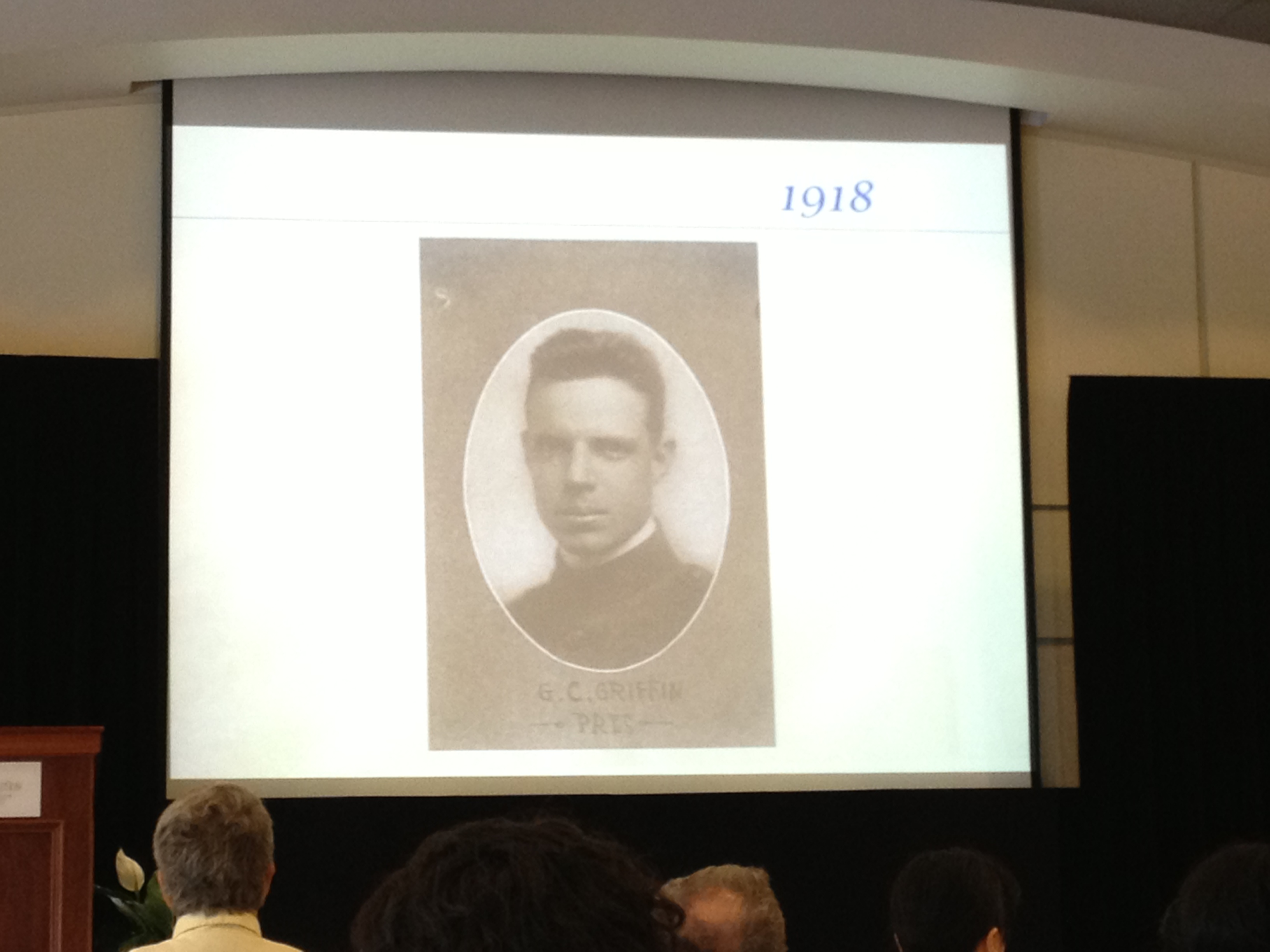
    George C. Griffin, 1918
    George C. Griffin, 1918

    Today, the Georgia Tech Alumni Student Ambassadors and the Georgia Tech Center for the Enhancement of Teaching and Learning hosted the Dean Griffin Day Luncheon to recognize recipients of “Thank a Teacher” notes. I was honored by a Thank a Teacher note from one of my students.

    Associate Vice Provost for Learning Excellence Donna Llewellyn told us about the origins of the Thank a Teacher program and recited some of the notes that recipients had received.

    Marilyn Somers, Director of Georgia Tech’s Living History Program, guided us through enjoyable multimedia-driven stories about Dean George C. Griffin. Her enthusiasm for Georgia Tech is only matched by her passion as a storyteller.

    Vice Provost for Undergraduate Education Colin Potts delivered a meditation on what exactly it is that makes a great teacher and how that relates to the modern development of online education in MOOCs (massive open online course). The two most provocative things that I took away from his talk include the question, “What makes a good teacher?,” and the observation, MOOCs are part of the evolution of education but not the end.

    On my walk back to the Hall Building, I thought about Dr. Potts’ question: What makes a good teacher. Of course, I have given this idea a lot of thought before and after entering the profession, but it is a question that we as educators should continually return to in our work as reflective practitioners. The best quality that I have found in my teachers (and I mean those people who are educators in the broadest sense of the word) is passion. This includes a passion for the material being taught, a passion for student learning and success, a passion for engaging others, a passion for life-long learning, a passion for energetic discourse, a passion for understanding, a passion for a passion for giving back to a community, a passion for being a part of larger conversations beyond the classroom, and a passion for kindness. What’s intriguing about my experiences with some fantastic teachers during my life is that I do not believe that any of them perform, demonstrate, or conduct these same passions in the same way. There many different paths to these things, and its amazing to me how many different people tread very different paths yet have achieved for me the same positive and enriching outcomes.

    This reminds me of something else that Dr. Potts warned about MOOCs–the impulse of some to promote a singular, superstar educator as the one way for a course to be delivered and taught. In a smaller way, I think back to my Calculus education at Georgia Tech. There were simply some professors who I could learn from–that is, their teaching style and methodology synced, jived, and meshed with my thinking and learning ability. The professors who I did learn Calculus best from might not have been the exemplars of the profession at Tech at that time, but they were, to me anyways, the best educators of Calculus (I should know, because I had some false starts early on in my educational career). We have to be very careful about the choices that we make as an institution and as a profession as we move further into offering MOOCs. These choices should extend beyond the calculus of student completion rates. We have to consider the effects MOOCs will have on pedagogy and educators. How will MOOCs, over time, influence education? How will MOOCs influence student success in areas not explicitly concerned with a course that teachers often provide and encourage (finding out how students are doing, having informal chats, making sure students are doing okay, etc.)? Will MOOCs push out some educators and educational styles in favor of others? Can the passions of educators be provided/conveyed and can the passions of students for learning, solving puzzles, and engaging discourses be fostered in a MOOC?

    A final note: I am listening to Dr. Eric Rabkin’s lectures on tape for his Science Fiction: The Technological Imagination course from the University of Michigan. Certainly, he is passionate about science fiction, and it is, I believe, unavoidable for his passion to infect his audience. He knows the material, and he is obviously excited to convey this knowledge to his students (in the classroom and in the world–those of us listening to the lectures on tape). However, Dr. Rabkin cannot provide the same kinds of things as a teacher (educator, mentor, counselor, etc.) in a MOOC or lectures on tape that he can provide in a class of reasonable size (another issue). Don’t get me wrong–Dr. Rabkin is a fantastic person and I count him among my professional friends. However, there are limitations to what an educator can and cannot do in a MOOC or lectures on tape. For example, in his own highly popular MOOC, I imagine that he cannot read all of the comments or questions of every student (when I see Dr. Rabkin next, I will certainly ask him about how he compares his classroom and MOOC teaching). This is something possible when you have reasonable class enrollments and course loads (this leads into another area of concern about having too large of a class for a qualitative and composition oriented course–there is a point at which the teacher cannot provide the necessary and needed passion for all students. In which case, a too big of a class, too many classes, or a MOOC can become indistinguishable from the perspective of the educator). Of course, I can see that the objectives of the classroom learning environment compared to the MOOC/lectures on tape should be different. I am left wondering though if everyone who promotes MOOCs truly recognizes the different affordances of each without trying to make one into the other at the cost of each.