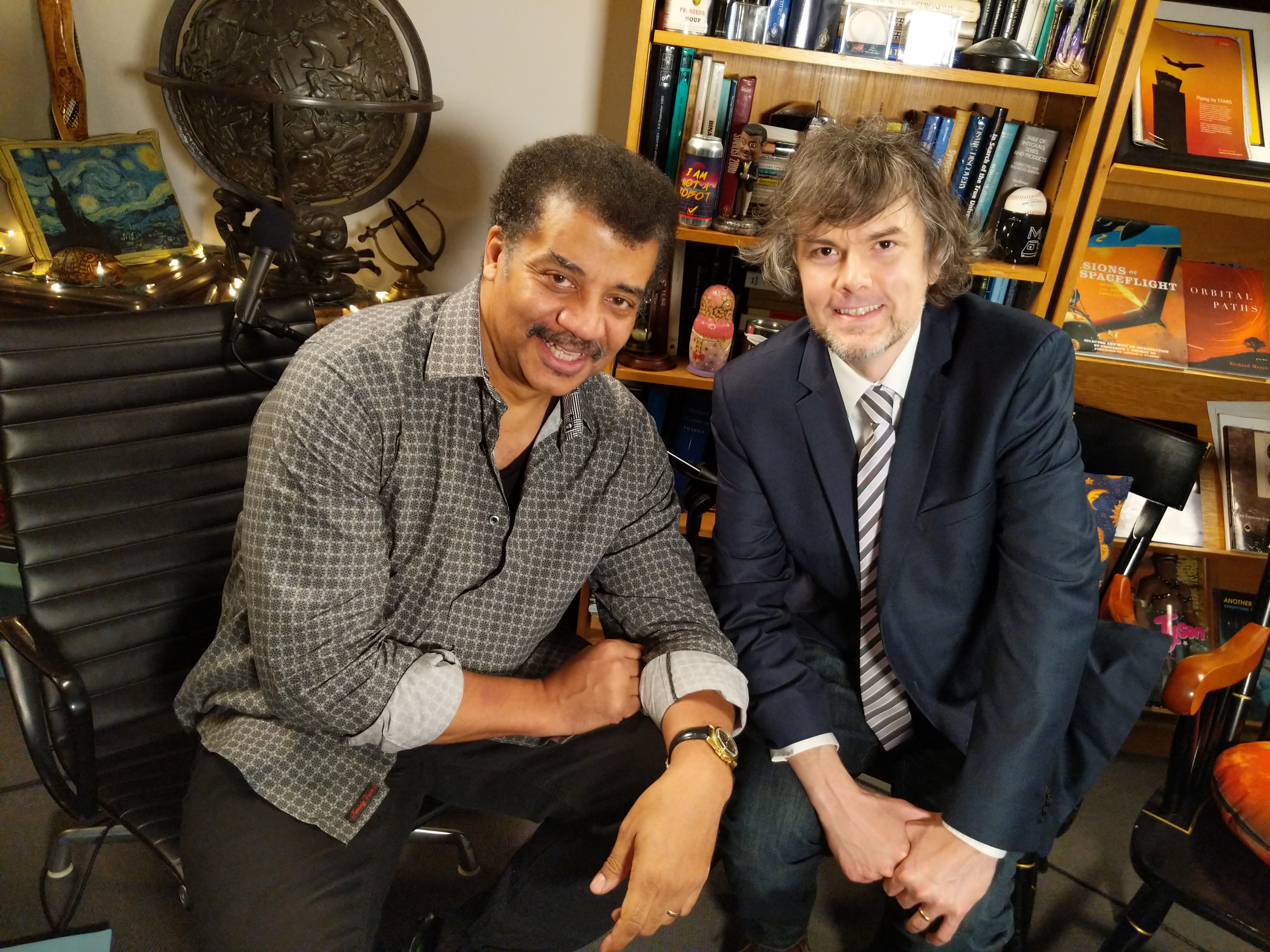
Neil deGrasse Tyson and Jason Ellis in Dr. Tyson’s Office at the AMNH Planetarium.
I had the distinct honor to join the conversation about science fiction and society on Dr. Neil deGrasse Tyson’s StarTalk Radio Show on May 30, 2019 (season 10, episode 22). The episode is about Creating Science Fiction, with Gale Anne Hurd, the producer of The Terminator and The Walking Dead. I shared some thoughts on Hugo Gernsback’s formula for “scientifiction,” H.G. Wells and Sir Ernest Swinton’s legal fight over the modern battle tank, the power of SF to engage social issues and debate, and my personal, lifelong relationship to SF. You can listen to the episode here or embedded below:
The Terminator, The Walking Dead, Aliens, and a lot more. Those are just some of the producing credits for this week’s main guest on StarTalk Radio. Neil deGrasse Tyson sits down with producer-extraordinaire Gale Anne Hurd to explore what it takes to bring great science fiction to life. Neil is joined by comic co-host Chuck Nice, science fiction expert Jason Ellis, PhD, and volcanologist Janine Krippner, PhD.
Because science fiction comes in many different forms and through many different avenues, there are many ways to get into it. You’ll learn how Gale’s childhood love of Marvel comic books and science fiction novels translated into a career “making what she likes to see.” She tells us how she served as a science fiction consultant to her local library to make sure their stock was up to date. Jason shares why not being able to see Star Wars in the theater sparked a rebellious love for science fiction.
You’ll hear about the history of science fiction and how it combines the STEM fields and the humanities. We debate if science fiction informs the future of every technological invention. You’ll find out about a lawsuit H.G Wells brought upon military figureheads because he claimed they stole his idea from one of his science fiction stories. Explore using science fiction as social commentary. Discover more about the famous kiss between Captain Kirk and Lt. Uhura, and how William Shatner and Nichelle Nichols purposely flubbed takes to make sure it stayed in the episode.
We take a deep dive into Dante’s Peak as volcanologist Janine Krippner stops by to share her take on the film. She explains why she thinks it’s still the best volcano movie even with its flaws. Gale gives us a behind-the-scenes look on how she fought for even more scientific realism to be in the film but encountered pushback from the studio. Neil also confronts Gale on the famous scientific inaccuracies of Armageddon. Chuck shares his love for The Expanse, we discuss Interstellar, and Neil tells us about his involvement in The Europa Report.
Lastly, you’ll also find out the differences between creating science fiction for television and film. According to Hugo Gernsback, the father of science fiction, sci-fi should be 75% romance and 25% science – is that still the goal? All that, plus, Jason caps it off with a story on how he was criticizing the film Sunshine right in front of director Danny Boyle’s family.
Uncle Doc (William Cook) and Aunt Lettie Ann at their home in 2009.
My Aunt Lettie Ann Cook passed away on May 17, 2019. I flew to my hometown to fulfill her request that I speak at her funeral and serve as a pallbearer. Her husband of 54 years, William Cook, who I knew as Uncle Doc, had preceded her in death in 2015.
They were both good people, who I and many others miss. I am reminded of fun-filled childhood pool parties at their house–one being particularly memorable during which I used a snorkel face mask for the first time and I played with my cousin Mark’s bad-ass Boba Fett action figure. That was probably around 1981. Or, learning from Aunt Lettie Ann how she made ceramic sculptures. Or, learning from Uncle Doc how to melt lead for my pinewood derby racer, use a scroll saw and drill press, and work with wood to make storage chests and other things. Or, enjoying cookouts featuring Aunt Lettie Ann’s great home cooking at their house after they moved from Brunswick to Hortense. And above all, reveling in their open door hospitality.
Uncle Doc died suddenly in 2015, and I was regrettably unable to return for his funeral. Before Aunt Lettie Ann died, she asked my dad to help me fly down and speak at her funeral as I had done for my Granny Ellis in 2012. The week before last, I said these words for her:
Remembering Aunt Lettie Ann
My dad tells me that my Aunt Lettie Ann had asked him while she was still lucid that I speak at her funeral. I’m saddened that it’s on this occasion that I am speaking with you today, but I consider it an honor to do this small thing for her.
I wanted to begin by sharing with you a seemingly mundane yet meaningful dream that I had three weeks ago, the night after I learned Aunt Lettie Ann was back in the hospital. To be honest with you, I don’t put much truck in dream visitations or other forms of clairvoyance, but this dream’s timing and content unnerved me.
The dream begins with me standing in the foyer of Aunt Lettie Ann’s fine house on Baker Hill Road. I see her descending the steep stairs slowly and carefully with her hands clutching the railing, but her face is beaming, and she says that she’s so glad to see me. After sharing a big hug, she tells me that I need to eat. Leaving me to sit at the extended dining room table with low sunlight entering the windows, she fusses in the kitchen to quickly prepare something for me. Then, while plying me with her delicious home cooking, she asks, how are you doing, how’s my sweet pea—that’s Y, my wife, what are you both up to? Answering her questions, I never got to ask how she was before I was suddenly awake.
That dream lingered in my mind throughout her ordeal. I hoped that it was more like a good memory than a kind of goodbye. I can say that it brought back many happy memories of Aunt Lettie Ann showing her unconditional love and care, such as birthdays and Christmases, visits to see her when I was at home from school or work, and times that she hosted me when Uncle Doc, who you might have known as Bill or Wilbur or grandpa or dad—helped me on Scouting projects. And, it reminded me how she demonstrated her love and care in other ways, such as wanting to know how you are and what you’re up to—listening equally about your triumphs and failures, your good health and bad, and even your daily trifles—before sharing her own, in which she emphasized the positive over the negative and made light of her own troubles; needing to take care of you and make sure that you’re comfortable and well fed; giving deeply personal gifts—in fact, thinking to get Christmas presents for our cats Miao Miao and Mose who she didn’t even have a chance to meet; and above all else striving to make you feel loved and special. However, Y told me that it is more than that—the feeling of being loved by Aunt Lettie Ann remains with you even after you say goodbye and you carry her love with you wherever you might go next. I think she’s absolutely right.
I share with you all a tremendous sadness that Aunt Lettie Ann is no longer here to love and care for us. I know we will all miss her great big hugs, her delicious cooking and get-togethers, and her looking out for us. However, I am deeply heartened to know that her love is still all around us, because we each carry it in our hearts and memories. I encourage you to cherish Aunt Lettie Ann’s love as a celebration of her life, an enduring remembrance of who she was, and a reminder of the kind of person who we should all strive to be.
During today’s class, we will conclude your discussion of Marjane Satrapi’s two groundbreaking graphic novels, Persepolis: The Story of a Childhood (2000 and 2001/English translation 2003) and Persepolis 2 (2002 and 2003/English translation 2004).
First, I need to give you two reminders:
–Round 3 of blog posts are due by midnight on May 9 from Clifford, Andrew, Marla, and Sandra. The rest of the class has until midnight May 14 to post their comments. If anyone is missing any of their previous blog posts or comments, they also must be completed by midnight, May 14. A reminder for the students: these instructions and the blog schedule are on our OpenLab site.
–Their research projects are due at the start of class on May 14. They will need to have their bibliographic sheets ready for submission, and the order of individual presentations will be randomly-determined at the start of class. They can access the instructions for this assignment, as well as a template for the bib. sheets, on our OpenLab page.
Professor Mazumdar
Now, to begin our discussion today, let’s consider the relationship between private histories (individual and familial) and public histories (recorded, published, recognized, shared).
The Oxford English Dictionary defines history as:
A written narrative constituting a continuous chronological record of important or public events (esp. in a particular place) or of a particular trend, institution, or person’s life.
This is a broad definition of what we usually think of as history. On the one hand, it includes “record of important or public events” as well as “a person’s life.” The former tends to mean the events that shape all of our lives, such as presidential elections, wars, and national tragedies. It is recorded in newspapers, magazines, journals, books, documentaries, and other media. The latter switches from larger events to the individual. Of course, biographies and autobiographies of celebrities, politicians, scientists, etc. are about individuals and they concern the larger history that shape our lives as those recognized individuals contributed to our society and culture in some way–good or bad. But it can also be about individuals like you and me. It can be about families, too. The stories of these private histories are pass along through oral traditions (storytelling) and recorded in oral histories (recordings of interviews with persons and families about their experiences, struggles, and memory of events), life writing (diaries, journals, letters, postcards, memoirs, biographies, autobiographies, and today, social media and other digital writing).
Considering these two meanings of history, let’s call the “record of important and public events” a public history and the smaller scale history of individuals and families a private history. Let’s explore the interaction between these two types of history. Rosenzweig and Thelen present one way of framing the relationship between public and private histories:
When we approach the more familiar content of academic history, we need to investigate how in their intimate relationships individuals used and did not use, went along with and defied larger “historical” trends. At this level the dichotomy between “intimate” and “national,” public and private, dissolves into dynamic and reciprocal interaction. Respondents more often mentioned public experiences than private ones as the most formative of their lives, but they mentioned those public events most often as intimate experiences. What they remembered was the personal contexts in which they engaged the public events (teachers and students in a fifth grade class weeping when they heard of Kennedy’s assassination) or their own participation in those events (fighting in a battle in World War II). They often drew personal meanings when they recalled public figures as the most important individuals in their lives. In distinguishing between those experiences that still live in active memory, passed on orally from individual to individual because people believe that they continue to provide meaningful anchors for the present, on one hand, and those experiences now remembered only in writing—in books, written by professional historians—Pierre Nora draws a more important distinction than that between personal and national pasts. What matters is whether something lives for participants in the present.
In other words, walling off public from private pasts doesn’t make sense. When not forced to choose between family and national pasts, half the respondents who wanted their children to learn their family heritage also wanted their children to learn their national heritage. They connected these heritages, intimate with public, each time they toured a museum or visited a site with family or friends, each time they reenacted a battle or showed objects they had collected to others. They named both national figures and family members as influences; about the same number of people in the national sample (24) named John F. Kennedy as a formative influence as named their grandfathers. Many worried about how larger historical developments—economic insecurity, waning of discipline—might have eroded the family, turning it into a source of disintegration instead of support. Respondents gave meaning to large phenomena like immigration or economic depression by describing how they had changed and been changed by passage through those experiences.
A fundamentally historical culture centered on individual participation would invite members to explore just how individuals conform to and resist larger historical trends, how the rhythms and narratives of family life fit or do not fit those of changing power and institutional arrangements in the larger society. It would envision individuals as more than examples of large and impersonal cultures and institutions. It would take seriously how they live lives and meet needs in relationships driven by forces different from those that power institutions and cultures. (Rosenzweig and Thelen 196-197).
Rosenzweig, Roy and David Thelen, The Presence of the Past: Popular Uses of History in American Life: Columbia University Press, 1998.
Rosenzweig and Thelen explore the relationship between individuals’ private histories and the larger public histories, the larger events, that they experienced. They find that private and public histories inform one another–the former giving context to the latter. They interact in deeply personal ways that shape the memories of ourselves and those around us. Public history influences private history, and public history is captured in private history in complex ways.
Rosenzweig and Thelen mention Pierre Nora, whose work might be helpful for our thinking about the private histories and public histories, or put another way, memory and history.
Memory and history, far from being synonymous, appear now to be in fundamental opposition. Memory is life, borne by living societies founded in its name. It remains in permanent evolution, open to the dialectic of remembering and forgetting, unconscious of its successive deformations, vulnerable to manipulation and appropriation, susceptible to being long dormant and periodically revived. History, on the other hand, is the reconstruction, always problematic and incomplete, of what is no longer. Memory is a perpetually actual phenomenon, a bond tying us to the eternal present; history is a representation of the past. Memory, insofar as it is affective and magical, only accommodates those facts that suit it; it nourishes recollections that may be out of focus or telescopic, global or detached, particular or symbolic-responsive to each avenue of conveyance or phenomenal screen, to every censorship or projection. History, because it is an intellectual and secular production, calls for analysis and criticism. Memory installs remembrance within the sacred; history, always prosaic, releases it again. Memory is blind to all but the group it binds-which is to say, as Maurice Halbwachs has said, that there are as many memories as there are groups, that memory is by nature multiple and yet specific; collective, plural, and yet individual. History, on the other hand, belongs to everyone and to no one, whence its claim to universal authority. Memory takes root in the concrete, in spaces, gestures, images, and objects; history binds itself strictly to temporal continuities, to progressions and to relations between things. Memory is absolute, while history can only conceive the relative.
At the heart of history is a critical discourse that is antithetical to spontaneous memory. History is perpetually suspicious of memory, and its true mission is to suppress and destroy it. At the horizon of historical societies, at the limits of the completely historicized world, there would occur a permanent secularization. History’s goal and ambition is not to exalt but to annihilate what has in reality taken place. A generalized critical history would no doubt preserve some museums, some medallions and monuments-that is to say, the materials necessary for its work-but it would empty them of what, to us, would make them lieux de memoire. In the end, a society living wholly under the sign of history could not, any more than could a traditional society, conceive such sites for anchoring its memory. (Nora 8-9)
Nora, Pierre. “Between Memory and History: Les Lieux de Mémoire.” Representations, 26, 1989, 7-24.
An important term that Nora uses is lieux de memoire. What does this mean?
[A] lieu de memoire [site of memory] is any significant entity, whether material or nonmaterial in nature, which by dint of human will or the work of time has become a symbolic element of the memorial heritage of any community. (Nora xvii)
Nora, Pierre. “Preface to English Language Edition: From Lieux de memoire to Realms of Memory.” Realms of Memory: Rethinking the French Past, edited by Pierre Nora, Columbia University Press, 1996, pp. xv-xxiv.
Lieux de memoire or sites of memory are invested with history by our shared experiences and memory of events in the past. They are communal, but the memory supporting the site (whether it is material like a place or nonmaterial like a story, language, or tradition) depends on the sustenance of the memory by individuals sharing and passing on the memory across time. A lieu de memoire is a kind of in-between of public history and private history that depends on individual memory, which takes the place of the milieux de memoire:
Our interest in lieux de memoire where memory crystallizes and secretes itself has occurred at a particular historical moment, a turning point where consciousness of a break with the past is bound up with the sense that memory has been torn-but torn in such a way as to pose the problem of the embodiment of memory in certain sites where a sense of historical continuity persists. There are lieux de memoire, sites of memory, because there are no longer milieux de memoire, real environments of memory. (Nora 7)
Nora, Pierre. “Between Memory and History: Les Lieux de Memoire.” Representation, no. 26, Spring 1989, 7-24.
The milieux de memoire or real environments of memory are the places, cultures, and events lost to the past that, because of changes in the world from when those things represented the idea now held (the lieu de memoire), no longer represent or correspond to that past. Some examples that we can discuss include baseball, the World Trade Center, and Persepolis [the place in Iran].
The disconnection between the milieux de memoire and the lieu de memoire points the way to our forgotten past. Some of our past is selected to be recorded as public history by historians (and others) based on a variety of criteria and influences, including politics, ideology, hegemony, research interest, etc., while other parts of our past are de-emphasized, erased, and not selected. Private history, or the history of individuals and families, plays such an important role in our better understanding of the past that gets left out of public histories.
Marjane Satrapi combines private history and public history in her autobiographical graphic novels, Persepolis and Persepolis 2. Loren Baybrook writes about it in these ways:
The color fades, and the story of the Islamic Revolution in 1979 unfolds as a contest between private history, which pulls her back to her family, and public history, which has pushed her so far from them. (Baybrook 1)
Marji’s alternation between individual conscience and group consciousness, between private and public history, points, then, to the deeper culprit of civic ruin. (Baybrook 2)
Less militantly and didactically, yet still in that vein, Uncle Anoush affirms to Marji the public ideal of enforcing a “society of justice and freedom”. But only his personal history—a tale of conspiracy and death and escape, but also, as if the film is visually resurrecting the mythic promise of The City of Persians, a tale of Anoush’s journey back to the land of butterflies, floating snowflakes, flying fish, and birds presiding over the destiny of Persia—only this history actually matters to his young niece. Why? Because, as Anoush tells her, she herself matters to that history: “family memory must live on” through her. He gives her a miniature swan to seal her promise “never to forget” this intimate bond to individuals. And then comes a montage of other families’ private histories to affirm this lesson in civics. (Baybrook 2)
Persepolis is a history of private voices surviving—or not—amidst the public ones. (Baybrook 2)
In the passages above, Baybrook explores how Satrapi’s private history is intertwined with the public history in interesting ways. For example, the Islamic Revolution in Iran is ultimately what leads to her leaving her homeland and living in Austria, and the private history of her experiences in Austria (that she doesn’t share with her parents but entrusts to the reader) leads her back to her homeland and the ongoing unfolding of its public history. Additionally, her private history (such as falsely accusing the man looking at her as saying something indecent to her) says something about the individual’s potential to be the oppressor in relation those oppressing her. Finally, the importance of Uncle Anoush’s message to her–“family memory must live on”–gives power and importance to private history. Anoush recognizes that so much of what was happening in Iran before and after the Revolution would be erased from public history. It is within those who live and witness can remember and pass on what they remember so that the private history can challenge, enrich, and correct the official public historical accounts.
Public history and private history are intricately interconnected. Public history helps us make sense of and anchor our private history, while private history gives important context to the public history that one lives through and configures the world we are born into by its having created the setting, characters, and props of our individual history’s stage, which reminds me of one more thing from Shakespeare:
Jaques to Duke Senior:
All the world’s a stage, And all the men and women merely players. They have their exits and their entrances, And one man in his time plays many parts, His acts being seven ages. At first the infant, Mewling and puking in the nurse’s arms. Then the whining schoolboy, with his satchel And shining morning face, creeping like snail Unwillingly to school. And then the lover, Sighing like furnace, with a woeful ballad Made to his mistress’ eyebrow. Then a soldier, Full of strange oaths, and bearded like the pard, Jealous in honor, sudden, and quick in quarrel, Seeking the bubble reputation Even in the cannon’s mouth. And then the justice, In fair round belly with good capon lined, With eyes severe and beard of formal cut, Full of wise saws and modern instances; And so he plays his part. The sixth age shifts Into the lean and slippered pantaloon, With spectacles on nose and pouch on side, His youthful hose, well saved, a world too wide For his shrunk shank; and his big manly voice, Turning again toward childish treble, pipes And whistles in his sound. Last scene of all, That ends this strange eventful history, Is second childishness and mere oblivion, Sans teeth, sans eyes, sans taste, sans everything. (Shakespeare 2.4.1118-1145)
During the final phase of today’s class, we’re going to compare some passages in the graphic novels and their animated film adaptation Persepolis (2007), directed by Marjane Satrapi and Vincent Paronnaud.
What do we mean by the term adaptation? An adaptation is the active recreation of a source text in one medium (e.g., a graphic novel) into a new medium (e.g., an animated film). It can be thought of as a translation of a story from one medium to another, because different languages can imply similar meanings but how they do so in terms of sentence structure, vocabulary, and idioms is quite different.
Each medium has its own unique affordances and constrains. A graphic novel includes images drawn and inked arranged in panels across pages with words providing dialog, interior thoughts and emotions, and narration. The images and text work together to tell the story. Like a graphic novel, an animated film uses images, but instead of being static, they are moving images. Action that might otherwise be implied in static drawings in the graphic novel are given movement, life, and energy. Instead of having to read text as in the graphic novel, the animated film uses character dialog and occasional narrative voice-over. Nonverbal changes of expression are fluid instead of jarring as in the graphic novel. Body language and tone of voice, cadence of speech, and emphasis of speech provide richer and nuanced meaning that might get left out of the graphic novel. Unlike a graphic novel, the film uses music–orchestral soundtrack and popular music–to imply emotional content, set the tone of a scene, and provide cues to the audience of the intensity or pace of a scene.
Now, let’s look at some specific scenes together and discuss them.
Continuing from my previous post on The Dark Knight Returns, I’ve assembled a selection of videos below featuring Frank Miller and others talking about Miller’s work in The Dark Knight Returns.
In this interview introduced by science fiction writer and editor Harlan Ellison for “The Masters of Comic Book Art (1987), Frank Miller discusses The Dark Knight Returns, Ronin, and other works.
DC Comics interviews people about their work on and memories of The Dark Knight Returns.
The Frank Miller episode of G4’s Icons discusses The Dark Knight Returns at the 16:00 mark.
Frank Miller was interviewed for Comic Book Confidential (1988). His part of documentary is embedded below.
In this final video, Frank Miller talks about his work and influences.
On Thursday, Feb. 14, I’m filling in for Prof. Rebecca Mazumdar in her ENG3402 Special Topics Class on The Graphic Novel.
Students were asked to read the first two books of Frank Miller’s Batman: The Dark Knight Returns (1986) and Chapter 3, “Blood in the Gutter” of Scott McCloud’s Understanding Comics (1993) for today’s class.
During today’s class, we’ll discuss The Dark Knight Returns, Superheroes, and the Antihero. These topics will return for discussion in future classes when Prof. Mazumdar joins you next.
These are some resources that will inform our discussion (in the order of reference):
Nicholls, Peter, and David Langford. “Superheroes.” The Encyclopedia of Science Fiction. Eds. John Clute, David Langford, Peter Nicholls and Graham Sleight. Gollancz, 31 Aug. 2018, http://www.sf-encyclopedia.com/entry/superheroes.
Langford, David. “Superpowers.” The Encyclopedia of Science Fiction. Eds. John Clute, David Langford, Peter Nicholls and Graham Sleight. Gollancz, 8 May 2015, http://www.sf-encyclopedia.com/entry/superpowers.
Langford, David. “Clarke’s Laws.” The Encyclopedia of Science Fiction. Eds. John Clute, David Langford, Peter Nicholls and Graham Sleight. Gollancz, 2 Aug. 2016, http://www.sf-encyclopedia.com/entry/clarkes_laws.
Tiner, Ron, David Roache DRo and John Platt. “Batman.” The Encyclopedia of Science Fiction. Eds. John Clute, David Langford, Peter Nicholls and Graham Sleight. Gollancz, 15 Oct. 2018, http://www.sf-encyclopedia.com/entry/batman.
Langford, David. “Antiheroes.” The Encyclopedia of Science Fiction. Eds. John Clute, David Langford, Peter Nicholls and Graham Sleight. Gollancz, 6 Oct. 2017, http://www.sf-encyclopedia.com/entry/antiheroes.