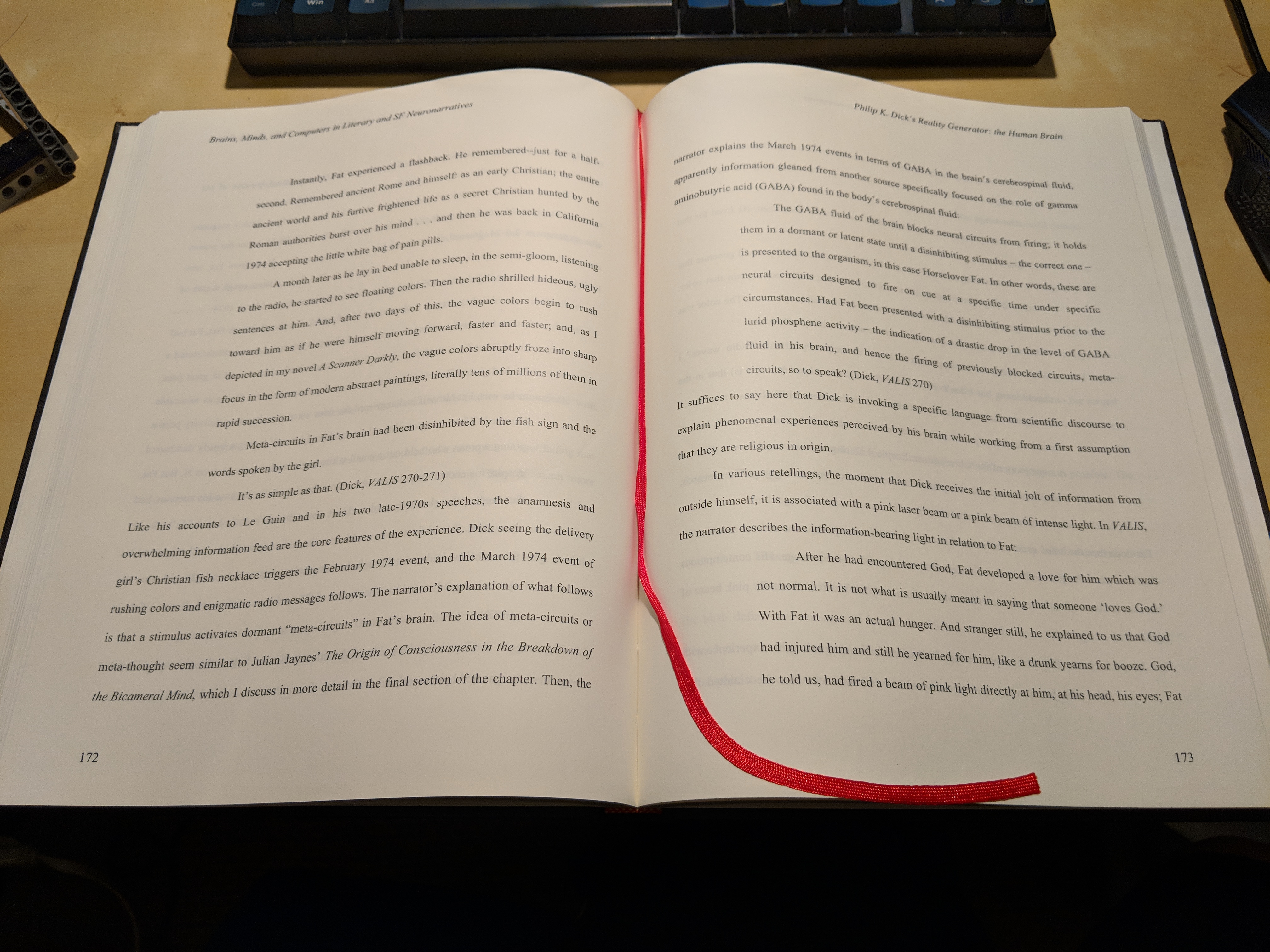
I was sad to learn that Zonghe Zhuangding, Ltd., the publisher who worked with Y’s father to print an exquisite hardcover edition of my PhD dissertation, “Brains, Minds, and Computers in Literary and Science Fiction Neuronarratives,” shuttered their business after their shop burned down. Zonghe Zhuangding provided printing and book binding services for publishers in Taiwan until the fire consumed their entire facility.
Y’s father insisted that we publish my dissertation after I defended it in 2012. Zonghe Zhuangding did an amazing job printing the book-version of my dissertation, which I had to layout with opposing running headers and other book-design features. The gold-typeface on the cover and spine look very impressive. And, the stitched-in red ribbon bookmark was a surprise bonus (see below).
After Y defended her dissertation last year, her father had her dissertation printed there, too.
N.B.: In Chinese, zhuangding means binding or book binding.
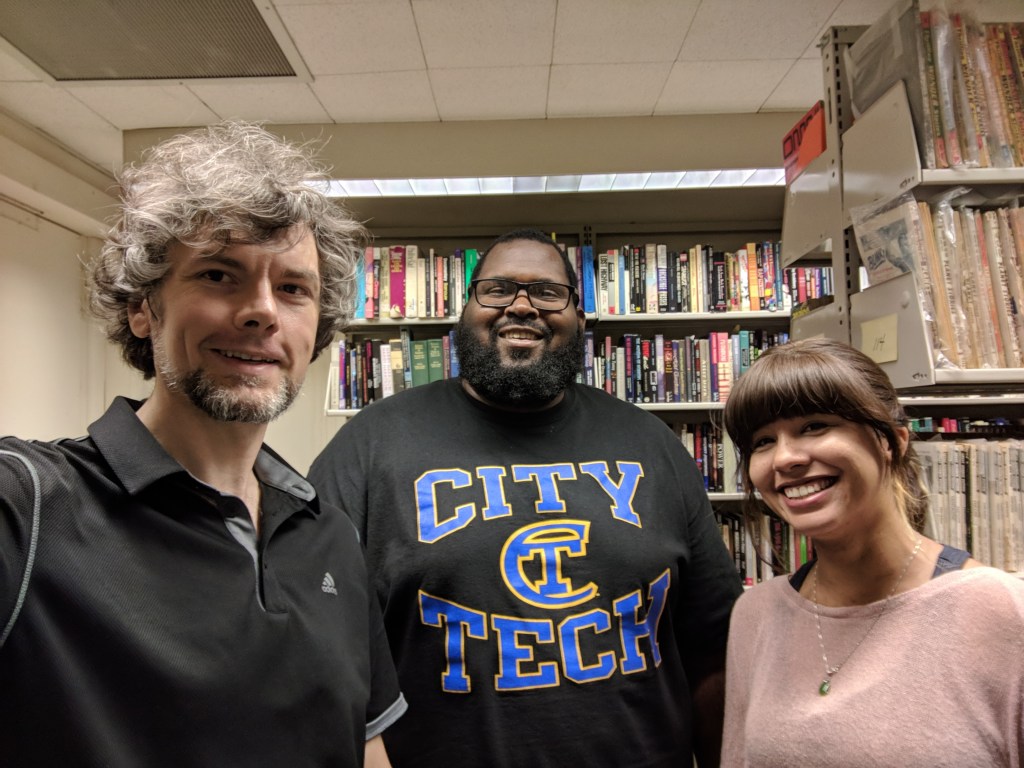
L to R: Jason Ellis, Lavelle Porter, and Jessica Roman
Over the past three days, I worked with my City Tech colleagues–Laura Westengard, Lavelle Porter, and Lucas Kwong–and student–Jessica Roman–to inventory the City Tech Science Fiction Collection. Two years ago, I began the collection’s finding aid by cataloging the 4,000+ magazines. Last year, I inventoried the collection’s nearly 1,700 monographs and anthologies. This year, we are creating an inventory of the remaining parts of the collection: scholarly journals and novels. Read details of our progress on the Science Fiction at City Tech OpenLab site here.
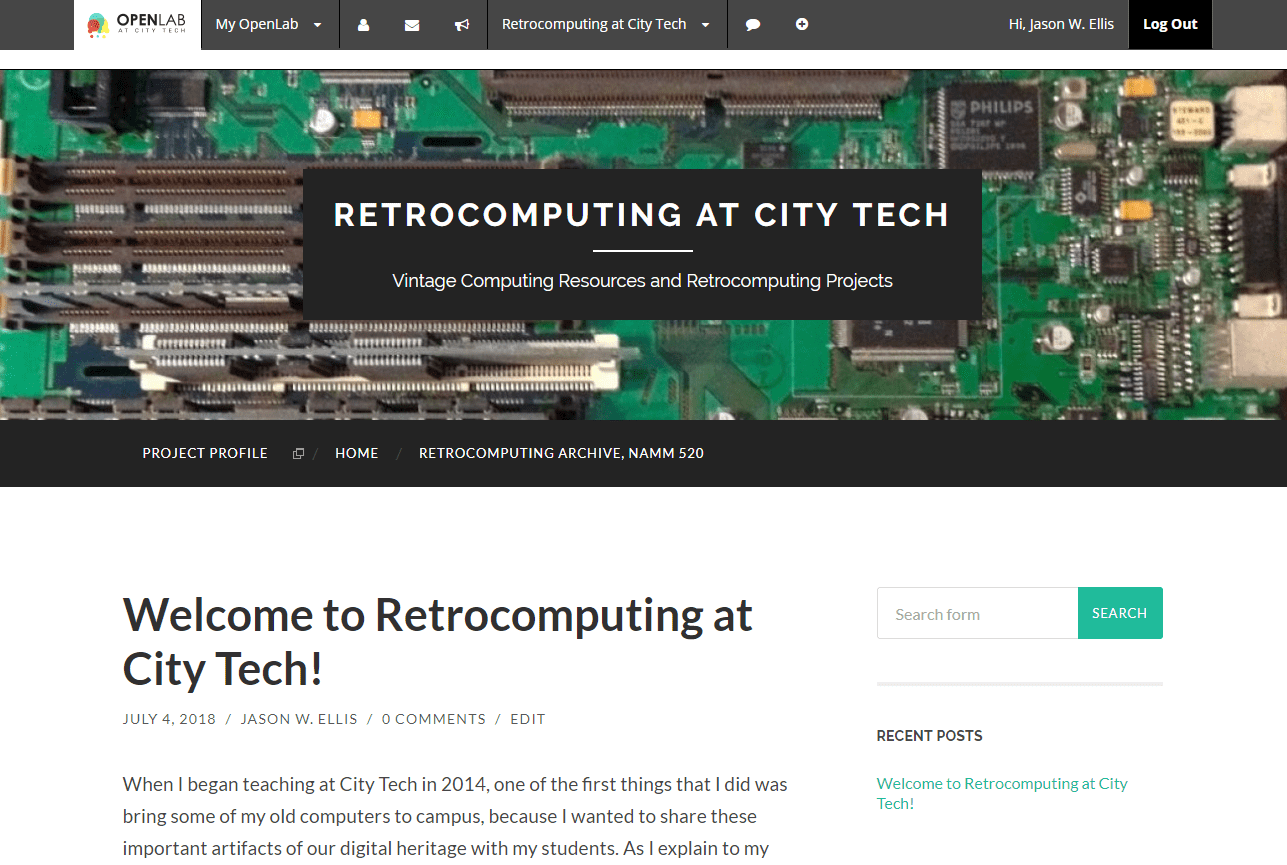
In addition to working on a book review today, I created a new OpenLab site for Retrocomputing at City Tech. In addition to recording how I use vintage computers in the classroom and in research, the new OpenLab site contains a catalog of my vintage computing archive. I populated this catalog with most of the hardware, but I plan to granulize it further and create a catalog of my software. This, of course, will take time. At least there is a place for me to record these things now within the auspices of the work that I do at City Tech. I updated my previous Retrocomputing Lab page on this site with a link to the updated site on OpenLab.
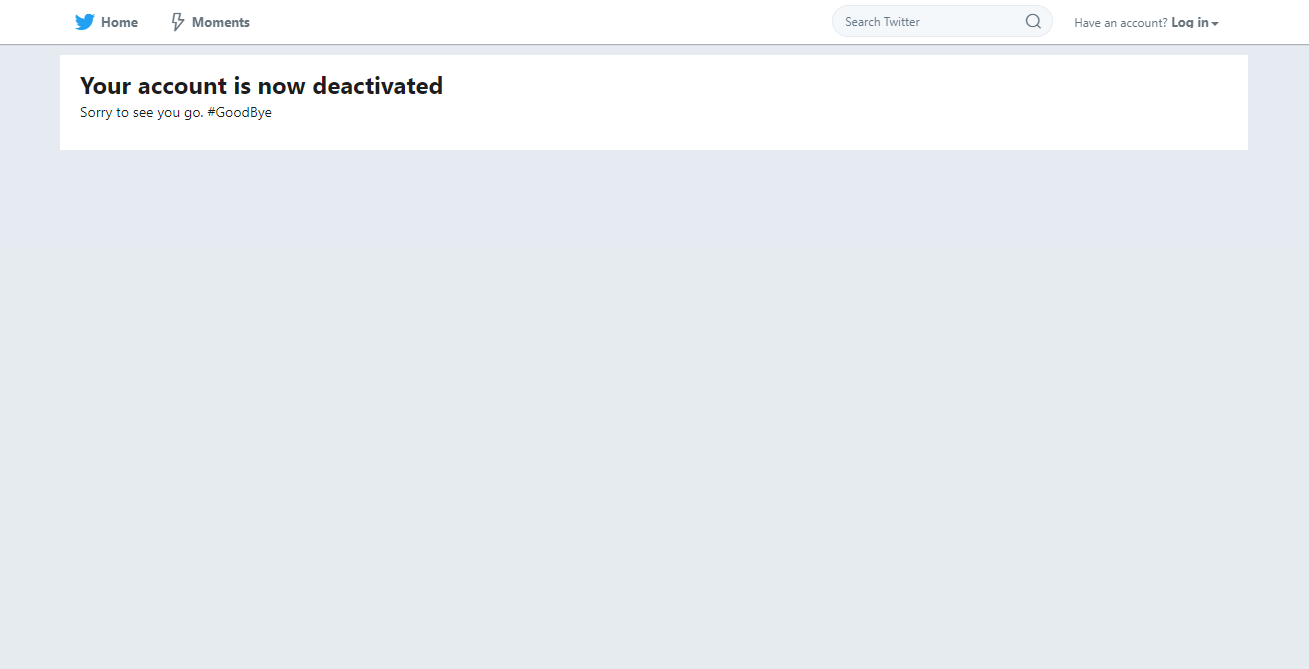
Back in 2013 and after long deliberation, I deleted my Facebook, Google+, and Academia.edu accounts. Then, I deleted my Flickr/Yahoo and LinkedIn accounts. Now, I’ve wiped out my Twitter and Reddit accounts.
I used Twitter for seven-and-a-half years and had posted nearly 10,000 tweets (this number ebbed after cleaning up a hoard of past tweets). And I had a Reddit account for four years, and I had a healthy number of upvotes for my LEGO-related posts and discussions there.
I leveraged my Twitter and Reddit accounts to keep up with what’s going on in my profession as well as learn and contribute to other areas of interest including computer culture and LEGO. However, my cost for keeping up to date was considerable in terms of time and cognitive effort. And while I saw, read, and learned a lot from the work of social media, actionable returns–what I think of as a meaningful returns in terms of conversation, connections, and opportunities–were very small.
Ultimately, my decision to further reduce my social media footprint was based on these issues:
Cost (time, attention, and cognitive load)
Content (anxiety over posting, persistent needle-in-the-haystack problem for finding useful information)
Discourse (challenge to follow threads, gain background information for out-of-context posts, rage cycles, hot takes, fear of missing out)
Connection (so many discussions but uncertain where to contribute, sustaining conversation, social media not leading to projects outside of that realm)
People (nonsense, bullshit, bigotry, and sexism; e.g., disheartening cases of disconnection between how some users comport in online LEGO communities and elsewhere)
Of course, there are arguments for remaining on social media, such as maintaining a professional presence on these platforms, publicizing the work that you and others do, discovering new and compelling work that isn’t amplified elsewhere, and leveraging social media to expand discourse through discussion, debate, and public engagement. For me, however, the daily reality of these platforms do not live up to the promise or potential with which they are often sold to end users.
My choices and these issues will inform how I approach social media in my classes. The reality for many of my students–especially those entering the field of technical communication–will need and rely on various social media platforms for their professional work and advancement. I think that informed, strategic, and purposeful social media choices are the best for them and others. I’m looking forward to these upcoming discussions in the classroom.
If you’d like to trim your social media presence, Wired has a guide for deleting the most popular social media accounts. These instructions show how to deactivate your Twitter account. After 30 days of inactivity, your account and its content are deleted. And, these instructions tell you how to delete your Reddit account. One caveat: Your posts and comments will remain unless you take steps to remove or edit them. In my case, I manually deleted them, but there are automated approaches, such as Shreddit and Nuke Reddit History for Firefox or Chrome.
I was fortunate to have met him at Dragon*Con ’98 in Atlanta, Georgia. Despite his public controversies and cultivated abrasiveness, he demonstrated there how invested he was in his fans throughout the convention–at his readings, signings, and public performances (the Atlanta Radio Theater Company’s on-stage production of Heinlein’s “The Man Who Traveled in Elephants” with Anthony Daniels and introduced by Ray Bradbury).
I took the photo above while he was signing one of his collections for me. After his talk and before his signing, he vowed that no fans would be turned away and all would have a chance to talk and receive autographs. I thought that he was crazy considering how many people were there for him. Nevertheless, he was true to his word.