
Thinking about the composite image of the Bandai 1/144 scale Millennium Falcon in space that I created using GIMP (GNU Image Manipulation Program) led me to imagine creating a different composite of the LEGO 21108 Ghostbusters set from 2014 in front of the filming location of the Ghostbuster’s headquarters, Hook and Ladder Company 8 in Manhattan.
I started with these photos that I had taken in 2015:
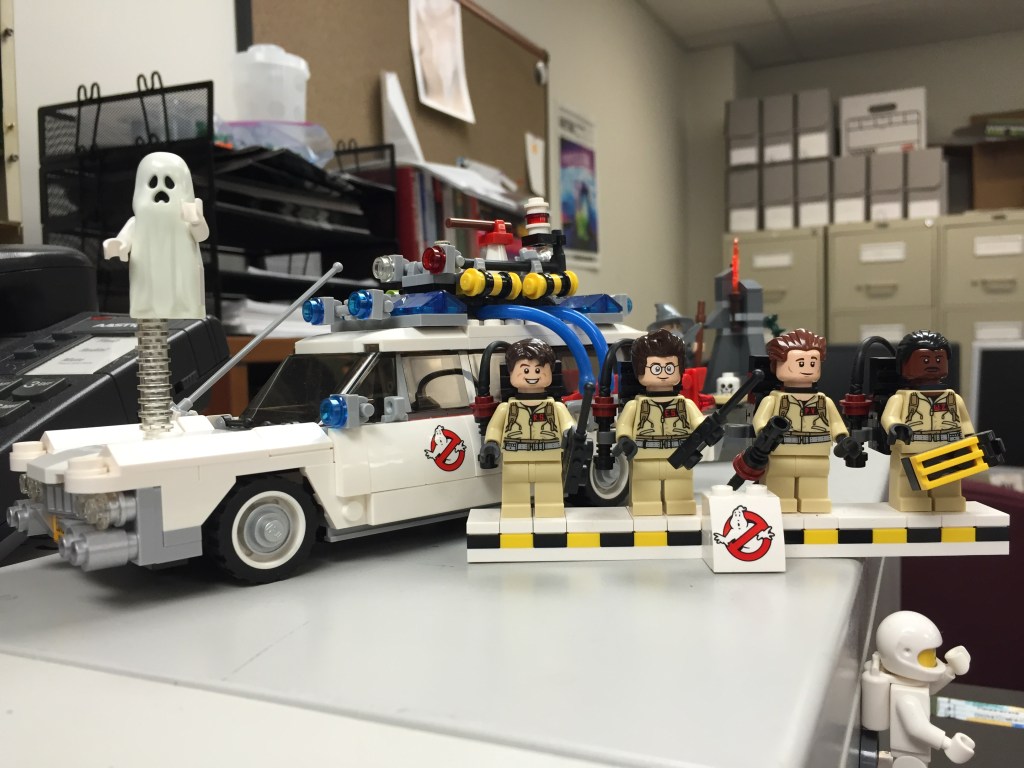
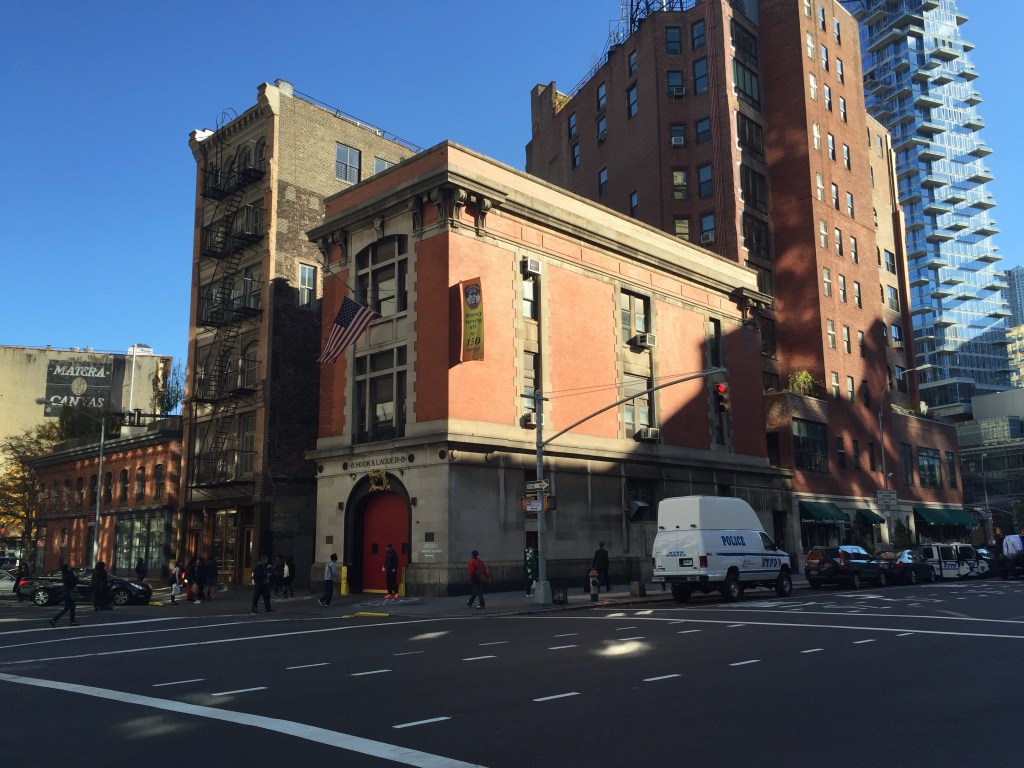
On the left is a photo that I took of the Ghostbusters LEGO 21108 set on my desk at City Tech. All of the elements that I needed are here, but I realized that I would have to break it down into parts to create the composite image–ghost, Ecto-1, Ray, Ego, Peter, and Winston. On the right above is a photo that I took of the Hook and Ladder Company 8 building in Manhattan. Due to the time of day that the photo was taken, the front of the building is in shadow and there are sightseers in front of the firetruck door that need to be removed.
I setup my work document in GIMP in the following way.
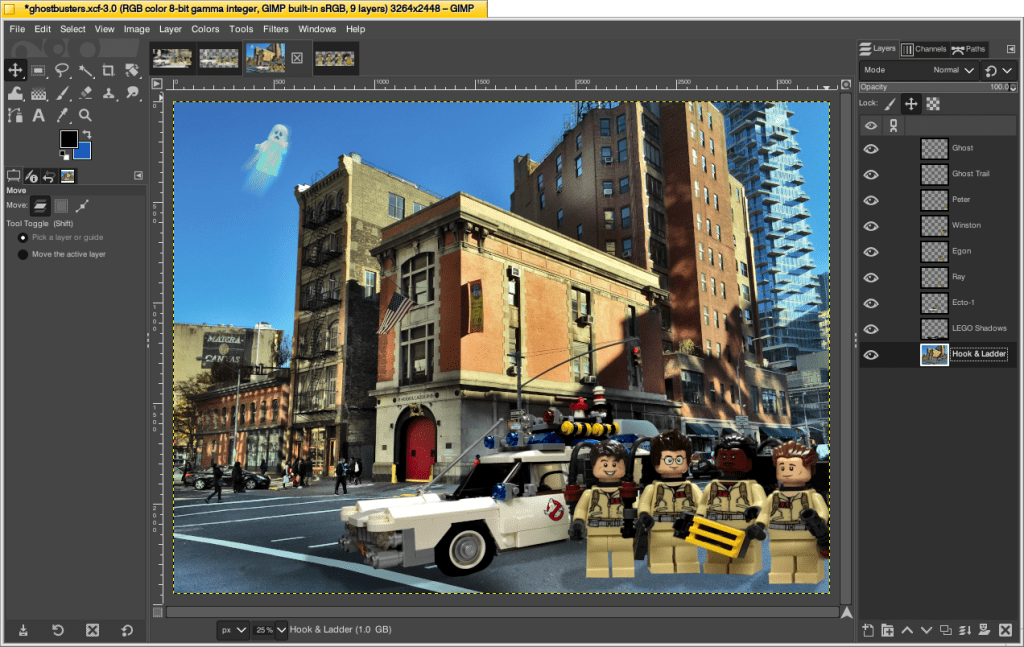
First, I pasted the hook and ladder photo as the bottom-most layer. I adjusted the colors and reduced the shadows to help the firehouse pop in the center of the photo. I used the lasso tool (creating irregular shapes instead of squares or circles helps with blending later) and clone tool to copy material over the sightseers in the front of the firehouse and to remove a light reflection on the road surface in front of the pedestrian walking line in the lower left. I smoothed out these fixes with the smudge tool.
Then, I cut out the ghost, Ecto-1, and four Ghostbusters and pasted each into its own independent layer and adjusted colors appropriately. Because the Ghostbusters are obscuring part of Ecto-1 in the original photo, I needed to arrange the composition so that they hid the back of the vehicle. But, I had to use the clone tool to repair some aspects of the car (e.g., the clear 1×1 round studs that had supported the ghost needed to be removed and the white surface of the hood restored), and some of the exterior windows and side panels peeked through gaps between the Ghostbusters (I used the clone tool and lasso tool to create the rear windows and side panels). Also, I wanted to arrange them so that it appeared more like a group shot instead of a line as in the display for the original set. To achieve this, I flipped horizontally Winston and Peter’s images to that they are turned toward Ray and Egon to their right. Unfortunately, this flips their name tags, but maybe no one will notice! Also, I increased their size by 120% to make them appear further away from Ecto-1 and closer to the viewer. I’ll return to the ghost below.
Next, I added a layer between the firehouse image and Ecto-1 (being the lowest layer of the LEGO images). I used the paintbrush with a large brush to paint black “shadow” under Ecto-1 and falling from right to left on each Ghostbuster member. I reduced the opacity of the layer to lighten its appearance so that the shadow wasn’t too harsh.
Finally, I transformed the ghost layer and rotated it to about 60 degrees. I adjusted its colors to give it a neon green hue. I then duplicated the layer. On the lower ghost layer, I applied a linear blur to give it a flowing, streak effect, which I positioned under the ghost to give it implied ethereal movement.
The final product isn’t perfect, but it was fun to make and it helped me learn/reinforce workflow practices in GIMP.
Don’t let perfection hold you back from using tools to make things that bring you joy. Each time you make something, you learn new things and get better at doing the things you’ve learned before. If you have the time, energy, and material, you can always take another stab at the thing you did before to make a better iteration. Though, I recommend starting fresh each time instead of making adjustments to something you’ve already made. The process of building and making from start to finish can yield wildly divergent and better outcomes that can be surprising and unexpected. Tweaking what you’ve already done might yield something interesting, but the constraints of the original project might limit what is ultimately possible.
