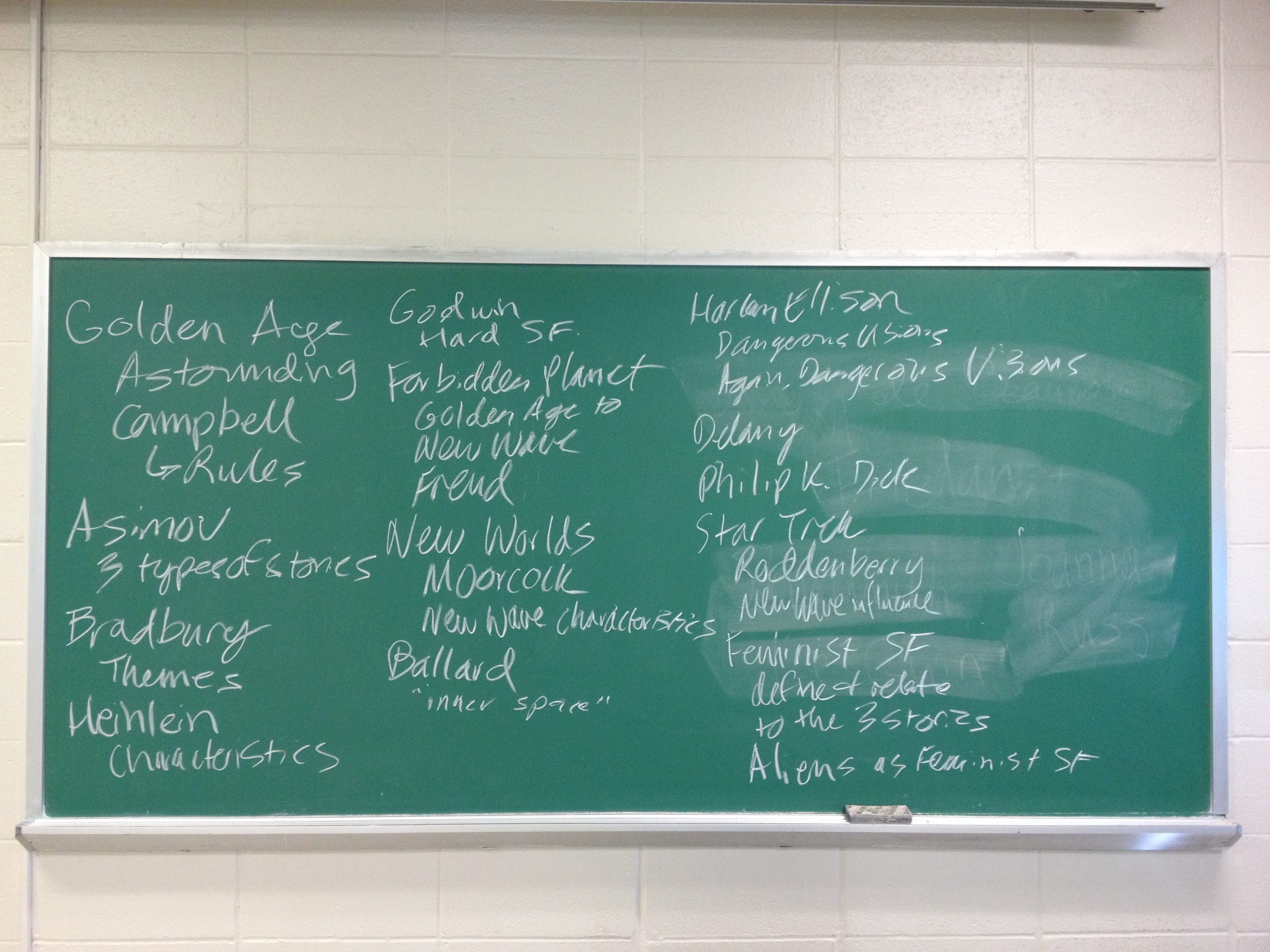
In today’s class, we finished watching James Cameron’s Aliens and discussed how it fits into our earlier discussions on feminist SF (Ripley as strong female hero, challenging stereotypes: Ripley, Vasquez, Ferro, and Dietrich vs. Gorman and Hudson, alternative modes of reproduction, the human role in alien reproduction–“impregnate,” remaking motherhood, what does it mean to be a mother, sexualized bodies of the aliens/HR Giger).
We also spent some time reviewing for their second major exam, which will take place during the first half of Monday’s class. I recommended students to build a new set of notes that consolidates important information, dates, lists, etc., because it will make their studying over the weekend easier. I also recommended for them to chart connections between the themes and characteristics of SF eras and the stories that we discussed in relation to those eras. The idea is that making the information more meaningful through interconnections will improve their use and recall of course material.
Next week, we conclude the class. There will be units on cyberpunk, global perspectives/Taiwanese SF, and maybe something creative–this is a fun surprise that I am still working on. I will have a busy weekend planning these things out, but I believe that it will lead to an exciting and fun conclusion of my first SF class!
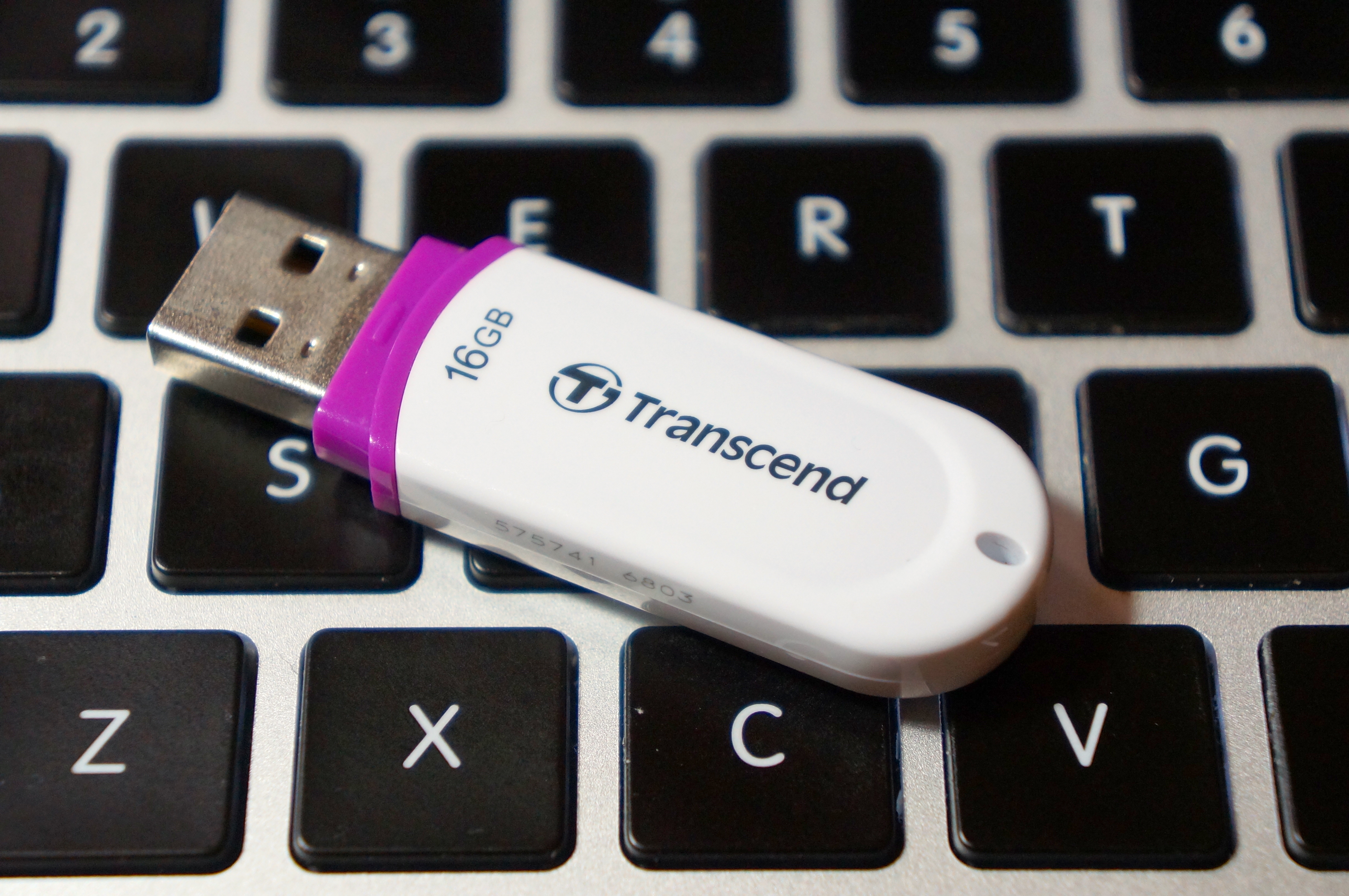
16 GB Transcend Flash Drive from NOVA in Taipei, Taiwan
My friend sent me a link to a video by someone who turned an older Core2Duo-based Dell Optiplex into a Hackintosh. The video convinced me to do something that I had been meaning to do for a long time but had never got around to actually doing: removing Windows 7 on my ASUS P8Z77-V/Intel i7-based PC that I built late last year and installing Mac OS X 10.8.
A Hackintosh, or what some folks call a CustoMac, is a standard PC that runs one of the Intel-based version of Mac OS (this includes 10.4 Tiger, 10.5 Leopard, 10.6 Snow Leopard, 10.7 Lion, and 10.8 Mountain Lion).
Prior to this project, I had purchased Mountain Lion from the MacApp Store for my old MacBook 5,1 (Aluminum Unibody, Late-2008). When my parents gifted me a rMPB, it already had Mountain Lion installed. This gave me the needed components that I needed to setup my flash drive to install Mac OS on my PC: a Mac and a purchased copy of Mountain Lion.
According to the definitive source for creating CustoMacs, TonyMacx86, my hardware isn’t ideally suited for a pain-free installation (If you are beginning from scratch, you should check out TonyMacx86’s excellent buyer’s guide here). Nevertheless, I worked my way through six re-installations before discovering the combination of settings that yielded a reliable and stable Mountain Lion installation.
evga 01G-P3-1561-KR GeForce GTX 560 Ti 1024MB GDDR5 PCIe 2.0 x16 Video Card
Antec High Current Gamer 750W Gamer Power Supply HCG-750
Corsair Vengeance C70 Gaming Mid Tower Case Military Green
Cooler Master Hyper 212 Plus Universal CPU Cooler
Samsung 22X DVD±RW Burner with Dual Layer Support – OEM
Intel 128 GB SATA SSD
Western Digital Caviar Green WD10EARX 1TB IntelliPower 64MB Cache SATA 6.0Gb/s 3.5″ Internal Hard Drive – Bare Drive
These are the steps that led to my successful Mountain Lion installation:
Follow TonyMacx86’s UniBeast (the software that prepares your installation media) and Mountain Lion installation guide here. I have modified the instructions below to reflect what I did after creating my bootable flash drive containing the Mountain Lion installer and a folder that I made containing MultiBeast (the software that configures your Mountain Lion installation for your computer’s hardware). (Depending on your needs, you might need other software, including MaciASL, which can create a DSDT file–another kind of configuration file for MultiBeast that gives Mac OS the information that it needs to run well on your hardware. You will need to configure it with sources from PJALM’s DSDT Patch Repositories. Ultimately, I decided to proceed with a DSDT-free installation.)
Turn on the PC with the flash drive inserted on one of the front mounted USB 3.0 slots.
Press F8 to select bootup device and select the flash drive.
Chimera, the bootloader software, provides you with an option to select the flash drive’s Mac OS installation to boot. If you press the down arrow key on the keyboard, you will be presented with other options including help. If you begin typing, you can enter commands to assist with booting the installer.
On the Chimera boot selection screen, type “PCIRootUID=0”. Press Enter. This ensures that the installer’s Mac OS installation will display video correctly. Without this option, the screen goes dark after the Apple logo over gray screen.
From the Mac OS installer menu bar, select Utilities > Disk Utility > Format your boot drive for Mac OS Extended, Journaled. Close the Disk Utility window to return to the installer. Proceed with installation. Reboot when completed.
Press F8. Select the flash drive. At the Chimera screen, select your internal hard drive’s new Mac OS Mountain Lion installation, type in “PCIRootUID=0”, and press Enter.
Mountain Lion will boot from your hard drive and begin the setup procedure (choosing location, creating your Admin account, etc.).
If you have already downloaded MultiBeast and placed it in a new folder on your flash drive, open your flash drive from the Desktop, navigate to MultiBeast, and launch it.
Proceed to the selection screen and check these things:
Drivers & Bootloaders > Drivers > System > Patched AppleIntelCPUPowerManagement > OS X 10.8.x
Complete installation and close MultiBeast.
Navigate to Applications > Utilities > Disk Utility. Select your hard drive and click Repair Permissions. When completed, close Disk Utility, eject your flash drive and remove from the USB port, and reboot.
When back at the Desktop, go to System Preferences > Energy Saver > Disable Computer Sleep by sliding the widget to the far right.
Plug your computer into your router with an ethernet cable if you have not already done so. You can easily get online with the wired connection.
Your installation is complete!
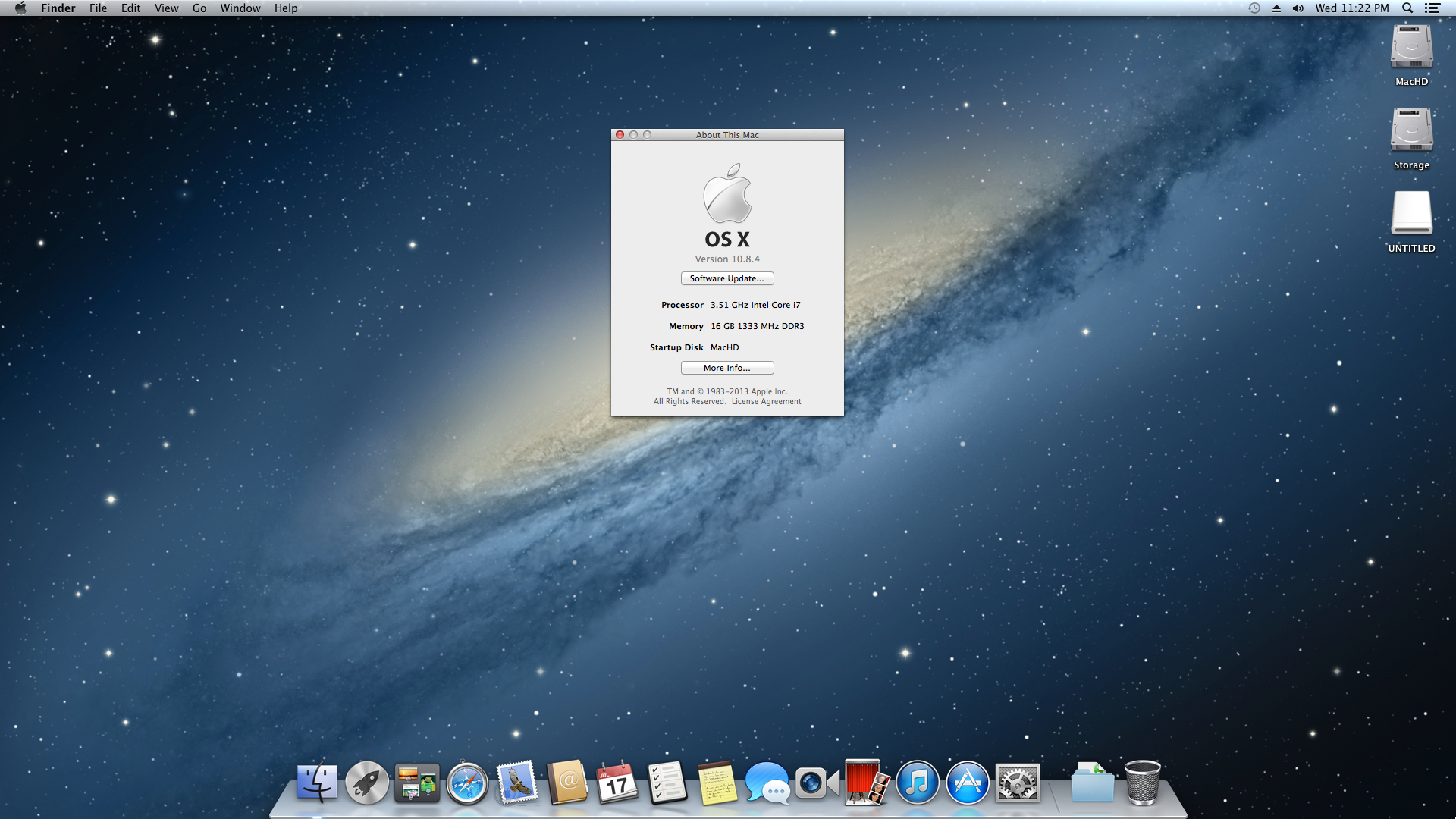
Mac OS X 10.8.4 desktop showing CPU and memory. Everything is running a-okay!
I chose to go this route, because I could not get Mac OS to boot with the DSDTs that I created with MaciASL (using the configuration for the P8Z77-V motherboard and graphics source per PJALM’s instructions). My problems could have been related to the DSDT or due to incompatibilities between its settings and my P8Z77-V’s BIOS ROM version (I was unable to use the motherboard’s BIOS Flashback feature to successfully load one of these hacked BIOS ROMs on this site). Apparently, if you can get the DSDT to install correctly and have the hacked BIOS, you will be able to enjoy power management settings and control. Since I have my computer only on when I am using it, I do not have any problem with this lack of functionality. Since installation, my Hackintosh has been running great. It is snappy, video and sound work great, network connectivity is fine, and Doom 3 plays fantastically at 1080p!
After the installation, I discovered one tremendous problem: FileVault cannot be activated for your boot drive. Apparently, this is due to FileVault needing a real Mac’s EFI environment (or the error message that it generates indicates that it has to do with its inability to re-partition the bootdrive–likely due to the Chimera bootloader). As far as I can tell from reading posts on the TonyMacx86 forums, there is no way around this problem. One option would be to save your files in a TrueCrypt container or fully encrypted drive that is separate from your bootdrive. Another way is to use TrueCrypt full disk encryption as detailed on this helpful blog post from Frugal Computing (FC also has some great articles about building Hackintoshes).
Others in the TonyMacx86 forums have had varying levels of success with the Asus P8Z77-V and Mountain Lion, so I do not want to dissuade you from attempting to get more functionality on your installation. The above is simply a report of what worked for me. It might work for you, and it might give you a beginning for your own Hackintosh project.
Today, we began watching James Cameron’s 1986 film Aliens, and I lectured on Ridley Scott’s earlier 1979 Alien and how these figure into feminist SF via their characters, themes, and source material: H.R. Giger’s “Necronom IV.” I shared pictures of my visit to Gruyères with the class, too (for the juxtaposition of quaint, medieval Swiss town with the Giger Museum and Bar). I asked the students to take notes about the film and identify how it exemplifies feminist SF as discussed during Tuesday’s class.
We will conclude Aliens during tomorrow’s class, discuss the students’ findings relating to it being feminist SF, and review for the second major exam.
For further learning, I found this interesting documentary about Giger’s Necronomicon and his influence on the first Alien film on YouTube:
For today’s class, my students came prepared to discuss three readings: Pamela Zoline’s “The Heat Death of the Universe” (New Worlds, July 1967), Joanna Russ’ “When It Changed” (Again, Dangerous Visions, 1972), and James Tiptree, Jr’s “The Women Men Don’t See” (Magazine of Fantasy and Science Fiction, Dec 1973).
Before discussion, I treated the class to a lecture on terminology (sex, gender, sexuality, sexism, patriarchy, heteronormativity, and feminism), a short history lesson on Feminism (bringing it full circle with Mary Wollstonecraft’s A Vindication of the Rights of Women, 1792 and covering First, Second, and Third Waves of Feminism), and a history of Feminist SF (building on our earlier readings by female writers, Dr. Lisa Yaszek’s rediscovery of “women’s SF,” and the New Wave/Second Wave/Feminist SF boom). We also discussed some of the major figures, including Margaret Cavendish, Charlotte Perkins Gilman, Joanna Russ, Pamela Sargent, Ursula K. Le Guin, Marge Piercy, Pamela Zoline, and James Tiptree, Jr. (Alice B. Sheldon). Learn more about Feminist SF on the Encyclopedia of SF entry here and in Ritch Calvin’s Feminist SF 101 article in SFRA Review #294 here.
Following lecture, my students engaged in another energized debate on the readings that brought up a lot of issues that I could only gloss over in the lecture. I was fortunate to have some students offer personal experiences with their families and others who played devil’s advocate. I believe that our discussion facilitated a much deeper exploration of the stories and the issues surrounding them.
Tomorrow, we will begin our viewing of James Cameron’s Aliens (1986). I consider this an example of feminist SF film, because unlike most SF film, it revolves around a strong female hero character who charts her own path based on the challenges of her future, corporatized society. However, it was made possible by the earlier work of feminist SF in the 1960s and 1970s. It also accomplishes interesting things with Ripley (Sigourney Weaver), because she is the strong hero who rediscovers her lost motherhood by destroying the mother of the xenomorphs–the Alien Queen. We will watch this through Thursday’s class, discuss it, and review for the second exam (taking place next during Monday’s class).
In today’s class, I lectured on Philip K. Dick’s life (2-3-74) and work (characteristics: ontological, epistemological, entropy, empathy, religion, and the “little man”) to conclude my discussion of New Wave writers began in the last class. Then, I lectured on Star Trek and used Harlan Ellison’s “The City on the Edge of Forever” as a bridge between the New Wave and popular, mainstream SF.
Tomorrow, we will begin our unit on Feminist SF and we will discuss readings by Pamela Zoline, Joanna Russ, and James Tiptree, Jr. (Alice B. Sheldon).