Category: Georgia Tech

  • Science Fiction, LMC3214: Concluding Aliens and Feminist SF, Review for Exam 2

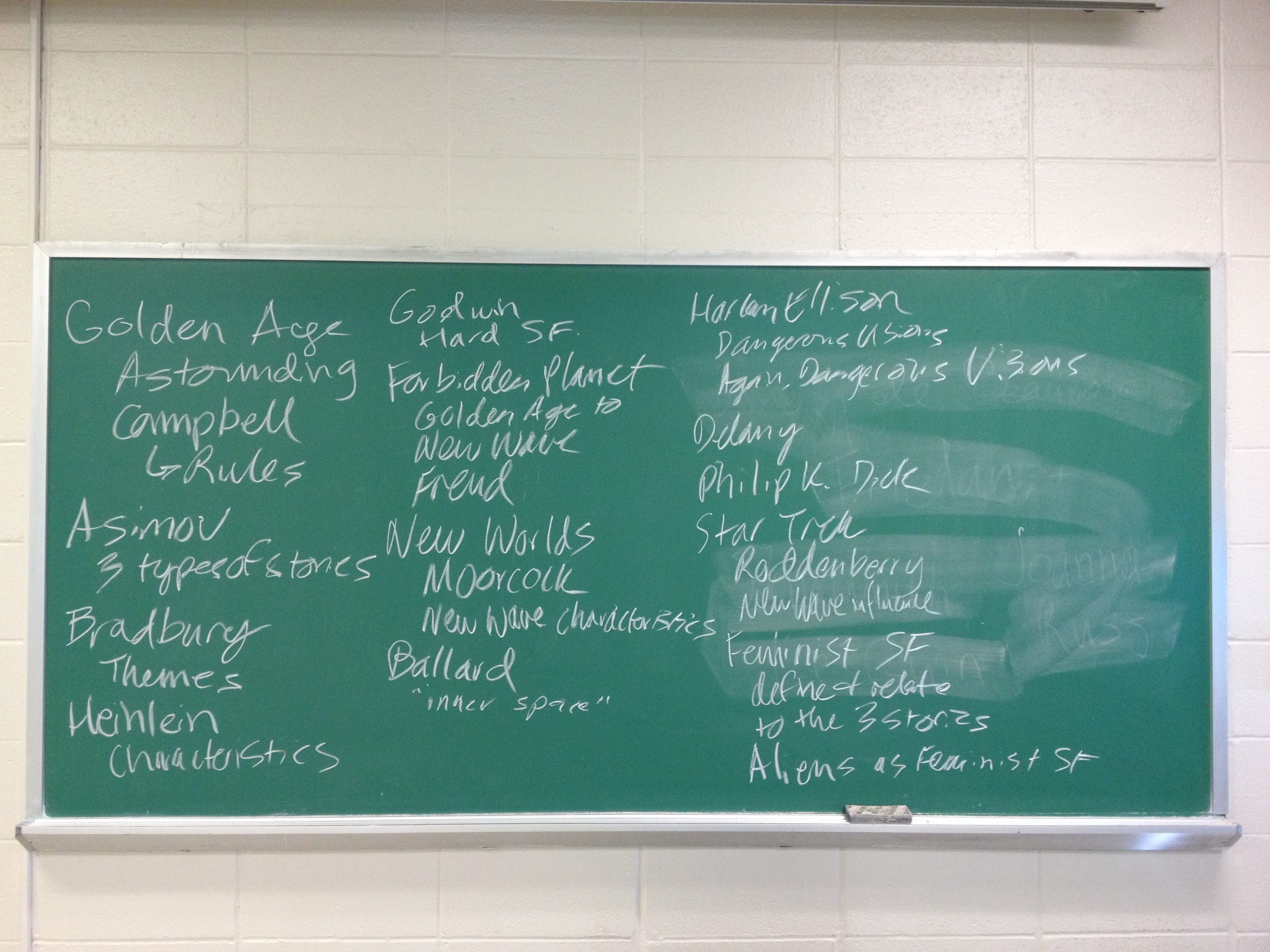
    Exam 2 review notes on the chalkboard.
    Exam 2 review notes on the chalkboard.

    In today’s class, we finished watching James Cameron’s Aliens and discussed how it fits into our earlier discussions on feminist SF (Ripley as strong female hero, challenging stereotypes: Ripley, Vasquez, Ferro, and Dietrich vs. Gorman and Hudson, alternative modes of reproduction, the human role in alien reproduction–“impregnate,” remaking motherhood, what does it mean to be a mother, sexualized bodies of the aliens/HR Giger).

    We also spent some time reviewing for their second major exam, which will take place during the first half of Monday’s class. I recommended students to build a new set of notes that consolidates important information, dates, lists, etc., because it will make their studying over the weekend easier. I also recommended for them to chart connections between the themes and characteristics of SF eras and the stories that we discussed in relation to those eras. The idea is that making the information more meaningful through interconnections will improve their use and recall of course material.

    Next week, we conclude the class. There will be units on cyberpunk, global perspectives/Taiwanese SF, and maybe something creative–this is a fun surprise that I am still working on. I will have a busy weekend planning these things out, but I believe that it will lead to an exciting and fun conclusion of my first SF class!

  • Science Fiction, LMC3214: Alien, Aliens, Giger

    Today, we began watching James Cameron’s 1986 film Aliens, and I lectured on Ridley Scott’s earlier 1979 Alien and how these figure into feminist SF via their characters, themes, and source material: H.R. Giger’s “Necronom IV.” I shared pictures of my visit to Gruyères with the class, too (for the juxtaposition of quaint, medieval Swiss town with the Giger Museum and Bar). I asked the students to take notes about the film and identify how it exemplifies feminist SF as discussed during Tuesday’s class.

    We will conclude Aliens during tomorrow’s class, discuss the students’ findings relating to it being feminist SF, and review for the second major exam.

    For further learning, I found this interesting documentary about Giger’s Necronomicon and his influence on the first Alien film on YouTube:

  • Science Fiction, LMC3214: Lecture on Feminist SF and Readings by Zoline, Russ, and Tiptree, Jr.

    For today’s class, my students came prepared to discuss three readings: Pamela Zoline’s “The Heat Death of the Universe” (New Worlds, July 1967), Joanna Russ’ “When It Changed” (Again, Dangerous Visions, 1972), and James Tiptree, Jr’s “The Women Men Don’t See” (Magazine of Fantasy and Science Fiction, Dec 1973).

    Before discussion, I treated the class to a lecture on terminology (sex, gender, sexuality, sexism, patriarchy, heteronormativity, and feminism), a short history lesson on Feminism (bringing it full circle with Mary Wollstonecraft’s A Vindication of the Rights of Women, 1792 and covering First, Second, and Third Waves of Feminism), and a history of Feminist SF (building on our earlier readings by female writers, Dr. Lisa Yaszek’s rediscovery of “women’s SF,” and the New Wave/Second Wave/Feminist SF boom).  We also discussed some of the major figures, including Margaret Cavendish, Charlotte Perkins Gilman, Joanna Russ, Pamela Sargent, Ursula K. Le Guin, Marge Piercy, Pamela Zoline, and James Tiptree, Jr. (Alice B. Sheldon). Learn more about Feminist SF on the Encyclopedia of SF entry here and in Ritch Calvin’s Feminist SF 101 article in SFRA Review #294 here.

    Following lecture, my students engaged in another energized debate on the readings that brought up a lot of issues that I could only gloss over in the lecture. I was fortunate to have some students offer personal experiences with their families and others who played devil’s advocate. I believe that our discussion facilitated a much deeper exploration of the stories and the issues surrounding them.

    Tomorrow, we will begin our viewing of James Cameron’s Aliens (1986). I consider this an example of feminist SF film, because unlike most SF film, it revolves around a strong female hero character who charts her own path based on the challenges of her future, corporatized society. However, it was made possible by the earlier work of feminist SF in the 1960s and 1970s. It also accomplishes interesting things with Ripley (Sigourney Weaver), because she is the strong hero who rediscovers her lost motherhood by destroying the mother of the xenomorphs–the Alien Queen. We will watch this through Thursday’s class, discuss it, and review for the second exam (taking place next during Monday’s class).

  • Science Fiction, LMC3214: Concluding New Wave SF with Philip K. Dick and Star Trek’s “The City on the Edge of Forever”

    In today’s class, I lectured on Philip K. Dick’s life (2-3-74) and work (characteristics: ontological, epistemological, entropy, empathy, religion, and the “little man”) to conclude my discussion of New Wave writers began in the last class. Then, I lectured on Star Trek and used Harlan Ellison’s “The City on the Edge of Forever” as a bridge between the New Wave and popular, mainstream SF.

    Tomorrow, we will begin our unit on Feminist SF and we will discuss readings by Pamela Zoline, Joanna Russ, and James Tiptree, Jr. (Alice B. Sheldon).

  • Science Fiction, LMC3214: New Wave Lecture and Three Story Discussion

    Today’s class was like an exclamation point in two ways. First, there was the long stroke of lecture. I lectured on the origins of the New Wave in New Worlds, Judith Merril’s England Swings SF, and Harlan Ellison’s Dangerous Visions. I gave my students background on semiotics, modernity/postmodernity, and modernism/postmodernism to anchor the New Wave (alas, arguing for a grand narrative while saying there ain’t such a thing). I talked more in-depth about the writers whose work we had read for today: J.G. Ballard, Harlan Ellison, and Samuel R. Delany. It was a long lecture, but it was material that I felt was important. Then, the hard dot fell after the pen raised from that long stroke! Students loved, “Repent Harlequin, Said the Ticktockman.” Other students hated it. Students loved, “The Cage of Sand.” Other students hated it. We had a knock-down drag out discussion. It was a beautiful conclusion to a week of lectures, readings, and film viewings. Next week, we continue the New Wave. I will talk about other New Wave writers and we will watch the original Star Trek episode, “The City on the Edge of Forever.” Looking further ahead next week, we will discuss Feminist SF and watch James Cameron’s Aliens (1986).