Today, I began teaching my first Science Fiction class at Georgia Tech (LMC 3214 SS2). It is a short-session class, so my students and I will explore the history of SF in only five weeks on a grueling 4 days per week, 2 hours per day schedule.
Following a short break after reading the syllabus, I conducted an interactive exercise where I wrote “Science Fiction (SF)” on the left side of the chalkboard and “Sci-Fi” on the right side. I sketched out the differences between the two terms and how we might use them to identify different types of SF. Then, I handed the chalk to a student who I asked to go to the board and write a type of SF that she liked in the spot that she felt best represented it in the SF/Sci-Fi continuum. As a class, we would discuss these examples. The other students and I would help point out how we might view these examples in different ways along the SF/Sci-Fi axis. Each student would hand off the chalk to the next student. We completed two rounds of this before running out of time in class.
I think that I have an excellent group of students. Most are SF fans invested in the genre in one media form or another. Some students are there for pragmatic reasons. I believe that as the class unfolds all of my students will find interesting and significant connections to their thinking, life, and work.
Tomorrow, we begin discussing Mary Shelley’s Frankenstein.
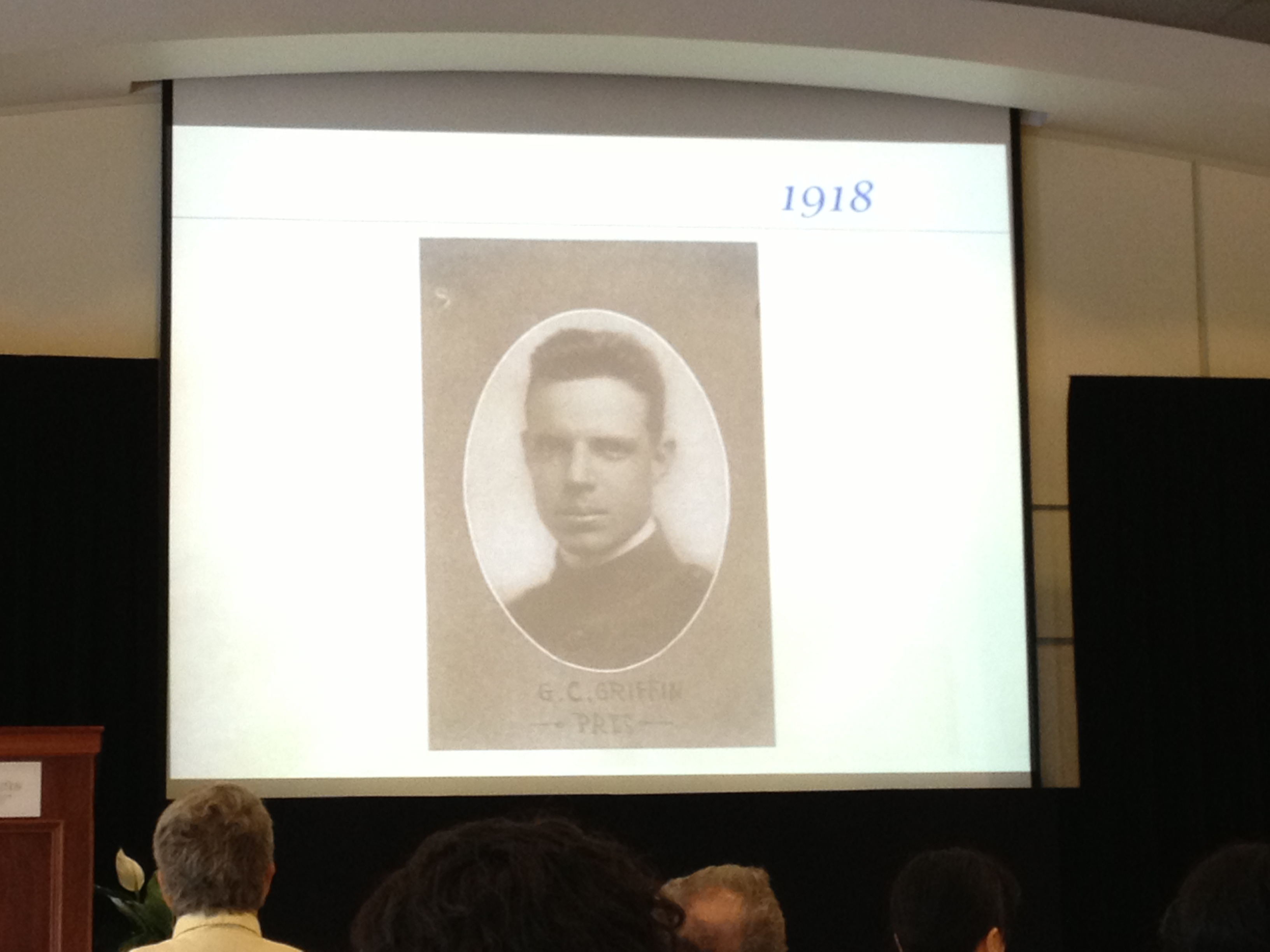
Today, the Georgia Tech Alumni Student Ambassadors and the Georgia Tech Center for the Enhancement of Teaching and Learning hosted the Dean Griffin Day Luncheon to recognize recipients of “Thank a Teacher” notes. I was honored by a Thank a Teacher note from one of my students.
Associate Vice Provost for Learning Excellence Donna Llewellyn told us about the origins of the Thank a Teacher program and recited some of the notes that recipients had received.
Marilyn Somers, Director of Georgia Tech’s Living History Program, guided us through enjoyable multimedia-driven stories about Dean George C. Griffin. Her enthusiasm for Georgia Tech is only matched by her passion as a storyteller.
Vice Provost for Undergraduate Education Colin Potts delivered a meditation on what exactly it is that makes a great teacher and how that relates to the modern development of online education in MOOCs (massive open online course). The two most provocative things that I took away from his talk include the question, “What makes a good teacher?,” and the observation, MOOCs are part of the evolution of education but not the end.
On my walk back to the Hall Building, I thought about Dr. Potts’ question: What makes a good teacher. Of course, I have given this idea a lot of thought before and after entering the profession, but it is a question that we as educators should continually return to in our work as reflective practitioners. The best quality that I have found in my teachers (and I mean those people who are educators in the broadest sense of the word) is passion. This includes a passion for the material being taught, a passion for student learning and success, a passion for engaging others, a passion for life-long learning, a passion for energetic discourse, a passion for understanding, a passion for a passion for giving back to a community, a passion for being a part of larger conversations beyond the classroom, and a passion for kindness. What’s intriguing about my experiences with some fantastic teachers during my life is that I do not believe that any of them perform, demonstrate, or conduct these same passions in the same way. There many different paths to these things, and its amazing to me how many different people tread very different paths yet have achieved for me the same positive and enriching outcomes.
This reminds me of something else that Dr. Potts warned about MOOCs–the impulse of some to promote a singular, superstar educator as the one way for a course to be delivered and taught. In a smaller way, I think back to my Calculus education at Georgia Tech. There were simply some professors who I could learn from–that is, their teaching style and methodology synced, jived, and meshed with my thinking and learning ability. The professors who I did learn Calculus best from might not have been the exemplars of the profession at Tech at that time, but they were, to me anyways, the best educators of Calculus (I should know, because I had some false starts early on in my educational career). We have to be very careful about the choices that we make as an institution and as a profession as we move further into offering MOOCs. These choices should extend beyond the calculus of student completion rates. We have to consider the effects MOOCs will have on pedagogy and educators. How will MOOCs, over time, influence education? How will MOOCs influence student success in areas not explicitly concerned with a course that teachers often provide and encourage (finding out how students are doing, having informal chats, making sure students are doing okay, etc.)? Will MOOCs push out some educators and educational styles in favor of others? Can the passions of educators be provided/conveyed and can the passions of students for learning, solving puzzles, and engaging discourses be fostered in a MOOC?
A final note: I am listening to Dr. Eric Rabkin’s lectures on tape for his Science Fiction: The Technological Imagination course from the University of Michigan. Certainly, he is passionate about science fiction, and it is, I believe, unavoidable for his passion to infect his audience. He knows the material, and he is obviously excited to convey this knowledge to his students (in the classroom and in the world–those of us listening to the lectures on tape). However, Dr. Rabkin cannot provide the same kinds of things as a teacher (educator, mentor, counselor, etc.) in a MOOC or lectures on tape that he can provide in a class of reasonable size (another issue). Don’t get me wrong–Dr. Rabkin is a fantastic person and I count him among my professional friends. However, there are limitations to what an educator can and cannot do in a MOOC or lectures on tape. For example, in his own highly popular MOOC, I imagine that he cannot read all of the comments or questions of every student (when I see Dr. Rabkin next, I will certainly ask him about how he compares his classroom and MOOC teaching). This is something possible when you have reasonable class enrollments and course loads (this leads into another area of concern about having too large of a class for a qualitative and composition oriented course–there is a point at which the teacher cannot provide the necessary and needed passion for all students. In which case, a too big of a class, too many classes, or a MOOC can become indistinguishable from the perspective of the educator). Of course, I can see that the objectives of the classroom learning environment compared to the MOOC/lectures on tape should be different. I am left wondering though if everyone who promotes MOOCs truly recognizes the different affordances of each without trying to make one into the other at the cost of each.
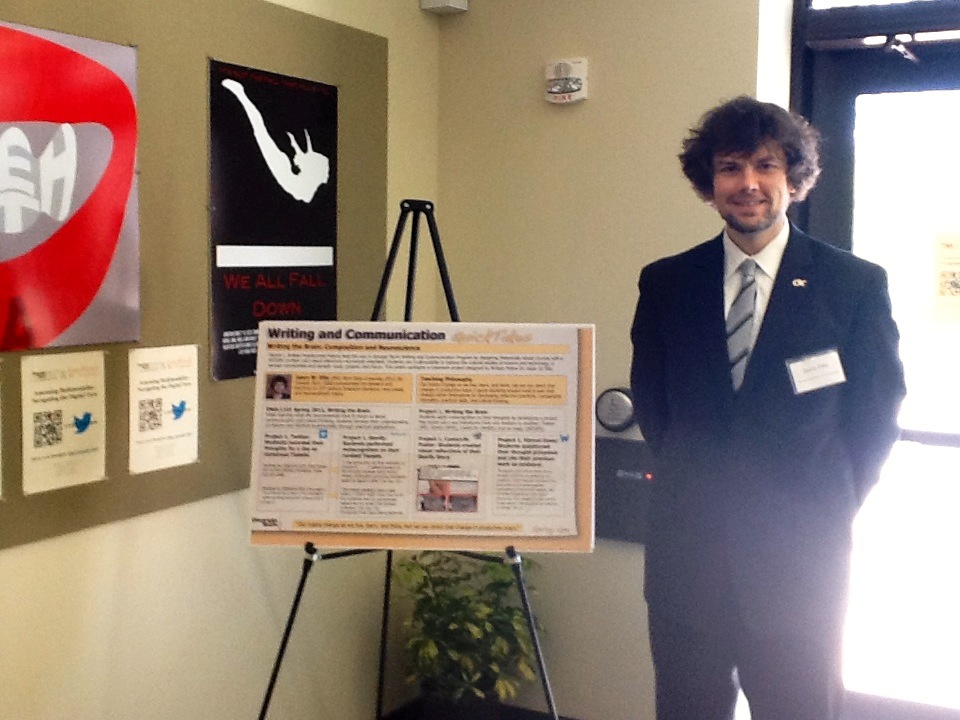
My Pedagogy Poster on “Writing the Brain” at Assessing Multimodality Symposium.
Today, the Georgia Tech Writing and Communication Program and Bedford St. Martins hosted a symposium on Assessing Multimodality: Navigating the Digital Turn. I co-presented a workshop with Mirja Lobnik on Multimodality and Perception and I presented a poster during one of the day’s sessions. Many of us were tweeting our experiences at the symposium today, too. Click through the Storify embed below to virtually experience the symposium 140 characters at a time.
This morning, Mirja Lobnik and I will be co-hosting a workshop on “Multimodality and Perception: A Multi-Sensory Approach to Teaching Rhetorical Skills” at the Assessing Multimodality: Navigating the Digital Turn Symposium co-hosted by Georgia Tech’s Writing and Communication Program and Bedford St. Martin’s. Our workshop is about multisensory perception, multimodal composition, and cognition:
Associated with the use of various media to create cohesive rhetorical artifacts and the neurology of the ways humans process information through different sensory channels, multimodality has gained considerable ground in the composition classroom. Insofar as multimodal pedagogies emphasize the role of students as active, resourceful, and creative meaning-makers, it tends to enhance student engagement and, by extension, the teaching of composition and rhetorical skills. Focusing on sensory details of embodied, lived experience, this workshop centers on teaching that engages students both in mind and body. This approach not only promotes the students’ creation of multimodal artifacts but also encourages students to explore and critically reflect on personal experiences. Specifically, Lobnik focuses on aural composing modalities, including speech, music, and sound, and assignments that highlight sound as a rhetorical and creative resource: a transcription, audio essay, and a video. Ellis discusses cognition, metacognition, and curation and an assignment that integrates Twitter, Storify, ComicLife, and the written essay.
If you get to attend our workshop or the symposium’s other great sessions, please tweet using the hashtag: #AMsymposium.
Dr. Laura Otis presenting in GT Library’s Ferst Room.
Today, Georgia Tech’s School of Literature, Media, and Communication invited Emory University’s Dr. Laura Otis to give a presentation in the Library’s Ferst Room. Dr. Otis’ presentation was titled, “The Surprising Antics of Other People’s Minds” [read the abstract here].
In Dr. Otis’ work, she aims to show with data that she has collected from interviews with an admittedly small number of English-speaking people from the United States that:
1) visual thinking and verbal thinking are not opposites and they cannot be separated,” 2) there is no such thing as a visual thinking type or a verbal thinking type–every mind is unique, and 3) visual and verbal inclinations are not destinies. Anyone can develop visual or verbal skills with practice.
She also offered two suggestions for literary studies:
1) refer to visual imagery in readings, because this might help include more students who may feel excluded by verbal readings, and 2) take reader’s visual imagery seriously, because this might help reconnect the reader to creative writing as co-creator of its imagery.
You can download my handwritten notes on Dr. Otis’ talk and the Q&A session from the event as a PDF from here.
I enjoyed Dr. Otis’ presentation, and it provided me with a new insight into something that I had already read and thought about but in a more biological sense: we each think differently, because our brains are wired differently. Our experience of the world and life, which includes our biology, environment, and culture, leaves its indelible trace on our brain’s physical wiring. As we live, our brains wire themselves to accommodate new memories, abilities, and ways of thinking. It makes sense that all of these experiences would shape our thinking, but more importantly, we can exert our own conscious control over our thinking by adopting reflective practices and training/practice to improve abilities that we already have to greater or lesser degrees.