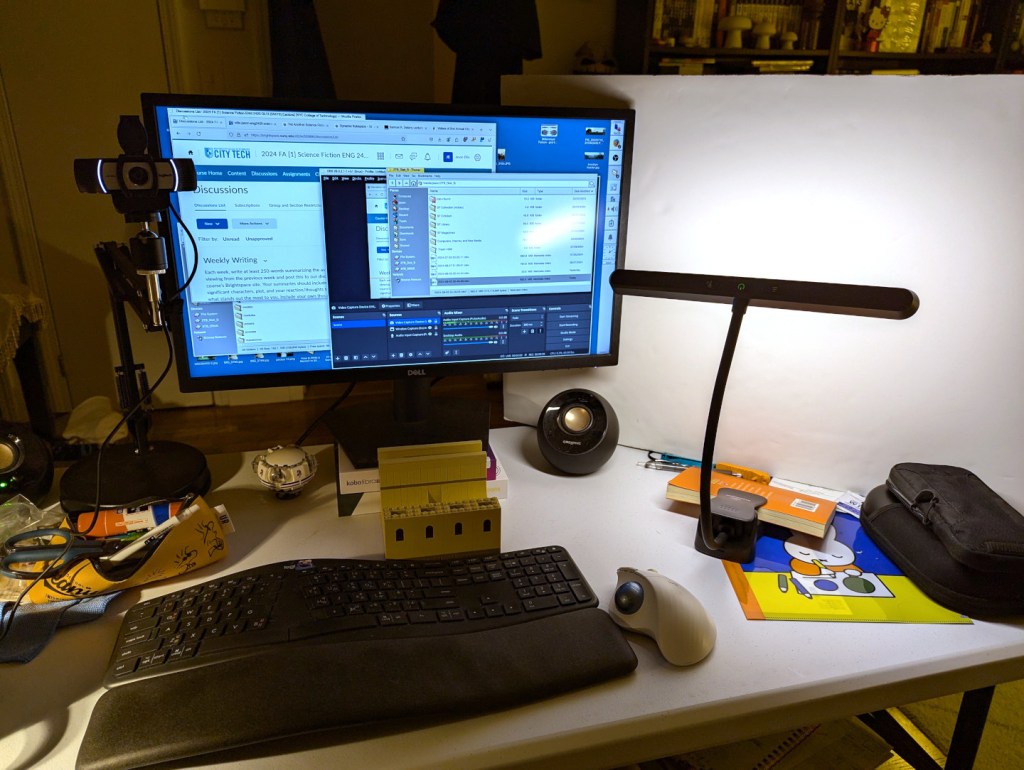
For my online, asynchronous Science Fiction (ENG 2420) class at City Tech this semester, I am recording my weekly lectures at my desk at home. I think the setup that I created for the second week’s lecture shown above will work out well for my recordings.
I have a 1080p Logitech webcam with stereo mics on the left of my monitor. I have a 2 x 3 ft. foam board propped up on the right side. Originally, this was to cut down on the sound from the living room air conditioner. But, tonight, I setup a temperature controlled LED light to reflect light off the foam board onto me. This produced a much better picture than with the overhead pot lights and even provided nice illumination with the overhead lights turned off as shown.
I used OBS Studio to record my lecture, and I edited the footage with Shotcut. Then, I uploaded the edited MP4 to YouTube.
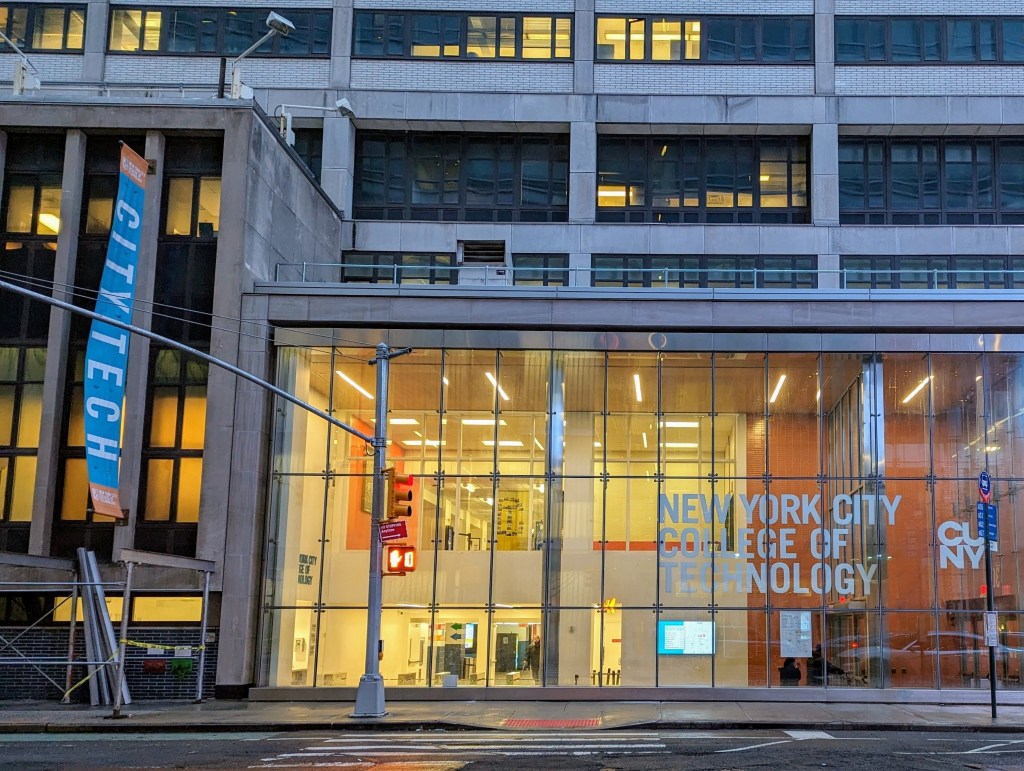
It’s hard for me to believe that it’s only been 10 years since I started teaching at City Tech in Brooklyn. My gray hair seems like a testament to it being far longer.
I’ve been able to accomplish a lot of things since landing in Brooklyn as evidenced by my CV and Teaching Portfolio. I’ve had the joy of teaching great students, and I’ve enjoyed the collegiality and comradery of excellent coworkers.
Some of the greatest hits of things that I’ve done–some alongside the best colleagues and others by myself–include:
Acquired, Shelved, and Built the Finding Aid for the City Tech Science Fiction Collection (with Alan Lovegreen, Wanett Clyde, Justin Vazquez-Poritz, Maura Smale, Morris Hounion, Laura Westengard, Lavelle Porter, Keith Muchowski, Anne Leonard, and Jessica Roman).
Inaugurated the Annual City Tech Science Fiction Symposium (with Aaron Barlow, Jill Belli, Mary Nilles for the first, and Lucas Kwong, Lavelle Porter, Wanett Clyde, Sean Scanlan, Leigh Gold, Kel Karpinski, and Emily Hockaday on subsequent ones).
Directed City Tech’s B.S. in Professional and Technical Writing Program.
Won some grants with Patrick Corbett to fund projects to leverage LEGO in writing classes and communication workshops.
Contributed as an NEH Faculty Fellow and co-developed four pedagogical modules for A Cultural History of Digital Technology: Postulating a Humanities Approach to STEM (directed by Anne Leonhardt and co-directed by Sandra Cheng, Satyanand Singh, and Peter Spellane).
Fall 2024 classes begin on Wednesday, August 28. Originally, I was hoping to teach City Tech’s ENG2420, Science Fiction course in person this semester, but the in-person section had too few students to run. Thankfully, after the administration switched the class to being online, asynchronous and sending a message blast to prospective students, the new online class quickly filled up. Since City Tech recently switched to a new learning management system (LMS) called Brightspace, I’m going to experiment teaching the class on it instead of using our open learning system, OpenLab. However, I will still create my video lectures as YouTube videos, so they will be public facing for anyone interested in following along or using them in their own classes. Also, this will be my first time teaching the class using my open educational resource (OER) Yet Another Science Fiction Textbook. Here’s to a positive and productive semester!
The next academic year is just around the corner, so I wanted to give a shout out for the open educational resource (OER) that I published earlier this year, Yet Another Science Fiction Textbook (YASFT), an over 60,000 word textbook on the history of SF literature that includes a syllabus, video lectures, and more.
And, if you’re an educator needing open and free teaching materials and textbooks, here are some useful resources where you can find OERs:
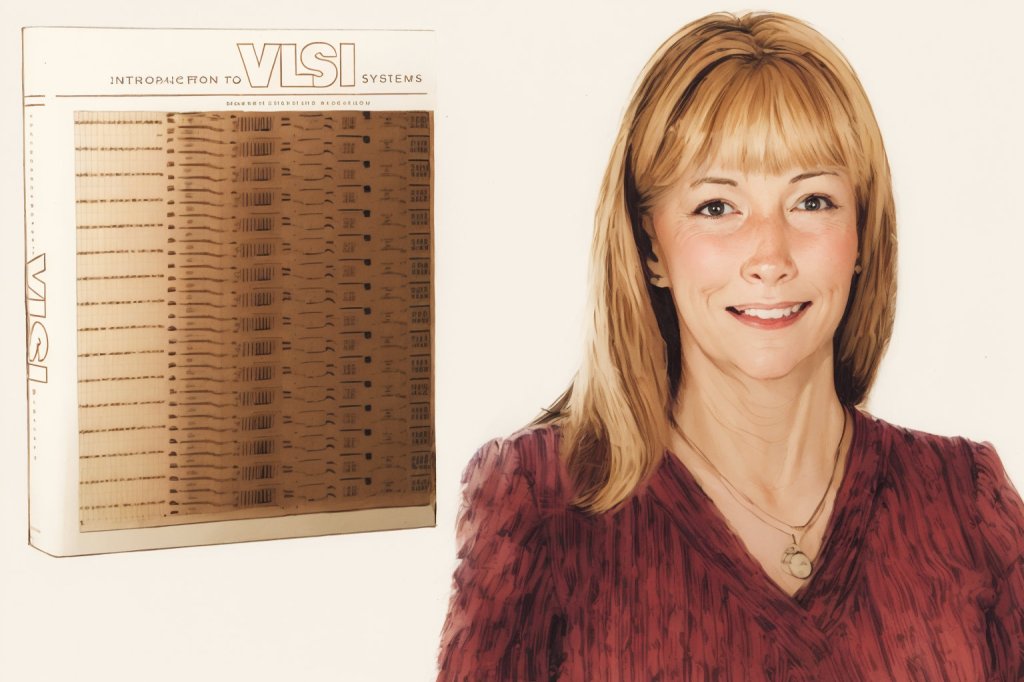
Illustration of Lynn Conway with a copy of Mead and Conway’s Introduction to VLSI Systems. Conway’s likeness is based on Charles Roger’s photo on Wikipedia, which he released under a CC BY-SA 2.5 License. Image created with Stable Diffusion.
This past weekend, The New York Times ran an obituary for Lynn Conway, half of the namesake for the Mead-Conway VLSI Revolution and co-author of the groundbreaking textbook Introduction to VLSI Systems (1980). She died at the age of 86.
What is so cool about the Mead-Conway VLSI chip design revolution was not only that it was the paradigm shift that made possible the next step in microprocessor design and fabrication by enabling electrical engineering and computer science students to do the work that was previously the domain of physicists and the high tech industry, but also that it was a under-the-radar pedagogical hack. Conway writes in the October 2018 issue of Computer:
"With all the pieces in place, an announcement was made on ARPANET to electrical engineering and computer science departments at major research universities about what became known as "MPC79." On the surface, while appearing to be official and institutionally based, it was done in the spirit of a classic "MIT hack"--a covert but visible technical stunt that stuns the pubic, who can't figure out how it was done or what did it. (I'd been an undergrad at MIT in the 1950s).

The bait was the promise of chip fabrication for all student projects. Faculty members at 12 research universities signed on to offer Mead-Conway VLSI design courses. This was bootleg, unofficial, and off the books, underscoring the principle that "it's easier to beg forgiveness than to get permission" (p. 69).
While this was a huge contribution to the development of the computer industry leading into the 1980s and beyond, it was only one of her many accomplishments–innovating an out-of-order queuing processing system for IBM only to be fired in 1968 when she began transitioning to become a woman, starting her career over and eventually making her way to Xerox PARC, later joining the University of Michigan as a professor of electrical engineering and computer science and serving as associate dean of engineering, and becoming a transgender advocate later in life. She was recognized with many awards and honorary doctorates for her contributions to the field as an engineer and educator.