Category: Research

  • 2011-2012 R. D. Mullen Fellowship Winners

    Last week, Rob Latham of the University of California, Riverside announced the winners of the 2011-2012 R. D. Mullen Fellowship winners. I am one among the three recipients! This fellowship will provide each of us with funding to travel to California during the next school year to conduct research in the Eaton Science Fiction Collection at Riverside. I am very honored to have been selected as one of this year’s winners, and I congratulate the other recipients, Alexander and Jennifer, listed below from the original release:

    I would like to announce the winners of the third annual R.D. Mullen Research Fellowship, which is funded by Science Fiction Studies in the name of our late founding editor to support archival research in the J. Lloyd Eaton Collection of Science Fiction, Fantasy, Horror, and Utopian Literature at UC-Riverside. The committee—chaired by me and consisting of Andrea Bell, Neil Easterbrook, Joan Gordon, and Brooks Landon—reviewed a number of excellent applications and settled on a slate of three winners for 2011-12:

    JASON ELLIS is a PhD student in the English Department at Kent State University. His dissertation studies what he calls “neuronarratives,” sf texts that deal with the cognitive implications of artificial intelligence and human-machine interfaces. He is the coeditor of The Postnational Fantasy:  Postcolonialism, Cosmopolitics, and Science Fiction (McFarland, 2011) and has published articles on H.G. Wells, on digital nomadism, and on World of Warcraft. He plans to visit UC-Riverside to do research towards the writing of a dissertation chapter on “the effects of brain trauma” in the work of Philip K. Dick.

    ALEXANDER ISER is a PhD student in the School of Culture and Communication at the University of Melbourne. His dissertation focuses on how time-travel narratives draw out the links “between apocalyptic crises and societal conceptions of time.” He will be spending several weeks at UC-Riverside examining the Eaton’s extensive fanzine collection for evidence of how readers interpreted major time-travel stories as allegories of cultural crisis.

    JENNIFER L. LIEBERMAN is a PhD student in the Department of English at the University of Illinois. Her dissertation, entitled Power Lines: Electric Networks and the American Literary Imagination, studies how “literature helped to shape American perceptions of electrical technologies between 1870 and 1952.” She has published essays on Mark Twain’s A Connecticut Yankee in King Arthur’s Court and on Gertrude Atherton’s Patience Sparhawk and Her Times. At the Eaton, she plans to explore dime novels, boys’ adventure stories, and other proto/early-sf materials in terms of their evocation of the engineer as “the new frontiersman of the twentieth century.”

    I am very grateful to my committee for their work in vetting the applications, and my congratulations to the three winners, whom I hope to see soon here at UCR.
  • Neuroscience, the Neuronovel, and Science Fiction

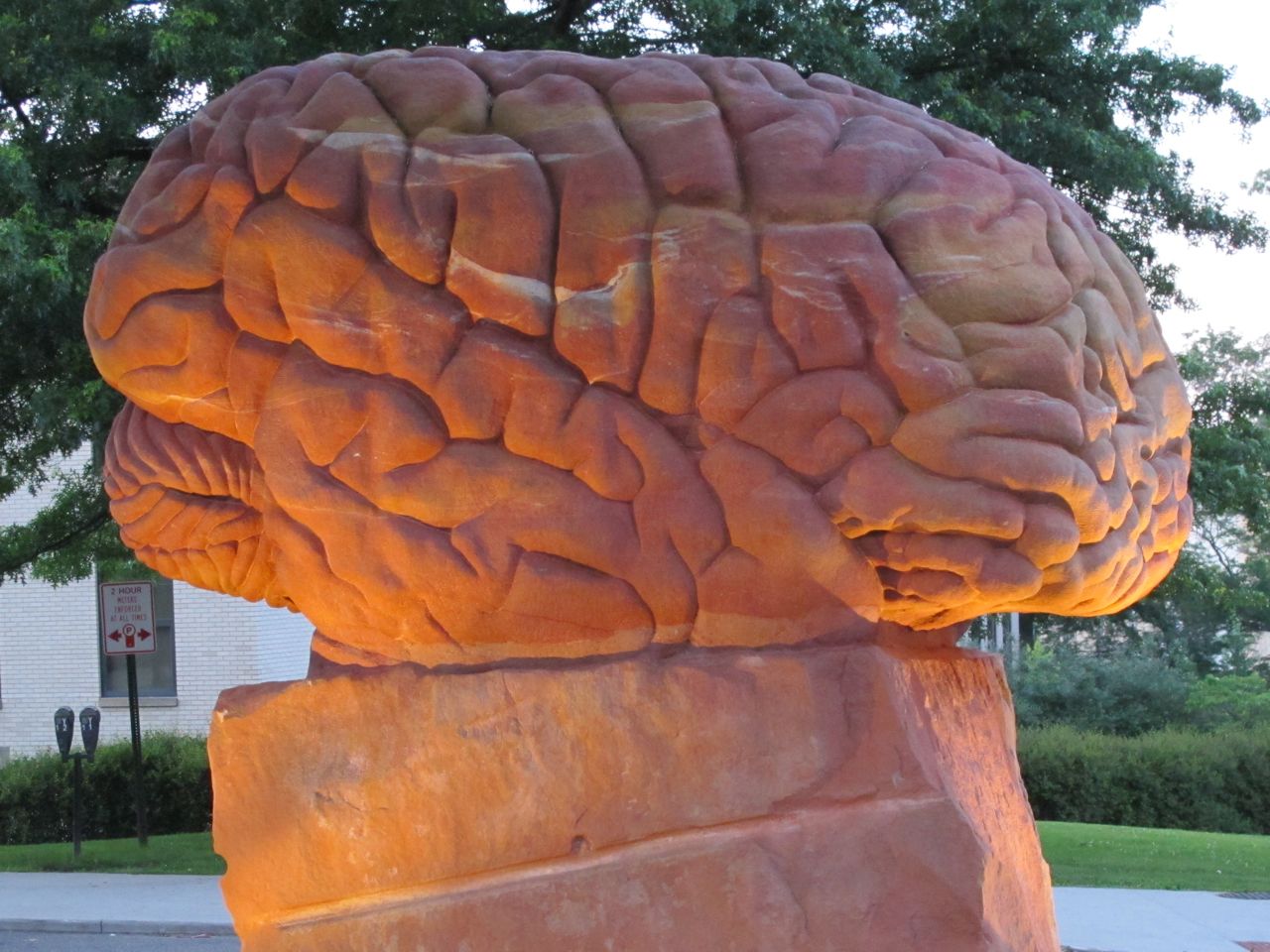
    Several conversations with Tammy Clewell on the neuronovel rekindled my interest in the biology of the human brain. As a result, I have decided to do some research on the neuronovel and its relationship to science fiction. The neuronovel, with its emphasis on the hardware of the brain over the software of psychology, is arguably a hard science fiction topic (albeit most lacking an extrapolative element). Additionally, novels traditionally seen in terms of psychological explanation can be re-read with neuroscience in mind (pun intended).

    I am building a list of science fiction novels and short stories that specifically addresses the neuronovel’s emphasis of brains over mind. What titles of novels or short stories from approximately 1950 to the present can you recommend that emphasize brains over mind, and the brain’s influence on one’s sense of self and understanding of the world. This would include brain trauma over psychological trauma, neuroscience over psychology, depictions of creating or developing brains and how that shapes one’s engagement with the world, introspection or internal dialog that might have a biological explanation rather than a psychological one, etc. Two sets of works that immediate come to mind are Asimov’s robots (they exhibit psychological problems, but there is an emphasis on those behaviors resulting from the way they are hardwired), and Dick’s VALIS novels (the author’s 2-3-74 events can be more simply diagnosed as the first in a series of unfortunate strokes).

    This is a very rough sketch at this point, so please bear with me as a work through it. All suggestions are welcome and much appreciated.

  • Isaac Asimov’s Robots and Freed Slaves’ Names in Up From Slavery

    A passage in Booker T. Washington’s Up From Slavery caught my attention the other night while I was reading it for my African-American Literature seminar:

    After the coming of freedom there were two points upon which practically all the people on our place were agreed, and I found that this was generally true throughout the South: that they must change their names, and that they must leave the old plantation for at least a few days or weeks in order that they might really feel sure that they were free.

    In some way a feeling got among the coloured people that it was far from proper for them to bear the surname of their former owners, and a great many of them took other surnames. This was one of the first signs of freedom. When they were slaves, a coloured person was simply called “John” or “Susan.” There was seldom occasion for more than the use of the one name. If “John” or “Susan” belonged to a white man by the name of “Hatcher,” sometimes he was called “John Hatcher,” or as often “Hatcher’s John.” But there was a feeling that “John Hatcher” or “Hatcher’s John” was not the proper title by which to denote a freeman; and so in many cases “John Hatcher” was changed to “John S. Lincoln” or “John S. Sherman,” the initial “S” standing for no name, it being simply a part of what the coloured man proudly called his “entitles.”

    Washington doesn’t go into any more depth on his example of the former slave who chose “S.” as his middle initial, but that particular letter immediately reminded me of the “R.” at the beginning of Isaac Asimov’s humaniform robot:  R. Daneel Olivaw.  Was the selection of “S.” in Washington’s example a conscious or unconscious choice to signify the individual as being a former slave?  Also, did Asimov choose to the “R.” initial with a knowledge of Washington’s writing to serve as inspiration?  

    I have heard that Asimov’s robots represent African-Americans, and Asimov was involved in the Civil Rights movement.  However, I do not have sources to backup these claims.  If that is true, the above passage may be a strong link between the political work of Washington and the SF/political work of Asimov.  I do want to return to this idea in the future, and if anyone has anything to add to this, I would be very much interested in hearing from you.

  • Why Is the Digital Future Only Found in Books?

    Awhile back, Mack Hassler and I were talking about online personas and the differences between created personas in traditional print culture and the new electronic media.  Mack pointed out that the real interesting personae come through print culture and he named examples including Swift, Greg Egan, Philip K. Dick, and David Foster Wallace (think “Lyndon”)–all of whom employ internal controversies and different voices.  Philip K. Dick is an interesting example particularly if you consider his last published novel, The Transmigration of Timothy Archer (1982).  It strikes me how much his supposedly strong female protagonist, Angel Archer, is like the author.  After reading Sutin’s biography of Dick, Divine Invasions (2005), there are unmistakable parallels between Archer and Dick, and I draw the conclusion that Archer is a voice for the author–a persona of her creator–PKD.

    What does that have to do with the divide between print and computer media cultures?  There’s something to be said about the complexity and the richness of layers, all of which are probably tempered and strengthened by the publication process including acceptance and editing, present in print media–novels and short stories–that facilitates strong persona creation unequaled by electronic media as yet.  We all create online personae through email, social networking, or blogging (among other personal broadcast technologies). Those who interact with us electronically do so via cyberspace, that shared consensual hallucination, and we meet with only what we bring us–our words and stray bits of data including images, sounds, videos, and our reputation.  It is these things that others use to create an image or avatar of ourselves in their minds in order to make sense of our interactions–that’s just what our brains do with the available data at hand.  However, as Mack observed and I agree, the new media has permitted a proliferation of persona creation, but it is by-and-large thinned out in comparison to what we find in print media.

    This then leads to my personal conundrum.  Mack said to me, “You’re serious about print, but you’re not serious.”  I am heavily invested in computer technology.  I built a PC specifically for online gaming–not that my grad student responsibilities allow me any time for that–and I recently decided to invest in Apple due to the economic downturn, which netted me their latest and greatest machined aluminum MacBook with a solid-state hard drive.  Despite the hardware underpinnings of my digital life via email, Facebook, and my blog, I rarely read or encounter stories online.  Yes, I read a lot online, probably more than I should considering my other duties, but the one thing that I don’t read online are SF stories.  The stories, the SF, that creates, imagines, and interfaces with the future is largely nonexistent on the medium that those stories take as its object of interest.  If I want to read about cyberspace, I don’t look online, I turn to pulp, paper, and the book for that imaginative immersion.

    Where does that leave us in regard to the new media and books?  Considering my recent conversation with Stephen R. Donaldson, there is change in the wind, but obviously no one has the one answer to what that change may encompass.  I’m curious to hear the thoughts of Robert H. Jackson next Tuesday when he presents on the future of books at the Kent State Library.  I know he won’t have all (if any) the answers, but perhaps the face-to-face interaction will be illuminating in ways that online persona interaction is not.

  • Ama Ata Aidoo’s Our Sister Killjoy and Frankenstein

    Y showed me a quote about Frankenstein and Science Fiction in a book on her postcolonial literature comprehensive exam reading list, Ama Ata Aidoo’s Our Sister Killjoy (1977).  Aidoo is a Ghanaian feminist writer, and she’s currently a visiting professor at Brown University.  I thought it was really interesting the way that Aidoo uses the Western Frankenstein myth or model to talk about the evolutionary derivation of whiteness (Europeans) from blackness (African) following the early-human diaspora from the African continent a couple million years ago.  The speaker aligns Europeans with Frankenstein’s monster, or the “man from the icy caves of the north,” through the exclamation, “But good God, I refuse to think that the man from the icy caves of the north could have been one of our inventions.  Yet sometimes one wonders, considering the ferocity with which he has been attacking us.  As though we were to blame for his feelings of inadequacy.  Both physical and otherwise.  Especially physical” (115).  And then the speaker ties it together with the Frankenstein story and a terrific observation about the nature of SF in general by saying, “It all sounds like science fiction.  Like the story of Frankenstein.  But then, science fiction is only a wild extension of reality, no?”  I’ve included the full quote with some extra material leading up to it below.

                My question is:  who was there when we were saying farewell to our God?  My Darling, we are not responsible for anybody else but ourselves.  We did not create other races.  So we should not let others make us suffer because we are stronger than them or have better skins.

                Sickle cell anaemia.  High blood pressure.  Faster heartbeats in infancy.  One truth maybe.  A whole lot of wishful thinking.  No amount of pseudo-scientific junk is going to make us a weaker race than we are.  And may they come to no good who wish us ill.  After all, what baby doesn’t know that the glistening blackest coal also gives the hottest and the most sustained heat?  Energy.  Motion.  We are all that.  Yes, why not? . . . A curse on those who for money would ruin the Earth and trade in human miseries.

                We have always produced great minds.  But good God, I refuse to think that the man from the icy caves of the north could have been one of our inventions.  Yet sometimes one wonders, considering the ferocity with which he has been attacking us.  As though we were to blame for his feelings of inadequacy.  Both physical and otherwise.  Especially physical.

                It all sounds like science fiction.  Like the story of Frankenstein.  But then, science fiction is only a wild extension of reality, no?  (Aidoo 114-115)

     What’s even more interesting about this quote is the fact that this novel is representative of Ghanaian literature despite its modernist underpinnings and Western intertextualities.  I’m not saying that a Ghanaian novel cannot do or contain those things, but my suspicion is that there are other novels that aren’t considered world literature, and here I’m borrowing from James English’s analysis of Keri Hulme’s the bone people in The Economy of Prestige, because they aren’t readily accessible to a Western audience.  This is because they are more Ghanian (whatever that might mean) and less engaged with post-Enlightenment, Western (or in this case, Northern) ideas and textual networks.

    However, this is the great debate in postcolonialist studies–following the colonial era, you can’t, as the saying goes, return home.  The colonial experience irrevocably changes the colonized’s culture and language.  In Ghana’s case, it was once a colonial holding of the United Kingdom, and it was the first African colony to achieve its independence from the crown.  As a result of the colonizer’s influence, English is the primary language of Ghana, and the UK educational system is more than likely similar to that of other former colonial holdings such as India.  Ghana is implicated with and tied to the West through its past and present, so there really isn’t such a thing as “pure” Ghanaian literature devoid of Western influence, but there is certainly Ghanaian literature that is part of the expansive global networks emanating diachronically from the Enlightenment and the continuing influence of the Western colonizer.

    Find out more about Aidoo on Wikipedia here, or on her Brown University faculty entry here.  The bibliographic entry for her novel is:

    Aidoo, Ama Ata.  Our Sister Killjoy, or Reflections from a Black-eyed Squint.  New York:  Longman, 1977.