Category: Science Fiction

  • Science Fiction, LMC 3214: Exam 1 and Lecture on Golden Age SF Part 1

    Today, my students bravely wielded their pens and Blue Books to endure their first exam in our Science Fiction class. The exam covered Mary Shelley’s Frankenstein through the early SF film serials. The exam had twenty short and long answer questions. A few students completed the exam in the allotted 60 minutes, but I gave the rest of the class an additional 15 minutes to complete the test. I made it very clear that I could not give credit to illegible responses, so I think that the writing component slowed some students down. I will take this into consideration as I plan the second exam while making my lecture notes for the upcoming two weeks of class.

    After the exam, I delivered the first part of my lecture on Golden Age SF. I covered a rough sketch of the Golden Age, John W. Campbell, Jr., and Isaac Asimov. In tomorrow’s class, I will lecture on Robert A. Heinlein, Tom Godwin, Ray Bradbury, and the maturation of SF film. We will discuss the readings for Monday and Tuesday, too: Asimov’s “Reason,” Bradbury’s “There Will Come Soft Rains,” Heinlein’s “All You Zombies–,” and Godwin’s “The Cold Equations.”
  • Science Fiction, LMC3214: Early SF Film Serials, Remediation and Media Translation, Flash Gordon, and Exam Prep

    I began today’s class by showing them the first episode of the 1936 Flash Gordon film serial episode, “The Planet of Peril.” After having a taste for what I would lecture on in today’s class, I launched into a discussion of pulp of a different kind: SF film serials and SF comic strips. In particular, we talked about Buck Rogers (continuing from last class’ discussion of Gernsback’s Amazing Stories) and Flash Gordon. After lecture, I answered questions about Monday’s upcoming exam that covers Mary Shelley to Poe and Hawthorne to Verne and Wells to Gernsback, Moore, and Lovecraft to Buster Crabbe. Then, we watched two more episodes of Flash Gordon. It was a good class. After the exam on Monday, we will begin talking about Golden Age SF and readings from Isaac Asimov and Ray Bradbury.

  • Science Fiction, LMC 3214: Pulp SF, Gernsback, CL Moore, and HP Lovecraft

    In today’s class, we managed a whirlwind of material!

    Before discussing the assigned reading: CL Moore’s “Shambleau” and HP Lovecraft’s “The Colour Out of Space,” I gave a lecture on the origins of pulp fiction, Hugo Gernsback, Amazing Stories, Space Opera, Weird Tales, Weird Fiction, and Cosmic Horror.

    Dr. Malavika Shetty from Georgia Tech’s Communication Center also stopped by to let my students know what the Comm Center can do for them as they begin working on their final paper assignments.

    Tomorrow, we will talk about SF film serials and watch a few episodes of Flash Gordon: Space Soldiers before reviewing for the first exam at the beginning of class next Monday (no class on Thursday this week because of Independence Day sans Will Smith and Jeff Goldblum).

  • Science Fiction, LMC 3214: Proto-SF, Voyages Extraordinaires, and Scientific Romances

    Today’s class was chocked full of lecture and discussion.

    We began by going over the final paper assignment on applying definitions of science fiction to a single work of SF or SFnal that we did not discuss as a class. Since many of the students might not have written literary criticism before, I framed the assignment as an experiment:

    • Identify a problem: Choose a work of fiction (book, short story, film, video game, etc.) that: 1) we did not discuss as a class, and 2) has some science fictional aspect—either strongly or weakly. Pose the question: Is this SF (or SF of a particular type)?
    • Form a hypothesis about the work being SF or not.
    • Choose data for testing your hypothesis: Write about specific themes, examples, and scenes from the work that you choose.
    • Test your hypothesis: Using at least two of the attached definitions from the list, argue for and against your hypothesis.
    • Draw a conclusion: In your discussion, you should: 1) explain why or why not your example work is SF, and 2) build your own definition of SF and write it in your own words.

    I believe that having students get their hands dirty with definitions while trying to formulate their own definition will lead to a deeper understanding of SF discourse.

    The bulk of our class was spent on laying foundational lecture material for this week’s material. I introduced them to the cultural forces needed for SF to emerge, early practitioners of proto-SF such as Edgar Allan Poe and Nathaniel Hawthorne, Jules Verne and his Voyages Extraordinaires, and H.G. Wells and Scientific Romances.

    For today’s class, we discussed H.G. Wells’ “The Star” (and I introduced them to Voyager’s Pale Blue Dot photograph) and E.M. Forster’s “The Machine Stops” (which led to an AMAZING discussion about social media and contemporary communication technologies).

    Tomorrow, we will discuss the Pulps, Hugo Gernsback, C.L. Moore’s “Shambleau,” and H.P. Lovecraft’s “The Colour Out of Space.”

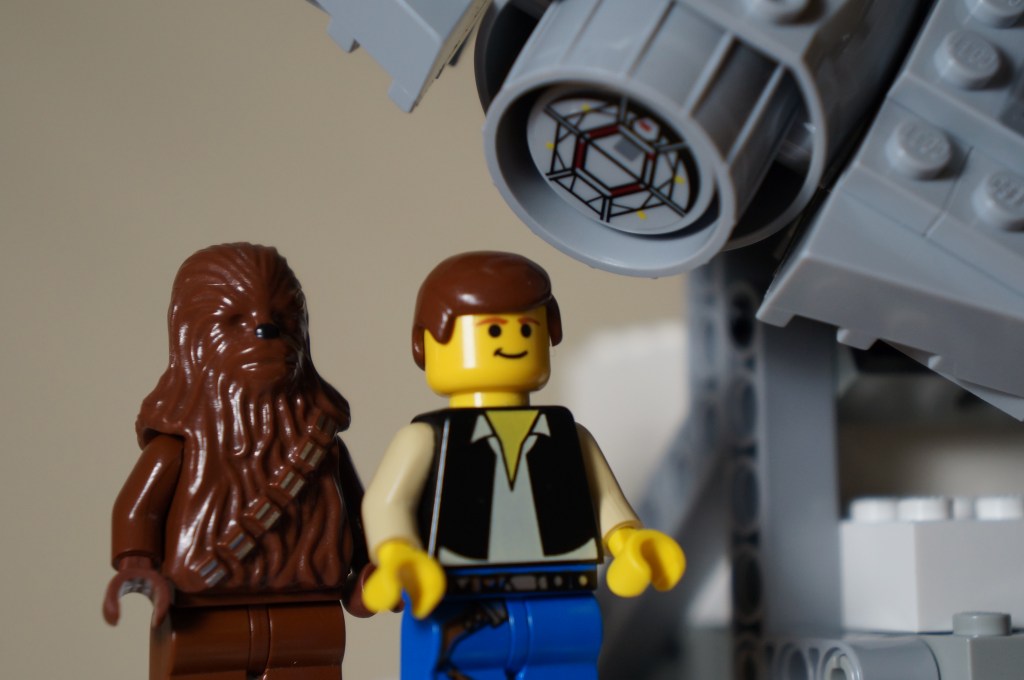
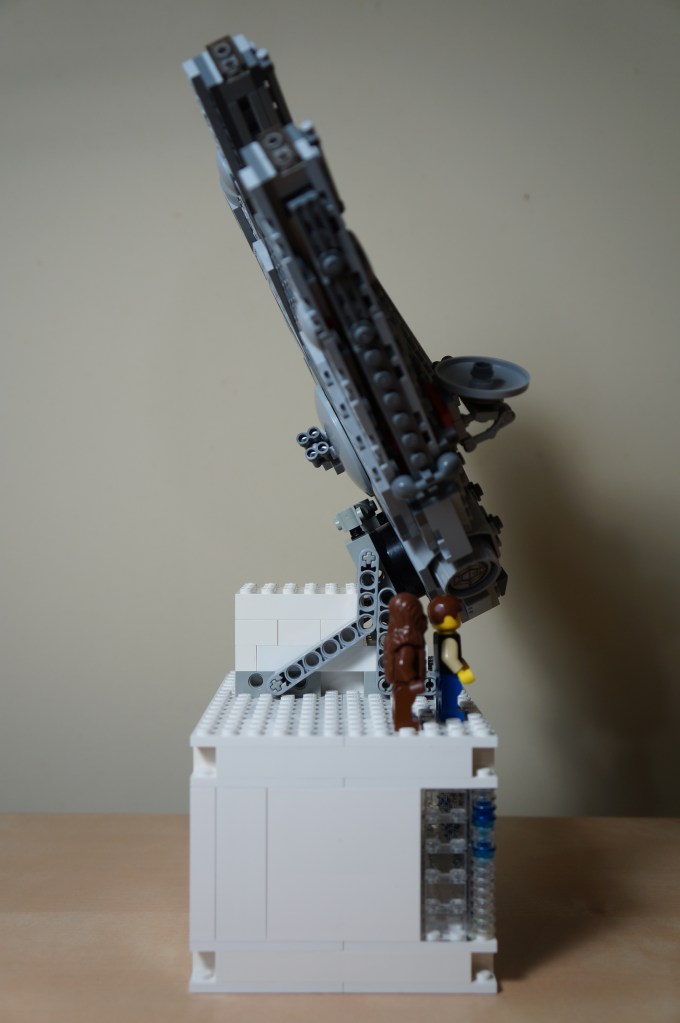
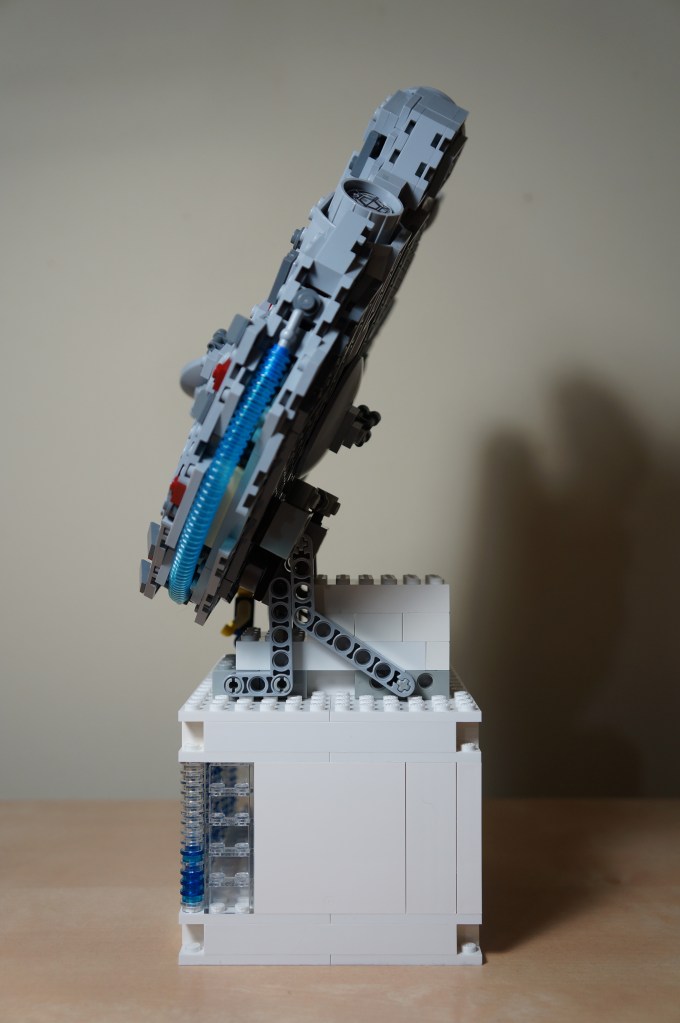
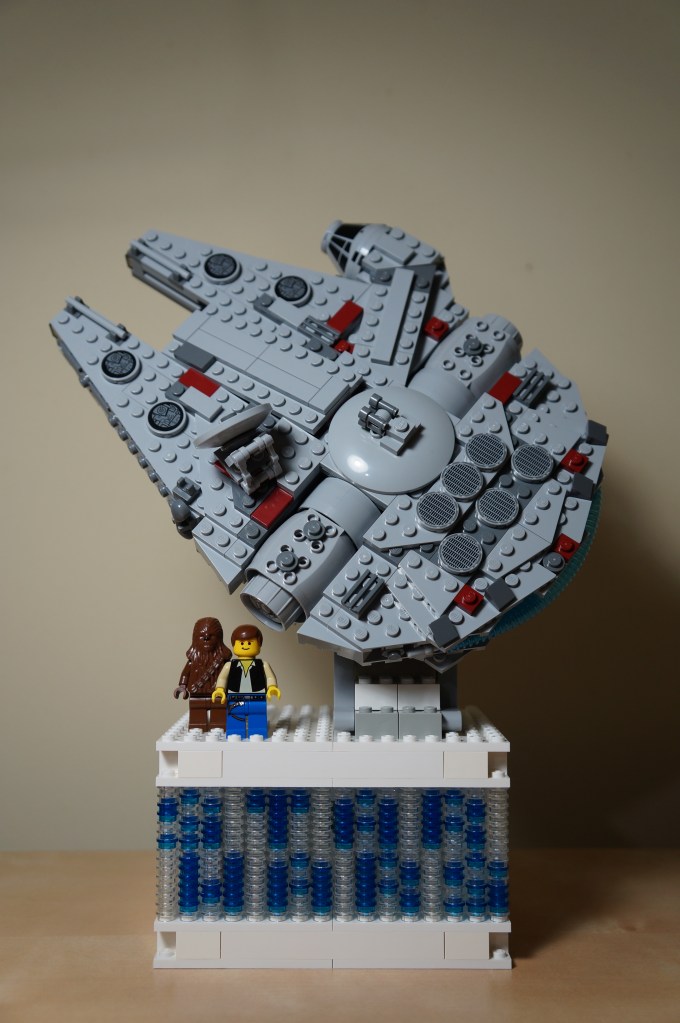
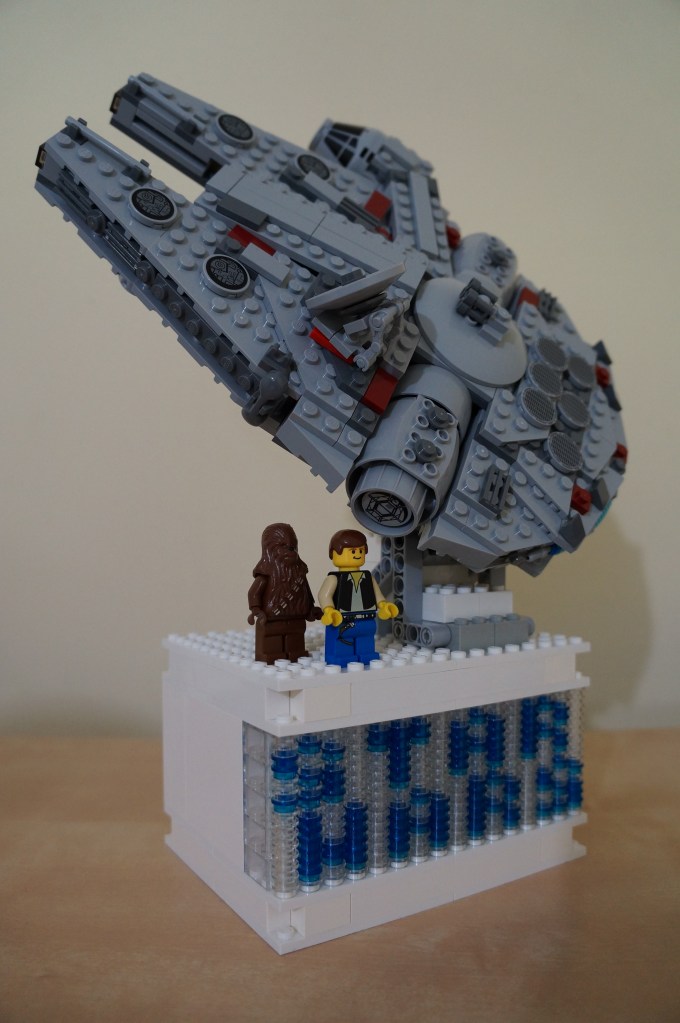
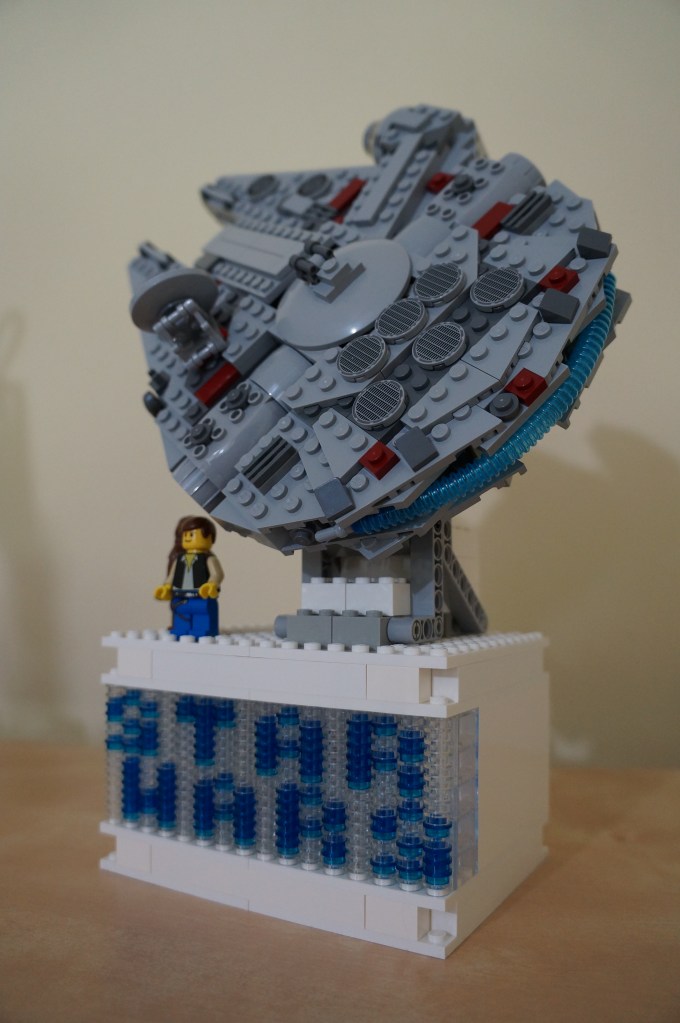
  • Custom Light-Up Display Stand for LEGO Star Wars Midi-Scale Millennium Falcon 7778 with Han Solo and Chewbacca from 7190

    Yesterday, I spent the afternoon building a custom display stand for the “midi-scale” Lego Star Wars Millennium Falcon 7778. I used white bricks and plates to build an empty box for its base. On its front, I used clear round pieces for filler and translucent blue pieces for the letters. I planned out the letters on an index card that I drew a grid pattern on. If you count the columns, you can see that I was left with an extra, unused column. Y suggested setting the bottom line of text off by one column to spread this spare column between both lines of text, which I think works very well. In the back of the base, I installed a light brick to illuminate the Star Wars text on the front. On top of the base, I build a stand for the Falcon using Technic bricks. It took some experimentation with different elements to get the angle that I wanted. On top of the stand, I used a 4×4 rotating assemblage to give the Falcon a more dramatic pose. In order to keep it at the rotation angle that I choose, I used a Technics rod assembly attached with a 2×2 rotating assemblage to meet it to the Falcon and hold it in place. I added the Han Solo and Chewbacca minifigures from the original Lego Star Wars Millennium Falcon 7190 set to complete the project.