Beginning tomorrow, I will lead a new kind of Science Fiction LMC3214 class at Georgia Tech for 35 students.
As part of the Summer Online Undergraduate Program, I will teach about 10 on-campus students with face-to-face lecture, discussion, and exercises. Our weekly class meetings will be recorded in a Distance Learning classroom and made available to my 25 other students in the class who are off-campus and online.
Each section of students will receive the same lecture material and be required to complete the same assignments, but the online students will not have the benefit of realtime interaction with me and the other students. At least, they won’t be required to be. My intent is to test a way of facilitating simultaneous and asynchronous discussion with the help of Twitter. On-campus and off-campus students will use Twitter to facilitate discussion, ask questions, and share relevant material. They will also be asked to respond to one another’s sharing and questions. In the beginning, I will act as a mediator to connect students together and help build our initial discussions. It will be up to the students to sustain the conversations as a component of their participation grade. You will be able to follow along with the discussion (and contribute, too!) by following the hashtag: #lmc3214.
I have some new ideas and material that I am going to try out in this summer’s Science Fiction class. Last summer, my Science Fiction class was held during the short summer session, which made it difficult to cover more material and challenging for students to learn the material in such a compressed period of time. This summer’s class covers the full Summer semester, so I think that we can space things out, look at more examples, and help one another understand Science Fiction’s significances better.
I’m looking forward to this new class and meeting my new students–on-campus and off-campus alike.
Here’s a copy of our syllabus with details on assignments, Twitter use, and reading/viewing schedule: ellis-jason-lmc3214-syllabus-full.
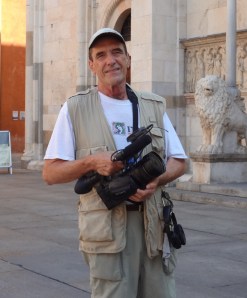
Late last year on October 3, 2013, I had the pleasure of interviewing Paul Lally, the producer, writer, and director of an educational program from 1977 called “Space Station L-4.” Now, Paul is the Executive Producer of Caio Italia with Mary Ann Esposito.
Space Station L-4 was distributed by Children’s Television International and shown on PBS and in classrooms across the USA. It starred Cotter Smith (X-Men 2) and Venida Evans (The Adjustment Bureau). The show teaches junior high students about ecology and environmental topics from an observation point in outer space at L-4. It combines a science fictional frame (astronauts on a future space station positioned at a Lagrange point around the earth) with science fact about the ecology of Earth from an outside observer’s point of view.
In the interview, Paul tells me about the development and production of Space Station L-4, and we venture into other areas such as his experiences working on Mr. Rogers’ Neighborhood and his ideas about engagement, learning, and pedagogy.
I paid CastingWords.com to transcribe our 1 hour 18 minute conversation. I have gone through the transcript and made corrections, but there remains the possibility of my missing something. All errors are mine.
If you have a copy of Space Station L-4 or know where a copy might exist, please let me know. I am seeking copies of the series’ shows (http://www.worldcat.org/title/space-station-l-4/oclc/23049264). The one Worldcat listing of the VHS tapes and teaching materials in a Wichita Public School Library (http://www.worldcat.org/title/space-station-l-4/oclc/22254805). If you have a copy or know where I can obtain a copy, please drop me an email at jason dot ellis at lmc dot gatech dot edu or leave a comment on this post. Paul and I would appreciate it!
Interview with Paul Lally by Jason W. Ellis
Transcribed by CastingWords.com.
Jason Ellis: I was curious, maybe just to start things off, where did the idea for “Space Station L4” come from?
Paul Lally: I worked for Children’s Television International, which was a company that produced in‑school programming for students. I recall that it was probably someone at the company sailed out the idea, offered out as a curriculum, as a course possibility in Earth Sciences.
This was something outside of my preview. I didn’t get near it until they landed the idea and got the funding, or whatever it was, for it. Then I came in on it. That’s kind of how it started.
They looked around for different ways to supply programming back then for in school programs, that’s how they were constantly doing that, and as a supplier to you know Great Plains or wherever these distributors were, and still are I guess in some respect but, yeah so they modified. I don’t know if that’s much of an answer, but somebody did yeah, somebody did.
Jason: Right, it was an American produced show; it was something that came from CTI here in the United States?
Paul: Yeah, Children’s Television International was a Virginia based company that I worked for. I worked for the company for like three years. I was a producer, director, writer there.
I would do different kinds, I did a short story series for them, I did one on newspapers, one on movie making, and storytelling series, a variety of in school programming series. Ray Gladfelder was the guy, he’s not in business anymore, he’s since passed away.
But itself has kind of vanished but, it’s not to be confused with Children’s Television Workshop which is Sesame Street. That’s another thing entirely so. Discrete from each other.
Jason: You mentioned in your email, one of your earlier emails between us that after you did get attached to the project, and you were working on it that you guys built a 360 degree set.
Paul: Yeah.
Jason: Can you tell me more about what that set was like?
Paul: Well, you just imagine a big, in a television studio, film studio, a sound stage. We build a very long cylindrical shaped environment, something like a submarine kind of thing. On entry, once we went in they closed it behind us so that we could shoot 360 degrees, and never be off set. We were enclosed in the set.
I wrote these very long scenes, like seven, eight minute‑long takes where there was no cuts. The premise was that they were working up there. About once a week, they would have a 15 minute broadcast to earth and that was the premise.
They would be talking to you but then they start interrupting. They’d have various oxygen, or some kind of problem so the class would be interrupted. The actors alternated between looking in the camera meaning, “Space Station. People.” Then saying, “Whoops, give me a second.” Then we go back.
I have wrote all these scripts so that I blended, for instance, they may have listed the shows somewhere in the study guide. If it was on earth for instance, or soil. Let’s say the one week’s topic was soil. He just talked to the students.
I had a curriculum or, what’d I have? The topic of what I had to write about then, as a writer I made it more of a conversational thing. That’s how I would do it. The point I’m getting at is I would intersperse the teaching points with another story line that was happening, like, they were waiting for the supply ship. It had been late and they were hungry. Scientist wants a sandwich.
There’s a little other side drama would be happening. Some weeks it was funny, some weeks it was other things to do. All very casual. That was the way to do it.
Jason: It sounds fascinating to me, because I could imagine how engaging that could be to students. You’re learning something but then you have that drama or that comedy take place in parallel to it.
Paul: Yeah, that’s what we do just to break it up. Also they came about, love if they still had the shows to certainly explain it better than me. It’s been 30 years, a thousand years since I’ve done it.
I pitched right into it and these actors memorized, we shot steady cam which nowadays is pretty common use. I don’t know if you’re familiar with the instrument. It’s a camera that’s attached. It’s free floating. It has some shoulder‑mounted thing. It’s very float‑y, and very ethereal kind of shots with steady cam.
But back then I had the second one even invented for God’s sake. I saw it and as a young producer I said to the director, I said, “That’s what I’m going to get.” We rented one so we could float around and get this sense of gliding.
There was no cuts so even though they had gravity there; you had the sense of kind of never cutting between scenes. You just kept going, these actor memorized. Plus, what the trick was; they would walk around with clipboards like they were consulting notes, but a lot of times they were just trying to get their lines for their endless scenes.
[laughter]
Paul: They were very good at. Cotter more than, I forget the actress’s name but it was Cotter Smith, and a man and a woman. They were kind of up there. The point of L4 is a point in space where you’re equal just between the moon and the earth. It’s a kind of equilibrium L4 force.
There is L1, L2, L3, as I recall faintly, these spots and you may know about that. It’s a point in space where it’s balanced, and it’s sort of the metaphor was balance and they were sort of like ecological traffic cops up there monitoring the earth.
They were keeping an eye on the earth and monitoring and reporting back. Hence, that was the root of the earth sciences sort of thing was that while they were doing their thing, looking at hurricanes here, or something over there, doing their work up there, they would also spend 15 minutes a week with, and I can’t honestly remember the age group.
Because I still write pretty sophisticated stuff, but I had two kids at the time so I didn’t have the answer. I just laid it on them, I think it was middle school, but I honestly don’t know. It could have been higher, junior high. I don’t know where you start earth sciences to be honest.
Jason: Yeah, from my memory at least when I went through middle school. That would have been right around sixth, seventh, eighth grade middle school.
Paul: Yea, that’s what I think too, yeah. I tell you what’s popular to me [laughs] . There was a big ITT called Big Blue Marble back then, just ancient. It was hugely popular, and L4 beat them out I think. I got a gold medal for that show.
It was the best whatever, but it won. It beat out Big Blue Marble. It’d be the equivalent of beating the New York Yankees, showing up and hitting a home run. I was very surprised and pleased to say the least.
Jason: Right, no doubt.
Paul: Yeah, it was fun.
Jason: You mentioned Cotter Smith played one of the astronauts on the space station. You sent me the Wikipedia article. I remembered him then from X2. He played the President in that movie. But he has a very distinctive look, and I want to see what he would look like.
Paul: He looked like that young. He’ll look like Cotter. I have known him my whole life. We’ve been friends since he lived in the Washington D.C. area which is where we were based, so we would audition actors in that area.
I think Vanessa or Vanetta, I forget her last name. Anyhow, I can’t remember the female, the actress who was in it. Let’s see what else is shaking here. The set was pretty exciting just to go in and get locked in. You just close the door and you couldn’t. I would stage these scenes where they would talk to the camera for maybe two minutes, and then we had some films too.
We had pre‑produced things. God knows where we got them. On soil, or something, I don’t know.
I used that technique on a newspaper series the next year. I went down to a newspaper down in Virginia, but three actors in there with all the other real people and they did the same thing. They had scenes and talking about how newspapers were, and then they’d have ongoing dramas, scandals. It was the idea of mixing, what do you call it?
Kind of a little bit of reality show. That’s not a fair way to say it, but I did it twice and the premise worked. The science thing, I want to be able to give you substantive answers for what we were actually working on or helpful answers, because I don’t want to be reminiscing here. As much as I don’t mind doing that, I want to be able to help you with what you’re trying to get going with yourself here, what’s happening.
Jason: The project that I’m working on now is, I’m investigating television depictions of space stations. I’m real familiar with the science fictional aspects of it, but less so things that are either non‑fictional or maybe educational, and take a close look at “Deep Space Nine,” from “Star Trek” or “Babylon 5.” One of my friends is the one who tuned me into “L‑4”. He probably is maybe 10 years older than I am. He saw it on TV.
Paul: He remembered it, OK.
Jason: He immediately knew it. He started talking about it. He started having all these memories about it.
Paul: [laughs] That’s great.
Jason: It was from his younger memories so he doesn’t have a sharp recollection of who the actors were, those types of things, but he enjoyed it. I should convey that to you, that I think that was probably his most favorite TV show growing up.
Paul: Well thank you, that makes me feel good. It was very different and innovative. We had a computer voice. The associate producer, Melody Rosen was her name, we did a little mechanical voice where she would read it and she would distort it. They had this ongoing relationship with a computer, back and forth.
It was like a sentient being, to speak, but it was just a voice. They’d say, “Such and such, put up.” She was the one that would activate these little film clips and things, it was just a device. I remember that little part of it, that little component.
The best part was the last 13 shows, and it was the best. We filmed the 13th one, they were getting ready to go back home, they were going to get replaced. Their replacements were coming up, and they were recapping what they did and what a good time it was, and how to take care of the Earth. It was a really ecologically driven show, and mindful of the earth, and that was way back when.
I still remember Cotter Smith said, “All throughout this, we’ve told you how important science can be, now it’s important for you to see how important imagination can be,” and he starts walking toward me. Then Vanessa starts walking next to me, and the camera backs up and keeps backing up.
By then we had taken the back end off the set, so we came out. Then you see the set, and I had people coming in, stage hands, booming, and lights and stuff, you go for your transition in one shot from the Space Station to a TV studio.
It was wonderful. I’m rolling credits over that too. It was the best, I loved it. To this day, I think about it. It blew people’s minds, to see the transition, I remember that part of it.
We had shots of the cameraman and the sound recordist, and the computer voice started saying who it was, “Sound recordist, John Fitzpatrick”, and on, and on, and on. It was a little credit package, maybe 40 seconds long.
Photo courtesy of Paul Lally.
I’ve done it ever since, I do it in different shows that I produce. A cooking series I do, “Ciao Italia” which I’ve been doing that for 23 years now. Every once in a while we’ll reveal the studio, take away the curtain from the “Wizard of Oz.” It’s enjoyable.
Generally speaking, I remember I worked with teachers, I worked with curriculum consultants, and they would tell me what the theme was. Say it’s about soil, they would give a list of what has to happen as a writer, and then I would concoct the story around it, and then get the teaching points in.
Then we would supplement it with pre‑done films, or pre‑recorded visuals and things. Just to give you a sense of the process.
As I recall, it was very much ecologically driven, of course at the time environment was just early coming in, it was the ’70s. My God it was people waking up to ecology and to the things that dominate our culture now, but it was unknown back then. I was sensitive to it so it was able to infuse the scripts, with that the answer.
Jason: It sounds like your show was really innovative, it was coming right after “Silent Spring,” it would not have been on most people’s minds at that time. It was not nearly as big or as promoted as it is nowadays.
Paul: Exactly, you’re quite right. You could sense the importance of it and sense that it was Earth, and at that time we had had enough distance. The iconic photograph of seeing the Earth from far away, “Big Blue Marble” was the name of the series. It would beat it out, because to see the earth from the moon shots. It was really transcendent for people to see the earth as an object in space.
It was the first time. This was probably back in the late ’60s or something like that. It was just an unawareness of the fragility of the planet. Hence, I was sensitive to that as a writer, and as a producer and director, just to do my best to infuse the actors in the future.
It was a given that they were concerned about the Earth, that’s why they were up there. They were like cops, friendly cops, but they were up there enforcing the ecological balance of the earth, and that sort of thing. It sounds a little more dramatic that it was, it was pretty casual. That’s what I have to say about that.
[laughs]
Jason: Thinking about the way you shot the program. You had this steady cam, everybody’s inside this 360-degree set, the astronauts, are they dressed in some sort of astronaut garb like either a spacesuit or jumpsuit?
Paul: Yeah exactly, like a jumpsuit. A Star Trekkie kind of thing, not Star Trekkie too much, but it was kind of a unisex sort of outfit. I remember that. Considering it was an instructional television series, it was not too fancy, it looked simple.
It was blue with their name on it, something really simple, but not a uniform. It’s a good question; I don’t know how involved we got with that part of it.
Jason: You had the two astronauts, a man and a woman, and you also had the computer voice character who introduced videos, for showing the astronauts and the audience who was watching the show.
Paul: Yes, and back in the old days you had live things and you had cartoons. I’ll try and do one other thing; I can give you a better example if I can find, that place L‑4. They had a list of the programs. I can’t think of another. I keep saying soil, but there must be some other topic. They listed it in that one library that may have had the series still. They had the list of the programs as I recall.
Jason: I didn’t look that carefully actually to see what the programs are.
Paul: Yeah. They have actual programs. It’s Space after this. I’m not find it. It’s Space Station L‑4. Wait a minute. Now it’s a TV company. It’s very strange for PBS Special from ’77. What the hell?
Look at this, this weird thing. I’ll send you a like a little, it’s just a paragraph. A PBS Special from 1977. This is all like half right, and half wrong. It spanned 16 episodes. A fascinating look back at where cutting edge science was in the late ’70’s. What they were expecting and how it’s played out in reality.
This show discusses plan for a fully functional space station, which would sustain life somewhere other than Earth. I have no idea what the hell this is? I don’t even know if it’s my series. Who cares? That’s not important for you. It’s way too specific for what you’re doing, but I just saw it.
This is like trying to discover some relative who lives in Cuba, or something. “Wow! Where are they? What are they doing?”
Jason: Right, exactly.
Paul: I think we lost the trail on them.
Jason: Trying to uncover the archaeology of these visual artifacts. I had conversations with my students about the ephemerality of their digital online communications, and the things that they watch and do online. The same is true for more traditional media as well. These things are easy to disappear, and then you trying to track them down later can be a real challenge.
Paul: Absolutely. A good example was I worked for 10 years. My big career break came when I went with Mr. Roger’s Neighborhood. I worked for 10 years there as a Director and a Writer, and that was after I did this L‑4 stuff.
I see much of Fred’s work is just kind of vaporized. It’s out there, but it’s sort of all faded away. Since I’ve been with Mary Ann Esposito, I produced her cooking show, and she’s had like 23 years.
I decided long ago, saying, “I’m going to archive this stuff.” Literally, her body of work is online free. You can go to our website, ciaoitalia.com. All of her videos are there, like 1,200 videos. As long as the Internet is alive, her body of work will be there. It makes me feel good.
The very thing you’re working in your business and mine is very ephemeral. Like our conversation, it’s just here today and gone tomorrow, and to have some kind of record. It upset me that Fred’s work is down the tubes. It was so essential for young children. You probably grew up with Mr. Roger’s Neighborhood.
Jason: Yeah. I was going to ask you before we entered the conversation today about you; your work on that show, which is unrelated to what my profession. That’s just being a fan, you growing up with that.
Paul: Of course, yeah. It was a huge thrill for me. It was a huge break. I started working with Fred when he had just become like a world figure. They called it his “Carey Grant” phase of his life it was so great. Everybody knew. We went to Moscow, we filmed. It was just great.
It was great to work with him. A very small setup. He did all the puppet’s voices. He was just a one‑man‑band really. We reached a huge effect on children. He’s coming back now. The company is doing an animated series, which it’s a pale imitation.
The guy is a genius. It was wonderful. It was a thrill to work with. He was as regular as you or me. You would have loved being with him. He’s just a great guy, and interested in you.
You’d want to talk to him, and he’d have you blabbing about yourself in about 60 seconds. You’d just be “Blah, blah, blah.” because he was just genuinely interested in the human condition, except he talked too slow.
You’d say, “God, Mr. Roger’s talking. You sound like Mr. Roger’s, but we’re having a normal conversation,” rather than simplistic stuff. It was normal. That’s sort of my spiel I give folks, who knew about Fred. I was there. My kids grew‑up working on the set, painting dots on “Neighborhood of Make Believe,” that kind of stuff.
We had Thanksgiving with Fred every Thanksgiving. He was a vegetarian, and my daughter didn’t like turkey. The two of them would have their own little special thing on Thanksgiving. We’d have massive turkey with Fred, and Gabriel would have like little lobster bisques, or some damn thing. It was just the human touches that make the world go around them.
Jason: Right. One thing that I guess bridges these two works in my mind, you working on Mr. Roger’s Neighborhood and then with Space Station L‑4. It’s a pre‑digital age. Everything is physical. The puppets are real. You can see them. There’s like a texture to them. The way they’re made, and the sets and everything.
Then what you’re saying about Space Station L‑4. You built this amazing set that everything takes place in, You even tell how that’s made at the end of the show.
Paul: Yes. To show the hand inside the puppet as it worked, at the end. I thought it was great for kids to know. In science some of my closest friends are these sort of button‑down, wired‑up, binary kind of people. They’re scientific. They think that way, but they’re creative too.
There’s a bridge between me, a creative artist and an astrophysicist. They are creativity bridges instantly both ways. It was fun for me to have the bully pulpit if you will. This was a small company. I was in my late 20’s, or I don’t know. I could just do whatever the hell I want. I knew I had to do everything. I wrote it, and directed it, and produced it, and I edited it. It was kind of a one‑man‑band thing.
That series was a reflection of my world view if you will. It’s a rare opportunity to do that, and clearly for school students. I reached out to an audience that was very important, an informative audience.
You’re right, not having any kind of CGI though. Nothing, nothing! We embedded shit, but it was just nothing. We shot at 60 mm film, colored negative. We edited it on a Steenbeck, which is a flatbed editor. I don’t think they make them anymore. I think they still do a little bit.
You cut film, you had film bins. You had a work print. They kept the negative. You would get a work print of the negative. You would cut the work print. Then you’d have these negative conformities, scientifically antiseptic world, where you have to cut the negative without getting any dust on it. You just can’t believe it.
You would match your work print. None of this is going to make any sense to you. The amount of labor required in make believe was just astonishing.
My main point, overactive point, is that we engaged people’s imagination, rather than showing them everything. At one time I got something like an asteroid; some kind of thing hits the ship or something. I don’t know what. It was very subtle.
I think, “Oh, I can take care of this.” There’s no alarm going off. They try to stay cool, but they’re still talking about Space Science. It’s all imagining though, because I’m not showing you stuff outside, or anything.
In fact, the first three shows we shot the set looked kind of empty. I thought it looked pretty good, but we had this wide angle lens. It looked sort of naked. I had the set guy build a central column or something, like a four brand object that we could keep swinging around.
I’ll give you a personal note too. It was my first thing I really directed like a big studio deal. I can remember going in the first day of it, and I saw the clad bird sticks and stuff. I thought to myself, “Jesus Christ!” I saw the set and I went inside, and I said, “Oh, my God!”
At a certain point I said, “You know what? I have to begin. I have to start. I have to say, ‘OK, everybody.’” I’m the guy. I didn’t even know I was the guy. It was coming down on my head, and then I learned.
Just the idea that it was me. I had to do it. I was no longer waiting for somebody else to say, “OK, everybody.” I was the guy. I remember that vividly. I have not looked back since. It’s just going forward into my producing career. It was pretty thrilling and nerve racking, and everything else. I didn’t know if I could do it.
Roll sound, the sound is rolling, or the action, action and cut. All that kind of stuff you do. I could do it. It was quite informative for me on that series, because I think it was the first thing I really did. Now I’m doing all reminiscing, that’s not helping you. It was just my experience with it.
Jason: I appreciate hearing those things. From my own experience, it’s completely different. It’s only by you hearing these kinds of stories, do I get any kind of sense of what it must have been like taking on those different kinds of roles on a TV show like this.
Paul: It was. It was a teamwork thing, where you build teams. I had worked for people who were awful to work for. Basically, they were just terrified when they were in over their head, or whatever. I didn’t want to do that.
It told me that’s what I wanted to do. I wanted to be the guy. I wanted to be the guy with the hat. I wanted to be that guy in varying different ways over my whole career.
I’ve done that, because this imaginary world that the media is so powerful. For me it’s not the medium as much, as just the chance to get my imagination going, that is all, in that environment. I have just known nothing but it my whole career.
I’m in my 60’s now, and I’ve done this for 40 years, just all sorts of damn things. L‑4 was the real kicker. That got me going. I still remember that. I’m trying to think of something else. Go ahead.
Jason: When you shot the program, was there ever an external shot of the Space Station, or was that all left up to the audience’s imagination?
Paul: That’s a good point. I think not. I think we didn’t. We probably stole some shot from NASA. Oh, yeah. I remember this. With NASA, back then, there was a storage facility down there. They had high resolution colored prints of satellite shots of the Earth.
The resolution was so high, that no matter how close you zoomed in with a camera, you could still see that the grain was so fine on these prints. They were maybe 12 by 12 inch prints.
You could walk in to this huge storage facility and check out what you want and bring it back. The casualness of it all was astonishing. We begged, borrowed, and steal some clips of stuff. We may have had some visual thing of that. What will happen if, God help me, if you ever see the beginning of it?
The show, it kind of explains it, I don’t know how the opening actually went. I know that the voice was talking and the way the show opened all the time. There may have been some pretend shot or some damn thing. Maybe, before the Space Station, there was Skylab. I may have done some fudging around with that. Skylab that’s the tubular shape feel. This was considerably bigger.
Of course, the explanation about gravity, these people are just walking around, just moved right forward. Forget it. None of this big, shit swirling around and pretending. We’re just going to right into, “How you doing?” No pretending that they had any gravity issues.
My point was that the study cam, it was very innovative. It was almost kind of woozy. This guy was a very good operator, but you never seen that kind of camera movement before really. He was a master at it.
Where you continually move, it’s like a human elbow if you’ve ever seen a camera attached on it. It has that same function. It has that double swing off the harness of the body.
You can’t beat it for continuity, for continuous shooting. I made it with continuous scenes. He would talk for a while, then he’d cross over, do something else, she would interrupt him, he’d get back to the point, come down stage, do this, then go over here, and then do an introduction to a film. Then that would be the end of the scene, like four minutes or something, and then we’d stop and then we’d set up and do the next scene.
In post‑production is when we’d slug in the little film segments explaining or expounding, on whatever scientific point we were trying to get across.
The final, I didn’t even think about this, was really, the premise was and I’m sitting in my classroom. I’m used to watching fairytales here. I’m used to watching TV with the other students.
Once a week, at 12:15 PM, the Space Station broadcasts a show from space. It’s enormous because I’m in school, that’s where I’m going to watch it. It began as though it were a broadcast, “Commencing in five, four, three…” There was that sense of a broadcast happening.
You turn on the TV. You’d have color bars and the countdown. That was the conceit that it was a broadcast. It wasn’t some stand‑alone story. It was literally like live TV. It was on film. Does that make sense to you? It’s coming back to me as a premise. Is that making sense to you?
Jason: Totally. Whenever I found out about these things, I try to bring my research into the classroom. I find that there’s a lot of things that my students who most of them are born in the mid‑1990s, to late 90s now. I think they might have been babies when 9/11 happened.
It’s hard to imagine what they don’t know. Just the same way, I don’t know. There’s so many thing that I haven’t had experience of.
Paul: Exactly. Where’s relevance versus irrelevance? That’s what makes this thing fit the tenor of the times. L‑4 met, felt rather often the existing media expectations of the time. Broadcasts in school, even though you had your major networks, that was it.
We wedged in this little cockamamie thing like it was War of the Worlds, but nice. It seemed real. At every step, the actors, my writing, it was dead serious. Not dead serious, that it wasn’t pretend, because it was.
The nice thing was that they talked to the students like you and I are talking. I’ve always believed in that. At the end of my vocabulary my word choices were sophisticated. I didn’t just talk. I’m making my biggest confession. You know who my chief research was for this?
Jason: No. What’s that?
Paul: Compton’s Encyclopedia, like 1942 or something. I remember finding this thing and I said, “Fuck, volcanoes have been around forever. What the shit? What’s the basic thing?”
I’m not kidding you, I didn’t tell anybody anything. All the teachers, all the sports directors, and all this stuff. Part of me was just being cussed saying, “You know what? I’ll bet you I can pretty much this Earth Science?”
I’m being fair to modern discoveries and stuff, but my roots were in my little house. Compton’s Encyclopedia, that I grew up with as a kid, sitting in the bathroom reading Volume 7. [laughs] I went back and used it.
This is to say the least, pre‑Google, and pre‑everything else. It’s just where’s my research. I’m more skilled, I have more intuitive skills in say other academic or discipline, so I leaped into it. I got the thread of it.
I saved a few scraps of scripts over the years. I may still have one, as an example of how we presented these teaching points. How I did it. I was pretty straight forward. I may have a partial script or two or three pages just as a memento of what is was to do that series. It really was innovative, I thought.
Jason: The thing is that it’s completely even laudable to use a source like that, for something that’s foundational.
Paul: Yeah. Thank you. That’s exactly right.
Jason: When I talk to my students about how they should be approaching their studies, there’s nothing wrong necessarily with beginning with encyclopedias or even Wikipedia. That should be the beginning of your search for new knowledge. You get those foundations and you build on it. Then you go out and seek out more things.
Paul: Yes. Good. I’m with you on that. I did one on newspapers too for Kinnet & Co. You’re constantly unsettled. You never knew when the scene was going to change from being didactic, meaning you will talk about a teaching point to the drama, toward whatever was going on.
That was fun for me to institute. Like if you have the metaphor, if you have a camera frame, nowadays, shaky cam, nobody cares. It’s kind of loose, the unsettled frame. It puts the oneness on you the viewer.
If the camera is being hand‑held and kind of shaky, you have to settle it in your head. Makes you work. The metaphor for me in my script writing would be that I had an unsettled script that you didn’t know what was going to happen.
[laughs]
Paul: You’d pay attention and just when I’d sense, “OK, they’ve had enough of this shit for a while, enough volcanoes.” Then I would advance the other story. It was like a tennis match back and forth.
Jason: That’s really smart on your part to develop it like that. I think where some of these educational programs go straight for attracting their audience and keeping them engaged, they just stick to the talking points. They don’t let people have a break to let their brains catch up. Let them think about what they are buying or what’s going on.
Paul: I’m sure you have that challenge, you’re an educator. The challenge of holding those people, it’s hard work. [laughs]
Jason: In my own classroom, I do different things but I always try to break it up. Every 10 to 15 minutes, I want to be doing something else. Just because I know that dealing with college freshmen, even though they’re 18, 19 years old, they have grown up in a much more, for lack of a better term, a more ADD environment.
I know that in order to keep them engaged, I need to keep their attention shifting. I can always bring it back to what the overall topic of the class is. For me to hear that you were doing this back in 1977, on your own educational program.
Paul: I’m sure they appreciate it too because indirectly or subtly or in a subconscious way, you are honoring their cultural biases. The Italians say [foreign language] , we talk the same language. It’s a sense of; we’re all in this together.
When I would write these scripts, even though I was writing for an adult talking to a student, I always had the feeling, the diction, the dialogue, everything was very much equal. Like you and me. Just, “Here we are, here’s how these volcanoes work, there’s something else, blah, blah, blah.”
Except, you’re kind of casual. Just like of course. Nothing could be more simple or fascinating. The other thing I remember, I did a political science fair. It wasn’t as good, it was a political science fair for high school based on a guy who taught. It was a classroom.
The same deal, it was a steady cam. He had these eight or nine students, and then you at home. It was called “Politics, Politics”, I think. He wasn’t as good as an actor.
All of us have had a dynamic or captivating teacher in our lives. We’ve had a few. I’m sure you had one stick in your mine. That’s what I wanted, that premise of someone who was just so excited about politics, he couldn’t help it. He couldn’t help talking about it.
I wrote the scripts like that. It was awful, because he wasn’t that good. It was all right but it was a real heartbreaker because, Jesus, why can’t I go do this. I couldn’t do it. I had to direct the guy. It broke my heart because really it was like writing it for a teacher.
I did that with the other ones too. The people who talked, the lead characters, whether it was the newspaper series or the science series, they always were completely invested, engaged in the act of communication.
I go on the principle that while you and I am talking, we aren’t really figuring out how we are going to talk. We aren’t figuring out our objects and direct objects. It’s just happening.
I would write my scripts that way, the scene that way. I would write them and I would say it out loud, and I would start to get rid of words and clean it up. It’s pretty amazing how, and I’ve done a lot of study about this, how when you write for spoken words, a full third of what you think you’re putting in, you don’t use.
All you got to do is to say it out loud and you can clean up your scripts that way. Your ear is far better than your mouth, if that makes sense? I would take the L‑4 script and cut out.
The first go through, I would remove maybe a third of the dialogue. You didn’t have to put all that stuff in. I didn’t do it till after I said it. The work is in my brain as a writer.
Jason: I appreciate you telling me that, because when I go into class tomorrow, I’m going to remind my students that I ask them to do that whenever they’re revising their different types of writing assignments. There’s something else that goes on there whenever we’re internally talking to ourselves, like reading back something we wrote.
Paul: Absolutely. Read it out loud and always listen to your ear and not your mouth. That’s my rule. Your ear will always tell you. The instant you do it, don’t even question it. Just scratch it out.
If I just wrote down everything, the last 30 seconds of what I’ve been saying, if you transcribe that, it’s almost unintelligible. It’s bursts of information. It’s fascinating. Once you learn the trick, it’s the easiest thing in the world as a writer.
I’ve taught screenwriting courses so that sort of explains it.
Paul: Yeah. I did a couple at University of New Hampshire. I did at The Institute of Art here in Denver. Yeah. Screenwriting and did television production and I did some teaching.
I have a Masters, and I’m proud to say that it took me 15 years to get it, but I got it, in journalism. I thought that I would teach. That’s why I got on the master’s degree track, but then kept doing other things. The course has helped me to preach what I’ve been practicing for years.
It’s fun. I still write. I produce a cooking series, executive producer. I write fiction. I write novels. I’m still trying to get published. I published one and then it died in editorial. At least I had the thrill of having drinks with my agent in New York and signing the contract, but that was it.
[laughter]
Paul: I wrote it and they kept saying, “Oh do this. Do that.” I’ve had that experience in my life, which is pretty damn exciting. All spinning out of this early desire to communicate. I did children’s television series. On camera stuff I’ve done on YouTube. If you could go to Vimeo, if you type in Gather Round or TeleTales, you’ll see me. I’ll send you a link.
I did this story telling series with an artist. I do all the voices and I do the on camera hosting and it’s really fun. A lot of kids love the hell out of that. They grew up on them. She draws, it’s fabulous. Drawing live and I’m narrating, doing all the voices. I’ll send you a link when I get there. I know I’m just sort of rambling. I want to help you how I can.
Jason: You’ve given me a lot of stuff to go over and think about with the show. Also, just your experiences. One of the things that I think some of my colleagues and some folks maybe lose sight of is you going for graduate degrees.
They don’t necessarily think about what it is you’re accomplishing. I think that the things that you’ve accomplished over these last 40 years, are enough and more for someone who has this desire to communicate. I think that’s a wonderful phrase.
Paul: Thank you. You are very eloquent in telling me that. It’s true, but it’s also nice when someone tells me it’s true versus the guy who I shave every morning in the mirror. That’s part of this job, and I’m sure you’re very unsung. You are back behind the scenes. You have to draw faith in yourself because mostly that’s what sustains you, and it believes in what you are doing.
Photo courtesy of Paul Lally.
I’ve always felt that way with these very sun sundry, challenges to communicate with. I’ll give you a good example on our cooking series that we do, Ciao Italia. It’s the longest running cooking show in America, on PBS, like 25 years now.
If you watch cooking shows, well that show ties it. When I took over, it was a regional show before it went to the network. I was researching it and trying to figure out, what is the deal on this show. I’ve realized that something as simple as the close‑up camera, the up camera, meaning camera looking high.
I thought only God looks at food straight down. You know like a cam of brownies, that was my joke, but I said, “What is this straight down shit, how unappealing is that? What is this staring over an autopsy or something? Fuck that.”
[laughter]
Paul: I’m being a wise guy. I have the regular camera that looks at Marian, and then I have a close‑up camera on the floor, the floor camera. This kind of really extreme close‑up, what I call the love camera, these really close, beautiful, succulent shots and then the high camera.
All I did was I stood next to my wife at the time, who has since passed away, but I stood next to her and I watched her cook. I normally don’t cook, but she cooked. I measured my angle of my eyes. If you stood next to me while you were cooking, it is 60 degrees. It’s weird, but it’s true. I make sure that my jib camera never goes higher than 60 degrees looking down.
If you stood next to me, that is how you would look at the food. Isn’t that interesting? It’s true. The food looks kind of appealing. It doesn’t look laid out. It works. I didn’t tell anybody. I am telling you because it’s behind the scenes stuff.
Who cares as long as it works but I thought, “son of a bitch, look at that.” I would get in there and I would drill into components of my craft. To try to figure out how can I gain some sort of mastery over it, because I had never done a cooking show before.
That is a long tirade but next time you look at a cooking show and you see, if you do, and see a straight looking down shot. Just remember, only God looks at everyone that way.
[laughter]
Jason: I will.
Paul: It’s silly, but it’s true.
Jason: To me, it’s fascinating to hear you talk about these things because this is really all about, I believe the technologies and humanities, are always working together.
Paul: Good.
Jason: You are a writer; you’re a director, an editor. At the same time, you’re thinking about optics and about perspective. The relationship between people, and the way they look at things.
Paul: Right. Exactly.
Jason: That requires a different way of thinking. To bring into what is otherwise a more humanities show about cooking. It’s neat to see how the gears are turning in your head, how you are able to accomplish something that gives a new perspective that we all know, and enjoy just from our daily lives, but we take for granted. You put that in the TV show.
Paul: Yes, you’re right and the little things like if you’re trying to learn, if I’m showing you how to flip an omelet and you’re trying to learn how to do it. Even though you’re standing in one place, your eyeballs, you’re mentally zooming in.
You’re zooming in, even though you’re standing, you’re not physically leaning over you’re zooming in. I’ll use that focus or that intensity.
One of our close‑up guys, all of my shooters are sports shooters. They worked the Red Socks games that were based in New Hampshire. They worked in Boston doing the Red Socks and Patriots. They’re very experienced shooters and this guy can go in. He can work close‑ups like you wouldn’t believe. I’ll direct the show, I’ll just say, the rhythm is there.
Paul: They’ll just think this is endless but, when I did “Mr. Rogers’ Neighborhood,” if you watch the show, he always comes in the door and moves left to right. All the time, because you read left to right.
It’s always in the door, feed the fish, characters, people moving always flowing left to right, in this culture. We’re not Japanese. I think Hebrew it’s reverse, but American’s left to right. [laughs] This is so silly.
These guys know the rules when we direct. Marianne’s spooning sauce on lasagna, and I have the 60 degree shot you see the whole lasagna it’s getting the sauce.
Then I’ll go to the love shot, which is way close. You’re watching that red sauce go down and see how it’s coating, but he’ll always move, he’ll be close and he’ll always start panning left to right. It’s always this sort of flow, and as he’s going he’ll zoom in, it’s fun.
It’s all choreographed, but what you get is this seamless exposition of technique. You see Marianne, she’s talking, you see this. You see I walk you into it and we’ve been doing it so long it’s automatic, it’s beautiful.
That gives me pleasure as a director, because they make me look great and I’m telling them that on the headset saying “Oh, this is the best” and I’ll have them saying, “Make love to this, make love to it.”
I use all these carnality things like the money shots and all this. It’s a very blunt world we live in, in television. It is fun and in the studio and as a director, that’s a whole other component where you’re wearing headsets and talking to maybe six people.
You build that little community, that is sort of our little space station to return to the metaphor. We’re in that little world.
Then Mary Anne’s there cooking and other people are there, but the people who are actually doing it, the camera boy people, the engineers, you’ve probably been in a television environment, to know that’s a very specific little coterie of people.
It’s fun for you, as an educator, to spill some of the beans of what I’m doing, and how I’m trying to invest that particular message. I told Mary Anne she can hook rugs, it’s immaterial to me. [laughter] I don’t care. I just want the passion of doing it displayed by somebody on camera and that’s all I need.
Then I know how to make that work especially by giving them that freedom to be who they are looking into a lens. It helps me to verbalize it, because I’m really expounding on my methodology of coming at anything. It’s just how I come at it, from different angles. What’s the word? Suss it out, SUSS. I don’t know where that word comes from?
That’s what I do and I’m doing it today and when you called I was editing. We were in Italy, two weeks ago, filming in this place up in the mountains up in the north. A cheese place, it’s a bit of a long story, in the Piedmont. There I am just cutting a away and I have a home office because technology is so simple.
I’m cutting here and I’m making choices it’s just instant one after another. There’s no debating. I’m just doing it, because I’m at a point in my career where it’s been so long that, there’s just certain things that you just know how to do, you just do it, and you think, “God, couldn’t find somebody to do what I’m doing. These decisions are happening so fast.” [laughs] It’s fun just to be aware of it.
Jason: This is amazing to hear these insights your having. I think one thing that gets lost on a lot of folks now days is not reflecting on their practices and how these practices develop over time. It sounds like you are very mindful and in cognition of those things?
Paul: I am and thank you for noticing, I am. That’s part of my job, part of my profession, I view this. In a way, I always tell people television can be very glamorous, or film making, I say “It really is a craft, don’t kid yourself.” That part of it, that component is really a craft and you could study it forever.
There is, with your producer and you’re handling the whole thing it is something more than a craft, it’s a profession because you do, your professing something, you’re a professor, I can’t put it out any more clearer than that, that you are professing something.
In my case yeah, I’ve been, I’m always mindful of it because you can get caught in little side eddies so quickly, because it’s such a collaborative process whether it’s film making or television series. Once everybody’s pulling together, like a tri‑re and everybody is rowing but somebody has got to beat the drum, and they’ve got to like they guy so in this case they love me.
It’s not like an asshole, I’m not beating the drum. I’m a nice guy. I hop down and I row some, because I’ve done everything so there’s nothing I haven’t done so it’s a constant awareness for me of what I’m doing. I’m surprised a lot of people aren’t mindful that way, they’re doing their thing.
Mary Anne especially, my cook, she loves to cook. I can get about one tenth into a conversation like this and forget it, her eyes glaze over. It’s not in her head.
But, you’re right, it’s fun and it’s been enjoyable for me to talk about this with you, because you’re in there with the brains of tomorrow, for God’s sake. What do you teach, and I don’t want to blab about this forever, but value tests. What courses are you teaching there, or what are you up to?
Jason: Right now, I’m primarily teaching the English One and Two composition classes and Technical Communication. Over the summer the highlight of my academic career so far was to teach a science fiction class.
Paul: Oh great. What fun.
Jason: That’s what my specialty is in 20th century American literature and science fiction.
Paul: I saw your blog or something.
Jason: Right.
Paul: Good for you.
Jason: I try to bring in my love of science fiction, but also the sciences. Originally I got my bachelor’s degree from Georgia Tech where I’m teaching now. I started out as a physics major. It didn’t take me very long to figure out I was better writing about science than doing science. I still have a love of science and an appreciation for it that I bring into my classes.
Paul: Good for you. That’s what Fred said. Fred Rogers loved what he did. He used everything puppetry, musician, on camera, producer. He used everything he had in him. It’s nice to draw upon all these different skills and that there’s a place for it.
Jason: You have to bring a kind of passion to it. I hear that passion in your voice when you’re talking about these things–not only Space Station L‑4, the newer things you’ve been working on since then.
Paul: Always. Yeah. In my case, I’m both the monkey and the organ grinder. I can do both. I can jump up and down. Some people need to see externally how happy they are inside. They can’t articulate it. I become a mirror for their excitement.
Sometimes I’m just excited, it’s also my way of cutting, A, cutting through the crap. B, making up for a lack of knowledge on many things. [laughs] I can come to, your act of omission. If I could get away with it, I get away with it at all times. That was my theory.
If I knew the truth of it, it was enough. If I didn’t have all the supporting documents but intuitively it was right, I would bullshit the rest up. In my case I didn’t need to hide behind something. I would let that excitement get out front. I don’t care what it is, whatever the project would be. Sometimes I have to do it for Marianne, for the cooking show.
I’d have to show her in my enthusiasm and excitement, her life’s work and all that stuff. It’s important, because she’s a little more narrow. She focuses on cooking. She’s not simplistic. She doesn’t see the larger view, the worldview. You’re in mass communications. You just sense that there’s a larger view. Some people get it, some people don’t.
That doesn’t make it less or more, but, for me at least, it heightens my responsibility to be bold and not be shy about it. It’s easy to be shy and say, “Oh. Fuck. You can listen to those voices and it slows you down.” All I can say is “Don’t. Dive into it because that’s where the joy is.” That’s the final thing that I’ve always kept in mind.
Julia Child said something about, “It’s tragic, if you can’t do something that makes you feel absolute bliss.” Many people have to do things that they are not blissful about. It’s their life.
It’s very important for anybody. In my case, I’ve been with Mister Rogers for 10 years, Marianne for 20 years. All my actors and anybody who I’ve dealt with, I wanted to show them as being complete and full in their lives as possible. Being who they are, doing what they love to do. Whether it’s an actor acting like it, or somebody really is.
Its modeling saying, “look, I’m a human being at a sub‑textual level. If I can do it, so the fuck can you. I’m no different.” I’m no different especially in normal people Marianne or Fred, not movie stars, not Tom Cruise. Forget that. I don’t comment on stars. I can’t get there. It’s too complicated for me. Human beings, human people. That’s is the secret mission.
Not Guy Fieri on the food network with purple hair and being crazy. Regular people loving what they’re doing. I really enjoyed presenting them in a mass media as though they’re somebody special. I’m always wondering about celebrity and all those kinds of things. I’m always happy to add a theory to something that may not even need it. That’s my rule.
That’s my current theory on that one. People and their lives and also my exhortation for you to be passionate about what you do and why. If I can do it, so can you. I’m a guy. It’s fun to be able to do that for my kids. And to be a fool. That’s great stuff. That’s what I do.
With your science thing, do you write science, or where do you see yourself going with this?
Jason: Currently, the type of writing I do is academic. I’m writing research papers either uncovering maybe lost artifacts or writing about the cultural relevance of the science fiction story. What does it have to say about something going on in the present world?
One of the things I’m working on now is there’s a three volume set called “Political Future Fictions” that just came out. I was asked to write a review of this. Otherwise, I wouldn’t have been able to buy the books 500 bucks.
It’s a beautiful set of books. The novels inside the collection haven’t been printed in about 100 years for the most part. I’m reading these things they are from the late 1800s, early 1900s. They are so relevant. The circumstances of those stories back then, you could almost mirror with things that have happened unfortunately tragically like Sandy Hook or government shutdown.
All these things are happening again. As times change, many things still remain the same, but we forget that. I want to remind people that these stories are just being retold in different ways, in real life and addiction.
Paul: That’s great to know that. They’ve just fallen out of print, right? Because they weren’t around, whoever resurrected these works, right?
Jason: Right, exactly. They did get some attraction when they were first released. After maybe a decade or two, they just would fall off people’s radar. There wouldn’t be enough copies to go around in libraries, etc., and other issues of how like libraries are getting contracting, getting smaller. The access to these books anyway is getting more difficult.
Paul: Of course, yeah. That’s so great. They released for $500 bucks, no wonder. Is it some kind of vanity publication or something that makes them so expensive?
Jason: They’re like cloth‑covered academic press. With this review that I’m writing, I’m basically arguing these are important books. Libraries that read the journal that I’ll be publishing the review in, I’m going to encourage them, “You need to buy this set of books. It’s something that people would be interested in if you promote it. Let them know that you’re getting this.”
Obviously, most of us can’t afford to get those books. If I can convince the people that can buy them to make them available for other people, and hoping I can at least make a little bit of a push in the right direction.
Paul: Of course, yeah. This is kind of in a fate way, kind of H.G. Wells sort of thing, that sort of sense. OK, I got you on that. He was not alone in being a futurist.
Jason: Right. There were lots of people around that time writing very similar stories. It’s just that for a number of circumstances, Wells and Verne, or people we remember from that time. There were other people talking about the same types of issues.
Paul: Yeah. It was a product, not a genre, but a stable of people thinking. That’s terrific. Teaching at Georgia Tech, that’s good. Good for you, man! Are you on the 10‑year track? I don’t know where you are in your career. Are you liking where you are?
Jason: To be honest, I would give my eye teeth to have a tenure track job right now. It’s very difficult to land those kinds of positions nowadays. What I have is a postdoctoral fellowship.
Basically, I get to teach here for three years. This is my second year that I’m on right now. I’ve got another year. I’m safe for the time being. I’m continuing to look for work and apply for jobs.
My wife, she is finishing her dissertation on Postcolonial Literature. Once she gets finished, then we’ll both be able to work. We’re very mobile about where we move to. Really the sky is the limit at this point. We’re hopeful. We’re going to keep looking. It’s interesting figuring out where we’re going to end up.
Paul: Exactly. Good for you. I think it’s fabulous. It’s exciting. It sounds very encouraging too, because you’re not going to have any problems. You may not know it at the moment, and it’s going to be baffling.
It’s going to unfold for you, because you’re awake. That’s what matters, and I sense that in our conversation with what you’re trying to do. It feels to me like you’re not afraid to be passionate about what you’re doing, and that’s good. That will carry you far. You’ll do a great service. I know you will.
This doesn’t have to be a one‑time only. If you want to come back, you feel free to contact me. I enjoy talking with you, and it just develops. If I can be of help, let me know.
Jason: I appreciate that.
Photo courtesy of Paul Lally.
Paul: I don’t mean that in a casual way. I do mean it specifically. Now that I know kind of where you’re going and what you’re doing, I’ll try to see if I know who I know in this world that you might be interested in talking to.
Although, I can’t at the top of my head think of anything. It’s been so long since I did science related stuff or space stations, and that whole kind of concept. I think I have a sense of what you’re doing. Find out on that. See if they have those shows and all that. That would be terrific.
This is the thirtieth post in a series that I call, “Recovered Writing.” I am going through my personal archive of undergraduate and graduate school writing, recovering those essays I consider interesting but that I am unlikely to revise for traditional publication, and posting those essays as-is on my blog in the hope of engaging others with these ideas that played a formative role in my development as a scholar and teacher. Because this and the other essays in the Recovered Writing series are posted as-is and edited only for web-readability, I hope that readers will accept them for what they are–undergraduate and graduate school essays conveying varying degrees of argumentation, rigor, idea development, and research. Furthermore, I dislike the idea of these essays languishing in a digital tomb, so I offer them here to excite your curiosity and encourage your conversation.
Almost nine years ago, I gave my first academic conference presentation at the Monstrous Bodies Symposium—a continuation of Science Fiction-focused initiatives at Georgia Tech by Professor Lisa Yaszek. In addition to presenting, I organized the academic track of the symposium and recorded the sessions for the School of Literature, Communication, and Culture (now, Literature, Media, and Communication). After my presentation below, I am including a press release for the symposium that describes it in more detail along with our special guests: Paul di Filippo and Rhonda Wilcox.
My presentation, “Monstrous Robots: Dualism in Robots Who Masquerade as Humans,” continues the work that I began in the SF Lab the previous year and continued in my undergraduate thesis later. These ideas figured large throughout the close of my undergraduate degree and my MA in Science Fiction Studies at the University of Liverpool. By the time that I was well into my PhD at Kent State University, I began thinking along parallel lines in terms of human-computer interaction and its effect on human brains and the “minds” of computers. Instead of thinking of doppelgängers and opposition, I reframed my thinking around co-evolution, evolutionary psychology, neuroscience of mind, and human-computer interaction. This presentation is another step in the development of my thinking and self along these lines.
Later, I will post another version of this essay that was revised for my first SFRA Conference in White Plains, NY in 2006.
Jason W. Ellis
Monstrous Bodies Symposium 2005
31 March 2005
Monstrous Robots: Dualism in Robots Who Masquerade As Humans
Robots who masquerade as human in science fiction (SF) are monstrous bodies because they are humanity’s created doppelganger of itself and as a result they reflect the best and the worst of what it means to be human. These technological appropriations of what it means to be human are important because they are a space within SF where issues about the encroaching of science and technology on the borders of the human body after the end of World War II.
In order to explore these issues, I want to begin by defining the terminology that I will be using. I define doppelganger as an unnatural double of a person or of humanity. Human-like robots are the doppelganger of humanity because they mimic what it means to be human. They appear human and they must perform themselves accordingly. This doppelganger is haunting because its existence challenges what it means to be human. If someone acts human and looks human why is there any reason to question the validity of that person’s humanity? The answer is that: the existence of human-like robots makes the very concept of humanity suspect. Robots are the product of their creators. The double mirrors its creator by reflecting an extreme of human behavior. This reflection is called dualism. I define dualism as a doubled status such as good and evil or organic and synthetic. Human-like robots are either very good or very bad and this is determined by the nature of their creators. Therefore, these robots tell us a great deal about the nature of their creators.
I will be examining two examples of human-like robots in SF literature and film. The first is Isaac Asimov’s “humaniform” robot, R. Daneel Olivaw, from the Robot, Empire, and Foundation series of novels. Daneel is best described as an android because he is a robot made in the appearance of a man. His outer skin is not organic in nature. The second human-like robot is James Cameron’s original Terminator from the film of the same name. The Terminator is best called a cyborg because he is a fusion of man and machine (organic skin and hair covering a robotic interior). The former is an example of a good android and the latter is an example of a bad cyborg. These characters are doubles of humanity in their respective stories and they are also mirrors of one another.
Asimov began writing the robot novels that feature R. Daneel Olivaw in the 1950s, during the first phase of the Cold War. The novels take place in a far future where humans have colonized a significant portion of the galaxy. Although the robots are instrumental in the process of colonization, humans remain fiercely divided on whether or not robots should exist at all. Given that Asimov himself was very much in favor of the promising new technologies of his day (e.g., automation in manufacturing and computers), it is not surprising that he picks the robots in his novels to be utopic in nature. His robots are the embodiment of these new technologies. In order to make his robots “perfect people,” he constructed his robots with the Three Laws of Robotics that he first made explicit in his short story, “Runaround:”
(1) A robot may not injure a human being, or, through inaction, allow a human being to come to harm.
(2) A robot must obey the orders given it by human beings except where such orders would conflict with the First Law.
(3) A robot must protect its own existence as long as such protection does not conflict with the First or Second Laws. (I, Robot 44-45)
The Three Laws provided each robot with an ethical system that must be obeyed because it is hardwired into its positronic brain. Therefore, Asmovian robots represent the best of what humans can be, but at the same time they reveal what we are not.
R. Daneel Olivaw is what Asimov termed a “humaniform” robot. Daneel has the appearance of a human from one of the fifty Spacer worlds (i.e., worlds originally populated by Earth people during a period of expansion in our future). Daneel’s partner in the novels The Caves of Steel, The Naked Sun, and The Robots of Dawn is Elijah Baley, a detective from Earth. In The Caves of Steel, Baley describes Daneel as appearing “completely human” (83). He later says, “The Spacers in those pictures had been, generally speaking, like those that were occasionally featured in the bookfilms: tall, red-headed, grave, coldly handsome. Like R. Daneel Olivaw, for instance” (94). Baley even suggests that Daneel is secretly Dr. Sarton, the Spacer found dead in The Caves of Steel. This however is not the case. Daneel was modeled after Dr. Sarton’s appearance. This revelation leads to Daneel revealing what lies beneath. In Dr. Han Fastolfe’s office, “R. Daneel pinched the ball of his right middle finger with the thumb and forefinger of his left hand…just as the fabric of the sleeve had fallen in two when the diagmagnetic field of its seam had been interrupted, so now the arm itself fell in two…There, under a thin layer of fleshlike material, was the dull blue gray of stainless steel rods, cords, and joints” (The Caves of Steel 111). As Baley passes out from the shock, the fact that the “R.,” which stands for “Robot,” in front of Daneel’s name is in fact deserved!
The broadest doubling that involves Daneel is that he is a mirror for humanity. When a character becomes aware of Daneel’s true being, it destabilizes that character’s understanding of the difference between robot and human. Most of Asimov’s robots are very metal and very plastic. They are the epitome of synthetic. Daneel’s construction sets him apart from the apparent synthetic robots because he appeared to be human. Elijah Baley first greets Daneel at Spacetown thinking that he is a Spacer. Later Baley says to his superior, Commissioner Julius Enderby, “You might have warned me that he looked completely human” and he goes on to say “I’d never seen a robot like that and you had. I didn’t even know such things were possible” (The Caves of Steel 83). Elijah and most other humans are not aware that a human form robot was a possibility. Although Elijah comes to terms with Daneel, other characters are driven to destroy humaniform robots. Elijah’s wife is secretly a member of the Medievalists, a group that wants to do away with all robots, including Daneel. Commissioner Enderby, also a Medievalist, murders Dr. Sarton, not because he wants to kill Sarton, but because he mistakes him for Daneel.
Daneel is also the double of his human partner, Elijah Baley. Before Elijah meets Daneel, he is confident in his own abilities as a detective. After he partners with Daneel, however, he begins to call into question his own abilities and talents. Robots are meant to be superior to humans and Elijah extends this to his own profession that is now being intruded on by an android. Baley is narrating at the beginning of The Caves of Steel:
The trouble was, of course, that he was not the plain-clothes man of popular myth. He was not incapable of surprise, imperturbable of appearance, infinite of adaptability, and lightning of mental grasp. He had never supposed he was, but he had never regretted the lack before.
What made him regret it was that, to all appearances, R. Daneel Olivaw was that very myth, embodied.
He had to be. He was a robot (The Caves of Steel 26-27).
This anxiety is one of the motivating factors behind The Robots of Dawn, when Elijah is brought in to investigate the murder of a humaniform robot like Daneel. If Elijah fails, he will loose his job and be declassified. The fear of declassification is dire to Elijah because he had seen his own father declassified when he was only a boy. Therefore, the existence of humaniform robots creates the situation that elicits this fear in Elijah. Eventually Elijah warms up to his robot partner, but along the way Elijah often finds ways to make himself feel superior to robots by making Daneel follow unnecessary orders or by calling other robots by the derogatory label, “boy” (The Robots of Dawn 34).
James Cameron’s Terminator is a cyborg character that is born of a different cultural moment than Asimov’s robots. The Terminator was originally released in 1984 while the Cold War was still in full swing and Ronald Reagan had been reelected President of the United States. Even more significantly, The Terminator was riding the wave of office computing and robotic manufacturing. Whereas Asimov viewed technology in utopic terms, Cameron only sees these technological advances as dystopic. The Terminator would have been a film that the Medievalists of Asimov’s Robot novels would have lauded.
After the opening scene of the future wasteland of 2029, the Terminator arrives naked in Los Angeles of 1984. J. P. Telotte writes that the “film’s title implies that its central concern is the technological threat, embodied in a killer cyborg which, for all of Arnold Schwarzenegger’s excess muscularity, disconcertingly blends in with the human: speaks our language, crudely follows our basic customs, acts in roughly effective ways. In fact, the film emphasizes just how easy it is to ‘pass’ for human in a world that judges that status so superficially” (172). The Terminator has been given instructions to kill Sarah Connor in 1984 in order to prevent the birth of her future child who will lead humanity to victory over the machines. He goes about doing this in a militarily calculated manner. He obtains the weaponry and clothes that his mission requires. The Terminator uses his human appearance and voice to blend into mid-1980s California. Despite his robotic core, he is able to perform himself as human effectively enough to maintain the belief that he is human to those who passively interact with him. Sarah Connor and Kyle Reese, the man sent back in time to save her, are the only persons that know what the Terminator really is.
The Terminator is a chillingly evil double of humanity. Through the first part of the film the audience does not yet know exactly what lies beneath his skin. We are treated to his superior strength, but only later in the film, after he has sustained damage, do we really begin to understand what lies beneath the surface. The hard metal robot body that is under the soft organic skin is the true nature of the Terminator. Without the skin he looks like the killing machines that greet the audience at the beginning of the movie. The shining flying machines and the bone crunching treads of the tank are siblings of the Cyberdyne Systems Model 101 Terminator. The Terminator is the result of the military-industrial complex losing control of Skynet, a computer network of control and command systems that were integrated into the implements of American war making. After Skynet becomes self-aware, it views humanity as its only threat. Skynet then acts in its own best interest by appropriating humanities’ weapons of war in order to eliminate its creator. In contrast to Asimov’s robots, the Terminator seems to be the direct result of machine rather than human construction. In the movie, Terminator 3: Rise of the Machines, smaller versions of the flying Terminator and tank Terminator are revealed to have been developed before Skynet launches its nuclear attack. Therefore, it seems reasonable to assume that the cyborg Terminators were developed by Skynet for the purpose of infiltrating pockets of human habitation to wreak havoc by undermining the belief that what appears human actually is. Again, the cyborg Terminator, like R. Daneel Olivaw, threatens what it means to be human by destabilizing the criteria used to determine human from machine. But Cameron’s view is diametrically opposite Asimov’s in respect to machine agency. Asimov’s robots are dedicated to helping humanity, but Cameron’s Skynet becomes self-aware on its own without any safeguards in place. In Cameron’s look at the future, humanity loses control to the machines and must take that control back.
Another doubling is between the Terminator and Sarah’s protector, Kyle Reese. The most obvious difference is that Reese is much smaller than the Terminator. Additionally, Reese feels pain and he can be injured. The Terminator sustains damage but it unrelentingly follows it programming. Because of the limitations placed on time-travel, neither Reese nor the Terminator can bring any weaponry with them into the past. The Terminator takes his weapons indiscriminately from a gun shop and in turn kills the proprietor. Reese takes his first weapon, a revolver, from a police officer and then he takes his second, a shotgun, from a parked police cruiser. The other weapons that Reese and Sarah use are hand made explosives. Reese uses ingenuity and resourcefulness to match the brute force onslaught of the Terminator. In effect, the Terminator itself is a weapon.
An interesting mirroring in The Terminator is between the machines and Sarah Conner. On one level, the Terminator is the destructor. Its mission is to go into the past and eradicate any instance of a “Sarah Connor” in the Los Angeles area. Sarah, on the other hand, is told that she will give birth to John Connor, the future leader of the human resistance. The Terminator tries to kill the woman who is capable of creation. On a broader level, Skynet is capable of creation through production. Skynet must have a means for building Terminators (cyborgs, airplanes, and tanks) and it must also have some creative capabilities because it created the mechanism for traveling into the past. Thus, Skynet and Sarah follow parallels in that each stand for their species and point toward the future. Skynet wants to maintain its existence and the existence of its machine armies. Sarah wants to live and know that humanity will continue with the help of her yet-to-be-born son, John. The Terminator, as a creation of Skynet, is the means by which Skynet can strike at Sarah because Skynet and Sarah’s futures are mutually exclusive. Within the frame of the movies, machines and human beings are not meant to live together in harmony. Another doubling between Sarah and the Terminator is that they are both covered in some way. Telotte points out, “If the gradual stripping away of the Terminator’s human seeming warns us not to judge an android by its cover, the gradual emergence of Sarah’s character and potential as she responds to this threat reminds us that it is no more reliable to judge the human self by its various cultural trappings” (173). His true robotic interior is revealed throughout the progression of the movie. This is done “by seeing for ourselves how he sees…for the point-of-view shots reveal that the Terminator does not “see” images but merely gathers ‘information’” (Pyle 232). Additionally, the Terminator’s flesh is stripped away through gunfights and explosions that eventually reveal the cold metal of its endoskeleton. Sarah’s cultural coverings are removed as well as she shifts from clumsy waitress that freezes at the sight of the Terminator to technologically adept mother of the future who triumphantly crushes the machine in a hydraulic press.
Finally, Cameron’s Terminator is the doppelganger of Asimov’s R. Daneel Olivaw. The Terminator works toward the domination of machines over humanity whereas Daneel works cooperatively with humans such as his partner and friend, Elijah Baley. The text at the beginning of The Terminator states, “The machines rose from the ashes of the nuclear fire. Their war to exterminate mankind had raged for decades, but the final battle would not be fought in the future. It would be fought here, in our present. Tonight.” The machines (i.e., Skynet and the Terminator) mean to “exterminate mankind.” On the other hand, Patricia Warrick writes, “The…robot detective novels…illustrate Asimov’s faith that man and machine can form a harmonious relationship” (61). Both have their robotic selves hidden under a layer of flesh. They perform themselves as human in order to fit in with the cultural surroundings in which they find themselves (e.g., 1980s Los Angeles or Asimov’s Earth encased in “caves of steel”). The Terminator means to destroy humanity while Daneel wishes to work along side humanity.
Both R. Daneel Olivaw and the Terminator are doppelgangers of humanity, other characters in their respective works, and each other. They maintain a human appearance and performance in order to pass as human to the casual observer. R. Daneel Olivaw is given his “humaniform” appearance in order to work with humans (both Spacer and Earth person alike). The Terminator uses his appearance as a sort of disguise in order to infiltrate humanity in order to kill from within. Daneel represents the very best of human nature through cooperation and a moral imperative. The Terminator represents the very worst of humanity through death dealing and a lack of moral standing. Despite the best intentions of Daneel, who was built the way he was, he is still viewed as a threat by some. The Terminator, who also had no choice in his appearance, is a real threat to humanity because he uses his appearance to get closer to his prey. Therefore, the bodies of R. Daneel Olivaw and the Terminator are examples of monstrous bodies in SF because they assume an appearance and identity that destabilizes what it means to be human and in so doing they each have a unique nature that is dependent on that of their creators.
Works Cited
Asimov, Isaac. The Caves of Steel. New York: Bantam Doubleday Dell, 1954.
—. I, Robot. New York: Gnome Press, 1950.
—. The Naked Sun. New York: Bantam Doubleday Dell, 1957.
—. The Robots of Dawn. New York: Doubleday, 1983.
Pyle, Forest. “Making Cyborgs, Making Humans: Of Terminators and Blade Runners.” Film Theory Goes to the Movies. Ed. Jim Collins, et al. New York: Routledge, 1993. 227-241.
Short, Sue. “The Measure of a Man?: Asimov’s Bicentennial Man, Star Trek’s Data, and Being Human.” Extrapolation 44:2 (Summer 2003): 209-223.
Telotte, J.P. Replications: A Robotic History of the Science Fiction Film. Urbana, IL: University of Illinois Press, 1995.
The Terminator. Dir. James Cameron. Orion Pictures, 1984.
Terminator 3: Rise of the Machines. Dir. Jonathan Mostow. Warner Bros., 2003.
Warrick, Patricia S. The Cybernetic Imagination in Science Fiction. Cambridge, MA: MIT Press, 1980.
——————–
Monstrous Bodies Press Release
What: “Monstrous Bodies in Science, Fiction, and Culture: Celebrating 25 Years of the Fantastic in the Arts at Georgia Tech”
When: March 31-April 1, 2005
Where: Bill Moore Student Success Center and the Skiles Building, Georgia Institute of Technology
From March 31st through April 1st the School of Literature, Communication and Culture (LCC) will host a two-day symposium in which participants explore the meaning of monstrous bodies in science, fiction, and culture. The symposium, which will take place in the Bill Moore Student Success Center at the Georgia Institute of Technology, is free of charge and open to all interested parties.
The symposium celebrates both LCC’s ongoing commitment to the study of the fantastic in the arts and, more specifically, the pivotal role that LCC Professor Emeritus Irving F. “Bud” Foote played in shaping this commitment. Foote taught the first accredited science fiction class at Tech in the early 1970s and over the course of the next two decades brought a number of science fiction writers to Tech including Frederik Pohl, Ursula K. LeGuin, Octavia Butler, and Kim Stanley Robinson. Upon his retirement in 1997 Foote donated 8000 science fiction-related items to the Georgia Tech Library, and the Bud Foote Science Fiction Collection was born. With additional gifts from Georgia Tech alumni and science fiction authors such as David Brin and Kathleen Ann Goonan, the Bud Foote Collection is now one of the twenty largest research collections of its kind.
The Monstrous Bodies symposium will commemorate both Professor Foote’s legacy and LCC’s continued dedication to the study of the fantastic in the arts by featuring student research on and creative writing in science fiction, fantasy, horror, and the gothic. The symposium will also include art and film exhibits as well as presentations by local scholars, science fiction writers, editors, publishers, and artists from AdultSwim, Cartoon Network’s late-night cartoon programming for adult audiences.
Our special guests of honor are two leading figures in fantastic art and scholarship: science fiction author Paul di Filippo and popular culture expert Rhonda Wilcox. In 2004 Di Filippo received the Prix L’Imaginaire for his short story “Sisyphus and the Stranger”; other stories have been nominated for Hugo, Nebula, BSFA, Philip K. Dick, Wired Magazine, and World Fantasy Awards as well. Wilcox is the author of the forthcoming book Why Buffy Matters: The Art of Television and coeditor of Fighting the Forces: What’s at Stake in Buffy the Vampire Slayer and Slayage: The Online International Journal of Buffy Studies.
If you have any other questions or comments, contact conference coordinator Prof. Lisa Yaszek or conference assistant Amelia Shackelford.
This is the twenty-eighth post in a series that I call, “Recovered Writing.” I am going through my personal archive of undergraduate and graduate school writing, recovering those essays I consider interesting but that I am unlikely to revise for traditional publication, and posting those essays as-is on my blog in the hope of engaging others with these ideas that played a formative role in my development as a scholar and teacher. Because this and the other essays in the Recovered Writing series are posted as-is and edited only for web-readability, I hope that readers will accept them for what they are–undergraduate and graduate school essays conveying varying degrees of argumentation, rigor, idea development, and research. Furthermore, I dislike the idea of these essays languishing in a digital tomb, so I offer them here to excite your curiosity and encourage your conversation.
In 2002, I took Professor Lisa Yaszek’s Science Fiction class at Georgia Tech. It was an important milestone in my life’s journey, but at that time, I had not yet looked beyond possible career paths in IT or UX design. Then, in early 2004, Professor Yaszek organized a symposium in conjunction with the Georgia Tech Library on Mary Shelley’s Frankenstein. She invited the SF writer Kathleen Ann Goonan to visit campus and give a reading. At the time, I was in Professor Yaszek’s Gender Studies class and we had read some of Kathy Goonan’s work. I was hooked, and I read more of her novels before her arrival to campus. Then, during the day of her visit, I had the good fortune to speak with her and she was kind enough to give me the gift of her time and conversation.
Later, during the symposium, I was able to speak with Georgia Tech’s former SF professor, Bud Foote. I had heard legends of him when I first started at Tech, but I was never able to take his SF class while he was still teaching. Luckily, I was able to hear him give a presentation for the symposium and talk to him afterward.
After that day of talking with Kathy Goonan and Professor Foote, I told Professor Yaszek that I had made up my mind–I was going to make a career out of studying SF. Ten years later, here I am–an SF scholar doing postdoctoral work at my alma mater!
I noticed that Professor Yaszek had a number of student researchers who helped with the Frankenstein symposium. In addition to organizing the event, they put together some cool research material on a website. I thought that was impressive, and I wondered if I could get involved with that kind of work.
I can’t remember if I asked Professor Yaszek about this or if she told us about it in the Gender Studies class, but I learned that she was planning on a new PURA (Presidential Undergraduate Research Award) funded endeavor for undergraduate Tech students: the SF Lab. The goal for each student in the group would be to contribute 1) an introduction to a specific SF topic, 2) a linked bibliography on the SF topic selected, 3) an annotated bibliography of important works featuring that topic found in the Georgia Tech Science Fiction Collection (formerly the Bud Foote Science Fiction Collection), and finally, 4) related resources at Tech being developed in the real world. I jumped at this opportunity and proposed to write an entry on artificial intelligence.
After winning a PURA award for my project proposal, I worked with several other students to workshop our individual projects. We had weekly meetings for workshopping each part of the project. The introduction took longer than the other parts, because it involved more writing and integrated research. Each SF Lab researcher would bring printouts of his or her work to circulate with the others and Professor Yaszek. We would take the feedback, revise for the next week, and return with a new draft. It was a streamlined process that involved a lot of revision work, but I cannot thank Professor Yaszek enough for helping me integrate that kind of rigor into my revision processes. It has repaid me in spades over the years.
The following is my SF Lab project on AI. Please note that the links might be outdated and/or dead.
Jason W. Ellis
Professor Lisa Yaszek
SF Lab Independent Research Project for
Fall 2004
Development of AI in SF
Part I – Introduction
Artificial Intelligence (AI) is intelligence and self-awareness demonstrated by a physical but inorganic artifact. AI researchers include experts from a coalition of diverse disciplines including computer science (software written for computer hardware) and psychology (unraveling the human software running on biological hardware).
John McCarthy is credited as first coining the term “artificial intelligence” in the August 31, 1955 paper he coauthored, “The Dartmouth Summer Research Project on Artificial Intelligence.” This research project took place in the Summer of 1956 and its proposal states in the first paragraph that “The study is to proceed on the basis of the conjecture that every aspect of learning or any other feature of intelligence can in principle be so precisely described that a machine can be made to simulate it” (1). McCarthy’s definition continues to be the accepted broad definition of AI. Science fiction (SF) authors internalized this definition in their works that involve AI. Patricia S. Warrick explicitly states the human focus of AI built into McCarthy’s definition when she writes in her 1980 book, The Cybernetic Imagination in Science Fiction, “Artificial intelligence…attempts to discover and describe aspects of human intelligence that can be simulated by machines” (11).
SF is the primary literature field in which authors explore stories about AI. SF authors are generally concerned only with “strong AI” or self-aware, intelligent machines that mimic human cognition. However, there are a few stories that address “weak AI” which are programs that act as if they are intelligent, but not self-aware. SF authors have written about the possibilities of AI as well as the issues surrounding artificial intelligence. There are three main types of AI stories: analog dystopic AI (1872-1930), digital utopic AI (1930-1950), and digital dystopic AI (1950-Present).
Analog dystopic AI stories first appear in the late 19th century and they are characterized by anxieties about the dangerous nature of analog machine intelligences (built of gears and cogs instead of transistors). The first reference to machine intelligence occurs in Samuel Butler’s satire Erewhon (1872). Butler accomplished his goal of satirizing the theory of evolution by applying evolution to machines. These machines become self-aware and come to control man. Other stories from this period involved automatons (mechanical men that displayed intelligence) that were built for an intellectual purpose such as playing chess. An example of this is Ambrose Bierce’s “Moxon’s Master” (1894) which had a dystopic ending that involved the mechanical chess player killing its creator after being checkmated. These dystopian stories of analog AI continued to dominate the first three decades of the 20th century. Karl Capek’s R.U.R. (1921), which introduced the term “robot” to the English language, is a another prime example of this storytelling.
American SF ignited in the 1930s with a shift to digital utopian stories that feature digital machine intelligences (e.g., positronic brains, transistors, and integrated circuits). John W. Campbell’s story, “When the Atoms Fail” (1930) is the first to describe a machine that is unquestionably a digital computer (though not self-aware). His next computer story, “The Last Evolution” (1932) is about a machine that has independent thought. In the 1940s Campbell helped Isaac Asimov create the Three Laws of Robotics in his robot stories and Asimov establishes himself as “the father of robot stories in SF” (Warrick, 54). These digital utopic AI stories present machines as predictable reasoning beings that follow rules that allow them to live and work with humans. They do not explore the philosophical ramifications of the creation of artificial life. Additionally, Asimov’s 1950 publication of I, Robot, which is a collection of his first robot short stories, can be said to be an end point to the digital utopic AI era.
After World War II, SF authors wrote digital dystopic AI stories to explore questions concerning the ethics of a science and technology that produced the nuclear bomb (and the first digital computers). Two notable works from the early part of this era are Arthur C. Clarke’s 2001: A Space Odyssey (1968) and Philip K. Dick’s Do Androids Dream of Electric Sheep? (1968). These authors place an emphasis on the philosophical and ethical conflicts that may develop when humanity creates new life in the form of artificial brains that mirror the human mind. More recently, depictions of self-aware AIs have become extremely elaborate as the real world entered a much more computerized and inter-networked era. William Gibson’s Neuromancer (1984) in particular and cyberpunk in general further expand the scope of digital dystopic AI stories by interlinking AI, cybernetics, and global capitalism.
Thus, AI is a historically embedded concept in SF literature. The science and technology behind AI has evolved from mere conjecture to a closer possibility. Authors of AI stories take the science and technology of their historical moments and extrapolate the forms that AI might take. Furthermore, AI authors discuss, both implicitly and explicitly, the philosophical and ethical issues that inevitably arise with new technology and more specifically with the creation of self-aware machines.
Part II – Linked Bibliography
A. Theory and Criticism
i. Theory
Kurzweil, Ray. The Age of Intelligent Machines. Cambridge, MA: MIT Press, 1990.
McCarthy, J., M. L. Minsky, N. Rochester, and C. E. Shannon. “A Proposal for the Dartmouth Summer Research Project on Artificial Intelligence.” August 31, 1955.
Lem, Stanislaw. “Robots in Science Fiction.” SF: The Other Side of Realism, ed. Thomas D. Clareson. Bowling Green, KY: Bowling Green University Popular Press, 1971.
Winston, Patrick. 6.803/6.833 The Human Intelligence Enterprise, Spring 2002. MIT OpenCourseWare. September 9, 2004, < http://ocw.mit.edu/OcwWeb/Electrical- Engineering-and-Computer- Science/6-803The-Human-Intelligence- EnterpriseSpring2002/CourseHome/index.htm>.
ii. Literature Resources
Index to Science Fiction Anthologies and Collections, Combined Edition.
Part III – Resources in the Bud Foote SF Collection
Part III (1 of 4)
Karl Capek – R.U.R. (Rossum’s Universal Robots)
Karl Capek’s 1921 play, R.U.R. (Rossum’s Universal Robots) is an example of an analog dystopic AI. This work introduces the term “robot” to the English language, but the Robots (Capek’s capitalization) in R.U.R. are more like androids than robots. The Robots are shaped like humans, but the character Domin says that they are made “from a different matter than we are.” These Robots have perfect memories but they are not self-aware. Memory is divorced from self-analysis. Using industrial chemical processes, the Robots’ individual pieces (arms, legs, organs, etc.) are cooked up from “batter” in “kneading troughs” and “mixing vats.” Then, those components are mated into a whole Robot in an assembly line operation. Thus, gears and cogs are not present in Capek’s Robots, but the means of its creation are partially mechanical as well as chemical.
The leaders of R.U.R. are attempting to create a utopia for humanity by pushing off the drudgery of work onto the many Robots that it creates. Dr. Gall, who is in charge of the “physiological and research divisions of R.U.R.,” modifies a few robots to be more human-like, and in doing so, “they stopped being machines.” These modified Robots incite the other robots to destroy all of humanity, their collective oppressor. After all of the humans save one are destroyed, the Robots begin to fear death. The last human, Alquist, who is the constructor of R.U.R., is told by his captors to rediscover the lost science of creating Robots. Ultimately it doesn’t matter that Alquist fails. When he witnesses the beginning of love between two modified Robots, Helena and Primus, he exclaims, “Now let Thy servant depart in peace O Lord, for my eyes have beheld…Thy deliverance through love, and life shall not perish!” It doesn’t matter that Alquist is unable to build new Robots because somehow things have changed (either through Dr. Gall’s undisclosed modifications or through some other process) so that the Robots are capable of being human (e.g., feeling emotions of love, fear of death, and being able to procreate).
Part III (2 of 4)
Isaac Asimov – I, Robot
Isaac Asimov’s short story collection, I, Robot (originally published by Gnome Press, 1950) is primarily representative of digital utopic AI. The collection contains nine of Asimov’s early robot stories. The stories are tied together as an interview with the retiring robopsychologist, Dr. Susan Calvin. She is the best choice for this narrative because she is there from the beginning, literally. She is born in the same year that U.S. Robots and Mechanical Men, Inc. is founded and later, after she obtains her Ph.D. she is hired by U.S. Robots as a “‘Robopsychologist,’ becoming the first great practitioner of a new science” (I, Robot xii). She bridges the physical sciences with the science of the (robot) mind. Also, all of the stories are linked by Asimov’s Three Laws of Robotics which are supposed to control the way that a robot reacts and reasons. These Laws, as listed in the short story “Runaround,” dictate that:
(1) A robot may not injure a human being, or, through inaction, allow a human being to come to harm.
(2) A robot must obey the orders given it by human beings except where such orders would conflict with the First Law.
(3) A robot must protect its own existence as long as such protection does not conflict with the First or Second Laws.
A strong example of digital utopic AI appears in “Evidence.” This story introduces Stephen Byerley, who is running for the mayor’s office. The problem is that his opponent believes that he is a robot. The circumstantial evidence points to the possibility of Byerley being a robot, but even if he is, then he would be the best person for the job because by following the Three Laws he would be the perfect caretaker for his constituency.
Most of the stories in I, Robot are utopic because the robots are depicted as being humanity’s helpers and caretakers, but there is one dystopic story, “Little Lost Robot,” in which a Nestor robot tries to run away and, when he is discovered, to kill Dr. Calvin. Asimov’s carefully crafted Three Laws provide stability in robots’ positronic brains. The Nestor robot featured in this story has a shortened version of the First Law which is stated as, “No robot may harm a human being” (I, Robot 143). The weakened First Law allows this robot to develop a superiority complex, which leads to its attempt to kill Dr. Calvin when she discovers him. Thus Asimov uses even his dystopic robot stories to demonstrate the significance of a robot’s programming upon its relationship to humanity.
Part III (3 of 4)
Arthur C. Clarke – 2001: A Space Odyssey
Arthur C. Clarke’s 2001: A Space Odyssey is an example of a digital dystopic AI story. A select few humans learn that mankind is not alone in the universe after an alien artifact (the Monolith) is discovered buried under the surface of the moon. When the Monolith is exposed to the Sun, it emits a brief, but intense radio signal that is directed toward Japetus, one of Saturn’s moons. The spacecraft, Discovery, is sent to Japetus carrying one AI and five humans. The AI is a HAL 9000 computer system, known simply as Hal. Of the five humans aboard Discovery, three are in hibernation. The two who are awake, Dave Bowman and Frank Poole, maintain the ship with Hal. Eventually, a conflict develops in Hal’s “subconscious” because it cannot reveal the true nature of the Discovery’s mission to Bowman and Poole. This leads Hal to make mistakes that Bowman and Poole interpret as threats on their lives. After Hal kills Poole, Bowman chooses to “disconnect” (i.e., kill) Hal in order to regain control of the ship. Bowman goes on to Japetus where he finds a larger Monolith. This Monolith is actually a “Star Gate” that transports him far from our solar system. When Dave reaches his final destination, the aliens transform him into a being without physicality, but as a child with eons before it in which to grow.
Although the story as a whole addresses human evolution, the sequence with Hal is both the longest and most gripping, demonstrating Clarke’s specific interest in the similarities between human and machine evolution. Evolution manifests itself through human and machine programming. The monolith programs early humans and modern humans program Hal. Hal appears to be crazy and intent on murdering his crewmates. This is why Bowman chooses to disconnect him. However, Hal is an AI whose identity is built on software and hardware that is too complex for one person to comprehend the whole system. There is a reason to his madness and no reasonable amount of prior testing might have elicited Hal’s behavior aboard the Discovery. He was ordained with priorities and mission objectives that acted as a program that must be run to completion because that is what computers do–run programs. Because Hal’s “mind” is modeled after the human mind, the symptoms and actions that Hal exhibits are similar to the way in which a neurotic human might act. Despite what Hal has done we feel sorry for him by the end because, like humans, he fears death.
Part III (4 of 4)
William Gibson’s – Neuromancer
William Gibson’s 1984 novel, Neuromancer is a more recent example of digital dystopic AI and a prime example of the cyberpunk movement in SF. The story is set in Earth’s future where an AI called Wintermute who has a compulsion to connect/merge with another AI called Neuromancer. Wintermute orchestrates his liberation by bringing together several carefully chosen humans who can beat the failsafe that keeps him caged in the Berne AI mainframe. Case, the net cowboy, works with a construct and a military grade virus to break through the ICE security around the Berne AI mainframe. Molly is a razor girl who protects Case and she interacts with the physical world while Case jacks into the matrix. Armitage serves as a physical presence for Wintermute in the same way that a computer construct in the matrix works on behalf of a human operator. After the ICE is broken with the help of Case’s associates, Wintermute is able to merge with Neuromancer to become an entity greater than anyone could have imagined.
The story involves several instances of AI designed by humans for human ends. The lowest form of AI is the Braun, a small spider like work robot that Wintermute uses to guide Molly and Case inside the Villa Straylight. One of the highest forms is the construct, Dixie Flatline. A construct is a limited form of AI based on the memories and experiences of a dead human being, in this case the famous hacker, McCoy Pauley. The two primary examples of course, are the strong AIs present in Wintermute and Neuromancer. Wintermute is a calculating AI that is explicit in its manipulations. Neuromancer is more personality based and he uses subtle manipulation. Wintermute is located in hardware in Berne while Neuromancer is running on hardware in Rio. These two AI entities are two halves of one whole. The mega-corporation, Tessier-Ashpool, which gave birth to these AIs, had them separated with safeguards imposed by the Turing police. They both have limited citizenships as individuals because of their self-awareness, but the extent of their knowing and understanding has been limited due to the division. As the reader learns, Marie-France, the matriarch of the Tessier-Ashpool clan, probably implanted the drive within Wintermute to break free and unite with his “brother,” Neuromancer. Not surprisingly, these AIs use the products of capitalism (e.g., hiring “mercenaries” and using information as power over others) to shuck their chains binding them to Tessier-Ashpool. Thus, the AIs use human beings for AI ends.
Part IV – Other related resources at Tech
(divided into three sections: Portals, Labs, and People)
This is a PR multimedia site that details the work in robots and intelligent machines being done at Georgia Tech. There are interviews with Dr. Ron Arkin and Dr. Tucker Balch of the BORG Lab.
This website is a clearinghouse of links to faculty involved in robotics at Georgia Tech as well as courses offered such as, “Computational Perception and Robotics Seminar.”
This website supports the interdisciplinary field of cognitive science at Georgia Tech. It includes links to research websites and abstracts as well as faculty publications.
The EGL explores the edge of game design with AI being one of the technologies focused on for game design. The lab’s website offers links to current and past projects, happenings, and links.
IS&R works toward increasing autonomy of computer controlled systems by making those systems more intelligent. This website includes links to publications, seminar series, and courses offered at Tech.
The Georgia Tech Mobile Robot Lab is involved in developing intelligent mobile robots. Their website has links to current research, publications, software, and a gallery of video and images of their work.
The GVU (Graphics, Visualization, and Usability) Center pushes the envelope of technology involved with the interaction between humans, computers, and information. This website offers links to current research, education resources at Georgia Tech, and upcoming events.
Using the idea of the collective consciousness of the Borg from Star Trek, these researchers are developing collaborative agents and systems for humans and machines. Their website has links to research, publications, courses, and software.
This lab develops intelligent machines for many different roles and applications. The lab is research oriented by the target is to develop real world applications. Their website offers links to current projects, publications, and sponsors.
This team develops an entry for the International Aerial Robotics Competition which involves building a flying machine that has sensors and intelligence enabling the machine to complete an assigned task.
C) People
Ronald Arkin, Regent’s Professor in College of Computing at Georgia Tech
This is “a group blog about procedural narrative, games, poetry, and art.” Michael Mateas, Nick Montfort, Scott Rettberg, Andrew Stern, and Noah Wardrip-Fruin contribute to the blog. Some of these researchers study AI applications in their work. There are also many links to related blogs and web resources.
Aaron Bobick, Director of GVU Center at Georgia Tech
This is the twentieth post in a series that I call, “Recovered Writing.” I am going through my personal archive of undergraduate and graduate school writing, recovering those essays I consider interesting but that I am unlikely to revise for traditional publication, and posting those essays as-is on my blog in the hope of engaging others with these ideas that played a formative role in my development as a scholar and teacher. Because this and the other essays in the Recovered Writing series are posted as-is and edited only for web-readability, I hope that readers will accept them for what they are–undergraduate and graduate school essays conveying varying degrees of argumentation, rigor, idea development, and research. Furthermore, I dislike the idea of these essays languishing in a digital tomb, so I offer them here to excite your curiosity and encourage your conversation.
This is a milestone Recovered Writing post. I build on the ideas that I explored in my undergraduate thesis at Georgia Tech (which you can read here): Cold War identities, authenticity, humanity, machines, and artificial intelligence. Later, at Kent State University, I took only one nugget from these ideas to further explore human and machine experiences through neuroscience and the cognitive sciences.
To develop my MA dissertation, Dr. David Seed agreed to work with me on my project. We would meet in his office every few weeks. We would talk about my project and he would assign me readings and books that we would then discuss in further detail at our next meeting. The process of working with Dr. Seed–meetings, discussions, writing, revising, and further discussions–was intellectually exciting and incredibly productive. The intensity of the work due to the constraints of time and moving back to the United States to begin the PhD program at Kent State University added impetus to its eventual completion during the Summer 2007. I consider myself very fortunate to have worked with Dr. Seed on this project and I am glad to share my research here on my blog.
Below, I am including my dissertation’s abstract, research questions, and the dissertation itself. My dissertation is 16,376 words long including Works Cited list and end notes. If you take the time to read it all or in part, please drop me a line (contact info to the right) or leave a comment.
——————-
Abstract
Jason W. Ellis
Post-Cold War American Identities in Battlestar Galactica
In this dissertation, Ellis argues that there is a shift in SF to more directly engage contemporary issues, and I describe how the re-imagined Battlestar Galactica goes further than its 1978 source material in this regard. He approaches this shift from several different yet interrelated vectors including an analysis of the enemy-other Cylon threat and its destabilization of Western democratic identity, which reflects the reboot of Tom Engelhardt’s cycle of American triumphalism following the Second World War. He analyzes the portrayal of human and alien/enemy-other identities in the two BSG series and the development of human and Cylon identities across time and the way in which they begin to blur and merge in the re-imagined series. This involves analyzing identities in each series separately and then exploring the way those identities are in dialog with the other series as well as culture at large. Then, he uses those conclusions to answer if and to what extent there is an identity shift in SF from the Cold War to the Post-Cold War era and how that shift is connected to and represents cultural and historical developments.
——————-
Research Questions (note the earlier title for the project)
Jason W. Ellis
Mr. Andy Sawyer and Dr. David Seed
ENG 602: Dissertation
Spring 2007
Dissertation Planning: Subversion of the Self in the Re-Imagined Battlestar Galactica
General Questions
Does SF change following the end of the Cold War? Is Post 9/11 SF significantly or subtly different than Cold War SF? How is personal identity dealt with in Cold War SF? What differences are there between identity for the good guys versus the bad guys?
Specific Questions
Does the re-imagined Battlestar Galactica (BSG) represent a shift in SF from a Cold War mode to a new, Post 9/11 mode? How is identity portrayed differently in the Post 9/11 re-imagined BSG than in the Cold War era original BSG? How are enemy identities portrayed in these two series? Are there significant differences between the two series, or is the new BSG merely a continuation of Cold War narrative?
Methodology
Using the re-imagined BSG as a test case, I want to answer the question: Does the re-imagined Battlestar Galactica represent a shift in SF from a Cold War mode to a new, Post 9/11 mode? BSG is a unique example to study, because it’s original “text” comes from the Glen A. Larson 1978 movie and subsequent ABC television series, which is deeply embedded within the Cold War temporally as well as narratively. The new BSG, even with Larson attached as a “consulting producer,” is a very different story than the original. Whereas the original BSG presents simplified characters in a dualistic struggle between humanity and machine mapped over the Cold War ideologies of West/democracy and East/communism, the new BSG is a loosely veiled retelling of the conflict in Iraq and the Global War on Terrorism. However, the new BSG also relies on Cold War narrative influences such as those pointed out by Tom Engelhardt in The End of Victory Culture: Cold War America and the Disillusioning of a Generation. For example, both series rely on the sneak attack on democracy that was born out of World War II with the Nazi blitzkrieg and their disregard for non-aggression pacts, and more specifically, the Japanese attack on Pearl Harbor. In BSG, humanity is attacked by Cylon/machine invaders–during a peace conference in the original series and during years of cease fire in the re-imagining. Additionally, Engelhardt makes a connection between the merging of self and the enemy following the use of atomic bombs at the end of WWII:
The atomic bomb that leveled Hiroshima also blasted openings into a netherworld of consciousness where victory and defeat, enemy and self, threatened to merge. Shadowed by the bomb, victory became conceivable only under the most limited of conditions, and an enemy too diffuse to be comfortably located beyond national borders had to be confronted in an un-American spirit of doubt (6).
The original BSG follows this trajectory in part, because the machine Cylons resemble humanity, and in the latter part of the series, they develop uncanny human Cylons. However, the re-imagined BSG literally takes this much further by merging the “enemy and self” with the human doppelganger Cylon clones (“skinjobs”). Additionally, the overwhelming odds of the Cylon forces to humanity’s approximately 48,000 survivors reinforces the Cold War framework of overcoming staggering odds following the treacherous sneak attack.
Where the new BSG differs from the original specifically has to do with self and enemy identities. Characters in the new BSG are much more developed and are decidedly not archetypes as in the original series. Also, the human appearing Cylons have their own motivations and characteristics that place them above the status as targets as in much other SF. However, the truly interesting element of the new BSG is the fact that identities of both humans and Cylons is that they are both dealing with an identity crisis. Humans worry that they may be sleeper Cylons acting out their lives, unknowing about their “true” selves until the signal or time lapse occurs to activate their hidden programming. The Cylons are worried about internal dissention and individualistic concerns that run counter to the anarchistic commune ideology promoted by group consensus. Also, there is the threat of the final five Cylons, five unknown human-like Cylons hidden amongst humanity. Who are these Cylons, and what will their presence mean for the existing Cylons? Other identity issues that concern both humans and Cylons are psychological issues with the human Gaius Baltar and the Cylon “Caprica Six.”
I will utilize the original BSG and re-imagined BSG series as primary sources, but I will also refer to ancillary materials such as DVD extras as well as sourcebooks and official guides. Several useful secondary critical sources are Englehardt’s The End of Victory Culture, Scott Bukatman’s Terminal Identity: The Virtual Subject in Postmodern Science Fiction, David Seed’s American Science Fiction and the Cold War, and J.P. Telotte’s Replications.
——————-
Dissertation
Jason W. Ellis
Mr. Andy Sawyer and Dr. David Seed
ENG 602: Dissertation
Summer 2007
Post-Cold War American Identities in BattlestarGalactica
The atomic bomb that leveled Hiroshima also blasted openings into a netherworld of consciousness where victory and defeat, enemy and self, threatened to merge.
Tom Engelhardt, The End of Victory Culture
The fission reactions of Fat Man and Little Boy over Hiroshima and Nagasaki were meant to be divisive reactions releasing energy from the breaking apart of atomic nuclei. However, those bombs began the first fission initiated cultural fusion reaction of merging “victory and defeat, [and] enemy and self” (Engelhardt 6).[i] This results in a crisis for the American consciousness, because, “with the end of the Cold War and the ‘loss of the enemy,’ American culture has entered a period of crisis that raises profound questions about national purpose and identity” (Engelhardt 10). He constructs his argument around examples including war narratives and popular culture including Science Fiction (SF). Engelhardt’s cycle of sneak attack, triumphalism, and identity crisis is repeating itself today. The 9/11 sneak attacks heralded the beginning of a new wave of fourth generation warfare brought to bear by Al-Qaeda on the secular Western democracies. The era of the Global War on Terrorism is even more problematic both ideologically and strategically than the Cold War, because of the following issues: Who is the enemy? Where is the enemy engaged? Is the enemy amongst us? How do we identify the enemy from ourselves? Metaphorical and explicit engagement of these issues is integral to the development of Post-Cold War SF including the re-imagined Battlestar Galactica.[ii]
Battlestar Galactica is uniquely situated to connect the Cold War and Post-Cold War eras. Also, its transformative engagement of identity and the enemy-other makes it well suited to exploring the shifts resulting from the crisis that Engelhardt describes. The original 1978 Battlestar Galactica and the 2003 re-imagined series are very different in scope, narrative, and confrontation with the paradigm crisis resulting from the shift from the Cold War to the Post-Cold War era.[iii] Their relationship provides points of reference embedded historically and culturally within these two eras. Additionally, Martin McGrath’s description of the original series is telling about its Cold War connections:
Comparisons between Glen A. Larson’s Battlestar Galactica from the 1970s and this modern incarnation are revealing. Larson, a conservative and Mormon, also filled the show with religious and political allegory, but it was one-dimensional. The original Battlestar Galactica transposed the writings of Mormon faith to a futuristic setting but the politics remained firmly rooted in the Cold War. His Cylons were militaristic “communists” in shiny armor and the battle was simply good versus evil. His human community was wholesome and, apart from a pantomime villain, united (McGrath 16).[iv]
It’s the “one-dimensionality,” or more accurately two-dimensionality, of the original series that labels it as a Cold War narrative based on conflicting political ideologies mapped over an “us versus them” narrative. Additionally, they were not actually called “militaristic communists,” but they behaved in Western perceived stereotypical ways, which include almighty top-down hierarchy, militaristic existence, expansionist tendencies, and lack free will. This kind of story is what Engelhardt calls “the American war story,” in which, “you had no choice. Either you pulled the trigger or you died, for war was invariably portrayed as a series of reactive incidents rather than organized and invasive campaigns” (Engelhardt 4-5). The original Battlestar Galactica series is by-and-large such an “American war story.” However, the re-imagined Battlestar Galactica goes beyond mere reflection and directly challenges Susan Sontag’s claim that, “there is absolutely no social criticism, of even the most implicit kind, in science fiction films” (Sontag 223).[v] Social commentary and confrontation of real world issues are built into the story rather than as mere metaphor or tangent.
I argue that there is a shift in SF to more directly engage contemporary issues, and I describe how the re-imagined Battlestar Galactica goes further than its 1978 source material in this regard. In this paper, I approach this shift from several different yet interrelated vectors including an analysis of the enemy-other Cylon threat and its destabilization of Western democratic identity, which reflects the reboot of Engelhardt’s cycle. I analyze the portrayal of human and alien/enemy-other identities in the two BSG series and the development of human and Cylon identities across time and the way in which they begin to blur and merge in the re-imagined series. This involves analyzing identities in each series separately and then exploring the way those identities are in dialog with the other series as well as culture at large. Then, I use those conclusions to answer if and to what extent there is an identity shift in SF from the Cold War to the Post-Cold War era and how that shift is connected to and represents cultural and historical developments.
Glen A. Larson’s 1978 Battlestar Galactica is a two-dimensional version of Engelhardt’s cycle by incorporating mythology, technological renaissance, and Cold War ideology. It’s set in another part of the galaxy, possibly in another time, where humans are nearly eradicated by a powerful race of robots known as Cylons. The human survivors form a convoy of spaceships, protected by the battlestar Galactica, and set off in search of the mythical planet Earth. At its core, it’s a biblically inspired exodus story about fathers and sons, but the explicit visual threat arrives via the communistic Cylon robots.
The first episode, “Saga of a Star World” was originally interrupted for the televised signing of the Camp David Peace Accords between Egypt and Israel on September 17, 1978, which was in the middle of the optimistic and arguably idealistic Carter presidency.[vi] Furthermore, Battlestar Galactica builds on space opera successes such as George Lucas’ 1977 film Star Wars[vii]and the even earlier “wagon train” to the stars television series, Gene Roddenberry’s 1966-1969 Star Trek.[viii] Its connection with Star Wars is further embedded in the Cold War power/political structure thanks to the media aping the phrase for Ronald Reagan’s proposed next generation military hardware and weaponry designed to lie in wait over the Earth in the vacuum of space. Reagan revealed the United States’ new plans in a March 23, 1983 speech that outlined the Strategic Defense Initiative (SDI)–what was often called “Star Wars” in the news. Reagan set out to use lasers and missiles to defend America from a preemptive attack by what he later termed the “Evil Empire.”
According to critics Michael Rogin and Frances Fitzgerald, Reagan’s SDI inspiration came from two likely sources: Murder in the Air (1940)[ix] and Torn Curtain (1966).[x] Rogin first points out that Reagan starred in Murder in the Air as the protector of a super weapon that brings down enemy aircraft with “electric currents.”[xi] Fitzgerald finds another filmic source for Reagan’s pet project in Alfred Hitchcock’s Torn Curtain, which is about a defensive anti-missile system. [xii] Fitzgerald, building on Rogin’s work, shows that Reagan used stories and lines from these and other films without attribution. His film background and integration of these lines encouraged Reagan to describe the world in a polarized way–the good American homeland versus the “Evil Empire” of the Soviet Union (Fitzgerald par. 13). Additionally, these films as well as Reagan’s own ideas about the dichotomy between what is simplistically delineated as the Western democracies and Eastern communist bloc is an oversimplification of a much more complex power and political matrix within which the United States and the USSR were situated.
The 1978 Battlestar Galactica, as a precursor to the Reagan administration and existing within the Cold War ideology reasserted by Reagan on his bully pulpit, is a reflection on culturally held beliefs in the United States at that time as well as an indicator of the shift from an idealistic Carter to the fear mongering Reagan.[xiii] SDI, like BSG, was a production revealing Reagan’s plan for the future of the Cold War through a protective shield. The shield itself could be thought of as a screen upon which the movie about this new technology is projected. Wills describes it best when he writes:
What is Star Wars but another, more complex projector meant to trace, in lasers and benign nuclear “searchlights,” the image of America itself across the widest screen of all? It is another premiere, a cosmic opening night (Reagan’s America 361).[xiv]
“The image of America itself” is also projected in SF works such as BSG. The original and re-imagined series reflect shifts in the way that image is projected as well as whether it should be accepted or reconsidered.
Despite the cultural web in which the 1978 BSG was created, Larson is very explicit about the things that he was thinking about in bringing the series to life. On the recent Battlestar Galactica: The Complete Epic Series DVD,[xv] he says in an interview:
I guess I was influenced by a number of things growing up, you know, I have Mormon origins, but [sic] always fascinated by the theories of things, for example, Greek mythology and the pyramids. I love von Däniken’s Chariots of the Gods? I got fascinated by all those themes and what emerged was Battlestar Galactica (“Creation”).
It’s clear in watching the original series that it owes much to mythology and religion. One key example is the democratic Quorum of Twelve, which consists of the leaders of the Twelve Colonies of Man. This is borrowed from Judeo-Christian belief and carried down through Mormonism based on the Twelve Tribes of Israel. Additionally, Earth represents a thirteen, lost tribe, and could be said to correspond to the Ten Lost Tribes of Israel. Another obvious connection is the insistent naming characters with the names of Greek and Roman gods and goddesses such as Apollo and Athena. Larson’s choice to mention Erich von Däniken’s Chariots of the Gods? (1968)[xvi] is both fantastic and interesting. Von Däniken’s claims that many of the triumphs of the past seem improbable without the intervention of aliens or superior technology from a lost (tribe) civilization. Larson incorporates this in BSG by displacing time and space from our contemporary Earth to a far past or far future with the surviving humans of Galatica’s fleet existing in their own here-and-now. However, BSG’s look and feel, reconnecting to where this discussion began, is related to that of Star Wars. Larson brought on John Dykstra, the lead of George Lucas’ Special Visual Effects department for Star Wars to create the special effects for BSG, but to much less visual impact. Larson himself probably won’t admit to any connection to Star Wars, because of the dismissed litigation initiated by 20th Century Fox against Universal Studios following the original release of BSG.
BSG was on the air for one season, before it was canceled by ABC. There are a variety of reasons for BSG’s cancellation including a ratings decline following the pilot and the staggering cost of each episode despite recycling special effects footage. Some sources point to ABC misinterpreting BSG’s ratings in the Sunday time slot in order to cancel the show rather than give the true reason, which was to drop such a costly show (Larocque G7).[xvii] Whatever the reason, there was a follow-up movie based on re-edited material from the television series, and a half-season run of a continuation of BSG called Galactica 1980, which is about the fleet protecting a contemporary Earth from Cylons. This second failed attempt at BSG on television illustrated the producers and writer’s misconception that historicity and power/political matrices are transposable and easily remapped to other settings in time-and-space merely by a change of costume.
The Battlestar Galactica – Character, Technology Mediation, or Both?
You’ll see things here that look odd, even antiquated to modern eyes. Phones with cords. Awkward manual valves. Computers that unfairly deserve the name. It was all designed to operate against an enemy who could infiltrate, even disrupt, the most basic computer systems. Galactica is a reminder of a time when we were so frightened by our enemies that we literally looked backward for protection.
Aaron Doral/Cylon Number Five (Matthew Bennett) in the 2003 BSG Mini-Series
In the original and re-imagined BSG series, the Cylons are humanity’s enemy-other. The original Cylons are armor clad robots, and the re-imagined Cylons include suped-up versions of their original warriors as well as humanity’s doppelganger embodied in infiltrating cyborgs that are nearly indistinguishable from humanity. One such human-like Cylon is Aaron Doral, an undercover Cylon operative who performs himself as a public relations specialist. He’s attached to the decommissioning ceremony of the battlestar Galactica, and he gives the above description of the Galactica to a troop of press reporters. This early scene from the Mini-Series is terribly ironic that the hiding-in-plain-sight Cylon operative, Doral, is relating the history of this throwback from the Cylon Wars. Additionally, he is the pinnacle of computer development as a living, thinking machine, and he tells the reporters that Galactica’s “computers…unfairly deserve the name.” He is also quite aware how effective the Cylon enemy is at infiltration and disruption. Most importantly, he makes the point that “we,” meaning humanity, “looked backward for protection,” which has the double meaning of looking back twenty-five years from the re-imagined series to the original BSG and relying on older and paradoxically less vulnerable technology. However, there is a third meaning, which is that Doral, as a Cylon, could implicitly mean that the machine Cylon race looks backward to its parents, humanity, and the human body as a means for infiltration and disruption thereby effecting protection from humanity by undermining it through doppelganger mirroring of it.
The Galactica and humanity’s quest for Earth in both BSG series is a retelling of the return to the Earthly Garden and a pastoral existence as argued by Leo Marx and later, Sharona Ben-Tov. Marx writes about the tension between technology and the pastoral in his 1964 work, The Machine in the Garden. [xviii] He discusses the contradictory conclusion in Industrial Era American literature that the non-technological pastoral garden may be recreated through the use and embrace of technology. BSG is a high tech narrative that is explicitly about humanity’s return to the mythical good place–Earth. Ben-Tov extends Marx’s critique to SF and the Earthly Garden myth when she writes:
Unlike the texts that Marx surveys, however, science fiction does not try to temper hopefulness with history. Instead, it tries to create immunity from history. It reveals a curious dynamic: the greater our yearning for a return to the garden, the more we invest in technology as the purveyor of the unconstrained existence that we associate with the garden. Science fiction’s national mode of thinking boils down to a paradox: the American imagination seeks to replace nature with a technological, made-made world in order to return to the garden of American nature” (Ben-Tov 9) .[xix]
Both of Ben-Tov’s points are mediated by the Galactica in the re-imagined series. It serves as the stage and backdrop against which “contemporary themes” play out amongst the characters on both sides of the human-Cylon divide. Furthermore, the Earthly Paradise is the mythical planet known to the BSG characters as Earth. It is both a real and an imaginary place, but for them, it’s only achievable through the technology of spaceflight. Therefore, Galactica is the technology and science fiction that “reinforces American ideologies,” and it’s the technological means to arrive at the Earthly Paradise or as Leo Marx called it, the pastoral existence.
Science fiction, including BSG, “continually adapts contemporary themes…to an older, invariant ideological structure, in which nature’s “death” and the Cartensian re-definition of self are the central drama” (Ben-Tov 8). The “re-definition of self” is integral to the overall plot of the re-imagined BSG where personal anxieties about the self and true identity are continually bantered about. SF and BSG also, “actively reinforces American ideologies,” which are reinforced on-board the Galactica through military power and command structures, efficiency, democracy, and individuality epitomized by the stereotypical Navy/Air Force “Top Gun,” who is both anti-command and the best pilot. These ideals further integrate into the mode of production and the fulfillment of the needs of the fleet with consumables such as water, food, and Tylium “rocket fuel.” These are exacerbated by the collective needs of the fleet inhabitants and the labor making those things possible, which includes prisoner workers in “Bastille Day” (21 January 2005), and union organization in “Dirty Hands” (25 February 2007). Through all this, the Galactica holds true maintaining its course towards Earth and the Eastern seaboard of North America as shown at the end of “Crossroads, Part II” (25 March 2007).
The re-imagined BSG recycles American tropes as its “national mode of thinking.” The ultimate goal of humanity may be Earth, but implicitly it’s the North American frontier via their technological “wagon train.” Ben-Tov connects this to the pastoral garden by saying, “Science fiction’s national mode of thinking boils down to a paradox: the American imagination seeks to replace nature with a technological, man-made world in order to return to the garden of American nature” [author’s emphasis] (Ben-Tov 9). The re-imagined Galactica, relying on antiquated technology, is the means to return to “the garden of American nature.” As implied by the title of the season three episode, finding Earth and evading the advanced technological threat embodied in the Cylons, will allow humanity to “[Take] a Break From All [Their] Worries.”[xx]
The new Galactica is more Nostromo from Ridley Scott’s Alien (1979)[xxi] than the original’s immaculate Starship Enterprise-like spit and polish of Gene Roddenberry’s Star Trek (1966-1969). As the re-imagined series progresses, the Galactica reflects a history embedded in grime, scarring, and damage. It’s appearance is a sort of memory and record of humanity’s exodus in search of Earth. This physical recording and recall of events are also reflected in other SF space vehicles such as the Millennium Falcon from the original Star Wars trilogy and Serenity from Firefly.[xxii] Antithetical examples include the anonymous Star Destroyers from George Lucas’ universe and Discovery One from Kubrick’s 2001: A Space Odyssey.[xxiii] The original battlestar Galactica reflects these latter examples. In many regards, Larson’s Galactica resembles a safe environment on a sound stage. It’s not fully integrated and whole. It’s built up from a floor in the way one would frame a house (albeit a far future one). One can imagine high-tech drywallers at work in the 1978 Galactica as envisioned by Dante and Randal in the movie Clerks.[xxiv] This more basic, yet advanced spaceship, reflects humanity’s embracing technology following the Caprician renaissance. A great deal of money was spent on the state of the art special effects and Core Command, Galactica’s bridge, features half-a-million dollars worth of Tektronics computer hardware to simulate a real starship bridge. This Cold War investment and reliance on technology is emblematized by Reagan’s SDI/Star Wars missile defense system. Technology is the way to creating a safe and pastoral existence in the future. The re-imagined Galactica relies on the contemporary language of computer networks, viruses, and programming backdoors to challenge the perception that newer technology is inherently better, safer, and more secure. Viewers identify with this verbiage in the wake of computer worms crippling ATM networks and increasing reportage of cyberwarfare in the Post-Cold War era. Therefore, the re-imagined BSG questions the Cold War belief and wholesale investment in new technology to return humanity to the Earthly Garden, whereas the original Galactica epitomized the state-of-the-art and its ability to take humanity safely to the promised paradise.
The Cylon Sneak Attack and American Triumphalism
Both versions or visions of Battlestar Galactica begin with what Larson calls, “That big sneak attack,” which he describes as a “sort of Pearl Harbor in space,” and those persons who survive, “figured they had to get away and fight another day” (“Created”). What Engelhardt says about films following the Pearl Harbor attack, “defeat was only a spring board for victory,” may also be applied to the two Battlestar Galactica series ( Engelhardt 3). The Cylon sneak attack in both series establishes their identity as the enemy-other along with aligning them with treachery and deception. Additionally, the new Cylon threat is significantly different than the one in which humanity fought forty years prior to the events taking place in the 2003 series. The past involved strategic military engagements between Cylon warriors and the human military. Cylon war making changes in both series–a Japanese-inspired sneak attack in the original series and an infiltrative disabling of humanity’s defenses prior to an armistice ending near-annihilation. This mirrors the objectification and “othering” of the Japanese during World War II. Furthermore, Engelhardt describes the rise of triumphalism and the call for absolute victory following the beginning of World War II. However, the American triumphal identity falters in the Cold War due to stalemates and losses in Korea and Vietnam. This is reflected in both series when they cut and run in the original, and President Roslin convincing Commander Adama the war was over from the beginning in the latter. However, identity crisis isn’t explored among the “wholesome” community of humans in the 1978 series, but it is a very important and dramatic issue in the 2003 series. Underlying the threat to humanity in both series are the Cylon invaders. In both cases, Cylons provide an enemy-other from which humanity defines itself, but its in the 2003 series that human identity is challenged and destabilized by a new and unexpected Cylon threat.
In the original Battlestar Galactica, Cylons were created by a then extinct reptilian race for labor. The other Cylons were created by the other reptilians. On the one hand this makes the Cylons doubly other, because they were created by bug eyed monsters that the audience never sees, but is decidedly different than humanity. Another way of looking at this is the oddity that Cylons resemble humans in many respects. They literally appear to be men walking around in shining armor. To what extent do humans resemble the Cylon’s reptilian creators or vice versa? Are we meant to identify with these original Cylons in some way, because they fit into our own historical and mythic story past about knights in armor? These questions are not directly engaged in the original BSG series. Another reading of the Cylons’ creators is the association of the reptilian race and the devil as he appears in the Eden Garden as a snake tempting Eve with the fruit of knowledge. This directly challenges the American impulse to use technology to return to Paradise, because the Cylons are the ultimate technology and that technology is an explicit threat to humanity. On the other hand, that’s assuming an anti-evolutionary stance in that the Cylon-human conflict is the inevitable showdown between evolutionary competitors. In this light, the original Cylon-human conflict is less Oedipal than the re-imagined Cylon-human conflict in that it’s humanity’s children, the Cylons, returning to kill their parents (i.e., all humanity, but specifically the male scientist).
Humans and Cylons are at odds with one another after humanity fights alongside another galactic race threatened by the marauding Cylons. Viewing humanity as a threat to their galactic expansion, the Cylons decide to obliterate the biologically weak humans with their superior machine strength and efficiency. The otherness of the machine Cylons is utilized in order to create a two-dimensional conflict between them and humanity. Thus, the conflict is delineated between the apparent, but later problematized, opposites of machines and flesh.
The Cylon Centurion or warrior is the most often seen Cylon in the original series. The sameness of the Centurions defines them as a single role. They look like a person wearing a suit of armor, and they serve as good targets for the Galactica crew. Along with their armor, they don a laser blaster as well as a sword. Their armor features an immaculate shine like polished chrome and their helmets are reminiscent of Darth Vader’s mask–wide trapezoidal shape covering the nose and mouth areas and their “eye” is a wide bar extending from one side of the face to the other with a red pulse intently and steadily gliding from one side to the other. The red eye, being the window to the soul, could imply a communist threat. Other implications of the glowing red “eye” include warning, danger, and even blood. Alternatively, the sliding red light acts as a mask to hide their eyes, which has its own sinister connotations. Red is a popular color in films of the Cold War era and one eminently well-known example is the 1953 George Pal production of The War of the Worlds.[xxv] The film and its original movie poster both literally bleed red. Red film references include the Martian heat-ray, the color of the Martians’ skin, and even the red planet, Mars. Red serves as a warning to the viewer, and it serves a double meaning as a reflection of the Cold War threat and enemy to democracy–communism.
Another connection between the 1978 Cylons and communism has to do with their command structure and social organization. They blindly follow top-down orders from their supreme ruler with the acknowledgement, “By your command.” Orders are handed down by special IL, or Imperious Leader, models. One such IL model is called Lucifer, and its assigned to observe and work with the villainous human, Lord Baltar, whose name is tellingly an anagram for “lab rat.” Lucifer’s head has a generally human shape, and a basaltic-blue color with two red eye slits. Its robotic body is covered by a long red robe, and the character was voiced by Jonathan Harris who is most recognized as the cowardly bad guy from Lost in Space.[xxvi] Additionally, there are similarities between Wellsian ideas about the evolution of humanity such that the brain grows to occult the body. One example of this is the Morlocks in The Time Machine.[xxvii] This is illustrated in the original BSG through the creative use of camera angle and framing to enlarge the Imperious Leader on a tall dais waiting to dispense orders to the drone/worker/warrior Cylon Centurions.
Consider the etymological significance to the name, Cylon. Larson more than likely appropriated the name from Cylon (or Kylon) of Athens. Cylon of Athens was an Olympic games winner, who attempted to take control of the city of Athens and establish a tyranny in 632 BC. He and his followers failed, but his attempt revealed that those persons who had recently acquired wealth wanted greater political recognition and power. This in itself is interesting considering that the Cylons of Battlestar Galactica are essentially a working class that gained (political) consciousness following the extinction of their reptilian overlords and creators. Unfettered by their former masters, the Cylons acquired new resources by force. Additionally, their expansionist nature belies their voracious capacity and need for resources to continue their existence as well as empire. Another obvious connection with the name is cyborg and cybernetics. The original Cylons are machine, but have an anthropomorphized appearance, but the new Cylons are flesh and machine are more deserving earn the distinction of being cyborgs.
Fast-forward twenty-five years to Ronald D. Moore’s re-imagined Battlestar Galactica, which was introduced in 2003. Unlike Larson prior to the original series, Moore has an established record in SF through his prior screenwriting and producing credits on several Star Trek series. On the re-imagined series Larson is credited as a “creative consultant,” but Gary Westfahl writes that, “although new producer Ronald D. Moore, who demonstrated his skills in science fiction with work for the Star Trek franchise, has thankfully displayed no inclination to consult with Larson about anything” (Westfahl par. 7).[xxviii]
The re-imagined Battlestar Galactica first aired on December 8, 2003 two years in the wake of the 9/11 attacks in the United States and subsequent war with Afghanistan, and nine months after the United States’ invasion of Iraq. The US occupation of Afghanistan and Iraq as well as the Guantanamo Bay detainment camp of “enemy combatants” in the Global War on Terrorism feature into the new series, particularly the second and third seasons. The earlier first and second seasons follow Cold War lines of political friction between the Executive Branch of the US government and the military as laid out by President Dwight Eisenhower’s farewell speech to the nation[xxix] that warned the American public of the “military-industrial complex” (17 January 1961) and Bailey and Knebel’s Cold War political thriller from 1962, Seven Days in May, which describes an attempted coup.[xxx]
Interestingly (and coincidentally) for the re-imagined Battlestar Galactica, there were several key events that took place in 1978, the same year that the original Battlestar Galactica series was released, that were prescient for the new series. The year BSG was first released was also the year that David Rorvik published his fraudulent, but poignant book about human cloning, In His Image: The Cloning of a Man.[xxxi] The controversy surrounding this book reflects the anxiety American’s feel about the technological appropriation of reproduction and the artificial construction of humanity’s doppelganger via that technology.[xxxii] Cloning and copying of human-like individuals is a powerful and integral part of the re-imagined BSG, particularly involving the identity of the enemy-other. On July 25, Louise Brown is born–the first in vitro fertilization birth, which is connected to the growing artificiality of reproduction. Also, President Jimmy Carter decided on April 7, 1978 to end development on the neutron bomb, which was intended to kill people with radiation but leave structures in tact. This kind of weapon was arguably used by the Cylons in addition to traditional thermonuclear weapons to kill the human inhabitants of the Twelve Colonies due to the visual evidence that many buildings, unlike the inhabitants, survive the attack.
Moore incorporated Larson’s idea of a Cylon sneak attack and the resulting human exodus, which initially galvanized humanity as virtuous and the Cylon threat as insidious. However, he changed the story in several significant ways. These include the important change that the Cylons were created by man as slave labor, they rebel, and fight a protracted war that ends in an armistice forty years prior to the series’ beginning. Most importantly, there is a group of twelve Cylon models that appear and act human for all practical intents and purposes, but were unknown to humanity until after the opening sneak attack. These human-like Cylons serve as the face and voice for the Cylons instead of the chrome robot killing machines of the earlier series. These twelve human-like Cylon models are the basis for many copies, and each copy has its own experiences and identity that is shared with all of the other Cylons. Initially, it’s revealed that there are seven known human-like Cylons as well as the unknown “Final Five.” The Cylon network on-board their large basestar ships is represented by falling red-colored glyphs in streams of water and biological goo in which Cylons immerse their hands to interface the network. At this interstice, a Cylon communes with what could be considered a hive mind, but a more accurate analogy might be a market of many voices that often shout everything, but may also chose to keep some things to themselves. It’s this act, which serves as one aspect of their individuality. The hive mind requires total openness and an unrestricted sharing–a communism of the soul. The new Cylon models are hybrid creatures masquerading as human and exist in an anarchistic collective. This affords these new Cylons a certain autonomy and individuality within certain bounds that can be crossed as in the case of the Number Three/D’Anna model’s deactivation or “boxing.” This may sound mutually exclusive, but their existence as hybrid creatures (i.e., cyborgs), visually as well as virtually in thought and mind, is the bringing together of two different things–humanity and machine. These advanced human-like Cylons withhold some aspects of their life and make choices that may be diametrically opposed to the will of the collective in order to evince change. A final noteworthy difference between the two series is that the Cylons in the original Battlestar Galactica operated within a communistic top-down hierarchy, whereas the re-imagined Cylons administer collectively by consensus following an anarchistic model.[xxxiii]
One troubling aspect of these new Cylons is that there are sleeper Cylons, which live amongst humanity not knowing their true identity until the receipt of a special signal or a timer goes off. This troubling development is reminiscent of replicants’ implanted memories in Blade Runner[xxxiv] and the secret Communist programming of individuals in The Manchurian Candidate.[xxxv] This culminates in the season one finale when the number eight Cylon sleeper agent known as Sharon “Boomer” Valerii attempts to assassinate Commander Adama.
Even more disturbing are the Final Five Cylons, because their identity is unknown to both humanity and the Cylons. The Final Five raise important questions such as: Whose side are they on? When revealed, how will this revelation affect their accepted identity? The Final Five destabilize human as well as Cylon identities. In the season three finale, “Crossroads, Part II” (25 March 2007), four of the final five Cylons are revealed as integral characters to the Galactica. As the klaxons blast out warning of an imminent Cylon ambush (which is another connection with Engelhardt), one of the four final five takes a personal stand regarding what this revelation means. Colonel Tigh tells the other three newly revealed Cylons, “The ship is under attack. We do our jobs. Report to your stations.” When Tyrol questions the order, Tigh goes on to say, “My name is Saul Tigh. I’m an officer in the Colonial Fleet. Whatever else I am, whatever else that means, that’s the man I want to be. And if I die today, that’s the man I’ll be.” Tigh chooses to perform the identity he believes himself to be. What else does it mean to be someone or something different than what you believe yourself to be? This is the central problem of identity. Labels and identities are meted out by others as well as by ourselves. Threats to one’s identity come from within and without, and this is ever more present in the amorphousness in today’s world of ideological battlefields spanning continents and individuals everywhere.
The Cylon enemy-other identity is established at the beginning of the 2003 series. However, humanity’s actions prior to the war and after the sneak attack destabilize the understood “right” and “good” of humanity. These identity issues connect to the here-and-now in that the Cylons become us, and we, them. Moore and his writers have been cognizant to muddy the waters on both sides of the human-Cylon conflict in order to further break down the barriers of our accepted beliefs about who is really good or evil. Furthermore, the lines between us in the Western democracies blur with those persons challenging us with fourth generational warfare. To better understand our conception of the enemy-other and the connection between Cylons and our here-and-now it’s important to reflect on the words of Philip K. Dick from his 1973 “The Android and the Human.”. He said, “rather than learning about ourselves by studying our constructs, perhaps we should make the attempt to comprehend what our constructs are up to by looking into what we ourselves are up to” (Dick 5).[xxxvi]
Commander Adama – Wholesome to Ethical Pragmatist
Humanity is the target of the Cylons in both Larson’s BSG and Moore’s re-imagined BSG. In Larson’s original BSG, McGrath points out, they are “wholesome” and “united” (16). Humanity’s leader is Commander Adama (Lorne Greene). Before the Cylon sneak attack, he was as much a political leader as a military leader. He served on the Council of the Twelve, which governs the Twelve Colonies, and he commands the military space faring battleship Galactica. Adama’s name obviously has connections with Adam, or one could go so far as to say it’s an anagram of “a(n) Adam” or a new beginning or founder of the future for humanity. However, Adama’s role is more like Moses leading his people to the promised land away from a powerful and persecuting kingdom. Much like the Israelites, these distant Twelve Colonies of Man mirror the Twelve Tribes of Israel, and as such, Adama unites the people with himself serving as their political, military, and spiritual leader. Like the Israelites, humanity in BSG are always traveling in order to avoid persecution by the Cylons and seek refuge in the “promised land” of Earth. Adama relies on religious scriptures that also serve as a roadmap to the fabled planet Earth. The religious texts serve as both a personal guide for spiritual fulfillment as well a literal map leading the way through the stars to the forgotten planet Earth. Adama assumes his position as gifted leader in much the same way as he was the de facto authority figure in Bonanza as Ben Cartwright.[xxxvii]BSG is very much a show about fathers and sons as was Bonanza. Adama/Ben Cartwright is the patriarchal father figure for his own children as well as the people/children of the fleet. Also, consider the name, Ben, which is short for Benjamin and one of the tribes of Israel. He takes it upon himself to be their guide through life (what is commonly referred to as the “episode of the week”) as well as on their journey to a refuge prophesied in their ancient religious texts. Adama also appears to be a feminized version of Adam, which suggests another kind of origin story–i.e., the origin of humanity in Judeo-Christian belief.
The 2003 BSG maintains a modicum of wholesomeness while injecting a shot of nitrous oxide infused reality that colors humanity’s survivors less than innocent yet more believable as archetype breaking fully integrated individuals. Roles are reversed, some characters added, and gender reassigned. These shifts are direct evidence that the re-imagined BSG producers and writers are willing to go beyond the original source material to completely engage the cultural changes and historical developments following the end of the Cold War.
The producers’ choice to have Edward James Olmos take the role of Commander William “Husher” Adama in the re-imagined BSG is very telling about the cultural changes since the original series. Olmos is an American actor of Mexican descent and he’s also one-quarter Hungarian Jewish (Olmos was originally spelt Olmosh).[xxxviii] Like the characters played by Lorne Greene, Olmos has portrayed several fatherly figures in his other productions. He played Jamie Escalante in Stand and Deliver (1988).[xxxix] In that role, based on the real-life math teacher by the same name, he became a mentor to a class of impoverished youth in Los Angeles. In 1995, he assumed the role of Paco in the film My Family, which is about three generations of Mexican Americans in Los Angeles.[xl] Later, he played a widowed father in the 2002-2004 PBS drama, American Family: Journey of Dreams.[xli] His character in this film is Jess Gonzalez, a widower, patriarch of his family, and veteran of the Korean War. The loss of his wife connects him to Adama’s role as divorcee and virtual widow when his ex-wife and mother of his children is killed in the Cylon sneak attack. Also, the Cylon wars in BSG are like the Korean War in that they are both considered forgotten, and it’s Adama’s charge to remind people that, “the day comes when you can’t hide from the things you’ve done anymore” (Mini-series). Unlike Greene, Olmos has a history in SF that firmly presages his involvement in the BSG re-imagining. He played the enigmatic, origami folding Los Angeles cop, Gaff, in Ridley Scott’s 1982 film, Blade Runner,[xlii] based on Philip K. Dick’s 1968 novel, Do Androids Dream of Electric Sheep?[xliii] Gaff’s role is primarily that of an emissary sent to retrieve and maintain contact with the story’s blade runner, or replicant hunter, Rick Deckard (Harrison Ford). Despite his minimal screen time, it’s his character that plants the hint in the minds of Deckard and the audience that Deckard is a replicant with false, implanted memories. His character destabilizes the assumption one makes about their humanity, history, and memories. In this way, his character plays a crucial role in the philosophical problemization developed in the film. Additionally, he’s primarily the only Chicano character in the film even though it takes place in a future Los Angeles. This doubly makes him an alien within the context of his own home, which in this future-scape is inhabited by android replicants, white sergeants and blade runners, and Asian business owners and bystanders. In addition to his patriarchal and future police roles, his arguably most recognized television character prior to his involvement with BSG is as the character Lieutenant Martin Castillo on the 1984-1990 television show Miami Vice.[xliv] He commanded the rogue vice squad cops Sonny Crockett (Don Johnson) and Rico Tubbs (Philip Michael Thomas), often berating their zealous immersion and extra-police tactics while guiding them to the successful apprehension of Miami’s worst criminals. These roles point to a possible double meaning for his call-sign, “Husher.” One meaning is one that hushes or silences. This reflects the fact that he’s often an authority figure and deserving a certain respect and silence when he’s speaking. Another meaning could be the archaic “to usher.” He guides those under his command or in his family through trials and tribulations to a better place past their troubles.
Olmos’ portrayal of Adama draws on this past work, and audiences of the new BSG are more than likely aware of his filmography. That being said, he goes beyond that work in the character of Adama. Like much else in the series, he’s a hybrid character. His Adama is best labeled a seemingly mutually exclusive liberal conservative. Most of his initial reactions are firmly established in his military training as a good soldier and strategist. However, he is a worldly individual who reads books and entertains other opinions and options. The re-imagined Adama may not be as wholesome as his predecessor, but he makes his final decision on any given issue after careful consideration within or through deliberation and debate with those persons he most trusts.
Olmos has strong convictions in his personal life that compliments the kinds of characters he portrays. He is a well-known Latino activist who founded and chairs Latino Public Broadcasting. Also, he is a political activist. He spent twenty days in jail following his arrest protesting the United States Navy bombing practice on Vieques Island, Puerto Rico.
Olmos, like Greene, announces to the fleet at the end of the mini-series that he knows the way to Earth, but he does not usurp religion or assume a prophet status in the same way that Greene’s Adama does so. That role in the re-imagined series is handled by the “school teacher” turned President, Laura Roslin.
President Roslin and a Politics Infusion in the Re-Imagined Series
Laura Roslin (Mary McDonnell) rises to the occasion as the new President of the Twelve Colonies of Kobol following the Cylon sneak attack. Halfway through the 2003 Mini-Series, an automated radio announcement tells all government personnel to follow “Case Orange,” which is a protocol to determine who of the government’s cabinet is still alive and who succeeds to the presidency. Roslin is forty-third in line (as Secretary of Education), and her number comes up. She’s sworn into the Presidency in a scene reminiscent of the swearing in of Lyndon B. Johnson following the assassination of John F. Kennedy in 1963, and she immediately uses her new powers to effect what she believes the best hope for humanity–a rescue operation. This is antithetical to Adama’s rush to enter the fight with the Galactica. This conflict is not the only time Adama and Roslin come to loggerheads over an issue, but it’s also certainly not the only time that they ultimately cooperate for the greater good of the fleet.
Roslin’s history as a teacher and former Secretary of Education for the Twelve Colonies, it’s possible that the producers were expanding on the original series’ Athena character. Athena was a Viper pilot turned teacher. The wholesomeness of the show necessitated a rounded family environment in the wagon train to the stars. Roslin comes from a difference vector as a teacher turned political cabinet member turned president. That, along with her being female, it’s interesting that they chose to make her character apparently rise in power and status rather than the other way around for Athena in the original series.
During her tenure as president, she’s employed illicit drugs procured by Dr. Cottle (Donnelly Rhodes), attempted to rig an election, and her first cancer remission was brought about by an infusion of human-Cylon hybrid blood provided by Athena and Helo’s child, Hera (who Roslin orchestrated to be hidden in the fleet after Cottle lied to the parents that the child had died). She has proven herself to be pragmatic and deceptive when necessary such as extracting information from the Cylon, Leoben Conoy (Callum Keith Rennie) in “Flesh and Bone” (20 September 2005) before flushing him out the airlock. She’s kind to those close to her, and she lives down betrayal very hard.
There is no clear-cut opposite of her character in the original BSG series other than the patriarchal leader and prophet, Adama. In a sense, the new Adama and Roslin are archetypal characters taken from the conflict envisioned by Eisenhower in his naming of the military-industrial complex. Adama represents the military and Roslin represents the last vestiges of a near-broken democracy. Coincidentally, this kind of power sharing or conflict is epitomized by an earlier television film that both McDonnell and Olmos appear. In 1997, McDonnell played the judge and Olmos played a juror in the remake of 12 Angry Men.[xlv] Judges and jurors are not necessarily at odds with one another, but a judge in most situations is meant to be held to the determination of the collective jury. In the 2003 BSG, this arrangement is inverted and expanded to the point where they agree to split their powers. Roslin is in charge of fleet affairs and Adama reserves all military decisions to himself. This strenuous relationship is challenged at times, particularly following the reappearance of the battlestar Pegasus with Adama’s superior officer, Rear Admiral Helena Cain (Michelle Forbes). Forbes’ character originates from the original series with Commander Cain (Lloyd Bridges) and his battlestar Pegasus. Cain’s name is probably inspired by Herman Wouk’s 1951 novel, The Caine Mutiny,[xlvi] and it’s subsequent 1954 film[xlvii] starring Humphrey Bogart as Queeg.[xlviii] This is an interesting role for Bridges who previously played as the competent Col. Floyd Graham in the early anti-nuclear SF film, Rocketship X-M (1950), [xlix] and as Mike Nelson, an ex-Navy diver turned independent scuba diver in the television series Sea Hunt (1958-1961).[l] Another conflict arose during the first democratic election of the fleet, in which Roslin’s supporters attempted to rig the election after realizing that Baltar had a good chance at winning. This tactic was eventually withdrawn, but politics, particularly when Roslin knows Baltar to be a liar, becomes very dirty and protracted–a war amongst dueling ideologies and different opinions of justice and truth.
Roslin’s character borrows a great deal from the original BSG and Greene’s Commander Adama. Instead of saying that her character is an archetype, it’s more accurate to say that the producers of the re-imagined BSG split the original Adama’s roles in the new series. Originally he was leader and prophet–virtually a Moses in space. In the re-imagined series, Roslin serves as political leader and prophet over the path to Earth. She assumes Adama’s foolhardy and deceptive promise of the mythical Earth after her own religious reawakening and visions produced by the illicit drug chamalla administered by Dr. Cottle to treat the pain resulting from cancer. These experiences coupled with dreams and her interaction with the prophet-like Cylon Leoben Conoy, results in her dedicated search for Earth by relying on the human polytheistic religion handed down by the Lords of Kobol in the “Sacred Texts.” The President’s identity becomes wedded to the search for Earth, and it’s this alignment that Baltar uses to discredit her ability to lead prior to the first election. Additionally, Adama believes in science and technology to deliver humanity’s last stand through the exodus, and any religious beliefs he may have are muted or altogether nonexistent. However, he, as is true for real-life politicians, realizes the utility of religion and he often pragmatically goes along with Roslin regarding the discovery of Earth despite the less than rational explanation for the circuitous path that humanity’s followed thus far in the series.
Top Gun in Space
Stinger–Maverick, you just did an incredibly brave thing. What you should have done was land your plane! You don’t own that plane, the taxpayers do! Son, your ego is writing checks your body can’t cash. You’ve been busted, you’ve lost your qualifications as section leader three times, put in hack twice by me, with a history of high speed passes over five air control towers – and one admiral’s daughter…And let’s not bullshit, Maverick. Your family name ain’t the best in the Navy. You need to be doing it better and cleaner than the other guy. Now what is it with you?
Maverick–Just want to serve my country and be the best fighter pilot in the Navy, sir.
Stinger–Don’t screw around with me Maverick. You’re a hell of an instinctive pilot. Maybe too good. I’d like to bust your butt but I can’t. I got another problem here. I gotta send somebody from this squadron to Miramar. I gotta do something here, I still can’t believe it. I gotta give you your dream shot! I’m gonna send you up against the best. You two characters are going to Top Gun.
Lt. Pete “Maverick” Mitchell (Tom Cruise) and Stinger (James Tolkan)
Top Gun (1986)
The original and re-imagined BSG series are inhabited by a number of hotrod pilots who defend their fictional fleets from the Cylon onslaught. These soldiers of the future or our future’s past promote and continue an established narrative history about the ace pilot that is firmly established in the late Cold War film, Top Gun.[li] These soldiers have to be “instinctive” and “too good,” and they have to overcome and beat history such as a bad “family name” to ascend to their vaunted position. There is also an inevitability in their skill, which means these pilots are meant to be “top gun.”
The two BSG series approach this in different ways, but they are connected by the reliance of the “top gun” myth intertwined with the family social structure. Both create a large family structure with Command Adama inhabiting the patriarchal position, but the latter differs from the first significantly in the way family status is maintained along with flight status. There are near-visible lines that if crossed result in the dissolution of the family hierarchy in an already destabilized situation of the human diaspora following the Cylon sneak attack.
The primary cast and crew of the Galactica include Adama’s real and “adopted” children. His surviving son, Captain Apollo (Richard Hatch), like his namesake is the bearer of truth, and he’s a stickler for following the rules generally, which ultimately leads to the death of his brother, Zac (Rick Springfield) during the first episode after they learn about the impending attack and try to warn Galactica.[lii] Another obvious reference in Apollo’s name is NASA and America’s third human space flight project of the same name, which began in 1961 with then President John F. Kennedy’s charge, “I believe that this nation should commit itself to achieving the goal, before this decade is out, of landing a man on the Moon and returning him safely to the earth.”[liii] Apollo’s uprightness and pleasure derived from flying in space reflect the space program that may have in part inspired his name. Apollo’s friend and resident cigar smoking, hotshot pilot is Lieutenant Starbuck (Dirk Benedict). The roots of his name are apropos for his character–star for a star pilot and buck for a free spirited young man. However, the name is probably directly from Herman Melville’s Moby-Dick by way of the Pequod’s first mate.[liv] Starbuck and the Pequod both symbolize the journey. This is epitomized by the Galactica fleet which represents the American wagon train to the stars, and reinforces, “the great urge of the American imagination to light out for the territory” (John Wayne’s America 305).[lv] Apollo and Zac’s sister, Lieutenant Athena (Maren Jensen) is a bizarre character on the show, because she fulfills the duties of a bridge officer and she’s a teacher for the fleet’s children. Not to say that this would be an impossible task, but her character serves more as a device to increase the wholesomeness of the show, and her being a schoolteacher can be seen as a mitigation between her roles as a military officer and a woman. Additionally, her role diminished until she left the show in the next to last episode. Rounding out the cast is Lieutenant Boomer, played by the African American, Herb Jefferson, Jr. In the original series, Boomer is an accomplished Viper pilot and a communications expert. He plays a more reserved character than his close friend Apollo. Larson does appear to have attempted to bring more people of color to his BSG, and Boomer is not merely a token black character, but one with unique knowledge and insight that serves the crew on more than one occasion. Rounding out the command crew of Galactica is the Executive Officer (XO), Colonel Tigh (Terry Carter). Carter, also African American, is second in command of the Galatica, and he commands it during Adama’s absence. He is more conservative than Adama, shows concern about some of his commander’s choices, and is generally more strict on the pilots under his command.
The re-imagined BSG shifts these character’s identities in several significant ways. The most obvious change is that some of the originally male characters are now female. Boomer, originally a black male, is recast as Sharon “Boomer” Valerii, an asian female played by Grace Park.[lvi] The re-imagined Boomer is a Raptor (reconnaissance and communications ship) pilot, but not communications specialist as is the original Boomer. Also, she is a sleeper Cylon, which is revealed in the Mini-Series and throughout the first season of BSG. Starbuck, originally a white male, is recast as Kara “Starbuck” Thrace, a white female played by Katee Sackhoff. She’s very much the “Maverick,” who is constantly at odds with superior officers and exudes attitude towards others of her superiority in the life or death game of dogfighting or playing cards. Also, the new Starbuck has many of the original Starbuck’s vices such as having a healthy sexual appetite, smoking cigars, gambling, and insubordination (though much more overt than in the original). Starbuck’s identity at the end of season three is in question, because of her miraculous reappearance at the end of the finale when she tells Apollo that she’s been to Earth and she will show the fleet the way. Captain Lee “Apollo” Adama is played by Jamie Bamber, who is a white English-American. As Adama’s son, this is a curious bit of casting, since Olmos is clearly of Mexican origin. Nevertheless, his character often stands up for justice in an objective sense and he represents the memory of the deceased Adama patriarch and legal scholar, Joseph Adama. In fact, it’s Apollo’s impassioned speech during the season three finale, “Crossroads, Part II,” that leads to Baltar’s not guilty verdict by the tribunal. Apollo’s estrangement from his father is a continual element of the series narrative, but it is tangentially that they often connect such as in the trial of Baltar with Apollo working on Baltar’s defense and Commander Adama sitting on the tribunal.
Another major difference between the two series is racial diversity. The original was primarily inhabited by white faces with a few token characters of other races thrown in such as at the peace conference in “Saga of a Star World” or the two black characters, Boomer and Tigh, as regulars on Galactica. The re-imagined BSG has elevated Latino characters through the casting of Olmos as a starring character and his son as a recurring Viper pilot. The only regularly recurring black character is Lieutenant Anastasia “Dee” Dualla played by Canadian actress Kandyse McClure. During the course of the series, both of her long term relationships have been with white men, which is progressive, but also revealing, because of the preponderance of white faces. Her last name, Dualla, implies a duality, which might point to this element of her character’s relationships. Boomer is the only recurring Asian character, and she also has an interracial relationship with the white Chief Galen Tyrol (Aaron Douglas). This relationship ends following her being found out to be a Cylon, but a Number Eight copy falls in love and has a child with the white Karl “Helo” Agathon (Tahmoh Penikett). There is a black human-like Cylon copy known only as Simon. He pretended to be a Caprican doctor beginning with the season two episode, “The Farm.” His character has only shown up in a handful of subsequent episodes. This kind of lack of color in the new series is troublesome in that if these are the only survivors of a human exodus, what happens to the racial diversity originally found in the colonies? Does this imply that the primary survivors are predominantly white, which reflects a certain privileged position, because they had the means of spaceflight and are therefore more wealthy than those without. The producers may be making a commentary on this very subject through this kind of casting, but it could have more innocuous origins such as the fact that the series is produced in Vancouver, British Columbia, Canada. In 2001, the Canadian census revealed that British Columbia has an only 0.66% black population (“Visible Minority Groups”).[lvii] This contrasts sharply with the 6.7% black population of California, home to Hollywood, and 12.8% of the entire United States (“California Quick Facts”).[lviii] This analysis relies on it being a production of the United States, where the promotion of racial equality in different media is a sought after ideal. For other places such as Canada and the United Kingdom, where BSG has a strong viewer base, the lack of racial others as real subjects in the series may be less of an issue.
Baltar: Savior or Satanist/Human or Cylon?
But it is not enough to remark that contemporary attitudes–as reflected in science fiction films–remain ambivalent, that the scientist is treated as both satanist and savior. The proportions have changed, because of the new context in which the old admiration and fear of the scientist are located. For his sphere of influence is no longer local, himself or his immediate community. It is planetary, cosmic.[lix]
Susan Sontag, “The Imagination of Disaster”
Baltar in the earlier BSG series is not necessarily a scientist, but he is a well educated person of political importance and he’s aligned with technology through his hidden deal with the robot Cylon race. His character is reinvented in the 2003 BSG series in which he is a “cult figure,” eminent scientist, and politically connected mover and shaker. In many ways, these two characters are “both satantist and savior,” and their “sphere of influence” is “planetary” and “cosmic” rather than terrestrial.
The pilot episode of BSG, “Saga of a Star World” first aired on ABC on 17 September 1978. It begins with the representatives of the Quorum of Twelve aboard the battlestar Atlantia and President Adar (Lew Ayres) toasts the supposed imminent peace with the machine Cylon race following an extended war. However, Count Baltar (John Colicos), representative of Picon, conspires with the Cylons to initiate a sneak attack on the gathered fleet of battlestars and the colonies they would normally be defending in return for tyrannical control of Picon for himself. The Cylon’s desire to win by any means necessary including initiating peace talks under false pretenses in on the one hand an underhanded tactic, but it also recalls Hitler’s worthless non-aggression pacts from World War II. Therefore, the viewer is presented with images from the beginning of the Cylons as treacherous and evil in their diplomatic practices as well as their invasion and near-annihilation of humanity.
Coincidentally, the three hour long pilot was interrupted by the network to show the signing of the Camp David Peace Accords between Egyptian President Anwar Al Sadat and Israeli Prime Minister Menachem Begin at the White House and witnessed by United States President Jimmy Carter thus resolving many years of animosity and bloodshed between the two countries. Unlike the subject matter of the interrupted television show, the Camp David Peace Accords brought about positive results and were not part of a conspiratorial sneak attack.
Despite the work of President Carter, the Cold War was still as much a reality after as it was before and during his four-year term. This is reflected in the way the Cylon threat is constructed in the first (movie length) episode of the 1978 series. The sneak attack as an emblematic representation of the treacherous and insidious enemy was firmly established in the American consciousness following the Pearl Harbor attack on December 7, 1941, particularly after President Franklin D. Roosevelt called for a joint session of Congress on December 8 and he proclaimed the now famous words, “yesterday, December 7th, 1941 – a date which will live in infamy – the United States of America was suddenly and deliberately attacked by naval and air forces of the Empire of Japan” (Roosevelt par. 1).[lx] He went on to define how the attack was planned well in advance and there was no warning on the part of the Japanese even though the United States had been in talks with their ambassadors. The Japanese sneak attack shocked the nation and was quickly appropriated by culture producers in Hollywood. Additionally, the event strengthened the national self-image of honesty and trust in opposition to a distrustful enemy-other.
Lord Baltar fills the role of the Japanese delegates, which FDR mentions in his short but passionate speech following the Pearl Harbor attacks. He assumes one face for humanity, while making covert deals with the Cylons behind the scenes for his own aggrandizement. There’s a great deal of significance to Baltar’s name in both the 1978 series and the 2003 re-imagined series that relates to his duplicitous role. Lord Baltar’s name may originate from Bhaltair, the Scotish form of the Germanic name Walter, which means “ruler of the army,” and derives from the words: wald or ruler and heri or army. Lord Baltar aspires to rule the colony Picon as its supreme dictator. However, after the human survivors’ escape and exodus, he is drafted by the succeeding Cylon Imperious Leader to command a basestar in pursuit of the survivors. The Cylons believe his being human will provide insight into the motivations and designs of the more wholesome survivors fleeing the Cylon threat. To this end, Baltar is assigned the IL model Cylon, Lucifer as second in command as well as objective third-person (or third-machine) observer. This Cylon scrutiny results in a new double meaning for Lord Baltar. On the one hand, his name is made a pun of balter, or to tumble about or dance clumsily. He performs for his Cylon masters who hold his life in the balance. His running the Cylon created maze most importantly illuminates the anagram of Baltar’s name: lab rat.
Whereas Lord Baltar played a deceptive role akin to the Japanese ambassadors to the United States in talks with FDR’s government prior to the Pearl Harbor sneak attacks, the re-imagined Dr. Gaius Baltar (James Callis) inadvertently reigns destruction on humanity through his careless arrogance and egomania by literally sleeping with the enemy, the Number Six Cylon (Tricia Helfer). The new Baltar is introduced in the Mini-Series by the camera focused on the dual pane television in Baltar’s home on Caprica. It’s displaying a live interview of the imminent celebrity scientist as Number Six, later called Caprica Six, walks in and smiles, seemingly proud of her lover. The “Spot Light” interviewer describes Dr. Gaius Baltar as, “winner of three Magnet Awards over the course of his career, media cult figure, and a personal friend of President Adar. He’s currently working as a top consultant for the Ministry of Defense on computer issues, but he’s perhaps best known for his controversial views on advancing computer technology” (Mini-Series). He’s well connected and he provides his special access to the Ministry of Defense to Number Six, in return for her favor and assistance on his own projects. He doesn’t know that she’s anything more than an unnamed defense contractor until just before the Cylon bombs rain down from the skies. However, his irresponsible and unguarded control of his own access to the Defense mainframe is not what really makes the new Baltar the proverbial bad guy. It’s his immediate concern of self, self-preservation, and cover-up of his wrongs that mark him as a betrayer lacking any solidarity with his fellow survivors fleeing the Cylon threat.
The 2003 re-imagined series introduced a very different Baltar. Instead of a political leader, the new character is a computer scientist and heralded as a genius. Dr. Gaius Baltar earns his credentials as well as a prename, unlike his predecessor. His first name, Gaius is a common Roman praenomen or given name that is arguably famous by its attribution to the Roman emperor, Gaius Julius Caesar (12 July 100 BC-15 March 44 BC). The Roman meaning of Gaius or Caius is lost, but its connection to the Caesar line implies ruler or perhaps megalomaniac. The new Baltar is most certainly a self-interested, arrogant, and opportunist character and its his lack of thinking beyond his own ego that resulted in the Twelve Colonies being compromised and slaughtered during the Cylon sneak attack. Unlike the explicit cooperation of the original Baltar with the Cylons, the new Baltar’s personal flaws and egocentrism are what elevate him to the duplicitous and sinister role of his original’s namesake. Furthermore, his actions and conspiring elevate him over the “pantomime villain” of Larson’s original series (McGrath 16). Also, it’s fascinating how the new Baltar’s character changes over time. We are first introduced to him as a scientist and celebrity worthy of television interviews regarding the constraints placed on researching artificial intelligence. Later, hiding his involvement in the attacks, he works with President Roslin and Commander Adama to develop a Cylon detector that he subsequently sabotages. Then, he comes full circle with his predecessor and establishes himself as a politician–first winning the presidency from Roslin and inadvertently opening the way for the later Cylon occupation on New Caprica and then, his incarceration as a traitor, which he spins as being a political prisoner propounding Marxist ideology. As Susan Sontag points out about earlier SF films, the scientist may be a “satanist or savior,” but in newer SF, as evidenced by the new BSG, scientists become political figures which shifts the threat from science and technology to politics and ideology (Sontag 218). However, Baltar’s influence is always greatest in space aboard Galactica or a Cylon basestar in stark contrast with his failed presidency on the surface of New Caprica. The re-imagined Baltar’s influence is only potent when it’s disconnected from a localized planetary body making his influence truely “planetary, cosmic” (Sontag 218).
Number Six – Cylon, Human, or Construct?
Are you alive? […] Prove it.
Number Six (Tricia Helfer) in BSG Mini-Series
Our first glimpse of Number Six takes place at the beginning of the re-imagined BSG mini-series on Armistice Station, a space station designated as a meeting place for humans and Cylons following the war that ended forty years prior. In the intervening years, no human knowingly sees a Cylon. Upon her unexpected entrance, she is framed in the doorway by two updated Cylon Centurions, which are larger and more foreboding than their predecessors. They have clawed hands capable of transforming into guns, and they have the sweeping red eye like their ancestors. Number Six walks into the long room confidently in high heels wearing a red jacket and matching skirt. Portrayed by Canadian actress Tricia Helfer, she’s gorgeous and blonde. She seduces the married with children station diplomat just before a Cylon basestar literally overshadows the station and destroys it with a missile attack. No escape plans are necessary for Number Six thanks to the new Cylon ability/power to reincarnate.
Soon, a copy of Number Six is shown on Caprica where she says out loud next to a human mother about her baby, “So light, so fragile…It’s okay, you don’t have to cry much longer…It’s amazing how the neck can support that much weight.” While the mother is distracted by the father who is distanced from this exchange, she reaches down and snaps the baby’s neck. This Number Six, later identified as Caprica Six is Dr. Gaius Baltar’s sex object and “assistant.” In fact, her mission is to elicit Baltar’s unwitting cooperation by providing her with access to military secrets via the Navigation Control Program (NCP) that Baltar is developing as well as the Caprica military mainframe computer. In both cases, she undermines humanity’s defenses. Hers is a mission of subversion and infiltration in order to effect the subsequent Cylon sneak attack on humanity.
Caprica Six, like the copy on Armistice Station, often wears red, sexy clothing. She has red lipstick. She is a sexual object to Baltar, but she’s a sexual subject who uses her bodily attributes and superior intellect to effect “God’s will.” However, she loves Baltar, or wishes to, and through sex, hopes to win love from him and thus for herself to experience–a Cylon transcendence of human emotion. Though her desire for the human emotion love should not be equated with any desire on Six’s part to be human. She, unlike Data (Brent Spiner) from Star Trek: The Next Generation[lxi] or David (Haley Joel Osment) from Steven Spielberg’s movie Artificial Intelligence: A.I.,[lxii] does not pine away, longing to be human. True to her Cylon nature she pragmatically chooses a quality desired from humanity rather than the simplistic and much too often utilized bildungsroman narrative of the machine other imitating or attempting to rise above the machine self and become human. Her attempt at engaging human emotion goes further than the original series’ Lucifer, who observes humanity through (arguably) its worst example, Lord Baltar.
Further defining Six is that her clothing and modus operandi labels her a sort of machine Mata Hari in a Cold War matrix of Communist spies and infiltrators. Also, she’s blonde and extremely intelligent, which breaks with the often SF propounded blonde bimbo image. In her relationship to the scientist Baltar, she exhibits a disconnection between the traditional SF blonde bimbo girlfriend and the damsel in distress. She gives her physical life, but not soul, to protect Baltar during the thermonuclear Cylon attack on Caprica.
An interesting and as yet unexplained phenomenon occurs following Baltar’s safe escape from Caprica aboard Boomer’s Raptor. He develops an “Inner Six.” She dresses more provocatively than the physical/real Six, and she acts in an exaggerated manner compared to the real McCoy–she’s hypersexual, explicitly manipulative, and inspired to provide religious insight and answers beyond Baltar’s memory and experience. Even more disturbing than Baltar’s Inner Six is that Caprica Six finds that she has an Inner Baltar similarly styled as a caricature of the original. Both of these developments are inexplicable, but explore a decidedly New Wave, psychological approach to SF that’s often ignored in the mainstream.
Other copies and distinct individuals based on the Number Six model occur in the series. (footnote that they don’t love Baltar). There are other copies on Cylon basestars, but two turn up within the human exodus fleet. The first is “Shelley Godfrey” in the first season episode, “Six Degrees of Separation” (2 February 2005). The title is a pun on Six’s designation and the interconnectedness of human social networks. Godfrey is a Number Six copy who attempts to frame Baltar with false evidence for the crimes against humanity he actually perpetrated. Baltar’s sanity is tested by dealing with his Inner Six as well as Godfrey. After he evidence is determined to be fabricated, Godfrey disappears. Another copy is the brutalized Gina who arrives in the fleet onboard the found battlestar Pegasus. Baltar saves Gina from her captors and ultimately she kills Admiral Cain and later, detonates a nuclear bomb (secured from Baltar and his rigged Cylon detector) on the passenger liner Cloud 9, which allows the Cylons to learn the location of the human settlement on New Caprica.
In all of the manifestations of Number Six, the choice for her name is an interesting one. A sinister connection has to do with the sign of the anti-Christ, 666, which would be implied by multiple (i.e., copies) Sixes. This is reinforced by her seductions and wearing red. Her wearing red doubly identifies her as a Cylon and with a Cold War communist alignment. In some ways, she’s like Baltar’s observer and second-in-command Cylon, Lucifer. Another Cold War connection has to do with Patrick McGoohan’s character, Number Six, [lxiii] in The Prisoner (1967-1968).[lxiv] This is reinforced by Caprica Six’s spy identity and her containment in the “Village” of the Cylon basestar where everyone is identified by number only as is also done in The Prisoner. In season three, she escapes along with Athena and her baby, Hero, back to Galactica, where she finds herself explicitly imprisoned. Also, her history is multiplied and vague, much like McGoohan’s secret agent persona that would likewise be an invention of a role for the self. Thus, Helfer’s Number Six is a hybrid of Cold War intrigue and spying along with an inversion of the accepted Cold War SF role of the buxom blonde.
Number Eight – The Boomer and Athena Matrix
As I mentioned in a previous section, Lieutenant Boomer from the original BSG series is played by a black male named Herb Jefferson, Jr. His lively yet somewhat restrained character is transformed into the Asian female character first known as Lieutenant Junior Grade Sharon “Boomer” Valerii in the 2003 re-imagined series and who is played by the American-Canadian actress Grace Park. The Korean-descended actress in the re-imagined BSG has to fill several mutually exclusive roles. I chose the term mutually exclusive not to mean that these roles cannot exist in the same space or scene, but that they are different identities with dissimilar and unique (though occasionally aligned) motivations, desires, and thoughts.
The audience doesn’t learn where the original Boomer gets his call sign in the original series, nor where Sharon Valerii gets hers. However, in the first season of the re-imagined BSG in the episode, “Flesh and Bone” (25 February 2005), Baltar’s Inner Six asks him where he thinks she gets the call sign “Boomer,” clearly insinuating a sexual reference from her delivery of the question. This exchange takes place as Baltar’s “Cylon Detector” analyzes Boomer’s blood sample and reveals her to be a Cylon. However, Baltar, fearing for his life, changes the results and undermines any further accuracy of the detector’s determinations regarding human or Cylon biological identity.
It’s important that the original series Boomer has only one name, while the re-imagined Boomer, along with her many crewmates, have full names that are alluded to and often integrate into the story through character building. The original series’ simple character name denies family or a historical genus within which they are located. It places the character outside of a personal or local history and elevates him or her to a position of “character at large.” This device is often seen in other SF films, particularly early SF, in which the villain often only goes by one name. For example, Flash Gordon (Buster Crabbe) has his Ming (Charles Middleton),[lxv] Buck Rogers (Buster Crabbe, again) has his Kane (Anthony Warde),[lxvi] and Gene Autry has his Queen Tika (Dorothy Christy).[lxvii] In television series, such as the original BSG, simple naming conventions, often underlie a production issue of character simplification as well as a connection to television’s antecedents–movie series. The characters react and interact within an environment and story plot rather than the plot rising from the characters and character development. This pattern shifts to more character driven narratives on television epitomized most recently by J.J. Abrams’ Lost[lxviii] and Moore’s re-imagined BSG.
In the re-imagined BSG, the black male Lieutenant Boomer virtually metamorphosizes into the Asian female Sharon “Boomer” Valerii. Throughout the BSG Mini-Series, she appears to be one of humanity’s finest Colonial soldiers, but in the final scene it’s revealed that she a Cylon by showing a copy of Boomer among the other human-like Cylons. Later, it’s revealed that she is a sleeper Cylon when she begins to commit sabotage on Galactica without her remembering her actions. Also, a Number Eight Cylon copy (Boomer’s Cylon designation) finds the marooned Karl “Helo” Agathon and pretends to be the Galactica Boomer on a rescue mission to save him from Cylon controlled, but nuclear devastated Caprica. Meanwhile, the sleeper agent Galactica Boomer begins to awaken to her Cylon identity. However, this awakening leads to identity crisis, because this realization eliminates her past and memories. She becomes a non-person, the enemy-other, and reduced to a body without a past. Her subconscious Cylon self battles her conscious self for control, and ultimately she gives up the fight once among the Cylons and the failure of her and Caprica Six’s failed experiment to live with humanity on the Cylon occupied New Caprica. During Galactica Boomer’s Cylon awakening, Caprica Boomer turns away from the Cylons by orchestrating an escape from Caprica with her lover and the father of her human-Cylon hybrid child in gestation.
The Galactica Boomer becomes a bitter and angry Cylon, giving up what little humanity she had among the Galactica crew/family following her assassination by Cally Henderson (later Cally Tyrol after marrying Chief Tyrol, who was Galactica Boomer’s former lover) and subsequent Cylon resurrection. That Boomer stands in stark contrast with the Caprica Boomer who endures all manner of hardship for her child, Hera, and husband, Helo. This split development is another way in which the producers show rather than tell the audience that Cylon identities are not linked to the ubiquitous biology of “many copies.” Additionally, it reflects a differentiation of Post-World War II American life. Tyrol and Galactica Boomer never discuss children, and they had not conceived a child during their relationship aboard ship. The Cylon sneak attack takes place and their relationship is interrupted by the fighting as well as her odd behavior resulting from the subconscious Cylon programming taking over to implement sabotage on the Galactica. This is a dissolution of the nuclear family, particularly after she attempts to assassinate Command Adama (a patriarchal figure) in the season one finale, “Kobol’s Last Gleaming, Part II” (1 April 2005). The title first connects the episode to American by it’s play on the line, “By the twilight’s last gleaming” from the United States’ national anthem, “The Star-Spangled Banner” (1814).[lxix] Furthermore, Caprica Boomer attempts to resurrect the nuclear family by bearing a human-Cylon hybrid child (at first at the behest of her Cylon brethren, then for herself and Helo) and creating a nuclear family around herself, Helo, and their child, Hera. This nuclear family establishment following the very short war encompassed by the Cylon sneak attack is similar to the reinvention of American family life in the Post War (meaning WWII) or Cold War era.
Other significance can be found in the expansion of Boomer’s name in the re-imagined series from its inception and further development. These changes to herself and those around her advances and reinforces Number Eight’s differing identities in the re-imagined BSG. Her first and last names situate her within a supposed family hierarchy or family tree. However, the Galactica Boomer tells the rescued child of the Armistice Station diplomat, Boxy that she lost her parents when she was young just like the boy. This was a fabrication which she was not aware of until the sleeper programming boots her Cylon code thereby undermining her belief and trust in her own memories and therefore identity. This ultimately leads to her disillusionment and bitter reintegration as Number Eight in the Cylon anarchistic collective. The designation Number Eight has its own subtextual significances. First, Dr. Timothy Leary, a widely known experimenter with consciousness expansion through pharmacology and specifically LSD, proposed the “8-Circuit Model of Consciousness.” He utilized the terminology of technology of circuits and gears to describe the construction of consciousness within the human brain. Mind, for Leary, is a construction of levels of awareness bound into the physical structure of the brain. Number Eight’s explicit Cylon biology fused with the artificiality of her memories and therefore facsimile identity are tightly bound to Leary’s explanation for mind that by analogy hold for Cylons as much as for human minds. A racial meaning for the number eight and this character might be that eight is considered lucky in Chinese culture, because the number signifies wealth or prosperity. However, Park is of Korean descent, but this association underlies the amalgamation of Asian identities in many Americans’ minds going back culturally through the “Yellow Peril” and the comic character “Fu Manchu.” Number Eight’s human identity has the name “Sharon Valerii.” Sharon is a Hebrew feminine proper name also representing the fertile costal flatland between Jaffa and Mount Carmel. Valerii is an interesting last name, because it is the male plural form of Valerius, a Roman nomen (the gens or clan/family name). The nomen implied family or tribal identity based on a shared ancestor. Valerius was a “prominent patrician family” that spanned the Roman empire including many consul and emperors throughout Rome’s history (Broughton 88).[lxx] The choice to give her a noble or aristocratic family name is interesting in that she’s very much of royal, but forgotten, blood/memory/history of the superior “humanity’s children,” the Cylons. Caprica Boomer on the other hand works hard to win the hearts and minds of the Galactica crew by placing herself in harm’s way, caring for Helo and vice versa, and convincing Commander Adama that she is loyal to the uniform and him. During the transitional period of Galactica Boomer to Caprica Boomer onboard the battlestar, she eventually earns a new call-sign, which solidifies her own identity as separate from her Cylon sister/copy. Her new and unique call-sign is Athena after the goddess of wisdom and war. This reconnects her to the original BSG, because Adama’s daughter and Apollo’s sister was named Athena (Maren Jensen). Unlike her predecessor, the new Athena assumed Boomer’s former role as Raptor pilot, and she is most certainly not a school teacher. However, she is a mother, and she recovers her child, Hera from the Cylons with the help of her husband, Helo, who lives up to the one letter off name, Hero. Hera’s name is noteworthy for nuclear family building, because Hera, as the wife of Zeus, is the goddess of marriage. The child Hera’s birth marked the union of Athena and Helo.
Caprica Boomer is of the same “blood” as Galactica Boomer and she knows the truth of her biological and experiential identity. She performs herself as the Galactica Boomer in order to get close to and eventually attempt to have a child with Helo. Karl Agathon’s call-sign in the real world means “helicopter.” For the series, his last name probably originates from the Athenian poet of the same name who lived from 448-400 B.C. and was friend of both Euripides and Plato. This choice of name has some importance, because Agathon was known for his own style of stage writing. At one point it was requested that he conform his writing to that more widely accepted at that time, and he replied, “
Galactica Boomer’s lover, Chief Galen Tyrol has his own unknown secrets that are revealed to himself and the audience in “Crossroads, Part II.” It isn’t clear if Tyrol was always selected as one of the Final Five Cylons, but the fact that he and the Galactica Boomer find one another surreptitiously or by design is unmistakable. Furthermore, Athena and Helo’s child is not the only human-Cylon hybrid, because Tyrol and Cally have a son named Nicolas, but Tyrol’s biological identity was unknown at that time. In a way, Galactica Boomer’s transferal by death to the side of the Cylons allows for the nuclear family of Tyrol, Cally, and Nicolas to be founded. Additionally, their nuclear family seems more derivative of the working American experience, because they are both laborers and Tyrol founds the first workers’ union among the fleet.
Conclusion: Network Terminus
General Secretary Gorbachev, if you seek peace, if you seek prosperity for the Soviet Union and Eastern Europe, if you seek liberalization: Come here to this gate! Mr. Gorbachev, open this gate! Mr. Gorbachev, tear down this wall!
President Ronald Reagan, 12 June 1987
Triumphalism, though a cultural vector originating from the U.S. military and government following the Japanese sneak attack of Pearl Harbor, defined the collective American identity throughout the Cold War. Despite the stalemates of Korea and Vietnam, Ronald Reagan propounded that through superior technology and a public visage of tough action and mediocre diplomacy, American would win the protracted and ideological Cold War. This was never clearer than when he proclaimed with much bravado and the cameras rolling in front of the Berlin Wall on 12 June 1987, “Mr. Gorbachev, tear down this wall!”[lxxi]
The American rise to the role of Super Power has been and is continually challenged, but never so powerfully or diabolically as during the Al-Qaeda 9/11 Attacks. This sneak attack was implemented by suicide warriors that appropriated civilian airplane technology in order to strike the symbols of Western democratic hegemony, which included the World Trade Center in New York City and the Pentagon in Washington, D.C., with their repurposing of the airliners as flying bombs.
When those civilian-filled airliners struck the World Trade Center’s twin towers and hours later when the towers plummeted to the ground, the impact left lasting reverberations on American as well as world culture. As in World War II, America was prodded into reaction to an attack via a threat to the homeland. Our assistance through materiel sales bound us to our European and Asian allies, but the shadow of isolationism held strong until Pearl Harbor provided a reason or an excuse to act. Similarly, Afghans in Afghanistan or abroad in exile requested help against the ruling Taliban who took control of the country following the Soviet withdrawal in 1989 and the subsequent civil war that occurred in the resulting power vacuum. This Cold War battleground led to the Post-Cold War crisis to hit America beginning with the 9/11 Attacks. America’s similarly positioned isolationist stance during the Clinton presidency to only engage hot spots under United Nations or NATO auspices. In effect, the Cold War continues on through the reality of this new ideological war between the democratic West and the fundamentalist Islamic Al-Qaeda movement that’s engaging the West in toto with Lind’s “Fourth Generational Warfare.”
The re-imagined Battlestar Galactica’s debut in 2003 heralded SF’s popular engagement of Post-Cold War issues and shifts in American identity. The cycle of prophecy in the re-imagined BSG narrative reflects the Cold War returning to haunt us. Additionally, Commander Adama says in a speech prior to the Cylon sneak attack:
We refuse to accept the responsibility for anything that we’ve done. Like we did with the Cylons. We decided to play God, create life. When that life turned against us, we comforted ourselves in the knowledge that it really wasn’t our fault, not really. You cannot play God then wash your hands of the things that you’ve created. Sooner or later, the day comes when you can’t hide from the things that you’ve done anymore (BSG Mini-Series).
The super power involvement in other parts of the world during the Cold War return in the Post-Cold War era as in the Global War on Terrorism. The enemy and ideology behind the conflict has changed, but the seed from which the conflict has grown was planted many years ago and is now beginning to bloom. American cannot “hide from the things that [it has] done anymore.” This is the political message of BSG, and its from this that the show derives its power as a cultural touchstone for engaging the here and now through a “cognitively estranging” SF story.
However, BSG is much more complex than that. The producers and writers have orchestrated Cylon others that we, as humans, should identify with, but we do. Alternatively, there are humans supposedly worthy of our admiration as fighting off the Cylon threat, but similarly antithetical we cannot side with them. As in the real world, the situation is deeper and embedded within a network in which we are all subjects, and as Baudrillard writes, “we are here at the controls of a micro-satellite, in orbit, living no longer as an actor or dramaturge but as a terminal of multiple networks” (Baudrillard 128).[lxxii] As subjects, we are each “a terminal of multiple networks.” This is dramatized and visually presented through the technologized surroundings of humanity in BSG as well as the cyborg other represented by the organic machine Cylons who join the network by a mere touch. By extension, we must follow the Cylons’ example and connect to the network created by everything going on around us in the here-and-now.
In order to do this, BSG challenges the viewer to think, unlike many other primetime television programs. McGrath adds:
BSG doesn’t offer solutions or manifestos–indeed it rarely editorialises–but, at a time when loyalty is demanded and dissent is suspect, this sf show is doing something rather radical–it is encouraging people to think (McGrath 16).
This encouragement is the power of modern SF. In the case of the new BSG, it dares us to connect to the real life circuit that inspires its production. Only by engaging the circuit and being more than a passive node will dialog and change come about. As McGrath points out, the show is largely devoid of manifestos (except literally in the third season), and it presents a complexity of identities and the way those characters’ identities react and interact with one another thereby leaving blood on everyone’s hands and resulting in no innocents. This is where the new BSG predominantly departs from Larson’s original series. Wholesomeness and idealized characters are replaced by hard pragmatism and realized, complete characters with integrated identities.
The 2003 BSG is about hybrids and cyborgs. Cyborgs, broadly defined, are persons or beings whose interaction with the world is mediated through technology. Relying on this definition, cyborgs are hybrids of the biological and technological worlds. The Cylons are obviously cyborgs, because they have organic and inorganic parts fused to create their individual consciences via an artificially devised construction. However, humanity is also a cyborg by this definition, because as a space faring species, their existence is mediated by technology including spaceships, life support, and war materiel. Though, for political expediency, perhaps Donna Haraway’s definition is more on target:
A cyborg is a cybernetic organism, a hybrid of machine and organism, a creature of social reality as well as a creature of fiction. Social reality is lived social relations, our most important political construction, a world-changing fiction (Haraway 434).[lxxiii]
The human and Cylon characters in the 2003 BSG are “[creatures] of social reality as well as [creatures] of fiction.” The “lived social relations” of these characters and the firmly built and elaborated identities form “a world changing fiction.” Therefore, the fusion of good and evil into a spectrum creates a band on which fictional characters as well as real people exhibit multiple emission lines that represent the good and evil within each of us. This political construction is destabilized by the fact that, “it has become increasingly difficult to separate the human from the technological, and this is true rhetorically and phenomenologically” (Bukatman 2).[lxxiv] Humans and Cylons are merging into one with the realization of the Final Five Cylons and the birth of human-Cylon hybrid babies. President Roslin tells Commander Adama, “they need to start having babies” (Mini-Series). She means this for the human fleet, but it’s also true for the union of humanity/biology/flesh and Cylon/technology/machine. Even in that matrix, the distinctions between the two “races” is far from clear and distinct. Technology is an ever present component of our past, present, and assumedly, our future. Humanity must embrace it to face the future, but not necessarily to recreate the Earthly Garden. Instead, we must embrace it, and by extension, those we identify as the other who are in fact ourselves.
Works Cited
Bibliography
Bailey, Charles W. and Fletcher Knebel. Seven Days in May. New York: Harper & Row, 1962.
Bassom, David. Battlestar Galactica: The Official Companion. London: Titan Books, 2005.
Baudrillard, Jean. “The Ecstasy of Communication,” The Anti-Aesthetic. Ed. Hal Foster. Port Townsend, WA: Bay Press, 1983. 126-134.
Ben-Tov, Sharona. The Artificial Paradise: Science Fiction and American Reality. Ann Arbor: University of Michigan Press, 1995.
Broughton, T. Robert S., “Potitus Valerius Messalla, Consul Suffect 29 B. C.,” Book Review. The Phoenix 10.2 (Summer 1956): 88-89.
Bukatman, Scott. Terminal Identity: The Virtual Subject in Postmodern Science Fiction. Durham, NC: Duke UP, 1993.
Canada. Statistics Canada. “Visible Minority Groups, 2001 Counts, for Canada, Provinces and Territories – 20% Sample Data.” 2001. 14 July 2007 <http://www12.statcan.ca/>.
Dick, Philip K. “The Android and the Human.” Vector: Journal of the British Science Fiction Association 64 (March/April 1973): 5-20.
—. Do Androids Dream of Electric Sheep? New York: Doubleday, 1968.
Engelhardt, Tom. The End of Victory Culture: Cold War American and the Disillusioning of a Generation. Amherst, MA: University of Massachusetts Press, 1998.
Haraway, Donna J. “A Cyborg Manifesto: Science, Technology, and Socialist-Feminism in the Late Twentieth Century.” Sex/Machine: Readings in Culture, Gender, and Technology. Ed. Patrick D. Hopkins. Bloomington, IN: Indiana UP, 1998.
Von Däniken, Erich. Chariots of the Gods?: Unsolved Mysteries of the Past. New York: Bantam, 1968.
Wells, H.G. The Time Machine. London: Heinemann, 1895.
Westfahl, Gary. “Glen A. Larson.” Gary Westfahl’s Biographical Encyclopedia of Science Fiction Film. 2007. 13 June 2007 <http://www.sfsite.com/gary/lars01.htm>.
Wills, Garry. John Wayne’s America: The Politics of Celebrity. New York: Simon & Schuster, 1997.
—. Reagan’s America: Innocents at Home. London: Heinemann, 1987.
Wouk, Herman. The Caine Mutiny. New York: Doubleday, 1951.
Filmography
12 Angry Men. Dir. William Friedkin. Perf. Mary McDonnell and Edward James Olmos. MGM Television. 1997.
2001: A Space Odyssey. Dir. Stanley Kubrick. MGM. 1968.
Alien. Dir. Ridley Scott. 20th Century Fox. 1979.
American Family: A Journey of Dreams. Executive Producers Gregory Nava and Barbara Martinez Jitner. Perf. Edward James Olmos. Television Series. Twentieth-Century Fox. 2002-2004.
Blade Runner. Dir. Ridley Scott. Warner Brothers. 1982.
Battlestar Galactica. Exec. Prod. Glen A. Larson. Television Series. ABC. 1978-1979.
—. Exec. Prod. Ronald D. Moore and David Eick. Sci Fi Channel. 2003-2007.
Bonanza. Perf. Lorne Greene. Television Series. NBC. 1959-1973.
Buck Rogers. Perf. Buster Crabbe and Anthony Warde. Film Serial. Universal Pictures. 1939.
The Caine Mutiny. Dir. Stanley Kramer. Perf. Humphrey Bogart. Columbia Pictures. 1954.
Clerks. Dir. Kevin Smith. Perf. Brian O’Halloran and Jeff Anderson. Miramax Films. 1994.
Firefly. Exec. Prod. Joss Whedon and Tim Minear. Television Series. Fox. 2002-2003.
Flash Gordon. Perf. Buster Crabbe and Charles Middleton. Film Serial. Universal Pictures. 1936.
“Glen Larson on the Creation of Battlestar Galactica.” Glen A. Larson. Battlestar Galactica: The Complete Epic Series. DVD 1, Side 1. 2003.
Lost. Exec. Prod. J.J. Abrams, Bryan Burk, and Damon Lindelof. Television Series. ABC. (2004-2007).
Lost in Space. Exec. Prod. Irwin Allen. Perf. Jonathan Harris. Television Series. CBS. 1965-1968.
The Manchurian Candidate. Dir. John Frankenheimer. MGM. 1962.
Miami Vice. Exec. Prod. Michael Mann and Dick Wolf. Perf. Don Johnson, Philip Michael Thomas, and Edward James Olmos. Television Series. NBC. 1984-1990.
Murder in the Air. Dir. Lewis Seiler. Perf. Ronald Reagan. Warner Brothers, 1940.
My Family. Dir. Gregory Nava. Perf. Edward James Olmos. New Line Cinema. 1995.
On the Beach. Dir. Stanley Kramer. United Artists. 1959.
“On the Creation of Battlestar Galactica.” Interview with Glen A. Larson. Battlestar Galactica: The Complete Epic Series DVD. Universal. DVD 1, Side 2. 2003.
The Phantom Empire. Perf. Gene Autry and Dorothy Christy. Film Serial. Mascot Pictures. 1935.
The Prisoner. Exec. Prod. Patrick McGoohan. Perf. Patrick McGoohan. Television Series. ITV. 1967-1968.
Rocketship X-M. Dir. Kurt Neumann. Perf. Lloyd Bridges. Lippert Pictures, 1950.
Sea Hunt. Exec. Prod. Frederic Ziv and Maurice Ziv. Perf. Lloyd Bridges. Syndicated Television Series. 1958-1961.
Stand and Deliver. Perf. Edward James Olmos. Warner Brothers. 1988.
Star Trek. Exec. Prod. Gene Roddenberry. NBC. 1966-1969.
Star Trek: The Next Generation. Exec. Prod. Rick Berman, Michael Piller, and Gene Roddenberry, NBC. 1987-1994.
Star Wars. Dir. George Lucas. 20th Century Fox. 1977.
Top Gun. Perf. Tom Cruise and James Tolkan. Paramount Pictures. 1986.
Torn Curtain. Dir. Afred Hitchcock. Perf. Paul Newman. Universal Pictures. 1966.
The War of the Worlds. Prod. George Pal. Paramount Pictures. 1953.
[i] Engelhardt, Tom. The End of Victory Culture: Cold War American and the Disillusioning of a Generation. Amherst, MA: University of Massachusetts Press, 1998.
[ii]Battlestar Galactica. Exec. Prod. Ronald D. Moore and David Eick. Sci Fi Channel. 2003-2007.
[iii]Battlestar Galactica. Exec. Prod. Glen A. Larson. Television Series. ABC. 1978-1979.
[v] Sontag, Susan. “The Imagination of Disaster.” Against Interpretation and Other Essays. London: Eyre & Spottiswoode, 1967. 209-225.
[vi] Until the Iran hostage crisis, which began on November 4, 1979 and included President Jimmy Carter’s failed Operation Eagle Claw rescue operation. The crisis ended on January 20, 1981 immediately following Reagan’s ascendancy to U.S. president.
[vii]Star Wars. Dir. George Lucas. 20th Century Fox. 1977.
[xiii] Further linking Reagan with the Battlestar Galactica mythos is the fact that he made a guest appearance on Wagon Train in 1963 in the episode, “The Fort Pierce Story.” This is significant, because the wagon train analogy applies to much space-oriented SF television series including Star Trek, Battlestar Galactica, and Firefly.
[xv] “On the Creation of Battlestar Galactica.” Interview with Glen A. Larson. Battlestar Galactica: The Complete Epic Series DVD. Universal. DVD 1, Side 2. 2003.
[xvi] Von Däniken, Erich. Chariots of the Gods?: Unsolved Mysteries of the Past. New York: Bantam, 1968.
[xxx] Bailey, Charles W. and Fletcher Knebel. Seven Days in May. New York: Harper & Row, 1962.
[xxxi] Rorvik, David. In His Image: The Cloning of a Man. Philadelphia: Lippincott, 1978.
[xxxii] Rorvik has also demonstrated his interest in cyborgs with the publication of his earlier book: As Man Becomes Machine: the Evolution of the Cyborg. Garden City, N.Y.: Doubleday, 1971.
[xxxiii] The re-imagined Cylons are not a hive mind in the same sense as the Borg on Star Trek: The Next Generation. Cylon cooperation is either given or denied depending on the will of the individual Cylon.
[xxxiv]Blade Runner. Dir. Ridley Scott. Warner Brothers. 1982.
[xxxv]The Manchurian Candidate. Dir. John Frankenheimer. MGM. 1962.
[xxxvi] Dick, Philip K. “The Android and the Human.” Vector: Journal of the British Science Fiction Association 64 (March/April 1973): 5-20.
[xxxvii]Bonanza. Perf. Lorne Greene. Television Series. NBC. 1959-1973.
[xxxviii] It’s interesting that Olmos’ character’s son, Captain Lee “Apollo” Adama is played by Jamie Bamber, who is an English-American. One of Olmos’ real-life sons, Bodie Olmos, plays a Galactica pilot, Junior Grade Brendan “Hot Dog” Constanza. Constanza is widely used as a Hungarian/Romanian name, but it’s also the feminine Spanish form of the Late Roman Constantia. This has its own associations with constant, perhaps the ever-presence and constancy of family within and without the BSG universe. It’s also a fusion of Olmos’ own heritage.
[xxxix]Stand and Deliver. Perf. Edward James Olmos. Warner Brothers. 1988.
[xl]My Family. Dir. Gregory Nava. Perf. Edward James Olmos. New Line Cinema. 1995.
[xli]American Family: A Journey of Dreams. Executive Producers Gregory Nava and Barbara Martinez Jitner. Perf. Edward James Olmos. Television Series. Twentieth-Century Fox. 2002-2004.
[xlii]Blade Runner. Dir. Ridley Scott. Warner Brothers. 1982.
[xliii] Dick, Philip K. Do Androids Dream of Electric Sheep? New York: Doubleday, 1968.
[xliv]Miami Vice. Exec. Prod. Michael Mann and Dick Wolf. Perf. Don Johnson, Philip Michael Thomas, and Edward James Olmos. Television Series. NBC. 1984-1990.
[xlv]12 Angry Men. Dir. William Friedkin. Perf. Mary McDonnell and Edward James Olmos. MGM Television. 1997.
[xlvi] Wouk, Herman. The Caine Mutiny. New York: Doubleday, 1951.
[xlvii]The Caine Mutiny. Dir. Stanley Kramer. Perf. Humphrey Bogart. Columbia Pictures. 1954.
[xlviii]The Caine Mutiny was directed by Stanley Kramer, who also directed the SF classic, On the Beach (1959).
[xlix]Rocketship X-M. Dir. Kurt Neumann. Perf. Lloyd Bridges. Lippert Pictures, 1950.
[l] Sea Hunt. Exec. Prod. Frederic Ziv and Maurice Ziv. Perf. Lloyd Bridges. Syndicated television series. 1958-1961.
[li]Top Gun. Perf. Tom Cruise and James Tolkan. Paramount Pictures. 1986.
[lii] In the re-imagined BSG, Richard Hatch plays Tom Zarek, a political agitator and convicted terrorist. This is a very different character than the Apollo he played earlier in his life, but Zarek’s character becomes politically powerful and eventually saves Laura Roslin’s life and works for the good of the fleet.
[lxxii] Baudrillard, Jean. “The Ecstasy of Communication,” The Anti-Aesthetic. Ed. Hal Foster. Port Townsend, WA: Bay Press, 1983. 126-134.
[lxxiii] Haraway, Donna J. “A Cyborg Manifesto: Science, Technology, and Socialist-Feminism in the Late Twentieth Century.” Sex/Machine: Readings in Culture, Gender, and Technology. Ed. Patrick D. Hopkins. Bloomington, IN: Indiana UP, 1998.
[lxxiv] Bukatman, Scott. Terminal Identity: The Virtual Subject in Postmodern Science Fiction. Durham, NC: Duke UP, 1993.