This is my inaugural post in a new series titled, “Recovered Writing.” I am going through my personal archive of undergraduate and graduate school writing, recovering those essays I consider interesting but that I am unlikely to revise for traditional publication, and posting those essays as-is on my blog in the hope of engaging others with these ideas that played a formative role in my development as a scholar and teacher. Because this and the other essays in the Recovered Writing series are posted as-is and edited only for web-readability, I hope that readers will accept them for what they are–undergraduate and graduate school essays conveying varying degrees of argumentation, rigor, idea development, and research. Furthermore, I dislike the idea of these essays languishing in a digital tomb, so I offer them here to excite your curiosity and encourage your conversation.
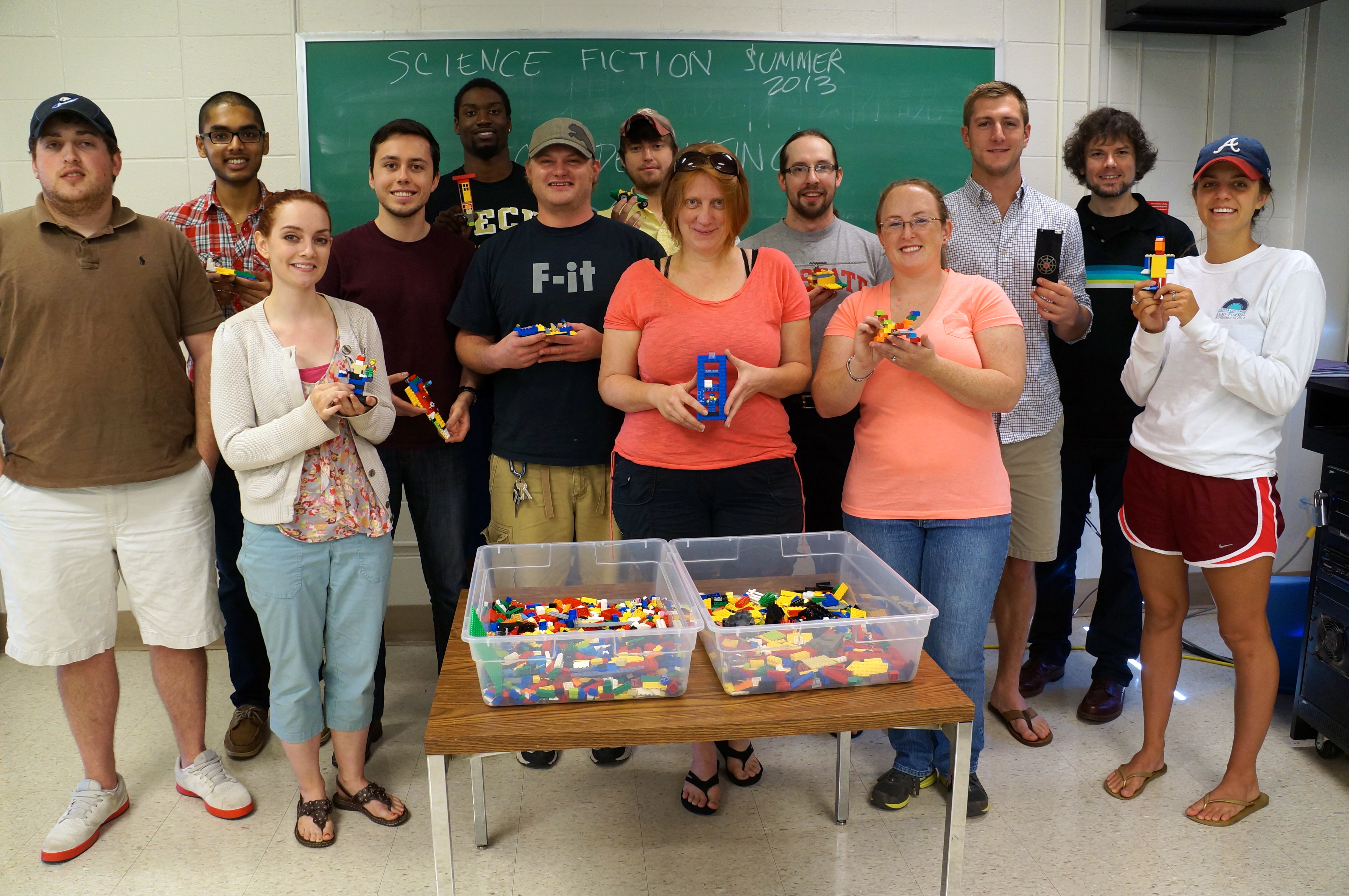
This essay was my final project in Professor Lisa Yaszek’s Science Fiction class at Georgia Tech in the summer semester of 2002. My friend Mark Warbington had recently introduced me to Blake’s 7, which I immediately liked. There were a lot of cross-connections between the subject matter of our SF class and Blake’s 7, which I found exciting and pointed the direction for some of my future scholastic work. Specifically, I wrote about technological mediation of human experience, memory, and perception in this groundbreaking British SF series.
Jason W. Ellis
Professor Lisa Yaszek
LCC3214 Science Fiction
July 26, 2002
Final Paper: Blake’s 7
Blake’s 7, the BBC science fiction television show that ran from 1977-1981, has many characters who are either computers/robots or cyborgs. These characters are either all technology or their person has been radically altered by technology. Their character traits or level of technical mediation often is reflective of their role as “good” or “bad.” These representations bring into question concepts such as “human” and “identity” in a world where technological mediation is dictated by an oppressive government.
Roj Blake is the main character of Blake’s 7 and he is a cyborg. His life experiences have been mediated with the use of chemicals and psychological treatments designed to alter his memories and divert his way of thinking in a way different from how he would have wanted it to be. When the series opens in the episode, “The Way Back,” the first scene is of a menacing black video camera, topped by a red indicator light, diligently scanning the prosaic passing by of pedestrians along a corridor. The black video camera serves as an always watchful eye over the citizens of the Earth Federation. Among the pedestrians is Blake. He is meeting with a young woman, Ravella, who is going to take Blake to meet with a man who has news of Blake’s family–at least as far as Blake knows. As they are walking Ravella asks Blake, “And eating and drinking — you’ve managed to do without?” Blake answers in an irritated voice, “Well, since you were so insistent I’ve done without food or drink for thirty-six hours.” Ravella asks him if he feels any different. Blake says that he does not. She then says, “All our food and drink is treated with suppressants. Going without for a day and a half, they should be wearing off.” Blake says laughing, “Not that again.” Blake doesn’t know that he has been modified by the Federation after he gained prominence as a renegade leader against the Federation. Instead of making a martyr out of Blake, the Federation turned him into a pawn for their uses. They had him admit his guilt and then denounce the work he had once done against the Federation. Later Blake finds his way back to who he really is, but as is shown in later episodes the Federation programming is still a part of him. This long term programming does not cause him to be “bad,” but it will allow control over his thought processes to an extent that the Federation can bring Blake to them as part of a ruse.
An extension to Federation reprogramming of people to serve a purpose is the use of Mutoids. In the second season episode “Duel,” Space Commander Travis has set a trap for Blake. Travis’ helmsman is a female Mutoid. Prior to the space battle between Travis’ ships and Blake’s Liberator, the Mutoid takes a small vial of liquid and places it in a recess on her chest. During their discussion the Mutoid refers to Travis as “an unmodified” and Travis acknowledges her “need for blood serum.” The Mutoid also notes, “Opponents of mutoid modification call us vampires.” The reason for this reference is made later in the episode when the Mutoid is in need of serum and she tries to supplant her needs by draining the blood out of bat like creatures. Then the Mutoid captures Jenna of Blake’s crew and the Mutoid extends a long hypodermic needle from her arm gauntlet, but Travis stops the Mutoid before she is allowed to use it. On the night before Jenna’s capture Travis and the Mutoid are waiting up in a tree for daylight. Travis asks the Mutoid, “Tell me something, do you remember who you were?” Travis is referring to the Mutoid’s life before she was “modified.” Travis is clearly attracted to the Mutoid and he tries to interest her with information about her past, “Your name was Keyeira…You were very beautiful, very much admired.” Unfortunately for Travis the Mutoid had no interest in her past life. Her transformation from Keyeira to the Mutoid was complete and unencumbered. The chemical and technological alterations to her body made her a cyborg. Her mental programming however made her much more like a robot in that she was self aware, but uninterested beyond what her duty was. The role of the Mutoid is a tool. She is to follow orders and be a contributing officer of the Earth Federation.
During the second season the viewer is introduced to a clone of Blake in the episode, “Weapon.” Clonemaster Fen makes two clones of Blake based on the Federation’s “DNA identity profile” of Blake which the Clonemasters were able to deduce “a full genetic pattern” which they used to build the multiple Blakes. Clonemaster Fen says of these new Blakes, “We may copy life. We may not create new forms. This man is a copy of Blake, a physical copy only, because he was not grown from a cell taken from Blake. And since he has not Blake’s experiences, he cannot be Blake. We have given him some background knowledge, the beginnings of identity, and the basis of understanding.” This clone of Blake is a being grown in a laboratory and has its memory imprinted by technological means. It is a cyborg in that it was not born of woman and that its knowledge and mind were developed inside a computer and implanted with technological equipment. This clone soon meets up with another cyborg, Rashel.
Rashel is a labor-grade slave who Coser, the inventor of IMIPAK, brings with him on his escape from the Federation. At the beginning of the episode, “Weapon,” Coser and Rashel are watching their space craft explode. Rashel keeps answering Coser as “yes, sir.” Coser responds loudly to her, “And don’t call me, sir. You’re not a slave anymore. You’re with me now. I set you free.” Not much is said of how a labor-grade slave comes to be, but looking at how the Federation has a special corp devoted to reprogramming of persons to fitted roles in society, I venture that Rashel was likewise programmed. This could have taken the form of being raised with psychological conditioning and administered drugs as in Huxley’s Brave New World, or she was like the Mutoid in “Duel,” with a unique past which was taken from her when she was reprogrammed by the Federation. Coser who says he has freed Rashel has his own problems adjusting to Rashel’s new station as a free person. He constantly bosses her around and physically acts out in rage about her sometimes not understanding a situation or something that he has said. After Rashel has been assaulted by a monster inhabiting the planet they are on, she says, “Perhaps that was the only one.” Coser angrily says, “Perhaps, perhaps! Just get on with it, will you?!” Rashel yells back to Coser, “Stop treating me like a bond slave! [Coser picks up the projector] You set me free.” In a way it seems that Rashel was programmed to fill a certain role in society and those around her who know her station respond in kind. Coser has his own programming to overcome, but he is soon killed by the weapon he created so he doesn’t have the chance to deprogram the remains of Federation control over him.
Rashel and the clone Blake team up to make the Federation leave the abandoned planet where the action takes place in “Weapon.” Using IMIPAK they “tag” Servalan and Travis so that if anyone activated the trigger on IMIPAK Servalan, Travis and anyone else within a million miles range who has been tagged would be killed. The Clonemasters who made the Blake clone follow “the Rule of Life.” The clone Blake slips into this mode of thinking in his conversation with Coser when they first meet. Blake laces his fingers together and says, “All life is linked.” Servalan and Travis after obtaining IMIPAK wish to use it to demand absolute control over all. If someone is tagged with the IMIPAK projector then they could be killed at any point of their life with the IMIPAK trigger. When Coser was talking to the clone Blake about the potential of IMIPAK he said, “Selected victims, groups, whole populations. You can be like God.” The clone Blake understands the potential of this weapon and it violates the primary foundation of the Clonemaster’s programming. When the life of Rashel is threatened by Travis, the clone Blake throws his arms around her and says, “No! All life must have reverence.” The clone of Blake and the freed labor-grade slave, Rashel are more positive roles of cyborgs compared to Mutoids and the negative reprogramming done by the Federation. The Clonemasters value life and instilled that in the clone of Blake. Rashel was given the opportunity of freedom despite the one who freed her not quite coming to terms with that. Together they start out as Rashel says at the end of “Weapon,” “Then we could start to explore our planet.”
The Mutoid is the most cyborg of the characters in that her memory is erased and her body has been modified to handle much different situations than an unmodified human. The trade off is that her body is dependent on a blood serum. In being the most modified of the characters she is representative of the Federation and evil. The less technically mediated characters are those of Blake, Blake’s clone, and the freed labor-grade slave, Rashel. These characters break out of their assigned and programmed roles that the Federation has prepared for them. In doing so they become identified as “good” and they work against the Federation which is “bad.” Blake’s clone and Rashel work together to claim a planet for themselves by using a Federation weapon against that oppressive government. Blake reclaims his memories and identity after being forced to do so when the renegade organization he once led asked him back after he had been reprogrammed by the Federation to denounce them.
After Blake, Jenna, and Avon take control of the alien space ship that Blake calls the “Liberator,” they are introduced to the ship’s computer, Zen. In the third episode, “Cygnus Alpha,” Zen introduces himself and the crew begin to see how he operates and what his and the ship’s capabilities and limitations are. Zen can control the ship on voice command. It can also monitor ship’s internal (how badly have we been damaged?) and external sensors (are there ships following us?). Zen’s integration with the ship is not completely revealed. One way of looking at Zen is that of a robot who follows certain rules and obeys orders. The difference is that the robot is built into the ship and is referred to as a “computer.” Zen is not merely a device to figure things out and process information. Zen is able to perform assigned tasks and monitor other maintenance systems onboard ship such as the automatic repair function. There is a negative side to Zen’s abilities in that it can be “taken over” and controlled by remote. Another computer/robot called Orac was able to do this, and the alien builders of the “Liberator” were able to take control of Zen and fly the “Liberator” back to its home station.
Blake’s crew also encounters another computer called Orac who becomes one of the crew. This computer is able to view all Federation communications traffic as well as it has access to all computer stored information owned by the Federation. It is able to do this because it was built by the creator of the computer chips of most of the Federation’s computer systems. In his chip design there is a special part that Orac has access to–a kind of backdoor. Orac’s processing ability and it’s almost infinite access to information reveals that it is a very powerful computer. Again, Orac is also much like a disembodied robot in that it is able to perform assign tasks and it operates on a set of built-in rules. Orac is able to control other computer systems including Zen in the “Liberator.” Orac is subject to subversion on some of the carrier waves it uses for communication with other computer systems because it extends into dimensions outside of our own. An intelligence in another dimension once tried to use this carrier wave to enter our universe/dimension through Orac.
Zen and Orac serve positive roles in that they serve Blake and his crew. But they are subject to the same kind of problems that affect any centralized computer system. If the central computer is compromised then the whole system is compromised.
The prison ship serves as an analogy for the Federation in general. The ship relies on the central computer. Blake is trying to convince Avon to assist with the takeover of the ship. Blake knows that Avon’s skills are invaluable to his plan. Blake quizzes Avon on his abilities to operate the prisoner ship’s computer in the second episode, “Space Fall.” Avon responds, “ I could open every door, blind all the scanners, knock out the security overrides, and control the computer. Control the computer and you control the ship.” The Federation is also integrated to a great deal with it’s computer systems. In later episodes which culminate to the second season’s finale, “Star One.” Star One is the hidden base of the Federation’s central computer system. This computer system organizes and modulates all systems of production, economies, and weather systems on all the Federation’s worlds. It’s location is hidden even from upper command of the Federation because knowledge of its existence and its control would be the ultimate power in the Federation.
Centralized computer systems are the norm in Blake’s 7. Those that serve good are often more humanized than those that serve the forces of oppression and the Federation. Orac and Zen have names whereas the computers of the Federation are merely “computers.” Orac and Zen talk and have a higher level of interaction with the characters than do the computers of the Federation. Federation computers often involve Federation personnel reading off displays and dials what is going on. Orac and Zen have human elements of thought and action. The Federation computers require a human mediator to supply information and retrieve information.
Computers and cyborgs in Blake’s 7 both offer insight into the ideas of human and machine integration and interaction. Computers fill the role of the robot and information processing systems. Computers which are on the side of “good” are often more human than those on the side of “bad.” Cyborgs are presented as varying degrees of humanity reprogrammed and modified to serve a role dictated by the oppressive Federation. Some cyborgs are able to break out of this programming and in turn innovate their own programming. Others must maintain their role because of chemical necessity as is the case of the Mutoids. Those cyborgs who are less chemically mediated tend to be the more positive roles such as Blake, the clone of Blake and the labor-grade slave, Rashel.