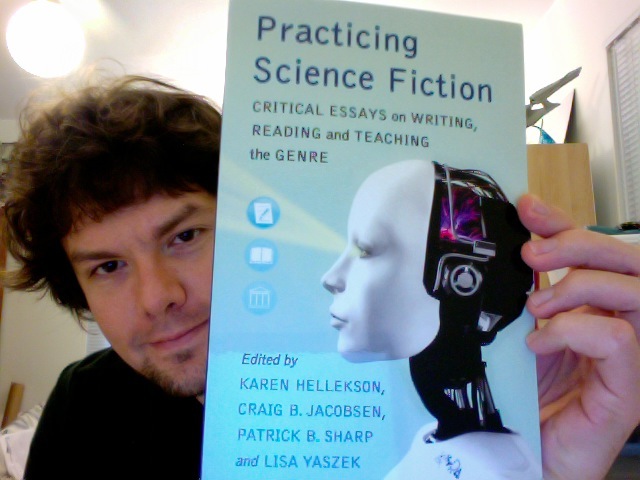
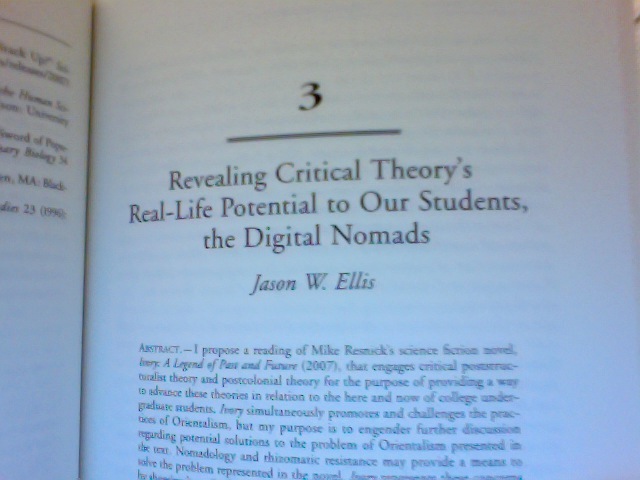
I received a nice Media Mail surprise today: Karen Hellekson sent me a complimentary copy of the book that she edited along with Craig B. Jacobsen, Patrick B. Sharp, and Lisa Yaszek from McFarland Publishers titled Practicing Science Fiction: Critical Essays on Writing, Reading, and Teaching the Genre. I’m particularly tickled about this arrival, because this is my first book chapter! My long ago essay, originally written for Masood Raja’s Postcolonialism course during my first year at Kent State and substantially rewritten since then for conferences and now this book project, has finally seen the light of day in print as chapter three of this collection titled, “Revealing Critical Theory’s Real-Life Potential to Our Students, the Digital Nomads.”
I have included a copy of the Practicing Science Fiction’s overview and chapter abstracts below, copied from Karen’s website. Please pick up a copy from the publisher here or on amazon.com here. Royalties from the collection go to the Science Fiction Research Association, of which I am a member and the organization’s publicity director.
Practicing Science Fiction
Karen Hellekson, Craig Jacobsen, Patrick Sharp, and Lisa Yaszek
Overview
The edited volume Practicing Science Fiction: Critical Essays on Writing, Reading and Teaching the Genre (ISBN 978-0-7864-4793-0) seeks to add to the academic literature related to reading, writing, and teaching science fiction. By presenting these ideas together, we hope to show the synergy between these modes of engagement and analysis. No edited volume has addressed the intersection among these three topics. The concerns of reading, writing, gender, and media—the topics that comprise the four sections of the book—are used to distance and critique concerns of interest to those interested in intellectual growth. The contributors to the teaching section discuss how science fiction texts lend themselves to teaching things other than SF literature. The writing section is not a how-to, but rather analyses of inscription and reinscription of knowledge and tradition through reading and writing. Finally, the sections on media and women contain close readings of exemplar texts related to larger issues such as female agency, memory, and ecodystopia that are usefully articulated through the distancing of SF.
Abstracts
From Practicing Science Fiction: Critical Essays on Writing, Reading and Teaching the Genre (c) 2010 SFRA by permission of McFarland & Company, Inc., Publishers, http://www.mcfarlandpub.com.
Part 1. Teaching
Teaching with Science Fiction
Section edited by Craig Jacobsen
The essays in this section demonstrate that pedagogical studies are integral to, rather than tangential to, the scholarship of science fiction. Understanding science fiction requires more than just being able to dissect a story or novel, or apply a theoretical viewpoint to a film. A profound understanding of science fiction means realizing what science fiction can be made to reveal about the world. (pp 7–12)
1. Grokking Rhetoric through Science Fiction: A Practical Examination of Course Construction
Jen Gunnels
Traditional teaching methods and materials for core curriculum all too often leave the student disengaged, or worse, confused. A text’s placement in the Western canon does not automatically make it accessible or engaging. It can leave the students bored and unconnected, and it can give them an inaccurate perception of rhetorical thought and the writing process. That is not to say that the canon is not important—it is—but often undergraduate core courses, especially mass courses such as rhetoric and composition, fall back on the same few texts. A reliance on canonical material—canonical to the instructor, but often unfamiliar to undergraduates—splits student focus between understanding the materials used to illustrate the concepts and the concepts themselves. A more accessible literature has the potential to free the student to concentrate on the new, often complicated, ideas being presented, and science fiction in particular can engage students who are studying core subjects by providing exemplar texts that clearly and compellingly illustrate major fundamental points. Here, I examine the use of science fiction in teaching basic undergraduate rhetoric and composition, and I reenvision its implementation. I include basic rhetorical elements that a course should cover, and I analyze a sample assignment, a brief rhetorical analysis of Tom Godwin’s 1954 story “The Cold Equations,” to illustrate basic rhetorical tools and wider arguments affecting rhetorical choices. (pp 13–23)
2. Incorporating Science Fiction into a Scientific Rhetoric Course
Michael J. Klein
Many of the scientific and technological achievements of the past century were prefigured by writers of speculative or science fiction. The scientific and technological achievements we view as commonplace (e.g., the Internet, wireless communication, advances in reproduction) were often discussed by literary authors decades before their “discovery.” Conversely, advances in science and technology drove authors to further their speculations and logically extend the discoveries of the day in their writing. In that spirit, I decided to expand the traditional canon of works I used in a scientific rhetoric course to include works of science fiction. The students in the course compared and contrasted the representation of science and scientists in fictional and factual accounts, examined the ways in which texts become important to a culture and a discourse community, and identified the means by which science informed science fiction, and vice versa, during the past century. I found that for undergraduates, the addition of literature made the concepts of scientific rhetoric more accessible and fostered greater conversation between students studying different subjects. The students in the humanities and social sciences used the literary works as a stepping stone to understanding the discourse within the scientific community. Conversely, students in the sciences and engineering recognized and appreciated the humanistic elements of science by seeing parallels in the works of fiction. These results speak to the benefits of increased dialogue among disciplines that address the concepts of science and technology. (pp 24–36)
3. Revealing Critical Theory’s Real-Life Potential to Our Students, the Digital Nomads
Jason W. Ellis
I propose a reading of Mike Resnick’s science fiction novel, Ivory: A Legend of Past and Future (2007), that engages critical poststructuralist theory and postcolonial theory for the purpose of providing a way to advance these theories in relation to the here and now of college undergraduate students. Ivory simultaneously promotes and challenges the practices of Orientalism, but my purpose is to engender further discussion regarding potential solutions to the problem of Orientalism presented in the text. Nomadology and rhizomatic resistance may provide a means to solve the problem represented in the novel. Ivory represents these concerns by showing how the fictional problem and its solution in fact epitomize our everyday digitalized and online existence. The novel explores models and provides examples of the online technologies that digital nomad students may use for self-empowerment and personal protection from the encroachment on their lives by the state and by global capital. (pp 37–50)
Part 2. Reading
Reading and Writing SF
Section edited by Patrick Sharp
The attempts of some to divide the sciences and humanities into two cultures ignore the fact that both contribute to the same system of genres that circulate throughout our culture. Scientists regularly draw on SF to make the case for why their science is important and worthy of funding. Authors of SF regularly draw on scientific narratives as they develop their “charming romances.” Though the system of genres in our culture has evolved over time, this interchange between science and SF has remained constant. The essays in this section explore specific texts as sites of this ongoing exchange between the interconnected subcultures of science and literature. They also address the importance of literacy—in regards to both science and literature—to the traditions of SF reading and writing. (pp 53–57)
4. Reading/Writing Martians: Seeing Technē and Poiēsis in The War of the Worlds
Charles Harding
From its opening lines, The War of the Worlds is concerned with seeing, or comprehending, through reading and writing. Wells’s novel emerges from a cultural environment in which a lack of foresight and illiteracy mark future-war stories and scientific discourse. Wells interrogates this cultural blindness and fosters competency by presenting his narrator as a scientific—that is, a knowing—spectator of the Martian invasion. The narrator strives to distinguish himself from those who exhibit nescience in relation to the attack. His insight proceeds from his ability to read—to comprehend and translate—what emerges from the Martian cylinders. The Martians figure as a prevision of a technologized future, and the narrator’s scrutiny of their features and annihilative machinery reveals a potentially dangerous element in humanity’s relationship to technology. This danger manifests in the Martians’ degenerate technē, their transformation of the world into a totally mechanized and depersonalized system. Despite the forbidding nature of this futuristic world, the possibility remains that it may be averted. This possibility lies in poiēsis, or artistic producing, which in The War of the Worlds culminates in the narrator’s rewriting of the invasion. According to Heidegger, poiēsis constitutes a space for an essential reflection on the danger for humanity in technology. Wells’s novel offers an opportunity for reflection on future humankind, embodied in the Martians, and its relationship to advanced technology by inviting readers to see alongside the narrator as he scrutinizes the Martians and their technē. With The War of the Worlds, Wells suggests that science fiction must be knowing fiction. (pp 58–73)
5. The Creation of Heinlein’s “Solution Unsatisfactory”
Edward Wysocki
Robert Heinlein’s short story “Solution Unsatisfactory,” which appeared in Astounding Science-Fiction in May 1941 under the pen name Anson MacDonald, is well known for its presentation of a precarious world situation after the development of a nuclear weapon. This story appeared well before the establishment of the Manhattan Project for the development of an atomic bomb. Knowledge of the state of nuclear physics in the time before the story’s creation is presented to show that its concept grew from an uncertainty regarding the means by which an atomic bomb could be constructed. The source of basic premise of the story, the use of radioactive dust rather than a bomb, is identified as Astounding’s editor, John W. Campbell Jr. Development of the story, while retaining the basic weapon concept, was then taken by Heinlein in a different direction than had been originally suggested to him. Possible sources of technical information available to Heinlein are then considered, and a connection shown to a friend of Heinlein who had just received his PhD in the field of nuclear physics, Robert Cornog. The dust idea presented in the story occurred shortly before the same idea appeared in a report developed to suggest possible military applications of atomic fission. Although the close timing between the work of fiction and the report has been noted previously in the literature, no effort had apparently been made to establish a connection. In this essay, I propose a definite connection. (pp 74–86)
6. Entropy, Entertainment, and Creative Energy in Ben Bova
Donald M. Hassler
Even though Ben Bova is discounted by some as an “easy” writer or, perhaps, even because of this fact, his usefulness as a representative of the genre has impressed me. Further, I like his storytelling both for its ease and for its consistency. So this essay is one of several I have written attempting to account for genre effects in SF. I discuss several recent Bova novels, each dealing with the extrapolation of what we know of one of the planets in our system; and I find, in fact, some rich resonance of what I call “genre effects” in these books. I write in part as a fan, as well as an academic who hopes to set enthusiasm into the larger context of literary study. Many of Bova’s storytelling techniques seem outdated because they appear in the same milieux as postmodern experimentation, and I evoke the family romance metaphor from Freud—we tend to seek out and to feel comfortable with the “generation” of our fathers. Much of my point, then, about Bova’s effects is captured in what I label in the title as “the entropy” of reading and genre. I argue that the vigorous generation, or family sense, in these science stories allows us to see beyond. (pp 87–96)
Part 3. Media
Media and Science Fiction
Section edited by Karen Hellekson
The proliferation of nonprint SF texts, such as film, television, Web content, comic books, and video games, indicates that SF remains a valuable and generative mode of storytelling. All three essays use close readings of exemplar nonprint texts to draw conclusions about contemporary concerns. And all three essays rely on texts that are themselves part of a larger multimedia megatext, be it the Doctor Who or Watchmen universes, or the film megatext created by the subgenre of the ecodystopia. All three essays rely on displacement—of genre, of medium, of message, of memory. They illustrate the power of nonprint SF as a tool to effectively engage with contemporary concerns. (pp 99–103)
7. Remembering Torchwood: Investigating the Postmodern Memory Crisis on the Small Screen
Susan A. George
In this analysis of the importance and reliability of memory in the context of postmodern SF, I use close readings of two exemplar episodes ( “Adam” and “Sleeper”) of the television program Torchwood (2006–9) to explore the fundamental nature of humanity. Torchwood asserts that some essential qualities escape quantification. These qualities define the human and separate the human from the nonhuman. Memory is the locus of these qualities, not some metaphysical or religious construct called the human soul. (pp 104–16)
8. Text’s Resistance to Being Interpreted: Unconventional Relationship between Text and Reader in Watchmen
Ho-Rim Song
Alan Moore and Dave Gibbons’s graphic novel Watchmen (1986–87) experiments with postmodern literary devices, forms, and style to problematize the conventional concept of interpretation. In particular, the text deconstructs the conventional relationship between text and readers as the interpreted and the interpreter, and by doing so, it calls into question readers’ perception of their own reality as well as that of the text. Watchmen ultimately claims that interpretation, or the act of finding truth or meaning, is meaningless for our postmodern reality. (pp 117–29)
9. “Breathe, baby, breathe!” Ecodystopia in Brazilian Science Fiction Film
Alfredo Suppia
This analysis of four ecodystopian Brazilian SF films—Claudinê Perina Camargo’s 93° Tunnel (1972), José de Anchieta’s Stop 88 (1978), Roberto Pires’s Nuclear Shelter (1981), and Marcos Bertoni’s Armadillo Blood (1986)—demonstrates that ecodystopia is one of the most structured and long-lasting manifestations of science fiction in Brazilian cinema, offering critical and speculative visions at the crossroads of social, political, and environmental issues that continue to remain strikingly relevant today. These films shed light on Brazilian anxieties regarding modernization in the atomic era that reflect greater world ecological concerns that are only becoming more compelling. (pp 130–45)
Part 4. Women
Women and Writing
Section edited by Lisa Yaszek
Women’s science fiction has taken a wide variety of forms over the past two centuries, but nearly all such writers have grappled with two fundamental questions: who counts as a hero in a technoscientific world, and what story forms best convey this heroism to readers? These questions are very much at the heart of the four essays included in this section. The first two authors examine how two iconic women writers, Joanna Russ and Octavia Butler, complicate received ideas about the nature of the science fiction hero. The second set of authors explore how women writing science fiction use their narrative practices to meditate on the nature of storytelling itself. (pp 149–53)
10. Hail the Conquering Campbellian S/Hero: Joanna Russ’s Alyx
Eileen Donaldson
For many theorists, both feminist and not, the figure of an archetypal, active female warrior hero has been problematic. Many feminists believe it is gender stereotyping to suggest that women are unable to possess the force of the archetypal warrior hero and that this archetype is ultimately available to both men and women. I briefly define the nature of the archetypal hero and an argument is made for the active female s/hero who possesses the “masculine” powers of the hero and thus allows the archetypal power of the active warrior hero to pass to women. Joseph Campbell’s work on the archetypal hero of myth is drawn on extensively. One of the genres that allow an exploration of the s/hero is SF. I explore the s/hero in SF, particularly as she is evoked in Joanna Russ’s Alyx stories, published as short stories first and then collected in 1983 and published as The Adventures of Alyx. (pp 154–67)
11. Essentialism and Constructionism in Octavia E. Butler’s Fledgling
Kristen Lillvis
Although critics have argued that science fiction writer Octavia E. Butler confines her heroines to biologically determined sex and gender roles, in this article, I look beyond genetic predispositions and explore the influence of social and material conditions on her characters’ beliefs and actions. I use Butler’s final novel, Fledgling (2005), to investigate acts of sexual violence, demands of heterosexual sexual practices, and traditional notions of maternal roles as they affect the novel’s human and vampire species as well as Butler’s protagonist, a genetically engineered being whose biology aligns her with both species but whose amnesia frees her from a socially constructed consciousness. I posit that although biological tendencies may exist in the novel, Butler uses her heroine’s atypical beliefs about and responses to female behavioral norms to demonstrate that sex-specific characteristics become unavoidable truths only for the individuals and societies that choose to accept them as such. (pp 168–82)
12. Joanna Russ and the Murder of the Female Child: We Who Are About To…
Rebekah Sheldon
In this essay, I investigate the violation of the rescue of the female child theme in Joanna Russ’s 1977 novel We Who Are About To…. In stories like “The Second Inquisition” (1970), Russ positions the reader as the double of the child in the plot and rescues both by engendering the story as a hero. I assert that We Who Are About To… rends open this closed loop through its refusal of proper narrative structure and its murder of the female child. I interpret this murder as an interrogation of the metaphysics of presence implicit in the rescue thematic, a move to a deconstructive writing practice and a liberation of the child from service as the site of future redemption. (pp 183–96)
13. Learning to Listen, Listening to Learn: The Taoist Way in Ursula K. Le Guin’s The Telling
James H. Thrall
Ursula K. Le Guin’s The Telling (2000) is more than simply a novel steeped in Taoism. It is, in fact, an attempt to make a political point by imagining a novel in a Taoist mode. Her protagonist moves beyond merely studying the Telling, a way of life modeled on Taoism, to becoming a practitioner herself. Le Guin contrasts her construction of the Telling’s grassroots system of communicating life wisdom through story with hierarchical systems of domination and control. By emphasizing the importance of properly engaged listening, which she sees as a key aspect of both Taoism’s and the Telling’s feminist principle, Le Guin advocates an alternative politics that embraces “peaceful anarchy” rooted in cooperation and discernment rather than conflict. (pp 197–212)
Citation information
Hellekson, Karen, Craig Jacobsen, Patrick Sharp, and Lisa Yaszek, eds. Practicing Science Fiction: Critical Essays on Writing, Reading and Teaching the Genre. Jefferson, NC: McFarland, 2010.