Alas, poor Yorick! I knew him, Horatio: a fellow
    of infinite jest, of most excellent fancy: he hath
    borne me on his back a thousand times; and now, how
    abhorred in my imagination it is! my gorge rims at
    it. Here hung those lips that I have kissed I know
    not how oft. Where be your gibes now? your
    gambols? your songs? your flashes of merriment,
    that were wont to set the table on a roar? Not one
    now, to mock your own grinning? quite chap-fallen?
    Now get you to my lady's chamber, and tell her, let
    her paint an inch thick, to this favour she must
    come; make her laugh at that. -Shakespeare, Hamlet
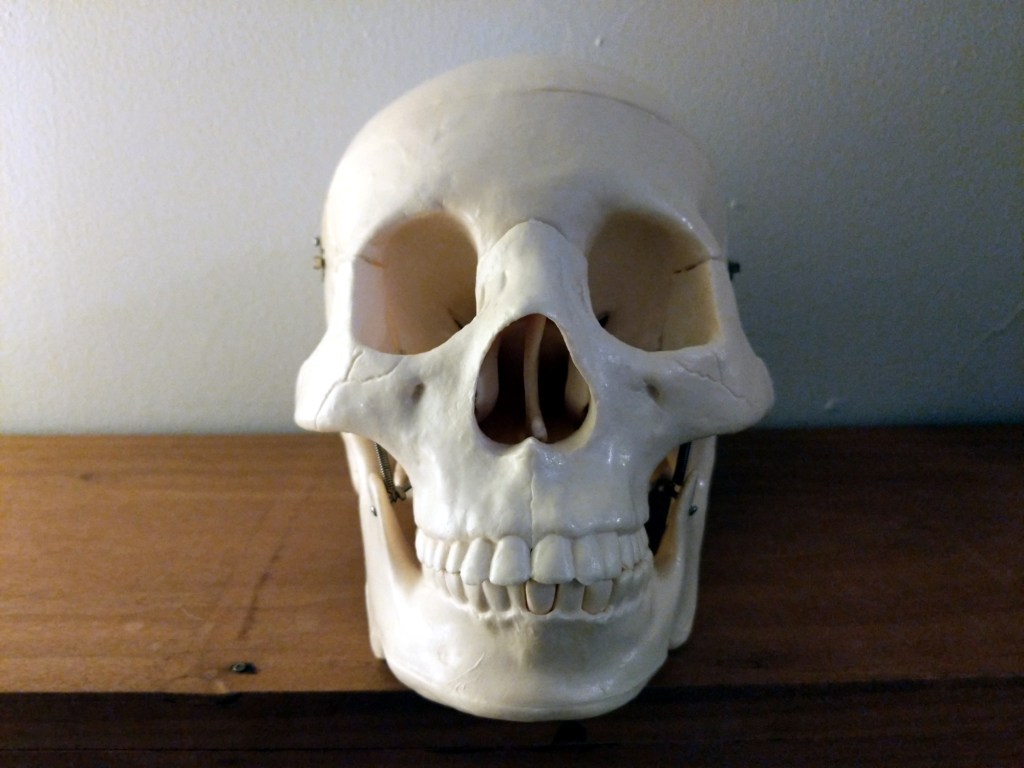
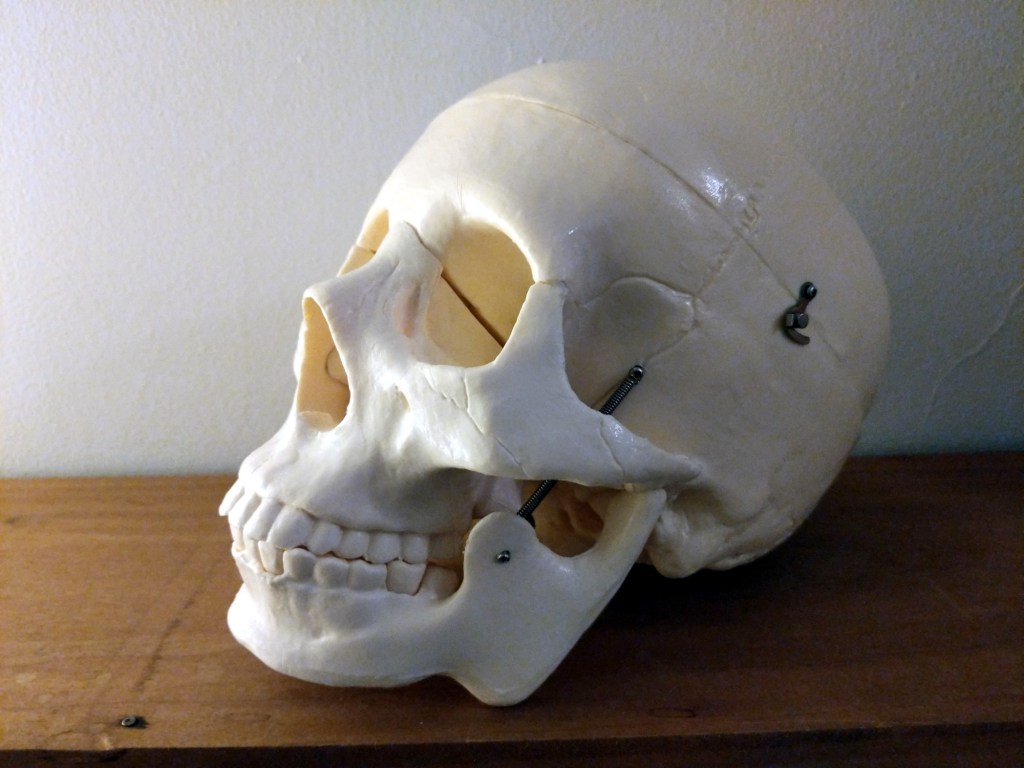
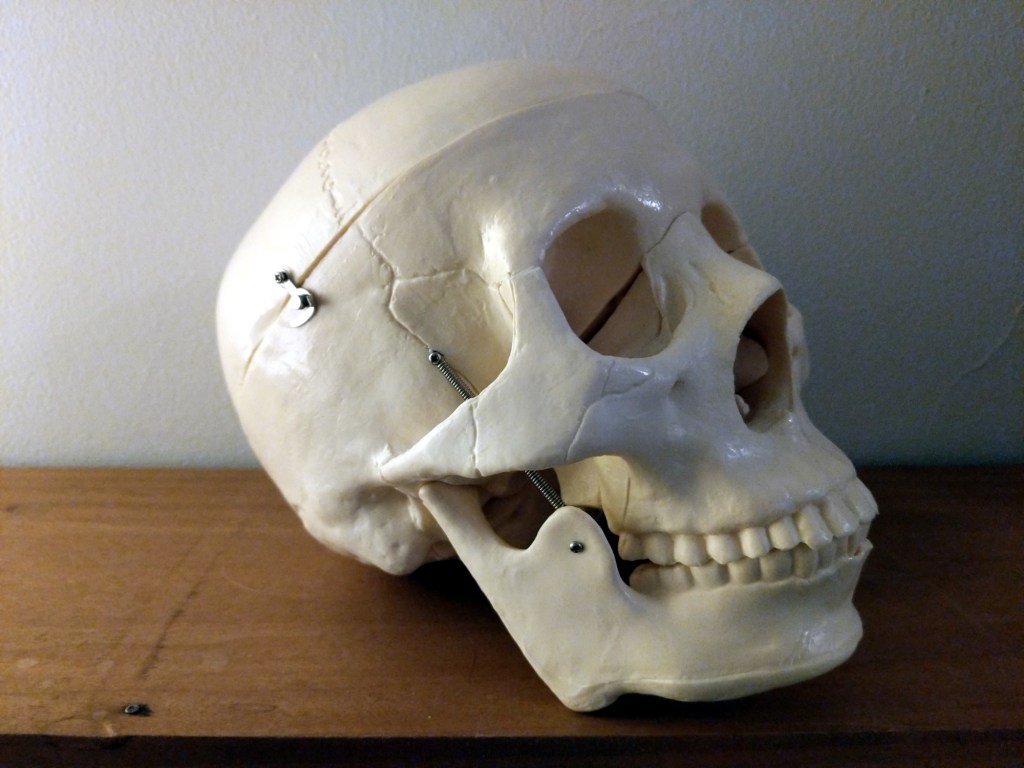
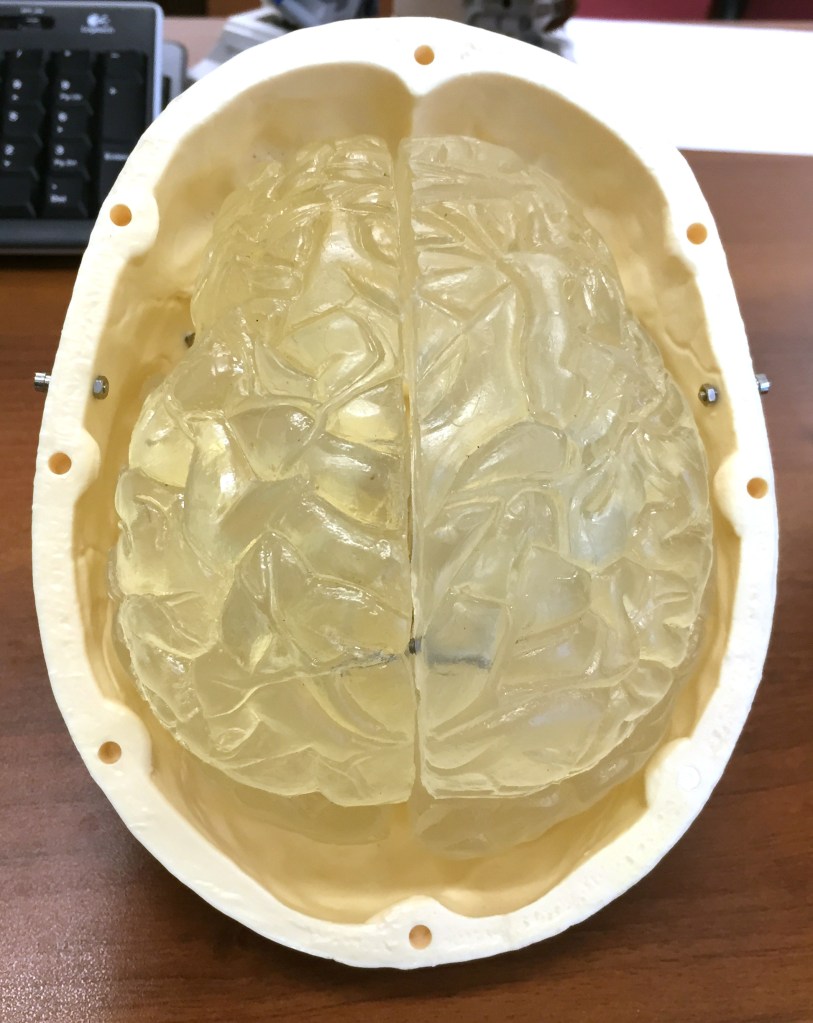
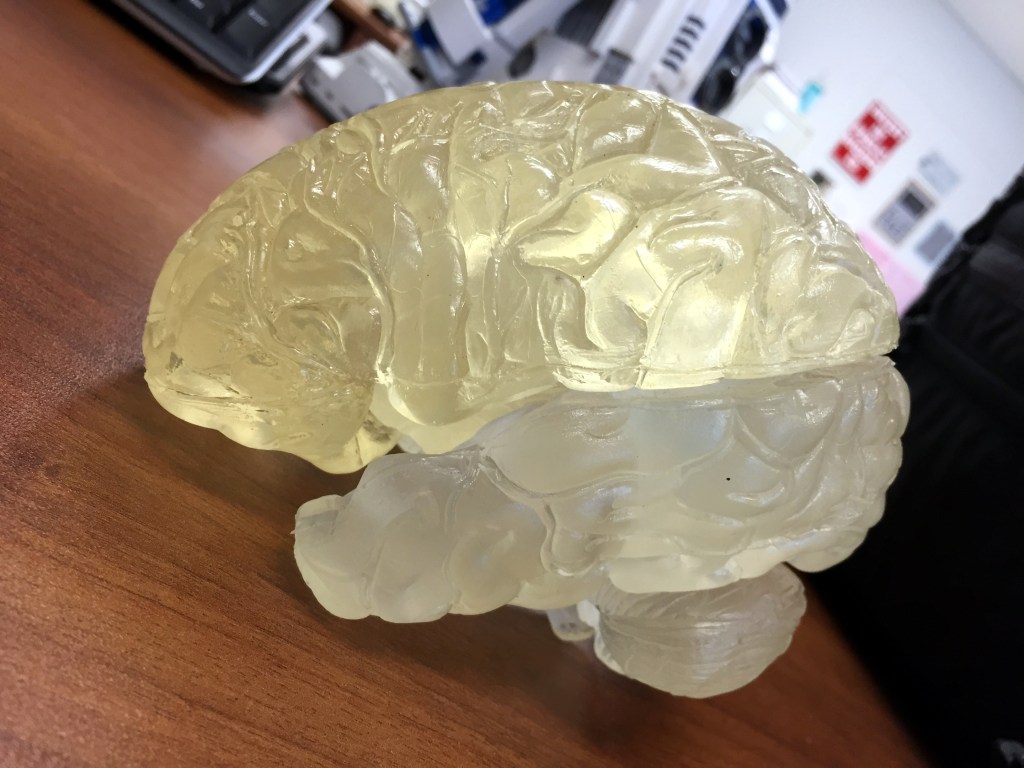
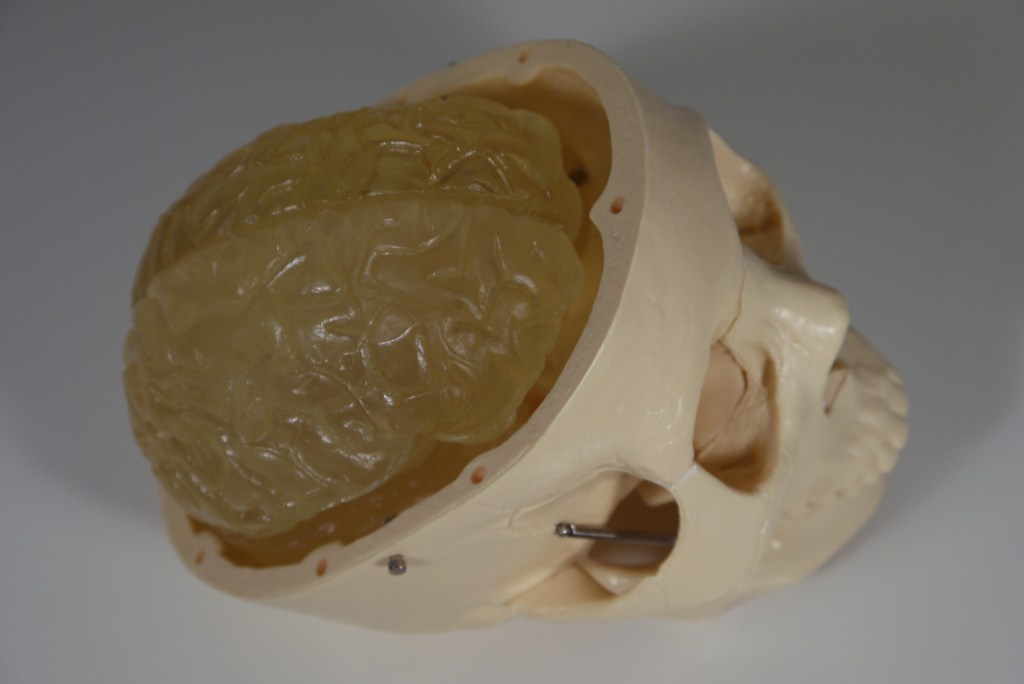
I bring my trusted skull and brain model nicknamed Yorick to my writing and science fiction classes when I want to talk about something related to cognition–e.g., how our attentional focus works, cognitive costs of switching cognitive tasks, time delay from sensory perception to processing to conscious awareness, where are the speech regions–Broca’s area and Wernicke’s area–located, etc. Yorick’s skull and multi-component brain gives students something that they can see and feel and manipulate when it gets passed around the classroom.
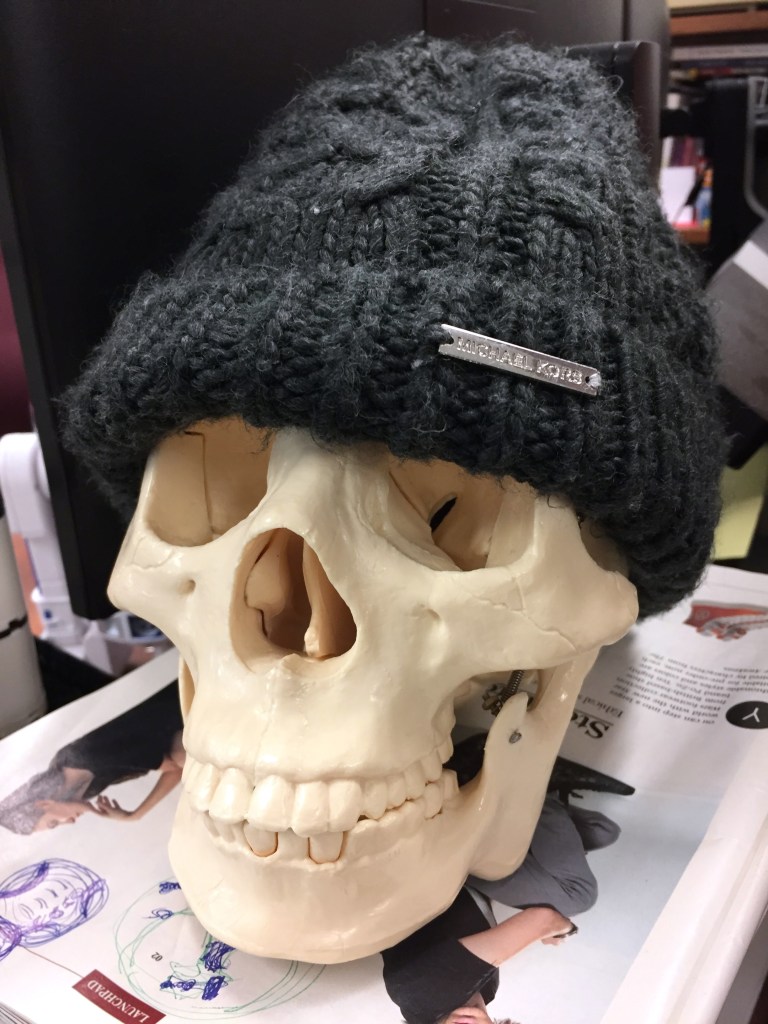
And when students leave a hat behind, Yorick gets a treat.
In my post-PhD academic career, I’ve had two offices–one at the Georgia Institute of Technology and one at the New York City College of Technology, CUNY. Both were/are in shared office spaces. Thankfully, the desks were not shared (a loathsome experience that I had at Mindspring years ago), so I can keep my things on my desk without concern someone will move them or mess with them. Since I spend so much of my life at work, I like to make these spaces my own to make myself and perhaps others happy to be in their proximity. I’ve combed through my photo collection to find the following snapshots of my office spaces over the years.
2012-2014, Georgia Institute of Technology
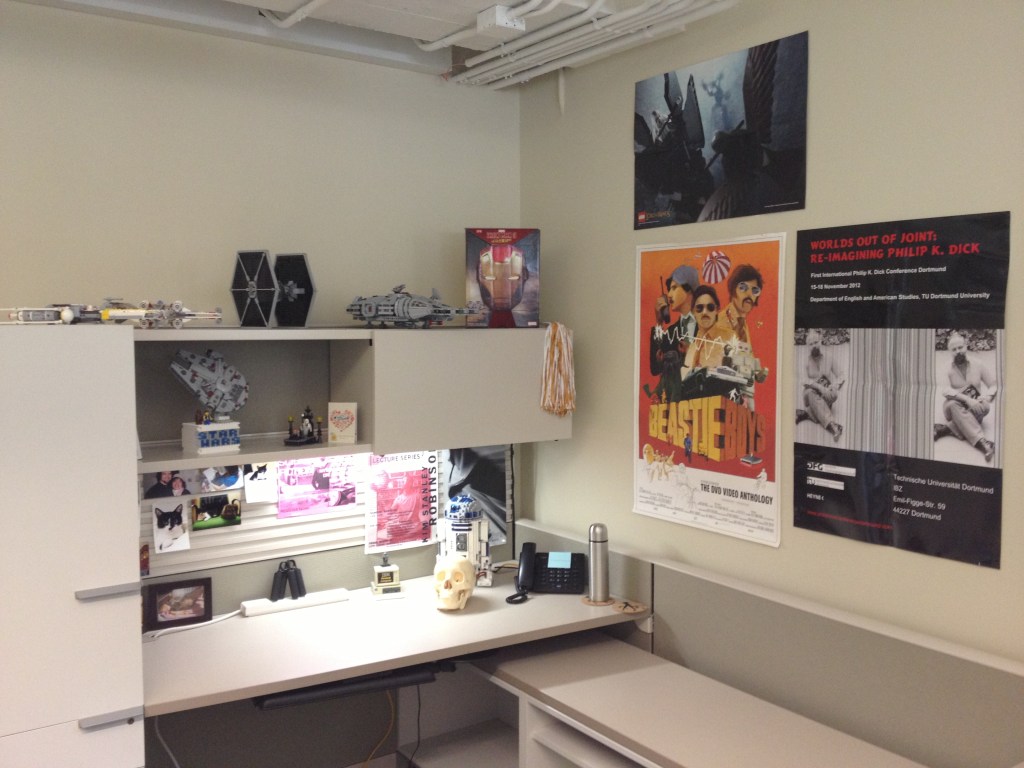
Fall 2013
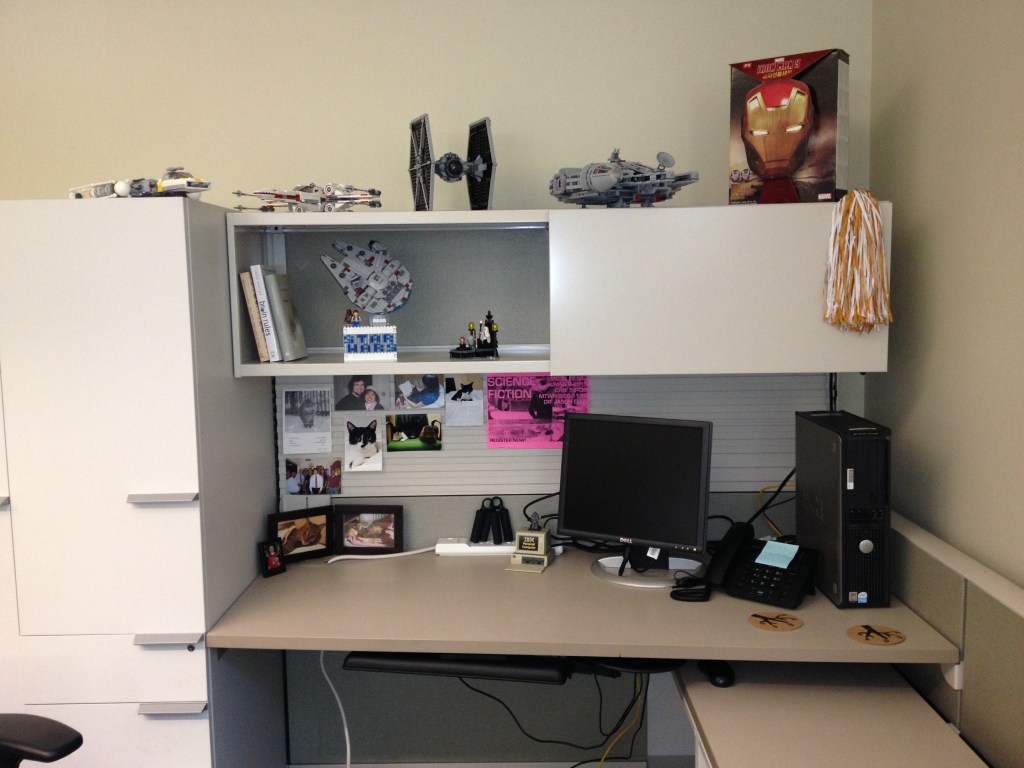
The Brittain Fellows’ office space in the Col. Stephen C. Hall Building has an open floor plan in large rooms with each Brittain Fellow getting a large cubical space with cabinets and shelving. This was a great place to work, collaborate with colleagues, and interact with students during office hours.
By Fall 2013, I had put up some favorite posters of LEGO LOTR, The Beastie Boys (not realizing that this could foreshadow where I was going next!), and the Philip K. Dick conference that I presented at in Dortmund, Germany. I had some favorite Star Wars LEGO sets and a cool Japanese-imported Iron Man snack box.
2014-Present, New York City College of Technology, CUNY
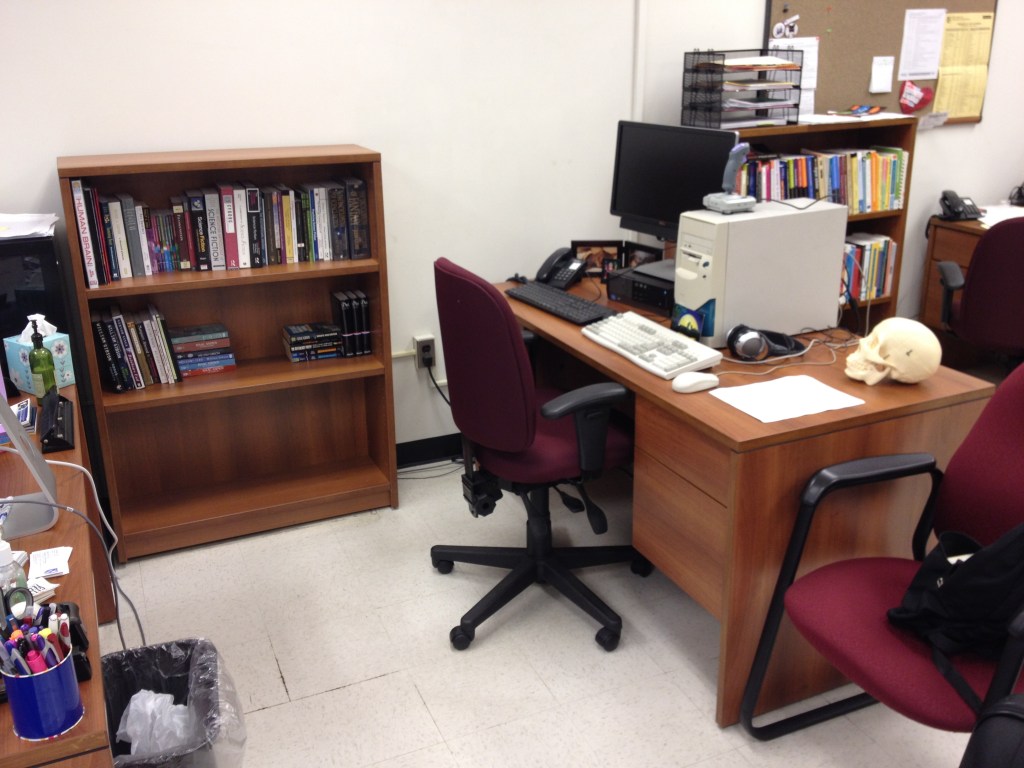
Fall 2014
This picture shows my office space within the six-person office that I share at City Tech after I first moved some things in at the beginning of the Fall 2014 semester. Each faculty member gets an allotted square footage of office space within a larger room shared with other faculty members. I have a great cohort of office mates who I have found to be collegial, collaborative, and supportive. It was agreed before I was hired that this office would not employ cubical walls, which might lend itself to a more open atmosphere of conversation and co-working than in other office areas with cubical dividers or fewer number of faculty members.
Within the next month of Fall 2014, I had added posters to the wall of an Apple I computer board and Star Wars LEGO sets on my desk and bookshelf.
By the end of the Fall 2014 semester, I had presented a paper at the annual research poster session, which I proudly displayed above my bookshelf.
Spring 2015
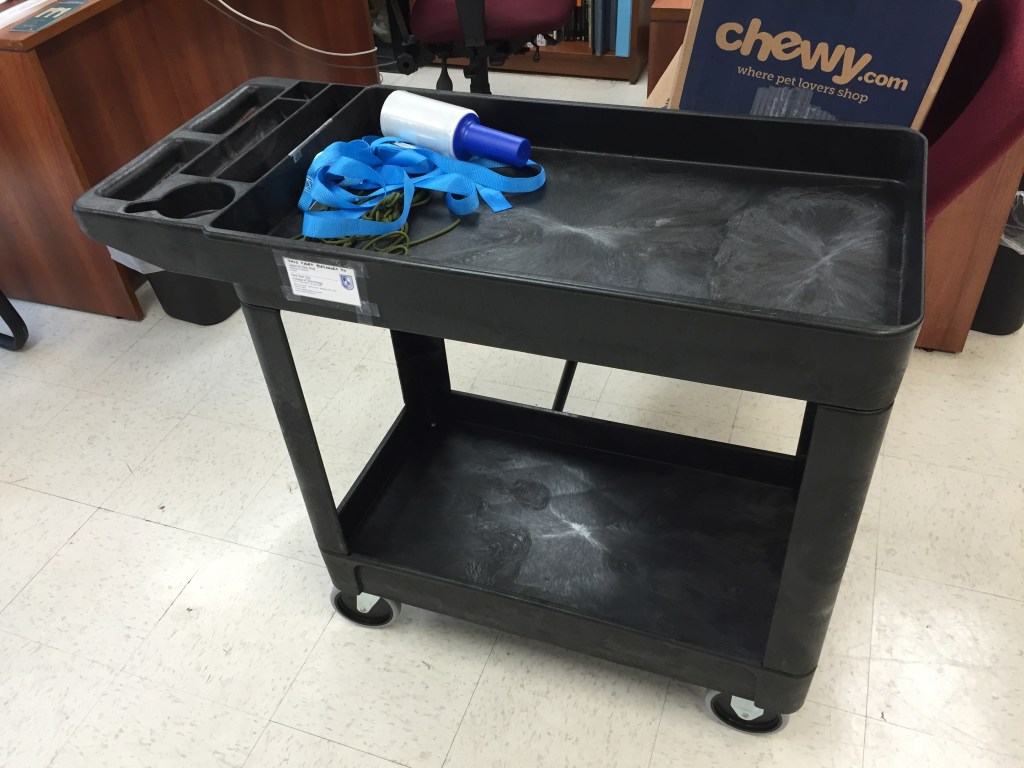
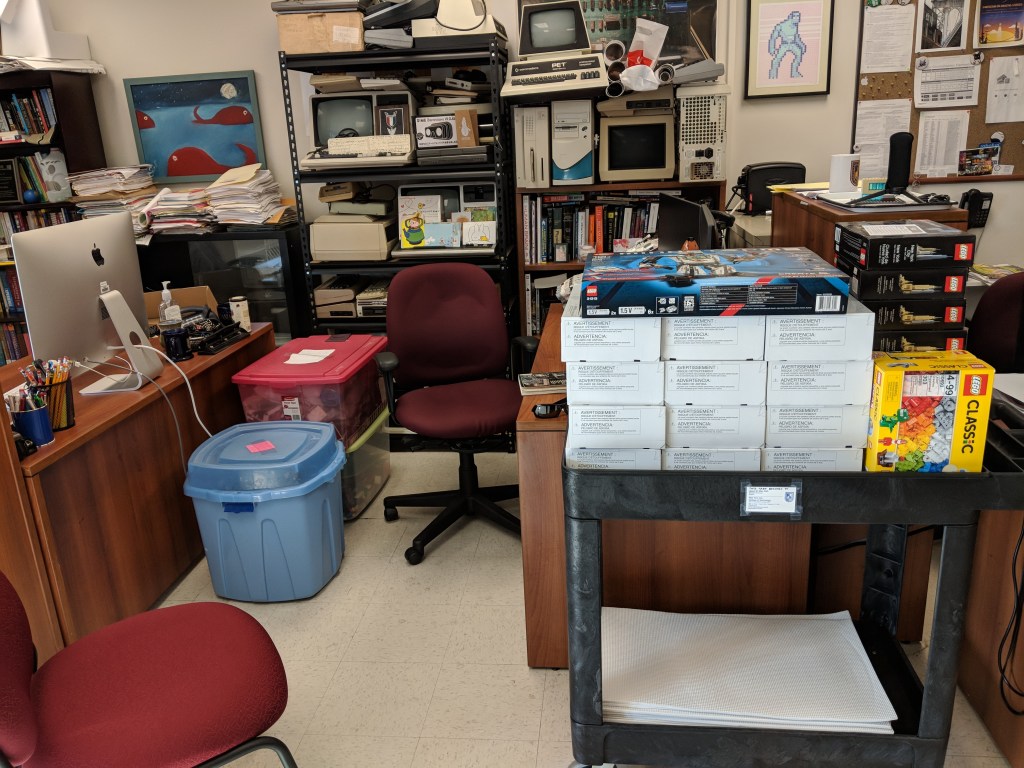
At the end of Spring 2015, I connected with Stanley Kaplan, a graduate of City Tech in 1969 who has worked as a lab assistant here since then. He had squirreled away these old computers in the Vorhees building.
I purchased the polycarbonate utility cart below to ferry these computers from that building to the Namm Building–a distance of several blocks.
Summer 2015
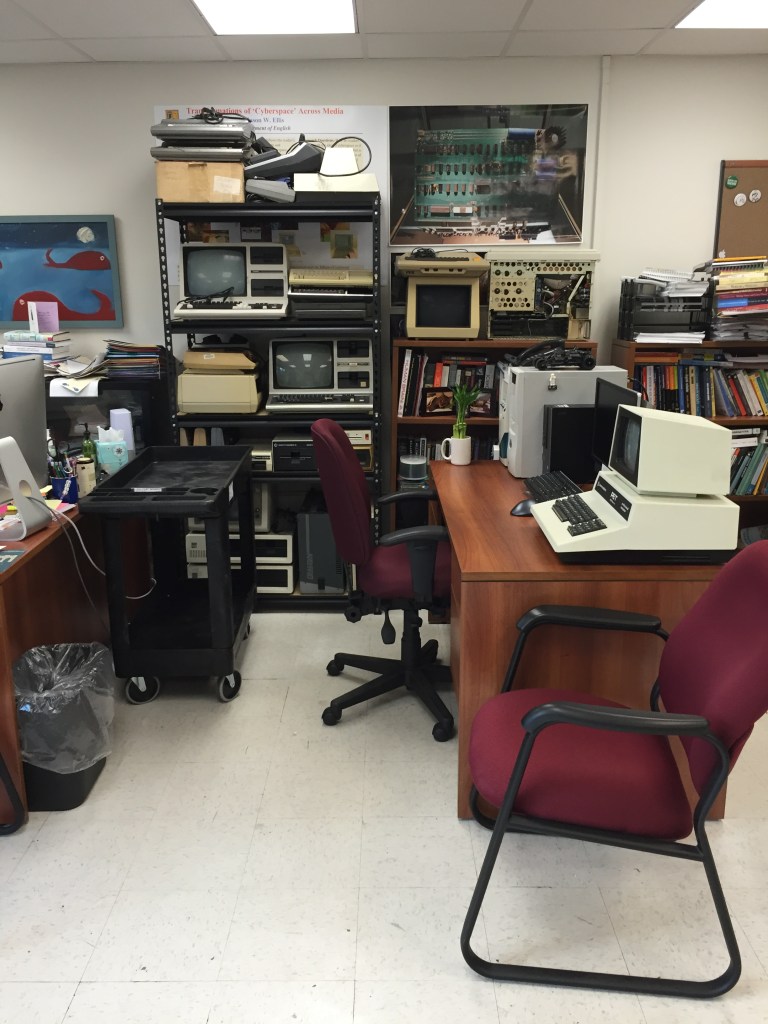
By the end of Summer 2015, I had purchased a large utility shelf from Lowes, which I setup to hold most of the vintage computers. I positioned it in my bookshelf’s old space and slid the bookshelf over with a little gap to allow me to reach between my desk and the bookshelf for books on it.
Spring 2016
In early Spring 2016, Alan Lovegreen and I received 160 boxes of donated books from an anonymous donor in California. Alan had supervised boxing and loading everything in California, and when he returned to Brooklyn, we brought all of the boxes up to our respective offices. Thanks to our understanding colleagues in both of our offices, we were able to store the boxes until the library had cleared enough shelf space for this initial 600-linear foot donation of near-complete runs of the major SF magazines, novels, monographs, and journals.
In this wide shot revealing all six desks in our shared office from late Spring 2016, you can see that the books have been moved to the library. My desk is the middle one on the left. Patrick is sitting at his desk in front of mine.
Spring 2017
By Spring 2017, I was carrying my MacBook Pro to work, so I cleared the center of my desk and daisy-chained the two Dell monitors (I hadn’t used my City Tech-issued Dell desktop since 2014–it’s not pictured here because by this point I had locked it away in my filing cabinet at the front wall of the room).
Also, I use the computers beside my desk to show off some of the postcards that Y and I receive via Postcrossing, which I’ve written about here and here. Admittedly, I have convinced some students that I was a distant friend of the British Royal Family with these!
Spring 2018
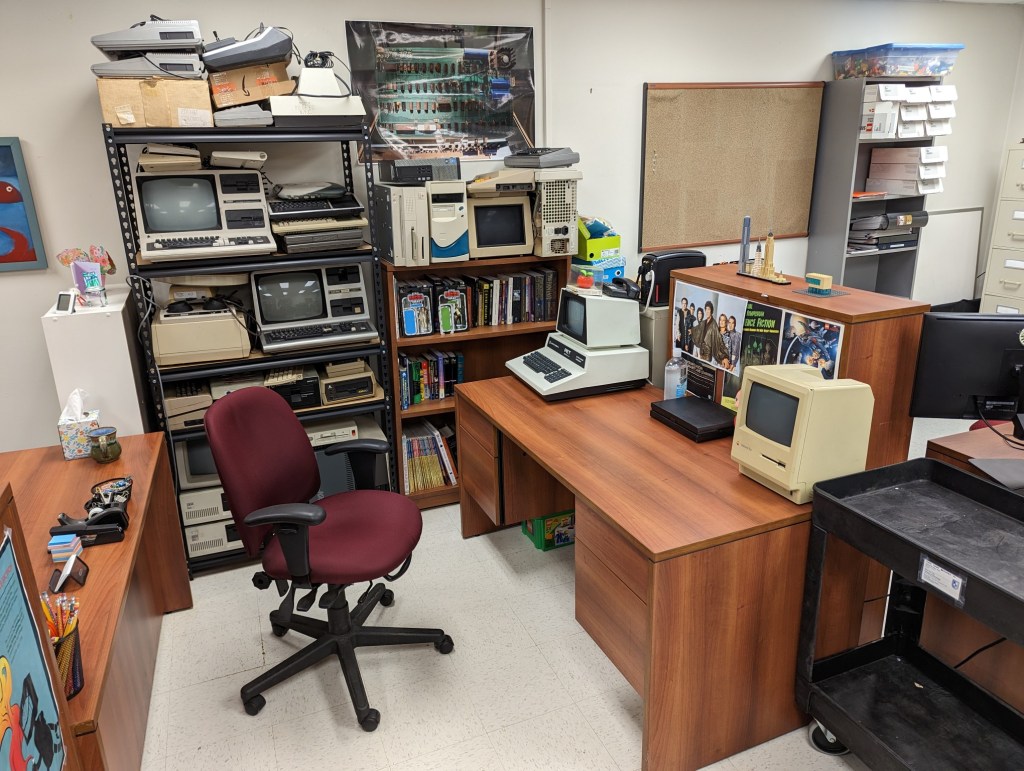
By the beginning of Spring 2018, my desk area had been overrun not only by the vintage computers but also by LEGO sets that my colleague and officemate to the right of this photo had acquired through grants. You can see that we now use the utility cart to move the LEGO sets around to our classes.
Fall 2018
Before the beginning of Fall 2018, I had donated my twin Dell monitors to Patrick so that he could have a super-wide 4-monitor setup on his desk. This opened up my desktop workspace considerably!
Summer 2019
At the beginning of Summer 2019, my cousin Ryan Cox gifted me his old clamshell iBook for the Retrocomputing Lab.
Fall 2019
By Fall 2019, my desk was once again overrun with LEGO sets–mostly Avengers (including my MOC/MOD Avengers Tower on the left) and some Star Wars. I was using my ThinkPad X220 as my work computer in the office and classroom.
Then, the pandemic happened, and I rarely visited the office.
Fall 2022
During the pandemic, we received a sizable donation of books and magazines from Charlie Seelig and others. By Fall 2022, most of the boxes had accumulated in my office. They are in such pristine shape thanks to the United States Postal Service (sarcasm).
Spring 2023
At the end Spring 2023, I moved all of the donated boxes of books into the library and shelved most of them as I wrote about here, here, and here on the Science Fiction at City Tech website. While there is still a lot of stuff in my office space, it is tidy and clean while I am away on sabbatical.
Reflection
My office space reflects the ebb and flow of my work and projects. It reflects aspects of my life that I choose to share in the workplace with my colleagues and students. Those reflections are also things that I want to see as a reminder of what brings me joy and happiness. Having more than books and office supplies at my desk makes me glad to inhabit this space while I am at work. On occasion, it has brought some happiness to students and colleagues, too.
I’m holding my Distinguished Alumni Award while standing next to Georgia Tech’s mascot, Buzz.
On Mar. 29, 2023, Georgia Tech’s Ivan Allen College held its 2023 Distinguished Alumni Awards Ceremony. The Ivan Allen College’s six academic schools and its three ROTC branches give these awards to “celebrate excellence in the College community.” I was honored to receive a Distinguished Alumni Award from the School of Literature, Media, and Communication for my contributions as a teacher, scholar, and organizer. The award reads, “For outstanding achievements that inspire continued excellence and bring credit to the School of Literature, Media, and Communication, the Ivan Allen College of Liberal Arts, and the Georgia Institute of Technology.”
To honor all of the Ivan Allen College professors who made my success possible, I delivered these remarks after receiving the Distinguished Alumni Award:
I am honored and humbled to receive this Distinguished Alumni Award. I want to thank the Ivan Allen College, Dean Husbands Fealing, and all of the faculty, administrators, and staff who make the Ivan Allen College not only a indispensable and integral part of Georgia Tech but also a home for someone like me who is better at writing about science than doing science. It also feels like home, because I’ve spent so many years here—first, it took me 10 years to “get out” with my bachelor’s degree, and then, I returned as a postdoctoral Brittain Fellow for 2 years to give back to Tech as an instructor where I had received so much from my former professors. Throughout my career, all of the work that I have done as a scholar, an instructor, an organizer, and an administrator can be traced back to my education and professionalization in the Ivan Allen College. To name a few examples, when I was asked to help establish the City Tech Science Fiction Collection where I now work, I looked at the problem with the engineering mindset that Tech instills in its students. I drew on my experience working under Lisa Yaszek on research projects, public outreach, and donation runs for what was originally called the Bud Foote Science Fiction Collection and now the Georgia Tech Science Fiction Collection. After starting the collection, I inaugurated an annual Science Fiction Symposium to celebrate the collection and create a platform for scholars and students (including Lisa’s SciFi Lab undergraduate researchers) to interact and share their findings. That work over the past seven years was made possible by the experiences that I had with Lisa when she mentored me to create the schedules for the Monstrous Bodies Symposium in 2005 and the international Science Fiction Research Association Conference held in Atlanta in 2009. Lisa has had a profound influence on my career. She’s my hero and I strive to be like her.

Other faculty have also played outsized roles in my development. Carol Senf and Narin Hassan gave me kind and essential advice at key points in my undergraduate career, and they also gave me some of my first editing work by asking me to proofread their respective manuscripts, which helped tremendously in the editing and collaborative writing that I have done over the years since then. In my teaching, I observed and learned from some of the best practioners. I want to excite my students in the way that Hugh Crawford can when talking about William Carlos Williams and bombsights, as detailed as Steven Usselman is about steam engine locomotives, or as illustrative as Robert Wood is when he talks about 15th century Florence. And I show my students compassion when things go wrong as Rebecca Merrens did for me when my maternal grandmother died, foster my students passions as Lisa Holloway-Attaway did for me in the two required freshman college writing classes, give my students a chance like Patrick Sharp did for me by readmitting me in 2002, give my students opportunities to contribute to the life work of our campus communities as Ken Knoespel did for me, and give students an opportunity to be successful and demonstrate learning when the student stumbles on a project they are ill fitted to such as the late Thomas Lux did for me by asking me to produce a Poetry Out Loud DVD for Georgia public schools in place of my atrocious writing as a poet. And while I never had the opportunity to take a class with Jay Telotte or Jay Bolter, their work had a significant influence on my early research, and I teach their scholarship to my students now. Most recently, Rebecca Burnett, the former Writing and Communication Program Director, led the Technical Communication theory and pedagogy seminar that I volunteered to participate in so that I could earn the opportunity to teach Tech Comm as a Brittain Fellow. That experience directly led to my job at the New York City College of Technology and my current position as Director of City Tech’s Professional and Technical Writing Program. Rebecca has continued to selflessly mentor me throughout my directorship.

And lastly, I want to offer a special thank you to Professor Hanchao Lu, because his Asia in the Modern World class had a profound effect on my personal life. He encouraged me to research Taiwan for my final paper. Years later, when I met a Taiwanese girl in graduate school in 2007, I drew on what I had learned in Professor Lu’s class to talk about the KMT and DPP political parties hoping that she might notice me. And guess what? She did, and we got married two years later! Thank you, again!
I arrived in Atlanta a day early, because I wanted to walk around and see all of the changes around Georgia Tech’s campus during the 8 1/2 years since I was last there. Some things remained comfortably familiar, like the entrance to the School of Literature, Media, and Communication on the 3rd floor of the Skiles Building.
School of Literature, Media, and Communication, 3rd Floor of Skiles Building.
However, there were subtle changes like the addition of outdoor tables and seats on breezeway, which I utilized to finish writing my thank you remarks.
Outdoor seating on the 3rd floor breezeway in Skiles.
Besides the changes to buildings and the construction of new facilities, there are new pieces of art that convey important historical events as well as excite the senses.
“The Three Pioneers” by Martin Dawe.
Approaching Tech Tower, I was greeted by this striking bronze sculpture titled “The Three Pioneers” by Martin Dawe. It depicts the first three African American students to matriculate at Georgia Tech in 1961: Ford C. Greene, Ralph A. Long, Jr., and Lawrence M. Williams.
“Continuing the Conversation” by Martin Dawe.
Walking toward the foot of Tech Tower, I sat in this engaging bronze and granite piece titled “Continuing the Conversation.” The viewer sits between two versions of Rosa Parks–42 on the right and 92 on the left. While Parks had never visited Tech’s campus before, this art reflects her influence on change and how we should be a part of that change moving forward.
Me and Robert Berks’ Einstein.
Walking through the center of campus–the Library, Skiles Building, and the Student Center–I found Robert Berks’ Einstein installation. While some folks think the statue is out of place at Tech, it meant something personal to me. When I was in high school, I read Einstein’s Relativity: The Special and the General Theories, which among other works by Carl Sagan, Michio Kaku, Roger Penrose, and Stephen Hawking, directly led to my enrolling as a Physics major at Georgia Tech in 1995. That didn’t work out so well for me academically, but I love Physics and Mathematics despite my own deficiencies.
John C. Portman, Jr.’s KR+C Sculpture.
Walking from the Einstein statute toward the green space between the back of the Library and the School of Architecture I encountered John C. Portman, Jr’s imposing KR+C (for Knowledge and Research plus Creativity) sculpture. Walking around its circumference reveals how it reshapes and changes depending on your perspective. I found that you can walk up the back stairs of the Library and Clough Undergraduate Learning Commons to get a bird’s eye view of this magnificent sculpture.
“Jetson” in the Clough Undergraduate Learning Commons.
Walking into the Clough Undergraduate Learning Commons, I found art suspended between its the clean perspectival lines. The sculpture above titled “Jetson” is a collaborative team project initiated by former College of Architecture Professor Volkan Alkanoglu. Primarily constructed from water jet cut aluminum, this large, futuristic sculpture only weights about 110 pounds!
Walking through the Clough Commons into the Library, I met with my former colleague Wendy Hagenmaier, Digital Curation Archivist and RetroTech Manager, in the 3rd floor Data Vizualization Lab and RetroTech shared space. RetroTech is a working collection of born digital (and analog) art (and science) artifacts that students can use, support, and learn from. Before moving to Brooklyn, I donated four of my vintage computers (a Dell Dimension 4100, Apple Macintosh Perform 550, iMac DV, and Apple Power Macintosh 8500) to the Georgia Tech Library to help kickstart RetroTech, a lab for students to use and interact with older technologies–computers, video game consoles, cameras, slide rules, typewriters, etc. I was amazed at how much space RetroTech has in conjunction with the Data Vizualization Lab. Besides having equipment and space, Wendy is developing RetroTech into a sustainable initiative involving students and cross campus connections. I’m really happy to see how much RetroTech has developed under Wendy’s leadership.
Leaving the Library, I walked through Deanna Sirlin’s “Watermark” installation. The sunlight passing through the colored glass panes creates a changing projected artwork on the floor and surroundings inside this entrance to the Crosland Tower of the Library.
Kessler Campanile.
Walking back toward the Student Center, I stopped in front of the Kessler Campanile designed by Richard Hill for the 1996 Olympics. It was installed during my freshman year at Tech.
Spending almost a whole week in the ATL gave me a much needed boost. 99x is back on the air. I enjoyed not one but two meals at Del Taco. I talked computers with Grantley and Melanie. I met Carol Senf for brunch to talk teaching. I hung out with Lisa Yaszek and Doug Davis at the West End. Rebecca Burnett and Jeff Jeffries invited me over to their home for a wonderful dinner. I talked Doctor Who and Dirk Gently with Mark Warbington. I discussed books with Keith Magnes. And, I got to visit Mike Flanagan in his new house and see his wife Diana compete in a local tennis tournament. Unfortunately, I didn’t have enough time to see everyone I know there, but I hope to get back to Atlanta before another 8 1/2 years pass!
My Distinguished Alumni Award lit by candlelight. Photo by Rebecca Burnett.
This post used to live as a page on DynamicSubspace.net. I’m archiving it as a post. All of the referenced content still lives at the links below.
As a new project for 2014, I am going through my personal archive of undergraduate and graduate school writing, recovering those essays I consider interesting but that I am unlikely to revise for traditional publication, and posting those essays as-is on my blog in the hope of engaging others with these ideas that played a formative role in my development as a scholar and teacher. I am calling this personal exploration and rediscovery of my personal digital archive, “Recovered Writing.” Because this and the other essays in the Recovered Writing series are posted as-is and edited only for web-readability, I hope that readers will accept them for what they are–undergraduate and graduate school essays conveying varying degrees of argumentation, rigor, idea development, and research. Furthermore, I dislike the idea of these essays languishing in a digital tomb, so I offer them here to excite your curiosity and encourage your conversation.
Below, I am including links to my Recovered Writing posts as they are published:
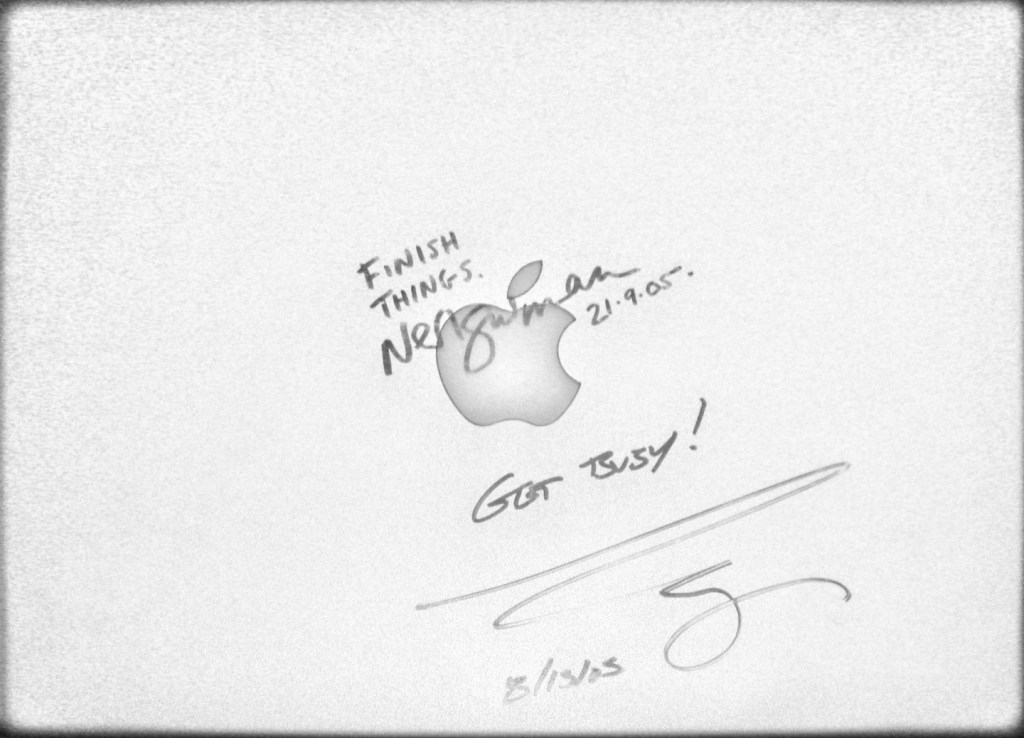
In 2005, I had the pleasure of meeting Neil Gaiman and Bruce Campbell during their separate book tours (Anansi Boys for Gaiman and If Chins Could Kill for Campbell). I asked each of these great people for advice on writing, which they committed to the front of my old 12″ Powerbook G4.