Category: Pedagogy

  • Science Fiction, LMC 3214, Summer 2014: Mary Shelley’s Frankenstein (Day 2 of 2)

    Georgia Tech: Engineering Great Minds.
    Georgia Tech: Engineering Great Minds.

    During today’s LMC 3214 Science Fiction class, I continued my lecture on the importance of the Biology of Mind to Frankenstein specifically and Science Fiction generally.

    In the last lecture, I ended on a discussion of the empiricist vs. rationalist debates. Then, I turned to the questions, “How and why do we enjoy literature?” I discussed solving puzzles (finding solutions), feeding our imagination (the novum), deploying our theory of mind and observing theory of mind at play in the novel, recognizing how the brain is a virtual reality simulator (it simulates our experience of the world and our experience of imagined worlds in fiction–in both cases there is a divide between us and the world itself–even more so in the case of the epistolary novel form), and finally, understanding that each person’s experience of the novel will be different based on wiring, hormonal production/reception, memories, and associations (we discussed how we observe this in the novel and how it is important to Romanticism).

    I ended the lecture on an etymology of hubris and nemesis and a discussion about how the novel is a critique of the Age of Enlightenment.

    In the last half of class, I asked the on-campus students to lead the discussion and raise those points, passages, or questions that they were most interested in concerning the novel. Our discussion ranged from Jurassic Park connections to women’s biological rights to the Creature’s missed potential due to his undutiful creator.

    There’s no class on Monday for Memorial Day or Wednesday due to a professional trip. Our class lecture for Wednesday (LS and QUP sections) will be available on T-Square under Resources as an MP4 video. In that lecture, I will discuss proto-SF, Voyages Extraordinaires, and Scientific Romances.We will continue our conversations on Twitter through this weekend and next week. We will resume normal classroom meetings and lecture recording on June 2.

  • Science Fiction, LMC 3214, Summer 2014: Mary Shelley’s Frankenstein (Day 1 of 2)

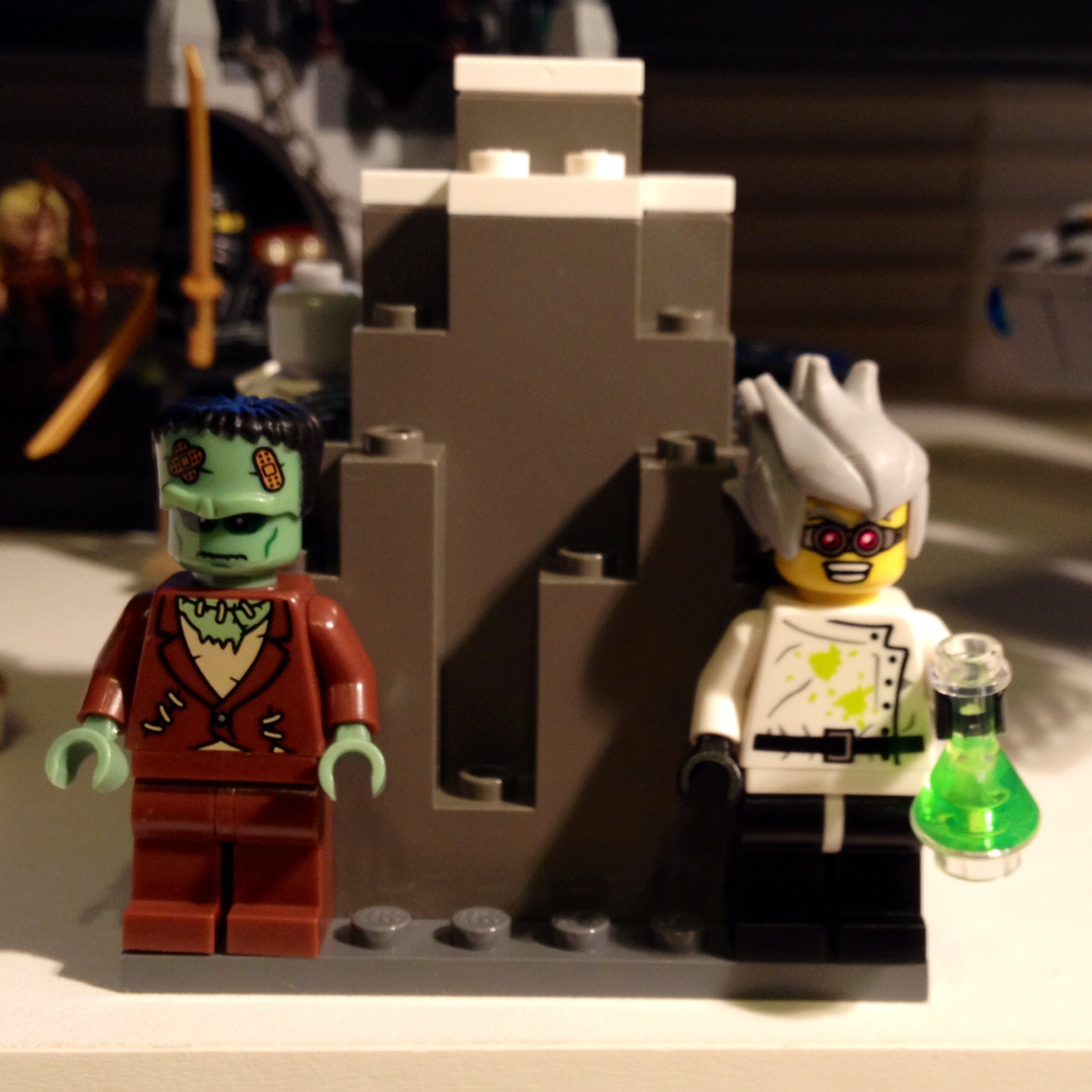
    Popular or Sci-Fi depictions: The Creature in Boris Karloff disguise and Victor Frankenstein as the mad scientist.
    Popular or Sci-Fi depictions: The Creature in Boris Karloff disguise and Victor Frankenstein as the mad scientist.

    Today, my LMC 3214 students and I shifted our attention away from contemporary science fiction as represented by Ted Chiang’s “The Truth of Fact, the Truth of Feeling” towards the beginning of the genre.

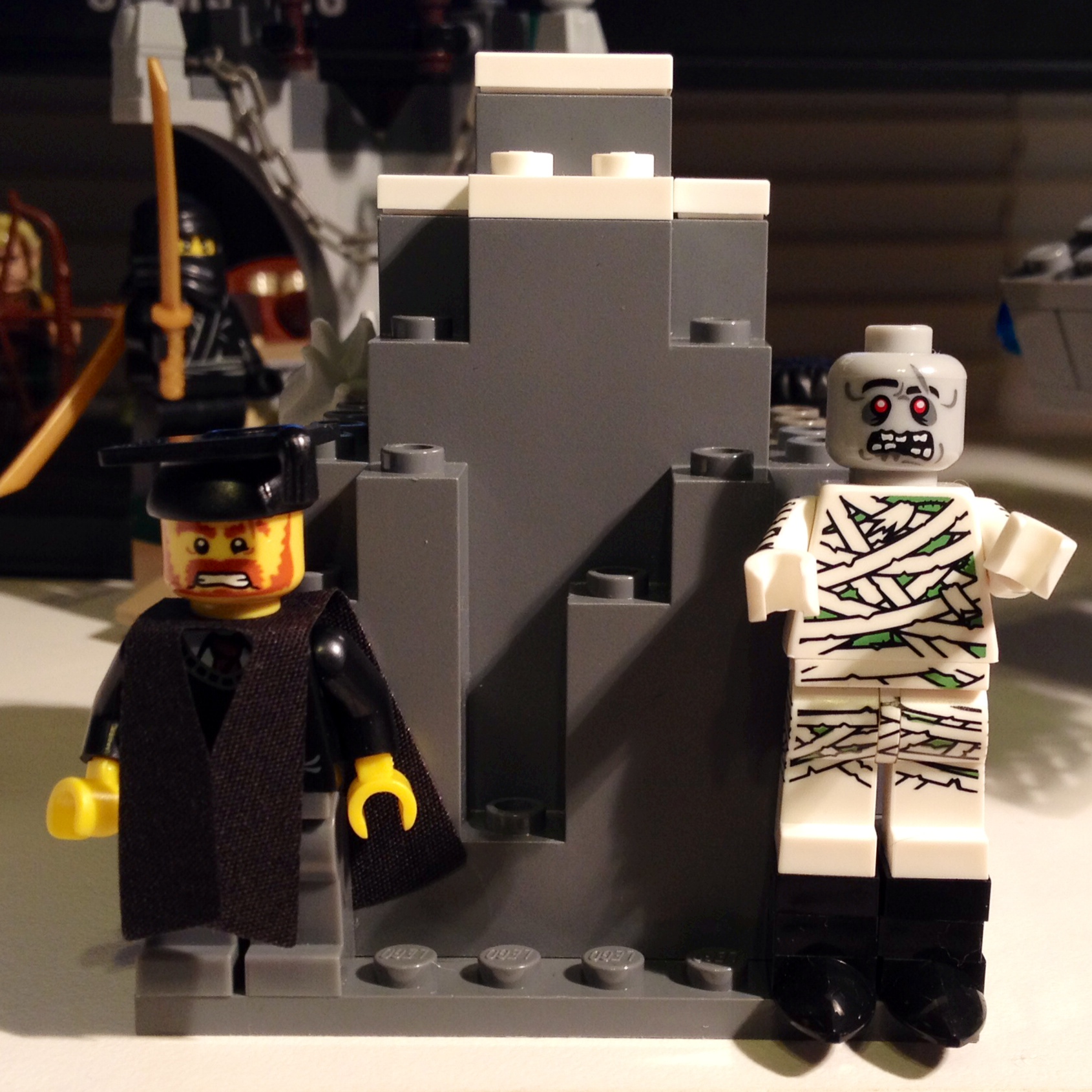
    My goal was to shift my students’ thinking about Frankenstein away from the popular conception (photo above) to the novel’s original depiction of these important characters in science fiction and English literature (photo to the right, below). When time and materials permit, I will bring in other Lego models to illustrate some of my larger points in class.

    SF original: Mary Shelley's learned and angry Victor Frankenstein and grotesque, gargantuan Creature.
    SF original: Mary Shelley’s learned and angry Victor Frankenstein and grotesque, gargantuan Creature.

    During today’s class, I lectured on precursors of the genre beginning with the Epic of Gilgamesh (connecting each of these earlier works to either Chiang’s story or Frankenstein to illustrate how the themes in SF influences still remain today) and moved forward to modernity. I glossed the Age of Enlightenment, the Scientific Revolution, the Industrial Revolution, Romanticism, and the Gothic.

    With that groundwork established, we began discussing Mary Shelley’s Frankenstein (1818). I lectured on her biography and significant themes in the novel (science saturated novel, all three protagonists are scientists–Walton, Victor, and the Creature, and the biology of mind). The latter theme of mind (empiricism vs. rationalism) was what I rounded out the lecture with by discussing how the rationalists via Noam Chomsky eventually won out over the empiricists (the tabula rasa/the blank slate).

    My students are building their discussions on Twitter using the hashtag #lmc3214. Please join in and participate in the conversation!

  • Recovered Writing, PhD in English, Teaching College Writing, Final Exam, July 1, 2008

    This is the fifty-fifth post in a series that I call, “Recovered Writing.” I am going through my personal archive of undergraduate and graduate school writing, recovering those essays I consider interesting but that I am unlikely to revise for traditional publication, and posting those essays as-is on my blog in the hope of engaging others with these ideas that played a formative role in my development as a scholar and teacher. Because this and the other essays in the Recovered Writing series are posted as-is and edited only for web-readability, I hope that readers will accept them for what they are–undergraduate and graduate school essays conveying varying degrees of argumentation, rigor, idea development, and research. Furthermore, I dislike the idea of these essays languishing in a digital tomb, so I offer them here to excite your curiosity and encourage your conversation.

    Before I could accept my teaching fellowship at Kent State University, I needed to take the graduate seminar, “Teaching College English.” I was fortunate to have the opportunity to take this class from Professor Brian Huot. At the time, I thought my primary concern was putting together my first syllabus, but through the seminar, I learned the importance of meeting student needs, considering outcomes, meeting students on the page, helping students improve their command of rhetoric and multimodality with a portfolio, and considering student work holistically (something that I continue to do with the Georgia Tech WCP’s WOVEN modalities and programmatic rubric).

    This final of four Recovered Writing posts from Teaching College Writing is my take home final exam. In these essay responses, I discuss theories of language and literacy, justifications for composition instruction techniques, and demonstrate a letter-writing approach to composition feedback.

    Jason W. Ellis

    Professor Brian Huot

    Teaching College Writing

    1 July 2008

    Take Home Final Exam

    I. What is your theory of language and literacy and how does it relate to first-year college writing instruction? Make sure you refer to relevant scholarship in the field to support your beliefs and assumptions about writing and its teaching.

    My theory of language (the protocols and method of communication) and literacy (the ability to read and write, or more broadly, to communicate via language) is that they are acquired through immersive practices. In the first-year college writing class, freshmen students bring a certain understanding of language and literacy that they’ve acquired through school and socialization outside of school. It’s my goal to tap into my student’s various skill sets, to reach into their toolboxes of communication, and guide them towards the attainment of new tools that will allow them to communicate better.

    My newfound theories of language and literacy come from a variety of sources. The first is Roger W. Shuy’s “A Holistic View of Language.” Shuy argues that form (the mechanics of writing) follows function (communication). This is a significant idea, because it points the way to findings such as those by Michael W. Williamson in his essay, “Common Sense Meets Research: The Debate Over Grammatical Instruction in Composition Instruction.” Essentially, rote teaching and practice of grammar and the forms of language do not good writers make. Engaging students as writers in topics that they find interesting are just as or better at building on and tapping into the student’s own innate knowledge and mastery of language. Additionally, this increases students’ enjoyment of writing. And it’s that enjoyment of mindful and effective communication that’s necessary to, as Mem Fox writes in “Notes from the Battlefield: Towards a Theory of Why People Write,” “ache with caring.” In order to jump start student caring about writing in the immersive environment, the teacher must enter dialog with the students as a collaborator that is willing to recognize and listen to his or her student’s voice and cultural context as suggested by James T. Zebroski in his, “A Hero in the Classroom,” and Carmen Kynard in her, “Y’all Are Killin’ Me up in Here: Response Theory from a New Jack Composition Instructor/Sistah Gurl Meeting Her Students on the Page.” Showing students that you’re “meeting them on the page,” or “listening to their voices on the page,” will not only show that you’re invested in them and their work, but it will invite them to invest in their own work as something of value, because it has an attentive audience. Additionally, expanding the audience beyond the student-teacher relationship is imperative for building student investment in their own work as well as the work of others. This is accomplished in the immersive classroom through group discussion and peer review. As teachers, we empower our students by teaching them not only how to write, but also how to read and respond to the work of others. For the student, peer review leads them toward an understanding that their work is not only intended for the eyes of a teacher and the subsequent marking and comments. Furthermore, the truly immersive writing class takes the student’s work beyond the confines of class into the real world through online posting of text and multimodal assignments or social assignments such as writing to representatives or the newspaper. This embeds writing with an importance beyond getting a grade, and the skillful, reflective teacher guides students through this realization by a carefully designed sequence of assignments connected by poignant or engrossing theme. Returning to Shuy, these exercises build students’ function of writing skills, but as Williamson argues in analog with Shuy, form follows function. Addressing grammatical issues has a place in the classroom if and when they become a non-self-correcting problem. My goal in the implementation of this theory is to guide my students, as writers, to be better communicators.


    II.       Choose three of the following subjects for the teaching of writing and write one page for each that describes what they are and the empirical and pedagogical basis for using these techniques with students.

    A. Multimodal projects are forms of communication beyond the traditional pen and paper essay. The emphasis is on the medium of communication rather than the rhetorical mode of communication, because various mediums of communication may all carry rhetorical communication. That is, a brochure, poster, audio essay, movie, or Flash animation all may be employed in making an argument and communicating some message. Additionally, borrowing from Marshall McLuhan and Quentin Fiore, “the medium is the message,” which means that choosing a particular medium is a rhetorical choice that carries its own meaning. As Pamela Takayoshi and Cynthia L. Selfe mention in, “Thinking about Multimodality,” the times they are a-changing. The twenty-first century digital world has expanded beyond the traditional writing assignment. The increase in computer usage and the lowering cost of audio and video technologies empowers individuals to engage other mediums for communication besides the written word. For these reasons, Takayoshi and Selfe insist that the definition of composition needs expansion to allow for multimodal projects, because the rhetoric underlying traditional composition and multimodal composition are the same–both use rhetoric to communicate a message. Additionally, students need digital literacy in multimodal forms so that they are better communicators in their private as well as professional lives. Furthermore, students enjoy working with new technologies, which is an effective means of engaging students in rhetorical practices. It’s important to note that, as Mickey Hess says in “Composing Multimodal Assignments,” there are other considerations to make as a teacher in developing multimodal assignments. Some of these include focusing on the rhetorical practices to emphasize in a particular assignment, allowing students the latitude to explore and figure out some things on their own, encouraging group work, and having students reflect on their work and the process in writing. Pedagogically, multimodal composition engages the same rhetorical communication skills developed in written composition–the medium has changed, but the function remains the same.

    B. We’ve encountered a number of complementary theories of productive student-teacher relationships over the past few weeks. Essentially, all of these involve mutual respect between teacher and student, and a leveling effect that puts the teacher and student on a more level plane of dialogic cooperation. Instead of employing a top-down, monolog approach to teaching, it’s more effective, empowering (for student and teacher), and fulfilling to have a dialog between teacher and student. One example of this comes from Hull, Rose, Fraser, and Castellano in their essay, “Remediation as Social Construct: Perspectives from an Analysis of Classroom Discourse.” These authors use classroom and student-teacher conference transcripts to remind teachers that it’s easy to drown out student voices. We should encourage more student turns in discussion, and listen and engage what our students have to say rather than hijacking class and conference discussions. Another view of productive student-teacher relationships comes from Annette Harris Powell’s “Conflicting Voices in the Classroom: Developing Critical Consciousness.” Powell employs socially engaging texts in her classroom to develop discussion and raise student’s awareness of competing discourses, thus expanding her student’s critical awareness. Powell’s ideas come up again in James T. Zebroski’s “A Hero in the Classroom,” but in reverse. Zebroski argues that teachers need to consider the heteroglossia within our students’ papers in order to better evaluate the work and connect with our students. My favorite student-teacher relationship building pedagogical tool is presented in Gerriets and Lowe’s, “Building Relationships through Written Dialog.” I like the idea of carrying on a discussion via writing with my students regarding their papers, because it allows both participants time to consider what is being said. This is not to say that I feel spoken dialog isn’t effective, but I think a combination of written and spoken dialog is important, because the teacher, as Carmen Kynard does, meets the students on the page as well in spoken dialog.

    C. Listserve or the email list is a tremendously effective tool in the writing classroom as I have evidenced in my own experience at other schools and in our Teaching College Writing class. Listserve allows the conversation to carry on outside of class by empowering students to communicate with their classmates in an “open” turn based environment. What that means is that students aren’t constrained to wait and talk. They write down their thoughts and send them out to the classmates, and in turn, read the responses of others to which they may respond again. All students may take part in the conversation on listserve, but it’s particularly liberating to students that are still developing group discussion skills–if their ideas are accepted online, they may be more willing to engage classroom discussion. Besides reinforcing group communication skills, they are effective for the writing classroom, because students are required to communicate in writing. This additional writing practice fosters “form following function,” as well as rhetoric skill practice (i.e., how to best explain myself to convince my classmates that I’m right or to convey what I mean to everyone else without causing a misunderstanding). Also, as a multimodal medium of communication, listserve introduces many students to online etiquette, which adds to their abilities as effective and respectful communicators in other mediums. In a tip of the iceberg kind of way, listserve also serves the requirements of the writing program for Tier I.

    III. Respond to the attached paper. Be sure to create a specific student in a particular class who is writing in response to a specific assignment. You may include any information about the student you believe to be important in understanding the pedagogical moment of this essay. Your only restrictions are that you must respond to the student you created.

    This student, who I’ll call Jim, is from a working class background. His mom and dad both work, and have at most a high school education. They want their son to succeed in life, and they see education as the key to that success. Therefore, they stressed his need for education without really explaining or fleshing out the reasons behind their belief that education is the key to a better life, and how could they without that kind of experience themselves? For Jim, this caused confusion as he went through school, because he could realize the tangible and immediate rewards of street education whereas school education provided less tangible payoffs. At the core of his being, he is someone that wants to embrace higher education and reap the good life for his efforts, but he’s looking for the hook, or reason, that will light his own fire to learn.

    Jim’s paper, “Renaissance Man,” was written in response to my second writing assignment in Tier I College Writing. The assignment was to write a three page personal response to a film that you’ve seen. The response should weave together personal narrative to support or refute what the student saw as the argument of the film.

    This is my response following Gerriets and Lowe’s written dialog method:

    7/2/08

    Dear Jim,

    I enjoyed reading your essay on Penny Marshall’s Renaissance Man (did you know Marshall also directed Tom Hanks in the film, Big? If you haven’t seen it, that’s another one that you should check out, because it addresses many of the issues you raise about different kinds of education). I saw two major arguments in your essay–one is that education is not just book learning, but it’s also experience gained outside of school, and the other is that learning takes place when the individual has a motivation to learn. These are powerful ideas, and I can see some of the ways you weaved your own narrative about your parents’ expectation that you go to college and other pressures that they placed on you growing up with the examples that you chose from the film. I’d like to go more in-depth on these examples, and perhaps together we can formulate a plan to make this an even stronger paper.

    After rereading your first paragraph, I get the sense that your theory has to do with encouraging students to learn in school. You claim that, “our school programs are missing a way to teach everyone…to find something that everyone is interested in.” I see where you’re coming from in that classes often lack a hook or a common idea that students are interested in learning about, or the reasons for learning aren’t always immediately apparent. That, perhaps, more should go into showing students how to be engaged learners or why learning is important and can be fun, rather than just telling students these things. Showing is definitely a more powerful rhetorical tool, especially when you’re writing, and I feel that you can do more of this to empower your own argument. If you decide to focus on this one idea to develop your own theory about learning in your next revision, I would suggest adding an example from your life when your parents put pressure on your to learn and perhaps their words didn’t work on you. Another way would be to talk about a specific example from school when the teacher didn’t spark your interest to learn. Show how that supports your theory, and then talk about Renaissance Man as reinforcing what you see as a need of education–a real reason or a more exciting reason to learn, to care about learning. Let me know if you go this direction, because I want to let give you an essay about this very topic by Mem Fox. When you read what she has to say, you’ll think you’re on the same wavelength!

    There’s another thread in your paper that you might want to pick up if you decide not to go the reason route. That other way has to do with what you wrote on page 2, “People put too much emphasis in the idea that good grades equal an educated person, this is a false statement. Many people that have poor grades in school are more intelligent than a person who makes good grades in school.”   I read it as you making a distinction between school learning and “real life” learning. This is another thread with which to center your essay around that you have good examples from the film that you can draw on. Additionally, as I said before, it would be great if you could show the reader an example of this from your own life. What are some things that you’ve learned outside of school, and what are some things that you’ve learned in school? What value do you place on the different things that you’ve learned?

    Think over these different approaches, and how you might focus your paper more on one or the other, and meet with me during office hours this week. We’ll sit down and talk about your plan. I’d like to hear about some of the stories and details that you can employ to show the reader more concretely what it is you’re talking about. See you soon!

    -Jason
  • Recovered Writing, PhD in English, Teaching College Writing, Quiz, What do people do when they write? June 16, 2008

    This is the fifty-fourth post in a series that I call, “Recovered Writing.” I am going through my personal archive of undergraduate and graduate school writing, recovering those essays I consider interesting but that I am unlikely to revise for traditional publication, and posting those essays as-is on my blog in the hope of engaging others with these ideas that played a formative role in my development as a scholar and teacher. Because this and the other essays in the Recovered Writing series are posted as-is and edited only for web-readability, I hope that readers will accept them for what they are–undergraduate and graduate school essays conveying varying degrees of argumentation, rigor, idea development, and research. Furthermore, I dislike the idea of these essays languishing in a digital tomb, so I offer them here to excite your curiosity and encourage your conversation.

    Before I could accept my teaching fellowship at Kent State University, I needed to take the graduate seminar, “Teaching College English.” I was fortunate to have the opportunity to take this class from Professor Brian Huot. At the time, I thought my primary concern was putting together my first syllabus, but through the seminar, I learned the importance of meeting student needs, considering outcomes, meeting students on the page, helping students improve their command of rhetoric and multimodality with a portfolio, and considering student work holistically (something that I continue to do with the Georgia Tech WCP’s WOVEN modalities and programmatic rubric).

    This third of four Recovered Writing posts from Teaching College Writing is my response to a quiz on an assigned reading on “What do people do when they write?” I can’t find the essay/handout that we were responding to, but I think that some of the thoughts that I put down regarding mechanics/surface vs. content/depth are interesting.

    Jason W. Ellis

    Professor Brian Huot

    Teaching College Writing

    16 June 2008

    “What do people do when they write?” Quiz

    1)  What can you say about the kinds of responses from students in the two groups?  Are the first group of responses for each grade level different than the second group–what are the differences or similarities for each group in each grade level?

    The responses from students in the first group of each grade level are typically about thought, expression, and explanation, and the second group responses of each grade level are about practices and methodology.  Linking these responses back to the class, the first groups are aligned with function, and the second groups are aligned with form.

    In the third-, fourth-, and fifth-grade responses, the first group overwhelming uses the following key words and phrases:  think, open their minds, and share…thoughts.  Also, they write for a purpose such as to relax, avoid boredom, or to communicate with friends and relatives.  The second group’s responses focus on practical matters and the mechanics of writing.  For example, these students talk about holding the pencil, sitting down to write, making letters, moving the hand and pencil, and wasting ink and pencil lead.

    Again, the responses of the first group of ninth graders are generally about expression.  They “tell about things,” “get stuff across,” and “express their thoughts.”  The responses from the second group are, like the second group of third to fifth graders, about the physicality of writing.  For example, they “just write stuff down,” “hold a pencil and move their hands,” and “put the point of the pencil to the paper and start making words and letters.”  There are exceptions in both groups that could be interpreted as belonging to the other group if the groups are divided based on function and form.

    The college freshmen groups are also split along lines of function and form.  The first group is largely about conveying, explaining, translating thoughts into words, and revealing thoughts, ideas, and emotions.  The second group of college freshmen is more closely aligned to the first than the other two grade levels, because there are some responses about expression and communication.  However, the majority of the responses concern mechanics (e.g., “usage and grammar”) and writing methods (e.g., “First you pick your topic, then you make sure you have enough information.  Then you rewrite and check the spelling and copy it down” and “They express their overall views on a given topic and later draw conclusions in a patterned coherent fashion”).  Also, there’s a response that describes the act of writing.


    2)  Do you see any similarities across grade levels for each of the groups?  Are there certain characteristics for either group one or two responses?  What are those characteristics?

    In general, the responses of the first group of each grade level are about the function of writing–i.e., communication and the expression of ideas, and those of the second group of each grade level are about the form of writing–i.e., the act of writing and methods of writing.


    3)  Considering your answers to the first two questions, what variable (consideration, category, quality) did the researchers use to separate the different groups of responses within each grade level?

    Considering our readings of the past week, and the writing concept that “form follows function,” it seems that the responses are grouped based on writing ability.  The first group in each grade level has stronger writers, and the second group respondents are weaker writers.  The stronger writers understand the function of writing, because they’ve internalized that through their acquisition of writing.  The weaker writers respond by describing the literal action of writing or process of using the plug-and-chug method of writing an essay in high school.  They are thinking about the surface level of writing rather than what lies underneath as did the first group respondents.

  • Recovered Writing, PhD in English, Teaching College Writing, Annotated Bibliography of Teaching SF Resources, June 29, 2008

    This is the fifty-third post in a series that I call, “Recovered Writing.” I am going through my personal archive of undergraduate and graduate school writing, recovering those essays I consider interesting but that I am unlikely to revise for traditional publication, and posting those essays as-is on my blog in the hope of engaging others with these ideas that played a formative role in my development as a scholar and teacher. Because this and the other essays in the Recovered Writing series are posted as-is and edited only for web-readability, I hope that readers will accept them for what they are–undergraduate and graduate school essays conveying varying degrees of argumentation, rigor, idea development, and research. Furthermore, I dislike the idea of these essays languishing in a digital tomb, so I offer them here to excite your curiosity and encourage your conversation.

    Before I could accept my teaching fellowship at Kent State University, I needed to take the graduate seminar, “Teaching College English.” I was fortunate to have the opportunity to take this class from Professor Brian Huot. At the time, I thought my primary concern was putting together my first syllabus, but through the seminar, I learned the importance of meeting student needs, considering outcomes, meeting students on the page, helping students improve their command of rhetoric and multimodality with a portfolio, and considering student work holistically (something that I continue to do with the Georgia Tech WCP’s WOVEN modalities and programmatic rubric).

    This second of four Recovered Writing posts from Teaching College Writing is a brief annotated bibliography of teaching science fiction resources. Professor Huot asked us to do research in our specific discipline and report back what we found. This kind of work has become an integral part of my professionalization as an educator (research+pedagogy) and reflective practitioner (how did this other person do that–how can I incorporate/modify/adapt their approach into mine–what worked/didn’t work and how can I make it better?).

    Jason W. Ellis

    Professor Brian Huot

    Teaching College Writing

    29 June 2008

    Teaching Science Fiction Annotated Bibliography

    Attebery, Brian. “Teaching Fantastic Literature.” Science-Fiction Studies 23:3 (Nov. 1996): 406-410.

    Instead of focusing his course on Science Fiction, Attebery combines fantasy and SF into one course under the umbrella of the fantastic. Again, this is a literature, and not a composition course, but the important lesson to take away from his essay is that students with fantasy/SF backgrounds, which are not necessarily the same thing, as well as students without an inkling of experience with the fantastic all have something to bring to class discussion. Also, some fantastic literature carries more cultural or historic baggage than students may already be acquainted with, which may break down discussion, or require more lecturing or assigned reading in order to prepare students for engaging a particular text.


    Bengels, Barbara. “The Pleasures and Perils of Teaching Science Fiction on the College Level.” Science-Fiction Studies 23:3 (Nov. 1996): 428-431.

    Bengels builds on examples from Science Fiction and criticism, both on teaching SF, “to address the inherent and unique difficulties of teaching a body of literature that is changing even as we attempt to examine it…to convey the excitement and sense of wonder that continues to set science fiction apart from any other form of literature” (428). Most importantly, she suggests that, “There’s a special sense of community in the sf world that finds its way right into the classroom; new ideas must be bounced off one another, making for very exciting classroom discussions: new words, new worlds, new concepts all to be explored together” (430).


    Csicsery-Ronay, Jr., Istvan. “The Seven Beauties of Science Fiction.” Science-Fiction Studies 23:3 (Nov. 1996): 385-388.

    Csicsery-Ronay begins his essay with this striking line: “Like being hanged, teaching introductory sf courses to undergraduates focuses the mind wonderfully” (385). He is addressing the teaching of Gunn’s SF genre course, but he provides a great framework for introducing students to SF through a handout titled, “WHAT MAKES SCIENCE FICTION SCIENCE FICTION?” (386). This handout, perhaps given after having students read an emblematic SF short story, would be a powerful tool for opening discussion about what constitutes SF and what our students think SF is. Furthermore, he responds to what is implicitly said in Bengels, Gunn, and others when he writes, “My sf texts must also introduce students to important philosophical, social, and literary ideas that they might not encounter anywhere else, given the state of contemporary higher education” (386). This significant accusation reflects the potential of SF to engage students in ideas and critical thought that they would not otherwise encounter.


    Elkins, Charles and Darko Suvin. “Preliminary Reflections on Teaching Science Fiction Critically.” Science-Fiction Studies 6 (1979): 263-270.

    There are some very practical and insightful contributions by Elkins and Suvin in this Marxist essay regarding the teaching of SF.          The authors propose that, “The main and the highest goal of SF teaching–as of all teaching–ought, in our opinion, to be a specific form of civic education” (267). SF is great for inculcating critical thinking, because SF often turns accepted systems upside-down. Introducing students to this and discussing what’s in the text and what the text leaves out should raise their ability to see beneath the surface of the text. Elkins and Suvin go on to suggest that, “Teaching SF…involves description and assessment, interpretation and evaluation; teaching SF is an act of literary criticism fused with the communication of that criticism” (268). In this passage, the authors are not literary saying that SF is literary criticism in the academic sense of an analysis of Shakespeare, but rather, SF is a critical literature that engages social issues. This is the power of SF that is useful for generating discussion in the introductory college writing classroom.


    Evans, Arthur B. and R.D. Mullen. “North American College Courses in Science Fiction, Utopian Literature, and Fantasy.” Science-Fiction Studies 23:3 (Nov. 1996): 437-528.

    Evans and Mullen compiled this list of SF, utopian, and fantasy courses complete with descriptions and book lists from colleges and universities all over the world. It also includes lists of works, authors, and films most often assigned.


    Finch, Sheila. “Dispatches from the Trenches: Science Fiction in the Classroom.” Extrapolation 41:1 (Spring 2000): 28-35.

    Finch writes that SF is a uniquely appropriate genre for stimulating student involvement and discussion, because it serves all the functions of other literature with, “the added distinction of being…a literature of ideas to think about in a peculiarly new way, what Albert Einstein called Gedankenexperimenten” (29). The thought experiment aspect of SF is indeed powerful for generating discussion, because it presents a new view to a (perhaps) mundane subject, and it begs the reader to critically evaluate the thought experiment on the surface narrative as well as what lies beneath. Like Bengels, Finch declares, “SF is a literature of ideas,” which can be employed as a useful tool in developing writing students skills at responding to things that they might not have considered before (31).


    Gunn, James. “Teaching Science Fiction.” Science-Fiction Studies 23:3 (Nov. 1996): 377-384.

    Gunn’s essay primarily concerns his own approaches to teaching SF as a genre course, and he makes the claim that of all of the SF courses available at various schools, “They seem to be as varied as the colleges and universities at which they are taught, and a number seem to address the question of what science fiction is and how to read it, that is, they are genre courses. But I would argue that there should be more” (377). In regard to his own various approaches to teaching SF, he identifies three course themes: 1) “the great books,” 2) “the ideas in science fiction,” and 3) “the historical approach.” He doesn’t address SF in the introductory writing classroom, but I believe his “ideas” theme is appropriate for generating discussion and leading into student essay topics without the course taking on a literature-laden mood.


    Mullen, R.D. “Science Fiction in Academe.” Science-Fiction Studies 23:3 (Nov. 1996): 371-374.

    This is a short history of the introduction of SF into the American college classroom. It includes early course descriptions and book lists.


    Ontell, Val. “Imagine That! Science Fiction as a Learning Motivation.” Community & Junior College Libraries 12:1 (2003): 57-70.

    This essay overflows with numerous examples of SF and fantasy stories, TV shows, and films, and how they may be used to engage our students’ attention and imagination. In addition to all of Ontell’s fabulous lists and contextualizations, she points out how the fantastic is an important learning tool: “Whether the students are in the elementary grades, middle school, high school, or higher, it is the function of teachers and librarians to provide the tools that enable them to question intelligently. Science Fiction provides many vehicles for inculcating those tools in a variety of subjects by stimulating the imagination and thus motivating students to learn” (57). In the writing classroom, building our students’ ability to “question intelligently” is essential to their success as readers and stronger writers.


    Samuelson, David N. “Adventures in Paraliterature.” Science-Fiction Studies 23:3 (Nov. 1996): 389-392.

    Samuelson provides a plethora of author and work successes in his classes. Also, he notes the usefulness of group presentations on particular works or authors to share with the class, and he lauds the use of a “cumulative journal” or portfolio in the classroom.