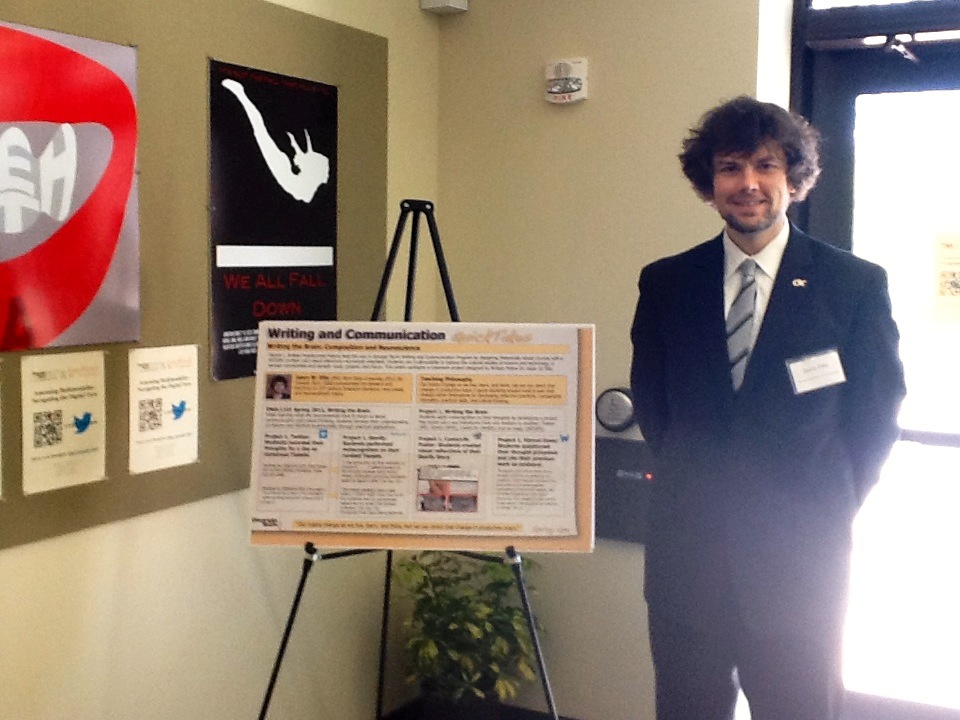
My Pedagogy Poster on “Writing the Brain” at Assessing Multimodality Symposium.
Today, the Georgia Tech Writing and Communication Program and Bedford St. Martins hosted a symposium on Assessing Multimodality: Navigating the Digital Turn. I co-presented a workshop with Mirja Lobnik on Multimodality and Perception and I presented a poster during one of the day’s sessions. Many of us were tweeting our experiences at the symposium today, too. Click through the Storify embed below to virtually experience the symposium 140 characters at a time.
This morning, Mirja Lobnik and I will be co-hosting a workshop on “Multimodality and Perception: A Multi-Sensory Approach to Teaching Rhetorical Skills” at the Assessing Multimodality: Navigating the Digital Turn Symposium co-hosted by Georgia Tech’s Writing and Communication Program and Bedford St. Martin’s. Our workshop is about multisensory perception, multimodal composition, and cognition:
Associated with the use of various media to create cohesive rhetorical artifacts and the neurology of the ways humans process information through different sensory channels, multimodality has gained considerable ground in the composition classroom. Insofar as multimodal pedagogies emphasize the role of students as active, resourceful, and creative meaning-makers, it tends to enhance student engagement and, by extension, the teaching of composition and rhetorical skills. Focusing on sensory details of embodied, lived experience, this workshop centers on teaching that engages students both in mind and body. This approach not only promotes the students’ creation of multimodal artifacts but also encourages students to explore and critically reflect on personal experiences. Specifically, Lobnik focuses on aural composing modalities, including speech, music, and sound, and assignments that highlight sound as a rhetorical and creative resource: a transcription, audio essay, and a video. Ellis discusses cognition, metacognition, and curation and an assignment that integrates Twitter, Storify, ComicLife, and the written essay.
If you get to attend our workshop or the symposium’s other great sessions, please tweet using the hashtag: #AMsymposium.
Dr. Laura Otis presenting in GT Library’s Ferst Room.
Today, Georgia Tech’s School of Literature, Media, and Communication invited Emory University’s Dr. Laura Otis to give a presentation in the Library’s Ferst Room. Dr. Otis’ presentation was titled, “The Surprising Antics of Other People’s Minds” [read the abstract here].
In Dr. Otis’ work, she aims to show with data that she has collected from interviews with an admittedly small number of English-speaking people from the United States that:
1) visual thinking and verbal thinking are not opposites and they cannot be separated,” 2) there is no such thing as a visual thinking type or a verbal thinking type–every mind is unique, and 3) visual and verbal inclinations are not destinies. Anyone can develop visual or verbal skills with practice.
She also offered two suggestions for literary studies:
1) refer to visual imagery in readings, because this might help include more students who may feel excluded by verbal readings, and 2) take reader’s visual imagery seriously, because this might help reconnect the reader to creative writing as co-creator of its imagery.
You can download my handwritten notes on Dr. Otis’ talk and the Q&A session from the event as a PDF from here.
I enjoyed Dr. Otis’ presentation, and it provided me with a new insight into something that I had already read and thought about but in a more biological sense: we each think differently, because our brains are wired differently. Our experience of the world and life, which includes our biology, environment, and culture, leaves its indelible trace on our brain’s physical wiring. As we live, our brains wire themselves to accommodate new memories, abilities, and ways of thinking. It makes sense that all of these experiences would shape our thinking, but more importantly, we can exert our own conscious control over our thinking by adopting reflective practices and training/practice to improve abilities that we already have to greater or lesser degrees.
This morning, Georgia Tech’s Center for the Enhancement of Learning (CETL) hosted the annual Celebrating Teaching Day.
We began with a poster session that showcased pedagogies and assignments from across campus.
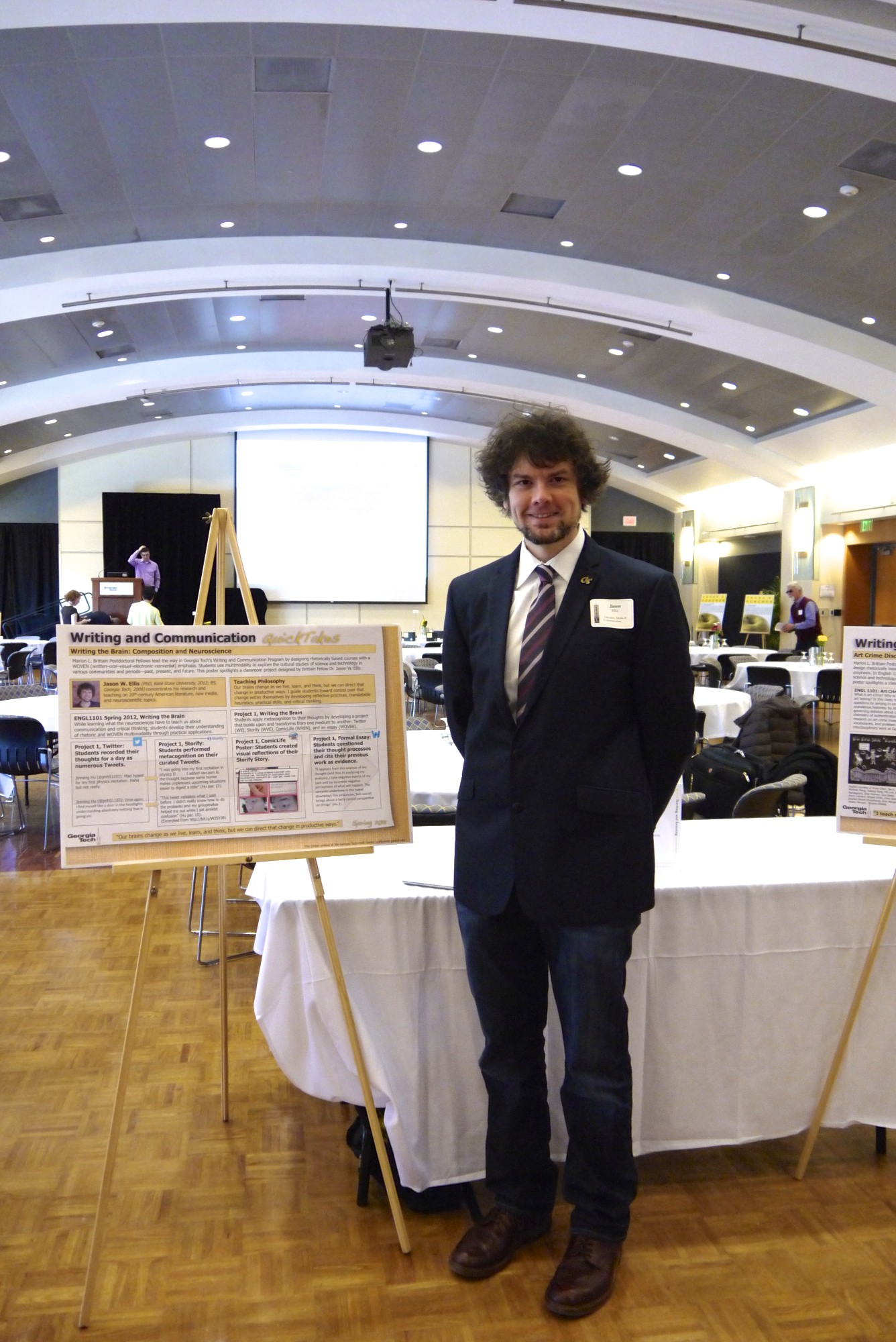
A number of Brittain Fellows had their posters on display and we were there in force to talk about our teaching of communication as rhetorical and multimodal (WOVEN = written, oral, visual, electronic, and nonverbal). I presented my poster on, “Writing the Brain: Composition and Neuroscience” [you may view it here–with thanks to my student Jinming Hu for giving me permission to share his work from class].
Fellow Britts: Olga Menagarishvili, Mollie Barnes, Emily Kane, and Iuliu Ratiu
We were able to share teaching ideas and techniques with others from the Georgia Tech community.
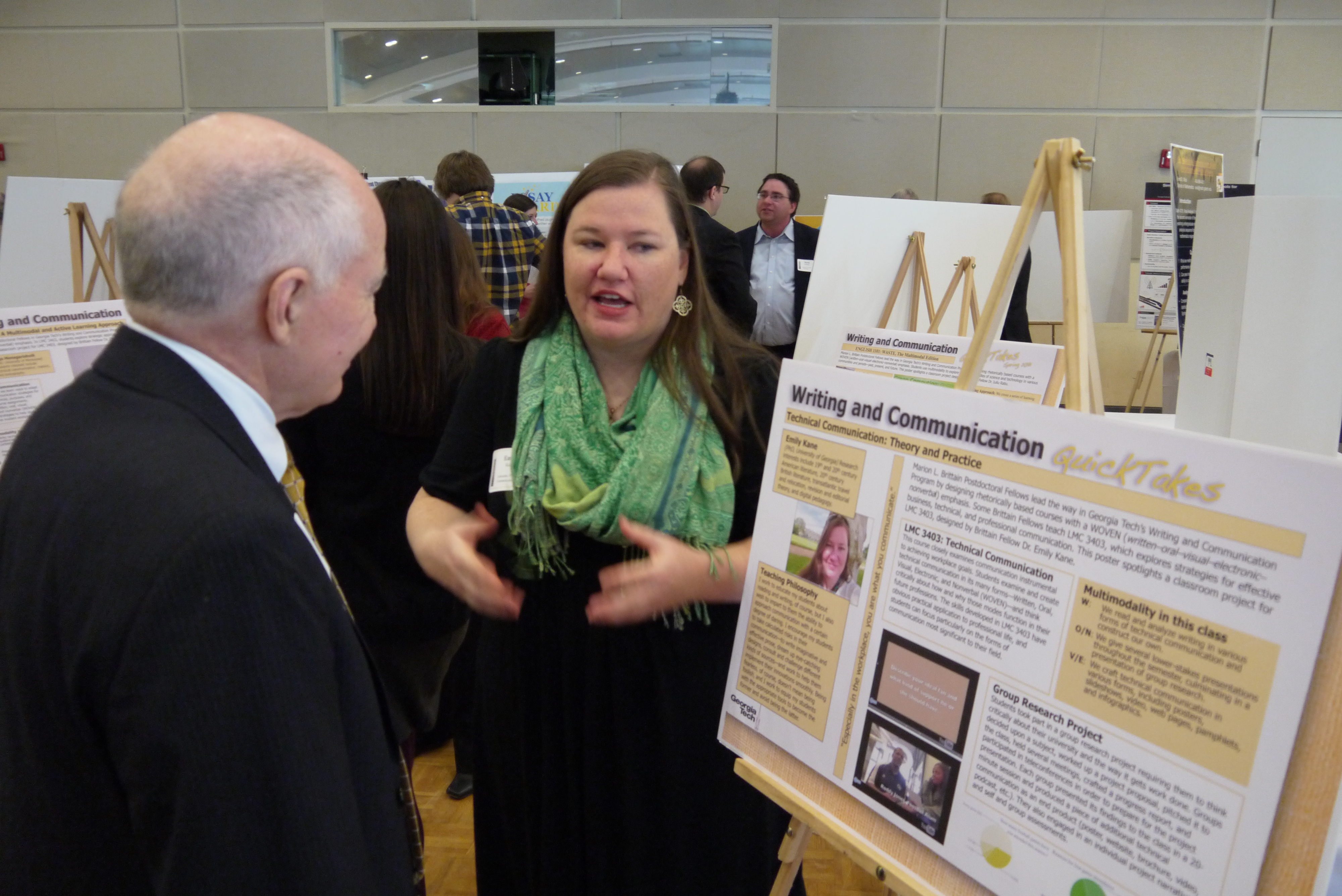
Emily Kane explaining her assignments.
The poster session was very well attended by people from across campus. The posters demonstrated the innovative teaching taking place at Georgia Tech.
Lots of visitors and lots of posters at Celebrating Teaching Day, 2013.
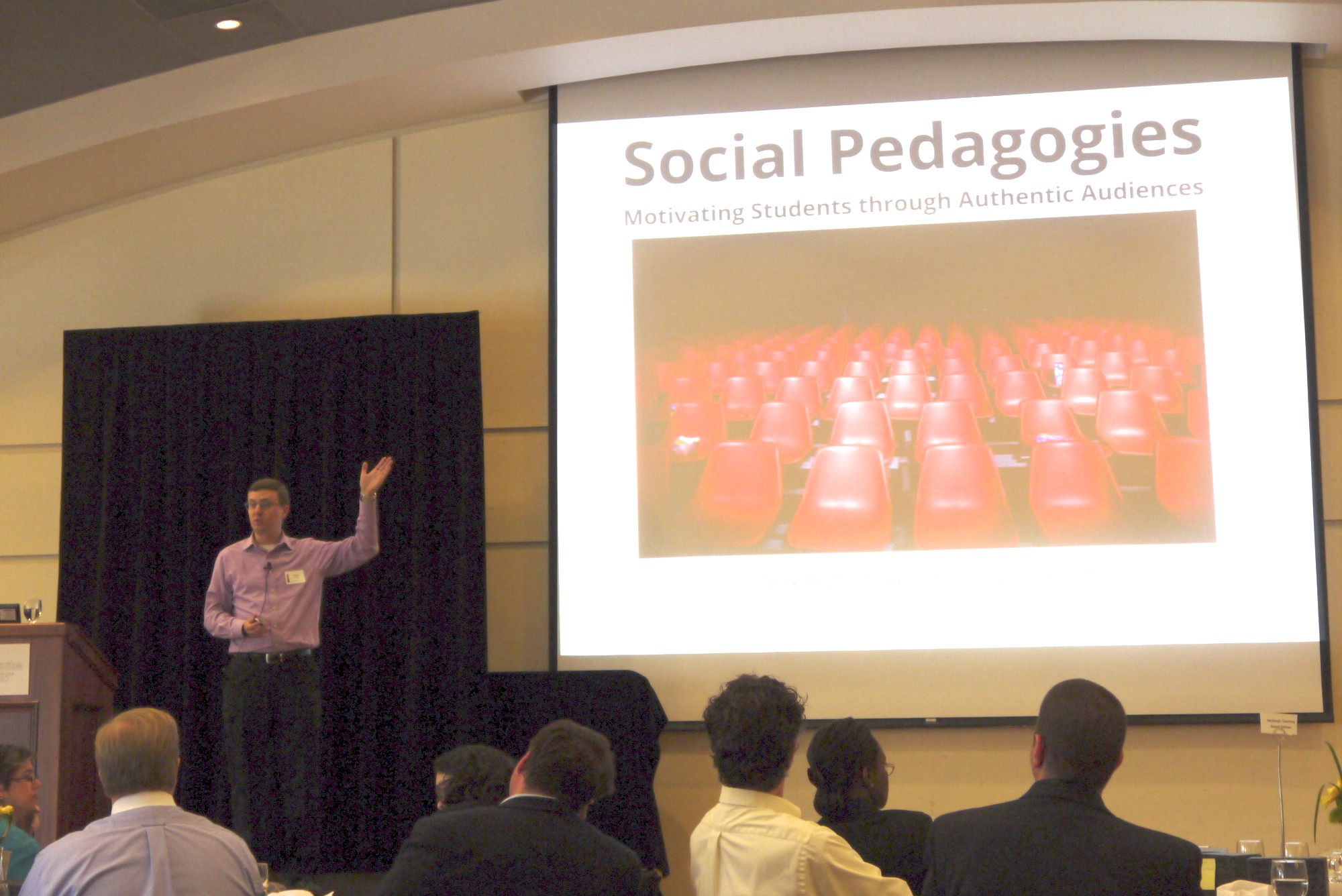
After the poster session, we were treated to lunch, an awards ceremony, remarks by President Bud Petersen, and finally, a presentation by Dr. Derek Bruff of Vanderbilt University on “Social Pedagogies.”
I am currently teaching three sections of ENGL1101 at Georgia Tech. The class’ theme, “Writing the Brain: Composition and Neuroscience,” remains the same as my earlier syllabus that I taught in Fall 2012 [available here]. However, I have made some fundamental changes to the reading list (two books instead of only one: John Medina’s Brain Rules and Jonathan Gottschall’s The Storytelling Animal), reading schedule (began with WOVENtext, then three fundamental essays/excerpts from O’Shea’s The Brain, Gary Marcus’ Kludge, and Geoffrey Miller’s The Mating Mind), and major projects (still three major projects, but now the first project incorporates Storify and ComicLife and the third project is an individual Pecha Kucha presentation instead of a group presentation–students will continue group work on the second project’s video). In the readings, I am encouraging more discussion about WOVEN and rhetoric in addition to discussion about the content and its application to composition. I have also integrated Twitter into the class’ daily rhythm and added daily reading presentations as a core component of the class. I have given the new syllabus a version 1.1 designation. Find out more by reading the new syllabus here.
I should also note that I had planned on teaching ENGL1102 in Spring 2013, but the school asked for a volunteer to teaching ENGL1101 again. This seemed like a terrific opportunity to put some of my ideas from reflection into practice right away. I do plan to teach ENGL1102 in the future, and I will be ready with this syllabus (unless, of course, I find the time to develop another syllabus, which is something that I would like to do by continuing the “Writing the Brain” theme into the second tier class with neuronovels and neuronarratives).



 I am currently teaching three sections of ENGL1101 at Georgia Tech. The class’ theme, “Writing the Brain: Composition and Neuroscience,” remains the same as my earlier syllabus that I taught in Fall 2012 [available