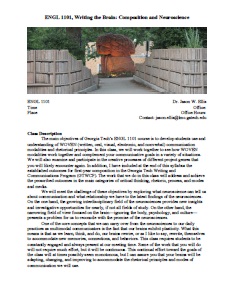
 My English composition students at Georgia Tech are now well into their second major project, so I figured that I should get in gear and post my syllabus for my newly designed, WOVEN (written, oral, visual, electronic, and nonverbal) focused ENGL 1101 syllabus. The title of my class is “Writing the Brain: Composition and Neuroscience.” Unlike the previous iteration of this class at Kent State called “The Brain and Writing,” I overhauled the whole class to only use nonfictional readings and more strongly emphasize multimodality in assignments and discussion. So far, I am very pleased with the results as demonstrated by the great work and commitment of my students. If you would like to read my syllabus, you can download it as a PDF here: ellis-jason-fall2012-1101-syllabus.
Category: Pedagogy
-
My ENGL 1101 Syllabus for “Writing the Brain: Composition and Neuroscience”
-
Learning from our Grandmothers: Memories of my Granny Ellis (1918-2012)
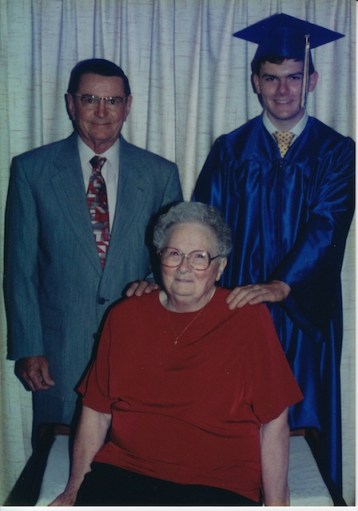
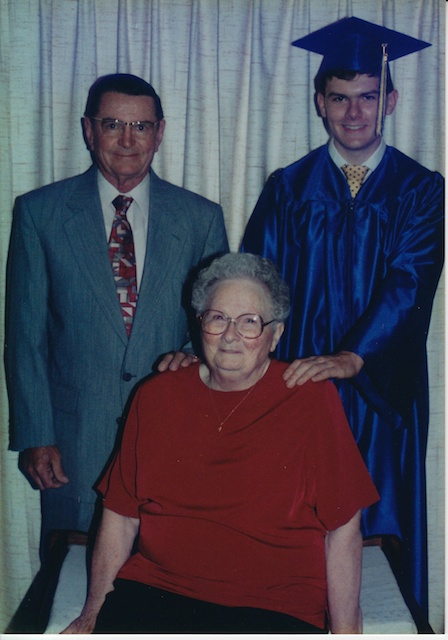
Papa and Granny Ellis with me after high school graduation in 1995. Early Monday morning, I received an unexpected phone call from my Dad. Obviously upset, he told me that my Granny Ellis had passed away during the night. It was hard to wrap my head around this fact. She was 94 years old, and she marshaled on despite numerous health problems–especially later in life. She was from “old stock,” a heartier stock that could weather setbacks and troubles without much complaint or fuss.
She was my last grandparent to pass away. I am very fortunate to have had so much time to spend and learn from my grandparents. Wilma, Papa Gerald, Papa Ellis, and Granny Ellis contributed in so many ways to my emergence as the person that I am today. I feel somewhat disconnected now from the past anchored by my grandparents–grandparents who I spent time with every day, every week, every summer when I was younger and who I called once a week no matter where I might be in: in Atlanta, Liverpool, or Ohio.
There are a couple of things that immediately come to mind in remembering Granny Ellis. The first has to do with food and the second has to do with the surprising power of memory.
When I was younger, I would usually spend Wednesday afternoons and some weekends with my Granny and Papa Ellis. More often than not, I wanted to “play” with my Legos or other toys, but what no one knew–even myself–was that I was learning. I was modeling. I was thinking through narrative. I was thinking about the possibilities in social interaction, engineering, and creativity.
Granny Ellis let me explore through my play without interruption–except when it was necessary, as she would remind me, to eat. She believed in making sure that I was well fed. With energy stores fulfilled, she would release me from an empty bowl of chili or a now barren plate where once sat made-from-scratch biscuits to return to my building, my thinking, my “play.” In her own way, I believe that she recognized that I needed to do those things to make sense of a world far different from the one she was born into so many years before. She recognized that even play is an important part of learning.
Then, many years after those afternoons on the carpeted floor hunting for the right brick, Granny Ellis developed neurological problems. Papa Ellis would need to guide Granny around. It was like she was there, trapped behind her eyes, unable to express herself as she had when I was younger. However, her doctors began experimenting with different medicines to combat what were ultimately long undiagnosed micro-seizures and dementia, she regained to some extent her old self. You could speak with her once again and she could recall the past remarkably well. Unfortunately, her short term memory was impaired–she could not remember from day-to-day or even minute-by-minute on most occasions.
Due to Granny Ellis’ trouble with short term memory, I expected her to not remember my wife Y after I introduced her. To my overwhelming joy, Granny Ellis not only remembered that I was married to a beautiful girl named Y, but she also remembered to ask how Y and I were doing. Granny’s face would light up when she saw Y on the too few occasions that we could both travel to Brunswick to visit. Despite these few encounters, Granny Ellis overcame her brain’s degenerative hurdles to hold on to that memory. Did her love for Y and me play some role in her brain’s ability to build a lasting long term memory from her short term memory? This question deserves further investigation. In the meantime, I believe that she expressed her love through her memory of Y, and I am glad that I now have that memory to hold onto in my life.
Our friends and family (and especially our grandmothers) have a lot to teach us. We can learn from them and our experiences. We can reflect on what they did–how they demonstrated solid pedagogical practices for learning and enabling learning–in our own thinking about the theory and practice of teaching.
-
Patrick E. McLean’s “A Defense of Writing Longhand”
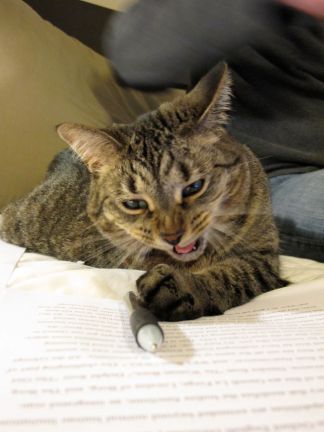
Folks who teach writing should read Patrick E. McLean’s essay, “A Defense of Writing Longhand” (on his official site here, and originally spotted on LifeHacker here). In his essay, he argues that he writes better longhand than computer typing, because longhand enforces a singular focus that we tend to lose when using a computer (I would say even with screen isolating typing software, because you may still think what is going on in cyberspace just beyond your imposed veil).
I tend to agree with McLean. I believe that I write better in longhand than I do by typing. After I have written something in longhand, I type it into my computer and in that process I begin editing. Putting ideas down in writing on the page is a different operation than styling and improving your words through editing. Computers are very well suited to editing, but I have to admit that my computer can be a multitasking nightmare for me. Even with all other applications closed, I still have reminders of backups, wireless networks, the time, and even with the screen blanked only for writing, I can still occasionally hear the click and whirr of my hard drive (even when I used to have a SSD, I could still hear the fans of the computer and a barely audible buzz from the hard drive compartment).
Of course, everyone’s approach to composition is different, but this is exactly the reason I ask my students to use computers and longhand for different assignments in my freshman and sophomore writing classes. This challenges students to use different styles of composition, and it allows students who may have one preference over another to show me what they are capable of in that particular medium.
-
A Few Reading Strategies for the Science Fiction Novice
Underlying many definitions of science fiction is the fact that reading science fiction requires some level of apprenticing and learning of the key concepts, tropes, and concepts that appear in much of the genre’s works. Damien Broderick formalized this in his book Reading by Starlight, in which he argues that there is a ‘science fiction megatext’ that authors borrow from and give to that science fiction readers learn over time. Thus, reading science fiction can be a daunting task for someone not yet accustomed to the genre and its many elements.
However, this is true of any literature that you may read whether it be mainstream fiction from one particular historical period versus another, or another genre such as detective fiction or the western. Any reading requires a certain amount of heavy lifting on the part of the reader to engage the story and its characters. Perhaps with science fiction there is an additional attendant requirement to figure out the science, technology, and estranging qualities of the story, but the reader’s success at figuring these things out is part of the joy of any kind of revelation.
Below, I have written out some strategies for reading science fiction that can equally apply to other literatures. If you have other suggestions, please leave them in the comments.
- Read slowly and carefully. Reading is not a race to the finish. You may have to read something more than once to completely understand the story, and you may have to read it a further time in order to uncover any greater meanings lying beneath the surface.
- Keep a notebook handy as you read. Jot down ideas with the page numbers that attend those ideas.
- Diagram the characters and actions in a flow chart or story outline to better make sense of a complex narrative. Who are the characters? Where do characters go? Who do they encounter? What happens to them? What do they do?
- Keep a web browser open with two tabs: one for your favorite search engine and the other for dictionary.oed.com. Search terms that you have not encountered before.
- Be smart with your reading. If you don’t have the time to read and re-read something, you should search the Lexis Nexis database for reviews of the novel. Wikipedia also has a number of plot summaries. However, I cannot warn you enough that these serve as a guide or introduction only; you should read the work at hand in order to fully understand it and experience the novel itself through the act of reading.
- Don’t always think literally, and vice versa. When you come across something like, “She turned on her right side,” it could have more than one interpretation. She could turn over onto the right side of her body, or it could mean that she powered up the right side of her body (cybernetic implants, computers, etc.).
- Pause during your reading to imagine what it is you are reading. This can be hard work, but it does get easier as you encounter it more often.
- You only build new and powerful connections in your brain through challenging and unique experiences. The readings in my classes are intended to be just that. If you don’t do the heavy lifting though, you won’t get any of the long term benefits of engaging and surmounting these challenges.
-
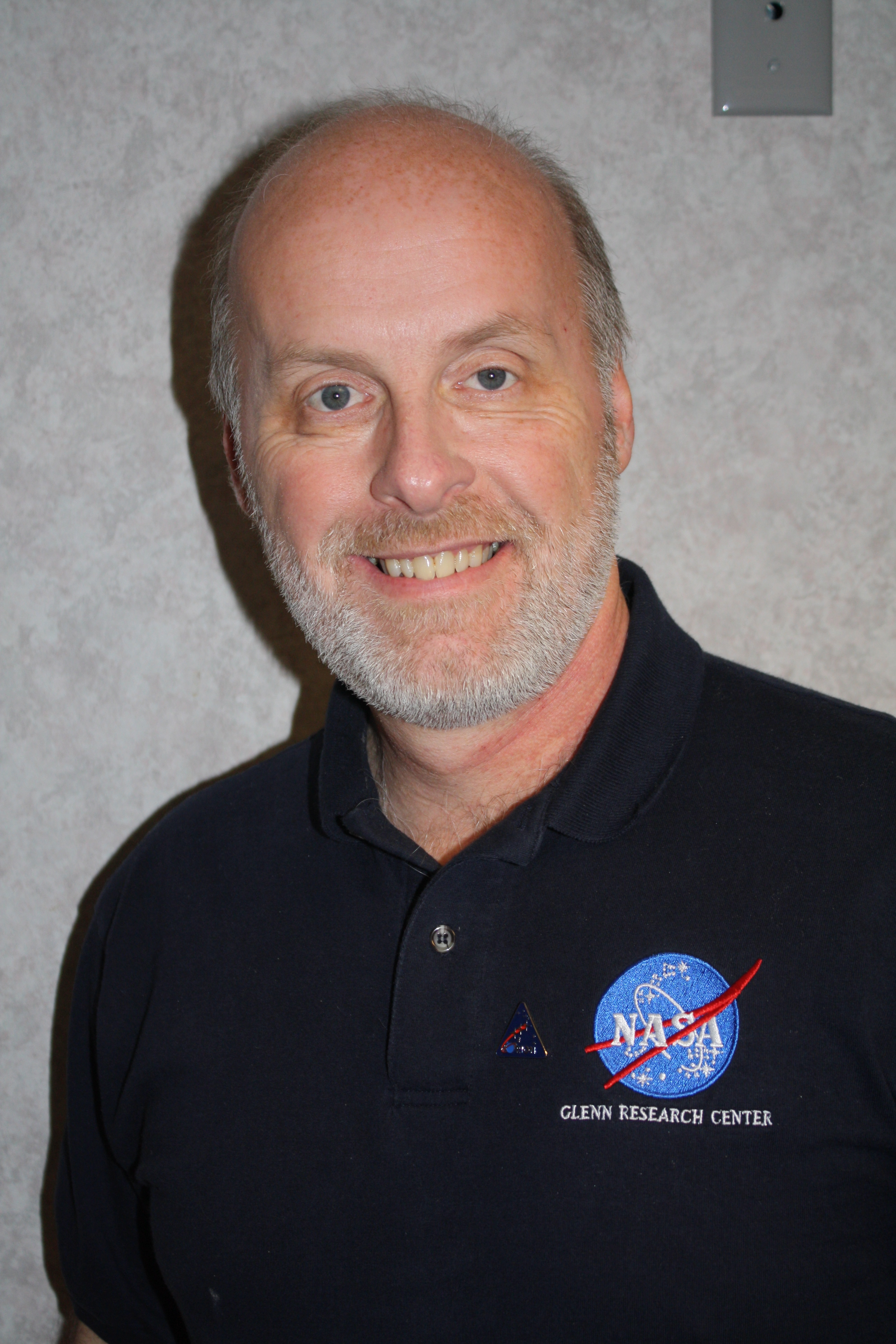
NASA Speaker Professor Jay Reynolds Visited My Writing Classes Today
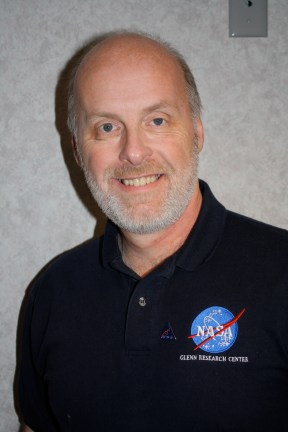
Thanks to NASA’s Speakers Bureau, Professor Jay Reynolds of Cleveland State University and the Glenn Research Station agreed to visit my two intro writing classes today to talk about America’s return to the Moon, current research on Mars, and investigations of asteroids and protoplanets, which is what Prof. Reynolds is at the present involved in with the DAWN mission to observe Vesta and Ceres.
I asked Prof. Reynolds to speak to my classes about some of the things taking place right now at NASA, particularly in relation to NE Ohio, where the majority of my students are from, and to give some context to the work that NASA does. He did an excellent job of this in his two presentations today for my students. Based on the subjects that he covered, I believe that he filled in many gaps that I either didn’t have the time to cover or those things that didn’t occur to me at the time as my classes worked their way through Arthur C. Clarke’s 2001: A Space Odyssey and Kim Stanley Robinson’s Red Mars as part of the “Space Exploration and Your Future” theme of my intro writing classes.
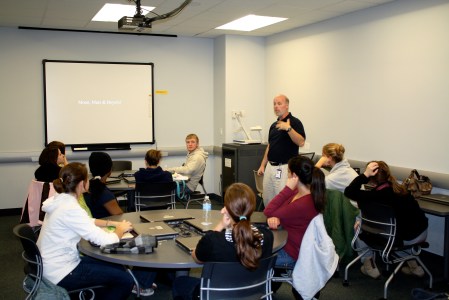
Prof. Reynolds demonstrated his depth of knowledge about NASA and its missions while also engaging broader economic and political interests in response to questions put to him by my students. He displayed a contagious abundance of energy and excitement about his work and the work taking place at NASA that I believe carried over to some of my students in the two classes.
At the beginning of his presentation, he began simply by asking my students what they thought of the unauthorized, yet mission making, Apollo 8 picture of the gibbous Earth next to the lunar surface [find it here] and the Apollo 17 image of the fully illuminated Earth [find it here]. What he stressed with these images was that our missions to the Moon turned into missions about the Earth. Our going out there gave us, meaning humanity, a new perspective on our planet and ourselves as co-inhabitants of what Carl Sagan termed a pale blue dot.
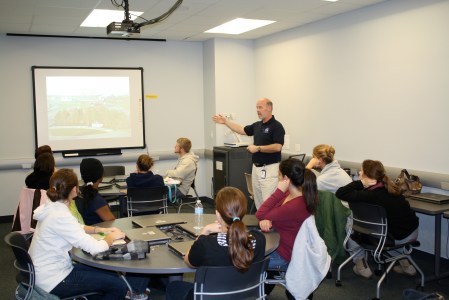
He discussed the Space Shuttle, Saturn V, and Ares I and V launch vehicles [see my Lego versions here] in detail, which elicited many questions between the two classes. Other questions included: How safe are the launch vehicles? Why did we go to the Moon? Does anyone own the Moon? What do you do with Helium-3?
Prof. Reynolds’ presentation ended with a discussion of asteroids and the importance of locating and tracking those objects which cross or may eventually cross the orbit of the Earth. This is related to the work that he does for NASA with the help of undergraduate and graduate students from Cleveland State University in conjunction with the DAWN mission [some related info here].
I am thankful that NASA can make a special event like this possible, and I am especially grateful to Prof. Reynolds for taking the time and energy to drive down to Kent and spend the afternoon with my students. It was a terrific occasion to close out the Fall 2009 semester for my students.