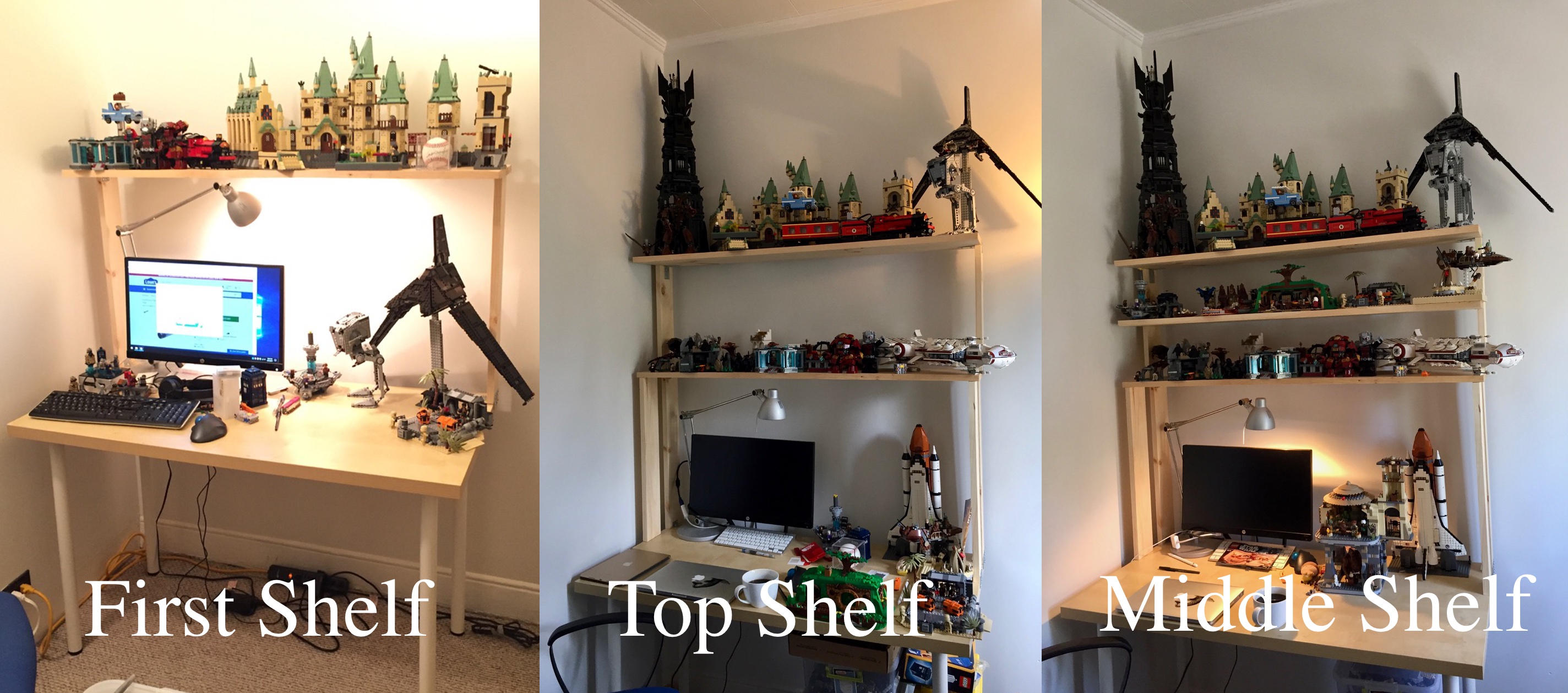
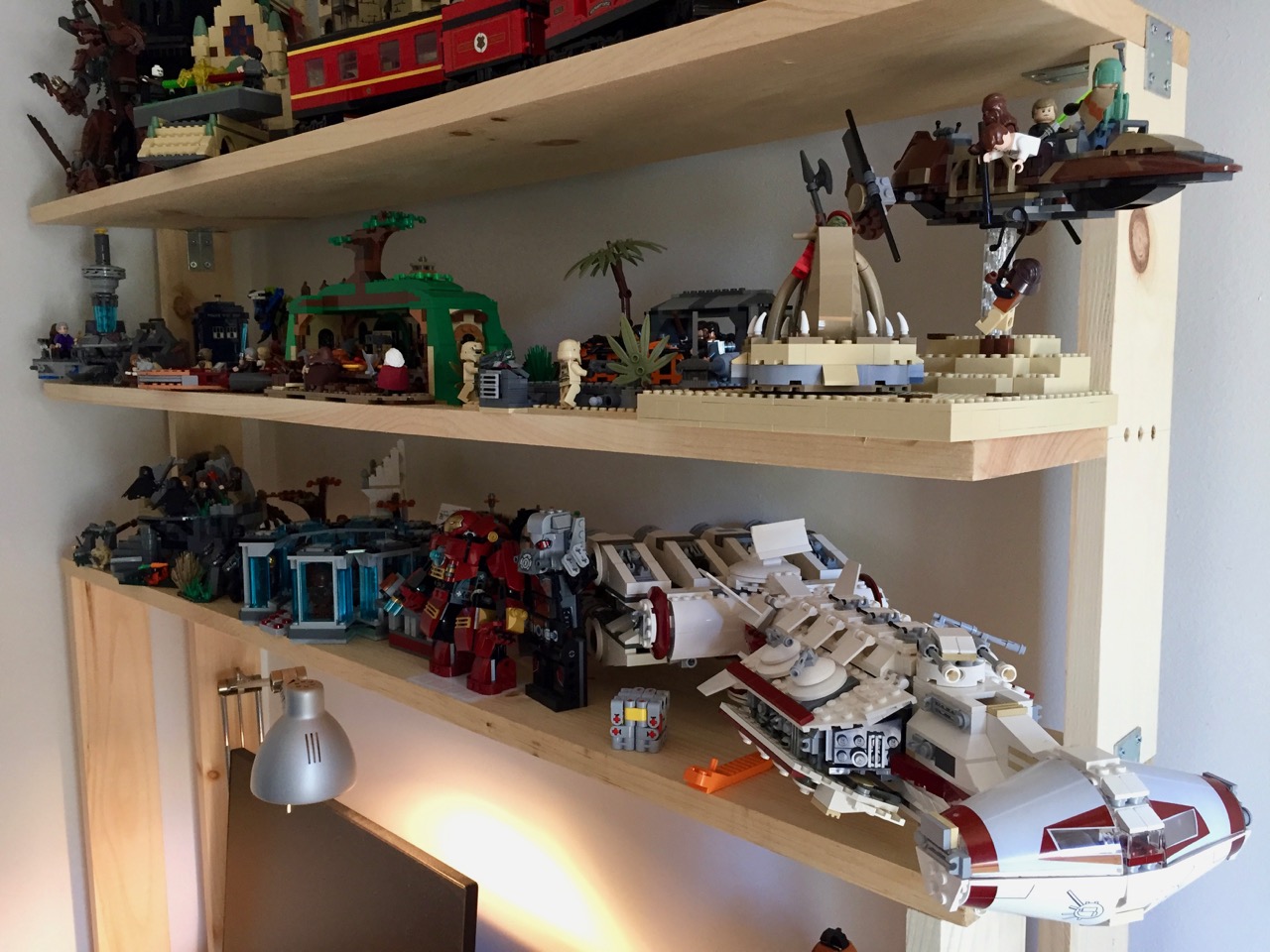
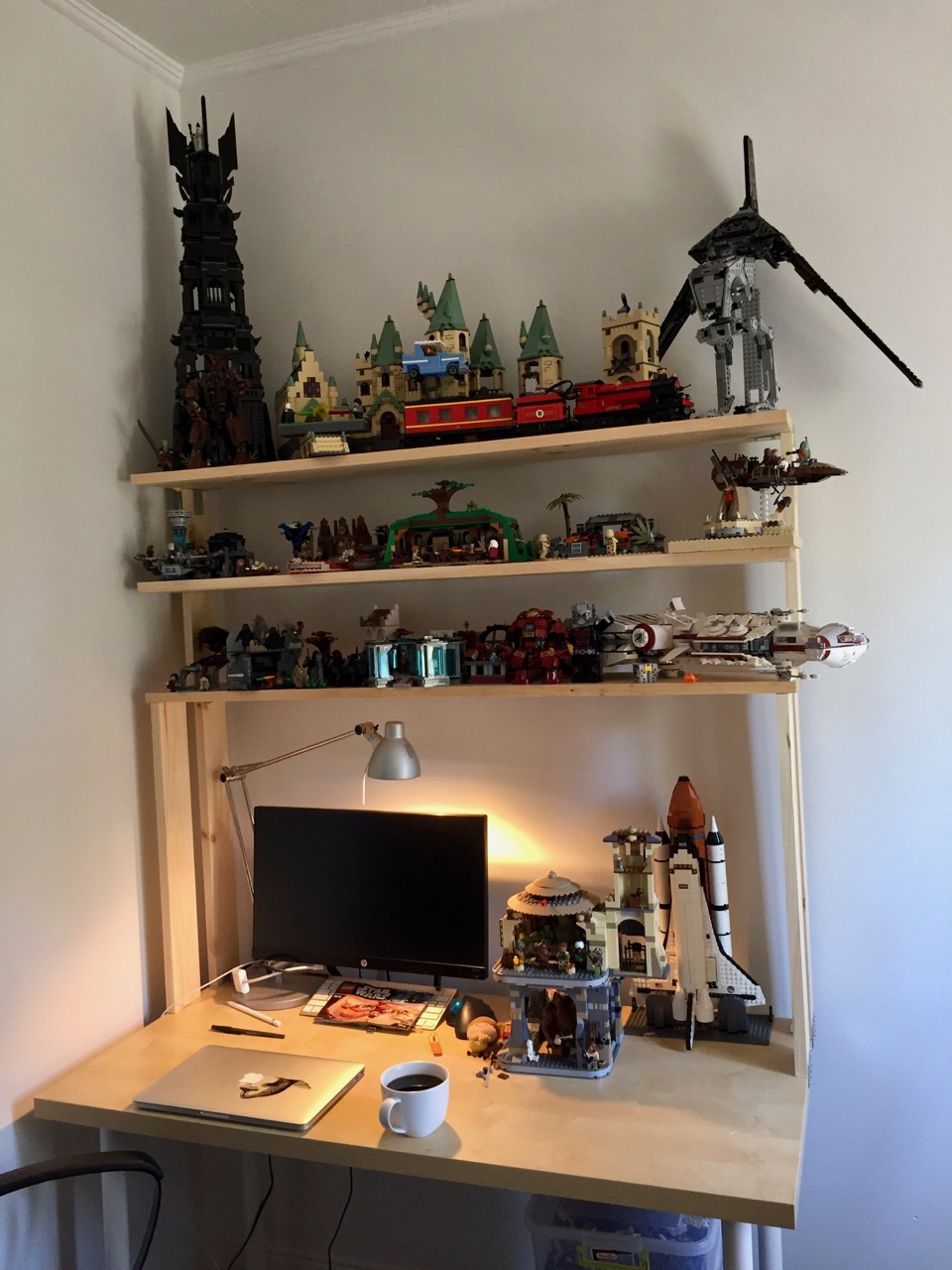
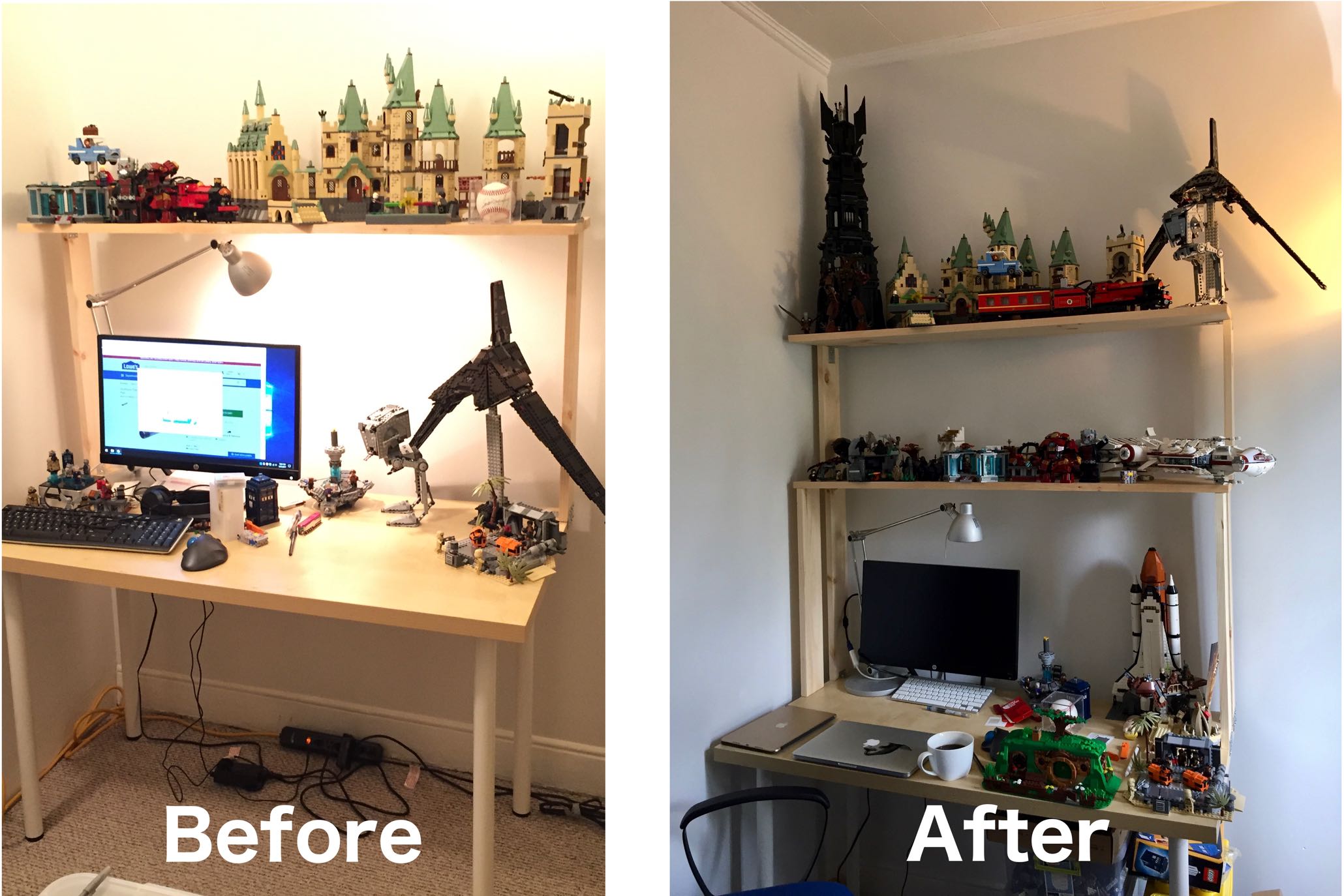
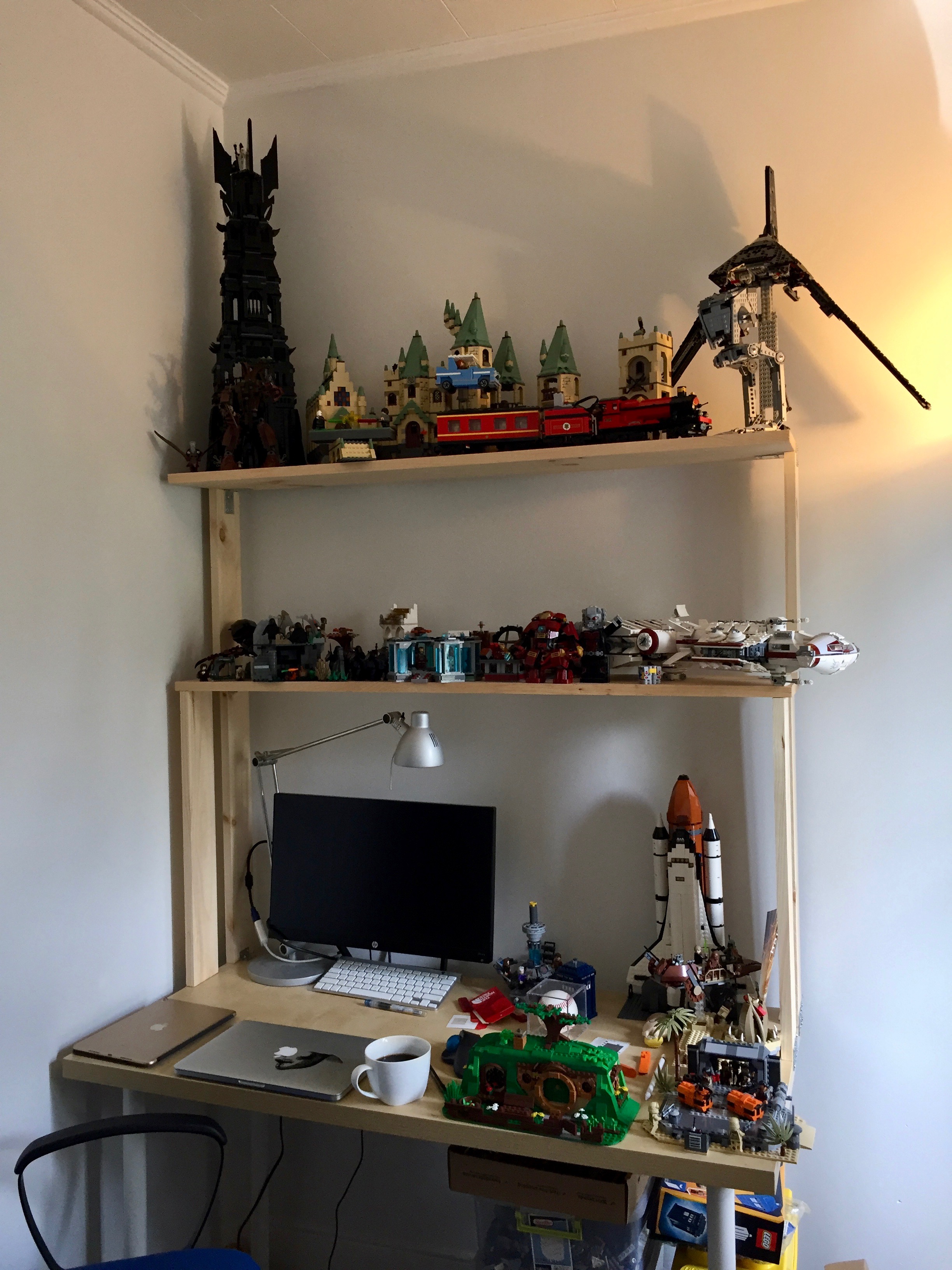
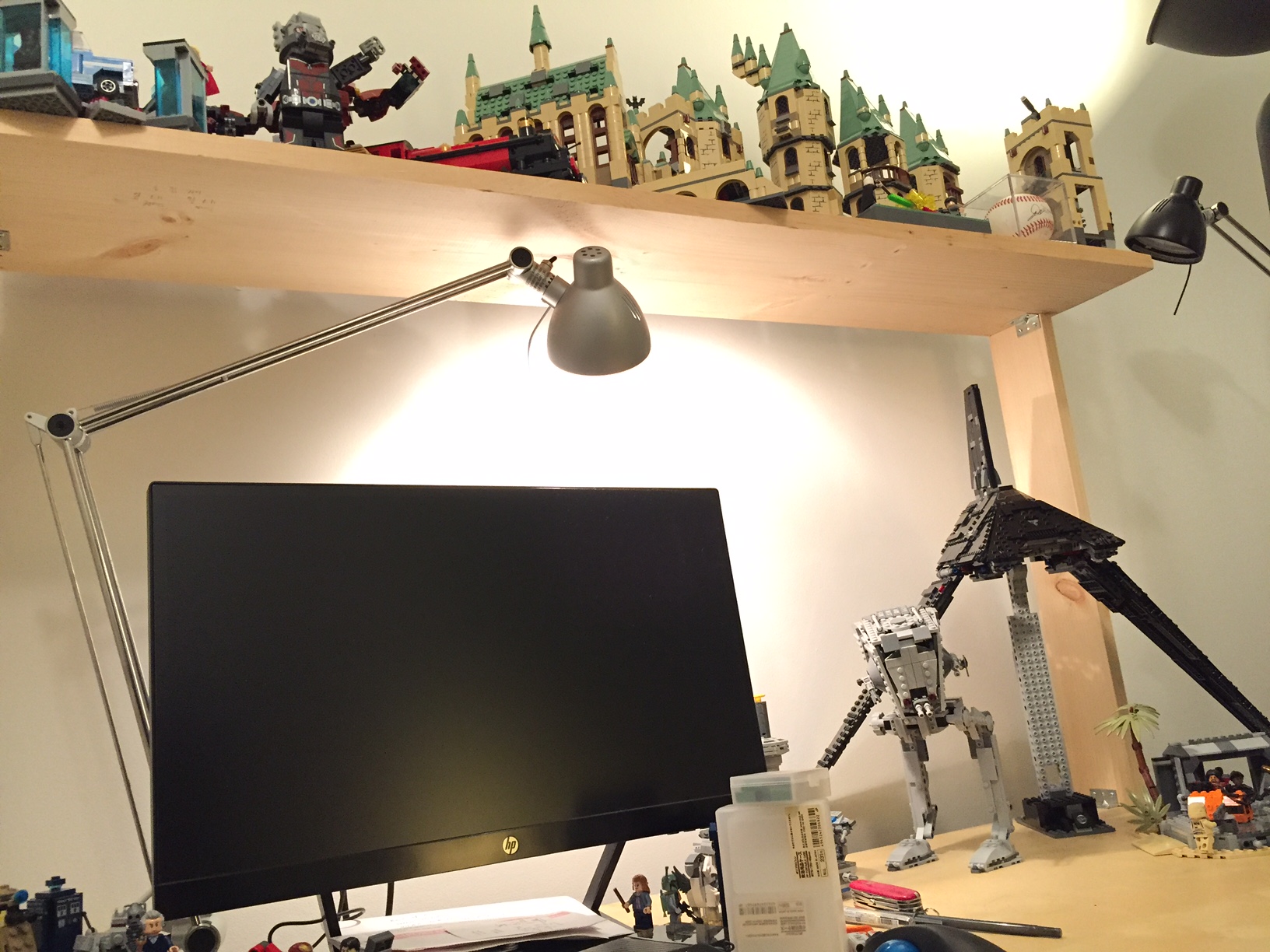
What began as a simple shelf to raise some of my LEGO sets off the workspace of my desk and rose to incorporate a higher shelf to accommodate more sets that I brought back from my parents’ home is now a three tier Franken-shelf.
It quickly became evident that I needed more shelf space for a few more sets that I had assembled. Also, I noticed that the 16″ space between the lower and upper shelves of the second phase construction was more than necessary. It seemed that 8″ headspace was required for most of my LEGO sets. So, I set about adding a third shelf between the lower and top shelves.
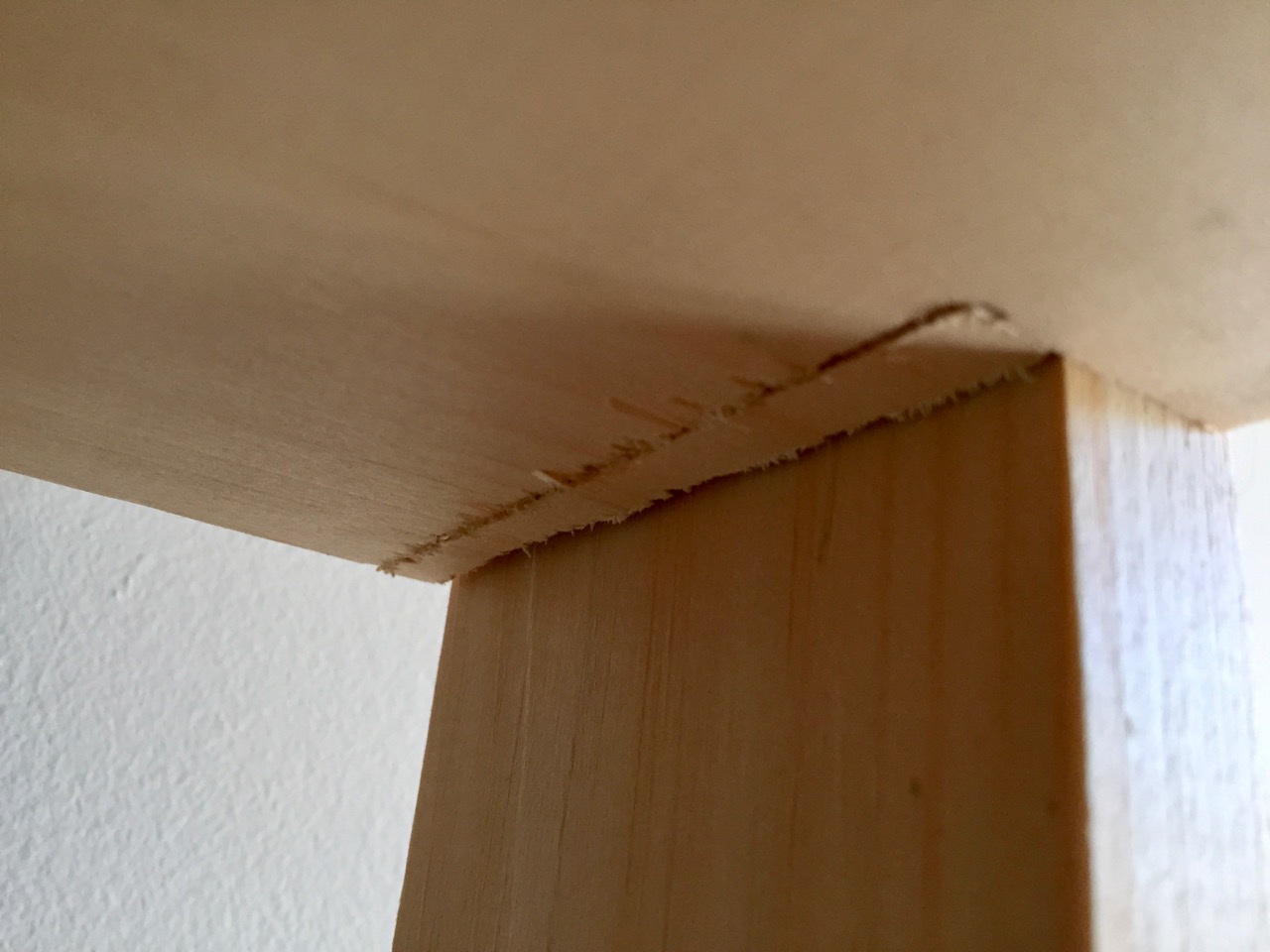
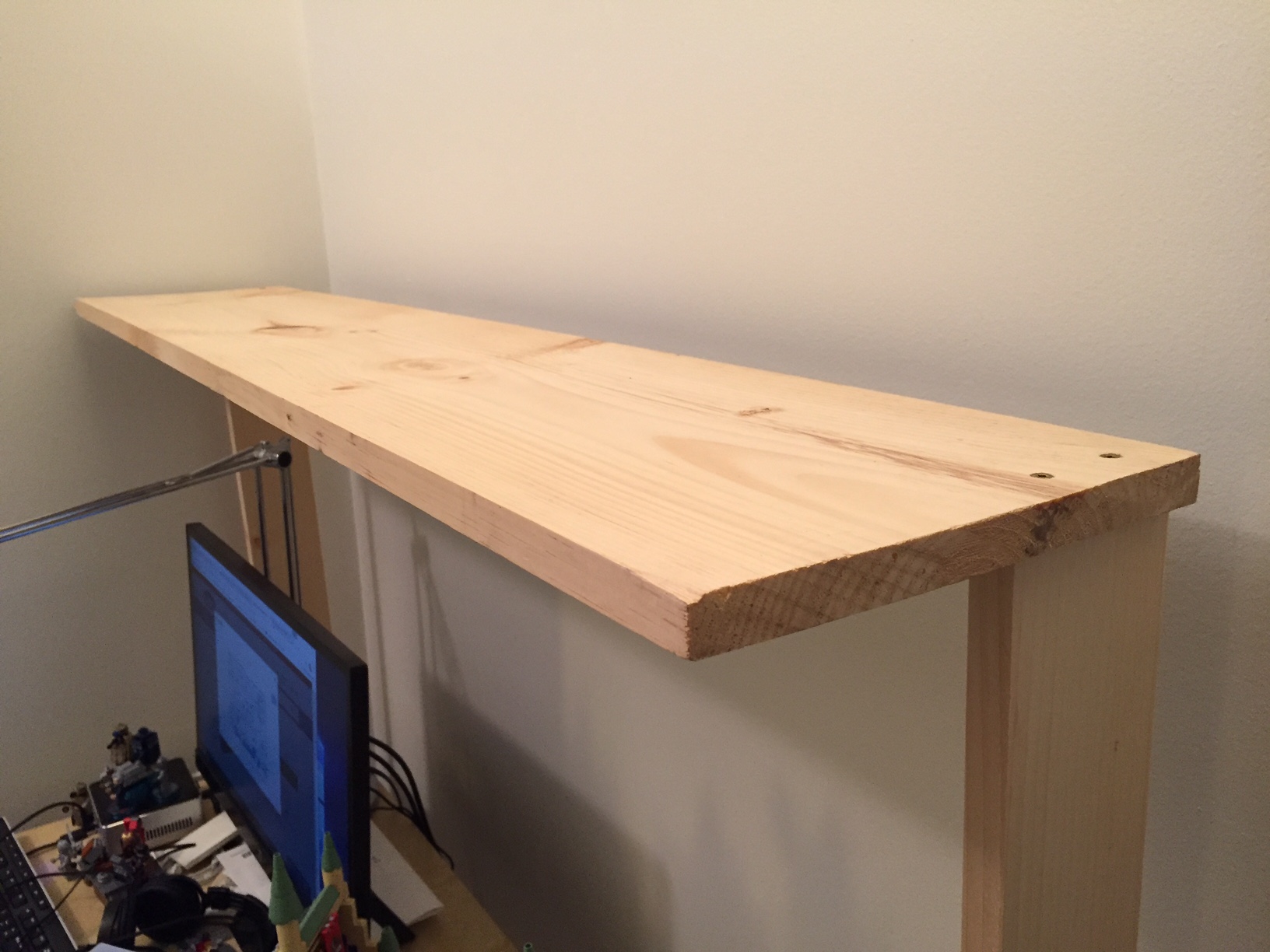
I decided to notch this 1″ x 10″ x 4′ shelf and install it only with deck screws through the upper shelf supports. I measured 46 1/2″ between the two supports and the 1″ x 4″ supports are 3/4″ thick. This is where I made a mistake with my initial cut. My measurements were correct, but during the 5 seconds that it takes for me to talk from my closet (where the desk is) to the living room where I had left my handsaw, my mind misremembered the measurement as 46″ between the supports. This meant that I cut 1/4″ more than needed on each side of the shelf! Luckily, I had a scrap piece of 1″ x 4″ board that I cut 1/4″ fillers from and glued into the notch to fill the missing material.
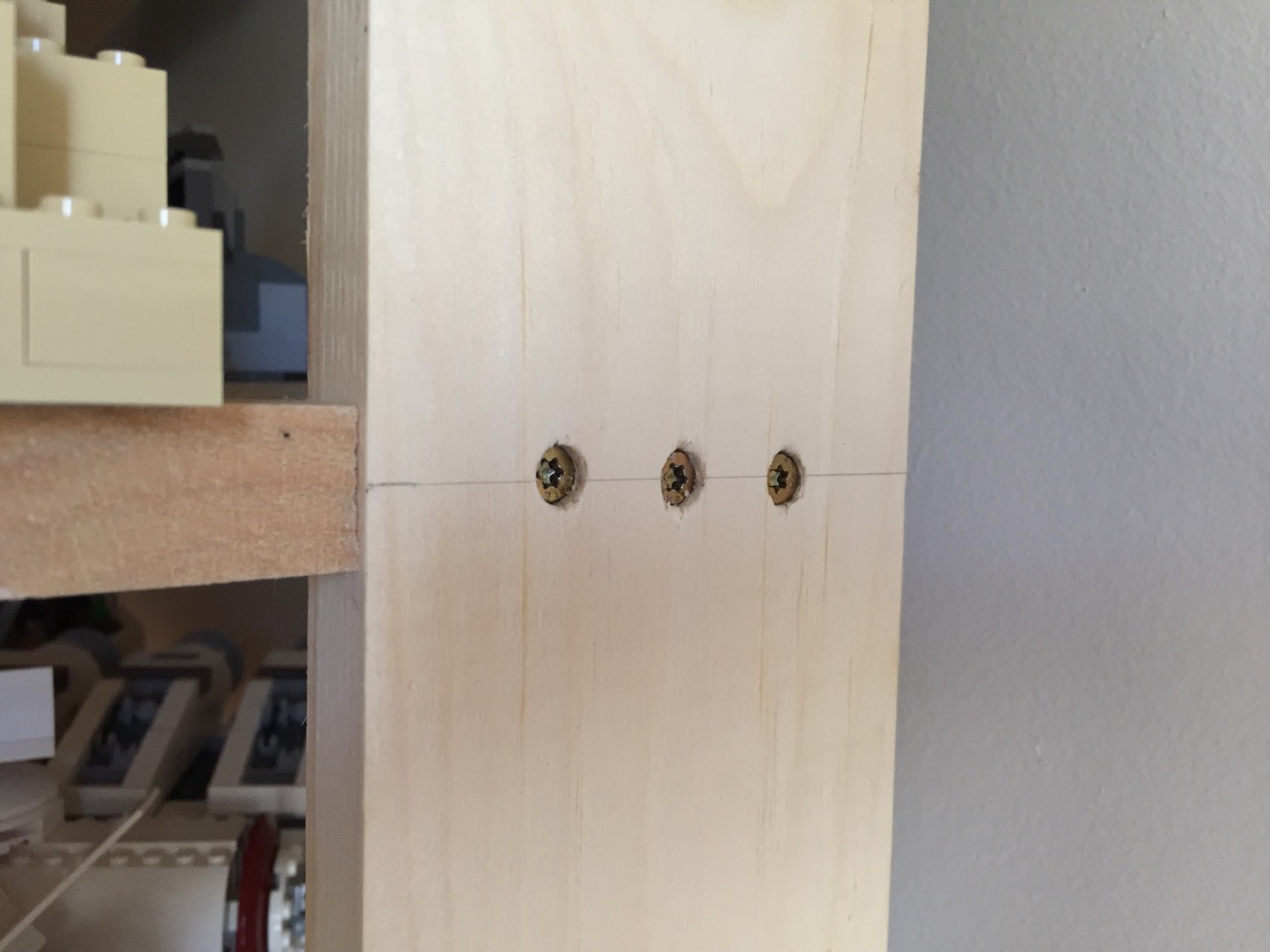
The shelf is centered on a line at 8″ between the top of the bottom shelf and the bottom of the top shelf, which is a distance of 16″.
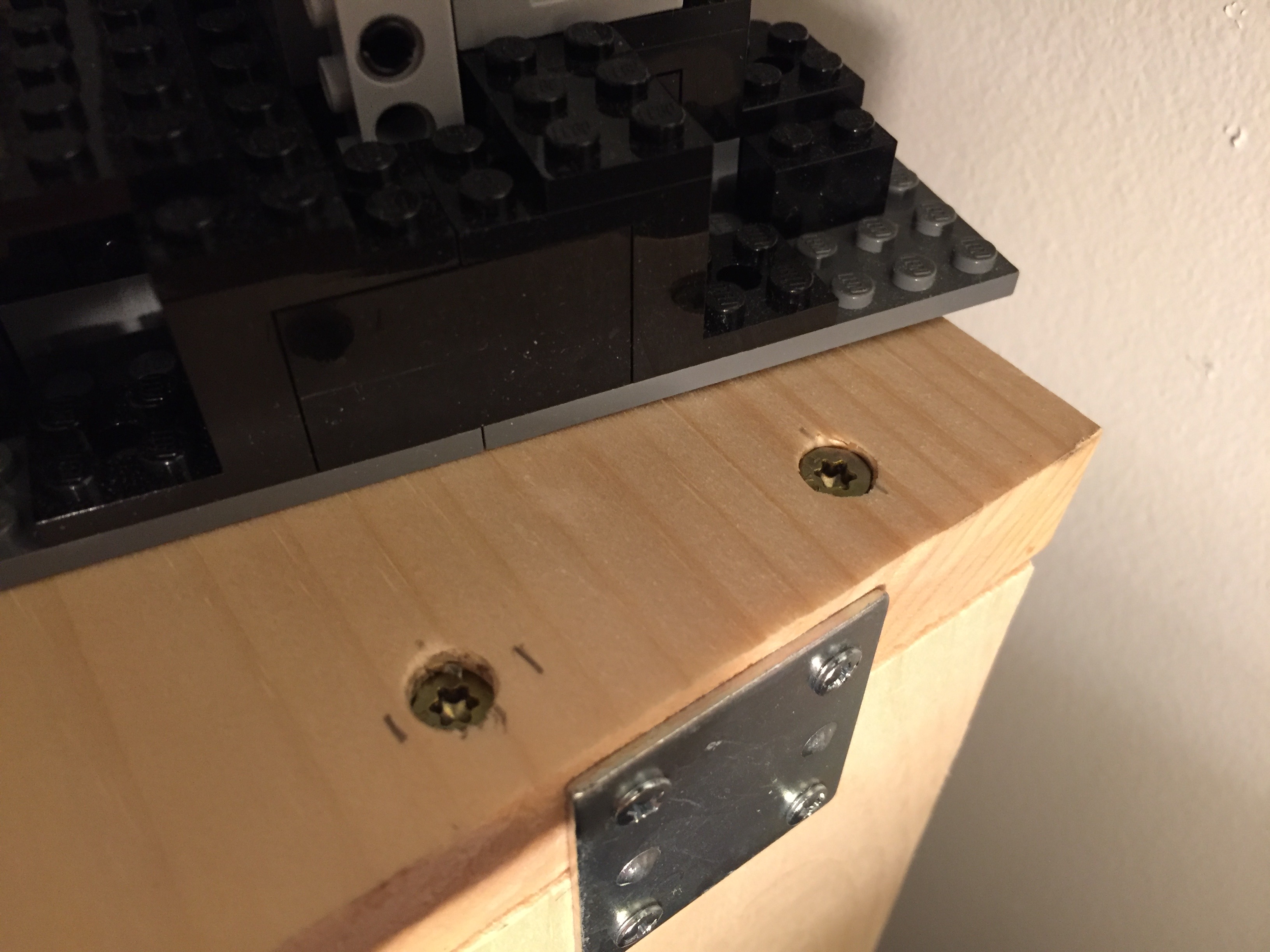
My deck screws extend through the supports and filler, and enter the shelf securely. They are spaced 1″ inside from either end and the third being in the middle (3/4″ from either end screw).
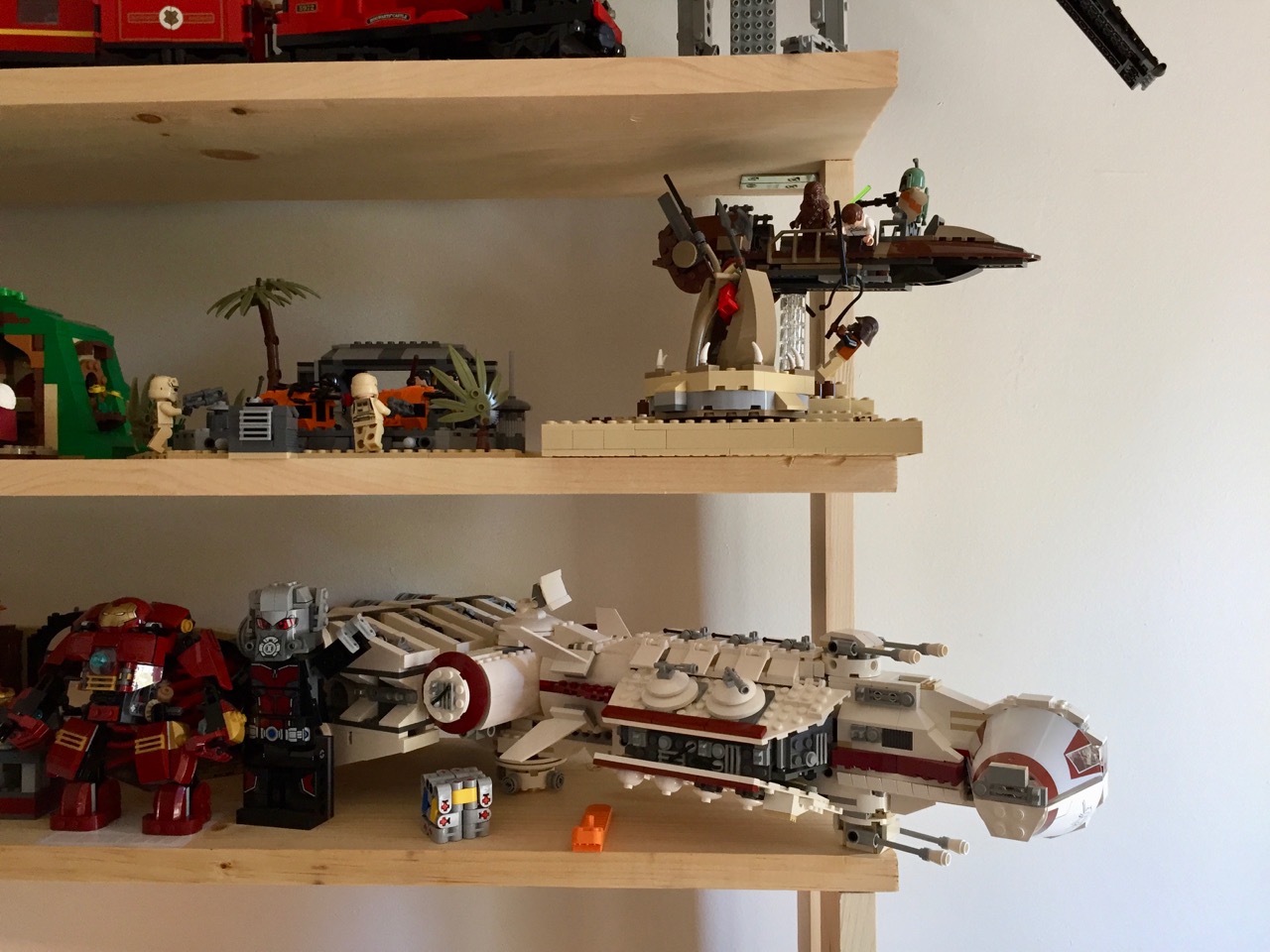
The new shelf easily accommodates a number of sets from Star Wars, Lord of the Rings, Harry Potter, and Doctor Who.
If I had planned out the shelves better than I had, I would have built the entire thing using only wood and deck screws (my previous blog posts explain how I used metal brackets and braces). This would have lowered the cost and it would have had a better craft appearance than horribly kludge-like. Nevertheless, it gets the job done–I can see my sets above and continue building on my clearer workspace below.
In my previous blog post, I documented a shelf that I built for my low-cost Ikea desk.
Since then, I brought back two checked bags full of LEGO from my parents’ home in Georgia where I had been storing it. I have not put all of these sets together or sorted the loose bricks into bins, but became quite clear after assembling 2/3 of the sets and two additional sets from eBay that I would need at least one more shelf.
To add another shelf, I needed to shore up the existing shelf and build up from it.
Two constraints to the height between the two shelves were the enormity of the Tower of Orthanc (10237) and the height of the room’s ceiling. I settled on a height of 16″ between the two shelves to allow enough room for medium- and small-sized sets on the lower shelf and larger sets (including Saruman’s lair) on the upper shelf.
To add the new shelf, I needed to purchase one 1″x10″x4′ pine board (the shelf), two 1″x4″x4′ pine boards (one of these was cut in half to support the lower, existing shelf and the other was cut into two 16″ long lengths to support the upper, new shelf), two packs of 1 1/2″ braces, and two packs of 2″ brackets (the smaller brackets that I used for the original shelf were sold out at the local Lowes).
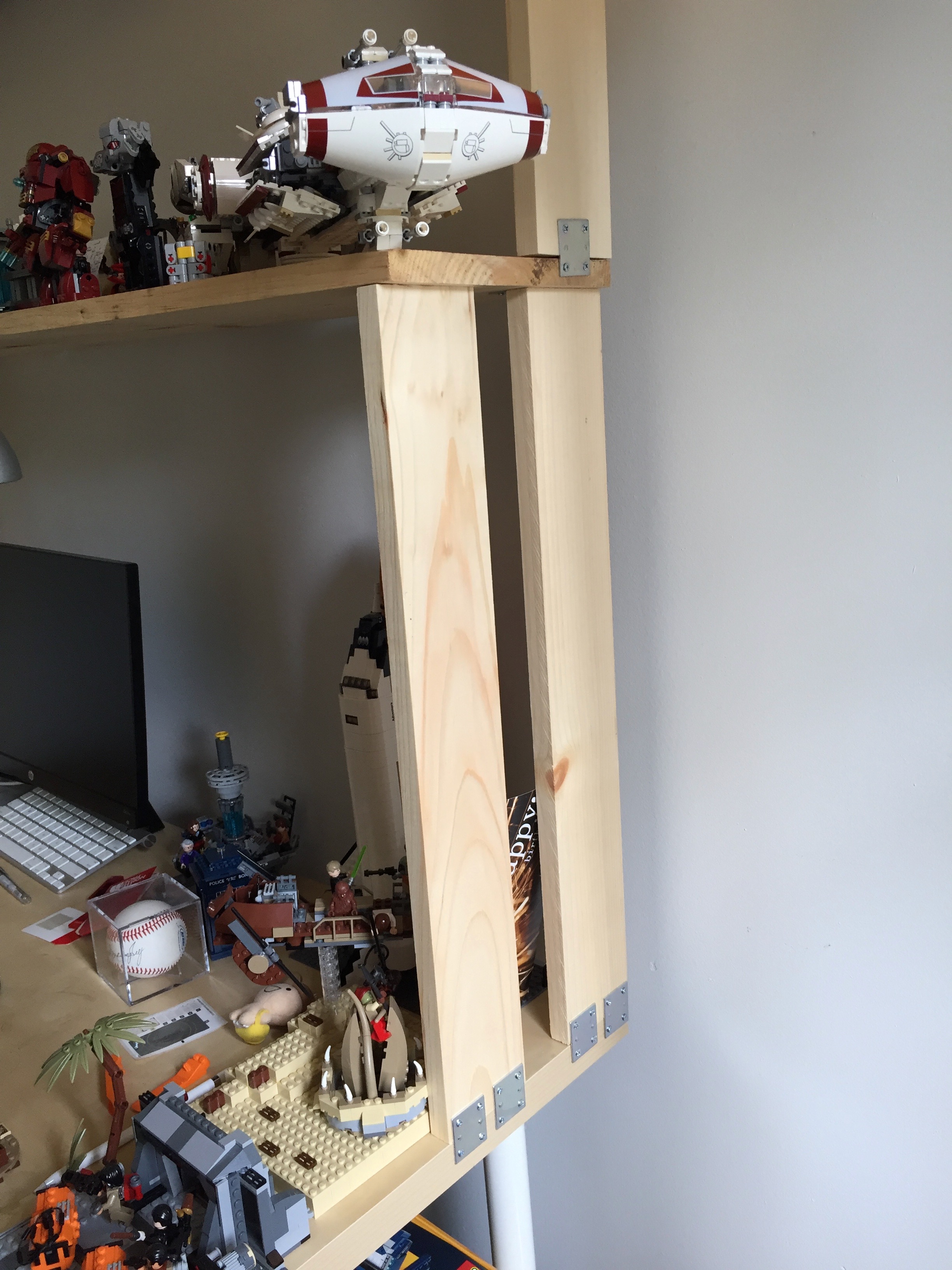
To shore up the lower shelf, I added a 24″ support to the front of the shelf. Originally, there was only one 24″ support at the back of the shelf, which was plenty for the needs of accommodating the few LEGO models originally put there. With the additional weight higher up from the new, upper shelf, I wanted to ensure that the lower shelf on which the upper shelf is built can sustain the weight and any torsion. I affixed each of these new, forward supports with two deck screws (pre-drilled) from the top of the shelf into the stop of the support. At the bottom, they are held in place with braces on the outside against the edge of the desk top.
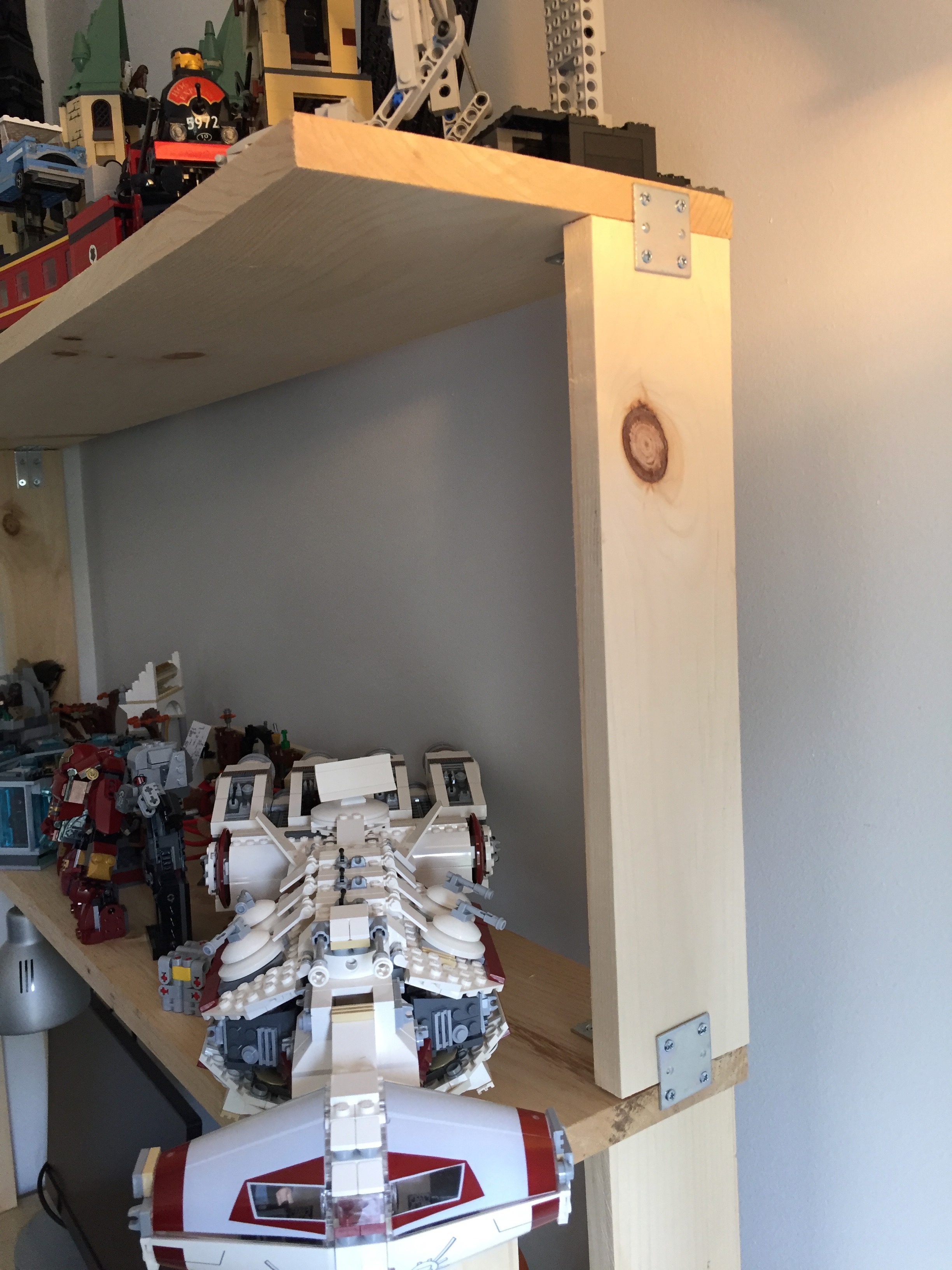
The upper shelf has two 16″ supports that affix to the back of the lower shelf. The upper shelf is attached to the supports first with two deck screws (pre-drilled) from the top through the shelf and into the supports. On the outside, they are connected to the lower shelf by a brace on either side. The shelf is strengthened with a brace at the top, too.
On the inside, brackets are used where the support meets the lower shelf’s top and the upper shelf’s bottom. Instead of using the metal braces, I could have used wood braces–such as another 1″x4″x4′ board running underneath the shelf and cut 3/4″ on either end to accommodate the supports. A few deck screws from top and sides would have made the shelves even stronger. I wanted to avoid the shelves catching more light in my dark office than they could, so I opted to use the metal brackets, which should be strong enough for this installation.
Now that the new shelf is installed, I realize that I need another shelf! Maybe I can fit one in between the lower and upper shelf. As you can see above, I can’t go any higher on the upper shelf or Saruman will go through the roof!
I believe that it is important for everyone to make things. Making uses the brain and the body. Making acts on the world. Making is an expression of ourselves. Making can be for ourselves alone or it can be shared with others. Making can be meta, too–making about making (like this blog post). Making in all of its forms is a really big part of what makes us human.
Doing a bit of making today, I built a raised shelf for my IKEA table top desk using pine boards. It began as a thing for myself, and it continues as a thing shared with you here.
I like working with wood. Unfortunately, I don’t get to build things with wood as often as I would like. When I lived in Atlanta, I had space and tools. Here in New York, I have little of the former and few of the latter. Nevertheless, I find small ways to stay in the woodworking game by building things to solve problems such as the state of my work-at-home desk:
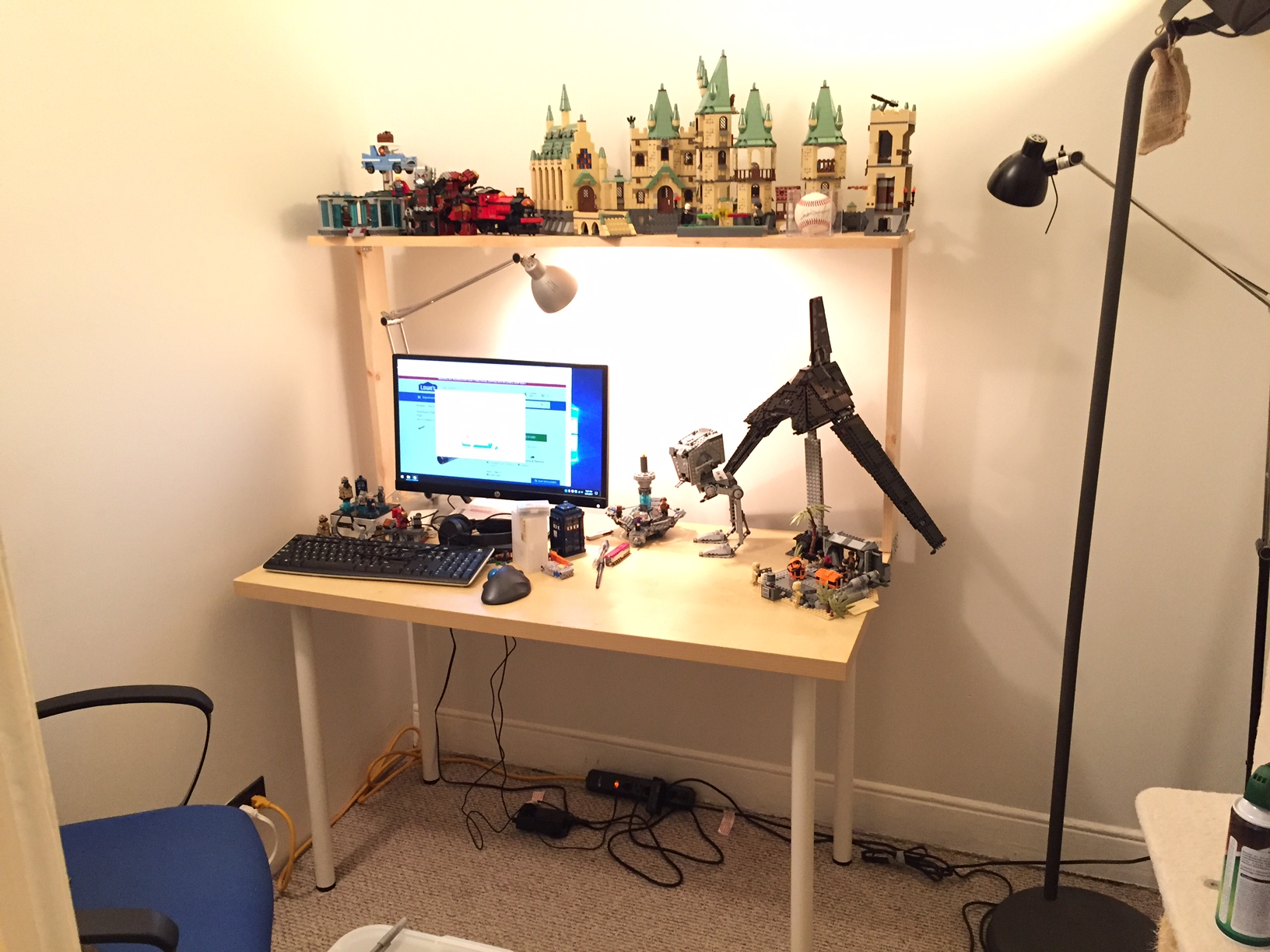
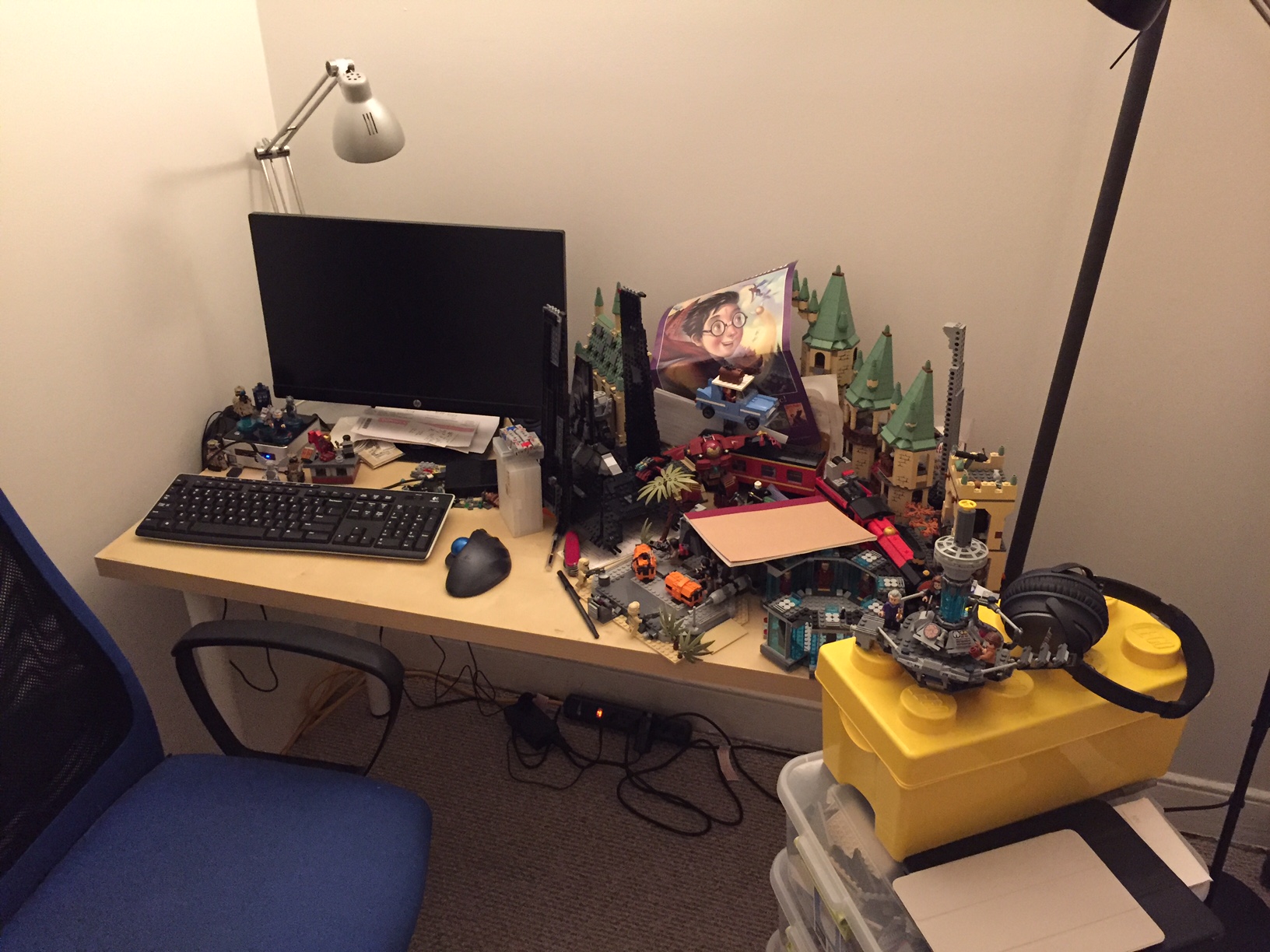
Even with my Intel NUC PC taking very little space on my desk, I felt overrun by my LEGO creations: Hogwarts Castle in the back, Rogue One scenes in the front, and Iron Man’s Hall of Armor to the right.
My LEGOs took the most amount of desk area, so I made it my goal to move them above my workspace onto a new shelf that I would build with materials acquired from the Brooklyn Lowes.
My IKEA table top measures 47 3/16″ wide and 23 1/2″ deep. I wanted my new shelf to be high enough to clear my HP 22″ LCD monitor and tabletop lamp. I figured 24″ height would be enough clearance. Also, I wanted it to be deep enough to hold my LEGO models but not deep enough that it excessively shaded my desk or posed a problem for my forehead. So, I figured 10″ depth for the shelf was good enough.
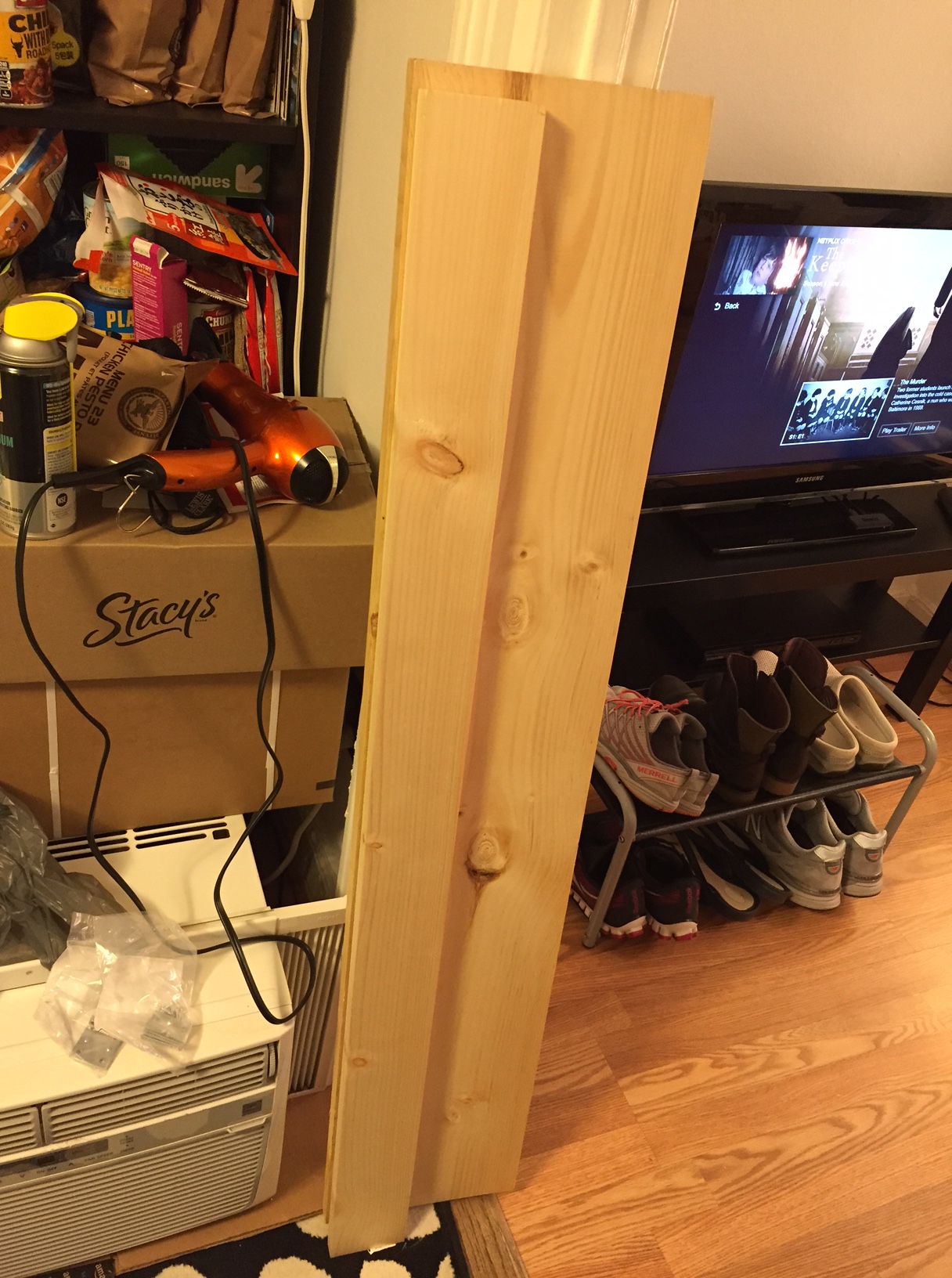
At Lowes, I purchased a 1″ x 10″ x 48″ pine board (to make the shelf supports), 1″ x 10″ x 48″ pine board (to serve as the shelf), 4-pack brackets (to support the shelf against the supports and the supports against the IKEA table top), and 4-pack braces (to affix the shelf’s supports to the IKEA table top). The total cost for these materials was about $16. Also, I used four deck screws that I had on-hand.
A note about selecting the shelf: If you’re doing this on the cheap like me, your selection of wood can serve in your favor. What I mean by this is that instead of building a shelf with some kind of support underneath it to prevent warping due to the weight of what you place on it over time, you can select a warped board and use the warp in your favor. To do this, find a board that is not overly warped but has some warp in its breadth. When building your shelf, have the warp pointing upward. Of course, running a support under the shelf and affixed to the shelf support on either side will strengthen the shelf to hold more weight, but with a light duty shelf like I am building, I chose to save the material and money.
The 1″ x 10″ x 48″ pine board was actually 47 15/16″ long, which meant that it would overhang my desk by 12/16″, so I split the difference and marked the shelf supports 6/16″ or 3/8″ from either end of the shelf. Also, instead of centering the shelf supports, I placed them at the rear of the desk and the rear of the shelf. Again, this is a light duty installation, so I didn’t think this would become unstable with how I planned to use it.
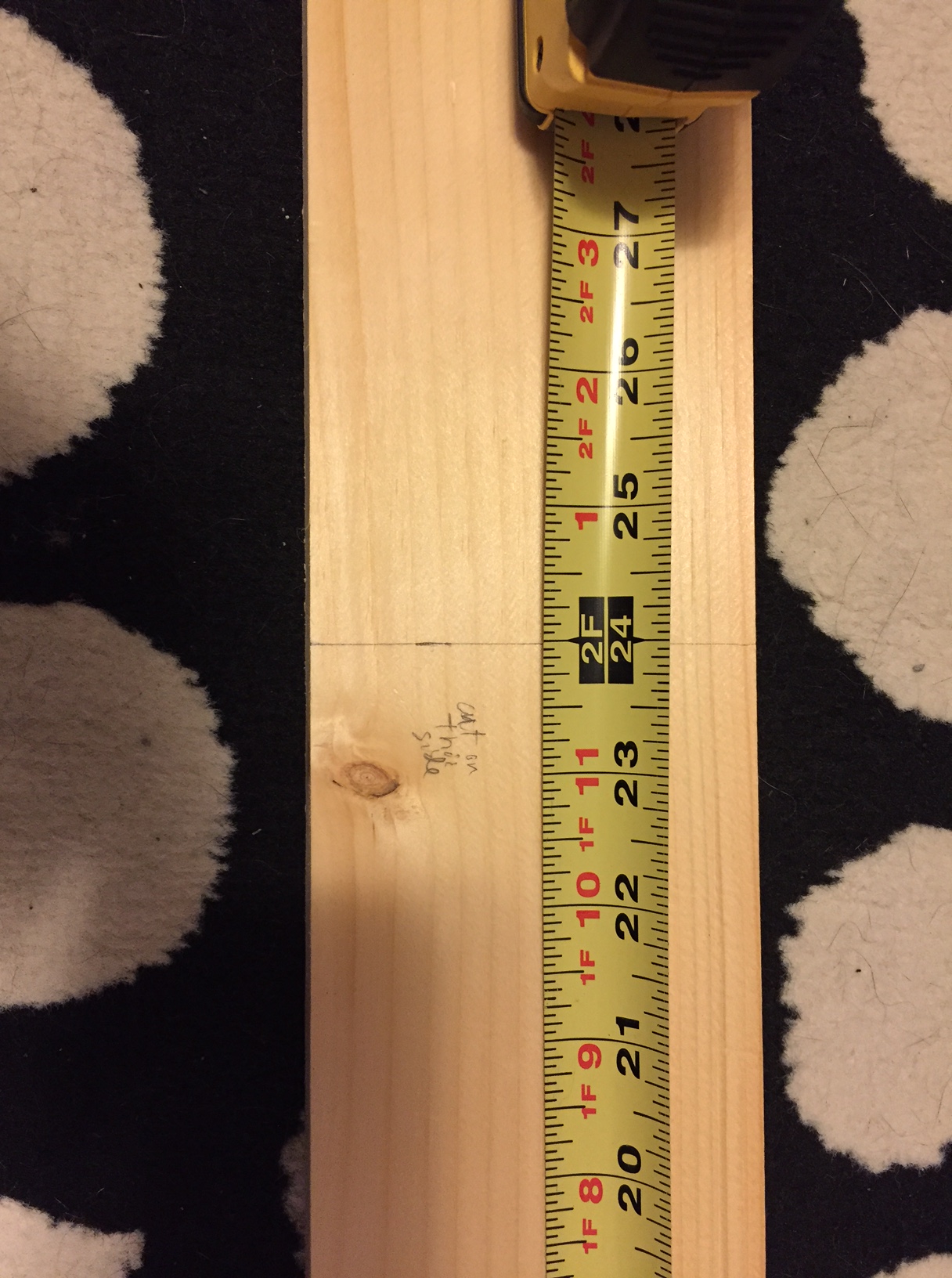
Next, I cut the shelf supports out of the 1″ x 4″ x 48″ pine board. Surprisingly, it was 47 15/16″ long, which is closer than 48″ than I expected. To cut it in half as accurately as possible, I took my miter box saw width into consideration with planning my cut. As you can see below, I wrote on the board which side to cut on to offset the board’s odd measurement.
The next step was affixing the supports to the shelf using deck screws that I already had on hand. Of course, pine is soft wood, but there is still the possibility of splitting it, so I pre-drilled four holes in the shelf (two on either end for each support) and two holes in the top of each shelf support. Before drilling, I drew a box on the shelf bottom for each support’s location. I halved this lengthwise and then marked 1″ from either end for my drill/screw locations. I did the same for the ends of each support board so that the holes would line up when I drove in the screws.
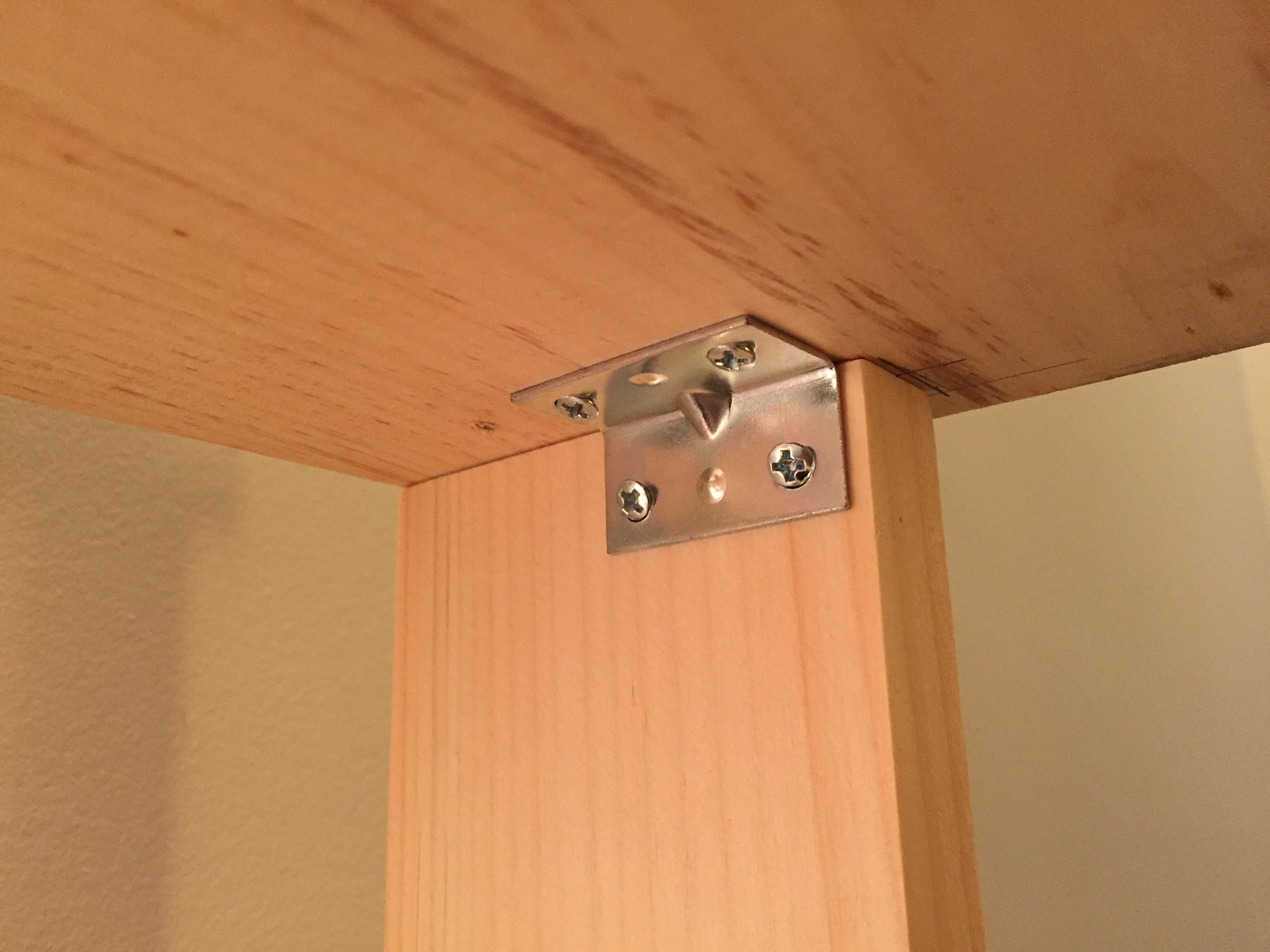
The final step of completing the shelf and shelf supports assembly before installing it on the IKEA table top involved installing two metal brackets to prevent shelf sway. These came with tiny philips-head screws, so I took a risk and did not pre-drill holes for these.
Finally, I installed the shelf assembly on top of the IKEA table top using four braces and two brackets. Each shelf support received two braces on the outside, and one bracket on the inside, centered. Again, I did not pre-drill holes in the IKEA table top or the pine board. I figured that the IKEA table top has a honeycomb structure inside with only parts of it being reinforced for the table legs and frame. I hoped that there would be enough material for the screws to dig into, and it seems to have been the case. However, I had to up the RPMs on my cordless drill to get the screws started and through the laminate covering the IKEA table top.
With the construction phase completed, I was able to begin enjoying my new shelf resting above my desk.
And move my LEGO models into their new home.
The making, of course, didn’t end there. In parallel, Y and I took pictures of my building progress. Then, I began writing this blog post and embedding the photos to share with others (another form of making). Maybe now, you will go make something of your own!
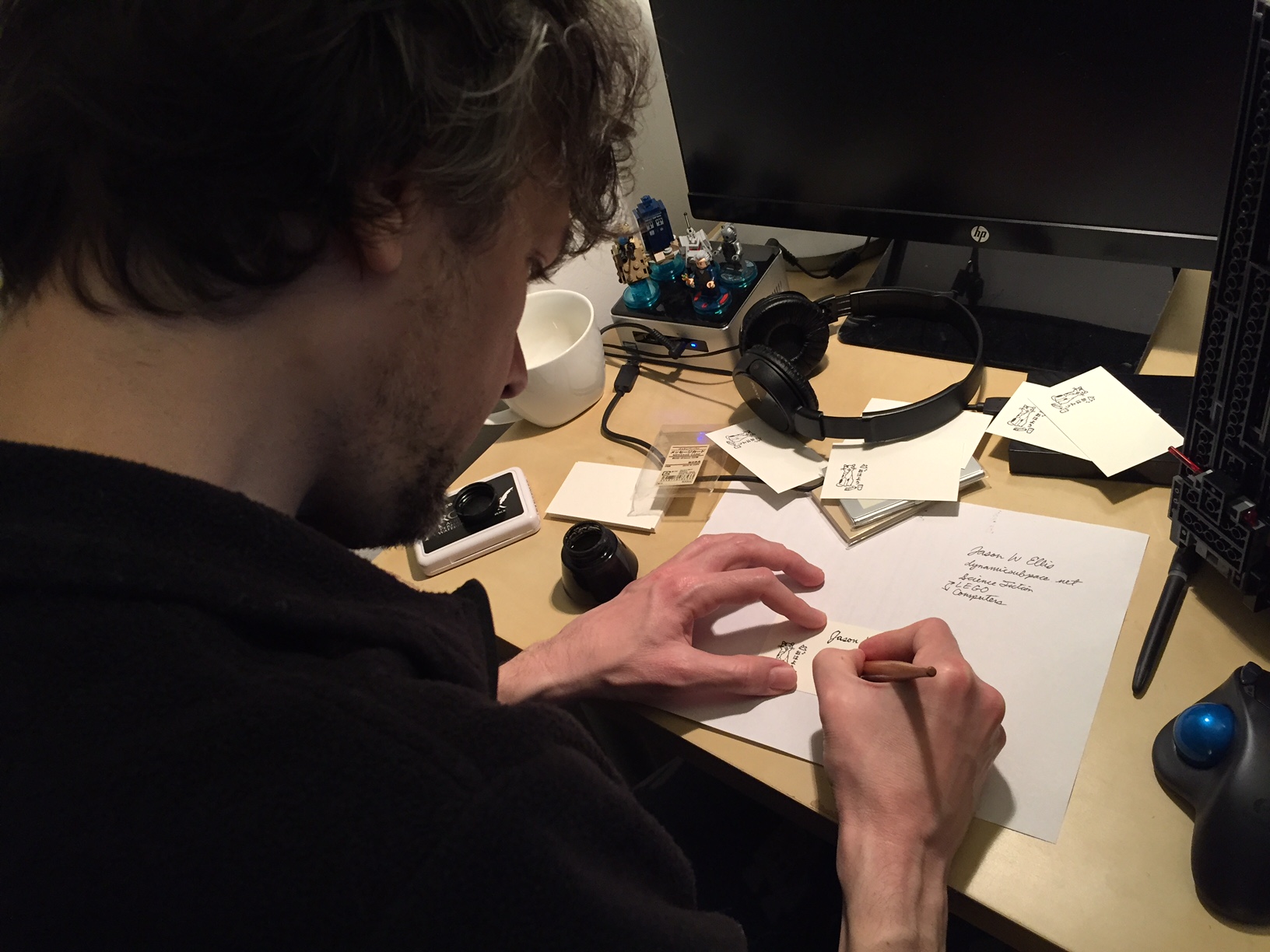
This Saturday afternoon, I wanted to make something useful by doing something fun, so I made a small batch of custom business cards using a rubber stamp and one of Y’s nib or dip pens.
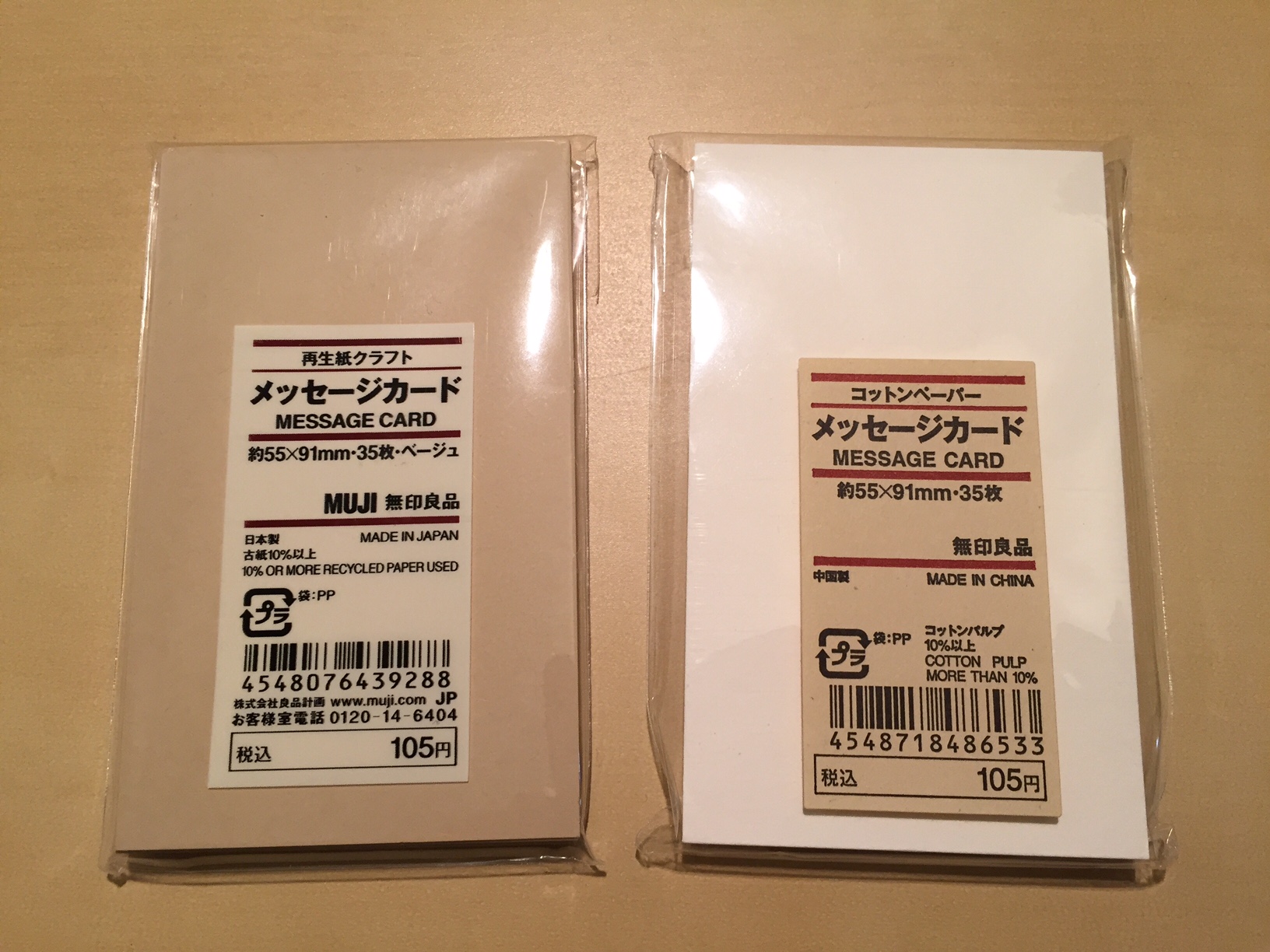
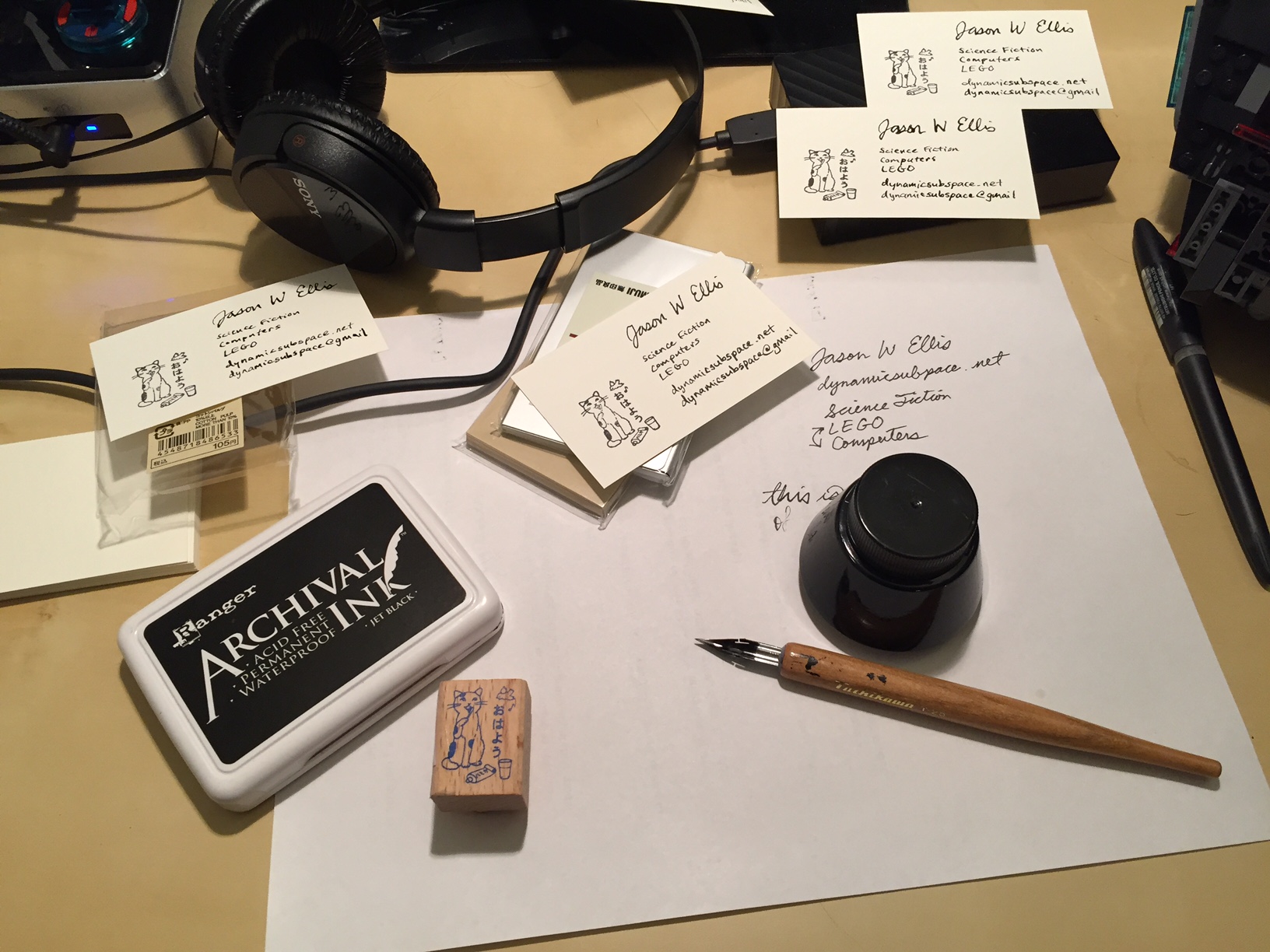
First, I assembled the materials for my business cards. I picked up “Message Card” packs in white and kraft from Muji in Manhattan.
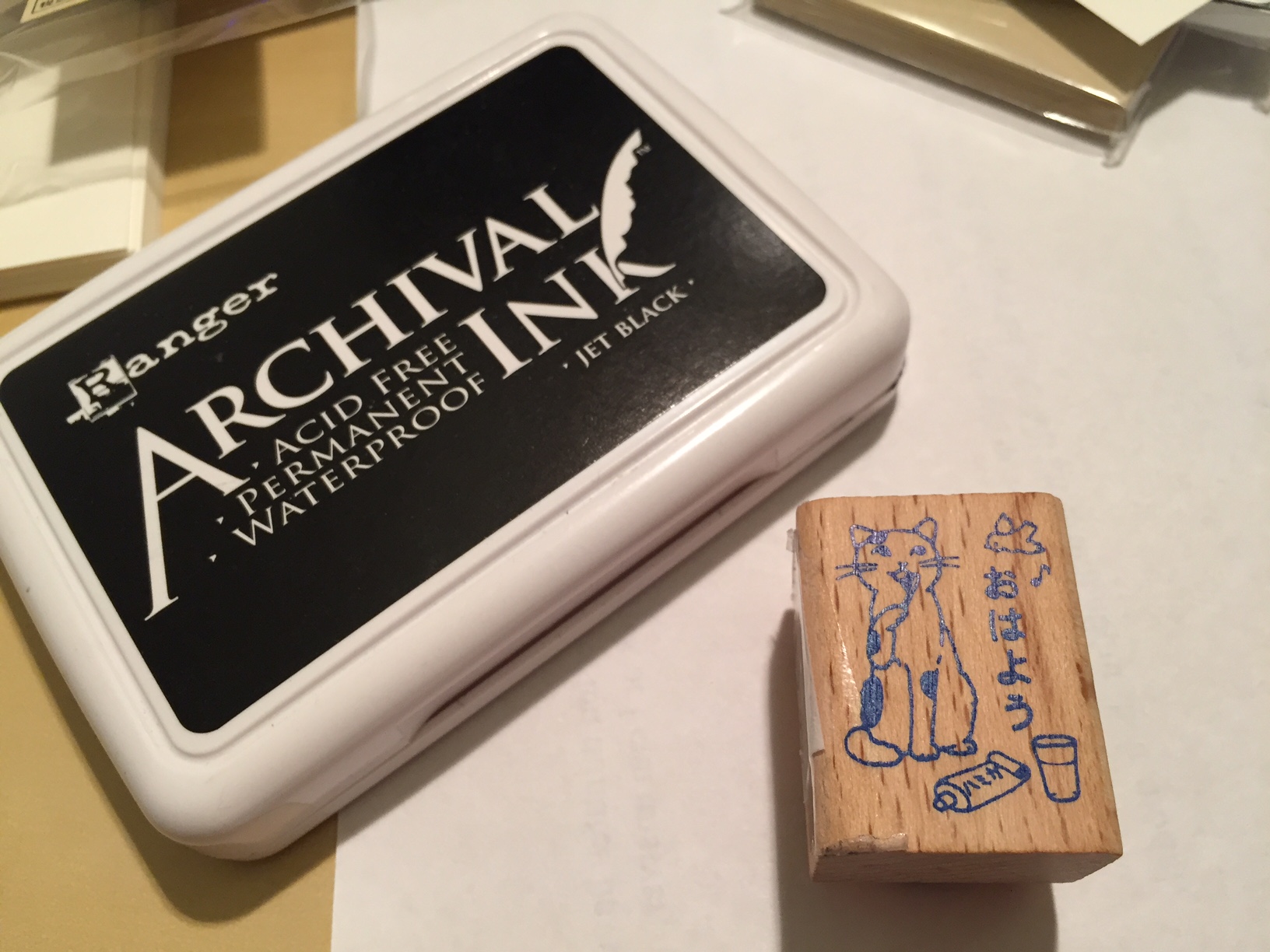
Next, I found a cute neko hanko/pottering cat rubber stamp that I liked at Kinokuniya by Bryant Park. This particular rubber stamp shows a cat brushing his teeth with the message おはよう (prounounced as ohayo), and translated as “good morning.” (NB: Y told me that the trick to properly inking the stamp is to hold the ink pad upside down and bring the stamp into contact with the pad from below in an upward motion–tap tap tap.)
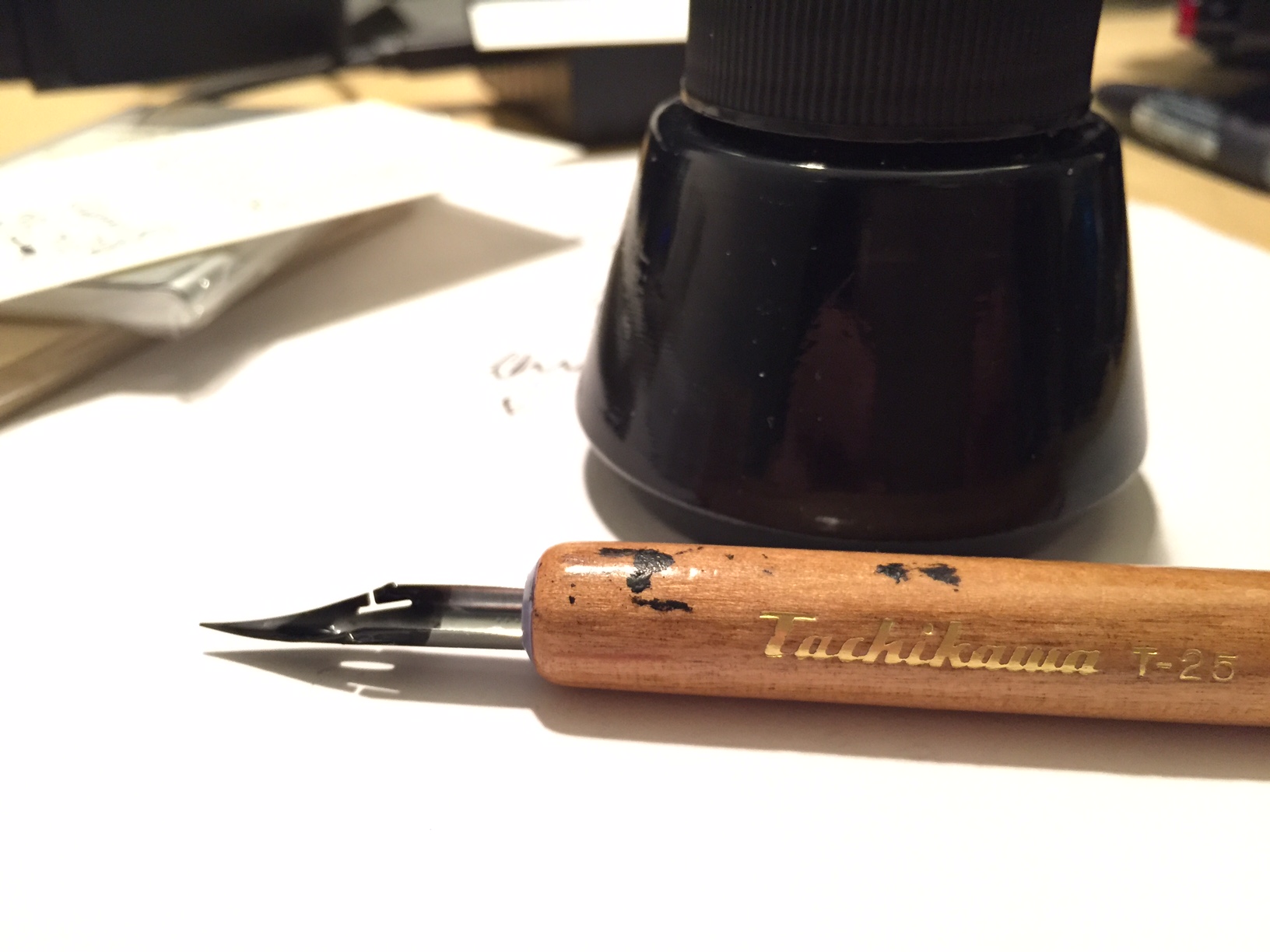
Since I wanted to write each card’s message by hand, I figured that using a dip pen would lead to a more interesting end product due to my being a novice using that kind of pen. I knew that there would be more variability with my writing than if I used a ball point pen, which is the look that I wanted each business card to have. (NB: Y instructed me to dip the nib into the ink well and then to dab off excess ink on the rim of the ink well before beginning to write.)
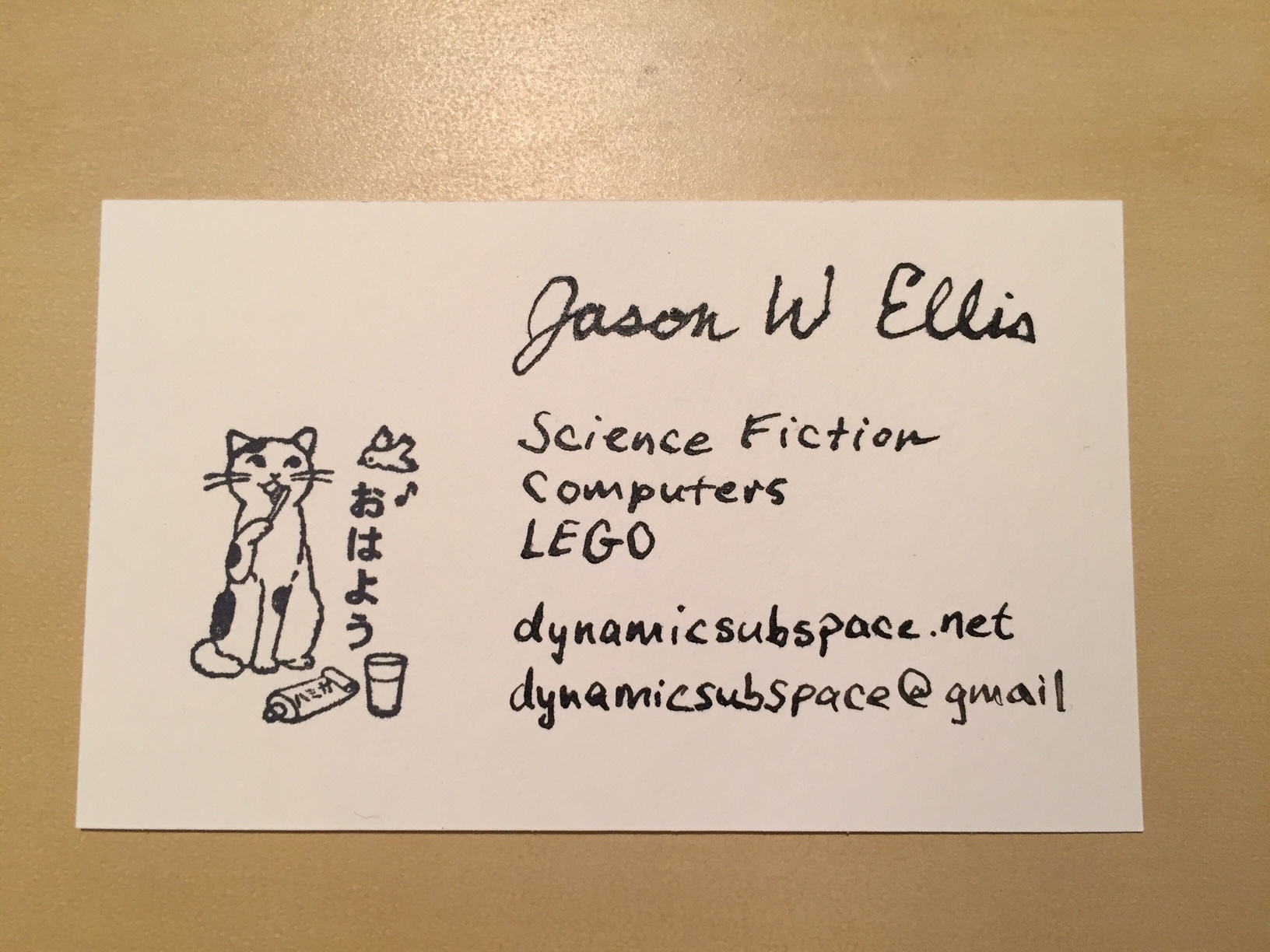
With my materials gathered, I cleared a bit of desk space and put a scrap piece of paper down to catch any stray ink from the ink pad and stamp or the ink well and nib pen. Also, I used the scrap paper to plan out what exactly I wanted to write on each business card, which in this case was:
Jason W. Ellis
Science Fiction
Computers
LEGO
dynamicsubspace.net
dynamicsubspace@gmail
With this first batch, I made ten business cards to give out to special contacts. Each card is slightly different. Because each is handmade, each card is unique. Perhaps this uniqueness and care put into each card will itself represent something important about me and my work ethic to those persons who receive one of these cards.
Also, I found this work to be enjoyable and relaxing. Inking the stamp, pressing the stamp, dipping the pen into ink, dabbing excess ink on the edge of the ink well, carefully writing with the nib are all satisfying activities. I found stamping and handwriting to be pleasurable during the act of making the cards. It was gratifying to see the finished cards peppered all over my desk.
I delivered this presentation at the James Madison University Pulp Studies Symposium on October 7, 2016. The video above shows my presentation’s images, and the script of my talk is included below.
The paper is about introducing new audiences to old ideas for the benefit of two different City Tech audiences: 1) frame the historical publication context of science fiction short stories for students, and 2) illuminate the deep history of technological ideas for faculty fellows in the NEH-funded “Cultural History of Digital Technology” project.
[UPDATE: The symposium was a great success! Thank you to everyone who had questions and comments during our session. I posted photos taken by colleague Caroline Hellman over at the Science Fiction at City Tech website.]
Engagement, Learning and Inspiration in SF: Use Cases for the City Tech Science Fiction Collection
Jason W. Ellis
In the first issue of Amazing Stories dated April 1926, Hugo Gernsback writes:
By ‘scientifiction’ I mean the Jules Verne, H. G. Wells and Edgar Allan Poe type of story—a charming romance intermingled with scientific fact and prophetic vision … Not only do these amazing tales make tremendously interesting reading—they are always instructive. (Gernsback 3)
According to Gernsback, the literary genre that would become known as science fiction combines romance, scientific fact, and prophetic vision. The romance engages the reader in an interesting story. The facts instruct the reader in science and technology. The prophetic vision extrapolates from what is known into the not-yet-known and simultaneously inspires readers to realize that vision. I believe that Gernsback’s vision of SF is fundamental to arguments for SF collections at colleges with a pedagogical and community-serving commission like City Tech. Our college occupies several buildings in downtown Brooklyn and serves the educational needs of over 17,000 students. Historically a trade and vocational school, it has over time and by design developed into a senior college of the City University of New York (CUNY) system. Nevertheless, the students it serves and the fields it attempts to prepare them for are primarily focused on STEM career paths. While not all stakeholders recognize the importance that the humanities have to STEM graduates’ success and overall outlook, the administration’s support of the City Tech Science Fiction Collection signals at least one way in which the humanities—in this case via SF—is seen as supportive to the otherwise STEM-focused educational work of the college. In effect, SF and the collection serves as a source for engagement, learning, and inspiration for students who have much to gain from it as a literary genre that reveals the inextricable linkages between STEM and the humanities. While I cannot within the scope of this presentation explore all of these functions of SF, I will restrict myself to discussing how I have used the collection to support my teaching and pedagogical work at City Tech.
Teaching Science Fiction from a Historical Perspective
For students, my SF syllabus takes a historical approach to the genre. Following Brian Aldiss, I point to Mary Shelley’s Frankenstein as the genre’s beginning, because its plot pivots upon on an extrapolation of science and technology. Following this novel, I have students read a chronological progression of short stories that correspond with the movements in the genre: proto-science fiction and SF’s influences, H.G. Wells and his scientific romances, Jules Verne and his Voyages extraordinaires, Hugo Gernsback’s scientifiction and the pulps, John W. Campbell, Jr. and the Golden Age, the New Wave, Feminist SF, Cyberpunk, and contemporary SF. Looking at my current syllabus, which draws on readings from the Wesleyan Anthology of Science Fiction and a few stories in PDF form that are not in the anthology, over half appear for the first time in magazines held in the City Tech Science Fiction Collection, including: Isaac Asimov’s “Reason,” Astounding Science Fiction, April 1941; Tom Godwin’s “The Cold Equations,” Astounding Science Fiction August 1954; Robert Heinlein’s “All You Zombies—,“ The Magazine of Fantasy and Science Fiction, March 1959; Harlan Ellison’s “Repent, Harlequin! Said the Ticktockman,” Galaxy Magazine, December 1965; Philip K. Dick’s “We Can Remember It For You Wholesale,” The Magazine of Fantasy and Science Fiction April 1966; James Tiptree, Jr’s “The Women Men Don’t See,” The Magazine of Fantasy and Science Fiction December 1973; William Gibson’s “Burning Chrome,” Omni July 1982; and Octavia Butler’s “Speech Sounds,” Isaac Asimov’s Science Fiction Magazine Mid-December 1983. In addition to discussing each story in its historical context and its addressing Gernsback’s tripartite definition (along with other definitions, too), I show students photos of the magazines and their contents. I relate how these magazines were a big deal that introduced readers to engaging stories, new science and technology, and inspirational ideas via the haptic and tactile experience of reading printed magazines. Furthermore, the contents of a given magazine add an anthropological context to the magazines via editorials, letters, fandom, and advertising. Finally, the magazines help situate the readings for students, because they empower me to point at the library and take the readings out of the abstract realm of anthologization.
NEH-sponsored “Cultural History of Digital Technology” Project
While my students’ experience of SF is enriched by the historical materiality of our readings, City Tech’s faculty, who are engaged in pedagogical planning that bridges STEM and the humanities, share some of the same needs as my students. I have learned that my STEM-focused colleagues are experts in their fields, but many do not conceptualize SF on one level as a literary genre that addresses Gernsback’s tripartite definition: romance, scientific facts, and prophetic vision, or on another level as a literary form built on interdisciplinary STEM methodologies (i.e., building assemblages of ideas and constructing extrapolations) and focused on the effects of science and technology on humanity and vice versa (e.g., Asimov’s concept of “social science fiction” or Philip K. Dick’s epistemological and ontological adventures). Professor Anne Leonhardt of Architectural Technology and director of the NEH-funded project titled, “The Cultural History of Digital Technology: Postulating a Humanities Approach to STEM,” asked me to join and contribute my humanities-focused perspective. The project’s goal is to create six interdisciplinary pedagogical modules—on maps, fractals, robotics and sociality, geotagging, topology, and finally, robotics and the workplace. We do this by inviting speakers, holding reading groups, and participating in pedagogical workshops. The student-facing modules will integrate readings, classroom lecture and demonstration, and a hands-on activity. Initially, I helped with finding readings for two modules—fractals and topology, but as I describe below, I have leveraged the City Tech Science Fiction Collection’s magazine holdings and demonstrated that humanities folks can do more than find interesting readings. Also, I will use Gernsback’s definition as a measure of each considered story’s usefulness to the module’s goals.
3D Printing
The first module that I contributed readings to is called “Fractals: Patterning, Fabrication, and the Materiality of Thinking.” Its purpose is to bridge students’ understanding of mathematics to the natural world by using fractal geometry—the notion that Benoit Mandelbrot introduced as the process and principle of order and structure underlying the physical world. We teach students the underlying principles of fractal geometry, help them create a workflow using open-source tools to generate a 3D printable STL, or STereoLithography model, and finally, have them print their model using one of City Tech’s powder or plastic 3D printers.
Initially, I did not consider the City Tech Science Fiction Collection’s holdings, because everything was sitting in 160 boxes stacked floor to ceiling in my office and my former colleague, Alan Lovegreen’s office. Rudy Rucker’s “As Above, So Below” (1989), a story not widely anthologized but available on the author’s website, first came to mind, because I knew that both sides of his professional work touched on this topic. Rucker, a cyberpunk SF writer and mathematician, had written this story after his own attempts at discovering what is now called a “Mandelbulb,” or a three-dimensional plot of the Mandelbrot set, the recognizable image based on a simple iterative function explored in the work of Benoit Mandelbrot. In Rucker’s story, a mathematican hacks together a program that creates a three-dimensional Mandelbrot set that breaks out of his computer screen and takes him on a trippy voyage away from life and into a crabmeat can in his pantry where he can code and enjoy energy drinks for the rest of his life—as long as no one get hungry for canned crab. While it is an interesting story and Rucker’s work on the Mandelbulb is noted in the module, his story is more romantic and possibly prophetic, but less instructive.
Shortly thereafter, Alan and I finished moving and shelving the City Tech SF Collection, and I began searching for a better story in the collection’s magazines—a story that fulfills the Gernsbackian requirements and connects to both of the module’s topics: fractals and 3D printing. One such contender was Robert Heinlein’s “Waldo,” which tended to capture the materiality-emphasis of the module better than Rucker’s much later story. Published in August 1942 in Astounding Science Fiction as by Heinlein’s pseudonym Anson MacDonald, “Waldo” features on the cover with art by Hubert Rogers and story illustration by Paul Orban. The story is where the term for a remote manipulator system is coined—a waldo. However, the story is about a man named Waldo Jones who invents remote manipulators to enable his weakened body to act on the world. With his invention, he sets out to make smaller ones and smaller ones until they were capable of manipulating microscopic neural tissue and investigate the cause of his physical handicap. The idea then is that waldoes could be used to build up matter in the same way they were used to build smaller versions of themselves. Heinlein’s story fulfills Gernsback’s requirements—romance (intrigue and revenge), scientific fact (cybernetics), and prophetic vision (what possibilities might waldoes enable), but it does not fulfill both module topics as strongly.
Eventually, I found the story that is credited as the first SF describing 3D printing in detail: Eric Frank Russell’s “Hobbyist,” in the September 1947 issue of Astounding Science Fiction. Unlike “Waldo,” “Hobbyist” is not as widely anthologized, so having access to it in its original magazine was a bonus. If you are familiar with the contemporary video game, No Man’s Sky, then you have an idea about what “Hobbyist” is generally about. Astronaut Steve Ander and his companion parrot Laura crash land on a distant world and are in need of nickel-thorium alloy for fuel, which will hopefully get them a little closer to home. While scavenging around the crash site, Ander notices unsettling patterns of repetition in the world around him and discovers a structure that houses what amounts to a collection of life forms created in a 3D printer of sorts and maintained by an omnipotent being. The narrator describes it thus:
It was done by electroponics, atom fed to atom like brick after brick to build a house. It wasn’t synthesis because that’s only assembly, and this was assembly plus growth in response to unknown laws. In each of these machines, he knew, was some key or code or cipher, some weird master-control of unimaginable complexity, determining the patterns each was building—and the patterns were infinitely variable. (Russell 56)
“Hobbyist” satisfied the Gernsbackian requirements—romance (escape the planet), scientific fact (small scale engineering, iterative and fractal growth), and prophetic vision (might this technology make us gods?) and united both module topics. Capturing “Hobbyist” with my iPhone and Scanner Pro app, I shared the story with the other NEH Fellows— the story’s text and in-story illustrations by Edd Cartier and cover art by Alejandro de Cañedo. During meetings, I related the history of the magazine and how that adds to the importance of the story as a nodal point of STEM ideas expressed through SF long before 3D printing was first innovated in the 1980s, and even before it was described in theoretical terms by Richard Feynman in his well-known December 1959 American Physical Society presentation, “There’s Plenty of Room at the Bottom.”
Topology
The second module that I contributed to is called “Topology: Behind Escher’s Wizardry, A Look at the Development of Modeling and Fabrication.” Unlike the earlier fractal module, the topology module would involve programming to create each student’s 3D printed model. In addition to my role as the humanist on the team, I made this a personal challenge to relearn Wolfram Mathematica, a symbolic computation program that supports a relatively easy-to-use programming language, because I wanted to demonstrate how its could satisfy all aspects of teaching, coding, and modeling. I began by creating a Mathematica workbook that demonstrated topology concepts, such as points, lines, polygons, and dimensionality, and easy-to-follow programming tutorials of topological surfaces. Additionally, I showed how Mathematica exported 3D printable STL files of the topological models students would create.
Initially, we considered Edwin Abbott’s Flatland: A Romance of Many Dimensions (1884), but Professor Satyanand Singh, a colleague in the Mathematics department, suggested that we show a video based on Abbott’s story instead. This created an opportunity.
While performing serious play with Mathematica, I recalled Robert Heinlein’s “—And He Built a Crooked House” from the February 1941 issue of Astounding Science Fiction. Featuring cover art by Hubert Rogers and story illustrations by Charles Schneeman, the story is about an ambitious architect who designs a house in the shape of an unfolded tesseract, or a four-dimensional cube. Unfolded means to create a geometric net or the interconnected, component elements of the object. For example, a three-dimensional cube unfolds into a net composed of two-dimensional squares arranged in eleven different configurations. On the other hand, a tesseract, which is four-dimensional, unfolds into a net of connected three-dimensional cubes with 168 possible configurations! The architect’s innovative design is such an arrangement of three-dimensional cubes, which in this case, resembles the Cross of St. Peter. Unfortunately, having been built in California, there is an earthquake and the house collapses into itself forming a nondescript house-like cube. The incredulous architect and his nonplussed clients enter the domicile to investigate and become trapped within the structure’s weird, higher-dimensional geometry. It is an improbable story, but it captures the strangeness of higher dimensions and introduces topics for discussion. “—And He Built a Crooked House” fulfills Gernsback’s definition—romance (escape the counter-intuitive house-turned-maze), scientific fact (higher dimensionality), and prophetic vision (let’s use math to build innovative buildings), and it tangentially fulfills the module’s focus on topology.
The NEH project is on going, so there are opportunities to locate other stories and materials in the SF magazines held in the City Tech Science Fiction Collection. In my SF class, I hope to bring my students to the archives for special projects pre-arranged with the librarians. Professor Jill Belli is doing this now, and some of her students’ work will be features in a special session of the upcoming Symposium on Amazing Stories: Inspiration, Learning, and Adventure in Science Fiction on November 29 at City Tech, which I hope that you all will consider presenting or attending. Thank you for listening.
Works Cited
Gernsback, Hugo. “A New Sort of Magazine.” Amazing Stories April 1926: 3.
Heinlein, Robert. “—And He Built a Crooked House. Astounding Science Fiction, February 1941, 68-83.
Russell, Eric Frank. “Hobbyist.” Astounding Science Fiction, September 1947. 33-61